Solar Glass vs Conventional Glazing: A Facade Guide
The glazing you pick sets a building’s energy profile for decades.
I. From Shelter to Power Plant
For most of the last century, a glass facade had two jobs. It kept weather out and let light in. Today, owners also expect it to cut cooling bills, meet net-zero targets, and look sharp from the street.
A. The evolution of the commercial envelope
Solar glass is photovoltaic (PV) glass, which means glass with solar cells or thin-film layers built into it. When it replaces ordinary glazing, it is part of BIPV, or building-integrated photovoltaics. It sits in the same position as conventional glass, but it also generates electricity.
Rules are pushing this way. Under the EU’s recast energy directive, new buildings must be zero-emission buildings from 1 January 2030 (public buildings from 2028). Money is following. The solar PV glass market was worth USD 18.46 billion in 2025 and is forecast to reach USD 93.72 billion by 2034.
B. The conflict: architectural vision vs. net-zero requirements
Picture the design meeting. The architect wants clean sightlines and a clear storefront. The energy consultant wants every available square meter to produce kilowatt-hours. The owner wants both, plus a budget that does not move.
This is the daily tension on facade projects. Both sides are right, which is why the choice needs numbers and not slogans.
C. Objective of this guide
This guide compares the two options side by side. It is written for curtain wall and roofing contractors, PV EPC teams, architects, and material distributors who need to specify or procure facade glass. The team at Цзя Мао Бипв hears the same first question on many calls: “What do I lose in light, weight, and complexity if I switch?” The sections below answer that.
Thesis in plain words: Conventional glazing gives the best transparency and the lowest first cost. Solar glass turns a passive wall into an active power plant. The right choice is a trade-off between looks, running cost (OPEX), and sustainability targets.
Quick Comparison at a Glance
You can copy this table straight into Excel.
| Характеристика | Conventional low-E glazing | Solar glass (BIPV) |
|---|---|---|
| Visible light transmittance (VLT) | About 50–75% for clear-vision units | 10–90% by design; 0% for opaque modules |
| SHGC | About 0.25–0.40 | About 0.15–0.45 |
| U-value (double unit, low-E + argon) | About 1.1–1.6 W/m²K | About 1.1–1.6 W/m²K with the same coating and fill |
| Typical weight (double unit) | About 30 kg/m² (6 + 6 mm) | About 40 kg/m² (5 + 5 mm PV laminate + 6 mm) |
| Makes electricity | No | Yes, about 40–220 W/m² |
| Wiring needed | No | Yes, DC cables, connectors, inverters |
| Single-unit replacement | Standard stock sizes | Custom unit, 12–16 weeks in many cases |
Ranges are typical planning values. Always ask for certified data for the exact unit.
For a wider look at this comparison, see our guide to solar glass wall versus traditional glazing.
II. Optical Performance and Aesthetic Trade-Offs
The main tension in facade choice is the balance between VLT and energy harvest. VLT (visible light transmittance) is the share of daylight that passes through the glass. A 60% VLT unit passes 60% of visible light.
A. Transparency levels: low-E clarity vs. BIPV tinting
Clear-vision low-E glass is hard to beat on clarity. Solar glass gives you a dial instead of a fixed setting.
Наш сайт semi-transparent BIPV glass comes in 30%, 50%, 70%, and 90% transparency. Wider cell spacing lets in more light and makes less power. Tighter spacing does the opposite.
Here is the rule to remember: every step up in transparency costs watts. Opaque modules reach about 120–220 W/m². Semi-transparent ones sit around 40–180 W/m². Our guide to transparent solar panels explained shows how those choices play out in real specifications.
B. Visual consistency: the “grid” look vs. seamless structural glazing
Cell grids are the most common objection from architects. Structural glazing looks like one smooth sheet. A cell pattern looks like a pattern.
There are three ways to soften it:
- Hide the busbars. These are the thin metal lines that collect current from each cell. Invisible-busbar layouts keep the surface clean and uniform.
- Match the pattern to the grid. Align cell spacing with the mullion rhythm so the pattern feels planned.
- Use color. Наш сайт colored solar glass options can be matched to adjacent glass or metal, with a color tolerance (ΔE) under 3. ΔE is a score of how different two colors look. Below 3, most people cannot tell.
Color has a cost. Deep filters send less light to the cells, so output drops. Ask for the power loss in writing before you approve a color.

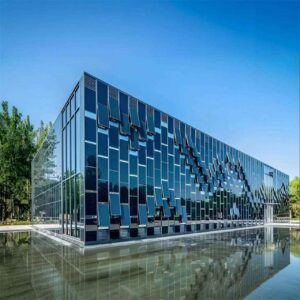
The Copenhagen International School facade uses roughly 12,000 colored solar panels over about 6,048 m². It shows that solar can look like a design choice. Photo: Marta Victoria, Wikimedia Commons, CC BY-SA 4.0.
Industry insight: Build an outdoor mock-up before you approve a pattern. A cell layout that looks calm on a screen can feel heavy across 30 stories. Mock-ups cost far less than a redesign.
C. Light quality: daylighting and supplemental lighting
Lower VLT means less daylight indoors. A 30% VLT window passes about half the daylight of a 60% VLT window.
Offices often aim for about 300–500 lux on the desk. (Lux measures light falling on a surface.) A common rule of thumb is that daylight reaches about twice the window head height into a room. With a 2.7 m head height, that is roughly 5 m.
If your floor plates are deeper than that, expect lights on more often. In our energy example below, we assume an extra 3,000 kWh a year of lighting.
Pattern shadows are the other issue. Moving cell shadows across a desk can cause comfort complaints. Put dense cell patterns above eye level and in spandrel zones. Keep the view zone clearer.
Solar glass facades have to protect, light, and power a building at the same time.
III. Thermal Dynamics and Energy Load Analysis
Solar glass changes the heat profile of a building. It absorbs solar energy that conventional glass mostly reflects or lets through.
A. SHGC: how BIPV reduces cooling loads
SHGC (solar heat gain coefficient) is the share of the sun’s heat that enters through the glass, from 0 to 1. Lower means less heat inside.
Here is why BIPV helps. Solar cells absorb much of the light that hits them. Part becomes electricity. The rest becomes heat, and in a double-glazed unit with the PV layer outside, much of that heat leaves to the outdoors instead of entering the room.
Typical SHGC for BIPV glass is about 0.15–0.45, depending on cell coverage and glass build-up. A module with about 50% coverage often lands at 0.20–0.30. Codes are moving this way. ASHRAE 90.1-2022 sets an SHGC of 0.25 for fixed commercial glazing in Climate Zones 1–3, which is a number solar glass can meet.
Climate matters. In a hot climate, a lower SHGC is a clear win. In a cold climate, free winter heat is useful, so ask your energy modeler to compare heating, cooling, daylight, and PV output together.
B. U-value comparison: PV units vs. high-performance glazing
U-значение measures how fast heat flows through a window. Lower is better.
Here is the insight many teams miss. The U-value comes from the air gap, the gas fill, and the low-E coating, not from the PV layer itself. A PV double unit with a low-E coating and argon can land close to a regular low-E double unit.
| Glass build-up | Typical U-value (W/m²K) |
|---|---|
| Single laminated PV glass | 5.0 – 5.8 |
| Double PV unit, air fill, no coating | 2.7 – 3.0 |
| Double PV unit, low-E + argon | 1.1 – 1.6 |
| Conventional double low-E + argon | 1.1 – 1.6 |
| Triple unit, low-E + argon | 0.6 – 1.0 |
Midpoints of the ranges above. Ask your supplier for U-values calculated to EN 673 or tested to NFRC 100 for the exact unit.
If the chart does not load in your editor, the table above holds the same data.
C. The “active” offset: net energy gain vs. passive glazing
Net gain means power generated, plus cooling energy saved, minus extra lighting energy. Here it is as a formula:
Here is a worked example. All inputs are assumptions you should replace with your own.
- Facade: 500 m² of south-facing semi-transparent PV glass at about 100 W/m², which is 50 kWp.
- PV yield: 850 kWh per kWp per year, so 42,500 kWh.
- Cooling saved: a conventional glass wall adds about 40 kWh/m² of cooling load (20,000 kWh). PV glass cuts that by 35%, which is 7,000 kWh.
- Lighting added: 3,000 kWh.
At $0.12/kWh, that is about $5,580 a year. Even with extra lighting, the wall comes out ahead. The 35% cooling cut is the low end of the 35–45% HVAC reductions we see reported in hot-climate solar glass retrofits.
IV. Structural Integration and Weight Considerations
Switching to solar glass adds new mechanical needs to the curtain wall. A curtain wall is a non-structural outer wall, usually an aluminum frame filled with glass. It carries its own weight and wind, not the building’s load.
A. Dead load analysis: weight and mullion sizing
Dead load is the permanent weight the frame must carry. Glass weighs about 2.5 kg/m² for every millimeter of thickness.
| Build-up | Approx. weight (kg/m²) |
|---|---|
| Conventional double (6 + 6 mm) | 30 |
| Conventional triple (6 + 6 + 6 mm) | 45 |
| PV double (5 + 5 mm laminate + 6 mm lite) | 40 |
| PV triple (adds a 6 mm lite) | 55 |
Over 1,000 m² of facade, a PV double unit adds about 10 tonnes compared with a conventional double.
A mullion is the vertical frame bar. Wind pressure usually sets the mullion size. The extra weight mostly affects anchors, brackets, setting blocks, and slab-edge checks. Ask your structural engineer to re-run dead-load checks as soon as the glass build-up changes, and do it before shop drawings are signed.
B. Mounting systems: pressure plates vs. BIPV framing
Traditional pressure-plate systems clamp the glass between a plate and the frame. They work for PV glass too, but you need to check three things:
- Bite and depth. Does the thicker build-up fit the glazing pocket?
- Wiring path. Is there a dry channel for cables, with room for connectors?
- Electrical bonding. Aluminum frames that touch PV modules need a planned grounding path.
Specialized BIPV framing builds the wiring channel into the profile. For a full comparison of options, see our guide to mounting systems compared.
Mounting choices decide both how the facade looks and how easily it can be wired and serviced.
C. Wind load and durability vs. standard tempered glass
Wind pressure follows a simple formula:
Here q is pressure in pascals (Pa) and V is wind speed in meters per second. At 45 m/s, that gives about 1,241 Pa before height and corner factors are applied.
Our ultra-clear tempered glass is rated for wind pressure of 4.0 kPa. IEC 61215 tests modules at 2,400 Pa of wind load and 5,400 Pa of snow load. It also includes a hail test, where a 25 mm ice ball hits at 23 m/s. Read how a hail impact test works before you set hail requirements.
For facades, tempered glass is heat-treated to be about four times stronger than normal glass. Ламинированное стекло holds together when it cracks. Both matter on a tall building. Our tempered laminated BIPV glass is tempered at about 680 °C and uses a 0.76 mm PVB interlayer. Our laminated photovoltaic glass is 11 mm thick (5 mm glass + 1 mm EVA + 5 mm tempered glass) and rated EN 356 P5A for security glazing.
Fire is part of durability. In FM’s large-scale fire tests of BIPV facades, the hazards included fire spreading in the cavity, glass shattering, burning encapsulants, and falling debris. Ask for fire data on the whole wall assembly, not only the module.
V. Electrical Infrastructure and EPC Coordination
Solar glass turns the facade from an architectural element into an electrical component. That changes who is responsible for what.
A. Wiring complexity: DC cabling without breaking water-tightness
DC (direct current) cables carry power from the glass to the inverter. The safest place for them is inside the dry zone of the frame, behind the weather seal.
Follow these rules:
- Decide cable exits and junction box positions before shop drawings are approved.
- Keep cables out of drainage channels and away from hot insulation layers.
- Use sealed grommets where cables cross a gasket line.
- Test each string (insulation resistance and open-circuit voltage) before the joints are closed.
Wiring in the wrong place is a common cause of leaks. For detailed coordination steps, read our guide for curtain wall contractors.
B. Inverter placement: micro-inverters vs. string inverters
An inverter converts DC from the glass into AC for the building. A string is a group of modules wired in series.
| Option | Best when | Watch out for |
|---|---|---|
| String inverter | Each elevation gets uniform sun | One shaded module can drag down the whole string |
| String inverter with several MPPT inputs | Different elevations need separate control | Needs a clear string plan per elevation |
| Micro-inverters or optimizers | Heavy shade or many orientations | More parts in inaccessible places |
MPPT is the inverter’s way of finding the best voltage for the sun it sees. Never mix east, south, and west modules on one input. Mixed orientations can cause mismatch losses of 15–20%.
Place inverters where electricians can reach them without scaffolding. Our facade modules and inverter guide covers layout in detail.
C. Grid integration: facade contractor and EPC handover
The most common failure is a gap in responsibility. Everyone assumes someone else tests the strings. Put the handover point on paper.
| Task | Facade contractor | Electrical EPC |
|---|---|---|
| Glass supply and install | ✔ | |
| Cable routing in frames | ✔ | |
| String testing before closing joints | ✔ (witnessed by EPC) | ✔ |
| Combiner boxes and inverters | ✔ | |
| AC wiring and grid connection | ✔ | |
| Commissioning records (IEC 62446-1) | Shares test data | ✔ |
| Monitoring setup | ✔ |
VI. Cost-Benefit Analysis: CAPEX vs. OPEX
CAPEX is what you spend up front. OPEX is what you spend to run the building each year. The case for solar glass sits in the gap between the two.
Compare net extra cost, not the full BIPV price.
A. Initial investment: the premium for BIPV and specialized labor
Glass and facade BIPV products often fall in a reference band of about $200–$625 per m². See our BIPV price ranges guide for how installation and wiring change that.
Do not compare that price to zero. A facade has to be built anyway. The right number is the net extra cost, which is the BIPV price minus the cost of the glass or cladding it replaces.
B. Operational savings: utility bills and feed-in revenue
Here is a worked example. Again, every input is an assumption.
- Area: 800 m² of facade, mixing opaque spandrel and semi-transparent zones.
- Yield: 90 kWh/m² per year on average, so 72,000 kWh.
- Electricity price: $0.18/kWh, so $12,960 a year.
- Cooling saved: about $2,000 a year, so total savings of $14,960.
- Conventional glazing and cladding: $260/m² installed, so $208,000.
- BIPV glass, supplied and installed with extra wiring: $420/m², so $336,000.
- Net extra cost: $128,000.
| Сценарий | Annual savings | Payback |
|---|---|---|
| Electricity at $0.12/kWh | $10,640 | 12.0 years |
| Electricity at $0.18/kWh (base) | $14,960 | 8.6 years |
| Electricity at $0.25/kWh | $20,000 | 6.4 years |
| Base price with a 20% incentive on BIPV cost | $14,960 | 4.1 years |
Example values, not quotes. The pie shows the base case.
Industry insight: Electricity price moves payback more than any other input. A site at $0.25/kWh pays back in about half the time of a site at $0.12/kWh. Run your own number before you decide, and see our cost and ROI guide for a longer model.
C. Incentives and certification
Certifications and incentives can close part of the gap.
- LEED awards points toward Certified, Silver (50–59), Gold (60–79), and Platinum (80+). On-site generation helps energy points.
- BREEAM is a UK-born method that covers energy, health, and resilience.
- In the U.S., the 30% federal investment tax credit has been applied to BIPV glass, but the rules changed in 2025. Check the current status, and model it conservatively or leave it out.
Our guide on how to verify certifications and test reports explains which documents to ask for, so claims can survive a certification audit.
VII. Maintenance and Long-Term Reliability
A facade is judged by how easy it is to repair and how slowly it declines. A solar glass wall adds two questions: how dirty will it get, and what happens when one unit breaks?
A. Cleaning and soiling: impact on yield
Dirt on PV glass cuts output. Common planning ranges are about 3–8% a year in cities and 10–15% near heavy traffic or construction.
Vertical walls usually collect less dust than tilted roofs, since rain and gravity clear them. Self-cleaning coatings help further. Our coated glass reduces maintenance costs by about 30% versus standard glass.
Clean PV glass on the same schedule as your normal facade cleaning, usually once or twice a year. Use soft tools and approved cleaners. Abrasive pads can scratch coatings and void warranties.
B. Component replacement: one broken pane
A broken standard unit can be reordered from stock sizes. A broken solar glass unit is usually a custom part. Lead time for a custom BIPV unit can be 12–16 weeks.
Plan for it:
- Order 1–3% spare units with the original batch. This also protects color match.
- Choose a layout where one unit can be isolated, using bypass diodes (small switches that route current around a failed section) or module-level electronics.
- Mark junction boxes so a technician can find and disconnect the right string fast.
Наш сайт warranty and certification checklist lists what the warranty should cover, including replacement.
C. Degradation rates: 20–25 years of decline
Solar cells lose a little output each year, commonly about 0.4–0.7%. At 0.5% a year:
After 25 years, the glass still produces about 88% of its original power. Our colored glass line carries a 25-year power warranty at 80% output. Our tempered laminated glass carries a 30-year warranty at 80% output.
Here is the point many owners miss. The glass keeps working as a window after the power drops. Even if you never replace it, it keeps doing its main job as part of the envelope.
VIII. Project Suitability Matrix: Where to Specify What
The right choice follows the project’s main KPI (key performance indicator). If the key goal is clarity, use clear glass. If it is energy autonomy, use solar glass. Many projects are best served by both.
| Primary KPI | Best choice | Why |
|---|---|---|
| Maximum transparency | Conventional glazing | No cell pattern, highest VLT |
| Energy autonomy | Solar glass | Every sunlit surface works |
| Both | Hybrid | Clear vision glass + PV spandrels |
A. High-transparency priority: conventional glazing
Atriums and retail storefronts live on views and daylight. A pattern in a shop window can hurt sales. Use clear low-E glass here, and keep solar glass for places where nobody is looking.
If an atrium must carry PV, read our windows and skylights comparison first, since the daylight trade-off is strong.
B. Energy-autonomy priority: solar glass
Solar glass wins on:
- South-facing facades (in the northern hemisphere), which have the highest yield.
- Industrial warehouses, where views do not matter.
- Net-zero corporate headquarters, where energy performance is a brand goal.
When energy autonomy is the KPI, the facade becomes the power plant.
C. Hybrid approaches: PV spandrels, clear vision panels
A spandrel is the opaque band of a curtain wall that hides floor slabs and ducts. It is already opaque, so no view is lost by making it solar.
In many office buildings, spandrel and other solid zones are about 30–40% of the facade. Take a 4,000 m² facade with 35% spandrel. That is 1,400 m². At 100 kWh/m² per year, the spandrels alone make about 140,000 kWh a year, and the vision glass stays clear.
To compare projects like this, see our real-world case studies. To check one project against a checklist, use our PV glass suitability assessment.
Watch: Advanced Glazing and BIPV
Click to watch the video on YouTube.
IX. Specification Factors for Decision Makers
Delays and cost overruns usually start with a parameter nobody locked down. These three are the ones to lock in the design phase.
A. Orientation and tilt: optimizing kWh yield
Orientation changes yield more than almost anything else.
| Facade orientation (northern hemisphere) | Share of south-facing yield |
|---|---|
| South | 100% |
| East or west | About 55–75% |
| North | Often only 25–40 kWh/m² per year from diffuse light |
Vertical walls also produce less than tilted roofs. A well-designed south wall at 30° latitude should target about 800–1,000 kWh/kWp per year, against 1,200–1,500 for a roof at the same site. That gap is physics, not a flaw. Tell stakeholders early.
Slight tilts, fins, or louvers can raise yield on some elevations. Read our guide on BIPV facade design for new construction for how to model it.
B. Cell technology selection: mono, thin-film, or CIGS
| Технология | Typical transparency | Typical facade yield (kWh/m²/yr) | Best for |
|---|---|---|---|
| Monocrystalline silicon | 0–40% | 80–120 | Highest output, opaque or semi-transparent |
| Thin-film (CdTe) | 10–50% | 50–85 | Uniform tint, hot climates |
| CIGS thin-film | 10–30% | 55–90 | Curved or colored uses |
Monocrystalline cells reach above 22% efficiency in our modules. CIGS is copper indium gallium selenide, a thin-film type that holds up well in diffuse light. Our cell technology trends guide compares them in more detail.
C. Interface standards: glass maker and curtain wall provider
This is where many projects slip. Lock these items in writing:
- Glass thickness, size tolerances, and edge deletion (the clear border with no coating or cells)
- Cable exit position and connector type
- Sealant compatibility with the structural silicone (ask for an ASTM C1087 compatibility test)
- Grounding and bonding method
- Setting block locations and bite
- Who owns each test, and when
For deeper technical reading, the IEA PVPS Task 15 guidebook offers independent drawings and case studies.
X. The Future of the Active Facade
A. Summary of trade-offs
Conventional glazing gives the clearest view and the lowest up-front cost. Solar glass gives you a power plant in the same space, with more weight, wiring, and coordination. Neither is wrong. The right choice depends on the KPI.
B. Final recommendation
Bring the architect, EPC, and facade contractor together before the glass is specified. Use the matrix above. Lock the interface items in writing. Model the net extra cost with your own electricity price.
C. Closing thought
Buildings used to be consumers. Many can now be producers. As mandates tighten, smart solar skins like self-dimming glass will make the choice more interesting.
If you have a facade project in the design phase, send your elevations, location, and target transparency. Contact Jia Mao Bipv and our team will help you decide which zones should be solar and which should stay clear.
Glossary of Key Terms
| Term | Plain-English meaning | Example |
|---|---|---|
| BIPV | Solar products that replace building materials | A facade panel that is also the wall |
| VLT | Share of visible light passing through glass | 30% VLT is darker than 60% VLT |
| SHGC | Share of the sun’s heat entering through glass | 0.25 lets in a quarter of solar heat |
| U-значение | How fast heat flows through glass; lower is better | Triple low-E units reach about 0.6–1.0 |
| Spandrel | Opaque band hiding floor slabs and ducts | Perfect place for opaque solar glass |
| Mullion | Vertical frame bar in a curtain wall | Often carries the DC cables |
| Unitized system | Factory-built glass-and-frame units hung on the building | Pre-wired panels lifted into place |
| Pressure plate | Plate that clamps glass into the frame | Needs a planned wiring path |
| Bypass diode | Small switch that routes current around a failed section | Keeps a string running |
| MPPT | Inverter function that finds the best voltage | One input per elevation |
| ΔE | Measure of color difference; below 3 is hard to see | Matching a replacement panel |
| CAPEX / OPEX | Up-front cost / yearly running cost | Glass purchase vs. energy bill |
Часто задаваемые вопросы
1. How does the cost per square meter of solar glass compare to high-end low-E glazing?
Solar glass costs more per m². Facade BIPV products often fall in a reference band of about $200–$625 per m², while premium low-E insulated units usually cost less before framing. The useful number is the net extra cost after subtracting the glass or cladding it replaces. In our worked example, that came to $160 per m².
2. Can solar glass be used in areas with low sunlight or high cloud cover?
Yes, but yield drops. North-facing walls in the northern hemisphere may give only about 25–40 kWh/m² per year from diffuse light. Thin-film types like CIGS often hold up better in diffuse light than standard silicon. Use solar glass in low-sun areas only where the glass replaces material anyway, or where the building cannot use the roof.
3. Does the integration of wiring in the curtain wall compromise the air and water seal?
Not if the wiring stays in the dry zone behind the weather seal. Keep cables out of drainage channels, use sealed grommets where cables cross gaskets, and test strings before closing joints. Most leaks start at cable exits placed late in the design.
4. What is the typical energy payback period (ROI) for BIPV facades?
Documented ranges are around 6–12 years for premium solar glass walls against standard glazing. Our 800 m² example paid back in 8.6 years at $0.18/kWh, 12.0 years at $0.12, and 6.4 years at $0.25. Your result depends mostly on electricity price, net extra cost, and incentives.
5. How do you handle the replacement of a single cracked solar panel in a unitized system?
Isolate the string, disconnect the unit, and swap it. Custom units can have a lead time of 12–16 weeks, so keep 1–3% spares from the original batch. Spares from the same batch also protect color match.
6. Does solar glass significantly increase the structural load on the building’s primary frame?
It adds weight, but usually not enough to be a problem if it is planned early. A PV double unit is about 40 kg/m², against about 30 kg/m² for a conventional double, which is roughly 10 tonnes extra per 1,000 m². Ask the structural engineer to recheck anchors, brackets, and slab edges.
7. Can BIPV modules be customized in color or pattern to meet architectural requirements?
Yes. Size, color, transparency, and power output can be tailored. Ask for a physical sample, the ΔE tolerance (below 3 is a good target), and the power loss for that color. Interference-coated finishes can keep roughly 93–95% of power, and very light finishes lose much more.
8. How does the degradation of PV cells affect the overall building value over 20 years?
Output falls about 0.4–0.7% a year, leaving around 88% after 25 years at 0.5%. The glass still works as a window, so envelope function is not lost. Our trends guide cites a 5–10% higher sale price for buildings with BIPV. Treat that as an upper-range figure and check local appraisals.
9. What are the most common coordination failures between facade contractors and electrical EPCs?
Four show up most often. Nobody owns string testing. Cable exits are decided after shop drawings. Junction boxes end up behind sealed ceilings. Inverter locations have no access path. A responsibility table, like the one in Section V, prevents most of them.
10. Is solar glass compatible with existing curtain wall profiles, or is a proprietary system required?
Often yes, if the glass build-up fits the glazing pocket and the frame can take the extra weight. Check bite, depth, setting blocks, and the cable path. Retrofit projects often need a structural check and some custom profile work.
11. How does the SHGC of solar glass compare to traditional reflective coatings?
Solar glass is typically about 0.15–0.45, depending on cell coverage and build-up. Reflective coatings are commonly around 0.20–0.35. The difference is that solar glass turns part of the absorbed energy into electricity, while reflective coatings only block it.
12. What certifications (UL, IEC, CE) should be mandatory when specifying solar glass?
Ask for IEC 61215 (design qualification) and IEC 61730 (safety). In North America, look for UL 61730 and UL’s BIPV testing and certification. In Europe, ask for CE marking and a fire classification such as EN 13501-1. On tall facades, require NFPA 285 documentation that covers the whole wall assembly. Request glazing test data for tempering and lamination too.