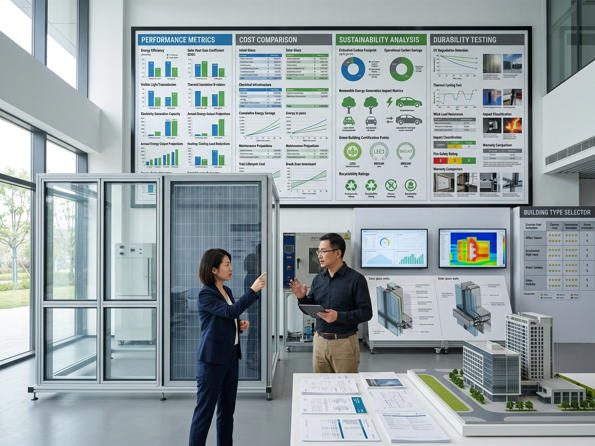
A rigorous, data-backed comparison of solar glass walls and traditional glazing — covering thermal performance, lifecycle cost, daylighting, sustainability, durability, and the specific scenarios where each technology wins. Designed for architects, developers, and sustainability consultants making glazing decisions that will outlast the next three leases.
Introduction to the Comparison
Glazing is the most thermally vulnerable element of any commercial building envelope — a single-pane clear glass wall transmits heat roughly 10 times faster than an equivalent area of insulated wall. Yet the glazing specification is often driven by aesthetics and initial cost rather than the 30-year performance envelope that governs everything from HVAC sizing to tenant comfort complaints to carbon reporting obligations.
The emergence of solar glass wall technology has changed the decision calculus. Where a traditional glazed curtain wall passively admits or blocks solar energy, a solar glass wall can selectively filter it, dynamically adjust to changing conditions, or convert it to on-site electricity — all within a glass assembly that occupies the same structural position as conventional glazing.
This comparison covers every performance dimension that a building project team needs to evaluate: thermal efficiency, daylighting quality, durability, initial cost, lifecycle economics, sustainability credentials, design compatibility, and risk. The goal is a clear, honest decision framework — not a promotional case for either technology.

The choice between solar glass and traditional glazing shapes a building’s energy performance for decades. Photo: Unsplash
Why Solar Glass Walls Are Gaining Traction in Modern Architecture
Three converging forces are driving solar glass adoption on commercial buildings. First, energy codes have become materially stricter: ASHRAE 90.1-2022 now mandates SHGC ≤ 0.25 for fixed commercial glazing in Climate Zones 1–3, a threshold achievable only with high-performance solar control coatings or BIPV glass. Second, commercial electricity rates have escalated faster than construction costs in most major markets, shifting the lifecycle economics in favor of higher-performance envelope solutions. Third, ESG reporting requirements — particularly GRESB for real estate and TCFD for institutional investors — are forcing building owners to account for operational and embodied carbon in ways that were previously voluntary.
Traditional glazing is not disappearing. But its domain is narrowing to specific climate zones, budget-constrained project types, and building programs where the thermal and electrical performance of solar glass is not worth the premium. Understanding exactly where that boundary lies is the purpose of this comparison.
Core Metrics Used for Comparison
This article evaluates both glazing approaches across six measurable dimensions: thermal energy performance (U-value and SHGC), daylighting quality (Visual Light Transmittance and glare management), durability and maintenance, initial capital cost, lifecycle cost and payback period, and sustainability metrics (embodied carbon, recyclability, certification contribution). Each dimension is supported by published data, not manufacturer claims.
Solar Glass Wall: Definition and Core Technologies
What Qualifies as a Solar Glass Wall
A solar glass wall is any glazing system in which the glass itself is engineered to actively manage solar radiation — either by modulating how much solar energy enters the building, by generating electricity from solar energy, or both. This distinguishes it from a simple clear or tinted glass wall, where solar radiation management is passive and largely uncontrolled.
The category is broader than many project teams realize. It spans four distinct technology families, each with different performance profiles, cost structures, and maintenance requirements:
| Технология | How It Works | Typical SHGC | Typical U-value (W/m²K) | Диапазон VLT | Generates Power? |
|---|---|---|---|---|---|
| High-performance Low-E solar control | Spectrally selective sputtered coatings reflect IR while transmitting visible light | 0.22–0.38 | 1.0–1.6 | 45–70% | No |
| Electrochromic (EC) dynamic glass | Applied voltage changes tint state; VLT ranges from ~60% (clear) to ~16% (tinted) | 0.09–0.41 (variable) | 1.1–1.4 | 16–60% | No |
| SPD (Suspended Particle Device) | Electrical field aligns nano-particles; switches from dark to clear on demand | 0.10–0.45 (variable) | 1.1–1.5 | 1–44% | No |
| Фотоэлектрическое стекло BIPV | PV cells laminated between glass layers; converts solar radiation to DC electricity | 0.15–0.35 | 0.9–1.6 | 0–45% | Yes — 30–200 W/m² |
Typical Configurations and Modules
Regardless of technology type, solar glass walls are constructed as IGUs (Insulated Glass Units) — two or three glass panes with sealed, gas-filled cavities — incorporating coatings, interlayers, or photovoltaic cells depending on the product family. The curtain wall or window framing that holds them in place is largely unchanged from conventional commercial glazing systems, which simplifies the structural design path but adds electrical integration requirements for BIPV variants.
For BIPV solar glass walls specifically, photovoltaic glass panel configurations range from fully opaque (spandrel zones, 0% VLT, maximum power density) through semitransparent (10–45% VLT, balanced daylighting and generation) to near-transparent (45–70% VLT, vision glass applications with reduced power density). The monocrystalline silicon cells used by manufacturers like Цзя Мао Бипв achieve cell efficiency above 22% — and the proprietary invisible busbar technology eliminates the silver grid lines that make conventional solar cells visually intrusive in architectural glazing, giving architects the flexibility to use BIPV glass in vision zones without the industrial appearance of traditional panel-on-frame solar.
Traditional Glazing: Overview and Common Types
Typical Glazing Types
| Glazing Type | U-value (W/m²K) | SHGC | VLT | Approx. Cost ($/ft²) | Primary Limitation |
|---|---|---|---|---|---|
| Single-pane clear glass | 5.8 | 0.86 | 83–88% | $8–$15 | Near-zero thermal resistance; fails modern energy codes |
| Double-pane clear (air-filled) | 2.7 | 0.70 | 78–82% | $18–$35 | Adequate insulation in mild climates; poor solar control |
| Double-pane with low-E coating (hard coat) | 1.8–2.2 | 0.45–0.55 | 55–70% | $22–$40 | Limited solar control; LSG typically ≤1.2 |
| Double-pane low-E (soft coat, argon) | 1.3–1.6 | 0.25–0.40 | 50–65% | $28–$55 | Approaches solar glass performance but generates no power |
| Triple-pane low-E (krypton, 2 coatings) | 0.8–1.0 | 0.20–0.30 | 48–62% | $50–$90 | Near-solar-glass performance; heavier; no power generation |
Conventional Performance Expectations and Limitations
The fundamental limitation of traditional glazing is that it manages solar energy passively — once the glass type is specified, its behavior is fixed for the life of the building. A double-pane clear wall admits the same fraction of solar heat on a 100°F August afternoon as it does on a 45°F November morning, forcing HVAC systems to compensate for both extremes. The result is oversized equipment, higher peak demand charges, and occupant discomfort in perimeter zones where the glass surface temperature diverges significantly from room air temperature.
There is also a systematic underperformance problem in warm climates. Research documented by the U.S. Department of Energy confirms that a building in ASHRAE Climate Zone 2 (Houston, Phoenix) switching from standard double-pane clear glass (SHGC 0.70, U-value 2.7 W/m²K) to high-performance solar control IGUs (SHGC 0.25, U-value 1.1 W/m²K) reduces annual cooling energy by 35–45% and total building EUI by 15–22%. That gap represents a systematic cost that traditional glazing projects accrue every year, compounding over a 30-year building life.
Performance: Energy Efficiency and Thermal Comfort

The thermal performance gap between solar glass and standard glazing is largest on east and west facades where low-angle solar radiation is hardest to shade. Photo: Unsplash
U-factor and Solar Heat Gain Coefficient (SHGC) Implications
U-factor and SHGC are the two numbers that determine a glazing system’s energy performance — and they operate in opposite directions depending on climate zone. U-factor controls how fast the building loses heat through the glass due to temperature difference; SHGC controls how much solar heat enters through the glass as sunlight. In hot climates (ASHRAE Zones 1–3), SHGC is the dominant performance driver. In cold climates (Zones 5–8), U-factor becomes equally or more important. In mixed climates (Zone 4), both parameters matter.
📊 U-value Comparison: Solar Glass Wall Variants vs. Traditional Glazing (W/m²K — lower is better)
Sources: ASHRAE 90.1-2022; U.S. DOE Energy Performance Ratings; manufacturer data. Lower values = better thermal insulation. Run project-specific simulation for actual specification values.
The practical significance of these numbers becomes clear in perimeter zones. A glass surface with U-value 5.8 W/m²K (single-pane) creates a “cold wall effect” in winter — the glass surface temperature can be 15–20°F colder than the room air, causing occupants within 6 feet of the wall to feel cold even when the thermostat reads 70°F. This consistently drives thermostat overrides and heating energy waste that never shows up in the energy model but appears clearly in utility billing data. Solar glass walls with U-values below 1.1 W/m²K virtually eliminate this phenomenon.
Thermal Bridging, Insulation Continuity, and Night-Time Cooling
Thermal bridging through curtain wall mullions and transoms is a performance penalty that affects both solar glass and traditional glazing systems — but it is more consequential when the glass itself has a low U-value, because the frame’s contribution to total heat loss becomes proportionally larger. Glass Magazine’s thermal bridging analysis documents that aluminum frames without thermal breaks can account for 20–25% of total glazing assembly heat loss, even when the center-of-glass U-value is excellent. The specification implication: a premium solar glass IGU installed in a non-thermally-broken aluminum frame performs significantly worse than its center-of-glass U-value suggests. Specify thermally broken frames whenever the glass unit U-value is below 1.6 W/m²K.
Night-time radiative cooling is an often-overlooked secondary benefit of low-SHGC solar glass. Glass with high solar reflectance in the infrared spectrum also limits the building’s radiant heat exchange with the night sky — which matters in commercial buildings that need to pre-cool their thermal mass overnight to reduce the morning cooling load. The interaction between glazing thermal mass, night ventilation strategies, and SHGC specification requires building energy modeling (EnergyPlus or IES-VE) to quantify accurately, but the directional result is consistent: lower SHGC solar glass reduces both daytime solar load and night-cooling requirements simultaneously.
Performance: Daylighting, Glare, and Visual Comfort
Daylight Autonomy vs. Glare Management
Daylight Autonomy (DA) quantifies how often a building space can meet its lighting needs from natural light alone. Traditional clear double-pane glass (VLT 80%) maximizes daylight admission but also maximizes glare — the same sunlight that illuminates the space makes computer screens unreadable and creates discomfort that causes occupants to close blinds. Studies consistently show that once blinds are deployed, both the daylighting benefit and any view connection are lost.
The behavioral paradox of traditional clear glazing: high VLT triggers blind closure, which eliminates daylight and forces electric lighting — producing the opposite of the energy efficiency intended. Solar glass walls with spectrally selective coatings (VLT 50–65%, SHGC 0.22–0.30) resolve this paradox by delivering adequate daylight illuminance without the direct solar glare that triggers blind closure. The result, documented in post-occupancy studies on electrochromic glass buildings, is a 48–67% reduction in lighting energy compared to conventional low-E glass with manual blinds — not because the glass transmits more light, but because occupants never need to block it.
💡 Annual Lighting Energy Use: Solar Glass Wall vs. Traditional Glazing Scenarios (kWh/m²/yr, indicative)
Sources: SageGlass GANA analysis (EC glass vs. low-E + manual blinds); post-occupancy studies on commercial offices with electrochromic facades. Actual values depend on facade orientation, WWR, and control strategy.
Impact on Occupier Comfort and Productivity
The connection between glazing quality and occupier productivity has moved from qualitative argument to quantifiable claim. A frequently cited World Green Building Council study found that improved natural light and thermal comfort in office environments correlates with 8–16% productivity gains, though causality in workplace studies is always complex. More directly, the cost of occupant-driven blind closure in a typical commercial office — measured as increased electric lighting energy plus HVAC load from reduced solar shading — routinely exceeds $3–$8/ft² annually in warm-climate buildings. This is a real cost that appears in utility bills but not in typical glazing ROI models.
The industry insight: traditional glazing ROI models systematically underestimate the value of solar glass walls because they omit the blind-closure productivity penalty, the perimeter-zone comfort complaints that drive thermostat overrides, and the asset-value premium that high-performance envelope specifications command in institutional real estate benchmarks like GRESB.
Durability, Maintenance, and Long-Term Performance
Coatings Durability, Cleaning Requirements, and Cleaning Cycles
The durability question for solar glass walls is more nuanced than for traditional glazing because multiple performance-critical components — coatings, sealants, gas fills, and (for BIPV) encapsulants and connectors — each have independent aging trajectories. Understanding which component is most likely to fail first, and when, is essential for accurate lifecycle cost modeling.
| Component | Solar Glass Wall | Traditional Glazing | Failure Mode | Maintenance Action |
|---|---|---|---|---|
| Low-E / solar control coating | 25–30 yr (sealed in IGU) | 25–30 yr (sealed in IGU) | IGU seal failure exposes coating to moisture | Replace failed IGU unit |
| IGU seal integrity | 15–20 yr (premium); 10–15 yr (standard) | 10–15 yr (standard) | Visible fogging between panes; loss of gas fill | Replace IGU unit |
| Anti-reflective / self-cleaning coating | 7–15 yr (exposed surface) | N/A (not standard) | Abrasion from improper cleaning; UV degradation | Re-coating or unit replacement |
| BIPV encapsulant & cell laminate | 25 yr (performance warranty) | Н/Д | Delamination, yellowing, PID effect (rare) | Panel replacement per warranty |
| Sealant joints & gaskets (frame) | 7–12 yr typical re-caulking cycle | 7–12 yr typical re-caulking cycle | Water infiltration; thermal fatigue | Re-caulk per facade maintenance schedule |
| Inverter / MLPE (BIPV only) | 10–15 yr | Н/Д | Electronic component aging; fault codes | Budget replacement at yr 12–15 |
Cleaning requirements are similar for both systems when surface coatings are compatible. The critical rule that applies to solar glass walls — and is frequently violated by commercial cleaning crews — is pH-neutral cleaning solutions only. Alkaline detergents above pH 10 degrade hydrophobic coatings; abrasive pads damage anti-reflective treatments. The self-cleaning coating on Jia Mao Bipv’s ultra-clear tempered solar glass reduces maintenance costs by approximately 30% relative to uncoated glass — on a 50-story tower cleaned three times per year at $1.50/ft², that coating saves roughly $22,000 per cleaning cycle, or $660,000 over a 30-year lifecycle.
Weather Resistance and Lifecycle Considerations
Both solar glass walls and traditional glazing must withstand the same environmental stressors: wind load (ASTM E1300), rain penetration (ASTM E331), thermal cycling (temperature differentials of 80°F+ across a single 24-hour cycle in continental climates), UV exposure, and seismic movement in appropriate geographies. The performance gap between the two systems on weather resistance is not large — both can be engineered for equivalent structural and weatherproofing performance when correctly specified and installed.
The lifecycle consideration that distinguishes solar glass walls is the dual performance obligation: the glazing must maintain both its thermal/optical properties and (for BIPV) its electrical output over a 25-year warranty horizon. NREL durability testing has confirmed that acid-etched anti-reflective coatings retain transmittance within 1% of initial values after 7 years of outdoor exposure — but only when maintained with manufacturer-approved cleaning protocols. Deviations from those protocols void coating warranties and degrade the energy performance that justifies the premium specification.
Initial Cost and Capital Expenditure Considerations
Material Costs, Installation Complexity, and Integration Challenges
🥧 Indicative Cost Breakdown — BIPV Solar Glass Wall Installation (Commercial Curtain Wall, $/ft²)
Indicative distribution for a commercial BIPV curtain wall project, U.S. market, 2025–2026. Standard solar control glass (non-BIPV) eliminates the 16% electrical component, reducing total installed cost proportionally.
| Glazing System | Material Cost ($/ft²) | Installed Cost ($/ft²) | vs. Standard Double-Pane | Electrical Integration Required? |
|---|---|---|---|---|
| Standard double-pane clear (baseline) | $18–$35 | $45–$85 | — | No |
| Double-pane low-E soft coat + argon | $28–$55 | $65–$110 | +25–35% | No |
| Solar control high-performance IGU | $35–$70 | $80–$140 | +40–65% | No |
| Electrochromic dynamic glass | $80–$150 | $150–$280 | +150–220% | Yes (control wiring) |
| SPD smart glass | $50–$120 | $120–$220 | +100–160% | Yes (control wiring) |
| BIPV semitransparent solar glass | $65–$130 | $140–$280 | +100–200% | Yes (DC + inverter) |
| BIPV opaque solar glass (spandrel) | $45–$90 | $110–$200 | +60–130% | Yes (DC + inverter) |
* U.S. market estimates, 2025–2026, commercial curtain wall installation. Material offset credit (avoided conventional cladding cost) not applied. Apply offset credit for BIPV zones replacing spandrel or cladding — typically reduces net incremental cost by $20–$40/ft².
Impact of Incentives, Codes, and Financing Options
The after-incentive cost picture for BIPV solar glass walls is materially better than the gross cost comparison above suggests. BIPV glass that generates electricity qualifies for the federal Investment Tax Credit — currently 30% of the system cost under the Inflation Reduction Act, though legislative changes in 2025 have introduced uncertainty about future ITC availability. Apply the ITC in a project’s financial model conservatively — model both with and without the credit — rather than treating it as a guaranteed input.
Beyond the ITC, high-performance solar glass walls frequently qualify for utility demand-response programs (for load-shifting electrochromic systems), green building loan products at below-market interest rates, and accelerated depreciation as energy-producing equipment. Energy code compliance in Climate Zones 1–3 is an indirect incentive: specifying solar glass that meets ASHRAE 90.1-2022 SHGC requirements eliminates the cost and delay of energy code variance requests that affect traditional glazing projects in these zones.
Lifecycle Costs, Energy Savings, and Payback Period

Lifecycle cost analysis consistently reverses the apparent advantage of cheaper traditional glazing — energy savings compound over 30 years while the glass premium is paid once. Photo: Pexels
Operating Costs, Energy Price Sensitivity, and Maintenance Spend
📊 30-Year Lifecycle Cost Comparison — 10,000 ft² South-Facing Facade, Climate Zone 2 (Houston)
Assumptions: 10,000 ft² facade, ASHRAE Zone 2, electricity $0.11/kWh escalating 2.5%/yr; BIPV output 120 kWh/m²/yr at $0.11/kWh credited; 30% ITC applied to BIPV; blind replacement every 10 yrs at $8.50/ft² for traditional glazing; HVAC sizing credit included. Not a project-specific analysis — use as directional guidance only.
The lifecycle cost gap is driven primarily by three compounding factors: HVAC energy savings (35–45% reduction in cooling-dominated climates), avoided blind purchase and replacement costs ($8.50–$12/ft² every 10 years for traditional glazed facades with high solar gain), and HVAC equipment downsizing (20–30% reduction in chiller capacity that reduces both capital cost and ongoing maintenance). For BIPV solar glass walls, the electricity generation credit adds a fourth value stream that becomes increasingly significant as utility rates escalate.
Lifecycle Assessment and Total Cost of Ownership
A complete Total Cost of Ownership (TCO) model for glazing selection should include: installed glass and frame cost, avoided conventional material cost (for BIPV replacing spandrel), HVAC capital cost adjustment, 30-year HVAC energy at escalating utility rates, electric lighting energy at escalating rates, blind purchase and replacement, glass cleaning and maintenance, IGU seal replacement reserve (1–2% of original cost annually from year 15), inverter replacement at year 12–15 (BIPV only), and residual asset value contribution. Projects that include all line items consistently find that premium solar glass walls have lower 30-year TCO than standard double-pane glazing — the crossover typically occurs at year 6–12 depending on climate and utility rate.
Sustainability and Environmental Impact
Embodied Energy, Recyclability, and End-of-Life Considerations
The sustainability comparison between solar glass walls and traditional glazing has two dimensions: operational carbon (driven by energy performance over the building’s life) and embodied carbon (the carbon emitted in manufacturing, transporting, and installing the glass). High-performance solar glass typically has 15–30% higher embodied carbon than standard clear glass of equivalent area — due to additional coatings, encapsulants, PV cells, and electrical components. However, this embodied carbon premium is offset by operational carbon savings within 3–6 years in most climate zones, after which the solar glass wall is generating net carbon reductions relative to standard glazing for the remaining 20+ years of its life.
The energy payback period for BIPV glass laminates — the time for the system to generate more energy than was consumed in manufacturing it — is typically 1.5–3.5 years for glass-glass BIPV assemblies. Over a 25-year service life, this means the system operates as a net energy producer for 21–23 years. BIPV panels are documented as >90% recyclable by weight at end of life — glass and aluminum frames being the dominant materials — significantly better than traditional glazing, which has lower recycling rates due to lamination interlayers and gas fill challenges.
Impact on Building Certifications (LEED, WELL)
| Certification Credit | Solar Glass Wall Contribution | Traditional Glazing Contribution | Potential Points |
|---|---|---|---|
| LEED EA: Optimize Energy Performance | Reduced HVAC energy → lower EUI → multiple points | Marginal improvement vs. baseline | Up to 18 pts (LEED v4.1) |
| LEED EA: Renewable Energy (BIPV only) | On-site electricity generation from BIPV glass | None | 1–3 pts |
| LEED EQ: Daylight | High LSG maintains daylighting without glare-driven blind closure | Often fails due to high SHGC triggering blind use | 2–3 pts |
| LEED EQ: Quality Views | Maintained with appropriate VLT ≥40% | Maintained if VLT ≥40% | 1 pt |
| LEED MR: Building Life-Cycle Impact Reduction | BIPV replaces conventional materials → lower total material impact | Neutral | Up to 5 pts |
| WELL L01–L05 (Light & Views) | Spectrally selective glass achieves target illuminance + glare control | Requires blinds → fails automated glare metrics | Up to 12 WELL pts |
Design, Integration, and Architectural Considerations
Aesthetics, Daylighting Impact, and Façade Integration
The aesthetic dimension is where traditional glazing retains its strongest argument. Standard double or triple-pane low-E glass is available in virtually unlimited sizes, shapes, colors, and tint options, with a well-established supply chain and contractor familiarity that minimizes coordination risk. Solar glass walls — particularly BIPV variants — require earlier design engagement, longer procurement lead times (10–24 weeks for custom BIPV modules), and closer coordination between the facade engineer, electrical engineer, and glazing contractor.
However, the aesthetic flexibility of solar glass has expanded dramatically. The invisible busbar technology in products from Jia Mao Bipv’s transparent solar glass range eliminates the silver grid lines that made early BIPV glass visually conspicuous. Custom cell patterns — circular, hexagonal, abstract — allow architects to design the PV layout as an intentional facade pattern rather than a technical imposition. And the transparency range of 10–90% gives the same product family the ability to serve as spandrel glass (opaque, maximum power), vision glass (semitransparent, balanced daylighting), or skylight glazing (near-transparent, minimal power density) within a single facade design.
Structural, Glazing System Compatibility, and Controls
Both solar glass walls and traditional glazing use the same structural platform: stick-built or unitized curtain wall systems, structural glazing (SSG), or point-fix systems, all of which accommodate IGUs of standard commercial dimensions. The structural differentiation begins with weight: solar glass IGUs are typically 15–30% heavier than equivalent standard glass, requiring verification of floor slab edge capacity and mullion/transom sizing. For electrochromic and SPD smart glass, a low-voltage electrical supply must reach each glass unit — typically routed through mullion cavities — and a building management system (BMS) or dedicated facade control system must be specified.
The controls architecture for smart solar glass walls is an important specification decision. Occupant-controlled systems (dimmer switches, app interfaces) tend to deliver better lighting comfort outcomes but require occupant training. Automated systems (BMS-driven, sun-path-based) deliver more consistent energy performance but can reduce occupant satisfaction if the control logic does not respond to local comfort complaints. The highest-performing installations combine automated baseline operation with occupant override capability in individual zones — a design approach that aligns well with WELL v2 occupant control requirements.
Solar glazing explained: how transparent energy solutions are transforming building facades. Source: YouTube
Risk, Standards, and Performance Warranties
Reliability of Performance Claims and Testing Standards
The performance claims made for solar glass walls are regulated by a more complex standards framework than traditional glazing, because BIPV products must satisfy both glazing standards and PV electrical standards simultaneously. The key standards framework for commercial specification includes:
- IEC 61215: Design qualification and type approval for photovoltaic modules — required for BIPV glass
- IEC 61730-1 & -2 / UL 61730: PV module safety requirements — must match application class for facade use
- NFRC 100 / 200: U-factor and SHGC certification — required for code compliance; center-of-glass and whole-product ratings must match specified IGU configuration
- ASTM E1300: Wind load resistance — structural adequacy of glazing under design wind pressures
- ASTM E331 / E1105: Water penetration resistance — field testing of installed glazing system
- NFPA 285: Fire propagation testing for curtain wall assemblies — required for BIPV in exterior wall applications
- ISO/IEC 17025: Accreditation standard for testing laboratories — verify that certification bodies hold this accreditation
A detailed guide to interpreting test reports and evaluating warranty terms for solar glass products is available at how to verify solar glass certifications and warranty terms — a useful pre-procurement reference for project teams that have not previously specified BIPV glazing. The IEA PVPS has also documented that BIPV standardization remains underdeveloped relative to conventional PV, meaning that project teams must be more vigilant about verifying which specific standards a given product has been tested to, rather than assuming that a CE or UL mark covers all relevant performance dimensions.
Warranties, Maintenance Contracts, and Service Life
The warranty structure for solar glass walls is more complex than for traditional glazing because multiple performance dimensions — each with different warranty terms — must be tracked simultaneously. A robust procurement contract should specify minimum warranty terms for each component category and confirm that the warranty applies to the specific IGU configuration being installed, not to a generic product family:
| Warranty Category | Solar Glass Wall (Premium) | Traditional High-Performance Glazing | Key Caveat |
|---|---|---|---|
| IGU seal integrity | 15–20 years | 10-15 лет | Void if wrong cleaning chemicals used |
| Coating durability | 20–25 years (sealed); 7–15 years (exposed) | 20–25 years (sealed) | Abrasion from improper maintenance voids |
| Выходная мощность BIPV (линейная) | 90% at yr 10; 80% at yr 25 | Н/Д | Coverage limited to defined degradation rate |
| Structural integrity (laminate) | 25 лет | Varies (typically 10 years) | Physical damage exclusions apply |
| Inverter / MLPE | 10-15 лет | Н/Д | Extended service contracts available |
Maintenance contracts for solar glass walls should cover: scheduled cleaning with approved protocols, annual technical inspection (sealants, cables, connectors, electrical performance), performance monitoring with quarterly reporting, and emergency response for glass breakage or electrical fault. The best practice — aligned with WBDG BIPV guidance — is to combine the facade maintenance contract and the solar O&M contract under a single service provider, eliminating the interface dispute risk that arises when glazing contractors and solar contractors share responsibility for the same assembly.
Conclusions and Practical Recommendations

The glazing decision framework should start with climate zone, energy code, and sustainability goals — then evaluate technology options against those constraints. Photo: Unsplash
Scenarios Where Solar Glass Walls Outperform Traditional Glazing
☀️ Solar Glass Wall Wins When:
- Building is in ASHRAE Zones 1–3 (hot or very hot climates)
- Window-to-wall ratio exceeds 35–40%
- Project owner has hold period >7 years
- LEED, WELL, or BREEAM certification is targeted
- BIPV glass replaces conventional spandrel or cladding (material offset applies)
- Corporate ESG or net-zero commitments require documented carbon reduction
- Tenant market is sustainability-sensitive (tech, finance, life sciences sectors)
- Energy code compliance in Zone 1–3 requires SHGC ≤ 0.25 (solar glass is the path of least resistance)
🔲 Traditional Glazing Wins When:
- Building is in ASHRAE Zones 6–8 (cold climates where passive solar gain is beneficial)
- Project has a short development hold period (<5 years, speculative)
- Window-to-wall ratio is below 25% (limited surface area reduces absolute energy impact)
- Budget constraints are severe and lifecycle analysis is not accepted by ownership
- Historic preservation requirements prohibit visible changes to facade appearance
- Retrofit where existing frame system cannot accommodate heavier solar glass units
- Local utility rates are very low (<$0.07/kWh) reducing energy savings value
Decision Framework Based on Climate, Budget, and Sustainability Goals
The structured approach to a defensible glazing specification follows four steps: First, establish the non-negotiable constraints — energy code compliance requirements, budget ceiling, and hold-period economics. Second, quantify the performance gap between standard glazing and solar glass through building energy modeling for the specific building geometry, orientation, and climate zone. Third, apply a lifecycle cost model (not just upfront cost) to the shortlisted options, including HVAC sizing credit, energy savings, and certification contribution value. Fourth, evaluate supplier qualifications against the certification and warranty framework above — eliminating vendors who cannot provide NFRC-certified performance data for the specified configuration.
For the complete technical product comparison that supports Step 4, the 2026 review of glass-integrated solar panel and facade systems provides an independent evaluation of leading BIPV glass products against the metrics in this article — a useful starting point before issuing an RFP to potential suppliers.
Need Help Specifying the Right Glazing System?
Explore transparent BIPV glass, solar control glazing, and custom solar wall solutions — with technical documentation, NFRC-certified performance data, and project support from specification through commissioning.
Explore Jia Mao Bipv Glass Solutions →Conclusion
The solar glass wall vs. traditional glazing comparison is not a contest between a premium product and a budget product — it is a comparison between two fundamentally different theories of what a commercial building facade should do. Traditional glazing treats the envelope as a passive barrier; solar glass walls treat it as an active performance system.
The data supports a clear conclusion: in hot and mixed climates, on buildings with significant glazing area, held by owners with a medium-to-long investment horizon, solar glass walls deliver lower total cost of ownership, stronger energy code compliance, and better occupant outcomes than standard traditional glazing — with payback periods that have compressed from 15+ years a decade ago to 6–12 years in 2026, driven by rising energy costs, falling solar glass prices, and improving product performance.
Traditional glazing retains a legitimate role — in cold climates where passive solar gain is a heating asset, in short-hold speculative developments, and in budget-constrained retrofit situations where the existing structural system cannot accommodate the additional weight. Understanding the boundary conditions is the core professional skill that this comparison aims to develop.
The future trajectory of glazing performance is one-directional: energy codes will tighten, electricity costs will rise, and ESG transparency requirements will make embodied and operational carbon a standard part of every glazing specification. The projects that build that discipline into their decision process today will find the transition straightforward. Those that defer it will find the same lifecycle cost argument growing more compelling — and more urgent — every year. Resources like the solar facade panels and mounting systems comparison guide can help teams move from general principles to specific product decisions efficiently.
📖 Глоссарий ключевых терминов
- SHGC (коэффициент солнечной теплоотдачи)
- The fraction of incident solar radiation that passes through glazing as heat into the building. Range 0–1; lower values = less solar heat gain. Critical specification metric for hot climates.
- U-значение (тепловой коэффициент пропускания)
- Rate of non-solar heat transfer through the glass assembly due to indoor-outdoor temperature difference. Measured in W/m²K or BTU/hr·ft²·°F. Lower values = better insulation. Critical for cold climates.
- VLT (Пропускание видимого света)
- Percentage of visible light (380–780 nm) that passes through the glass. Higher VLT = brighter interiors. Target range for commercial offices: 40–65%.
- LSG (отношение освещенности к солнечному усилению)
- VLT ÷ SHGC. Values above 1.25 indicate spectral selectivity — the glass admits proportionally more light than heat. Premium solar control glass achieves LSG of 2.0–2.6.
- IGU (стеклопакет)
- Two or more glass panes sealed with a gas-filled cavity. Standard commercial glazing construction. Low-E coatings and inert gas fills (argon, krypton) determine thermal performance.
- BIPV (интегрированная в здание фотовольтаика)
- PV modules integrated into the building envelope — glazing, cladding, roofing — replacing conventional materials while simultaneously generating electricity.
- Thermal Bridging
- Heat transfer through structural elements (mullions, anchors, frames) that bypass the insulating properties of the glass itself. Accounts for 15–25% of total glazing assembly heat loss in standard aluminum curtain walls.
- Daylight Autonomy (DA)
- The percentage of annual occupied hours during which a space achieves a target illuminance level (typically 300 lux for offices) from natural light alone, without supplemental electric lighting.
- Electrochromic Glass (EC Glass)
- Dynamic glazing that changes tint in response to an applied electrical voltage, allowing variable VLT (typically 16–60%) and SHGC on demand. Eliminates the need for manual blinds.
- Energy Payback Period
- The time for a building product to save (or generate) more energy than was consumed in its manufacture, transport, and installation. Distinct from financial payback period.
Часто задаваемые вопросы
These questions address the most common queries from architects, developers, sustainability consultants, and facilities managers evaluating solar glass walls against traditional glazing.
What are the main performance differences between solar glass walls and traditional glazing?
The most quantifiable performance differences are in three areas: thermal insulation (U-value range: 0.82–1.6 W/m²K for premium solar glass vs. 1.3–5.8 W/m²K for standard glazing — up to 7× difference), solar heat control (SHGC range: 0.09–0.38 for solar glass vs. 0.25–0.86 for standard glazing), and electricity generation (BIPV solar glass generates 30–200 W/m² depending on transparency — traditional glazing generates nothing). For thermal performance specifically, a 40-story tower in Phoenix switching from clear double-pane (SHGC 0.86) to high-performance solar glass (SHGC 0.25) documented a 41% reduction in annual HVAC energy consumption. For daylighting, electrochromic solar glass buildings record 48–67% lower lighting energy compared to conventional low-E glass with manual blinds — because occupants never need to close blinds to manage glare, so daylight is utilized throughout occupied hours rather than periodically blocked. For a deeper specification-level comparison, see the solar glass efficiency and glazing performance guide.
How do lifecycle costs compare between solar glass walls and traditional glazing, including maintenance and energy savings?
When all lifecycle cost components are included — glass and installation, HVAC energy over 30 years at escalating utility rates, blind purchase and replacement, HVAC equipment sizing credit, and glass maintenance — solar glass walls consistently show lower 30-year total cost of ownership than standard traditional glazing in ASHRAE Climate Zones 1–4. The lifecycle cost crossover point (where cumulative solar glass savings exceed the initial premium) typically occurs at year 6–12, depending on local electricity rate, climate severity, and whether BIPV electricity generation is credited. A representative 10,000 ft² facade in Climate Zone 2 (Houston) shows 30-year lifecycle costs of ~$815,000 for standard clear double-pane glass versus ~$540,000 for high-performance solar control glass — a $275,000 difference that represents a 34% lifecycle cost reduction despite the solar glass costing 40–65% more upfront. For BIPV solar glass that also generates electricity, the effective lifecycle cost gap widens further as credited electricity production reduces the net system cost over time. Maintenance costs for solar glass walls are broadly comparable to traditional glazing — with the addition of annual electrical inspection (inverter and connector check, roughly $200–$400 for a commercial system) and potential inverter replacement at year 12–15.
Which climates or building types benefit most from solar glass walls?
Solar glass walls deliver the strongest value in four specific conditions: (1) Hot climates (ASHRAE Zones 1–3) — Phoenix, Houston, Miami, Dubai, Singapore — where cooling loads dominate and SHGC reduction delivers the largest HVAC energy savings. A building in Zone 2 with 40% window-to-wall ratio can reduce cooling energy by 35–45% by specifying solar glass over standard double-pane clear. (2) High window-to-wall ratio buildings — commercial offices, corporate campuses, hotels, and mixed-use towers with WWR above 35% where glazing area is large enough for the per-unit savings to accumulate significantly. (3) Long-hold institutional owners — REITs, pension funds, universities, and government buildings where 20–30 year financial models are used and lifecycle cost correctly overrides initial cost. (4) Buildings targeting sustainability certifications (LEED, WELL, BREEAM) where solar glass contributes across multiple credit categories simultaneously — reducing EUI, improving daylighting, potentially generating on-site renewable energy, and contributing to embodied carbon reduction through material offset credit for BIPV. In cold climates (Zones 6–8), the calculus is more nuanced: triple-pane traditional glazing with appropriate SHGC for passive solar gain can approach solar glass performance on the thermal metrics, and the lack of electricity generation in cold climates (lower annual solar irradiance and more vertical sun angles) reduces the BIPV value proposition.
Are there common challenges or integration issues to plan for with solar glass walls?
The four most consistently documented challenges are: (1) Electrical-envelope interface coordination — DC cable routes for BIPV glass must thread through curtain wall mullions without compromising water management; this requires glazing contractor, electrical contractor, and BIPV manufacturer to align during design development, not at shop drawing stage. Late coordination is the single most common source of expensive change orders on BIPV facade projects. (2) Long procurement lead times — custom BIPV glass modules typically require 10–24 weeks from order confirmation to delivery. The procurement must be initiated at design development (60% construction documents) — not at permit issuance — to avoid construction schedule delays. (3) Warranty complexity — solar glass walls have multiple overlapping warranties (IGU seal, coating, BIPV power output, inverter) each with different exclusion clauses. A single cleaning event with the wrong detergent can void the coating warranty on a $200,000 facade section. Detailed warranty training for the facility management team is not optional. (4) Structural weight — BIPV laminated glass units can reach 50–55 kg/m², significantly heavier than standard glazing. Floor slab edge capacity and curtain wall framing must be verified in structural engineering before procurement, especially on retrofit projects where the existing structure was designed for lighter glass.
What incentives or standards affect the adoption of solar glass walls?
Several regulatory and incentive frameworks directly shape solar glass wall economics: (1) U.S. Federal Investment Tax Credit (ITC) — BIPV solar glass that generates electricity qualifies for the 30% ITC under the Inflation Reduction Act, though legislative changes in 2025 have introduced uncertainty about future ITC availability and duration. Apply the credit conservatively in financial models. (2) ASHRAE 90.1 energy code — mandates SHGC ≤ 0.25 for fixed commercial glazing in Climate Zones 1–3, which effectively requires solar glass or equivalent high-performance coatings for code compliance in those zones. (3) LEED/WELL/BREEAM — solar glass contributes to multiple credit categories simultaneously, and the certification premium (typically 3–7% rent uplift in institutional commercial markets) provides an indirect financial incentive. (4) State-level net metering and utility programs — BIPV facade electricity exported to the grid receives compensation under applicable net metering rules (rates and structures vary significantly by state). (5) Accelerated depreciation — BIPV glass classified as energy-producing equipment (rather than building structure) may qualify for bonus depreciation under applicable tax rules, improving the after-tax financial return. Consult a tax advisor for project-specific guidance on ITC eligibility and depreciation treatment. For the standards framework, IEA PVPS’s 2024 BIPV standardization report documents the current state of standardization and identifies the areas where project teams must exercise additional verification diligence.
How does thermal bridging affect solar glass wall performance vs. traditional glazing?
Thermal bridging through curtain wall frames is a performance penalty that affects both systems, but its relative impact is larger for solar glass walls because the glass itself has such a low U-value that the frame’s contribution becomes the dominant source of heat loss. A premium solar glass IGU with center-of-glass U-value of 0.82 W/m²K installed in a standard non-thermally-broken aluminum frame system will deliver a whole-product U-value of 1.8–2.2 W/m²K — more than double the glass U-value — because the aluminum frame conducts heat rapidly between interior and exterior. Thermally broken aluminum frames (polyamide or polyurethane thermal breaks) reduce this penalty, achieving whole-product U-values 30–40% lower than non-broken frames. For solar glass wall specifications with target U-values below 1.4 W/m²K, thermally broken frames are non-negotiable. For traditional glazing with standard double-pane clear glass, the frame U-value gap is proportionally smaller because the glass itself is already highly conductive — making the frame specification less critical but the overall thermal performance inherently worse.
Can solar glass walls be retrofitted onto existing buildings with traditional glazing?
Yes — solar glass wall retrofits on existing commercial buildings follow two primary approaches. The first is a glass-only replacement within the existing curtain wall or window frames: removing standard IGUs and installing solar glass IGUs of the same dimensions. This preserves the existing framing and avoids structural modifications, but is constrained by the frame’s dimensional pocket depth (which limits the maximum IGU thickness) and structural capacity (heavier BIPV glass units may exceed the original frame’s dead-load design). The second approach is a full facade over-cladding: installing a new exterior curtain wall system (or rainscreen panel system) over the existing facade, incorporating solar glass in the new outer layer. This approach allows complete optimization of all glazing parameters and is particularly suited to buildings where the existing facade is life-expired or energy-code non-compliant. For existing buildings where the original frame can accept solar glass unit dimensions, the glass-only replacement is typically more cost-effective. For buildings with heavily non-compliant facades in Climate Zones 1–3, the full re-cladding approach with BIPV glass replacing conventional spandrel and cladding materials can be economically justified when the material offset credit is properly applied. More on BIPV installation and design for existing buildings.
How does BIPV solar glass wall electricity generation compare to rooftop solar for the same building?
Rooftop solar consistently generates more electricity per square meter of panel than facade BIPV glass, because roof panels can be optimally tilted toward the sun (30–35° in the northern hemisphere for maximum annual yield) while facade glass is typically vertical or near-vertical — producing roughly 45–65% of the yield of an equivalent south-facing tilted roof panel. However, the comparison is not simply about yield per m²: facade BIPV glass occupies area that has no competing use (the facade must be there regardless), while rooftop solar competes with mechanical equipment, green roofs, roof terraces, and structural loading limits. On tall commercial buildings where the facade area substantially exceeds the usable roof area, BIPV glass can generate more total electricity than rooftop solar despite the per-m² yield disadvantage. The industry insight: treat rooftop solar and facade BIPV glass as complementary, not competing, strategies on commercial buildings — maximize both surfaces based on available area and structural capacity. Compare BIPV product types and yield estimates across roof, facade, and skylight applications for a full building-level energy analysis.
- WBDG: Окна и остекление - Руководство по проектированию целых зданий
- U.S. DOE: Energy Performance Ratings for Windows, Doors & Skylights
- IEA PVPS: BIPV Standardization Report (2024)
- Glass-Integrated Solar Panels & Facade Systems: 2026 Review
- How to Specify and Install BIPV in New Construction
- Совет по экологическому строительству США - Рейтинговая система LEED
- Vitro Glass Education Center: Glass and Embodied Carbon