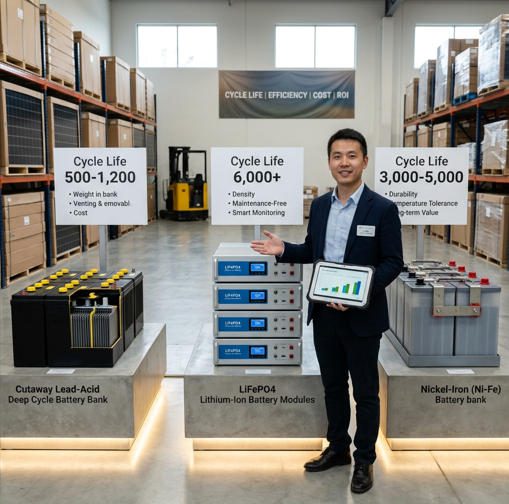
A comprehensive guide for distributors and solar product agents to understand battery chemistries, compare performance metrics, and make informed purchasing and sales decisions
Why Battery Chemistry Is Your Competitive Edge
In 2025, the global lithium-ion battery market exceeded USD $150 billion — up more than 20% from the previous year, according to the IEA. Battery storage capacity deployed worldwide hit 108 GW of new installations in 2025 alone, a 40% year-on-year jump. The energy storage revolution is no longer a forecast. It’s the current market condition your customers are operating in right now.
For solar distributors and agents, this surge creates both opportunity and complexity. Your customers — installers, contractors, project developers, and commercial operators — are being bombarded with competing product claims across three distinct battery chemistries. They’re asking increasingly specific questions: Why does one 10 kWh system cost twice as much as another? What does “80% DoD” actually mean for my project? Is the cheaper lead-acid option going to cost me more in the long run?
The distributor who can answer these questions with precision and confidence — backed by real data, not marketing language — wins the relationship. The one who simply forwards a spec sheet loses it.
This guide was built specifically for the B2B side of the solar value chain: distributors, regional agents, system integrators, and building contractors who need to understand battery chemistry deeply enough to guide customers, build winning product portfolios, and position themselves as the technical authority in their market.
What follows is a comprehensive, data-driven breakdown of the three battery technology families dominating the solar storage market today — lead-acid, lithium-ion, and nickel-based — covering performance science, total cost of ownership, real-world use cases, sales strategy, and the emerging technologies your customers will be asking about within the next 18–36 months.
 Modern energy storage facilities deploy battery chemistries matched to their load profile, cycling demands, and climate conditions — decisions that begin with distributor expertise.
Section 1: Understanding Solar Battery Fundamentals
What Makes Solar Batteries Different from Conventional Batteries
Not all batteries are designed for the same job. A starting battery in a vehicle delivers a massive burst of current for 1–2 seconds, then immediately begins recharging from the alternator. It almost never reaches more than 10–20% depth of discharge.
A solar storage battery works in the exact opposite pattern. It charges gradually over 4–8 hours of sunlight, then discharges slowly and deeply over 8–16 hours of household or commercial use. This daily partial-to-full cycling regime, sustained over thousands of cycles across 10+ years, is the defining challenge of solar battery design — and the primary reason chemistry selection matters so much.
Solar batteries must also tolerate variable charge rates. A cloud passes over a solar array, and charge current drops from 50A to 5A in seconds. The cloud clears, and it spikes back. Batteries that can’t absorb and deliver power across this dynamic range without cell-level stress degradation will underperform and fail prematurely, regardless of their rated specifications.
Key Performance Metrics Every Distributor Should Know
Before comparing chemistries, your team needs to speak the same language as your customers’ engineers and procurement managers. These are the six metrics that determine real-world battery value:
Cycle Life refers to the number of complete charge-discharge cycles a battery can complete before its capacity degrades to 80% of its original rated value. A battery rated for 5,000 cycles at 80% DoD will deliver 80% of its original storage capacity after 5,000 full cycles — roughly 13.7 years of daily cycling.
Round-Trip Efficiency (RTE) measures how much energy you get out of a battery relative to what you put in. If you charge a battery with 10 kWh of solar energy and can draw 8.5 kWh from it, the RTE is 85%. The remaining 1.5 kWh was lost as heat during charge and discharge reactions. For a customer generating 20 kWh/day, moving from 80% to 95% RTE means recovering an additional 3 kWh daily — or approximately 1,095 kWh per year — from the same solar array.
Depth of Discharge (DoD) — the percentage of a battery’s total capacity that can be safely discharged without causing accelerated degradation — is perhaps the most misunderstood metric in the field. A 10 kWh battery with a 50% DoD rating delivers only 5 kWh of usable energy. The same 10 kWh battery with 90% DoD delivers 9 kWh. Comparing batteries purely on nameplate capacity without accounting for DoD is one of the most common and costly mistakes buyers make.
Calendar Life is the absolute elapsed time a battery remains functional, regardless of how frequently it’s cycled. A battery that sits partially charged in a warehouse for three years has aged three years of calendar life — and that time cannot be recovered.
Self-Discharge Rate quantifies how quickly a battery loses charge when idle. Lead-acid batteries can lose 5–15% of their stored energy per month through internal chemical reactions. High-quality LiFePO4 modules typically self-discharge at less than 3% per month. For seasonal installations or backup systems that sit idle for extended periods, this difference is significant.
Levelized Cost of Energy (LCOE) is the most comprehensive economic metric, calculated by dividing the total lifetime cost of a battery system (purchase price + installation + maintenance + replacement) by the total kilowatt-hours it delivers over its service life. This single number cuts through the confusion of comparing batteries with different upfront prices, efficiencies, and lifespans — and it almost always tells a different story than the purchase invoice alone.
Section 2: Lead-Acid Batteries — The Traditional Choice
Overview and Chemistry Basics
Lead-acid batteries have powered electrical systems since 1859 — and in the solar storage market, they remain a significant presence. The electrochemical reaction is simple: lead plates immersed in dilute sulfuric acid electrolyte undergo reversible oxidation and reduction reactions during charge and discharge cycles. That simplicity is both their greatest strength and their primary limitation.
Two main variants exist in solar applications. Flooded lead-acid (FLA) batteries use liquid electrolyte that requires periodic replenishment as water evaporates during charging. They’re cheaper and can tolerate overcharging better than sealed variants, but they demand ventilation and regular maintenance. Sealed AGM (Absorbed Glass Mat) batteries immobilize the electrolyte in a fiberglass mat, eliminating liquid handling, reducing off-gassing, and allowing installation in more diverse orientations. AGM batteries cost more than flooded equivalents but significantly less than lithium alternatives.
In the U.S. market, lead-acid batteries carry a remarkable environmental credential: a 99% recycling rate, the highest of any battery chemistry, according to the Battery Council International. New lead-acid batteries contain over 80% recycled material. For distributors selling to environmentally conscious institutional customers, this is a genuine and defensible talking point — not greenwashing.
Performance Characteristics
| Metric | Flooded Lead-Acid | Sealed AGM |
|---|---|---|
| Calendar Life | 3–5 years | 4–7 years |
| Cycle Life (at 50% DoD) | 300–500 cycles | 500–800 cycles |
| Round-Trip Efficiency | 70–80% | 75–85% |
| Depth of Discharge (safe) | 50% | 50% |
| Self-Discharge Rate | 10–15%/month | 5–10%/month |
| Operating Temperature | -20°C to 50°C | -20°C to 50°C |
| Maintenance Requirement | Monthly water checks | Minimal |
| Typical Cost per kWh (nameplate) | $100–$150 | $150–$250 |
The 50% DoD ceiling is the most consequential performance constraint. In practice, a 200Ah 48V lead-acid bank holds 9.6 kWh of nameplate capacity but should only deliver 4.8 kWh in daily use. Pushing deeper than 50% DoD regularly — something many DIY customers do by accident — accelerates sulfation (the buildup of lead sulfate crystals on the plates) and cuts service life dramatically. A bank designed for 500 cycles at 50% DoD may survive only 200–300 cycles when regularly discharged to 70–80%.
Temperature is a compounding factor. At 0°C (32°F), a lead-acid battery delivers approximately 70–80% of its rated capacity. At -20°C, that drops to 50–60%. In cold climates, systems sized on summer performance will be chronically underpowered through winter — a support issue that falls on your team to resolve after the fact.
Advantages for Your Sales Strategy
Lead-acid batteries remain the lowest-cost entry point in solar storage, both in terms of purchase price and installation system complexity. They require no sophisticated BMS, are compatible with virtually all legacy charge controllers, and are available through established distribution channels with short lead times.
For price-sensitive market segments — particularly in regions where the economic case for premium lithium systems hasn’t yet matured — lead-acid offers a genuine solution that works, provided it’s sized and installed correctly for the application.
Disadvantages and Limitations
The performance limitations are real and increasingly well-known among sophisticated buyers. Shorter effective lifespan means higher total cost of ownership in most applications. Maintenance requirements for flooded models create ongoing customer touchpoints that can turn into complaints. The weight penalty is substantial — a 200Ah 48V flooded lead-acid bank can weigh 400–500 kg, creating installation complexity for rooftop or space-constrained applications.
The competitive pressure from lithium is relentless. As lithium-ion battery pack prices dropped to a record low of $108/kWh in 2025 — an 8% year-on-year decline according to BNEF — the upfront price gap that once made lead-acid the obvious budget choice has narrowed considerably. The economic argument for lead-acid is becoming harder to sustain in all but the most price-constrained scenarios.
Ideal Use Cases and Market Segments
Lead-acid technology still makes strategic sense for: off-grid seasonal properties used fewer than 150 days per year (where low cycle count requirements match the chemistry’s limitations); backup power systems with infrequent discharge events; markets where lithium supply chains are unreliable or where import costs for lithium systems are prohibitive; and pilot installations for customers who want to verify the off-grid concept before committing larger capital.
AGM sealed lead-acid batteries remain a viable option for low-cycling seasonal applications — but the economic case narrows each year as lithium prices decline.
Section 3: Lithium-Ion Batteries — The Modern Standard
Overview and Chemistry Basics
Lithium-ion technology has undergone a transformation over the past decade that’s rare in energy technology: it simultaneously improved in performance, safety, and cost — falling over 99% in price per kWh from 1991 to 2025. The category now dominates new solar storage installations globally, accounting for the vast majority of the 108 GW of storage capacity added in 2025.
Within the “lithium-ion” umbrella, three distinct chemistries are relevant to solar distribution:
LFP (Lithium Iron Phosphate) uses an iron-phosphate cathode that is inherently thermally stable, making thermal runaway — the phenomenon behind most high-profile lithium battery fires — extremely rare. LFP offers exceptional cycle life (5,000–10,000 cycles), good temperature tolerance, and a flat discharge voltage curve that simplifies battery management. It has become the dominant chemistry in stationary solar storage worldwide. The residential energy storage systems from Jia Mao Bipv are built on this chemistry, designed for the 3.8 kWh to 11.5 kWh residential range.
NMC (Nickel Manganese Cobalt) offers higher energy density than LFP — meaning more energy stored per kilogram and per liter of volume — at the cost of shorter cycle life (1,000–2,500 cycles), higher thermal sensitivity, and dependence on cobalt, a mineral with documented supply chain ethics concerns. NMC is more commonly found in EV applications where energy density is critical and cycle life is secondary.
NCA (Nickel Cobalt Aluminum) is used primarily in Tesla’s vehicle battery packs. It offers the highest energy density of the three but the most demanding thermal management requirements and the highest cobalt content. NCA is rarely the appropriate choice for stationary solar storage.
For your distribution portfolio, the practical question is almost always LFP vs. lead-acid or LFP vs. NMC — and LFP wins both comparisons for stationary solar applications across cycle life, safety, and total cost of ownership.
Performance Characteristics
| Metric | LFP | NMC |
|---|---|---|
| Calendar Life | 10–15 years | 8–12 years |
| Cycle Life (at 80% DoD) | 5,000–10,000 | 1,000–2,500 |
| Round-Trip Efficiency | 92–97% | 90–95% |
| Depth of Discharge (safe) | 80–95% | 80–90% |
| Self-Discharge Rate | 1–3%/month | 2–5%/month |
| Operating Temperature | -20°C to 60°C | -20°C to 55°C |
| Energy Density | 90–160 Wh/kg | 150–220 Wh/kg |
| Thermal Stability | Excellent | Moderate |
| BMS Complexity | Moderate | High |
Advantages for Your Distribution Network
The numbers above tell part of the story. Real-world deployment data tells the rest.
A commercial solar installer deploying 100 kWh of LFP storage for a resort property in northern Thailand reported that after 3 years of daily cycling at 80% DoD through ambient temperatures averaging 35°C, capacity retention measured at 94% — well within the 80% threshold at which warranty claims typically apply. The equivalent AGM lead-acid bank would have required replacement at least once in that period, at approximately $15,000 in hardware and labor.
Higher DoD means a smaller bank accomplishes the same job. A system requiring 8 kWh of daily usable energy needs a 10 kWh LFP bank (at 80% DoD) but requires a 16 kWh lead-acid bank (at 50% DoD). That 6 kWh difference represents significant cost savings in hardware even before accounting for lithium’s longer service life.
Round-trip efficiency of 92–97% means a customer generating 20 kWh/day from solar retains 18.4–19.4 kWh for use. A lead-acid system at 78% RTE retains only 15.6 kWh — a 3 kWh daily shortfall that compounds significantly over a year and is experienced as chronic energy insufficiency, not as an abstract efficiency metric.
Disadvantages and Limitations
The upfront capital requirement remains the primary objection in most distributor conversations. LFP battery systems typically cost 2–3× more than equivalent AGM lead-acid systems at point of purchase. For customers without access to project financing or who are comparing hardware costs without accounting for lifecycle economics, this gap is a real barrier.
Lithium batteries also require a more sophisticated BMS than lead-acid systems. The BMS monitors individual cell voltages and temperatures, manages cell balancing, and enforces charge/discharge limits. A quality BMS adds reliability and longevity — but also adds cost and requires proper configuration during installation, creating a training and support obligation for your team.
Supply chain risk is a legitimate concern. The lithium battery market is concentrated geographically, with production and raw material sourcing heavily weighted toward China. While production has diversified meaningfully since 2020, geopolitical and logistical disruptions can affect pricing and availability in ways that lead-acid supply chains — which are far more globally distributed — are less vulnerable to.
Ideal Use Cases and Market Segments
LFP is the right recommendation for: daily-cycling residential and commercial solar systems; grid-connected installations that participate in time-of-use arbitrage or demand charge management; off-grid systems in remote or difficult-to-service locations where maintenance reliability is critical; projects in climate-diverse regions where temperature extremes are a design constraint; and any customer for whom 10-year total cost of ownership is the primary evaluation metric.
Section 4: Nickel-Based Batteries — The Emerging Alternative
Overview and Chemistry Basics
Nickel-based battery technologies occupy an interesting middle position in the solar storage market — more capable than lead-acid, less proven at scale than lithium, but increasingly relevant as concerns about cobalt supply chains and lithium material costs drive interest in alternative chemistries.
Nickel-Metal Hydride (NiMH) — the chemistry that powered the first generation of hybrid vehicles — uses a nickel oxide hydroxide cathode and a hydrogen-absorbing alloy anode. NiMH batteries are cobalt-free by design, offer solid energy density compared to lead-acid, and have a reasonable cycle life for moderate-demand applications. The global NiMH battery market was valued at $3.6 billion in 2026 and is projected to grow steadily to $4.9 billion by 2033.
Nickel-Cobalt alternatives and emerging formulations include NMC variants engineered to reduce cobalt content to near-zero, as well as research-stage nickel-based solid-state configurations. The direction of travel in battery chemistry research is clearly toward cobalt reduction — driven partly by ethical concerns around artisanal cobalt mining in the DRC and partly by straightforward cost and supply chain risk reduction.
Performance Characteristics
| Metric | NiMH |
|---|---|
| Calendar Life | 8–12 years |
| Cycle Life | 500–1,500 cycles |
| Round-Trip Efficiency | 65–80% |
| Depth of Discharge (practical) | 60–80% |
| Self-Discharge Rate | 15–30%/month |
| Operating Temperature | -20°C to 45°C |
| Memory Effect Risk | Present in some formulations |
The high self-discharge rate — NiMH can lose 15–30% of stored charge per month — is a significant limitation for solar applications, particularly for systems that experience periods of low generation (cloudy seasons) where the battery needs to hold charge for extended periods rather than cycle daily. An off-grid system in a cloudy winter climate could find a NiMH bank half-depleted simply from self-discharge before a load ever draws from it.
The memory effect — a reduction in effective capacity caused by repeatedly partial-charging a battery without occasional full charge cycles — is present in some NiMH formulations, though modern conditioning cycles and BMS designs have substantially mitigated it. It remains a concern worth flagging to customers considering NiMH for high-cycling applications.
Advantages for Forward-Thinking Distributors
The cobalt-free profile is the most commercially compelling argument. Customers in ESG-conscious corporate sectors — building contractors serving multinational tenants, government procurement channels with sustainability requirements, and commercial developers seeking green building certifications — increasingly ask about cobalt content in battery supply chains. NiMH provides a defensible answer.
Pricing sits between lead-acid and premium LFP, creating a genuinely useful middle tier for customers who find LFP financially out of reach but want better performance than lead-acid.
Disadvantages and Limitations
The performance data is the primary constraint on NiMH recommendation. The high self-discharge rate makes it a poor choice for any application with irregular cycling or seasonal idle periods. Cycle life of 500–1,500 is substantially below LFP, and efficiency in the 65–80% range means meaningful energy loss compared to lithium alternatives.
More practically: the ecosystem of charge controllers, inverters, and BMS systems configured for NiMH solar applications is thin compared to the mature LFP ecosystem. Commissioning and troubleshooting a NiMH system requires more specialized knowledge than LFP, with less community support available.
Ideal Use Cases and Market Segments
NiMH makes sense for mid-range residential installations in markets where cobalt-free credentials carry commercial value; applications with regular daily cycling and predictable seasonal patterns; and market segments where customers are specifically researching nickel alternatives and whose decision is partly driven by supply chain ethics rather than pure performance metrics.
Section 5: Comparative Analysis — Head-to-Head Performance
Lifespan Comparison Across Technologies
The lifespan story across battery chemistries is perhaps the most commercially consequential data your sales team needs to internalize — because it’s where upfront cost comparisons most frequently mislead buyers.
Battery Lifespan & Cycle Life Comparison
─────────────────────────────────────────────────────────────────
  Technology     │ Calendar Life │ Cycle Life (typical DoD) │
─────────────────┼───────────────┼──────────────────────────┤
  Lead-Acid FLA  │  3–5 years   │  300–500 (50% DoD)       │
  Lead-Acid AGM  │  4–7 years   │  500–800 (50% DoD)       │
  NiMH           │  8–12 years  │  500–1,500 (70% DoD)     │
  NMC Lithium    │  8–12 years  │  1,000–2,500 (80% DoD)   │
  LFP Lithium    │  10–15 years │  5,000–10,000 (80% DoD)  │
─────────────────────────────────────────────────────────────────
Over a 15-year system horizon — a standard assumption for residential solar projects — a lead-acid installation may require 2–4 battery replacements. Each replacement carries not just hardware cost but also labor, disposal fees, and the disruption cost to the customer. An LFP bank installed at the project outset may outlast the solar panels themselves.
Total Cost of Ownership (TCO) Comparison
The following table models a residential system requiring 5 kWh of usable daily energy storage over a 10-year period. All costs are illustrative and representative of typical market pricing.
| Cost Element | Lead-Acid AGM | LFP Lithium |
|---|---|---|
| Required Nameplate Capacity (at respective DoD) | 10 kWh | 6.25 kWh |
| Initial Hardware Cost | $1,800 | $3,750 |
| Installation Cost | $500 | $600 |
| Year 5 Replacement (hardware + labor) | $2,300 | $0 |
| 10-Year Maintenance | $600 | $150 |
| 10-Year Total Cost | $5,200 | $4,500 |
| Total Energy Delivered (kWh) | ~14,000 | ~16,400 |
| Cost per kWh Delivered | $0.37/kWh | $0.27/kWh |
The PowerTech Systems analysis found the total cost of ownership per usable kWh to be approximately 2.8× lower for lithium-based systems versus lead-acid over equivalent service horizons. The exact ratio shifts with local hardware costs, labor rates, and cycling intensity — but the directional conclusion is consistent across independent analyses.
Efficiency Metrics and Energy Loss Analysis
Round-trip efficiency differences create a compounding effect over years of operation that’s often invisible in static cost comparisons.
For a system charging and discharging 10 kWh daily:
- Lead-Acid at 78% RTE:
- LFP at 95% RTE:
That 620 kWh annual difference represents either wasted solar generation or additional panels required to compensate — a hidden cost that makes the lead-acid system’s lower sticker price progressively less attractive over time.
Temperature Performance and Environmental Tolerance
| Temperature Condition | Lead-Acid Performance | NiMH Performance | LFP Performance |
|---|---|---|---|
| -20°C (Deep Cold) | 50–60% capacity | 60–70% capacity | 70–80% capacity |
| 0°C (Cold) | 70–80% capacity | 80–85% capacity | 85–90% capacity |
| 25°C (Optimal) | 100% capacity | 100% capacity | 100% capacity |
| 40°C (Hot) | 90–95% (aging accelerates) | 90% (stable) | 95–98% capacity |
| 50°C+ (Extreme Heat) | Severe aging, electrolyte loss | Performance degrades | Stable (BMS manages) |
For distributors serving markets in Scandinavia, Canada, high-altitude central Asia, or Southern South America, cold-weather performance data is frequently the deciding factor in customer consultations. At -20°C, an LFP system delivers nearly 30–40% more usable capacity than the equivalent lead-acid bank — a difference that translates directly into whether the cabin has heat through the night or the commercial facility stays powered.
🎥 Watch This: Lead-Acid vs. LFP Battery Cost Per kWh — Real Calculations
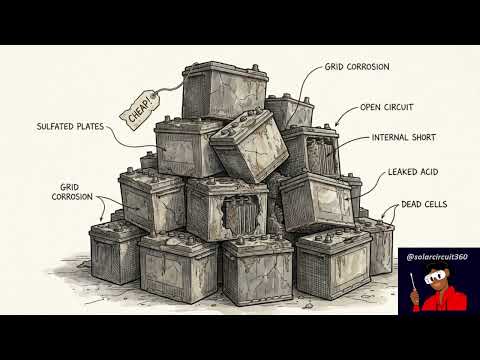
This analysis breaks down the true lifetime cost-per-kWh comparison between lead-acid and LiFePO4 batteries — exactly the calculation your customers need to see before making a purchasing decision.
Cost Analysis for Distributors and End-Users
Stationary battery storage costs have fallen dramatically. According to Ember Energy, all-in Battery Energy Storage System (BESS) projects now cost approximately $125/kWh as of late 2025, translating to a levelized cost of storage of around $65/MWh. This compares to $458/kWh just years prior, demonstrating the pace of cost reduction that is reshaping the competitive landscape between chemistries.
The LCOE formula that your team should be able to deploy in customer conversations:
Where:
Running this calculation with customer-specific inputs — local hardware prices, labor rates, expected cycling frequency — transforms abstract chemistry discussions into concrete financial decisions.

Section 6: Making the Right Choice for Your Customer Base
Assessment Framework for Distributor Decision-Making
Rather than recommending a chemistry based on what’s easiest to sell, build a structured assessment process that your sales team applies consistently. The following five-factor framework guides the recommendation:
Factor 1: Cycling Frequency — How many charge-discharge cycles per year does the application require? Daily residential use demands 350+ cycles per year; a seasonal backup system may need only 50–100. This single factor often eliminates lead-acid from high-cycling applications before any other evaluation is needed.
Factor 2: Climate Zone — What are the annual low temperatures at the installation site? Below -10°C regularly, LFP becomes the defensible choice for reliability. Hot climates above 35°C average require proper enclosure and thermal management for any chemistry, but LFP degrades significantly less than lead-acid in sustained high-heat environments.
Factor 3: Budget Structure — Is the customer evaluating upfront capital cost or lifecycle economics? If upfront cost is the genuine constraint (not a negotiating position), lead-acid or NiMH may be appropriate. If lifecycle ROI is the frame, LFP wins the analysis for almost every application lasting more than 5 years.
Factor 4: Maintenance Capacity — Does the customer have the infrastructure, personnel, and discipline to perform regular battery maintenance? In remote off-grid installations, flooded lead-acid maintenance requirements are often incompatible with the operational reality. Sealed AGM or LFP significantly reduce this risk.
Factor 5: Future Scalability — Will the system need to expand? LFP systems with modular architectures support clean capacity additions; lead-acid banks become increasingly difficult to expand as cells age and internal resistance diverges.
Regional Market Considerations
Market conditions vary dramatically across geographies, and a recommendation appropriate for a German residential market may be wrong for a Vietnamese agricultural application or a Chilean off-grid mining site.
In markets with established lithium supply chains (Western Europe, North America, Australia, Japan, South Korea), LFP should be your portfolio anchor — market familiarity, financing options, and installer knowledge support premium positioning.
In emerging markets with developing supply chains, lead-acid remains relevant for price-sensitive applications, but the trend is clear: as local lithium distributors establish themselves and project finance becomes more accessible, lead-acid market share shrinks reliably year over year.
In regions with extreme climate variation — continental climates with both hot summers and cold winters — LFP’s wider operating temperature range and smaller calendar-life climate sensitivity is a meaningful competitive advantage worth leading with in sales conversations.
Matching Battery Chemistry to Customer Needs — Quick Reference
| Customer Profile | Recommended Chemistry | Key Selling Point |
|---|---|---|
| Off-grid residential, mild climate, budget-sensitive | Lead-Acid AGM | Lowest upfront cost |
| Off-grid residential, cold climate, remote location | LFP | Cold performance + no maintenance |
| Daily-cycling urban residential with solar | LFP | Efficiency + 10-year life |
| Commercial facility, grid-tie, demand management | LFP | Cycle life + efficiency |
| Seasonal cabin, 100 days/year usage | Lead-Acid AGM or NiMH | Low cycle requirement |
| ESG-conscious institutional client | NiMH or LFP | Cobalt-free / low environmental footprint |
| Large commercial/industrial project | LFP (liquid-cooled) | Scalability + performance |
For industrial and commercial scale installations, the JMBiPV liquid-cooled L1000 energy storage system addresses the thermal management demands of high-density, high-cycling commercial deployments that standard air-cooled systems cannot reliably sustain.
Section 7: Sales Strategy and Customer Communication
How to Position Each Battery Type in Your Portfolio
The most effective distributor portfolios use a tiered structure that makes the value progression explicit — and frames each tier as a deliberate choice rather than a compromise.
Tier 1 — Entry Level (Lead-Acid AGM): Position as the “proven reliability at accessible cost” option. Lead with the 99% recycling rate, the established technology track record, and the lower upfront investment. Be transparent about the 50% DoD constraint and the maintenance calendar. Customers who understand and accept these constraints will be satisfied. Customers who don’t understand them will call your support line and leave negative reviews.
Tier 2 — Balanced Performance (NiMH): Position as “the cobalt-free middle path.” Lead with the ethical supply chain story, the longer service life versus lead-acid, and the competitive pricing. Be transparent about self-discharge limitations for seasonal applications.
Tier 3 — Premium Long-Term (LFP): Position as “the 15-year solution.” Lead with cycle life data, total cost of ownership calculations, and the DoD advantage. Use the LCOE formula to demonstrate that the premium tier is typically the lowest-cost choice over a 10-year horizon. This is where your margin opportunity is greatest, and where technical confidence in the sales conversation creates the most value.
Educational Content for Your Sales Team
The most common objection your team will encounter: “The lithium system costs twice as much.”
The most effective response isn’t a general claim about lithium being better. It’s a specific calculation: “For your daily load of X kWh, the lead-acid system needs a Y kWh nameplate bank at 50% DoD. The LFP system needs a Z kWh bank at 85% DoD. At current pricing, the hardware difference is [amount]. Over 10 years, accounting for one lead-acid replacement and the efficiency difference in daily operation, the LFP system costs approximately [amount] less per kWh delivered. Would you like to walk through the numbers for your specific system?”
That level of specificity — delivered calmly and supported by a printed or digital comparison — ends most price objection conversations. The customer either agrees with the math or reveals that upfront capital availability is the actual constraint, which opens a different conversation about financing or phased deployment.
Marketing Materials and Customer Resources
The educational content your team needs available for customer consultations includes a battery chemistry comparison chart (available for download), a simplified LCOE calculator (Excel-based, pre-configured for common system sizes), visual DoD infographics showing actual usable capacity versus nameplate capacity across chemistries, and installation case studies with documented performance data from commissioned projects.
For teams seeking to build this educational content library, the Jia Mao Bipv resource hub provides ongoing technical content covering system design, chemistry selection, and installation best practices — useful both for internal training and for content to share directly with customer contacts.
 Distributors who can walk customers through a detailed TCO analysis — rather than a simple price comparison — convert more consultations and build longer relationships.
Section 8: Future Trends and Emerging Technologies
The Evolution of Battery Chemistry
The battery chemistry landscape is moving faster than at any point since the commercialization of lithium-ion in the 1990s. Understanding the directional trends — even without knowing precisely which technologies will win — allows your team to position your business ahead of customer questions rather than behind them.
Solid-State Batteries replace the liquid electrolyte in conventional lithium-ion cells with a solid ionic conductor. This architectural change eliminates the primary flammability concern in lithium batteries, potentially enables higher energy density, and may significantly improve cycle life. Multiple manufacturers (Toyota, Samsung, QuantumScape) are targeting commercial production in the 2027–2030 range for automotive applications; stationary storage applications will follow. Costs are currently far above conventional LFP, but the trajectory is downward.
Sodium-Ion (Na-ion) Batteries use sodium rather than lithium as the charge carrier — a meaningful supply chain advantage given sodium’s global abundance and geographic diversity of sources. A May 2026 research breakthrough at the University of Maryland demonstrated solid-state sodium batteries capable of stable performance at room temperature, a significant milestone toward practical deployment. CATL, the world’s largest battery manufacturer, has already launched commercial sodium-ion products at prices competitive with LFP. For stationary storage where energy density is less critical than cost, sodium-ion is a credible near-term alternative worth monitoring.
Flow Batteries store energy in liquid electrolyte solutions held in external tanks, with the electrochemical reactions occurring in a central stack. Unlike conventional batteries, flow battery capacity scales independently of power rating — adding more electrolyte volume increases energy storage without changing the stack. The vanadium redox flow battery (VRFB) market reached $601 million in 2025 and is projected to grow at 23% CAGR to $3.1 billion by 2033. For long-duration storage applications (4–12 hours of discharge) at commercial and utility scale, flow batteries are increasingly competitive.
Cobalt-Free Lithium Chemistries are an active research priority across the industry, driven partly by ethical supply chain concerns and partly by cost reduction imperatives. High-nickel cathode formulations that reduce cobalt content to near-zero are entering production in 2025–2026. LFP is already cobalt-free by design — one of its structural advantages over NMC and NCA.
Market Projections and Growth Opportunities
According to IEA data, the global lithium-ion battery market exceeded $150 billion in 2025. The IEA’s Net Zero Emissions scenario projects battery storage rising 14-fold to 1,200 GW by 2030. In 2025, solar and storage accounted for 54% and 25% respectively of new generating capacity added to the U.S. grid — an unprecedented concentration that signals where the energy transition capital is flowing.
Battery prices are projected to continue their downward trajectory, with a further 50% cost reduction by 2030 forecast by multiple research institutions. The implications for distributors: LFP’s cost advantage over lead-acid will continue to compress the lead-acid market, while falling LFP prices will expand the addressable market for premium battery systems in price-sensitive regions.
Preparing Your Distribution Business for Change
The most defensible position for a solar battery distributor over the next 5 years is not chemistry loyalty — it’s application expertise. The distributor who knows which chemistry fits which application, has relationships with multiple manufacturers across chemistry types, and can commission and support diverse systems will capture market share regardless of which specific technology wins the next generation of the market.
Section 9: Technical Specifications and Installation Considerations
System Integration Requirements
Battery chemistry determines the technical requirements of the entire system it integrates with. Getting this right at the specification stage prevents the most expensive category of post-installation problems: component mismatch.
BMS (Battery Management System) Compatibility — Lead-acid systems require only basic charge voltage control; most quality MPPT charge controllers handle this natively without additional hardware. LFP systems require a BMS that monitors individual cell voltages, manages cell balancing, and can communicate with the charge controller and inverter — ideally via a standard protocol (CAN bus or RS-485). The hybrid inverter systems from Jia Mao Bipv are designed with broad battery communication compatibility, supporting seamless integration with major LFP BMS platforms.
Inverter and Charge Controller Specifications — The most critical compatibility check is battery voltage range. LFP 48V systems swing from approximately 43V (near-empty) to 58V (full charge). NMC systems have different voltage windows. Lead-acid 48V systems swing from approximately 44V to 57V. Every charge controller and inverter connected to the battery bank must specify compatibility across the full voltage range of the chosen chemistry — not just at nominal voltage.
Thermal Management and Cooling Solutions — For residential and small commercial LFP installations, passive air ventilation is typically sufficient, provided ambient temperatures don’t consistently exceed 35°C. Above that threshold — or for large commercial systems above 100 kWh where self-heating under high discharge currents becomes significant — active cooling (forced air or liquid cooling) becomes important for cycle life preservation. The operational temperature range of -20°C to 60°C claimed for LFP is real but optimistic at the extremes; sustained operation at 55–60°C will meaningfully reduce cycle life relative to operation at 25°C.
Installation Best Practices by Chemistry Type
For lead-acid installations, always verify ventilation adequacy before finalizing enclosure design. Flooded cells produce hydrogen gas during charging — a 1,000 Ah flooded lead-acid bank generates meaningful hydrogen volumes during equalization charging, which requires ventilation engineering rather than approximation.
For LFP installations, the BMS commissioning step is the most technically demanding — and the most frequently rushed. Proper BMS configuration (battery capacity setting, cell count, charge/discharge current limits, temperature thresholds) takes time, requires verification tools, and should be documented in the commissioning record. A misconfigured BMS can either underprotect the battery (leading to damage) or overprotect it (leading to nuisance disconnects that the customer experiences as system failure).
Maintenance and Support Protocols
| Task | Lead-Acid FLA | Lead-Acid AGM | NiMH | LFP |
|---|---|---|---|---|
| Electrolyte check | Monthly | N/A | N/A | N/A |
| Terminal inspection | Quarterly | Quarterly | Quarterly | Quarterly |
| Capacity test | Annually | Annually | Annually | Annually |
| BMS firmware update | N/A | N/A | Annually | Annually |
| Equalization charge | Every 2–3 months | Every 6 months | N/A | N/A |
| Full professional service | Annually | Annually | Every 2 years | Every 2–3 years |
The practical implication for your distribution business: LFP installations generate significantly less post-sale support burden than lead-acid, freeing your technical team’s time for new project commissioning rather than reactive maintenance calls. Over a portfolio of 50 active residential customers, the support time differential between an all-lead-acid and all-LFP customer base is measurable in months per year.
Section 10: Conclusion and Action Steps
Key Takeaways for Distributors and Agents
The solar battery market is not moving toward greater simplicity — it’s moving toward greater variety, at lower prices, with higher performance expectations from increasingly sophisticated buyers. The distributor who treats battery chemistry as an afterthought and recommends whatever is easiest to procure will lose ground every year to competitors who have made this knowledge a core competency.
The core conclusions from this analysis:
Lead-acid batteries remain relevant for specific, well-defined applications — but the economic case narrows annually as lithium prices decline. Sell lead-acid with clear documentation of its limitations, or your support team will pay the price in customer complaints.
LFP lithium is the correct recommendation for most daily-cycling solar storage applications when the evaluation horizon extends beyond 5 years. The upfront premium is real; the lifecycle economics are compelling; and the performance data from real-world deployments consistently validates the premium.
Nickel-based batteries occupy a genuine middle tier, with the cobalt-free supply chain story being their strongest commercial differentiator for ESG-conscious customer segments.
The technologies emerging over the next 5–7 years — solid-state, sodium-ion, next-generation flow — will create new market segments and displace some current ones. Building supplier relationships now across chemistry types, and investing in your team’s technical education, positions your business to adapt rather than react.
Building Your Winning Battery Strategy
Start with a portfolio audit: which chemistries do you currently stock, and which customer segments are you missing because of chemistry gaps? Map your current customer base against the assessment framework in Section 6. Identify the three most common application types you serve and verify that your recommended product for each aligns with the lifecycle economics analysis, not just the procurement price.
Then build the customer-facing materials that let your sales team have chemistry conversations with confidence: comparison charts, simplified LCOE calculators, and case study documentation from your best-performing installations. These assets compound in value with every customer conversation.
Ready to transform your solar product distribution business with deeper battery chemistry expertise?
Here’s your next step:
- 📊 Download the Battery Chemistry Comparison Guide — detailed specifications, installation checklists, and customer segmentation frameworks your team can use immediately
- 🔢 Access the interactive ROI calculator — pre-configured for lead-acid, NiMH, and LFP comparison across common residential and commercial system sizes
- 🤝 Connect with Jia Mao Bipv’s technical partner team at jmbipvtech.com to discuss distributor partnership programs, product portfolio consultation, and custom energy storage solutions for your market
- 📋 Explore the full product range — from residential LFP battery modules to commercial liquid-cooled storage systems and hybrid inverter platforms
- 🎓 Book a 15-minute strategy consultation with our solar energy specialists to optimize your battery portfolio and margin structure
Glossary of Key Terms
BMS (Battery Management System): Electronic system that monitors cell voltages, temperatures, and state of charge in a battery bank; manages cell balancing and enforces safety limits. Complexity scales from basic (lead-acid) to sophisticated (LFP/NMC).
Calendar Life: The total elapsed time a battery remains functional, regardless of how many cycles it has completed. A battery sitting on a shelf still ages.
Cobalt: A critical mineral used as a cathode material in NMC and NCA lithium batteries. Associated with supply chain ethics concerns due to mining conditions in the DRC. LFP and NiMH chemistries are cobalt-free.
Cycle Life: The number of complete charge-discharge cycles a battery can complete before capacity degrades to 80% of original rated value. Often specified at a particular DoD level.
DoD (Depth of Discharge): The percentage of a battery’s total capacity that has been used. A 100 Ah battery discharged to 50% DoD has used 50 Ah. Higher DoD ratings mean more usable energy per installed kWh.
LFP (Lithium Iron Phosphate): The dominant chemistry for stationary solar storage. Cobalt-free, thermally stable, long cycle life (5,000–10,000 cycles), and excellent safety profile.
LCOE (Levelized Cost of Energy): Total lifetime cost of a battery system divided by total kilowatt-hours delivered. The most comprehensive economic comparison metric for different battery chemistries.
NMC (Nickel Manganese Cobalt): A lithium battery chemistry offering higher energy density than LFP, used primarily in EVs. Contains cobalt and requires more sophisticated thermal management.
Round-Trip Efficiency (RTE): The ratio of energy discharged from a battery to energy charged into it, expressed as a percentage. LFP: 92–97%. Lead-acid: 70–85%.
Sulfation: The buildup of lead sulfate crystals on lead-acid battery plates, caused by chronic deep discharge or extended undercharge. The primary cause of premature lead-acid failure in solar applications.
Thermal Runaway: A self-reinforcing heat generation reaction in lithium batteries that can lead to fire. Far rarer in LFP chemistry than in NMC/NCA due to the superior thermal stability of the iron-phosphate bond.
Frequently Asked Questions (FAQ)
1. What is the most cost-effective battery option for budget-conscious customers?
Budget-conscious is not the same as lowest-upfront-cost — and the distinction matters for your customer relationships. Lead-acid AGM carries the lowest purchase price, typically $150–$250 per kWh of nameplate capacity, making it accessible for price-sensitive projects. However, at 50% practical DoD and 4–7 year service life, the cost per kWh delivered over 10 years typically runs $0.35–$0.42. LFP at 80–90% DoD and 10+ year service life runs $0.20–$0.27 per kWh delivered despite a 2–3× higher purchase price. For customers with access to project finance or who will hold the installation for more than 5 years, LFP is nearly always the more cost-effective solution. Lead-acid is most appropriate for short-horizon projects, pilot installations, and markets where upfront capital access genuinely constrains the decision.
2. How do I calculate the true total cost of ownership for each battery type?
The Levelized Cost of Energy (LCOE) calculation divides total lifetime costs by total energy delivered: . For a 10 kWh LFP system at $3,750 hardware + $600 installation, zero replacements, $150 maintenance over 10 years, delivering approximately 26,000 kWh over its life (at 80% DoD daily cycling), LCOE ≈ $0.17/kWh. The same usable capacity in AGM, requiring a 20 kWh nameplate bank, one replacement at year 5, and higher maintenance, delivers roughly 14,000 kWh at a total cost of $6,400 — or $0.46/kWh. Run this calculation with your customer’s specific system parameters using current local pricing.
3. Which battery chemistry performs best in extreme temperatures?
LFP consistently outperforms both alternatives across temperature extremes. At -20°C, LFP delivers 70–80% of rated capacity; AGM lead-acid delivers 50–60%. At sustained temperatures above 40°C, LFP degrades more slowly than lead-acid, which experiences accelerated electrolyte loss and plate corrosion above 35°C. NiMH occupies a middle position — better than lead-acid in cold, worse than LFP across all temperature extremes. For any installation in a climate with regular sub-zero winters or sustained 35°C+ summers, LFP is the only defensible chemistry recommendation.
4. What does depth of discharge mean, and why should my customers care?
Depth of Discharge (DoD) defines how much of a battery’s total capacity can be used in each cycle without causing accelerated aging. Think of it as the battery’s usable portion: lead-acid should not be discharged below 50% of its nameplate capacity; LFP can safely go to 80–95%. The practical consequence: a customer who needs 5 kWh of daily usable energy requires a 10 kWh lead-acid bank but only a 6.25 kWh LFP bank to accomplish the same job. Every dollar spent on battery hardware below the DoD floor delivers no usable energy — it’s capacity kept in reserve to protect the chemistry’s lifespan. When customers compare batteries on nameplate kWh alone, they’re comparing the wrong number.
5. Are lithium-ion batteries worth the higher initial investment for most solar applications?
For any application with daily cycling and a service horizon beyond 5 years, the answer from the data is yes. LFP batteries deliver 2–3× more cycles than AGM lead-acid at the same DoD, with 15–20% better round-trip efficiency and a service life that typically outlasts the solar panels they’re paired with. The upfront premium of $150–$250/kWh additional cost versus AGM is recovered through avoided replacement costs (typically one full bank replacement for lead-acid over a 10-year horizon), reduced maintenance labor, and energy recovered through higher efficiency. The scenario where lead-acid wins on total economics is narrow: very-low-cycling applications (fewer than 100 cycles per year), short evaluation horizons (under 4 years), or markets where lithium import costs significantly elevate the purchase price differential.
6. How should I advise customers about battery recycling and environmental impact?
Lead-acid carries the most mature recycling infrastructure with a 99% collection and recycling rate in the U.S. — the highest of any battery chemistry. New lead-acid batteries contain over 80% recycled material, according to EPA data. LFP recycling infrastructure is developing rapidly but not yet at this recovery rate; however, LFP’s longer lifespan means fewer total batteries consumed per decade of service. NiMH is cobalt-free and benefits from established recycling programs from its decades in hybrid vehicles. The most environmentally sound recommendation for most customers is LFP — not because of recycling, but because fewer total batteries consumed across a 15-year service horizon means less manufacturing energy and material consumption overall.
7. What’s the practical difference between flooded and sealed AGM lead-acid batteries?
Flooded lead-acid (FLA) uses liquid sulfuric acid electrolyte that requires periodic water replenishment — typically every 1–3 months under regular cycling. FLA batteries are cheaper, tolerate overcharging better, and generate slightly more energy than AGM in hot climates. But they require ventilated enclosures (hydrogen gas off-gassing), upright installation, and regular maintenance that many installation environments cannot support. AGM batteries immobilize the electrolyte in a fiberglass mat, eliminating liquid handling, enabling flexible installation orientation, and significantly reducing maintenance requirements. For most solar applications where a customer isn’t on-site to perform monthly maintenance, sealed AGM is the correct recommendation even at its higher purchase price.
8. Can different battery chemistries be mixed in one system?
No. Different chemistries operate at different nominal voltages, have different charge acceptance profiles, and respond differently to the same charge controller settings. Mixing LFP and lead-acid in a single bank, for example, means the LFP cells reach full charge while the lead-acid cells are still charging — triggering the BMS to disconnect the bank while the lead-acid cells are chronically undercharged, leading to sulfation and accelerated failure. Even mixing batteries of the same chemistry from different manufacturers is not recommended, as variations in internal resistance and capacity cause progressive imbalance under cycling. Keep battery banks homogeneous: same chemistry, same manufacturer, same model, and ideally same production batch.
9. How does temperature affect both efficiency and long-term lifespan?
The temperature-lifespan relationship follows a well-documented rule: for most battery chemistries, every 10°C increase in average operating temperature above the optimal range (typically 20–25°C) reduces calendar lifespan by 10–20%. A lead-acid battery rated for 7 years at 25°C may last only 4–5 years in a climate where the battery enclosure sustains 35°C through summer. Cold temperatures reduce available capacity temporarily but generally don’t accelerate permanent degradation — a battery that gets cold in winter and warms in summer ages primarily based on the time it spends at elevated temperatures. For customers in hot climates, thermal management of the battery enclosure — shading, ventilation, and in extreme cases active cooling — is not an aesthetic concern but a direct determinant of how long the system performs within warranty.
10. What warranty periods should customers expect for each chemistry?
Lead-acid AGM typically carries 2–5 year warranties, often including a prorated period after the full-replacement initial term. NiMH warranties typically run 5–8 years. LFP warranties in the commercial segment commonly specify 10-year terms with an 80% capacity retention guarantee — meaning the manufacturer commits that after 10 years and the equivalent of 3,650 daily cycles, the battery will still deliver at least 80% of its original rated capacity. A 10-year capacity retention warranty is qualitatively different from a 3-year replacement warranty: it transfers performance risk to the manufacturer rather than to your customer, which is a meaningful value proposition in high-stakes commercial and industrial deployments. Always read the fine print on capacity retention thresholds and cycle count conditions.
11. How do battery management systems differ in complexity across chemistries, and why does it matter to distributors?
Lead-acid systems require only a basic charge controller that limits voltage and current during charging — most quality MPPT controllers handle this without additional hardware. NiMH requires moderate cell-level monitoring for voltage balance and temperature. LFP requires a sophisticated BMS that monitors individual cell voltages (often 16 cells in a 48V pack), manages active or passive balancing, enforces temperature cutoffs for both charging and discharging, and communicates with the charge controller and inverter via digital protocols (CAN bus, RS-485, or Modbus). The practical implication: LFP systems take longer to commission correctly, require more technical training for your installation teams, and carry more opportunity for misconfiguration errors that manifest as nuisance disconnects or premature BMS trips. Distributors who invest in proper LFP commissioning training eliminate the most common post-installation support call category.
12. What’s the difference between cycle life and calendar life, and which limits my customer’s system first?
Cycle life measures how many charge-discharge cycles a battery can complete before capacity degrades to 80% of original — typically specified at a given DoD. Calendar life measures elapsed time regardless of use. An LFP battery rated for 5,000 cycles at 80% DoD has a cycle life equivalent to 13.7 years of daily use. But its calendar life — the absolute time it remains functional — is typically 10–15 years. In a daily-cycling residential application, calendar life is typically the binding constraint for LFP; cycle life is usually what limits lead-acid in daily-cycling applications. For low-use backup systems (fewer than 200 cycles per year), calendar aging may exhaust a battery’s service life before its cycle count is reached — making calendar life the more relevant specification for that application type.
13. Should different battery chemistries be recommended for grid-connected versus off-grid systems?
Grid-connected systems with battery backup (hybrid systems) can technically use any chemistry, but LFP is strongly preferred. The rationale: hybrid systems often participate in time-of-use arbitrage, cycling the battery multiple times per day to shift energy from low-price to high-price periods. A battery that cannot sustain 1–2 cycles per day over 10 years — which eliminates most lead-acid and NiMH options — is not suited for active grid arbitrage. Off-grid systems are more forgiving of chemistry selection because they typically cycle once per day and don’t require the peak-performance reliability that grid services demand. That said, LFP remains the preferred choice for off-grid systems in remote locations where battery failure has serious consequences and replacement logistics are complex.
14. How do I explain round-trip efficiency to customers without engineering backgrounds?
Use the “energy tax” framing: “Every time energy goes into the battery and comes back out, a portion is lost as heat. Think of it as a tax on every kWh you store. Lead-acid batteries charge a 15–30% tax on every kWh — so if your solar panels generate 10 kWh on a good day, you only get 7–8.5 kWh back from the battery to use. Lithium batteries charge a 5–10% tax, so you get 9–9.5 kWh back. Over a year, that 10–20% efficiency difference on a 10 kWh daily system adds up to 700–1,000 kWh of recovered energy — roughly equivalent to several weeks of household electricity consumption.” This framing makes the efficiency difference tangible without requiring the customer to understand electrochemistry.
15. What’s the impact of partial charging cycles on battery lifespan, and how should customers manage this?
Partial cycling — charging and discharging without reaching the full range of the battery’s SoC — is actually beneficial for LFP lifespan. Cycling between 20% and 80% SoC, rather than 0% to 100%, substantially reduces stress on the electrode materials and extends cycle life significantly. This is why well-designed BMS systems often set charge cutoff at 95% rather than 100%, and discharge cutoff at 10–15% rather than 0%. The misconception to address with customers: many assume that “using the full battery” maximizes value. In practice, the battery that always cycles between 20% and 80% will outlast the one that’s regularly drained to empty and charged to maximum, delivering more total energy over its extended service life. Educating customers on appropriate cycling habits is one of the highest-value post-sale service touchpoints a distributor can provide.
For technical specifications, distributor partnership inquiries, and custom energy storage system design, contact the Jia Mao Bipv technical team. Explore the full product range — from residential LFP battery modules to commercial liquid-cooled storage and hybrid inverter systems — built for the demands of professional solar distribution.
Additional authoritative references: IEA Battery Storage Report | SEIA Solar & Storage Data | NFPA 855 Energy Storage Standard | BloombergNEF Battery Price Survey