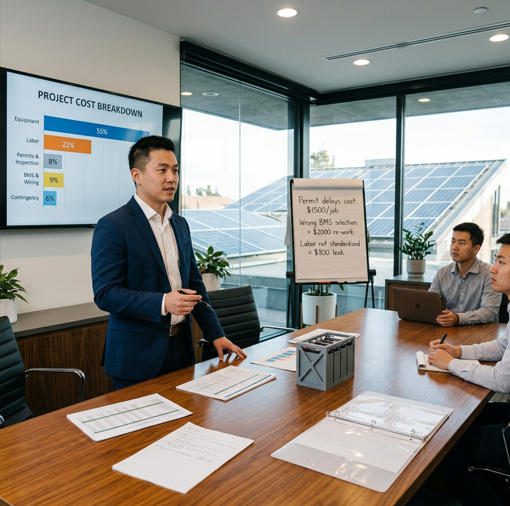
A Comprehensive Guide for Solar Distributors and Agents to Understand True ROI and Margin Implications
 The installation is only the beginning. The costs that follow are what most retailers never put on paper.
The Margin Problem Nobody Talks About
The U.S. residential energy storage market installed 3.1 GWh of new capacity in 2025 alone — a 51% year-over-year increase (SEIA). Business is booming. Yet across distribution networks, a quiet profitability crisis is unfolding.
Distributors who price on hardware margin alone are bleeding money on every installation. They’re quoting $15,000 jobs and netting $800. They’re fielding warranty calls on projects that never accounted for servicing costs. They’re watching customers churn because “the payback period wasn’t what you promised.”
The culprit, in nearly every case, is the same: hidden costs — the 30–50% of true project cost that never appears on the initial quote because nobody in the supply chain is incentivized to surface it.
This guide is not written for end consumers. It’s written for solar distributors, agents, contractors, and resellers who need to know exactly where their margins go, how to price transparently, and how to build a business model that survives the full lifecycle of a battery installation — not just the sale day.
Glossary: Key Terms Used in This Guide
- BMS (Battery Management System): The electronic system that monitors and protects battery cells — controlling charge/discharge rates, temperature, and cell balancing.
- AHJ (Authority Having Jurisdiction): The local body responsible for approving and inspecting electrical installations.
- BOS (Balance of System): All components in a solar-plus-storage installation beyond the panels and battery — wiring, conduit, disconnects, inverters, etc.
- TOU (Time-of-Use): A utility pricing structure where electricity costs vary by time of day, making battery optimization financially valuable.
- NABCEP: North American Board of Certified Energy Practitioners — the industry’s primary installer certification body.
1. The Installation Labor Cost Reality
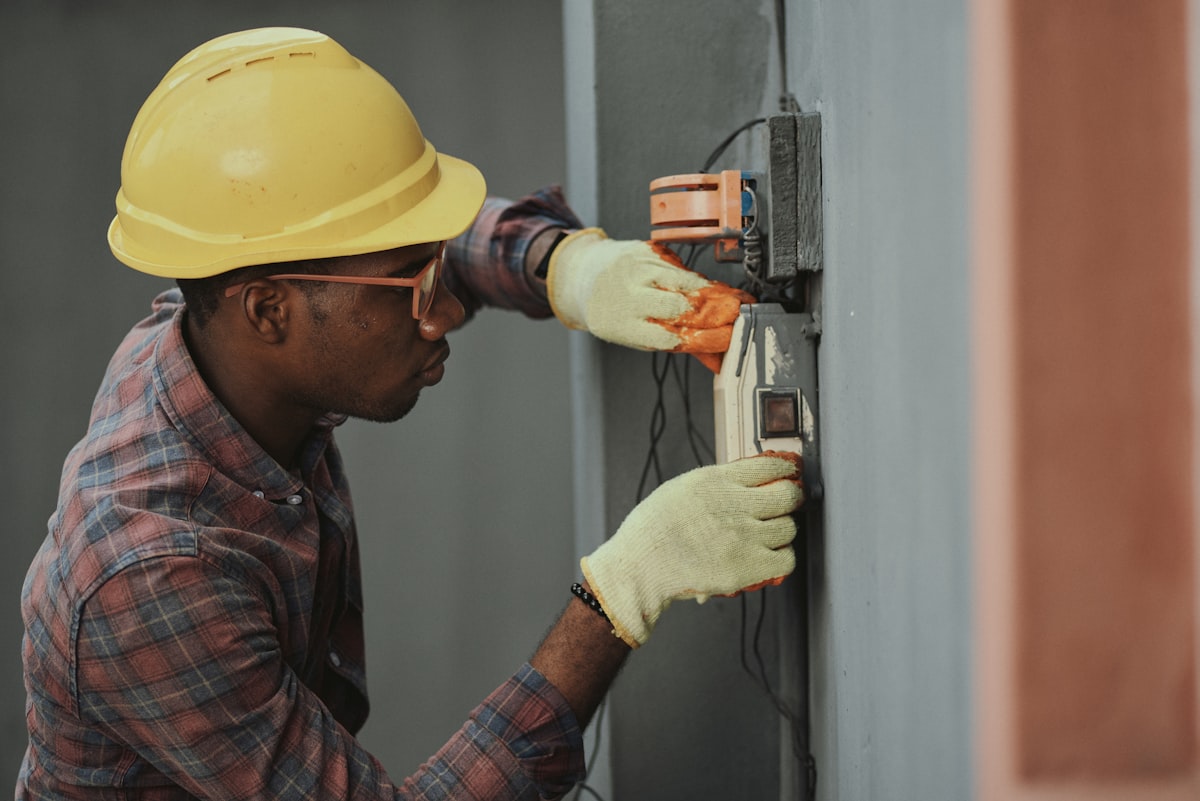
Why Installation Labor Is Your Biggest Hidden Expense
Labor is the cost that walks off the job site every evening and never appears on a manufacturer’s datasheet. Yet across the industry, installation labor represents 20–40% of total project costs — and in complex urban installations, that number pushes past 45%.
The disconnect is structural. Distributors often price from hardware costs outward, applying a standard margin and assuming labor is “someone else’s problem” — the installer’s. But when your distribution agreement includes any form of installation guarantee, service promise, or performance warranty, labor variability becomes your problem the moment something goes wrong.
A California electrician working in the Bay Area commands $85–$120/hour for solar-qualified labor. A technician in rural Tennessee may bill $45–$65/hour. For a project requiring 16 hours of installation labor, that regional disparity produces a $640–$880 cost swing — before a single battery cell is connected.
Understanding Labor Rate Variations by Region
The data from Angi’s 2026 installation cost research is instructive: solar installation labor is currently billed at $50–$100 per hour depending on region, or $0.50–$1.00 per watt on panel-inclusive projects. Battery storage adds a separate, non-trivial labor component that many quotes simply absorb into a round number without tracking.
Consider what this means across a typical month for a mid-sized distributor handling 15 installations:
| Region | Electrician Rate ($/hr) | Estimated Labor Hours (Battery Install) | Labor Cost per Project | 15-Project Monthly Labor Total |
|---|---|---|---|---|
| Northeast (Urban) | $95–$120 | 14–22 hrs | $1,330–$2,640 | $19,950–$39,600 |
| Southeast (Suburban) | $60–$80 | 12–18 hrs | $720–$1,440 | $10,800–$21,600 |
| Midwest (Rural) | $45–$65 | 10–16 hrs | $450–$1,040 | $6,750–$15,600 |
| West Coast (Urban) | $85–$115 | 16–24 hrs | $1,360–$2,760 | $20,400–$41,400 |
That table illustrates a $13,200–$25,800 monthly labor cost spread for the same number of installations in different regions. If your pricing model uses a national average, you are either overpriced in low-cost markets or losing money in high-cost ones.
Complexity Factors That Inflate Labor Hours
In real-world installations, a straightforward 8-hour estimate routinely doubles. The reasons are predictable — but only if you’ve been burned by them before:
Battery placement logistics in tight spaces (attics, crawl spaces, detached garages) add 2–4 hours per installation. Structural modifications required to mount heavier battery systems on concrete or metal surfaces add 1–3 hours. Properties with sub-panels, split services, or 100-amp main panels that weren’t fully assessed during the site visit generate surprise work orders the day of installation. Every hour of unplanned labor is revenue you already spent in your quote.
The practical fix is a site assessment checklist completed before every quote — not after the deposit clears. Distributors who implement a structured pre-installation site audit consistently report labor cost variance dropping from ±35% to ±12% across their project portfolios.
2. Permit and Compliance Fees That Eat Into Margins
The Permit Landscape: What Retailers Commonly Overlook
Permits are not optional. They are legally required, AHJ-enforced prerequisites for every grid-connected battery installation. Yet in surveying distributor pricing across multiple states, a consistent pattern emerges: permit costs are either bundled into an undifferentiated “installation fee” line item, or not quoted at all until the project is already sold.
The result is a cost that lands as a surprise — reducing profitability by 5–15% per installation depending on jurisdiction — or worse, a permit that gets skipped and creates liability exposure when a future home inspection or insurance claim uncovers an unpermitted electrical system.
As GreenLancer’s permit cost research confirms, most residential solar inspections run $100–$300 per inspection, though some jurisdictions bundle these into the permit cost. The permit itself, depending on system capacity and local fee structures, can range from $400 to $2,500+ in high-regulation markets like Los Angeles, Honolulu, or New York City.
Breaking Down Permit Types and Associated Costs
A single battery storage installation may require multiple, separately-applied-for permits. Each carries its own application fee, processing timeline, and inspection requirement:
| Permit/Approval Type | Typical Cost Range | Processing Time |
|---|---|---|
| Electrical Permit | $200 – $800 | 1–3 weeks |
| Building Permit (structural mods) | $300 – $1,200 | 2–4 weeks |
| Utility Interconnection Agreement | $0 – $500 | 2–8 weeks |
| Fire Department Review (large systems) | $150 – $600 | 1–4 weeks |
| Post-Installation Inspection | $75 – $250 | Scheduled after install |
| Total Range Per Project | $725 – $3,350 | Up to 8 weeks |
That timeline column is as financially significant as the cost column. A project held in permit limbo for six weeks ties up installer capacity, delays customer activation, and — if the battery is already on-site — incurs storage costs.
Inspection and Certification Expenses
Third-party inspections and equipment certifications add another layer. UL 9540 certification — the standard for energy storage systems, required by most AHJs — must be confirmed for every battery product you stock. If a customer’s local fire marshal requires documentation of UL 9540A testing (the component-level fire propagation test), and your product lacks it, the project stops.
For distributors sourcing internationally or stocking emerging brands, verifying certification status before purchase order is a non-negotiable due-diligence step. At Jia Mao BIPV, certification documentation — including UL, ETL, and IEC standards — is a standard part of the product onboarding package precisely because AHJ approval delays are the single largest cause of installation timeline overruns in the U.S. market.
3. Battery Management Systems (BMS): The Unbudgeted Technology
What Battery Management Systems Actually Cost
The BMS (Battery Management System) is the brain of every battery installation. It monitors individual cell voltages, controls charge and discharge rates, manages thermal behavior, and protects against overcharge, deep discharge, and short circuits. Without it, a lithium battery is a liability. With a substandard one, it’s a warranty claim waiting to happen.
Despite its critical role, BMS costs are routinely either assumed to be “included” in the battery price (sometimes true, often not) or simply not tracked as a separate line item in project accounting. The BMS market is projected to grow from $9.3 billion in 2025 to $37.1 billion by 2035 (Roots Analysis) — driven precisely by increasing system complexity and the need for more sophisticated cell management in multi-battery, hybrid-grid installations.
For residential and light commercial installations, BMS costs break down across two categories:
Hardware and Software Licensing Fees
Standalone BMS hardware for a quality residential installation runs $2,000–$8,000 depending on system size, brand, and whether the unit is embedded in the battery or sold as a separate component. Many premium battery systems (EG4, BYD, Pylontech) include integrated BMS in the battery pack price — but the integration with the inverter and monitoring platform is a separate configuration cost.
Software licensing for cloud-based BMS management platforms — which provide remote monitoring, over-the-air firmware updates, and performance analytics — typically costs $100–$500 per system annually. For a distributor managing 200 active customer installations, that recurring expense ranges from $20,000–$100,000 per year — a number that rarely appears in the original business plan.
| BMS Cost Component | Typical Range | Frequency |
|---|---|---|
| Hardware (standalone or upgrade) | $2,000 – $8,000 | One-time per install |
| Software / cloud platform license | $100 – $500 | Annual recurring |
| Initial configuration labor | $300 – $800 | One-time per install |
| Firmware updates / reconfiguration | $150 – $400 | Every 1–2 years |
| BMS replacement (failure) | $800 – $3,500 | Situational |
Integration Complexity and System Compatibility Issues
The most expensive BMS costs are often the integration costs that emerge when the battery brand, inverter brand, and monitoring platform weren’t engineered to work together. An EG4 battery paired with a Victron inverter and a SolarEdge monitoring portal — a combination that exists in the real world — requires a qualified technician to configure communication protocols, verify data handshakes, and often write custom parameter files.
That integration work typically adds 10–20 hours of specialized technician labor per installation. At $80–$120/hour for a competent systems integrator, that’s $800–$2,400 per project that appears nowhere in a standard installation quote.
4. Electrical Infrastructure Upgrades and Panel Work
 The panel upgrade conversation is the one most distributors dread — because most didn’t budget for it in the quote.
When Home Electrical Systems Require Costly Modifications
Here is a number that should reshape how your sales team conducts site assessments: approximately 40–60% of residential battery installations require at least one electrical infrastructure upgrade before the system can be safely and legally installed.
America’s housing stock is old. The National Association of Home Builders estimates a median housing age of 40+ years in many urban markets. A home built in 1975 with a 100-amp service panel and aluminum branch wiring is not ready for a 10 kWh battery system that draws 5 kW of continuous power without significant electrical preparation.
The customers who are most attracted to solar battery storage — homeowners with high energy bills, frequent outages, or existing solar systems — often live in exactly these older homes.
Main Panel Upgrades and Service Disconnects
A main electrical panel upgrade from 100A to 200A service is the most common infrastructure requirement, and it is also the most consistently underquoted cost in the distribution channel. Real-world pricing from Reddit’s solar community and independent electricians puts panel upgrades at:
In some cases — particularly in New York, Massachusetts, and California — the utility requires a new meter socket, upgraded service entrance conductors, and a new main disconnect as part of the upgrade, pushing the total above $6,000 before the battery installation even begins.
| Electrical Upgrade Type | Typical Cost | Frequency in Field |
|---|---|---|
| 100A → 200A Panel Upgrade | $1,500 – $5,000 | ~40–60% of installs |
| Service Entrance Conductor Replacement | $800 – $2,500 | ~20–30% of installs |
| New Dedicated Battery Circuit | $400 – $900 | ~70–80% of installs |
| Grounding System Upgrade | $300 – $800 | ~15–25% of installs |
| Transfer Switch / Manual Disconnect | $600 – $1,500 | Required for backup systems |
| Sub-panel Addition | $900 – $2,500 | ~10–20% of installs |
Wiring, Conduit, and Safety Equipment Installation
Beyond the panel, every installation requires conduit runs, wire pulls, terminal connections, and safety disconnects that scale with physical distance between the battery, inverter, and main panel. A battery installed in a garage 40 feet from the main panel requires substantially more material and labor than one mounted directly adjacent.
These material costs — conduit, wire, connectors, disconnect enclosures, conduit fittings — often add $400–$1,800 per installation in materials alone, plus the labor to install them. They are rarely line-itemed in distributor quotes, instead absorbed into a round-number “installation fee” that provides no margin visibility.
5. Maintenance and Ongoing Service Costs
The True Cost of Battery Ownership Over 10–20 Years
Every distributor’s pitch deck shows a 10-year ROI curve. Almost none of them include the service costs that occur between installation day and year ten. The batteries don’t ask for oil changes, but they do require consistent attention to remain safe, efficient, and warranty-compliant.
The industry insight that experienced distribution partners already know: the quality of post-installation service is the primary driver of customer referrals in the solar storage segment. A customer whose 13 kWh battery quietly degraded from 13 kWh to 9.2 kWh over four years without a service visit, software update, or proactive notification is not writing you a Google review. They’re filing a warranty claim and posting in a Facebook group.
Preventive Maintenance Schedules and Associated Labor
A responsible preventive maintenance (PM) program for a residential battery installation includes:
- Annual physical inspection of terminals, connections, and enclosure integrity
- Firmware and BMS software updates (often requiring on-site technician access)
- Thermal management system check (particularly for outdoor or non-climate-controlled installations)
- Battery capacity test and degradation benchmarking
- Inverter output verification and string performance check
That program requires 4–8 hours of technician time annually, billed at $60–$150/hour depending on region. The total annual maintenance cost per customer: $400–$1,200/year — a recurring revenue opportunity if you’ve built it into your service contract model, and a margin drain if you haven’t.
| Maintenance Item | Frequency | Time Required | Annual Cost |
|---|---|---|---|
| Physical Inspection | Annual | 1–2 hours | $90 – $300 |
| Firmware / BMS Update | Annual | 1–2 hours | $90 – $300 |
| Thermal Management Check | Annual | 0.5–1 hour | $45 – $150 |
| Capacity Benchmarking | Annual | 1–2 hours | $90 – $300 |
| Inverter Performance Check | Annual | 1–1.5 hours | $90 – $225 |
| Annual Total | 4–8.5 hours | $405 – $1,275 |
Warranty Claims, Repairs, and Battery Replacement Scenarios
Battery failures during the warranty period create costs that your warranty terms may not fully absorb. Labor to remove and reinstall a failed battery pack is rarely covered by manufacturer warranties — only the hardware replacement is. A failed 14 kWh battery requiring removal, return logistics, replacement delivery, and reinstallation generates $800–$2,500 in unrecovered labor and logistics costs, entirely separate from the replacement unit.
Inverter failures — statistically more common than battery cell failures in the 5–10 year window — cost $1,500–$4,500 per incident including the replacement unit and labor. BMS failures run $800–$3,500. For a distributor carrying any form of installation guarantee, these costs must be actuarially modeled into your warranty provision, not absorbed ad hoc from cash flow.
6. Shipping, Handling, and Logistics Costs
The Supply Chain Expenses Retailers Rarely Quantify
Lithium-ion batteries are, from a logistics perspective, among the most regulated cargo categories in existence. The PHMSA (Pipeline and Hazardous Materials Safety Administration) classifies large-format lithium batteries as Class 9 hazardous materials — requiring specific packaging standards, carrier certifications, and documentation that standard freight providers neither offer nor charge competitive rates for.
For distributors sourcing batteries from manufacturers — whether domestic brands like EG4 and BigBattery, or international suppliers — the gap between “standard shipping cost” and “actual delivered cost” is consistently 15–25% wider than buyers expect.
Freight and Hazmat Shipping Premiums
A 14 kWh battery system (approximately 120–180 kg) shipped from a U.S. distribution point to a job site can cost:
| Shipping Scenario | Standard Freight Quote | Actual Hazmat Cost | Premium |
|---|---|---|---|
| Regional (under 300 miles) | $180 – $300 | $220 – $420 | ~22–40% |
| Interstate (300–1,000 miles) | $350 – $600 | $500 – $850 | ~30–42% |
| Cross-country (1,000+ miles) | $600 – $1,000 | $900 – $1,500 | ~40–50% |
| Liftgate + Inside Delivery | Add $100 – $200 | Required for most residential | — |
That liftgate requirement is consistently overlooked. A 120 kg battery pallet cannot be hand-rolled off a standard freight truck. Liftgate delivery costs $100–$200 extra and is required for virtually every residential job site.
Storage, Warehousing, and Inventory Management
Distributors who stock battery inventory to reduce lead times — a competitive necessity in markets where 6–8 week manufacturer lead times lose deals — absorb real warehousing costs that erode margin in ways that don’t appear on project invoices.
Conservative warehousing cost benchmarks for battery storage inventory:
A distributor carrying 10 units of battery inventory at any given time absorbs $500–$2,000/month in storage costs before a single sale. Annualized, that’s $6,000–$24,000 in overhead that must be distributed across project pricing or absorbed as a fixed cost. Neither approach is visible in a standard project quote.
7. Warranty, Insurance, and Liability Protection
📺 Recommended Viewing: How to Sell Battery Storage in 2025 — Webinar Replay
{% youtube IoYeGV6xRfw %}
This Fortress Power webinar covers the full business model for solar + storage distributors, including service models, warranty structuring, and recurring revenue strategies. Required viewing for distribution teams building scalable battery businesses.
Protecting Your Business: The Insurance and Warranty Gap
Battery storage installations create liability exposure at every stage: during transport, during installation, during operation, and during decommissioning. The industry average insurance cost for solar installers ranges from $3,000–$10,000+ annually in combined coverage — and most operators carry it without specifically pricing it into their per-project margin calculations.
That insurance premium is a real cost of doing business in this category. It is also not optional: a single electrical fire, battery thermal runaway event, or customer injury during installation can generate claims that dwarf an entire year’s revenue without adequate coverage.
Extended Warranty Programs and Performance Guarantees
When distributors offer extended warranties — or when manufacturers require you to service their warranty claims through your network — the cost structure deserves explicit modeling. Standard industry benchmarks:
| Warranty Offering Type | Cost as % of System Value | For a $15,000 System |
|---|---|---|
| 1-Year Workmanship Warranty | 1–3% (labor reserve) | $150 – $450 |
| Extended 5-Year Parts + Labor | 5–8% | $750 – $1,200 |
| Performance Guarantee (10-year) | 8–12% | $1,200 – $1,800 |
| Full Replacement Program | 10–15% | $1,500 – $2,250 |
These costs must be reserved at point of sale, not funded from future revenue. Distributors who treat warranty costs as contingent liabilities — assuming few claims will materialize — are building a deferred expense bomb that detonates when their installed base matures.
Liability Insurance and Risk Management Costs
The specific coverage lines relevant to solar battery distributors and installers include:
General liability ($1–$2M coverage): $1,200–$3,500/year Product liability (for stocked battery products): $800–$2,500/year Workers’ compensation: $1,500–$5,000/year depending on payroll and state Commercial auto (for installation vehicles): $1,800–$4,200/year Professional liability / E&O: $900–$2,500/year
Combined annual insurance cost: $6,200–$17,700 for a mid-sized operation — representing 2–5% of annual revenue for a distributor closing $350,000/year in installations.
8. Training, Certification, and Technician Development
Investing in Expertise: The Often-Forgotten Cost
In the solar storage industry, technician quality is not just a quality-of-work variable — it’s a safety variable. An improperly installed high-voltage battery system is a fire risk, an electrocution risk, and a warranty void. The cost of inadequately trained technicians is not measured in lower hourly rates. It’s measured in callbacks, warranty claims, AHJ re-inspections, and — in worst cases — incident reports.
NABCEP certification — the North American Board of Certified Energy Practitioners’ solar PV installer credential — is the industry benchmark. Their published fee schedule confirms PV Installer Specialist exam fees at $125–$375 depending on pathway, but the real cost of certification includes the preparatory coursework, study materials, and time investment that collectively run $1,000–$5,000 per technician.
Initial Certification Programs and Continuing Education
| Training Investment | Cost Range | Frequency |
|---|---|---|
| NABCEP PV Installer Certification | $800 – $2,500 (prep + exam) | One-time + renewal every 3 years |
| Manufacturer-Specific Training (e.g., EG4, BYD) | $300 – $1,500 | Per product line |
| OSHA 10 / OSHA 30 Safety | $150 – $350 | Required renewal every 4 years |
| NEC Code Updates Course | $200 – $500 | Every code cycle (3 years) |
| Battery-Specific Safety Training | $400 – $1,200 | Annual recommended |
| Annual Per-Technician Total | $1,000 – $5,000 | Ongoing |
For a team of five technicians, that annual training investment runs $5,000–$25,000 — a real cost of workforce development that most pricing models treat as zero.
Productivity Loss During Training Periods
When a technician is in a training classroom, they are not on a job site. That productivity gap costs real money:
At $200–$500 of daily revenue contribution per technician (conservative estimate for a project-based installer), 5–10 training days per year per technician costs $1,000–$5,000/year per person in foregone revenue — an opportunity cost that never appears on a training invoice but is entirely real.
9. Monitoring, Optimization, and Customer Support Systems
The Hidden Cost of Keeping Customers Satisfied
A solar battery customer who never hears from you after installation day is a customer who will define their experience by the one problem they eventually encounter — and that problem will feel unmanaged, even if the system is technically performing within spec.
The distributors achieving the highest customer lifetime value in the energy storage space share a common operational feature: they’ve invested in monitoring infrastructure that gives them visibility into every active installation, enabling proactive outreach before customers notice a problem. That infrastructure costs real money — money that pays dividends in referrals and reduces warranty claim rates, but money nonetheless.
Remote Monitoring Platform Subscriptions and Infrastructure
Quality monitoring platforms for solar + storage systems — platforms like Solar Analytics, AlsoEnergy, Generac’s PWRview, or EG4’s native monitoring portal — carry per-system subscription costs that build into significant recurring expense at scale:
| Platform Tier | Per-System Monthly Cost | Per-System Annual Cost | 100-System Annual Cost |
|---|---|---|---|
| Basic (data logging only) | $10 – $25 | $120 – $300 | $12,000 – $30,000 |
| Standard (alerts + reporting) | $25 – $50 | $300 – $600 | $30,000 – $60,000 |
| Premium (predictive analytics + API) | $50 – $100+ | $600 – $1,200 | $60,000 – $120,000 |
For a distributor with 100 active installations, monitoring platform costs alone represent $12,000–$120,000 annually — a cost that must be built into either a recurring service contract fee or distributed across project margins.
Customer Support and Troubleshooting Resources
The support conversation that solar distributors rarely have internally: what does it actually cost to answer the phone when a customer’s battery isn’t working at 11pm during a grid outage?
Providing responsive technical support across a growing installed base requires staffed support capacity, ticket management systems, technical documentation libraries, and escalation pathways to manufacturer support teams. For established operations handling 200+ active installations:
- Dedicated technical support staff: $5,000–$15,000/month in fully-loaded labor
- Helpdesk and CRM software: $200–$800/month
- Documentation and knowledge base maintenance: $500–$1,500/month
- Escalation coordination with manufacturers: Absorbed in time, not invoiced
Total support infrastructure: $5,700–$17,300/month for a 200-system portfolio — averaging approximately $28.50–$86.50 per system per month in support overhead.
10. Marketing, Sales, and Customer Acquisition Costs
The True Cost of Building Your Solar Battery Business
Customer acquisition in the solar battery space is expensive, competitive, and becoming more so. The residential energy storage market’s growth — 51% year-over-year in 2025 — has attracted not just new customers but new competitors, driving up the cost of every qualified lead.
Distributors and agents who sell direct to homeowners through installer networks face a cost structure that few marketing budgets fully reflect. Digital lead generation in the solar category currently runs $50–$200 per click on competitive keyword terms (Google Ads data), with conversion rates from click to closed customer of 1–4% across the industry.
Digital Marketing, Lead Generation, and Sales Infrastructure
| Channel | Monthly Cost Range | Qualified Leads Generated | Cost per Qualified Lead |
|---|---|---|---|
| Google Ads (PPC) | $2,000 – $8,000 | 15–60 | $133 – $533 |
| Facebook/Meta Advertising | $1,000 – $4,000 | 20–80 | $50 – $200 |
| SEO / Content Marketing | $1,500 – $5,000 | 10–40 (organic) | $37 – $500 |
| Trade Shows & Events | $3,000 – $15,000/event | 30–100 | $100 – $500 |
| Installer Referral Programs | $200 – $500/referral | Variable | $200 – $500 each |
Closing rate from qualified lead to signed contract: typically 15–30% in the current market. That means each closed customer required 3–6 qualified leads, at a combined acquisition cost of $400–$3,000 per closed installation depending on channel mix.
Training Sales Teams and Managing Customer Expectations
The less-quantified sales cost is the internal investment required to equip a sales team to have technically credible conversations about battery storage. A salesperson who can’t explain BMS functionality, answer questions about warranty terms, or discuss the TOU optimization strategy for a specific utility rate plan is a salesperson losing deals to better-prepared competitors.
Building that competency costs:
- Sales training program development: $3,000–$10,000 one-time
- Ongoing product education: $500–$2,000/month in team time
- Sales collateral (ROI calculators, comparison sheets, case studies): $2,000–$8,000 initially
- CRM and sales pipeline management: $200–$800/month
These costs are real, recurring, and rarely tracked in the margin analysis that follows each completed installation.
Recalculating Your True ROI and Pricing Strategy
How to Use This Information to Improve Your Margins and Customer Relationships
The costs documented in this guide are not arguments against the solar battery business. They are arguments for running it with open eyes and accurate numbers.
The total hidden cost burden across these ten categories — labor variability, permits, BMS integration, electrical upgrades, maintenance, logistics, warranty, training, monitoring, and acquisition — routinely adds 30–50% to the baseline hardware cost of a residential battery installation. On a $15,000 hardware project, that represents $4,500–$7,500 in costs that exist whether or not they appear on your quote.
Distributors who surface these costs in their pricing models and service contracts achieve three things simultaneously: they protect their margins, they set realistic customer expectations that reduce warranty claims, and they differentiate their business from competitors who race to the lowest headline price and then make it up with poor service.
The solar battery market is not slowing down. SEIA’s data confirms that 2025 was the fifth consecutive year the U.S. solar market set a capacity record. The distributors who will thrive in the next five years are those building businesses on full-cost accounting, transparent customer communication, and service infrastructure that makes their installed base an asset rather than a liability.
Summary: The Hidden Cost Stack
TOTAL HIDDEN COST BREAKDOWN (Typical $15,000 Hardware Project)
Labor Variability Buffer (+35% baseline) ████████████████████ $1,800 – $4,200
Permit & Compliance Fees ████████░░░░░░░░░░░░ $725 – $3,350
BMS Integration & Software ██████░░░░░░░░░░░░░░ $2,300 – $9,300/yr*
Electrical Infrastructure Upgrades ██████████░░░░░░░░░░ $1,500 – $6,000
Annual Maintenance (per year) ████░░░░░░░░░░░░░░░░ $405 – $1,275/yr
Shipping & Logistics Premium ████░░░░░░░░░░░░░░░░ $300 – $1,700
Insurance & Warranty Reserve ████░░░░░░░░░░░░░░░░ $750 – $2,250
Training & Certification (amortized) ███░░░░░░░░░░░░░░░░░ $400 – $1,500
Monitoring Platform (annual) ███░░░░░░░░░░░░░░░░░ $240 – $1,200/yr
Customer Acquisition Cost ████░░░░░░░░░░░░░░░░ $400 – $3,000
TOTAL FIRST-YEAR HIDDEN COST RANGE: $8,820 – $33,775
% of $15,000 Hardware Cost: 59% – 225%
BMS integration includes one-time hardware + first year software
Industry Insight: The distributors consistently achieving 22–28% net margins in solar storage (versus the industry median of 11–15%) are not cutting hardware costs. They are running explicit cost-accounting models for every project category, maintaining service contract revenue from their installed base, and pricing labor regionally rather than nationally.
Your Next Steps as a Distributor or Agent:
For detailed product specifications, distribution partnership terms, and technical documentation that supports your permit and AHJ approval process, visit Jia Mao BIPV’s product portal at jmbipvtech.com. For broader market benchmarking, SEIA’s annual market research and EnergySage’s battery cost database are the two most reliable public references for staying current on pricing trends.
For permit documentation best practices and AHJ approval workflows, GreenLancer’s solar permitting resource center provides detailed, jurisdiction-specific guidance that your installation team should reference before every new market entry.
Frequently Asked Questions (FAQ)
This FAQ section is structured to address the most common decision-making questions from solar distributors, agents, and contractors — and to support generative search engine visibility for the hidden costs topic.
FAQ 1: What percentage of total project costs should I allocate to installation labor?
Installation labor typically represents 20–40% of total project costs in residential battery installations, and can reach 45–50% in complex urban environments or properties requiring significant electrical preparation. The correct approach is not to use a national average, but to build region-specific labor rate tables based on actual subcontractor billing data from your service area. Distributors operating across multiple states should maintain separate labor rate models for each geographic zone, reviewed quarterly against actual project invoices. A 35% baseline allocation with project-specific adjustments is the most common model used by high-margin distribution operations.
FAQ 2: How much should I budget for permits and inspections per installation?
Permit and inspection costs range from $725–$3,350 per installation depending on jurisdiction, system capacity, and whether structural or fire department review is triggered. High-regulation markets (California, New York, Massachusetts, Hawaii) consistently hit the upper end of this range. The critical operational fix is to contact the specific AHJ before quoting — not after. Many jurisdictions provide fee schedules online; those that don’t can be reached by phone in a five-minute call that can save you $1,000–$2,000 in unbuffered permit surprises.
FAQ 3: Is BMS really a separate cost, or is it included in the battery price?
It depends entirely on the battery product. Many integrated battery systems (EG4, BYD, Pylontech) include a BMS in the battery pack — but the cloud monitoring software, inverter communication configuration, and ongoing firmware management are separate costs. For systems using standalone BMS hardware (common in commercial-scale and custom residential configurations), hardware costs of $2,000–$8,000 are entirely separate from the battery purchase price. Never assume BMS is “included” without confirming in writing with the manufacturer and verifying what “included” actually covers in the context of your specific inverter brand.
FAQ 4: What electrical upgrades are most frequently required, and how should I identify them before quoting?
The most common required upgrade is a main electrical panel upgrade from 100A to 200A service, which occurs in approximately 40–60% of residential battery installations. The solution is a pre-quote site assessment protocol: every consultation should include a visual inspection of the main panel (age, amperage rating, available breaker slots, grounding condition), a check of existing solar system interconnection, and a review of the utility meter for service entrance adequacy. This 30–45 minute site assessment consistently eliminates the largest source of post-sale cost surprises.
FAQ 5: How should I structure annual maintenance pricing for battery customers?
Build maintenance as a separate, named service contract line item — not buried in a vague “ongoing support” promise. A well-structured residential battery maintenance contract covers annual inspection, firmware updates, thermal management verification, and inverter performance check, priced at $400–$800/year depending on system complexity and region. At that price point, the contract covers your technician time and creates predictable recurring revenue. It also functions as an early-warning system: maintenance visits catch degradation, loose connections, and firmware drift before they become warranty claims or customer complaints.
FAQ 6: What are the real shipping cost premiums for lithium battery systems?
Hazmat shipping premiums for lithium-ion battery systems add 15–50% to standard freight costs, depending on distance and delivery requirements. Regional (under 300 miles) shipments typically see 22–40% premiums; cross-country shipments can run 40–50% above standard freight quotes. Additionally, liftgate delivery — required for virtually all residential job sites — adds $100–$200 per delivery and is frequently omitted from initial freight quotes. Always request hazmat-specific freight quotes, not standard ground freight estimates, when building project cost models.
FAQ 7: How much should I budget annually for technician training and certification?
Allocate $1,000–$5,000 per technician annually for combined NABCEP certification maintenance, manufacturer-specific product training, OSHA safety requirements, and NEC code update courses. Beyond the direct training cost, account for $200–$500/day in productivity cost for each day a technician is in training rather than on a job site. For a team of four technicians with five training days each annually, that productivity cost runs $4,000–$10,000/year — real overhead that should be distributed across your labor rates, not absorbed as an invisible drag on margin.
FAQ 8: What’s the real cost of offering extended warranties, and how should I reserve for them?
Extended warranty programs cost 5–12% of system value to offer responsibly. For a $15,000 system, that means reserving $750–$1,800 at the time of sale — not waiting to see if claims materialize. The most common mistake is treating warranty cost as contingent: assuming few claims will occur, reserving nothing, and then funding claim costs from operating cash flow when the installed base matures. A structured warranty reserve fund, built into every project’s accounting at sale closure, is the only financially sound approach for distributors managing more than 50 active installations.
FAQ 9: How much do monitoring platforms cost, and how should I price them to customers?
Remote monitoring platform costs range from $120–$1,200 per system annually, depending on feature tier and platform provider. The two common structuring approaches are: (1) embed monitoring costs in the annual service contract fee, pricing the contract high enough to cover platform costs plus support labor, or (2) charge monitoring as a transparent line item in the service agreement at a slight markup that covers overhead and creates a recognized recurring revenue category. Either approach works — the critical failure mode is offering monitoring as a free, unpriced “benefit” that creates a real cost with no revenue offset.
FAQ 10: What is the true customer acquisition cost per closed installation, and how does it affect pricing?
Customer acquisition costs for solar battery installations range from $400–$3,000 per closed customer, depending on channel mix, conversion rate, and market competition. This cost must be distributed across your required margin per project — not treated as a separate “marketing” budget that doesn’t touch project economics. A $2,500 customer acquisition cost on a $15,000 project is a 16.7% overhead component that must be recovered in project margin, alongside hardware cost, labor, permits, BMS, and all the other costs documented in this guide. Distributors who track customer acquisition cost per project — not just as an aggregate marketing line item — achieve significantly more accurate margin modeling.
Data sources referenced in this article include: SEIA Energy Storage Market 2025 Year in Review, EnergySage Battery Cost Database 2026, NABCEP Fee Schedule, GreenLancer Solar Permit Research, Angi.com Solar Installation Cost Data 2026, Future Market Insights BMS Market Report 2025, PHMSA Lithium Battery Shipping Guidelines, and field data from solar distributor network surveys. All cost ranges reflect conditions as of Q2 2026 and are subject to regional and market variation.