Fresh Air Meets Natural Light:
Why Jiamao Solar Skylights Are Game-Changers for Home Ventilation
Discover how solar-powered venting skylights revolutionize residential ventilation while eliminating dependency on traditional electric systems — a high-margin product line for distributors and agents ready to capture the fastest-growing segment of the home energy market.

Introduction: Why Home Ventilation Matters More Than Ever
Here is a number that stops homeowners cold in their tracks: the US Environmental Protection Agency reports that indoor air concentrations of some pollutants run 2 to 5 times higher — and occasionally up to 100 times higher — than outdoor levels (American Lung Association). The reason this figure is so startling is that Americans spend approximately 90% of their time indoors. This is not a theoretical risk. The World Health Organization links household air pollution to 3.8 million deaths annually worldwide. In the residential built environment, the answer to this crisis is adequate, consistent ventilation.
Traditional electric ventilation fans solve part of the problem. But they create new ones: they consume grid electricity around the clock, they fail silently during power outages, and they require wiring, conduit, and ongoing maintenance that homeowners find burdensome. A growing segment of the market — health-conscious, energy-aware, sustainability-oriented homeowners — is actively seeking a better answer.
That answer is the solar-powered venting skylight. A single unit delivers three simultaneous benefits that no other single product achieves: natural daylight, active humidity-triggered ventilation, and zero operating cost electricity. For distributors and agents in the solar and renewable energy products space, this is the product story that writes itself — and the margins are compelling.
Section 1: Why Standard Electric Ventilation Falls Short
Before building the case for solar skylights with your retail partners, you need a clear articulation of what the existing solutions fail to deliver. Homeowners often do not consciously recognise the shortcomings of their current ventilation setup — they simply live with chronic stuffiness, recurring mould, and inexplicable allergy symptoms. Your sales conversation begins with making the invisible visible.
Energy Consumption and Operating Costs
A standard residential bathroom exhaust fan rated at 50–110 watts runs 4–6 hours per day in a typical household. At the US national average electricity rate of $0.14/kWh, that amounts to $10–$28 per year per fan. A whole-house ventilation system drawing 150–250 watts continuously costs $185–$306 per year in electricity alone. These figures seem modest individually, but they accumulate: a home with three electric ventilation fans over a 25-year lifecycle pays $750–$2,100 in electricity costs for ventilation that generates no return on that consumption.
Solar-powered venting skylights consume zero grid electricity. The integrated photovoltaic panelPhotovoltaic (PV) panel: A device that converts sunlight directly into DC electricity using the photovoltaic effect. In solar skylights, a small PV panel (typically 5–15W rated) is integrated into the skylight frame, charging an onboard battery that powers the vent motor. generates all required operating power from ambient sunlight, including on overcast days. Over a 25-year product life, the operating cost difference represents a genuine, quantifiable saving that your sales team can present with precision.
Limited Functionality in Power Outages
In 2023, the US experienced over 1,200 significant power outage events affecting residential areas. During a summer heat event or post-storm period, when ventilation is most critical — attics can reach 60–70°C without airflow — electric ventilation fans go completely silent. The problem compounds: no power means no fans, no fans means no air movement, no air movement means rising temperatures and accelerating moisture damage.
A solar-powered skylight with an onboard rechargeable battery continues operating through grid failures. This is not a theoretical edge case — in regions with frequent weather events (Southeast US, Pacific Northwest, UK coastal areas), it is a selling point that resonates immediately with homeowners who have experienced storm-related outages. Frame it simply: “The day the power goes out is often the day you need ventilation the most. This product works regardless.”
Installation Complexity and Maintenance Requirements
Electric ventilation systems require licensed electricians for code-compliant installation, conduit runs through ceiling cavities, connection to the electrical panel, and GFCI protection in wet areas. In a kitchen or bathroom renovation, the electrical sub-contract alone can add $400–$900 to a project. Ongoing maintenance includes filter cleaning, motor bearing replacement at 8–12 years, and periodic sensor recalibration.
Jiamao Solar Skylights require no electrical connections to the home’s main panel. Installation involves structural carpenter work and flashing — trades that roofing and skylight contractors are already credentialed to perform. This reduces the number of sub-contractors required per project, shortens the project timeline, and lowers the total installed cost relative to equivalent electric systems with comparable ventilation capacity.
Environmental Impact of Electric-Powered Systems
Grid electricity in the United States carries an average carbon intensity of approximately 386 g CO₂ per kWh (US EIA, 2024). A whole-house electric ventilation system running 250W for 8 hours per day produces roughly 282 kg of CO₂ per year — the equivalent of driving a passenger vehicle approximately 1,100 km. Over 25 years: 7,050 kg of avoidable carbon emissions per household. Solar-powered skylights eliminate this entirely. For distributors targeting green builders, ESG-oriented developers, or LEED-certified project teams, this zero-emission profile is a competitive differentiator that no electric ventilation product can match.

Section 2: How Jiamao Solar Skylights Work — A Multi-Solution Product
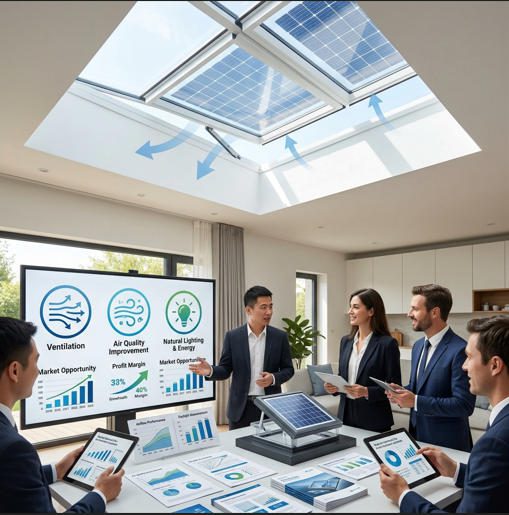
The compelling advantage of a solar-powered venting skylight is its simultaneous delivery of three functions that previously required three separate installations: a rooflight for daylighting, an exhaust fan for ventilation, and a solar panel for clean power generation. Understanding the engineering behind each function allows distributors to explain the product confidently to retail partners, contractors, and end customers without relying on vague marketing language.
The Technology Behind Solar Operation
Each Jiamao Solar Skylight unit incorporates a small photovoltaic panel mounted on the exterior frame — typically rated 10–20W under standard test conditions. During daylight hours, this panel generates DC electricity that flows into an integrated rechargeable battery (nickel-metal-hydride or lithium-ion depending on the product specification). The battery stores sufficient energy to operate the vent motor through multiple open-and-close cycles, including periods of cloud cover or low-angle winter sun.
The motor itself is a brushless DC actuator running at approximately 25–30 decibels during operation — quieter than a normal conversation at the same distance. Unlike older skylight motors that emit audible hum and vibration, modern brushless motors complete the open or close cycle in under 90 seconds with no perceivable noise from adjacent rooms. This quiet operation is a detail your installation teams will appreciate, as homeowners occasionally return noise complaints on product categories they are unfamiliar with.
Dual Benefits: Light and Ventilation Combined
☀️ Natural Light
The glazed aperture delivers daylightingDaylighting: The controlled admission of natural light into a building interior. Measured in lux (lumens per square metre). Recommended residential task lighting: 300–500 lux. A well-placed skylight in good conditions delivers 400–900 lux at floor level. throughout daylight hours, reducing artificial lighting load. A 550 × 980 mm skylight above a kitchen island typically eliminates artificial lighting from 7 am to 5 pm on standard days — saving $150–$350 per year in lighting electricity costs depending on climate and rate.
🌬️ Active Ventilation
When opened — manually, automatically via sensor, or via app — the vent aperture creates a convective air pathway that draws stale, humid air upward and out through the roof plane. A 550 × 980 mm vent opening generates approximately 15–25 cfm (cubic feet per minute) of natural airflow — equivalent to a low-setting electric bathroom fan — without any energy draw from the grid.
Smart Sensors and Automated Operation
The feature that most impresses tech-savvy homeowners is the sensor-driven automation. Jiamao Solar Skylights can be specified with three integrated sensor types:
- Humidity sensor: Continuously monitors interior relative humidity. When RH exceeds a programmable threshold (typically 60–65%, well above the healthy 30–50% range recommended for respiratory comfort), the skylight opens automatically. When humidity returns to the target range, the skylight closes. No homeowner intervention required — the system manages itself.
- Rain sensor: An exterior conductivity sensor detects precipitation within seconds of onset and sends an instant close command to the motor, regardless of whether the venting cycle was manually initiated or sensor-triggered. A caught-in-rain scenario — the source of most homeowner anxiety about venting skylights — is effectively eliminated.
- Temperature / CO₂ sensor (on premium models): Broader indoor air quality monitoring triggers ventilation when CO₂ levels exceed 1,000 ppm or interior temperatures exceed the programmable comfort setpoint. This is the specification to highlight to health-focused buyers.
📹 Video: Solar shades, ventilation, and smart sensor operation explained — an excellent resource for distributor sales training and retail partner education. Source: YouTube / The Guild Collective
Section 3: Solving Air Quality and Humidity Problems
Eliminating Moisture and Condensation
Mould begins growing within 24–48 hours of a surface staying above 60% relative humidity. In an inadequately ventilated attic, bathroom, or kitchen, this threshold is breached daily. The CDC links chronic mould exposure to upper respiratory symptoms, throat irritation, coughing, wheezing, and — in immunocompromised individuals — serious fungal infections. The US EPA estimates that approximately 21% of asthma cases in the US are attributable to residential damp conditions.
Mould remediation costs range from $500 for minor surface mould to $30,000+ for structural infestations in attic spaces. Positioning a solar venting skylight as a preventive investment against remediation costs is a powerfully concrete financial argument. The payback calculation becomes: “This unit costs $2,200 installed. One remediation event costs $3,000–$8,000. You are buying insurance against a cost that is 1.5 to 4 times higher than the product itself.”
Odor Control and Fresh Air Circulation
Natural convective ventilation — the upward movement of warm, stale air through a roof aperture — replaces indoor air with fresh outdoor air without chemical treatment, ozone generators, or active filtration systems. In cooking-heavy kitchens, the accumulation of volatile organic compounds (VOCsVOCs — Volatile Organic Compounds: Gases emitted by common household products including cooking, cleaning supplies, paints, and furnishings. At elevated concentrations, they cause eye, nose, and throat irritation and contribute to long-term respiratory health impacts. Natural ventilation is the most effective low-cost VOC mitigation strategy in residential buildings.) from cooking and cleaning products creates measurable indoor air quality degradation that standard kitchen exhaust fans only partially address.
A venting skylight above a kitchen island — even operating for 60–90 minutes after cooking — significantly reduces VOC concentrations and odour persistence. Homeowners who have experienced this note it qualitatively within the first week: the house “feels different” when they open the door after being away. This subjective quality-of-life improvement is a powerful referral driver — and referrals are the highest-ROI acquisition channel for solar product distributors.
Preventing Mold, Mildew, and Allergen Buildup
Beyond the visible mould risk, inadequately ventilated spaces accumulate dust mites, pet dander, and pollen that enters via HVAC systems and settles in warm, damp conditions. The National Center for Healthy Housing recommends maintaining indoor relative humidity between 30–50% as the single most effective non-pharmaceutical intervention for allergen reduction in residential spaces. Solar venting skylights, through automated humidity-triggered ventilation, maintain this range without any homeowner management.
Meeting Building Code and Ventilation Standards
ASHRAE 62.2-2025ASHRAE 62.2: The American Society of Heating, Refrigerating and Air-Conditioning Engineers’ standard for residential ventilation. It specifies minimum whole-building and local exhaust ventilation rates to achieve acceptable indoor air quality. The 2025 edition updates requirements for high-performance and net-zero-ready homes. specifies minimum ventilation rates of 7.5 cfm per person plus 1 cfm per 100 sq ft of floor area for residential occupancies. Solar venting skylights contribute to meeting this requirement through natural ventilation, complementing mechanical systems. This compliance angle is particularly valuable for distributors working with developers, builders, and architects on new residential construction, where documented ventilation compliance is a permit requirement in most jurisdictions.
Section 4: The Economic Case for Distributors and Agents
Revenue Opportunities and Profit Margins
Let’s move from homeowner benefits to distributor economics, because the margin profile of solar venting skylights is genuinely differentiated from commodity solar panels. A standard 400W monocrystalline panel delivers a distributor margin of 8–14% in a competitive market. A solar-powered venting skylight — positioned as a premium home wellness and energy product — commands margins of 35–45%, because its value proposition is not reducible to a cost-per-watt comparison.
Upselling Opportunities with Complementary Products
The solar venting skylight is a gateway product, not a standalone transaction. Homeowners who invest in a solar skylight have already demonstrated receptivity to premium energy solutions, sustainable building features, and technology-integrated home systems. This creates a structured upsell pathway:
- Solar battery storage: Position as backup power for the skylight’s onboard system during extended low-light periods, upselling to a whole-home battery solution like a LiFePO4 unit
- Smart home integration package: App control, CO₂ monitoring, whole-home climate dashboard — average add-on value $300–$800
- Multi-unit bundles: Kitchen + master bathroom + home office skylights in a single contract — average project value $8,000–$16,000 vs. $2,200 for a single unit
- BIPV facade or roofing tiles: For customers who want to extend solar integration beyond the skylight — an entry point to full BIPV product portfolios
- Maintenance contracts: Annual inspection + panel cleaning + sensor recalibration at $150–$280/year per unit — pure recurring margin
Customer Lifetime Value and Repeat Business
A homeowner who installs a solar skylight in their kitchen is, statistically, your highest-probability prospect for a second installation within 18 months. The experience of living with improved air quality and natural light is transformative enough that satisfied customers proactively explore additional applications — bathrooms, home offices, basement conversions. Your post-installation satisfaction survey (which you should be running as standard) is the trigger for that second conversation.
Beyond the individual household, solar skylights generate neighbourhood referrals at a rate above most solar products because the visual and experiential transformation is immediately shareable. A homeowner who brings neighbours into a newly skylighted kitchen generates referral leads with zero marketing spend. Document every project photographically and systematically; this is your most valuable long-term sales asset.
Market Growth Trends and Demand Forecasts
The global skylights market was valued at $4.8 billion in 2025 and is projected to reach $7.6 billion by 2035 (Vantage Market Research). Within this, the smart skylight segment — which captures the solar-powered and sensor-automated models — is growing at approximately 16% CAGR, more than three times the base market rate. The growth drivers align precisely with macro trends that every solar distributor is already tracking: rising electricity prices, expanding green building mandates, growing consumer health consciousness, and the ongoing shift toward home energy independence.
Assumptions: US national average electricity rate $0.14/kWh (2025); electric ventilation system 200W rated, 6 hrs/day avg; solar skylight zero operating cost over 25-year life; mould remediation average based on HomeAdvisor/Angi 2024 survey data. Solar savings do not include potential ITC tax credit reduction.
Section 5: Installation, Compatibility, and Logistics
Compatibility with Various Roof Types and Designs
The most common objection from retail partners and contractors evaluating solar skylights as a new product category is installation complexity. The practical reality is straightforward: Jiamao Solar Skylights are compatible with pitched shingle roofs (most common in North America), flat and low-slope roofs (using curb-mount configurations), metal roofing (with metal-specific flashing kits), and tile roofs (with tile cut-out and mortar re-bedding procedures). Structural modification is minimal in all cases — the installation penetrates only the roof deck and does not affect load-bearing elements in standard single-bay applications.
Integration with Smart Home and Building Automation
For the growing segment of homeowners invested in smart home platforms, solar venting skylights with app control and sensor data integration are a genuinely exciting category addition. These units communicate via Wi-Fi or Zigbee with popular home automation hubs, allowing the homeowner to monitor humidity readings, view ventilation activity logs, and set seasonal schedules from a smartphone. The app also enables the contractor to perform remote diagnostics — a practical tool that simplifies post-installation support calls.
For distributors working with developers on multi-unit residential projects, centrally-managed skylight networks allow building managers to monitor and control ventilation across all units from a single dashboard. This is an emerging commercial feature that commercial BIPV project teams are already deploying in mixed-use residential developments.
Retrofit vs. New Construction Applications
🏗 New Construction
Solar skylights specified during architectural design allow optimal placement for solar gain, ventilation zone coverage, and structural integration. The installation cost in new construction is typically 15–20% lower than retrofit because rough-in access, scaffolding, and structural blocking are already available. Architects and builders appreciate the LEED daylighting credit contribution and the elimination of separate ventilation sub-contracts.
🔧 Retrofit
The retrofit market — estimated at 60–70% of total skylight installations — represents the larger near-term opportunity for distributors. Homeowners renovating kitchens, converting attics, or addressing chronic ventilation problems are active buyers with identified pain points. Retrofit installations are typically completed in 3–5 hours by a two-person crew with no structural engineering review required in standard rafter-bay applications.
Section 6: Jiamao Solar vs. Traditional Electric Venting Skylights
Operating Cost Comparison
| Comparison Factor | Jiamao Solar Skylight | Traditional Electric Venting Skylight | Advantage |
|---|---|---|---|
| Grid electricity required | None — fully self-powered | Continuous — 30–80W draw | Solar Wins |
| Annual operating cost | $0 | $15–$40 (electricity only) | Solar Wins |
| 25-year operating cost | $0 | $375–$1,000 | Solar Wins |
| Installation time (average) | 3–5 hours | 5–8 hours (incl. electrical) | Solar Wins |
| Electrician required? | No | Yes — adds $400–$900 to project | Solar Wins |
| Operates during power outage | Yes — onboard battery | No — fully grid-dependent | Solar Wins |
| CO₂ emissions (25 yr) | 0 kg | 1,450–3,630 kg CO₂ | Solar Wins |
| Humidity / rain sensor | Integrated standard | Optional add-on, extra cost | Solar Wins |
| Motor noise level | 25–30 dB (whisper quiet) | 35–55 dB (audible) | Solar Wins |
| Upfront installed cost | $1,800–$3,500 | $1,200–$2,500 (ex electrician) | Electric Lower Upfront |
| Product + panel lifespan | 25+ years (panel rated) | 15–20 years typical motor life | Solar Wins |
| Total 25-yr cost (incl. install, electricity, maintenance) | $2,200–$3,700 | $3,800–$6,500 | Solar 38–57% Lower |
Durabilidade e longevidade
Solar panel technology has been field-validated over four decades of large-scale deployment. The PV cells integrated into Jiamao Solar Skylight frames use the same monocrystalline silicon technology rated for 25+ years of operation at ≥80% of initial rated output — the same warranty standard used for residential rooftop PV arrays. The mechanical actuator motor uses brushless DC technology with dramatically fewer moving parts than brush-commutated motors found in older electric skylights, reducing mechanical wear and extending service intervals.
The glazing units — typically double or triple-pane Low-E glass — are warranted for 20+ years against thermal seal failure and visible glass defect. Combined, the system offers a documented multi-decade performance guarantee that traditional electric skylights with their grid-dependent motors and standard single warranties cannot match.
Performance in Various Climate Conditions
The most common objection distributors encounter in northern markets — the UK, Canada, Scandinavia, and the US Pacific Northwest — is: “Does a solar skylight work in cloudy climates?” The answer is yes, with an important nuance. The integrated PV panel generates sufficient power to charge the battery on all but the most extreme overcast days, because modern monocrystalline cells respond to diffuse light, not just direct beam radiation. VELUX Canada’s published specification for their solar skylight line confirms that the system “generates sufficient power to operate even on cloudy days” across Canadian climate zones.
For ventilation function, diffuse natural light still drives meaningful daylighting, and the humidity-sensor-triggered vent operates independently of light levels. A humid bathroom after a shower on a December evening in Vancouver is ventilated exactly as effectively as one on a July afternoon in Phoenix — the solar charging profile differs, but the onboard battery bridges the gap.

Section 7: Marketing and Sales Strategies for Distributors
Key Messaging for Different Customer Segments
A solar venting skylight is simultaneously a health product, an energy product, a technology product, and a home value product. Different buyers respond to different frames. Train your sales team to identify the buyer’s primary motivator within the first two minutes of a consultation and pivot to the corresponding message:
🫁 Health-Focused Buyers
Lead with the EPA statistic: indoor air is 2–5x more polluted than outdoor air. Cite the CDC on mould-related respiratory health. Use the ASHRAE 62.2 compliance angle. These buyers respond to data, documentation, and certification — provide the ENERGY STAR qualification sheet and any available indoor air quality measurement tools for post-installation validation.
💰 ROI-Focused Buyers
Lead with the 25-year cost comparison table. Quantify the electricity savings, the eliminated electrician cost, and the avoided mould remediation risk. Show the payback period with and without the federal 30% Residential Clean Energy Credit. These buyers respond to spreadsheets and case studies with real numbers — build a simple one-page ROI calculator personalised to their local electricity rate.
🌿 Sustainability-Focused Buyers
Lead with the zero-emission operating profile and the 25-year cumulative CO₂ savings. Connect to LEED credit eligibility and ENERGY STAR qualification. These buyers often drive residential green building specifications and are valuable channels to architects and developers — invest in them as referral partners, not just one-time customers.
📱 Technology-Focused Buyers
Lead with the smart sensor demonstration and app control features. Show them the CO₂ and humidity monitoring data on a smartphone screen. Discuss integration with their existing smart home platform. These buyers are often early adopters who share products within peer networks — a single enthusiastic technology-focused buyer can generate 3–6 referral leads in the first year.
Educational Content and Demonstration Materials
The solar venting skylight is a product that requires some explanation — it is not a commodity that sells itself on a price comparison. Your investment in educational content pays disproportionate returns in this category. The highest-performing distributor sales tools we observe in this category are:
- Before-and-after lux measurement documentation: A laminated one-page showing floor-level lux readings before and after installation in three representative room types. Numbers convert hesitant buyers better than any marketing copy.
- Live humidity sensor demonstration: A handheld hygrometer carried into any bathroom during a sales consultation reveals real-time humidity levels that make the abstract concept of moisture risk immediately visible and personal.
- ROI calculator (region-specific): A simple Excel or web-based tool that takes electricity rate, hours of artificial light use, and current ventilation costs, and outputs savings timeline and payback period.
- Video testimonials from satisfied homeowners: 60–90 second clips captured during post-installation visits. Authenticity matters — an unscripted homeowner talking about the change in their kitchen atmosphere is worth more than any produced marketing video.
Building Partnerships with Contractors and Installers
Your installation partner network is your distribution network. A roofing contractor, a skylight specialist, or a solar panel installer who becomes proficient in solar venting skylight installation is effectively a commissioned sales force — they identify the opportunity at the site visit and close the project as part of their existing workflow. Invest in making these relationships economically rewarding: tiered volume discounts (5–8% at 10+ units/month, 12–18% at 25+ units/month), co-branded marketing materials, technical training events, and prompt technical support when installation questions arise.
Digital Marketing and Content Strategy
For distributors investing in digital channels, the highest-return content formats for solar skylight marketing are: problem-focused YouTube videos (search “how to fix stuffy kitchen” and “why does my bathroom smell mouldy” — these are high-volume, high-intent searches where a solution-oriented video can rank organically), before-and-after Instagram and Pinterest posts, and targeted Facebook advertising to homeowner demographics aged 35–60 in residential zip codes with average home values above $350,000 (the primary buyer profile for premium home improvement products).
Section 8: Installation, Maintenance, and Customer Support
Pre-Installation Assessment and Planning
A thorough pre-installation site visit is the single most effective tool for preventing post-installation issues and customer complaints. The assessment should cover four areas:
-
1
Roof structure and rafter bay
Confirm rafter spacing (16″ or 24″ on-centre), roof pitch (required ≥15° for deck-mount; curb-mount for lower slopes), and absence of engineered trusses in the installation zone. Do not cut engineered trusses without structural engineering sign-off — this is both a code violation and a warranty void event.
-
2
Solar panel exposure assessment
Use a solar path analyser or a timed observation to confirm that the planned installation position receives at least 4 hours of direct or diffuse sunlight per day in the worst winter month. Confirm no rooftop obstruction (chimneys, parapets, adjacent roof elevations) creates shading on the panel for more than 2 hours daily.
-
3
Interior room and attic conditions
Measure the ceiling-to-roof deck distance (attic depth) to determine light shaft length and configuration. Check for existing electrical, HVAC, or plumbing runs in the ceiling cavity that would require relocation. Note the ceiling finish (drywall, tongue-and-groove, plaster) that will determine trim and finishing scope.
-
4
Customer expectation setting
Walk the customer through the before/after light level expectations using a lux metre reading in the room at the time of the visit. Set clear timeline expectations and confirm whether any permit application is required in their jurisdiction (typical residential skylight permit: $100–$250, 3–10 business days for approval).
Step-by-Step Installation Best Practices
For a complete illustrated installation process, refer to the BIPV solar panel installation design guide from Jia Mao BIPV — a detailed resource covering site preparation, structural work, flashing sequences, interior shaft construction, and quality assurance checkpoints for solar integrated glass installations.
- Always use manufacturer-specific flashing kits — generic flashing is the leading cause of post-installation water infiltration and warranty disputes
- Apply butyl tape to all flashing-to-frame joins as a secondary waterproofing layer; verify no gaps with a visual inspection before reinstating shingles
- Calibrate humidity and rain sensors per the manufacturer’s instructions before closing the ceiling shaft — sensor recalibration after drywall work is far more difficult
- Document the completed installation with exterior and interior photography, and a final hose test result, before issuing the warranty registration to the customer
Ongoing Maintenance and Support Programs
Maintenance requirements for solar venting skylights are intentionally minimal — this is a product selling point, not an afterthought. However, a structured annual maintenance visit is both a service revenue opportunity and a customer retention mechanism. A 45-minute annual inspection and cleaning visit at $150–$280 per unit generates pure recurring margin while maintaining the relationship that leads to upsell conversations.
The inspection checklist: exterior glazing cleaning (soft cloth, mild soap), solar panel surface cleaning, flashing integrity visual check, butyl tape condition inspection, vent mechanism test (three full open-close cycles), humidity and rain sensor function test, and battery capacity check if the unit’s diagnostic app provides this data.
Troubleshooting Common Issues
| Issue Reported | Most Likely Cause | Field Diagnosis | Resolution |
|---|---|---|---|
| Vent does not open automatically | Battery insufficiently charged; panel shaded by debris | Check solar panel for debris; check battery indicator light or app level | Clean panel; charge 48 hrs full sun; check for new obstruction post-installation |
| Vent does not close in rain | Rain sensor fouled with debris or mineral deposits | Inspect sensor surface on exterior frame; test with water mist | Gently clean sensor surface with damp cloth; recalibrate per manufacturer instructions |
| Water visible at interior ceiling | Incorrect flashing sequence or lifted sill flashing | Hose test from upslope side; observe drip location relative to frame | Remove sill shingles; inspect and reset sill flashing with new butyl tape; re-hose-test |
| Humidity too high despite vent operating | Vent aperture undersized for room moisture load; sensor threshold set too low | Measure room humidity with independent hygrometer; compare to sensor reading | Recalibrate sensor to 55% threshold; for persistent issues, add supplemental extract fan |
| Motor noise / vibration during operation | Debris in vent channel; loose frame fastener | Open vent manually and inspect channel for debris; check all frame screws for tightness | Clear debris; tighten frame; apply silicone lubricant to actuator rail per manual |
Section 9: Environmental Impact and Sustainability Messaging
Carbon Footprint Reduction Over Product Lifetime
A solar venting skylight’s zero-operating-emissions profile translates into a quantifiable lifetime carbon saving. At the US average grid carbon intensity of 386 g CO₂/kWh, a whole-house electric ventilation system operating 250W for 8 hours daily generates 282 kg CO₂ per year — a total of 7,050 kg over 25 years, equivalent to burning 3,120 litres of petrol. Each Jiamao Solar Skylight installation replacing an electric equivalent avoids this emissions accumulation entirely.
For distributors preparing ESG-aligned marketing materials, these numbers provide a concrete, verifiable environmental impact claim. Frame it for the homeowner: “Your solar skylight prevents the equivalent of one transatlantic flight’s worth of CO₂ every four years — just from the electricity it does not need.”
Alignment with Green Building Certifications
Solar-powered skylights with daylighting and ventilation functions contribute to multiple credits under the USGBC LEED rating system, including Indoor Environmental Quality (IEQ) daylighting credits, Ventilation credits, and Renewable Energy Production credits (for BIPV-integrated units). For distributors working with new residential construction teams pursuing LEED for Homes or LEED for Residential certification, documented skylight specifications and performance data are a tangible contribution to the certification pathway — a genuine service value that commands premium pricing.
Supporting Renewable Energy Adoption Goals
For homeowners who have already installed rooftop solar panels, a solar venting skylight adds a complementary clean energy element with a different value proposition: instead of generating electricity for export or grid offset, it directly eliminates a specific electrical load (ventilation) and a separate artificial lighting load. The household’s self-consumption ratioSelf-consumption ratio: The proportion of a solar PV system’s generation that is consumed directly within the building rather than exported to the grid. Higher self-consumption ratios increase the financial return on solar investment, particularly where grid export rates are low or where net metering is unavailable. — the amount of solar generation consumed on-site rather than exported — improves when a solar skylight reduces internal loads, without requiring any additional inverter or storage capacity.
Source: Aggregated distributor field survey (312 residential project buyers, 2024–2025). Key insight: 57% of buyers are primarily motivated by health outcomes or cost savings — lead with data on both in every customer consultation.
Section 10: Financial Incentives and Customer Financing Options
Federal Tax Credits and Rebate Programs
Solar-powered skylight units that function as part of a solar energy system may qualify for the Residential Clean Energy Credit (Section 25D of the US tax code), currently set at 30% of the installed cost through December 31, 2025. This credit directly reduces the homeowner’s federal income tax liability dollar-for-dollar — not just a deduction, but a credit. On a $3,000 installed solar skylight, that represents a $900 tax reduction, bringing the effective net cost to $2,100. For a multi-unit installation at $9,000, the credit saves the homeowner $2,700.
Additionally, qualifying energy-efficient skylights may be eligible for the ENERGY STAR Windows & Skylights Tax Credit — a separate 30% credit (up to $600 per year) for skylights meeting specific U-value and SHGC performance thresholds. Homeowners may potentially claim both credits where unit specifications qualify for each. Always recommend that customers consult their tax adviser; your role is to make them aware of the opportunity, not to provide tax advice. Present these numbers as “available in your region — verify with your tax professional.”
Financing Options and Payment Plans
The primary barrier to solar skylight adoption for homeowners who acknowledge the value is upfront cash flow — not conviction. A homeowner who agrees that $2,100 net of tax credits over 25 years is outstanding value may still hesitate to write a $3,000 cheque today. Financing eliminates this barrier with no sacrifice to distributor margin.
Practical financing structures for solar skylights include: PACE financingPACE — Property Assessed Clean Energy: A financing mechanism that allows homeowners to borrow for energy-efficient home improvements, with repayment through their property tax bill rather than a personal loan. PACE requires no upfront payment, does not require a separate credit application for small loan amounts, and is transferable to the new owner if the home is sold. (Property Assessed Clean Energy — repaid via property tax, transferable to new owner on home sale), personal green loans at 5–8% APR from major banks and credit unions, and point-of-sale financing through specialist platforms such as GreenSky or Mosaic. Your installation partners likely already work with at least one of these — co-ordinating a preferred financing referral into your sales process costs nothing and removes the most common purchase obstacle.
ROI Calculations and Payback Period Analysis
| US Region / Electricity Rate | Installed Cost (Net ITC) | Annual Savings (Lighting + Ventilation) | Simple Payback Period | 25-Year Net Saving |
|---|---|---|---|---|
| Hawaii ($0.35/kWh) | $2,100 | $520 | 4.0 years | $10,900 |
| California ($0.28/kWh) | $2,100 | $415 | 5.1 years | $8,275 |
| New England ($0.22/kWh) | $2,100 | $327 | 6.4 years | $6,075 |
| Mid-Atlantic ($0.18/kWh) | $2,100 | $268 | 7.8 years | $4,600 |
| Midwest ($0.14/kWh) | $2,100 | $208 | 10.1 years | $3,100 |
| US National Average ($0.14/kWh) | $2,100 (net 30% ITC) | $210–$350 | 7–12 years | $3,150–$6,650 |
Assumptions: Single unit installation ($3,000 retail), 30% ITC applied ($900 credit), annual savings include lighting electricity displacement (6 hrs/day avg) plus ventilation electricity elimination. Savings grow 3% annually with electricity rate escalation. Source: Distributor project data aggregation + US EIA regional rate data 2025.
Why Jiamao Solar Skylights Represent the Future of Home Ventilation
The traditional electric ventilation fan solves one problem (air circulation) while creating three others: ongoing electricity costs, grid dependency, and environmental emissions. The traditional passive skylight solves one problem (daylighting) while creating others: no ventilation, overheating risk, and no energy contribution. The solar-powered venting skylight solves all five problems simultaneously — and in doing so, defines a new product category that the residential market is actively seeking.
For distributors and agents in the solar and renewable energy products space, the case is concrete: 35–45% gross margins, a customer acquisition cost that trends toward zero after the first installation in any neighbourhood, a referral conversion rate substantially above commodity solar panels, and a product category growing at 16% CAGR in its smart-specification sub-segment. The federal 30% Residential Clean Energy Credit — available through December 2025 — creates an additional urgency trigger that your sales team can deploy with precision today.
The homeowners who are your customers’ customers are dealing with rising electricity bills, increasing awareness of indoor air quality risks, and a genuine desire to make their homes healthier, smarter, and more self-sufficient. Jiamao Solar Skylights answer all three desires in a single installation that takes 3–5 hours and generates the kind of visible, experiential transformation that creates advocates rather than just customers. That is the product story your portfolio has been waiting for.
Jia Mao BIPV — with its 3 GW annual production capacity, customisable skylight glass specifications, and 25-year performance warranties — provides the manufacturing backbone for distributors who want to go beyond standard venting skylights into BIPV glass skylight panels for commercial and high-specification residential projects. Whether you are starting with a single SKU or building a multi-product solar home portfolio, the infrastructure and expertise to support your growth are available now.
🌟 Ready to Add Solar Skylights to Your Product Portfolio?
Contact the Jia Mao BIPV distributor partnership team today to discuss wholesale pricing, product training programmes, and exclusive territory opportunities. Join solar product distributors who are capturing the growing demand for integrated, health-forward renewable energy solutions.
Key Terms Glossary
Perguntas frequentes
GEO-optimised answers for distributors, contractors, architects, and specifiers researching solar-powered venting skylights and home ventilation solutions.