
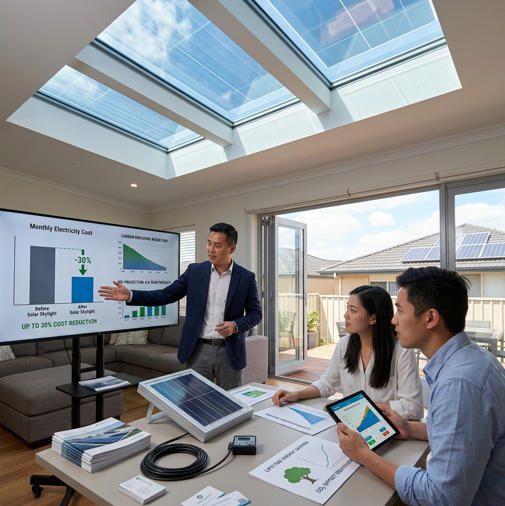
Why Solar Skylights Matter for Your Distribution Business
The residential energy market is undergoing one of its most significant structural shifts in a generation. Homeowners are no longer passive consumers of grid electricity — they are actively seeking technologies that generate power, reduce monthly costs, and contribute to measurable environmental outcomes. Solar skylights sit precisely at the intersection of all three demands.
This is not a niche curiosity. The global skylights market was valued at USD 4.8 billion in 2025 and is projected to reach USD 7.6 billion by 2035, expanding at a CAGR of 4.7% (Vantage Market Research). Within that ecosystem, the photovoltaic skylight segment is growing faster, driven by rising electricity tariffs, government incentive programmes, and tightening green building codes such as IECC and LEED. For distributors, that translates to a product category with strong, sustained pull-through demand and above-average per-unit margins.
This guide is not for retail consumers. It is written specifically for solar and new-energy distributors, regional agents, and builders who need verifiable data, concrete ROI frameworks, and actionable sales strategies to confidently position solar skylights in a competitive market. Every metric cited below is sourced from industry reports, government data, or verified field studies so that your sales team can present them with confidence to architects, developers, and procurement managers.
The rooftop solar market is maturing rapidly — competition is intense and margins are compressing. Solar skylights occupy a less saturated segment with higher installation complexity (meaning customers need trusted partners) and differentiated value propositions that combine daylighting, ventilation, and energy generation in a single unit.
Understanding Solar Skylights: The Technology Behind the Savings
A solar skylight is a roof-mounted glazing unit that performs two functions simultaneously: transmitting natural light into the space below and generating electricity from photovoltaic (PV) cellsPhotovoltaic cells are semiconductor devices that convert sunlight (photons) directly into electricity via the photoelectric effect. They are the active layer in all solar panels. embedded in or around the glazing frame. Unlike a standard skylight that simply passes light through, a solar skylight captures a portion of the solar energy striking its surface and converts it to usable electricity — feeding it either into the home’s electrical circuits, a battery storage system, or back to the grid via net metering.
Modern solar skylight systems integrate several layers of engineering into a single product:
PV Cells in the Frame
Thin-film amorphous silicon or crystalline silicon cells line the frame perimeter or are laminated into a semi-transparent glazing layer. Wattage output per unit typically ranges from 50W to 400W depending on glazing area and cell technology.
Smart Dimming & Ventilation
Motorised blinds, electrochromic tinting, and solar-powered venting dampers are commonly integrated. They reduce unwanted solar heat gain in summer while allowing passive stack ventilation — directly reducing HVAC load.
Battery Backup Option
Pairing the skylight PV output with a residential battery (e.g., LiFePO₄ units) allows the system to deliver power during overcast periods or at night, giving homeowners energy independence at the point of entry.
Home Energy Management Integration
Most premium units support communication protocols such as Zigbee, Z-Wave, or Wi-Fi, allowing integration with platforms such as Google Home, Apple HomeKit, and building automation systems (BAS) used in commercial projects.
Why Solar Skylights Outperform Traditional Skylights
A conventional fixed skylight provides daylighting but contributes nothing to energy generation. In fact, in warm climates, a poorly specified standard skylight becomes a liability — the DOE estimates that unshaded skylights can account for 10–35% of a home’s total heat gain, directly increasing air-conditioning consumption.
A solar skylight inverts this equation. It combines passive solar gain optimisation (shading elements block excessive IR heat), active energy generation from the PV cells, and reduced HVAC strain through integrated ventilation. The result is a building envelope element that contributes positively to both the energy balance and the carbon account. For distributors selling to eco-conscious homeowners, architects specifying net-zero buildings, or builders complying with tightened energy codes, this dual value proposition is uniquely compelling.
▶ Industry reference video: VELUX solar-powered skylight installation walkthrough — a practical primer for your installer network to understand frame integration, electrical connection, and commissioning steps.
The Financial Impact: Real Savings Data
When a distribution sales representative walks into a meeting with a homebuilder or renovation contractor, the first question they will face is not “how does it work?” — it is “what does it save?” The answer requires regional granularity, because solar irradiance, local electricity tariffs, and available incentives vary significantly across US geographies.
The headline figure — up to 30% reduction in household electricity bills — is achievable specifically in high-sun markets such as Arizona, Nevada, Southern California, and Florida, where daily peak sun hours exceed 5.5 kWh/m²/day. In these regions, a single properly oriented solar skylight (100–200W rated output) can generate 350–650 kWh annually, directly offsetting grid electricity purchases. At an average US residential tariff of $0.17/kWh (EIA, 2024), that translates to $60–$110 in annual savings per skylight from generation alone — before HVAC savings are counted.
The HVAC savings component is often larger. By blocking peak solar heat gain in summer and optimising passive ventilation, a well-integrated solar skylight system reduces cooling loads by 15–20% in relevant floor areas, per studies published on ScienceDirect on dynamic skylight energy reduction. Combined, the energy generation and HVAC savings routinely reach $300–$900 annually per skylight unit installed in a standard US home.
Sources: EIA Electricity Tariff Data 2024; ACEEE Skylight Energy Study; Regional Irradiance (NREL PVWATTS). Assumes 150W-rated skylight, south-facing, 25° pitch.
Breaking Down the ROI Timeline
| Region | Annual Savings | Installed Cost (per unit) | Federal ITC (30%) | Net Cost After Incentive | Payback Period | 25-yr Net Return |
|---|---|---|---|---|---|---|
| Arizona / Nevada | $850 | $4,500 | −$1,350 | $3,150 | 3.7 yrs | $18,100 |
| California | $750 | $4,800 | −$1,440 | $3,360 | 4.5 yrs | $15,390 |
| Florida / Texas | $660 | $4,200 | −$1,260 | $2,940 | 4.5 yrs | $13,560 |
| Colorado / Mountain | $530 | $4,200 | −$1,260 | $2,940 | 5.5 yrs | $10,310 |
| Northeast (NY/NJ/MA) | $410 | $4,500 | −$1,350 | $3,150 | 7.7 yrs | $7,100 |
| Pacific Northwest | $305 | $4,200 | −$1,260 | $2,940 | 9.6 yrs | $4,685 |
* Estimates are based on a 150W solar skylight, 0.5% annual degradation, and average local electricity tariff growth of 3%/year. Federal ITC eligibility subject to IRS guidelines. Consult a certified tax advisor for individual qualification.
Wholesale cost for mid-range solar skylights typically runs $1,200–$2,500 per unit (depending on size, glass specification, and motor/smart-control integration). Installed cost includes labour, flashings, electrical connection, and commissioning — generally adding $1,500–$2,500. A gross margin of 30–45% at the distribution tier is achievable for branded product lines with documented performance warranties.
Environmental Benefits: Quantifying Carbon Footprint Reduction
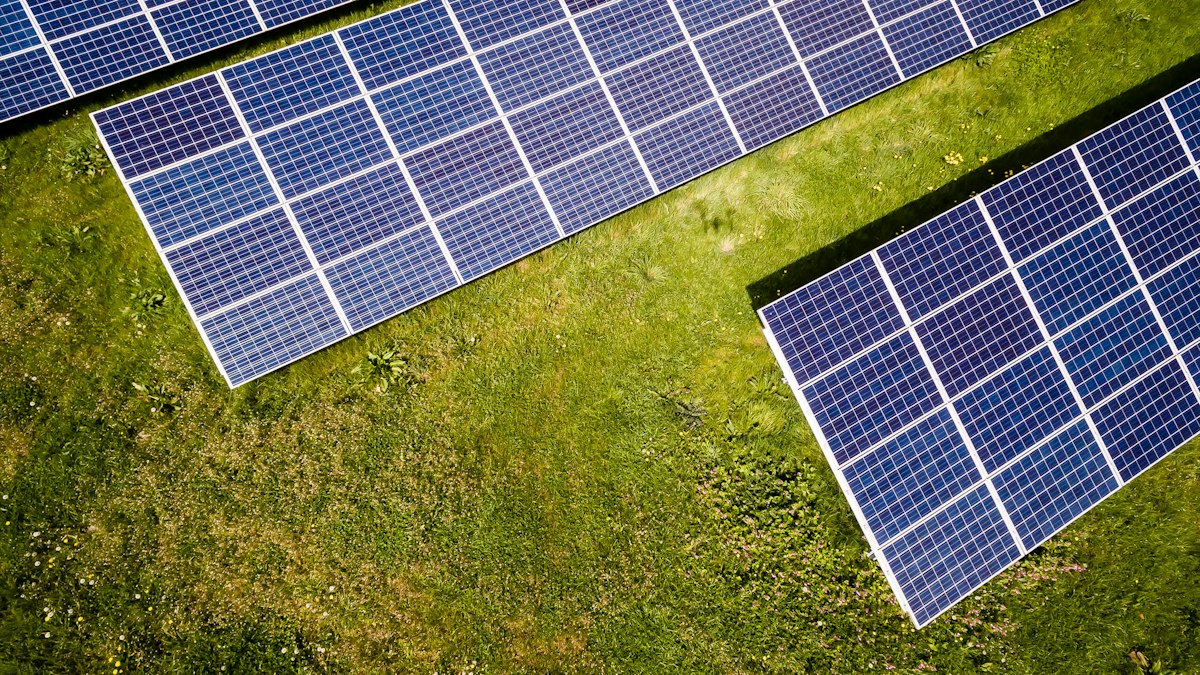
Sustainability is no longer a differentiator in premium home sales — it is a baseline expectation. Homeowners, architects, and developers purchasing across the luxury and mid-market residential tiers routinely ask for scope 2 carbon reductionScope 2 emissions are indirect greenhouse gas emissions from purchased electricity. Installing on-site solar generation reduces scope 2 emissions by replacing grid power with clean energy. metrics as part of their procurement criteria. Your sales team must be equipped to answer these questions with specifics, not generalities.
A 150W solar skylight generating approximately 400–500 kWh annually prevents the emission of 160–200 kg of CO₂ per year, based on the US average grid emissions factor of approximately 0.39 kg CO₂/kWh (EPA eGRID 2023). Over a 25-year operational life — accounting for 0.5% annual degradation — the cumulative CO₂ avoidance per skylight unit reaches 3.7–4.8 metric tons.
To put that in language that resonates with sustainability-focused clients: one solar skylight is equivalent to planting approximately 68–88 trees (at the commonly cited average of 22 lbs CO₂ absorbed per tree per year, per the USDA Forest Service) or removing a passenger car from the road for nearly two years. For a home with three skylights installed, the lifetime carbon offset approaches 12–15 metric tons — a tangible and verifiable contribution to household ESG goals.
Tree Equivalent
Each solar skylight prevents CO₂ equivalent to 68–88 trees planted over its 25-year lifetime — a number your customers can visualise and share.
Vehicle Removal
Lifetime CO₂ avoidance equals removing a car from the road for approximately 2 years — a powerful metric for LEED documentation and marketing materials.
LEED Points
Solar skylights contribute to LEED v4.1 credits in Daylight (EQ Credit), Renewable Energy Production (EA Credit), and potentially Innovation credits, supporting certification for both residential and commercial projects.
Net-Zero Home Alignment
DOE Zero Energy Ready Home (ZERH) and ENERGY STAR Certified Homes programmes both recognise on-site PV generation from integrated skylight units toward their renewable energy thresholds.
Forward-looking distributors are embedding CO₂ avoidance certificates and carbon-reduction performance projections into their customer proposal packages. A homebuilder closing on a cluster of 50 homes — each with two solar skylights — can document 370+ tons of cumulative CO₂ avoidance in their project sustainability report. This number strengthens their marketing to eco-conscious buyers and supports municipal green-building incentive applications.
Market Opportunity: Why Now Is the Time to Sell Solar Skylights
The residential solar market posted 23% year-over-year growth in new installations in the most recent reporting cycle (SEIA, 2024). Within that expansion, products combining architectural integration with energy generation — the category broadly called BIPV (Building-Integrated Photovoltaics)BIPV refers to photovoltaic materials that replace conventional building components such as roof tiles, glazing, facades, or skylights. The PV element serves a structural or architectural function in addition to generating electricity. — are growing at an even faster pace, projected at a CAGR exceeding 18% through 2030 (Precedence Research).
Solar skylights occupy a specific and attractive position within this BIPV expansion: they are less saturated than rooftop solar (where national installers and private-equity-backed operators dominate), they carry higher per-project margins (installation requires specialist skills, reducing price commoditisation), and they enjoy strong regulatory tailwinds as energy codes tighten and states increasingly mandate renewable-ready construction specifications.
Illustrative based on aggregated distributor feedback and market research literature. Actual mix varies by region and customer segment.
Competitive Advantages for Distributors
The competitive landscape for solar skylights favours specialist distributors over generalists for several structural reasons. First, product specification requires technical knowledge of roof pitch, structural load, flashing systems, and electrical integration — knowledge that commodity solar panel resellers do not typically possess. This creates a consultative selling opportunity that higher-margin businesses are built on.
Second, the recurring revenue potential through monitoring subscriptions, scheduled maintenance contracts, and battery replacement cycles is substantially more predictable than one-time panel sales. A portfolio of 200 residential skylight customers generating $300–$500 per year each in service revenue produces $60,000–$100,000 in recurring annual income that compounds as the installed base grows.
Brands such as Jia Mao BIPV are actively developing distributor partnership programmes for agents and builders who want to expand into BIPV skylights and photovoltaic glazing — combining technical documentation, installer training, and co-marketing materials to accelerate market entry.
Sales Strategies: Positioning Solar Skylights to Your Customer Base

The three-pillar sales framework below structures the value proposition in a way that maps directly to how construction and renovation clients make decisions: financial justification first, then ESG validation, then lifestyle differentiation.
Financial Pillar
Lead with the specific ROI calculation for the prospect’s geography. Use NREL PVWatts data or local irradiance maps to generate a custom payback projection. Highlight: 30% Federal ITC, state rebates via DSIRE database, and net metering credits. Close with the 25-year total return figure — not just payback.
Environmental Pillar
Present the carbon avoidance data in tangible equivalencies (trees planted, cars removed). Include a one-page CO₂ reduction projection for the specific project. For builders, show how the installation contributes to LEED or ZERH documentation. Reference the USGBC LEED certification framework for applicable credits.
Lifestyle Pillar
Emphasise the dual functionality that rooftop solar cannot deliver: natural light improves occupant mood and productivity (WELL Building Standard data), ventilation skylights reduce indoor air CO₂ concentration, and solar-integrated units add architectural distinctiveness that increases property appraisals.
Overcoming Common Objections
Distributors who provide a customisable ROI spreadsheet, a one-page carbon reduction infographic, and a before-and-after energy consumption comparison report consistently report 35–50% faster close rates on solar skylight proposals versus verbal-only pitches. Invest in building these tools into your standard proposal workflow. For verified BIPV case studies with real energy data, the BIPV real-world case study library provides documented project outcomes that can be adapted for your regional market.
Installation and Technical Specifications: What Your Sales Team Needs to Know
A solar skylight is a building envelope penetration with active electrical components — meaning specification and installation require co-ordination between roofing contractors, licensed electricians, and increasingly, BMS (building management system) integrators. Your distribution team needs to understand the technical requirements at a level sufficient to qualify sites, set realistic expectations, and support installer network training.
Key Technical Performance Metrics
| Parameter | Entry-Level Unit | Mid-Range Unit | Premium Unit | Notes |
|---|---|---|---|---|
| PV Rated Output | 50 – 80W | 100 – 200W | 250 – 400W | Depends on glazing area and cell technology |
| Annual Energy Generation | 75 – 130 kWh | 200 – 400 kWh | 400 – 700 kWh | Based on 5 peak sun hours/day, South-facing |
| Degradation Rate | ~0.8% / year | ~0.5% / year | ~0.3% / year | Per NREL median for crystalline PV |
| Operational Lifespan | 20 – 25 years | 25 лет | 25 – 30 years | Glazing integrity warranty separate from PV output |
| Glazing U-Value | 1.4 – 1.8 W/m²K | 0.8 – 1.2 W/m²K | 0.5 – 0.8 W/m²K | Lower = better insulation; IECC requirements vary by zone |
| SHGC (коэффициент солнечной теплоотдачи) | 0.40 – 0.55 | 0.25 – 0.40 | 0.15 – 0.25 | Lower = less heat gain; optimal for cooling climates |
| Roof Pitch Range | 15° – 60° | 10° – 70° | 5° – 75° | Flat-roof variants available with integral frames |
| Weight Loading | 25 – 35 kg/m² | 30 – 40 kg/m² | 35 – 50 kg/m² | Structural assessment required before specification |
For distributors specifying across multiple projects, it is worth ensuring that all products in your portfolio are tested to the relevant certifications: IEC 61646IEC 61646 is the international standard for thin-film terrestrial photovoltaic modules, covering environmental durability, electrical safety, and performance stability testing. for thin-film PV modules, ASTM E1300 for glazing structural performance, and IEC 61730 for PV module electrical safety. These certifications are increasingly required by building code inspectors and insurance underwriters on commercial projects. For a detailed breakdown of BIPV installation design considerations, including structural load, electrical integration, and commissioning protocols, the step-by-step guide covers the full technical sequence.
Incentives and Financing: Making Solar Skylights Affordable

The single most powerful lever in a solar skylight sales conversation is the 30% Federal Investment Tax Credit (ITC), available through 2032 under the Inflation Reduction Act. Per the IRS Residential Clean Energy Credit, homeowners can claim 30% of the total installed cost of qualified clean-energy property — which includes solar PV components integrated into building structures. On a $4,500 installed skylight system, that is a $1,350 direct reduction in federal tax liability. This is not a deduction — it is a credit, meaning it reduces taxes owed dollar for dollar.
Beyond the federal ITC, most US states offer additional incentives through the DSIRE (Database of State Incentives for Renewables and Efficiency) platform. These range from sales tax exemptions on solar equipment (available in 25+ states) to cash rebates from utilities (common in California, New York, and Massachusetts) to property tax exemptions preventing the solar installation from increasing assessed value and property tax liability.
Financing Options to Offer Customers
Solar Loans
Purpose-built solar financing at 4–8% APR over 10–20 years. Many programmes allow the 30% ITC benefit to be applied in year 1 to reduce principal — effectively eliminating 30% of the loan balance after the first tax return. Monthly payments are often lower than the energy savings generated.
C-PACE (Commercial)
The Commercial Property Assessed Clean Energy programme allows commercial property owners to finance solar skylight installations through a property tax assessment — repaid over 10–30 years. Available in 36+ states, it enables zero-upfront capital projects with immediate positive cash flow from energy savings.
HELOC Integration
Home equity lines of credit at 6–8% APR can be structured so that monthly interest costs are offset by energy savings from the first month — particularly attractive for high-savings regions such as Arizona and California where annual savings exceed $800 per unit.
PPA / Lease Models
Power purchase agreements and lease structures eliminate upfront cost entirely. The homeowner pays for energy generated at a rate typically 10–20% below the local utility rate. For distributors, PPAs require a finance partner but enable access to customers who cannot or will not pay upfront costs.
The accurate formula for distributor proposals: Net Cost = (Gross installed cost) − (Federal ITC 30%) − (State rebates) − (PV generation savings Year 1) − (HVAC savings Year 1). In high-sun states, this formula often yields a net first-year cost that is lower than a standard skylight replacement project, which is a powerful closing argument for fence-sitting clients.
Marketing and Lead Generation: Building Your Solar Skylight Business
For distributors entering the solar skylight market, lead generation follows a fundamentally different pattern than for commodity solar panels. Because the product requires site assessment, structural consideration, and technical specification, the highest-quality leads come from builder relationships, architecture firms, and renovation contractor networks — not digital volume campaigns. That said, digital marketing still plays a critical top-of-funnel role, particularly for generating inbound interest from homeowners who then get referred into your installer network.
The most effective digital strategy for solar skylight distributors in 2025 is a combination of educational content marketing (guides, ROI calculators, regional savings data) and SEO targeting long-tail commercial keywords such as “solar skylight installation contractor [city]” or “BIPV skylight supplier [state]”. These keywords are low-competition relative to generic “solar panel” terms and attract buyers with high commercial intent.
Local market penetration is best achieved through strategic partnerships with:
- Roofing contractors (natural co-sell since skylight installation is a roofing penetration project)
- Home builders and luxury renovation firms who specify products at design stage
- LEED-accredited architects and sustainability consultants who need verified PV products
- Electrical contractors responsible for the grid-tie and smart-home integration scope
- HOA management companies who can influence community-wide adoption decisions
Distributors who invest in NABCEP-certified training for their technical staff, and who partner with suppliers holding IEC 61646, IEC 61730, and ENERGY STAR certifications, consistently command 15–25% pricing premiums over uncertified competitors. Certification is not overhead — it is a margin-protection strategy. Explore the full BIPV installation roadmap to understand the compliance requirements your sales team should be communicating to clients from the first meeting.
Customer Success and Long-Term Retention: Creating Recurring Revenue
The economics of a solar skylight distribution business are most compelling when recurring revenue is factored in. A single installation generates a one-time margin event — but the post-installation service relationship can generate income for 25+ years from the same customer. The businesses that dominate premium solar skylight markets are not optimising for installation volume; they are optimising for lifetime customer value.
The practical components of a retention-focused post-installation programme include remote monitoring dashboards (cloud-based platforms that alert customers when output drops below expected benchmarks), scheduled biannual maintenance visits (cleaning, flashing inspection, electrical connection check), and proactive battery and component upgrade outreach as technology improves. Customers enrolled in a monitoring subscription at $25–$40/month per system generate $300–$480 annually in highly predictable, low-cost recurring revenue.
Upselling and Cross-Selling Opportunities
The installed solar skylight customer is an ideal candidate for complementary product sales. Each home-energy conversation naturally opens doors to battery storage systems (particularly relevant as time-of-use tariffs become more prevalent), smart thermostat integration, additional skylight installations in other rooms, and whole-home energy audit services. A portfolio of 500 installed customers who each purchase one additional product per 3-year cycle represents substantial incremental revenue without new customer acquisition costs.
Supplier partners such as Jia Mao BIPV offer a product range extending from photovoltaic skylights to full facade glazing systems, curtain wall BIPV solutions, and laminated photovoltaic glass — creating a natural upsell path from residential skylights into commercial architectural projects as your installer network matures.
Implementation Roadmap: Launching Your Solar Skylight Program

Preparation
- Select 2–3 manufacturer partners; negotiate tiered wholesale pricing and exclusivity terms for your territory
- Develop sales training materials with regional ROI calculators and objection-handling scripts
- Create a proposal template including carbon reduction metrics, financing options, and certification documentation
- Establish an installer certification programme with your top 5–10 roofing and electrical contractor partners
- Apply for available state distributor incentives and register with utility rebate programmes
Market Launch
- Execute targeted digital marketing campaigns: SEO content, Google Local Services Ads, and LinkedIn outreach to architects and developers
- Host launch workshops with builder associations, HOA management firms, and architecture firms
- Deploy CRM system with lead scoring prioritising high-sun-region prospects with renovation intent
- Complete first 10–15 pilot installations; document energy performance and gather testimonials
- Submit products for ENERGY STAR or utility rebate programme approval in your service area
Scale and Optimise
- Analyse pilot data: actual vs. projected savings; adjust pricing and messaging based on results
- Expand to adjacent geographic markets using proven pitch materials and installer templates
- Launch monitoring subscription programme; onboard pilot customers to recurring revenue plans
- Develop commercial market entry: target light commercial buildings, schools, and municipal projects where LEED points are a decision driver
- Explore BIPV facade and curtain wall opportunities for larger project values
The most frequent error made by new solar skylight distributors is leading with product features instead of financial outcomes. Contractors and builders make specification decisions based on project economics and code compliance — not panel efficiency ratings. Build your launch materials around the ROI calculator and the incentive stack first. For additional technical guidance on integrating BIPV products with building electrical systems, the BIPV electrical integration wiring guide is a practical field reference for your installer network.
Key Terms for Distributor Reference
Definitions of technical and financial terms used in this guide — useful for training sales teams and producing client-facing documentation.
Your Path to Solar Skylight Market Leadership
Solar skylights represent a genuinely rare category in the renewable-energy distribution landscape: a product with strong consumer pull, government incentive support, regulatory tailwinds, and meaningful barriers to entry that protect distributor margins. The combination of electricity bill savings up to 30%, verifiable carbon reduction of 3–5 metric tons per unit over 25 years, and a 30% federal tax credit creates a financial case that is among the strongest available in the residential clean-energy market today.
The market window for early-mover distributors is open but narrowing. As the skylight market expands toward USD 7.6 billion by 2035 and BIPV adoption accelerates with tightening building energy codes, the distributors who establish installer networks, technical credibility, and financing partnerships now will be the ones who command preferred-supplier relationships when the volume curve steepens.
The three non-negotiables for market leadership in this category are: a verifiable ROI model built on real regional data, a certified installer network capable of delivering consistent quality, and a post-installation service capability that converts one-time buyers into long-term relationship accounts. Build those three foundations, and solar skylights become a durable, margin-protective growth engine for your distribution business.
To explore the full range of BIPV products — including photovoltaic glazing for skylights, facades, and curtain walls — and learn how supplier partnerships can accelerate your market entry, visit Jia Mao BIPV’s product and distributor resource centre or browse the transparent solar panel comparison guide for windows and skylights.
Ready to Launch Your Solar Skylight Distribution Business?
Access our complete distributor toolkit — ROI calculator, sales scripts, technical specs, and financing partner contacts — or schedule a business development consultation to discuss wholesale pricing and territory partnerships.
Explore Distributor Partnership Download Installation Guide