Solar power glass — the category that fuses building-envelope materials with photovoltaic generation — has crossed from prototype territory into mainstream commercial specification. In 2026, BIPV glass is being bid into office towers in Dubai, distribution centres across Texas, and heritage retrofit projects throughout the EU. But the performance gap between the best and worst products on the market is wide enough to shift a project from a 9-year payback to a 16-year payback, or to produce 30 % less electricity than the design model predicted. This guide delivers a direct, data-grounded comparison of the leading solar power glass brands — covering performance metrics, durability test results, real installation weights, warranty structures, and total cost of ownership — so that architects, developers, and procurement teams can make defensible, evidence-based decisions.
The global solar photovoltaic glass market was valued at approximately USD 20.3 billion in 2025 and is forecast to reach USD 80.4 billion by 2034 at a CAGR of approximately 16 %, according to IMARC Group. Within that broader market, the BIPV glass segment specifically — glass that integrates solar cells as a building material — was estimated at USD 4.6 billion in 2025 and is projected to reach USD 24.1 billion by 2035 (CAGR 18.1 %, Vantage Market Research). For procurement teams, this growth creates both opportunity and risk: more manufacturers enter the market each year, and differentiating between credible long-term suppliers and under-capitalised entrants requires structured evaluation rather than price comparison alone.
Three structural forces are accelerating adoption. First, regulatory mandates: the EU’s revised Energy Performance of Buildings Directive (EPBD) requires all new buildings to achieve zero-emission status by 2030. Second, material science progress: monocrystalline BIPV cell efficiency has crossed 22 % at STC, closing the gap with conventional rack-mounted modules. Third, cost compression: module prices for BIPV glass dropped approximately 18 % between 2023 and 2025 as leading manufacturers scaled automated production lines. Suppliers such as Jia Mao BIPV, operating from Shanghai with a 3 GW annual production capacity, are contributing directly to that price compression through digitised MES systems, automated laminators, and laser-cut precision cell placement.

Brand Landscape: Solar Power Glass Brands Compared
Key Players in the Market
The solar power glass market organises itself into three distinct tiers based on product scope, geographic reach, and manufacturing scale. Understanding which tier a supplier occupies helps buyers calibrate procurement risk before spending time on detailed technical comparisons.
Tier 1 — Full-system BIPV integrators deliver complete facades: glass laminate, framing, electrical BOS, monitoring, and installation. They handle structural glazing certifications, carry multi-country service networks, and typically quote on a per-project basis rather than per-square-metre. Onyx Solar (Spain), Mitrex (Canada), and Jia Mao BIPV (China) occupy this tier.
Tier 2 — Glass component specialists manufacture the photovoltaic glass laminate as a certified component. Architects and BIPV integrators specify these products into curtain-wall or structural glazing assemblies. AGC Inc., Schott AG, Xinyi Solar, and Flat Glass Group operate in this space.
Tier 3 — Emerging and niche manufacturers offer specialised formats — walkable PV floors, coloured spandrel glass, thin-film PV skylights — or serve a single national market. Product quality varies substantially within this tier, and procurement due diligence is most critical here.
What Differentiates Glass-Based Solar Products
At the structural level, every solar glass product stacks the same sequence of functional layers: outer tempered or heat-strengthened glass, an anti-reflective (AR) coating, photovoltaic cells (crystalline silicon, thin-film CdTe/CIGS, or emerging perovskite), encapsulant polymer (EVA or POE), and a rear layer (glass or polymer backsheet). What differentiates brands is how they execute each layer — and how those decisions translate into 25-year field performance.
Performance Metrics to Evaluate
Efficiency Under Standard Test Conditions
STC efficiency is the headline number, but it is not the most useful single metric for BIPV glass procurement. Power density — rated output per square metre of glass area — is more directly useful because it accounts for transparency level and cell coverage ratio simultaneously. A semi-transparent glass at 40 % VLT will always have lower power density than an opaque BIPV panel, and comparing them on efficiency alone creates false impressions.
Note: Power density decreases as Visible Light Transmission (VLT) increases — a fundamental trade-off in all current solar glass technologies. Jia Mao BIPV’s product range spans both opaque and transparent formats, enabling specification across multiple facade and roof contexts.
Durability Under UV and Thermal Cycling
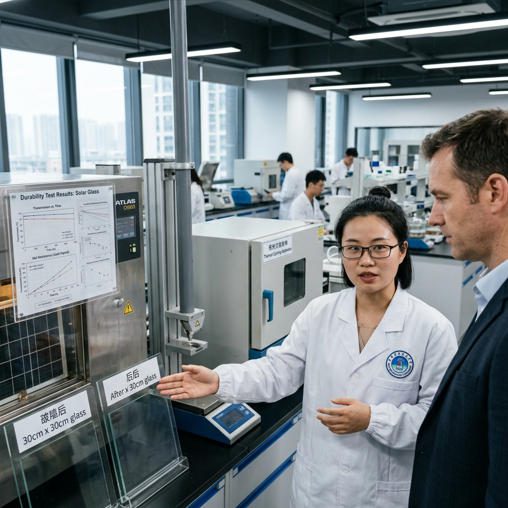
Long-term outdoor durability of solar glass is verified through two critical standardised tests. Damp heat testing at 85 °C / 85 % RH for 1,000 hours is the most diagnostic indicator for coastal and humid-climate projects. Thermal cycling (200 cycles between −40 °C and +85 °C per IEC 61215 MQT 11) tests solder joint fatigue, delamination resistance, and edge-seal integrity.
Premium glass-glass laminates — products with glass on both front and rear rather than a polymer backsheet — consistently outperform glass-backsheet modules in both tests, because the symmetric thermal expansion prevents differential stress at the cell layer. Procurement teams should request the actual test result pages showing measured power loss after each test. An acceptable result is less than 3 % power loss after 1,000 hours of damp heat; anything above 4 % is a risk signal for projects in coastal or tropical climates.
Durability and Weather Resistance
Impact of Hail, Wind, and Abrasion
The standard IEC 61215 hail test uses 25 mm ice balls at 23 m/s — adequate for many European and Asian locations, but insufficient for the US Great Plains, northern India, and parts of central Europe where hailstones frequently exceed 40–70 mm. For projects in these geographies, specify the Extended Hail Stress Sequence (HSS), which uses progressively larger impactors to failure. A standard IEC certificate does not cover this; request HSS test results explicitly from the shortlisted supplier.
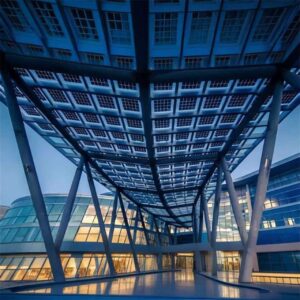
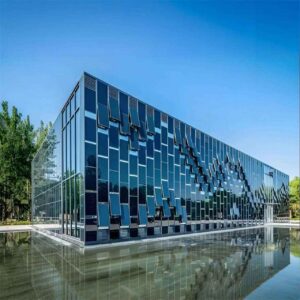
Wind load compliance is governed by IEC 61215 mechanical load tests: 2,400 Pa (roughly equivalent to 195 km/h design wind speed on a facade). For tall buildings in exposed coastal or high-altitude locations, local wind engineers may calculate design pressures substantially higher. Jia Mao BIPV’s laminated facade glass is rated to a wind-pressure resistance of 4.0 kPa — 67 % above the IEC minimum — making it viable for high-rise curtain-wall applications where standard BIPV products would require additional structural support.

Longevity Expectations
According to NREL’s PV performance database, the median annual degradation rate across modern crystalline silicon modules is approximately 0.5 %/year. Premium manufacturers using glass-glass laminates and POE encapsulant achieve 0.25–0.35 %/year in long-term field data. That 0.25 % difference sounds small — but over 25 years on a 1,000 m² facade generating 130 W/m² at 1,400 peak sun hours/year, the cumulative yield difference reaches approximately 455,000 kWh — roughly USD 54,600 at USD 0.12/kWh commercial tariffs before accounting for escalation.
SoliTek, the Lithuanian glass-glass BIPV manufacturer, warranties their SOLID glass-glass modules for 30 years product and 30 years at ≥90 % efficiency — the longest coverage structure in the mainstream market. This is underpinned by the inherent moisture-barrier advantage of dual-glass construction: glass-on-glass modules eliminate polymer backsheet degradation, the primary cause of accelerated ageing in standard modules.
Brand Alpha: Performance Highlights — Onyx Solar
Efficiency Gains and Light Transmission
Onyx Solar, headquartered in Ávila, Spain, is one of the most architecturally versatile BIPV glass suppliers with installations in more than 60 countries. Their product line covers both amorphous silicon (a-Si) thin-film and monocrystalline silicon (c-Si) photovoltaic glass in configurations for ventilated facades, curtain walls, skylights, walkable floors, and canopies.
Their a-Si product offers a temperature coefficient of Pmax of just −0.19 %/°C — roughly half the thermal loss of standard crystalline silicon (−0.35 to −0.40 %/°C). In Riyadh or Phoenix where roof surface temperatures regularly reach 70–75 °C, this coefficient advantage translates to approximately 8–12 % more annual energy generation relative to what the STC efficiency rating alone would imply. Their solar factor range of 6 %–41 % enables precise solar heat gain control — a meaningful value in both energy-modelling for building permits and for occupant thermal comfort specifications.
Warranty and Customer Feedback
Onyx Solar’s standard product warranty covers 10 years for manufacturing defects and 25 years for linear power output (80 % of rated output at year 25). Their curtain wall glass installations at Larsen & Toubro’s corporate campus in India and George Washington University’s walkable PV floor installation — two projects in very different climate and load contexts — both reported actual annual yields within 5 % of modelled projections after 3+ years of monitoring. For a BIPV facade product, that modelling accuracy is above the industry median; a ±15 % variance is common with first-time specifiers.
Brand Beta: Performance Highlights — Mitrex
Efficiency, Durability, and Warranties
Mitrex Integrated Solar Technology, based in Toronto, Canada, leads in opaque solar facade cladding — panels that replace spandrel or rain-screen cladding on commercial buildings while generating electricity. Their eFacade PRO line achieves cell efficiency up to 22.5 % and energy generation up to 405 W per standard panel, with a panel-level power density in the 150–194 W/m² range for opaque formats. eFacade LITE delivers up to 18 W/SF (≈ 194 W/m²) at lighter weight, targeting retrofit cladding projects.
Mitrex panels carry a 25-year warranty for both product quality and performance, with 80 % of rated output guaranteed at year 25. The product is designed for large-format facade applications: standard panel sizes run to 1,500 × 3,000 mm, which reduces installation time on grid-based curtain-wall systems compared to smaller-format BIPV modules. The company’s proprietary Mitrex Colour technology enables full-colour facade aesthetics — any RAL or custom colour — without meaningfully reducing power output, because the colour layer sits outside the optical path of the cell stack.
Brand Gamma: Performance Highlights — SoliTek & Jia Mao BIPV
Real-World Data and Case Studies
SoliTek (Lithuania) manufactures glass-glass BIPV modules specifically engineered for rooftop and facade integration in northern European climates. Their SOLID bifacial line combines 355–380 Wp per module with a 30-year product warranty and 30-year ≥90 % efficiency guarantee — the most aggressive performance warranty structure reviewed in this guide. Glass-glass bifacial construction means the rear face also captures diffuse reflected irradiation, adding 5–15 % to annual yield on roof installations with high-albedo surfaces. For Nordic projects where diffuse irradiation accounts for a substantial fraction of annual solar resource, this rear-side capture is commercially meaningful.
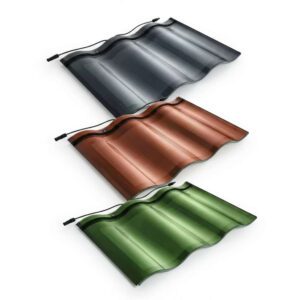
Jia Mao BIPV, manufactured by Shanghai Jia Mao New Energy Technology Co., Ltd., occupies a strategically important market position: a full-portfolio BIPV supplier — transparent solar glass, opaque facade panels, solar roof tiles, and PV shingles — with IEC 61215 and IEC 61730 certifications, a 25-year performance guarantee, and a 3 GW annual production capacity that enables economies of scale unreachable by smaller European BIPV manufacturers. Their ultra-clear tempered glass achieves 91.5 % light transmittance (8 % above standard glass), wind pressure resistance of 4.0 kPa, and a self-cleaning coating that reduces maintenance costs by approximately 30 % over the system life. Monocrystalline cells exceed 22 % efficiency, with invisible busbar technology that improves facade aesthetics on transparent installations. Importantly, their encapsulation uses imported POE films — improving UV-ageing resistance by 40 % versus standard EVA and eliminating PID risk with a double-layer moisture barrier.

Value for Money: Cost, Warranty, and Total Cost of Ownership
Initial Cost vs. Long-Term Savings
| Бренд | Cell Technology | Плотность мощности (Вт/м²) | Temp. Coeff. Pmax | Диапазон VLT | Glass-Glass | Product Warranty | Performance at Yr 25 | Installed Cost (USD/m²) | IEC 61215 + 61730 |
|---|---|---|---|---|---|---|---|---|---|
| Onyx Solar | a-Si thin-film / c-Si | 30–160 | −0.19 %/°C (a-Si) | 6 %–41 % | Да | 10 years | 80 % | $320–$580 | Both |
| Mitrex eFacade | Mono-Si c-Si | 150–194 | −0.35 %/°C | 0 % (opaque) | Да | 25 лет | 80 % | $280–$520 | Both |
| SoliTek SOLID | Mono-Si bifacial | 140–180 | −0.34 %/°C | 0 %–15 % | Да | 30 лет | 90 % | $220–$400 | Both |
| Schott Solar Glass | Glass component (multi-cell compatible) | N/A (component) | Per module assembler | Custom | Да | 25 лет | Per assembler | $95–$260 (FOB glass) | EN / IEC |
| Xinyi Solar | Low-iron AR glass component | N/A (component) | Per module assembler | Per spec | Options | 10 years | Per assembler | $95–$160 (FOB) | IEC / ISO |
| Jia Mao BIPV | Mono-Si (>22 % eff.) | 40–200 | −0.35 %/°C | 10 %–90 % | Да | 25 лет | 80 % | $120–$250 | Both + CE |
| Солнечная крыша Tesla | Mono-Si (tile format) | ~72 W/tile | ~−0.30 %/°C (est.) | 0 % (opaque) | Н/Д | 25 лет | 80 % | $600–$800/m² equiv. | UL / IEC |
| GAF Timberline Solar | Mono-Si shingle | ~45 W/shingle | ~−0.35 %/°C | 0 % (opaque) | Н/Д | 25 лет | 85 % | $380–$550/m² equiv. | UL / IEC |
Sources: manufacturer published datasheets; Metsolar BIPV cost analysis; Market Growth Reports 2024; IEA-PVPS Technical Guidebook 2025. Installed cost includes glass laminate, framing, and labour. FOB = factory price excluding installation. Ranges reflect product variety within each brand’s portfolio.
Based on: Metsolar cost study; Market Growth Reports BIPV 2024. Excludes energy revenue offset.
Warranty Terms and Service Coverage
A 25-year performance warranty is only as valuable as the company behind it. When LG Solar exited the PV business entirely in 2022, thousands of customers holding valid warranties discovered that the warranty document was effectively worthless without an operating manufacturer to service it. Procurement teams should evaluate warranty viability through three lenses: financial standing (publicly listed companies provide transparent balance-sheet access); local service presence (is there an authorized service partner in your project’s country?); and insurance backing (does the warranty carry underwriter backing independent of the manufacturer’s continued operation?).
For commercial projects, the most protective warranty structure combines a product workmanship warranty of at least 12 years, a linear power output warranty showing year-by-year power floors through year 25, and a defined SLA for warranty claims — 10 business days for initial response is best practice. Jia Mao BIPV’s 25-year performance guarantee includes a B1 flame-retardant classification and structural-grade adhesive certification with a 25-year service life — relevant not just for solar performance but for the building envelope certification that many commercial projects require for their structural glazing submissions.
Installation and Compatibility: Roof Types and Mounting
Weight Considerations and Mounting Options
Solar glass adds dead load to a building’s structural system that must be verified against the existing or designed load capacity. The range is meaningful:
| Product Format | Typical Weight (kg/m²) | Equivalent Dead Load (psf) | Compatible Roof Types | Mounting System | Structural Review Required? |
|---|---|---|---|---|---|
| Glass-Glass BIPV Laminate (4+4 mm) | 20–24 kg/m² | 4.1–4.9 psf | Flat, low-slope (<15°), curtain wall | Aluminium framing / point-fix | Yes — always |
| Thin Glass BIPV (2+2 mm) | 12–16 kg/m² | 2.5–3.3 psf | Flat, retrofit facades, skylights | Frameless bonding / rail | Yes — lightweight option |
| BIPV Roof Tile (concrete base) | 18–28 kg/m² | 3.7–5.7 psf | Pitched (15°–45°) — new build or full re-roof | Interlocking tile battens | Yes — especially retrofits |
| Metal Roof PV (Kalzip-style) | 8–12 kg/m² | 1.6–2.5 psf | Standing seam metal, barrel vault, curved | Bonded or clipped to seam | Often not required |
| Solar Shingle (GAF / Tesla format) | 10–14 kg/m² | 2.0–2.9 psf | Pitched residential / commercial (15°–60°) | Nailed / adhesive strip | Standard roof load check |
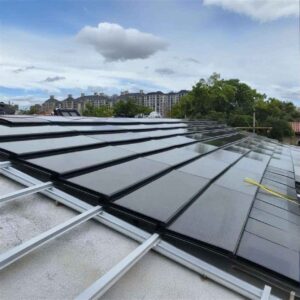
| Jia Mao BIPV Laminated Glass (BIPV facade) | ~21.5 kg/m² (11 mm stack) | ~4.4 psf | Facade, skylight, flat roof overlay | Structural silicone / curtain wall frame | Yes — structural calc provided by supplier |
Sources: Jia Mao BIPV solar glass roofing guide; ASCE 7-22 dead-load provisions; IEA-PVPS BIPV Technical Guidebook 2025. psf = pounds per square foot.
Compatibility with Existing PV Systems
Solar glass products operate at DC voltages and currents governed by the system’s inverter and string design. Most BIPV glass modules are compatible with standard string inverters and microinverter / DC optimizer architectures. For facade installations with complex shading patterns — mullion shadows, adjacent building obstructions, or low-angle winter sun across tall facades — module-level power electronics (MLPEs) such as microinverters or DC optimisers consistently outperform string configurations by 8–14 % annual yield in independently monitored installations. Confirm with the BIPV glass supplier that the module’s electrical connectors (MC4 or compatible) are accessible after installation and that bypass diode configuration matches the shading profile of the specific facade.
Maintenance and Support: Service Quality and Parts Availability
Replacement Parts and Response Times
Facade-integrated solar glass creates a maintenance context fundamentally different from rack-mounted panels. Roof panels can be accessed with standard fall-arrest equipment. Facade glass on a multi-storey building requires a building maintenance unit (BMU), rope access, or swing stage — equipment that costs approximately USD 8,000–22,000 per mobilisation for a typical commercial building. This maintenance access cost is frequently under-modelled in BIPV project financial cases; the actual field data shows it can account for 35–50 % of total 25-year O&M expenditure.
Minimising maintenance interventions therefore has real financial value. Products with self-cleaning coatings — hydrophilic or hydrophobic nano-coatings that prevent soiling adhesion and use rainfall to rinse the glass surface — reduce cleaning frequency from 3–4 times per year to 1–2 times in most urban environments. Jia Mao BIPV’s photovoltaic glass incorporates this self-cleaning coating as a standard specification, with documented maintenance cost reduction of approximately 30 % over equivalent non-coated glass in field conditions. For a 2,000 m² facade with annual cleaning costs of USD 3.50/m², that 30 % reduction saves approximately USD 2,100/year — or USD 52,500 over a 25-year service life before applying a discount rate.
Replacement glass availability is a procurement risk that most buyers underestimate. Ask every shortlisted supplier: “If I need a replacement panel for this project in year 12, will the current cell type and colour be available?” Some manufacturers commit to 15-year colour and cell-type availability for completed projects; others offer only best-effort matching. For buildings where visual facade uniformity matters — a hotel, a corporate headquarters, a cultural institution — this replacement-matching commitment should be a contractual term, not a verbal assurance.

Future Trends: Next-Gen Materials and Integration with PV Systems
Smart Glass and Dynamic Shading
The next performance frontier in solar power glass is the combination of photovoltaic generation with dynamic optical control. Electrochromic glass — which adjusts tint in response to electrical signals, UV intensity, or temperature — has been commercially available for a decade, but at prices that limited adoption to flagship buildings. The global electrochromic glass market stood at USD 2.13 billion in 2025 and is projected to reach USD 3.9 billion by 2035 (OpenPR, 2025). As manufacturing scale increases, integration with BIPV cell layers is becoming technically viable.
Researchers at Canada’s University of Toronto demonstrated in 2024 a hybrid electrochromic-perovskite solar glass that adjusts tint based on UV and infrared input while simultaneously generating electricity. In the clear state it generates maximum power; in the tinted state it blocks up to 78 % of solar heat gain. This dual function — generation and shading control — eliminates the traditional trade-off between transparency and energy yield that current semi-transparent BIPV glass faces. Commercial availability is expected in limited pilot formats by 2027–2028.
In parallel, UL’s BIPV product certification is increasingly required by US code jurisdictions as a condition of building permit approval — not just IEC certification. Third, the IEA-PVPS Task 15 working group published an updated BIPV Technical Guidebook in 2025, which standardises reference drawings and performance benchmarks for facades, curtain walls, and rainscreen systems — providing a common language for procurement specifications that reduces the risk of supplier-buyer misunderstanding on performance expectations.
Brand Comparison: Side-by-Side Decision Matrix
When to Choose Each Brand Profile
| Project Scenario | Best-Fit Brand Profile | Key Reason | Watch Out For |
|---|---|---|---|
| Hot climate (>40 °C avg summer, e.g., Dubai, Phoenix) | Onyx Solar (a-Si) or CdTe thin-film | Temperature coefficient −0.19 %/°C vs. −0.35 %/°C = 8–12 % more annual yield | Lower W/m² — need more facade area |
| Large-area opaque commercial facade cladding | Mitrex eFacade / Jia Mao BIPV opaque panel | Highest power density (150–194 W/m²), 25-yr warranty, scale pricing | No daylighting; requires cladding replacement budget |
| Nordic / high-latitude climate with diffuse irradiation | SoliTek SOLID bifacial | Rear-face capture adds 5–15 % in high-albedo conditions; 30-yr warranty | Higher per-panel cost vs. Chinese alternatives |
| Custom colour / heritage facade (any climate) | Onyx Solar coloured glass or Jia Mao BIPV coloured modules | Both offer custom RAL / Pantone colour with maintained certification | 8–15 % power loss vs. standard black cell; colour warranty required contractually |
| Skylights / overhead safety-critical glazing | Any glass-glass laminate with EN 356 / CPSC 16 CFR Part 1201 safety rating | Laminated glass prevents falling shards; mandatory for overhead use | Tempered-only BIPV glass is NOT acceptable overhead without interlayer |
| Budget-driven procurement with 25-yr lifecycle model | Jia Mao BIPV (full portfolio) | 3 GW capacity → scale pricing; $120–$250/m² covers facade, skylight, and tile formats | Verify IEC 61730 in addition to 61215 for building-envelope projects |
| Residential premium re-roof (aesthetics paramount) | Tesla Solar Roof / GAF Timberline Solar | Seamless integration; Class 3–4 hail rating; strong brand recognition for homeowners | Highest cost/W; Tesla installer availability varies by region |
| Large industrial / warehouse metal roof | Kalzip AluPlusSolar | Lightweight (8–12 kg/m²); bonds to standing seam without roof penetrations | Limited facade-format flexibility; curved profiles only in Kalzip seam system |

How to Apply This Comparison to Your Project
No single solar power glass brand dominates every application. The correct selection depends on the intersection of climate (temperature coefficient matters more in hot regions than cold), facade function (opaque cladding vs. transparent daylighting vs. overhead safety glazing each has distinct structural and optical requirements), budget structure (upfront vs. lifecycle), and project timeline (procurement lead times for custom BIPV glass can run 8–16 weeks from order to site delivery).
What the data consistently shows is that the performance gap between correctly specified premium glass and commodity alternatives is measurable and financially significant. A 500 m² facade choosing a product with a 0.70 %/year degradation rate instead of 0.30 %/year will generate approximately 250,000 fewer kWh over 25 years — equivalent to USD 30,000–USD 45,000 in lost revenue at typical commercial tariffs. That gap dwarfs the upfront price saving from choosing the cheaper product.
The actionable procurement sequence is: define climate and orientation; set power-density requirements and daylighting targets; require IEC 61215 + IEC 61730 test summary pages (not just certificates) from shortlisted suppliers; model 25-year NPV including O&M and degradation; verify manufacturer financial stability and local service presence; and confirm replacement-glass availability commitment before contract signature. Suppliers such as Jia Mao BIPV offer the full support documentation — IEC certificates, structural calculations, installation guides, and technical pre-sales review — that accelerates this process for procurement teams working against construction programme deadlines.
Request Samples, Technical Data, or a Project Quote
Whether you’re specifying a transparent curtain-wall facade, an opaque cladding system, or a full roof-plus-facade solar glass solution, Jia Mao BIPV’s technical team provides certified datasheets, structural load calculations, and project-specific pricing — backed by a 3 GW production facility and a 25-year performance guarantee.
Get a Technical Consultation →📖 Glossary of Solar Power Glass Terms
- BIPV (Building-Integrated Photovoltaics)
- Solar technology integrated directly into the building envelope — glass, tiles, or cladding — replacing a conventional building material while generating electricity. Contrast with BAPV (Building-Added PV), which mounts panels on top of a completed building.
- STC (Standard Test Conditions)
- The laboratory conditions used to rate PV modules: 1,000 W/m² irradiance, 25 °C cell temperature, AM 1.5 solar spectrum. Real-world output is almost always lower due to heat, shading, and angular losses.
- Плотность мощности (Вт/м²)
- Rated output per square metre of glass area at STC. More useful than efficiency percentage for comparing BIPV products of different transparency levels, because it directly tells you how much electricity a given facade area will generate at peak conditions.
- Temperature Coefficient of Pmax (%/°C)
- The rate at which power output declines per degree Celsius above 25 °C. Example: a panel rated −0.35 %/°C at 65 °C operating temperature produces (65−25) × 0.35 = 14 % less power than its nameplate rating. Lower values are better for hot climates.
- VLT / VT (Visible Light Transmission)
- The fraction of visible light that passes through the glass, expressed as a percentage. Higher VLT = more natural daylight indoors. Semi-transparent BIPV glass typically achieves 20–60 % VLT; transparent formats can reach 70–90 % VLT with proportionally lower power density.
- AR Coating (Anti-Reflective Coating)
- A nano-porous silica layer on the outer glass surface that reduces reflection from ~8 % to <1 %, boosting solar transmittance from ~91 % to 97 %+. Translates to approximately 4–7 % more energy yield vs. uncoated glass. Some AR coatings also repel soiling (hydrophobic) or promote self-cleaning (hydrophilic).
- Glass-Glass Laminate (Dual-Glass)
- A PV module with glass on both front and back, rather than a polymer backsheet on the rear. Better moisture protection; typically 0.10–0.20 %/yr lower degradation than glass-backsheet designs. Required for overhead glazing and skylights where safety regulations prohibit polymer-backsheet construction.
- POE Encapsulant (Polyolefin Elastomer)
- Premium encapsulant film bonding PV cells to glass, replacing the standard EVA. Resists UV-driven yellowing, absorbs less moisture, and reduces PID risk. Used by Jia Mao BIPV and leading EU manufacturers. Adds ~$3–8/m² to module cost but reduces degradation by 0.15–0.25 %/yr over 25 years.
- PID (Potential-Induced Degradation)
- Accelerated power loss caused by high DC system voltages driving current through the glass and frame into the PV cells. More common in 1,000 V+ systems. Glass-glass laminates with POE encapsulant and proper grounding substantially reduce PID risk.
- Performance Ratio (PR)
- Ratio of actual annual kWh output to theoretical maximum based on rated capacity and irradiation. A PR of 0.80 means the system captures 80 % of theoretically available energy. Industry benchmark for BIPV facades: 0.72–0.82. Useful for comparing actual installation performance against design projections.
- IEC 61215 / IEC 61730
- IEC 61215 = design qualification and type approval for terrestrial PV modules (thermal cycling, damp heat, hail, mechanical load). IEC 61730 = safety qualification (electrical insulation, dielectric withstand, wet leakage current). Both are minimum requirements for commercial BIPV glass procurement. For building-envelope use, also require applicable fire-safety classification (UL 790 Class A in the US; EN 13501-1 in Europe).
Часто задаваемые вопросы
What is the typical warranty period for solar power glass brands?
Most leading solar power glass brands offer a two-tier warranty: a product workmanship warranty covering manufacturing defects (typically 10–25 years depending on brand) and a linear power output warranty guaranteeing a minimum percentage of rated power at the end of the warranty term — usually 80 % at year 25. Premium manufacturers such as SoliTek offer a 30-year product warranty with a 90 % power floor at year 30, while Mitrex and Jia Mao BIPV offer 25-year combined product and performance warranties. Critically, the warranty is only valuable if the manufacturer remains solvent to honour it — always verify financial standing and local service availability alongside warranty document terms.
How should I compare efficiency ratings between solar glass brands?
Do not compare STC efficiency percentages in isolation. Instead, compare power density (W/m²) at STC and annual energy yield (kWh/m²/year) modelled for your specific site’s orientation, climate, and irradiation. Request third-party laboratory-verified power density figures, not manufacturer marketing data. Then model the temperature loss using the product’s temperature coefficient of Pmax for your location’s average operating temperature. A product rated at 150 W/m² STC with a −0.19 %/°C temperature coefficient may outperform a 175 W/m² product with −0.40 %/°C in a climate where average cell temperature exceeds 55 °C. The free NREL PVWatts Calculator can model annual yield for any location and orientation once you have the correct input parameters.
Can solar power glass be retrofitted to existing roofs?
Yes, with important caveats. Retrofit viability depends on three factors: structural load capacity (glass-glass BIPV laminates add 20–24 kg/m², which older roofs may not support without reinforcement); roof surface condition (the existing surface must be sound and level for bonded or framed BIPV systems); and electrical infrastructure (existing rooftop conduit and switchgear may need upgrading). Lightweight metal-PV systems such as Kalzip’s bonded-aluminium format (8–12 kg/m²) reduce the structural barrier. For pitched residential roofs in poor condition, a full re-roof using BIPV shingles or tiles (GAF Timberline, Tesla Solar Roof) is economically preferable to overlaying new glass panels on a failing substrate. Always conduct a structural assessment before specifying a retrofit BIPV product — load calculations provided by the glass manufacturer are a starting point, but a licensed structural engineer must verify site-specific conditions. See the Jia Mao BIPV installation and design guide for a systematic retrofit assessment framework.
How do installation methods affect long-term performance?
Installation quality is one of the most underestimated determinants of 25-year performance. Three installation decisions carry the highest long-term impact. First, ventilation gap: BIPV glass mounted flush against an insulated surface (no rear air gap) runs 7–15 °C hotter than ventilated mounting, causing additional temperature-coefficient losses and accelerating encapsulant ageing. Specify a minimum 50 mm rear ventilation gap on horizontal and low-slope installations where feasible. Second, edge-seal integrity: the perimeter seal is the primary moisture ingress point. Structural-grade silicone specified with a 25-year UV-resistance rating (not standard construction silicone) is the correct material — a detail that Jia Mao BIPV addresses through integrated drainage channels and certified structural adhesive strips with a 25-year service guarantee. Third, string configuration: panels connected in strings with mismatched orientations or shading exposure create diode-bypass losses. Module-level power electronics (microinverters or DC optimisers) applied to shaded or mixed-orientation installations recover 8–14 % in annual yield and pay back their additional cost in most commercial projects within 3–5 years. For background on MPPT optimisation in string configurations, the NREL PV research database provides the most current measured performance data.
What certifications are mandatory vs. recommended for BIPV glass?
Mandatory (for any commercial building-envelope application): IEC 61215 (design qualification), IEC 61730 (safety qualification), and applicable fire classification — UL 790 Class A or equivalent EN 13501 rating in Europe. For overhead glazing and skylights, laminated safety glass per EN 12543 or CPSC 16 CFR Part 1201 is additionally required. Strongly recommended: IEC 61701 salt mist certification for coastal projects (within 2 km of seawater), IEC TS 62804 for PID testing in 1,000–1,500 V DC systems, and the extended hail stress sequence (HSS) for projects in hail-prone geography. For US commercial projects, UL 61730 (the US national adoption of IEC 61730) is increasingly required by local jurisdictions as a building permit condition. The DSIRE incentive database can help verify which certifications are required for incentive eligibility in specific US states.
What is the payback period for solar power glass on a commercial building?
Payback periods for commercial BIPV glass projects typically range from 7–16 years depending on product, climate, electricity tariff, and incentive structure. A key variable is whether the BIPV product replaces a building material that would otherwise have been purchased — if so, only the incremental cost over standard cladding is attributed to the solar investment, shortening payback significantly. In the US, the 30 % federal Investment Tax Credit (ITC) and MACRS 5-year accelerated depreciation for commercial solar can reduce effective net cost by 40–55 % in year one for C-corporation taxpayers. European commercial projects benefit from feed-in premiums, SRECs, or net metering depending on jurisdiction. A 1,000 m² south-facing commercial facade in a mid-latitude location generating 110 kWh/m²/year at $0.12/kWh commercial tariff produces approximately $13,200/year in electricity value before incentives — providing a basis for straightforward payback modelling once total installed cost is established. The Jia Mao BIPV cost breakdown guide provides a structured methodology for building this financial model.
How does solar glass perform in different climates — and which brand is best for hot vs. cold regions?
In hot climates (Dubai, Phoenix, Singapore), the temperature coefficient of Pmax is the decisive technical specification. Onyx Solar’s amorphous silicon glass at −0.19 %/°C and CdTe thin-film products at −0.28 %/°C substantially outperform standard mono-Si BIPV (−0.35 to −0.40 %/°C) in high-temperature operating conditions. At 70 °C cell temperature — common on dark-coloured facades in summer — a panel with −0.35 %/°C operates at 84 % of rated output, while one at −0.19 %/°C operates at 91 %. Across a 1,000 m² facade in Dubai, that 7 % difference generates approximately 8,500 kWh/year more energy. In cold climates (Oslo, Helsinki, Calgary), high-efficiency mono-Si cells above 20 % are the better choice: the temperature advantage is minimal (cold temperatures actually improve crystalline silicon output), and maximising W/m² is critical to offsetting the lower annual irradiation. SoliTek’s bifacial glass-glass modules perform particularly well in Nordic contexts because rear-side capture of diffuse sky radiation adds 5–15 % to annual yield in these climates.
What is the difference between BIPV and BAPV, and which is more cost-effective?
BIPV (Building-Integrated Photovoltaics) means the solar element replaces a conventional building material — the glass panel is the facade, skylight, or roof cladding, performing all envelope functions (weather exclusion, insulation contribution, fire resistance) while generating electricity. BAPV (Building-Added Photovoltaics) means solar modules are mounted on top of a completed building envelope — the conventional rack-mount rooftop installation. Cost-effectiveness comparison requires accounting for the replaced material: a BIPV glass facade at $280/m² that replaces standard architectural glass at $180/m² carries only a $100/m² net incremental cost for the solar function. In contrast, BAPV adds its full cost on top of the existing building envelope. Over 25 years, the lifecycle NPV of BIPV consistently exceeds BAPV where architectural integration enables the dual-material replacement credit. The IEA-PVPS BIPV Technical Guidebook (2025) provides the authoritative framework for this cost comparison methodology.
What future technologies will change solar power glass performance?
Three technology developments will materially change performance benchmarks within the next 3–7 years. First, perovskite-silicon tandem cells have reached 33 %+ efficiency in laboratory conditions (NREL, 2024) and are targeted for commercial BIPV glass production by 2027–2029. Applied to opaque BIPV cladding, this would roughly double power density from today’s 150–175 W/m² to 280–320 W/m², transforming the financial case for facade solar. Second, integrated electrochromic-PV glass (demonstrated at University of Toronto, 2024) will allow facades to simultaneously generate power and dynamically control solar heat gain — eliminating the SHGC trade-off that currently forces specifiers to choose between daylighting, thermal control, and generation. Third, flexible BIPV substrates for curved architectural glass are progressing from prototype to early-production formats, enabling complex facade geometries that current rigid glass laminates cannot follow. Manufacturers such as Jia Mao BIPV already list flexible BIPV for curved designs within their intelligent material R&D roadmap — making material flexibility an emerging procurement option rather than a purely theoretical concept.
How do I verify that a solar glass supplier’s warranty claims are credible?
Warranty credibility verification should cover five areas. (1) Accredited test certificates: Request actual IEC 61215 and IEC 61730 test summary pages from an accredited laboratory — not just the certificate number. The IECEE CB Scheme provides internationally recognised test reports. (2) Field monitoring data: Ask for 12–36 months of monitored yield data from a completed installation of comparable scale. The ratio of monitored kWh/kWp to PVWatts modelled kWh/kWp reveals the real-world performance accuracy. (3) Financial standing: Listed companies (Xinyi Solar, AGC, NSG Group/Pilkington) provide public financial disclosure. For private manufacturers, request audited accounts or bankability assessment inclusion. (4) Bankability check: The PVEL/Kiwa PV Module Reliability Scorecard lists modules with the strongest long-term reliability profiles based on accelerated-stress test sequences more rigorous than standard IEC. (5) Warranty insurance: Premium suppliers offer warranty insurance through specialist underwriters (Lloyd’s of London market), providing a financial backstop independent of the manufacturer’s continued operation — ask specifically whether this option is available for your project value.