I. Introduction
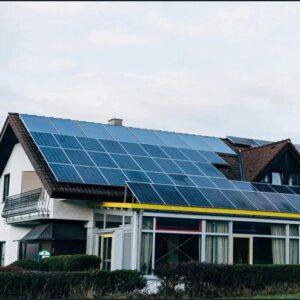
A rooftop solar array adds power generation to a building. Building-integrated photovoltaics (BIPV) go further: they replace part of the roof, façade, glazing, or shading system while generating electricity.
That difference changes the project brief.
For an engineering, procurement, and construction (EPC) contractor, solar glass is not just another module to connect. It must meet the architect’s visual requirements, the façade engineer’s load calculations, and the owner’s energy targets.
A pane with strong electrical output can still be the wrong choice if it makes an office too dark, overloads an existing frame, or leaves a junction box inaccessible.

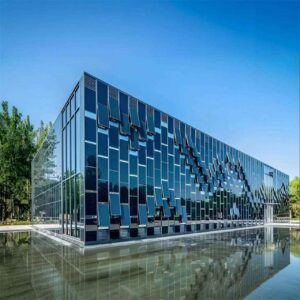
Feature image: Copenhagen International School illustrates how photovoltaic surfaces can become part of the architectural design. This is an opaque solar façade example, not transparent vision glazing. Photo: Leif Jørgensen, Wikimedia Commons image source, CC BY-SA 4.0.
Solar glass is architectural glass that incorporates photovoltaic cells or active films to produce electricity. Depending on its construction, it can also provide daylight, shading, insulation, and weather protection.
Its strongest business case combines these functions. Instead of buying conventional glazing and a separate solar installation, the project team evaluates one coordinated building-envelope asset.
The opportunity is not to maximize watts at any cost. It is to balance design, structural performance, building energy use, and long-term return.
II. Technical Synergy: Enhancing Energy Generation through Solar Glass
High-performance solar glass improves how sunlight reaches the photovoltaic material. Its glazing assembly must also manage the heat that sunlight brings into the building.
Match transparency to the space—not a universal target
Visible light transmittance (VLT) is the share of visible light that passes through glazing. A VLT of 40% means the tested assembly transmits 40% of incoming visible light.
For spaced silicon-cell glass, increasing the clear gaps generally reduces the active cell area per square meter. That usually lowers power density, even when the individual cells retain the same efficiency.
Cell efficiency and whole-module efficiency are not interchangeable. A supplier’s cell-efficiency figure does not describe the output of a large pane with clear gaps, borders, and inactive areas.
| Glazing strategy | Practical application | Energy trade-off | What to verify |
|---|---|---|---|
| Higher-transparency PV glass | Office vision areas and public entrances | More daylight, usually less active PV area | Whole-pane VLT, glare, and rated watts |
| Medium-transparency PV glass | Atriums, skylights, and shading elements | Balance between daylight and generation | Daylight and annual energy models |
| Low-transparency or opaque PV glass | Spandrels and service zones | More active area without sacrificing required views | Color consistency and façade heat behavior |
These are design categories, not universal product specifications.
For a mixed office façade, one sensible approach is to preserve clearer vision glazing and concentrate generation in spandrels or sun-exposed shading zones.
When reviewing transparent photovoltaic glazing options from Jia Mao Bipv, request a matched specification for each proposed configuration: VLT, rated power, glass build-up, and thermal properties. Do not combine the best figures from different variants.
Use anti-reflective coatings with realistic expectations
An anti-reflective coating reduces reflection at the glass surface, allowing more light to reach the cells.
The gain depends on the coating, sun angle, and complete module construction. Ask for test data that compares coated and uncoated versions of the same product.
Lower reflection also does not eliminate glare. Nearby roads, buildings, and pedestrian areas may still require a separate glare assessment.
Make bifacial gain a site-specific calculation
Bifacial cells generate electricity from light reaching both their front and rear surfaces.
A glass canopy above a light-colored courtyard may receive useful rear-side light. A module backed by an opaque spandrel panel may receive almost none.
Rear-side output depends on:
- Surface reflectivity.
- Clearance behind the module.
- Frame and structural shading.
- Nearby buildings.
- The module’s actual bifacial response.
Industry insight: A bifacial module label is not evidence of a bifacial energy gain. The project model must show that usable light reaches the rear cells.
III. Structural Integration: Solving the Architect-Engineer Conflict
Solar glass can remove the need for a separate PV mounting layer when it replaces an existing envelope component. It does not remove the need for engineered frames, anchors, drainage, or glass supports.
Coordinate curtain walls and skylights early
A curtain wall is a non-load-bearing exterior wall supported by the building’s structure. It still carries its own weight and transfers wind loads through its framing and anchors.
Successful PV glazing integration requires agreement on:
- Glass thickness and panel weight.
- Glazing-pocket dimensions.
- Edge support and setting blocks.
- Cable exits and accessible connection points.
- Drainage paths.
- Replacement access.
Skylights add overhead-glazing requirements. Post-breakage retention—the ability to keep broken glass in place—can be as important as strength before breakage.

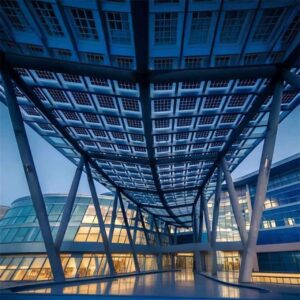
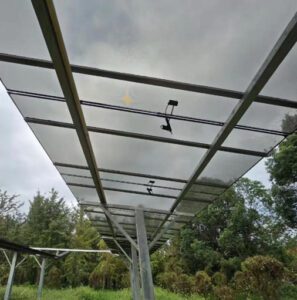
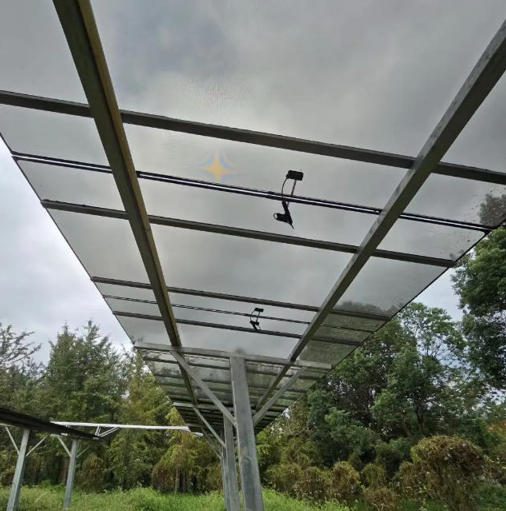
Structural reference: even an integrated solar design needs a defined load path and maintenance access. This photograph shows a solar canopy, not a certified solar-glass skylight. Photo: Philiplkinser, solar canopy image source, CC BY-SA 4.0.
Count avoided materials without overlooking added work
Replacing conventional glazing can avoid duplicate glass, separate mounting rails, and an additional installation sequence.
However, savings depend on the design. Custom sizes, special connectors, extra handling, and electrical inspections can offset those benefits.
Prepare a responsibility matrix before tender. Identify who owns the glazing installation, electrical connections, waterproofing, testing, and final commissioning.
The IEA PVPS BIPV technical guidebook provides reference details for curtain walls, roofs, shading systems, and other integration types.
Verify both electrical and building compliance
A PV module certificate does not prove that a façade assembly meets local building requirements.
| Evidence | What it addresses | Procurement check |
|---|---|---|
| IEC 61215, where applicable | PV design qualification and durability testing | Confirm the offered model and technology are covered |
| IEC 61730 or applicable UL listing | PV module electrical safety | Check model, voltage rating, and installation conditions |
| IEC 63092-1 and -2 | BIPV module and system requirements | Review the intended mounting arrangement |
| Local architectural-glass standards | Safety glazing and breakage behavior | Confirm suitability for the application |
| Façade assembly testing | Wind, air, water, and applicable fire performance | Assess the complete proposed system |
The IEC 63092-1 scope specifically addresses PV modules used as building products; mounting-system requirements fall under Part 2.
For laminated BIPV façade glass, obtain the relevant test reports for the exact glass build-up. Product-page descriptions are a starting point, not a substitute for approval documents.
IV. Thermal Performance and Building Energy Balance
Solar glass can influence building energy use beyond the electricity it generates. The result depends on the complete glazing assembly, climate, orientation, and occupancy.
Low-E controls radiant heat transfer
Low-emissivity (Low-E) coatings reduce radiant heat transfer through glazing. Different coatings serve different climate and solar-control needs.
An insulating glass unit (IGU) combines multiple panes with a sealed cavity. PV glass may form one pane within that assembly.
Solar glass is not automatically insulating, and it is not automatically Low-E. Specify the complete IGU rather than the photovoltaic laminate alone.
The U.S. Department of Energy’s window technology guidance highlights the importance of glazing, frames, spacers, and gas fills in overall window performance.
SHGC helps prevent overheating
The solar heat gain coefficient (SHGC) measures the share of solar energy entering through a glazing assembly as heat. Lower values generally mean less solar heat gain.
For example, under the same test conditions, glazing with an SHGC of 0.25 admits less solar heat than glazing with an SHGC of 0.50.
That does not mean the whole building’s cooling bill falls by half. Ventilation, people, equipment, lighting, and opaque walls also affect cooling demand.

PV shading can address incoming sunlight before it reaches the interior glazing. Photo: Esmail7, Singapore photovoltaic shading image source, CC BY-SA 3.0.
For commercial spaces, model three effects together:
- Electricity generation.
- Changes in heating and cooling energy.
- Changes in artificial-lighting demand.
Darker glass may reduce cooling while increasing lighting energy. In a heating-dominated climate, blocking winter solar gains may also carry a penalty.
LEED and BREEAM need project evidence
Solar glass can support energy-related certification outcomes, but it does not earn a fixed number of points simply by being installed.
The USGBC energy-performance guidance explains how qualifying renewable generation can enter the relevant LEED energy calculations.
Similarly, BREEAM’s photovoltaic delivered-energy guidance calls for delivered electrical energy in the calculation it addresses.
Confirm the project’s rating-system version and assessment route before promising credits.
Industry insight: Report energy generated and energy avoided separately. Combining them without explaining the baseline makes performance difficult to audit.
V. Cost-Benefit Analysis: From Capex to Long-Term ROI
Capital expenditure (capex) is the upfront project cost. For BIPV, that cost should be evaluated against the building component being replaced.
Calculate the installed net premium
Incremental BIPV cost = installed BIPV package − installed conventional-envelope package avoided.
Include engineering, wiring, inverters, handling, testing, and commissioning in the BIPV package. Subtract only costs that genuinely disappear.
Excel-ready worked example
The following is an illustrative commercial-façade feasibility model, not a supplier quotation or measured customer result. The table can be copied into Excel for project-specific revision.
| Input or calculation | Illustrative value | Basis |
|---|---|---|
| PV glazing area | 1,000 m² | Selected façade zones |
| Rated power density | 120 W/m² | Assumed whole-pane rating |
| Installed PV capacity | 120 kWp | 1,000 × 120 ÷ 1,000 |
| Annual specific yield | 600 kWh/kWp | Assumed net AC yield after losses |
| Annual PV generation | 72,000 kWh | 120 × 600 |
| Annual HVAC electricity avoided | 24,000 kWh | Assumed building-model result |
| Installed BIPV package | $450,000 | Envelope plus electrical scope |
| Conventional glazing avoided | $300,000 | Equivalent installed baseline |
| Incremental investment | $150,000 | $450,000 − $300,000 |
| Electricity value | $0.15/kWh | Assumes full on-site use |
| Annual PV electricity value | $10,800 | 72,000 × $0.15 |
| Annual HVAC savings value | $3,600 | 24,000 × $0.15 |
| Incremental annual maintenance | $2,400 | Assumed additional cost |
| Net annual benefit | $12,000 | $10,800 + $3,600 − $2,400 |
| Simple payback | 12.5 years | $150,000 ÷ $12,000 |
kWp means kilowatts of rated peak power under standard test conditions. kWh measures electricity produced or consumed over time.
Original chart based on the illustrative inputs above. The investment decision concerns the $150,000 premium—not the full $450,000 package alone.
This simple payback excludes financing, degradation, taxes, incentives, replacements, and changing electricity prices. It is a screening result, not a complete investment appraisal.
Compare LCOE on consistent terms
Levelized cost of energy (LCOE) is the discounted lifetime cost divided by discounted lifetime electricity production.
A well-oriented rooftop array may produce electricity more cheaply than vertical PV glazing. BIPV can still make financial sense because it replaces another required building component.
Show both:
- PV-only LCOE: electricity-generation costs assessed on a comparable basis.
- Incremental BIPV economics: the premium after avoided envelope costs, with thermal benefits listed separately.
Do not silently include HVAC savings in the electricity-generation denominator.
Treat property value and independence as conditional benefits
Reduced operating costs may improve an asset’s financial appeal. Any property-value uplift still depends on local valuations, leases, and evidence of sustained performance.
On-site solar can reduce purchased electricity. It does not guarantee power during an outage: backup operation requires suitable storage, controls, and islanding capability.
VI. Overcoming Installation Challenges for Specialized Contractors
Precision matters because solar glazing is both a live electrical component and part of the weather barrier.
Route wiring without blocking drainage
Conceal cables within approved frame channels, but keep them away from drainage routes, sharp edges, and moving joints.
Provide:
- Accessible junction boxes and connectors.
- Cable strain relief.
- Compatible, correctly matched connectors.
- Clear panel and circuit identification.
- Code-compliant isolation and emergency provisions.
Do not bury a service connection behind permanent finishes unless an approved replacement method exists.
Allow differential thermal movement
Glass, aluminum, seals, and cables expand at different rates.
The façade engineer should define edge clearances, setting blocks, joint movement, and cable slack. Installers should never force a tight-fitting pane into position.
Also evaluate partial shading, dark frit patterns, nearby heat sources, and edge damage. These can create uneven glass temperatures and increase thermal-stress risk.
Use three quality-control gates
| Gate | Required checks | Record to retain |
|---|---|---|
| Factory release | Dimensions, visual quality, electrical testing, traceability | Panel-specific release records |
| Instalação | Orientation, support, cable routing, seals, drainage | Inspection checklist and photographs |
| Commissioning | Electrical safety, output checks, air and water testing as specified | Signed reports and as-built drawings |
A full-size mock-up should include the real glass, framing, gaskets, cable exits, and connection details.
Industry insight: A successful glass sample proves appearance. A successful mock-up proves that the trades can build, test, and service the proposed assembly.
Watch: BIPV design and coordination
Acelab’s Understanding Building-Integrated Photovoltaics webinar provides an overview of solar façade integration.
https://www.youtube.com/watch?v=ZX-JbDQVBPo
VII. Strategic Sourcing and Material Selection for Distributors
For building-material brands and distributors, the main risk is not choosing the wrong marketing category. It is supplying a configuration that differs from the approved sample or tested assembly.
Tempered and laminated are not opposing choices
Vidro temperado is heat-treated for greater strength and a characteristic fragmentation pattern.
Vidro laminado uses an interlayer to bond glass panes and retain fragments after breakage. A PV laminate may use tempered or heat-strengthened panes.
Ask the engineer to specify both the glass treatment and the laminate construction. Overhead, barrier, and façade applications may have different requirements.
Check the electrical layers and edge protection
Conductive grids collect current from cells. Some thin-film technologies use transparent conductive coatings, which carry current while allowing light through.
Durability review should cover:
- Moisture ingress and edge sealing.
- Electrical interconnect stability.
- Delamination.
- UV exposure.
- Thermal cycling.
- Corrosion in coastal conditions.
- Compatibility with sealants and encapsulation materials.
Request evidence for the offered materials and model family, not an unrelated sample.
Control customization and lead times
Each new size, cell pattern, color, or connector position can affect engineering, testing, production, and replacement stock.
Before placing a large order:
- Freeze the glazing schedule.
- Approve a reference sample and tolerances.
- Confirm certification coverage.
- Map deliveries to façade installation zones.
- Agree on spare panels and reorder terms.
- Define when design changes become chargeable.
Use Jia Mao Bipv’s photovoltaic glass product range to begin configuration discussions, then convert the selection into a project-specific technical schedule.
VIII. Future-Proofing Projects with Smart Solar Glass
Smart glazing can add useful controls, but it also adds interfaces that need commissioning and maintenance.
Electrochromic glass needs a combined energy model
Electrochromic glazing changes tint when an electrical signal is applied.
Paired with PV glass, it may help manage glare and incoming solar heat. However, tinting can affect photovoltaic output if it reduces light reaching the active layer.
Verify layer order, optical performance in each tint state, controls, and warranties. Do not assume every PV product supports dynamic glazing.
Use monitoring to find actionable faults
Internet of Things (IoT) monitoring connects meters and sensors so operators can track system conditions.
Useful façade monitoring compares output with sunlight and temperature. It should help distinguish dirt, shading, and equipment faults from normal weather changes.
For example, if one façade zone underperforms while neighboring zones receive similar sunlight, an inspection may find a connection fault rather than a glass-performance problem.
Prepare the electrical infrastructure for future services
Vehicle-to-grid (V2G) allows compatible electric vehicles to export power through approved bidirectional charging equipment.
Solar glass does not provide V2G by itself. Future readiness depends on inverter capability, metering, switchgear, communications, and utility approval.
Reserve practical space and connection capacity where justified. Specify open data access and exportable performance records to reduce dependence on one monitoring platform.
IX. Case Study Analysis: High-Performance Implementation
SwissTech Convention Center: architectural integration with clear limits
The SwissTech Convention Center in Lausanne demonstrates how photovoltaic glazing can replace a planned shading function rather than arrive as a separate rooftop addition.
Its west-facing entrance façade uses colored dye-sensitized solar cells—a technology that uses light-absorbing dyes to help generate electrical current.

SwissTech Convention Center, Lausanne. Photo: Ramoul, SwissTech project image source, CC BY-SA 3.0.
The manufacturer’s delivery report documents:
| Project item | Publicly reported information |
|---|---|
| Installation area | Approximately 300 m² |
| Active photovoltaic area | Approximately 200 m² |
| Panels | 355 |
| Aparência | Five shades of red, orange, and green |
| Light transmission | More than half of incoming sunlight |
| Annual electricity | Approximately 2,000 kWh estimated |
| Monitoramento | Individual panel monitoring |
The design combined shading, daylight, color, and electricity generation. It should not be used as a modern silicon PV-glass yield benchmark.
An important source distinction also matters: EPFL’s early planning announcement projected 8,000 kWh annually, while the later manufacturer report estimated 2,000 kWh.
Neither figure is a measured annual production record in those sources. EPC proposals should use the final approved configuration and clearly separate predicted output from monitored results.
Energy saved versus energy generated
The published material describes protection against overheating, but it does not quantify annual HVAC savings.
For the separate commercial-façade model in Section V:
- PV electricity generated is assumed to be 72 MWh/year.
- HVAC electricity avoided is assumed to be 24 MWh/year.
- The gross annual financial benefit is $14,400 before additional maintenance.
Original illustrative chart. The percentages describe modeled financial benefits, not measured SwissTech performance.
Compare timelines without inventing savings
The SwissTech inauguration account reports a study phase, production in 2013, and delivery of all 355 panels in October. It provides no matched conventional-PV schedule.
For general contractors, the useful comparison is therefore the work sequence:
| Stage | Integrated solar glass | Conventional glazing plus separate PV |
|---|---|---|
| Design | Earlier façade-electrical coordination | More separation between packages |
| Procurement | Configuration freeze can become critical | Standard PV may offer more flexibility |
| Instalação | Glazing and wiring coordinated together | Distinct glazing and PV sequences |
| Commissioning | Envelope and electrical acceptance | More separate acceptance packages |
Integration can remove duplicate work, but custom approvals can extend preconstruction. Neither route is automatically faster.
Define client satisfaction before handover
Public sources do not provide a quantified satisfaction score or audited operating-cost reduction for this installation.
For a commercial project, agree on measurable acceptance criteria instead:
- Approved appearance under defined viewing conditions.
- Glare and daylight performance.
- Weather-normalized generation.
- Maintenance access.
- Comfort complaints.
- Actual operating costs against the agreed baseline.
That creates evidence the owner can use—not just a favorable photograph.
X. Conclusion
Solar glass earns its place in a PV EPC project when it performs several required jobs well: envelope protection, architectural design, daylight control, and electricity generation.
The commercial advantage comes from coordinating those jobs early.
Before tender, bring the façade contractor, electrical designer, architect, energy consultant, and supplier into one review. Confirm the assembly, annual yield, replacement method, and installed net premium before approving production.
For a project-specific discussion with Jia Mao Bipv’s solar building-material team, prepare the façade elevations, glazing schedule, site location, target appearance, and delivery sequence.
In a decarbonizing market, mastering BIPV means more than specifying solar glass. It means delivering a building component whose design, safety, energy performance, and financial value can all be checked.
Project glossary
| Term | Plain-English meaning | Practical example |
|---|---|---|
| VLT | Visible light passing through glazing | A 40% VLT assembly transmits 40% under the stated test conditions |
| SHGC | Solar energy entering as heat | Lower SHGC can help limit summer heat gain |
| Valor U | Rate of heat transfer through an assembly | Lower U-value generally means better insulation |
| Bifacial gain | Extra output from rear-side light | A reflective courtyard may improve canopy output |
| Thermal bridge | A path where heat bypasses insulation | An unbroken metal frame can weaken thermal performance |
| LCOE | Lifetime cost per unit of electricity | Compare systems using consistent assumptions |
| Weather-normalized yield | Output adjusted for weather differences | Helps identify faults during an unusually cloudy year |
Image licenses: the photographs are reusable with attribution under Creative Commons BY-SA 4.0 or Creative Commons BY-SA 3.0, as identified in each caption. No editorial alterations have been made.
Related FAQs for Clients
1. How does solar-glass transparency affect energy yield?
For spaced silicon-cell glass, greater transparency usually means less active cell area per square meter. Compare whole-pane VLT and rated power together. Annual yield also depends on orientation, shading, temperature, and system losses.
2. Can solar glass be retrofitted into an existing curtain wall?
Yes, if the existing frame, anchors, glazing pockets, drainage, and electrical routes can accommodate it. A façade survey and structural review are essential. Replacement during a planned envelope refurbishment may avoid some duplicate access costs.
3. What is the typical lifespan of solar glass?
Many crystalline-silicon PV products are designed around 25–30-year power-service expectations. For solar glass, assess the power warranty, laminate, seals, insulated-glass unit, connections, and access requirements separately. A power warranty does not guarantee the same life for every envelope component.
4. How can wiring and junction boxes remain hidden?
Use approved frame channels, concealed cable exits, and accessible service locations. Concealment must not obstruct drainage or prevent inspection. Require coordinated façade and electrical drawings before fabrication.
5. Does solar glass increase building-envelope weight?
It can. The result depends on the complete assembly being replaced. Glass weighs approximately 2.5 kg per square meter per millimeter of thickness. Two 5 mm panes therefore weigh about 25 kg/m² before cells, interlayers, or other components are added.
6. How does PV glass perform in cloudy urban conditions?
PV glass can generate electricity from diffuse light, but output falls as available sunlight decreases. Urban shadows can cause additional losses. Use hourly weather and shading models; low-light capability does not mean high annual yield on a shaded façade.
7. What cleaning and maintenance does PV glazing need?
Follow the approved glass, coating, and sealant instructions. Avoid abrasive methods and unapproved chemicals. Schedule safe cleaning access and inspect connections, seals, drainage, and output trends. Monitoring helps determine whether a loss comes from dirt or an electrical fault.
8. Which certifications matter most for solar-glass EPC projects?
Review applicable PV qualification and electrical-safety evidence, BIPV requirements, local safety-glass rules, and complete façade tests. IEC, UL, and CE serve different roles. CE marking is a conformity declaration, not a universal independent quality certificate.
9. How do we calculate the net cost of replacing conventional glass?
Subtract the equivalent installed conventional-envelope cost from the complete installed BIPV cost. Include added engineering, electrical equipment, testing, and commissioning. Then evaluate lifetime maintenance, replacements, generation, and modeled thermal effects separately.
10. How do thermal stress and customization affect performance?
Uneven heating, partial shading, dark patterns, constrained edges, and installation damage can increase glass stress. Color and texture may also change transmission and power output. Approve samples and performance data for the exact configuration, then complete the thermal and structural reviews before production.