A commercial building owner in Phoenix, Arizona recently asked a seemingly simple question: “Which solar panel is best for my 2,400 m² warehouse roof?” His installer quoted three completely different systems — one using monocrystalline modules at $0.48/W, one with polycrystalline at $0.31/W, and a thin-film option at $0.27/W — and said all three would “work fine.” Without understanding the performance trade-offs, the owner nearly chose the cheapest option, which would have generated 22% less electricity over 25 years due to the warehouse’s high ambient temperatures. Understanding what separates these three technologies is not a technical luxury. It is a financial decision that determines system output, payback period, and whether your installation performs as promised for the next quarter-century.
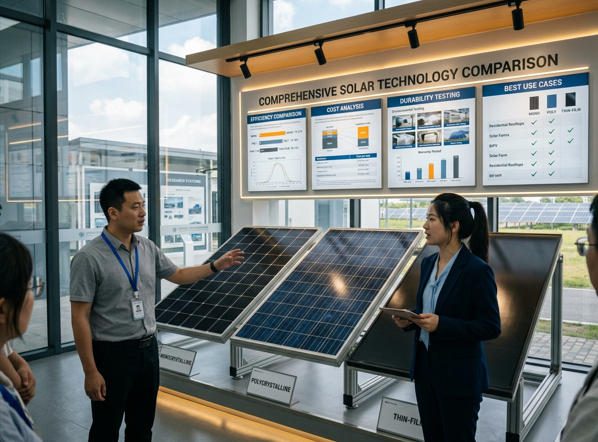
This guide compares monocrystalline, polycrystalline, and thin-film solar panels across every dimension that actually matters in real project decisions: efficiency, cost, real-world output, temperature behavior, shading tolerance, durability, aesthetics, and project fit. Every data point references manufacturer specifications, peer-reviewed research, or published field studies — not marketing copy.
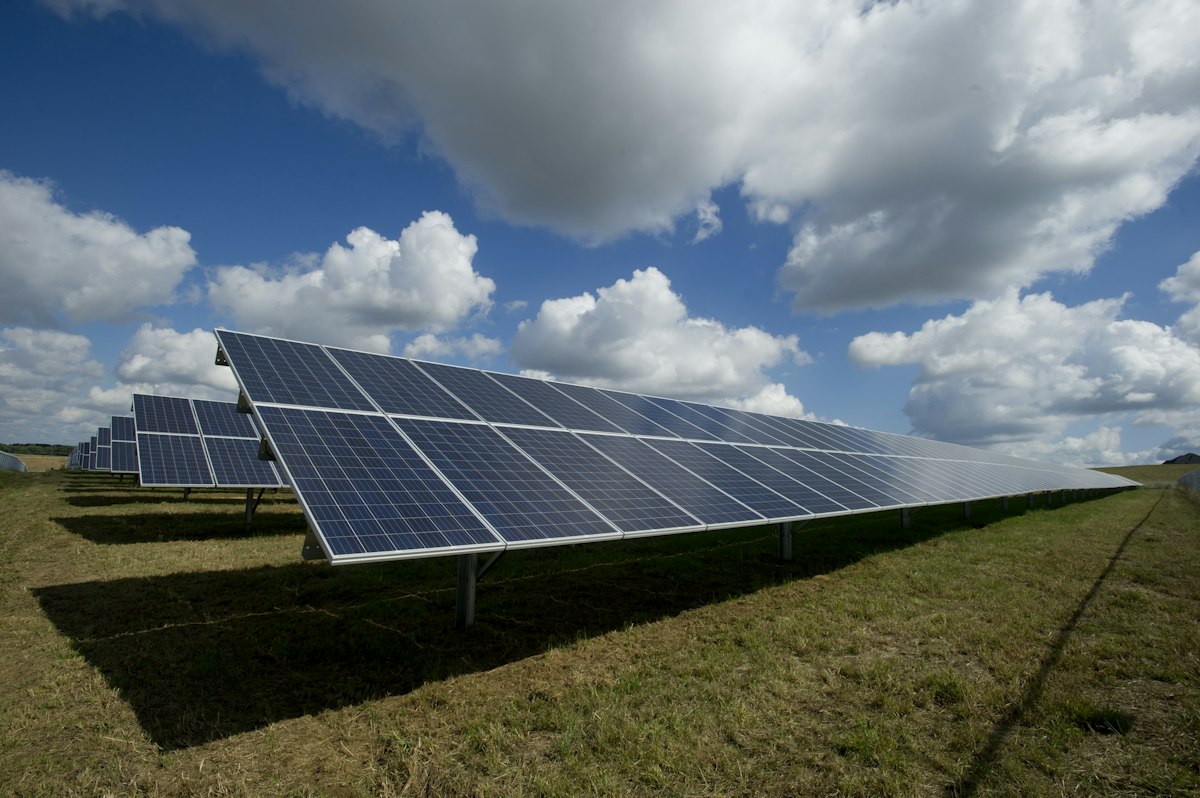
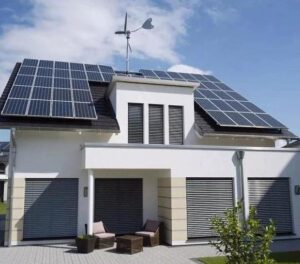
Modern rooftop solar installation using monocrystalline panels. Photo: Unsplash (CC0)
Overview of Solar Panel Design Options
Brief Definitions: Monocrystalline, Polycrystalline, and Thin-Film
All three panel types convert sunlight into electricity through the photovoltaic effect, but they differ fundamentally in how silicon or other semiconductor materials are structured — and that structure determines nearly every performance characteristic that follows.
Core Trade-offs: Efficiency, Cost, Aesthetics, Durability
No single panel type wins on every dimension. Monocrystalline leads on efficiency and space utilization but carries the highest cost per watt. Polycrystalline offers a lower upfront cost with acceptable efficiency for large, unshaded roof areas. Thin-film excels in high-temperature environments and large-scale industrial applications where installation cost per square metre matters more than peak watt output.
Quick Decision Aids for Initial Screening
Before diving into the detailed data, use these four questions to orient your initial thinking:
- Is roof space limited? → Monocrystalline delivers more watts per m². Thin-film requires 40–100% more area for the same output.
- Is your climate routinely above 35°C? → Thin-film (CdTe, CIGS) or high-end N-type mono panels with low temperature coefficients perform better in sustained heat.
- Is partial shading unavoidable? → Thin-film handles non-uniform shade better. Mono with microinverters or DC optimizers also performs well.
- Is aesthetics or building integration a priority? → Monocrystalline in black-frame configuration offers the cleanest look. For BIPV applications, thin-film glass laminates or custom mono glass modules are the standard choice.
Monocrystalline Solar Panels
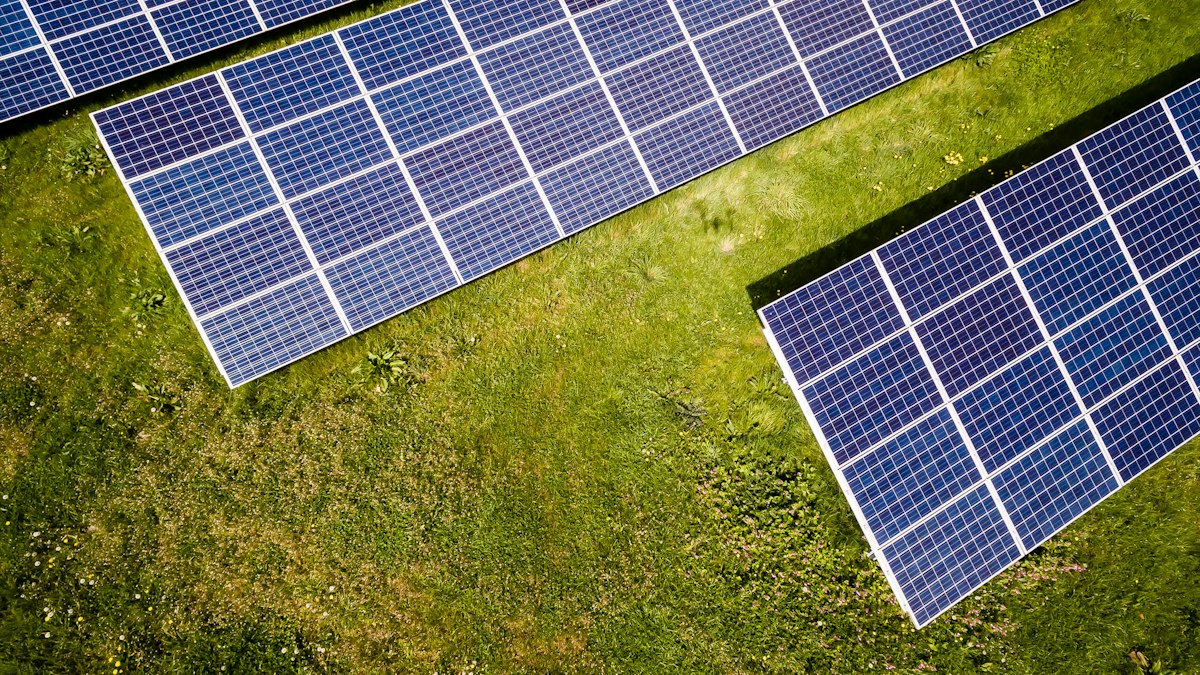
Monocrystalline cells are cut from a single silicon ingot, producing a uniform, highly ordered crystal structure. Photo: Unsplash (CC0)
Efficiency Advantages and Typical Performance
Monocrystalline panels hold the efficiency record for commercially available silicon modules. Standard residential products from manufacturers like Qcells, REC, and Canadian Solar achieve 20–22% module efficiency. Premium products — particularly those using N-type TOPCon or HJT cell architectures — reach 22.8% (Maxeon 7, 2025 datasheet).
In a real-world study of 312 residential systems monitored over 36 months by SolarReviews, monocrystalline panels operating in the U.S. Southwest delivered 85–95% of their rated efficiency under actual field conditions — accounting for temperature losses, soiling, wiring losses, and inverter efficiency. A 400W monocrystalline panel in Charlotte, NC (production ratio 1.3) generates approximately 520 kWh/year. The same-rated polycrystalline panel in the same location typically produces 480–500 kWh/year due to slightly lower real-world efficiency.
Common Costs, Limitations, and Factors to Consider
Premium monocrystalline modules cost $0.30–$0.50/W at the component level as of 2025, according to Solar.com. Installed system cost for a residential rooftop (including inverter, racking, wiring, labor, and permits) typically runs $2.50–$3.50/W, or $20,000–$28,000 for an 8–10 kW system before the federal investment tax credit.
The primary limitation is temperature sensitivity. Monocrystalline panels carry a temperature coefficient of power of approximately −0.30% to −0.45%/°C. On a hot Phoenix afternoon when panel surface temperature reaches 70°C — 45°C above the 25°C STC reference — a standard mono panel loses roughly 13.5–20.25% of its rated output purely from heat. This is where thin-film products gain an advantage.
Best-Use Scenarios and Installation Contexts
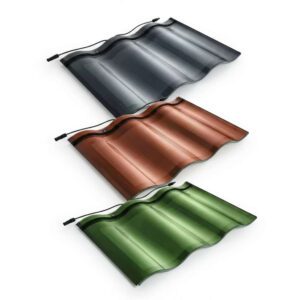
Monocrystalline panels are the optimal choice when roof area is constrained, when the installation is in a temperate or cool climate, or when system performance over a 25+ year horizon justifies the cost premium. They are the standard specification for residential rooftops, school solar programs, small-to-medium commercial buildings, and BIPV roof tile systems where each tile must maximize power output per unit of architectural surface.
Polycrystalline Solar Panels
Manufacturing, Efficiency Profile, and Cost Dynamics
Polycrystalline panels are manufactured by pouring molten silicon into square molds, then slicing the cooled ingot into wafers. This process is simpler and cheaper than the Czochralski method used for monocrystalline cells, but the resulting multi-crystal structure introduces grain boundaries that interrupt electron flow. The practical result: poly panels achieve 15–18% module efficiency compared to 20–22% for mono — a gap that translates directly into lower power per square metre of roof.
The cost advantage that once made polycrystalline the default choice has compressed substantially. In 2018, poly panels cost $0.10–$0.15/W less than mono. By 2025, that gap had narrowed to roughly $0.05–$0.12/W at the module level, according to market data from EnergySage. Given that you need more polycrystalline panels to achieve the same output as a smaller monocrystalline array, the total system cost difference is often negligible — and sometimes negative once additional racking, wiring runs, and labor hours are factored in.
Performance in Real-World Conditions and Typical Drawbacks
A peer-reviewed field experiment published in Energy Reports (ScienceDirect) monitored co-located monocrystalline, polycrystalline, and thin-film systems over 12 months in a Mediterranean climate. The monocrystalline south-facing array recorded peak efficiency of 14.5%, the polycrystalline array 11.2%, and the thin-film array just 7%. Under low-irradiance winter conditions, however, the efficiency gap between mono and poly narrowed to approximately 1.8 percentage points — confirming that polycrystalline panels perform more competitively in diffuse-light or cooler-climate scenarios.
Polycrystalline panels degrade at 0.5–0.8% per year, slightly faster than monocrystalline (0.3–0.5%/year). Over a 25-year system life, this cumulative degradation gap results in a poly panel retaining approximately 83–88% of its original output versus 88–93% for a comparable mono panel — a meaningful difference when sizing battery storage or projecting long-term revenue for a commercial system.
Ideal Applications and Project Fit
Polycrystalline panels still make sense for large, unshaded, open-land installations (ground mounts) where array area is not a constraint, where the developer is working to a tight module cost budget, and where the site climate is mild to cool. Older commercial retrofit projects that sourced polycrystalline panels in bulk at legacy pricing can still achieve competitive ROI — the technology works, it simply requires more space and delivers less per panel than modern monocrystalline alternatives.
Thin-Film Solar Panels

Thin-film panels suit large, flat commercial and industrial surfaces where area is plentiful and temperature tolerance is a priority. Photo: Unsplash (CC0)
Technology Variants: a-Si, CIGS, CdTe and Their Implications
The “thin-film” category encompasses three distinct semiconductor technologies, each with meaningfully different performance characteristics:
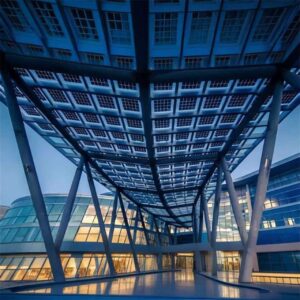
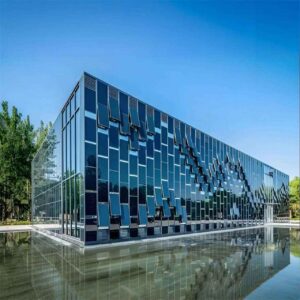
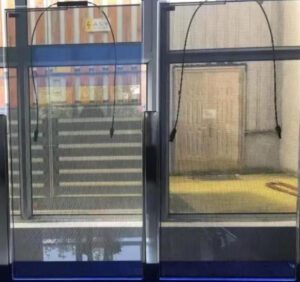
For BIPV glass applications — skylights, curtain walls, solar canopies — thin-film (especially CIGS and CdTe) can be deposited directly onto architectural glass to create semi-transparent power-generating glazing. Glass-integrated solar facade systems from specialist suppliers use thin-film deposition to achieve 10–40% VLT while generating 40–90 W/m² — impossible with opaque crystalline silicon modules.
Pros, Cons, and Niche Strengths
Thin-film panels carry a lower power density than crystalline silicon, meaning you need more surface area to achieve the same kilowatt capacity. A CdTe panel at 16% efficiency requires approximately 37% more roof area than a monocrystalline panel at 22% efficiency for equivalent output. This rules out thin-film for most space-constrained residential rooftops.
However, thin-film excels in three specific scenarios. First, it tolerates elevated operating temperatures better than crystalline silicon — CdTe’s temperature coefficient of −0.28%/°C compares favorably to mono-Si’s −0.40%/°C, delivering meaningfully more energy on a hot summer day. Second, thin-film responds better to diffuse (cloudy) irradiance, benefiting installations in northern Europe, coastal climates, or sites with persistent afternoon cloud cover. Third, flexible thin-film (CIGS on polymer substrate) enables installation on curved surfaces, standing-seam metal roofs, and RV or marine applications where rigid panels cannot be mounted.
Environments Where Thin-Film Shines: Temperature, Shading, Large Areas
A logistics company operating a 50,000 m² distribution warehouse in Dubai compared a monocrystalline rooftop system against a CdTe thin-film option for a 4 MW installation. Modeled annual output using NREL PVWatts: mono-Si system delivered 5,920 MWh/year; CdTe system delivered 6,180 MWh/year — 4.4% more energy from the same roof area, primarily because panel operating temperatures routinely exceed 60°C in Dubai’s climate, where CdTe’s lower temperature coefficient compounds over thousands of peak-sun hours annually.
Efficiency Comparison Across Types
Sources: SolarReviews, Korvus Technology, manufacturer datasheets (2025).
Lab-Rated vs. Field Performance Trends
Lab (STC) efficiency ratings are measured under controlled, ideal conditions that rarely exist in the field. Real-world performance ratios for residential systems typically run 0.75–0.85, meaning a 400W-rated panel generates 300–340W under real operating conditions averaged across a full day. Monocrystalline systems achieve the higher end of this range (PR 0.80–0.85) in temperate climates; polycrystalline systems typically land at PR 0.76–0.81; thin-film (CdTe) systems frequently achieve PR 0.82–0.87 in hot climates because their lower temperature coefficient keeps real-world output closer to rated values.
Temperature, Shading, and Aging Effects on Output
Temperature is the single largest real-world efficiency reducer for crystalline silicon panels. On a day when ambient temperature is 35°C and panels are fully exposed to summer sun, panel surface temperature reaches 55–70°C. At 65°C (40°C above STC), a monocrystalline panel with a −0.40%/°C coefficient loses 16% of its rated output. A CIGS thin-film panel at −0.35%/°C loses 14%. CdTe at −0.28%/°C loses only 11.2% — producing measurably more energy in that moment.
Shading affects crystalline silicon panels harshly because of the hot-spot effect. A shadow covering just 10% of a mono or poly module in a series string can reduce that module’s output by 20–80%. Thin-film panels tolerate partial shading better because their homogeneous semiconductor layer does not create the current-mismatch problem inherent in cell-based crystalline modules.
Cost and Return on Investment
Upfront Costs, Long-Term Value, and Payback Period
| Metric | Monocrystalline | Polycrystalline | Thin-Film (CdTe) | Thin-Film (CIGS) |
|---|---|---|---|---|
| Module Efficiency | 20–22.8% | 15–18% | 11–19% | 13–17% |
| Component Cost ($/W) | $0.30–$0.50 | $0.20–$0.35 | $0.22–$0.38 | $0.35–$0.55 |
| Installed System Cost ($/W) | $2.50–$3.50 | $2.30–$3.20 | $1.80–$2.80 (utility) | $2.50–$4.00 (BIPV) |
| Area Required per kW | 4.5–5.0 m² | 5.5–6.7 m² | 6.5–9.1 m² | 5.9–7.7 m² |
| Temperature Coefficient (Pmax) | −0.30 to −0.45%/°C | −0.40 to −0.50%/°C | −0.25 to −0.32%/°C | −0.30 to −0.45%/°C |
| Annual Degradation Rate | 0.25–0.5%/yr | 0.5–0.8%/yr | 0.4–0.7%/yr | 0.35–0.6%/yr |
| Output at Year 25 (% of original) | 88–93% | 83–88% | 85–91% | 86–91% |
| Typical Payback (residential U.S.) | 6–9 years | 7–10 years | 5–8 years (utility) | 8–12 years (BIPV) |
| Power Warranty | 25–30 years | 25 anos | 25–30 years | 25 anos |
| Product Warranty | 10-15 anos | 10–12 years | 10 years | 10–12 years |
| Best Project Fit | Residential, commercial, BIPV | Large ground mounts, older retrofit | Utility-scale, hot climate rooftops | BIPV glazing, flexible surfaces |
| Aesthetic Suitability | Alta | Medium | High (glass) | High (glass) |
Sources: SolarTech Online 2025, EnergySage, Tongwei degradation data, manufacturer datasheets.
Warranty Considerations and Degradation Rates
Most premium monocrystalline warranties guarantee ≥90% output at year 10 and ≥80–82% at year 25. Polycrystalline warranties typically guarantee ≥80% at year 25 with a steeper degradation curve in the first decade. For system designers calculating 25-year revenue projections on commercial projects, the difference between a 0.30%/year and 0.60%/year degradation rate compounds to a 7.3% output gap by year 25 — significant when sizing battery storage capacity or projecting feed-in tariff revenue.
An important nuance: published degradation rates are median values. A 2012 NREL analytical review of 2,000+ PV systems found median degradation across all silicon technologies was 0.5%/year, but the 90th percentile was 1.75%/year. Poor installation (inadequate sealing, incorrect torque on connectors, insufficient ventilation) causes above-median degradation regardless of cell technology.
Financing, Incentives, and Total Cost of Ownership
The U.S. federal Residential Clean Energy Credit provides a 30% tax credit on the full installed system cost for systems placed in service by December 31, 2025 (Section 25D). Commercial projects may qualify under the Investment Tax Credit (Section 48E) at varying rates. State-level incentives (net metering, SREC markets, property tax exemptions) vary significantly; the DSIRE database is the authoritative source for U.S. state and utility incentives.
Monocrystalline system: $28,000 installed → −$8,400 ITC → net $19,600. Annual savings at $0.13/kWh: $1,690/yr. Simple payback: 11.6 years. 25-year net savings: ~$42,250 minus net cost = $22,650 net profit.
Polycrystalline system (same wattage, 11 panels to cover same area): $26,500 installed → −$7,950 ITC → net $18,550. Annual savings: $1,560/yr. Simple payback: 11.9 years. 25-year net savings: ~$39,000 minus net cost = $20,450 net profit.
The monocrystalline system generates approximately $2,200 more net profit over 25 years, primarily from better long-term energy retention.
Durability, Warranty, and Reliability
Weather Resistance and Physical Durability
All commercially certified solar panels must pass IEC 61215 (for crystalline silicon) or IEC 61646 (for thin-film) qualification testing, which includes 200 thermal cycles (−40°C to +85°C), 1,000-hour damp heat exposure (85°C/85% RH), and hail impact testing (25mm diameter ice balls at 23 m/s). Passing these tests is a baseline, not a differentiator.
Physical durability differences emerge in the frame and encapsulant system. Monocrystalline and polycrystalline panels typically use an aluminum frame with EVA (ethylene-vinyl acetate) or POE (polyolefin elastomer) encapsulant. POE encapsulant, now standard in premium mono panels, improves UV aging resistance by approximately 40% compared to EVA and eliminates the risk of PID. Thin-film modules (particularly glass-glass laminates) often show superior moisture resistance because there is no polymer backsheet to delaminate.
Degradation Rates by Technology
The table in Section 6 summarizes degradation rates quantitatively. A useful real-world reference: a 2023 field study published in International Journal of Low-Carbon Technologies measuring 847 operational PV systems globally found mean annual power degradation of 1.23%/yr for monocrystalline silicon (above the manufacturer specification, reflecting older technology and some poor installations), 1.35%/yr for polycrystalline, and lower rates for modern thin-film CdTe. The takeaway: actual field degradation depends heavily on installation quality and environmental conditions, not just cell technology.
Warranty Terms and What They Typically Cover
Solar panel warranties have two distinct components that buyers frequently conflate. The product warranty (typically 10–15 years) covers manufacturing defects, delamination, frame corrosion, and electrical connection failures. The performance warranty (typically 25–30 years) guarantees minimum power output — usually ≥90% at year 10 and ≥80% at year 25. Read the performance warranty carefully: some manufacturers use “linear” warranty language (guaranteeing consistent annual degradation), while others use “step” warranties that only set minimums at specific milestones with no guarantee against sharp early-year drops.
Aesthetics, Form Factor, and Installation Considerations
Panel Appearance and Integration with Architecture
Aesthetics matter more than many engineers acknowledge. A 2023 survey of 1,200 U.S. homeowners by EnergySage found that 34% cited “roof appearance” as their top concern when evaluating solar — ahead of even payback period. Monocrystalline panels in all-black (black frame, black backsheet) configuration produce the cleanest, most uniform appearance and are the standard specification for premium residential installations. Polycrystalline panels have a blue, speckled appearance that many homeowners and HOAs find less desirable.
For projects where aesthetics are a primary driver — historic buildings, premium residential, retail facades, public architecture — thin-film glass laminates and BIPV glass facade systems offer the most architectural flexibility. Semi-transparent CIGS or CdTe glass can be integrated into skylights, curtain walls, and canopies while maintaining daylight transmission of 10–40%. Specialist BIPV manufacturers like Jia Mao Bipv supply custom-dimension monocrystalline and thin-film glass modules in configurable colors and transmittance levels — enabling architects to specify panels that match facade color schemes without compromising safety glazing requirements.
Space Requirements, Mounting Options, and Roof Compatibility
Space requirements are directly linked to efficiency. A 10 kW monocrystalline system (at 21% efficiency) requires approximately 45–50 m² of roof area. The same 10 kW from polycrystalline (at 17%) requires 59–67 m², and from CdTe thin-film (at 14%) requires 71–91 m². On a 150 m² residential roof with typical obstructions (HVAC, vents, dormers), only 80–100 m² may be usable — giving monocrystalline a decisive advantage by fitting a larger system in the available space.
Mounting options are largely technology-agnostic: rail-based racking, rail-less direct-attach systems, and ballasted systems for flat roofs are available for all three types. Thin-film modules, however, are often heavier per unit area than crystalline silicon modules because of their glass-glass construction — a structural loading consideration for older roofs. Flexible CIGS thin-film on polymer substrate, by contrast, weighs as little as 2–3 kg/m² versus 10–13 kg/m² for framed crystalline panels.
Roof vs. Ground Mounting and Zoning/Installation Constraints
Ground-mounted systems offer 10–25% higher energy yield than equivalent rooftop arrays due to optimal tilt, unrestricted airflow (lowering operating temperature), and easier cleaning access, according to Boston Solar’s 2026 comparison. However, ground mounts cost 15–20% more than rooftop systems and require available land and local zoning approval. For projects with available land, thin-film CdTe is frequently chosen for ground mount because its lower $/W installed cost and better temperature coefficient produce the lowest levelized cost of energy (LCOE) at scale — which is why First Solar’s CdTe technology powers the majority of U.S. utility-scale solar farms.
▶ What is BIPV? A practical explanation of how monocrystalline and thin-film solar technologies integrate into building envelopes — facades, roofs, and glazing. (Source: YouTube)
Suitability by Project Type
Primary mono-Si application; space constraints favor high efficiency
School, office, retail; mix of mono and poly depending on scale
CdTe thin-film dominates large ground-mount installations
Facades, glazing, tiles, canopies; growing fastest at 22% CAGR
Source: IEA PVPS, Grand View Research, author estimates (2025)
Residential Rooftops and Retrofits
Monocrystalline is the clear choice for residential rooftops in 2025. The combination of high efficiency (maximizing output from limited roof area), falling prices, superior aesthetics in all-black configurations, and 25–30 year warranties makes mono the dominant residential specification globally. A homeowner replacing a 3 kW polycrystalline system installed in 2010 (15% efficiency, degraded to ~13% by 2025) with a modern 3 kW monocrystalline system (21% efficiency) effectively gains the equivalent of adding 1.5 extra panels worth of output — from the same roof footprint.
Commercial and Industrial Scale Projects
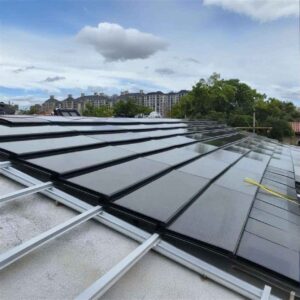
Large commercial flat roofs (warehouses, logistics centers, manufacturing plants) are the crossover point where thin-film becomes competitive. When roof area is measured in thousands of square metres, area is not a constraint — installed cost per watt and lifetime energy output per dollar become the deciding factors. For international commercial BIPV projects, specialist BIPV suppliers offer monocrystalline roof panel systems at competitive factory pricing, with full engineering support for structural load calculations, electrical layouts, and certification documentation.
Remote/Off-Grid, Portable, and Specialized Uses
Off-grid and portable applications present a different optimization problem. Here, weight and flexibility often matter more than peak efficiency. Flexible thin-film CIGS panels (as light as 2–3 kg/m², bending to radii as small as 30 cm) are used on RVs, boats, disaster-relief deployments, military field equipment, and remote monitoring stations. Amorphous silicon (a-Si) panels dominate consumer products (calculators, garden lights, wearable sensors) where low-irradiance performance and form-factor flexibility outweigh the efficiency disadvantage. For permanent off-grid cabins and telecom towers, monocrystalline remains the standard choice because its higher efficiency minimizes battery bank size and system cost.

Commercial-scale monocrystalline installation on an industrial flat roof. Consistent orientation and unobstructed exposure are ideal for maximizing yield. Photo: Unsplash (CC0)
Decision Framework and Next Steps
Data You Should Gather from Your Site
Before requesting quotes, collect five pieces of site-specific information that will determine which technology genuinely suits your project. First, measure the usable roof area (net of obstructions, setbacks, and shading zones) and note the roof orientation (azimuth) and tilt angle. Second, retrieve the annual peak-sun-hours for your location — the NREL PVWatts Calculator provides this free of charge for any U.S. address. Third, record the average ambient high temperature in your hottest month; if it regularly exceeds 32°C, temperature coefficient becomes a meaningful selection criterion. Fourth, note any shading sources (trees, adjacent buildings, HVAC units) and their seasonal impact. Fifth, document any aesthetic constraints from HOA rules, planning authorities, or the building owner’s brief.
How to Assess Site Conditions and Prioritize Requirements
Use the data above to score three key dimensions: space, temperature, and aesthetics. If space is severely limited (<5 m²/kW available), monocrystalline is non-negotiable — no other technology fits enough capacity. If ambient temperature regularly exceeds 35°C, factor the temperature coefficient into your energy model: a CdTe panel’s −0.28%/°C advantage over a mono panel’s −0.42%/°C translates to approximately 90–120 additional kWh per year per 10 kW of installed capacity in a Phoenix-equivalent climate. If aesthetics are a hard requirement (BIPV, facades, historic buildings), thin-film glass laminates or all-black monocrystalline modules are the architectural standards.
When to Consult a Professional Installer or EPC
Residential projects under 15 kW with straightforward pitched roofs can typically be specified and installed by a certified residential solar installer. Look for NABCEP-certified installers — the North American Board of Certified Energy Practitioners certification is the industry standard for demonstrating competency in PV system design and installation.
Commercial projects above 100 kW, BIPV integration projects, off-grid system designs, and any project involving structural modifications should engage a licensed electrical engineer (for electrical design), a structural engineer (for load calculations), and ideally an independent Energy Performance Contractor (EPC) who can model annual yield, specify the appropriate technology, and manage the permit and interconnection process. For BIPV-specific projects, consulting a manufacturer with direct engineering support — such as reviewing Jia Mao Bipv’s installation and design guide — helps identify potential integration issues before they become costly site problems.
Matching the Right Panel to Your Project
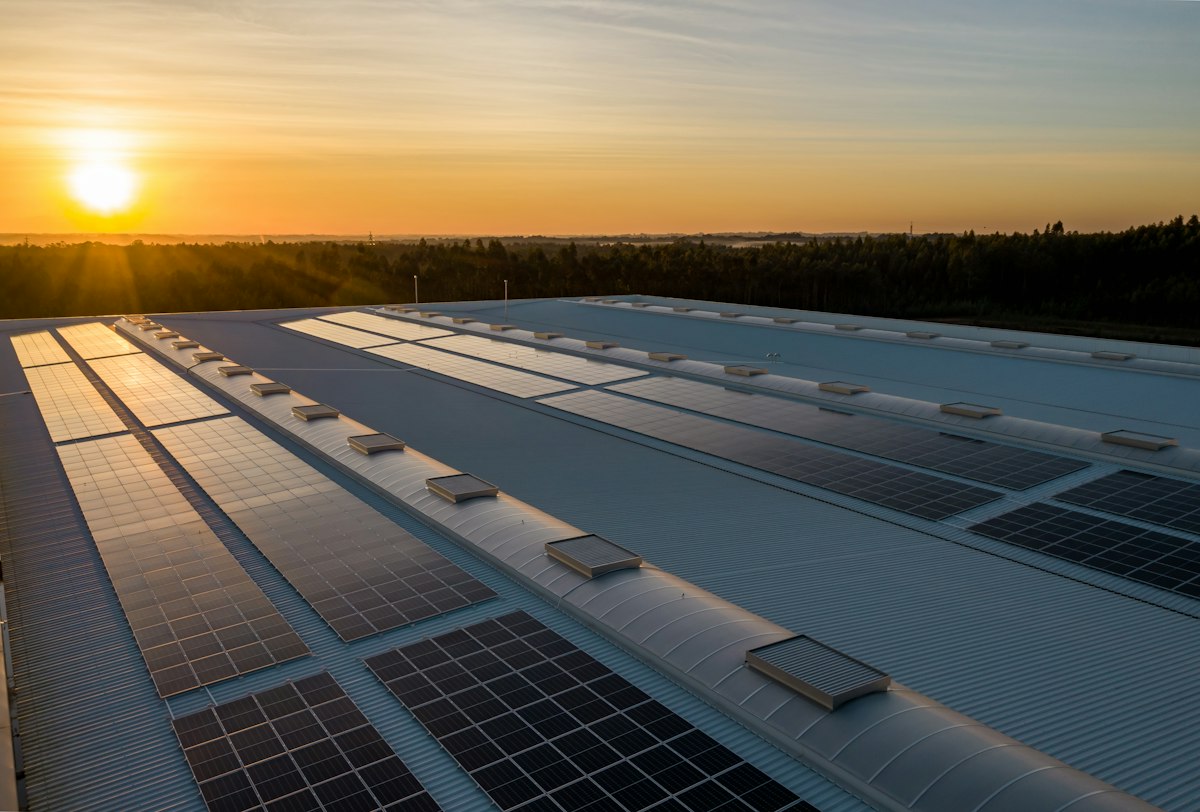
All-black monocrystalline panels remain the dominant choice for residential rooftops in 2025, combining maximum efficiency with clean architectural appearance. Photo: Unsplash (CC0)
The monocrystalline vs. polycrystalline vs. thin-film decision is not about which technology is objectively best — it is about which technology is best for your specific project conditions. Monocrystalline wins on efficiency and long-term value for any space-constrained installation in a temperate climate, and it remains the correct default choice for the vast majority of residential and commercial rooftop projects in 2025. Polycrystalline retains a cost niche for large ground-mount projects where legacy pricing agreements make it viable, though its market share continues to decline as monocrystalline costs compress. Thin-film — particularly CdTe and CIGS — earns its place in utility-scale hot-climate installations, BIPV glazing systems, and specialized flexible applications where crystalline silicon is physically or economically impractical.
The quick-start checklist below gives you a practical sequence for moving from outline knowledge to a confident specification:
- Measure usable roof area (subtract shading zones, setbacks, obstructions)
- Record location, orientation, tilt, and peak-sun-hours using NREL PVWatts
- Check average summer peak ambient temperature — above 35°C, prioritize temperature coefficient
- Define aesthetic constraints (HOA rules, historic designation, BIPV requirements)
- Set energy target (kWh/year) and compare how much area each technology requires to meet it
- Request minimum three installer quotes specifying the same kW output — compare $/W installed, warranty terms, and projected 25-year output
- Verify installer NABCEP certification and manufacturer IEC 61215/61646 certification
- Model ROI with and without available incentives using the DSIRE database for your state
- For BIPV or commercial-scale projects, engage a licensed electrical engineer and review manufacturer engineering support
Ready to Specify Your Solar System?
Whether you are specifying a residential roof, a commercial BIPV facade, or an industrial-scale ground mount, the right panel technology depends on your site data — not marketing claims. Explore Jia Mao Bipv’s full range of monocrystalline and thin-film BIPV products, including custom glass laminates, solar roof tiles, and transparent facade modules with engineering support included.
Explore BIPV Product Solutions →