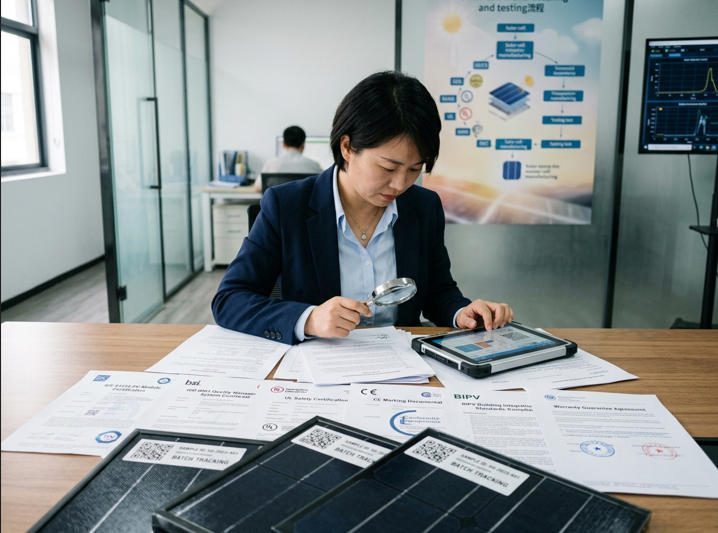

A single fraudulent IEC certificate on a 500-panel BIPV facade order can cost a project owner upward of $200,000 in replacement labor, rework delays, and voided insurance coverage — not counting the reputational damage. Yet most procurement teams spend less than 30 minutes reviewing the certification package before approving a solar glass purchase order. That gap between financial exposure and verification rigor is where this guide fits.
Solar glass procurement involves three categories of documents that together determine whether a product will perform safely for 25 years or become a liability within 5: certifications (third-party validation that the product meets safety and performance standards), testing reports (detailed laboratory results documenting how the product performed under specific stress conditions), and warranty terms (the manufacturer’s contractual commitment to repair or replace defective products). Each category has its own verification methods, its own red flags, and its own failure modes when overlooked.
The stakeholders in this process include manufacturers (who produce the glass and obtain certifications), certifying bodies like TÜV Rheinland, UL Solutionse Intertek (who test products and issue certificates), independent auditors (who verify ongoing quality compliance), and buyers — architects, EPC contractors, developers, and procurement managers — who must verify that every document in the package is authentic, current, and applicable to the exact product being purchased.
This guide provides the complete verification workflow. It covers what constitutes a valid certification, which standards to look for by region, how to authenticate certificates and cross-reference them with issuing bodies, how to interpret the testing data that matters for solar glass (not just pass/fail), what to expect and what to request during supplier quality audits, how warranty structures work and how to document valid claims, the red flags that indicate fraudulent or misleading documentation, a practical documentation checklist with renewal timelines, and two case studies that illustrate these principles in action. Whether you are procuring photovoltaic glass modules for a commercial curtain wall or solar roof tiles for a residential project, this framework applies.
Understanding Certifications and Their Importance
What Constitutes a Valid Certification for Solar Glass
A valid certification for solar glass is not a logo on a datasheet. It is a documented confirmation, issued by an accredited third-party laboratory, that a specific product model passed a defined set of tests under controlled conditions on a specific date. The certificate must identify the exact product model and variant tested (including dimensions, cell type, and glass configuration), the standard against which testing was performed (e.g., IEC 61215:2021 Edition 2), the name and accreditation number of the testing laboratory, the certificate number (which can be independently verified), the date of issue and expiry, and the scope of testing completed.
A certification that omits any of these elements is incomplete. A certification that covers “solar glass modules” generically without specifying the exact product model and configuration being procured is not valid for that purchase — because a manufacturer may hold certification for one product line but not another, and changes in glass thickness, cell layout, or encapsulant material can alter performance sufficiently to invalidate test results.
Manufacturers with mature quality systems, such as Jia Mao BIPV, maintain certification packages that map specific test certificates to specific product SKUs — their facility, operating at 3 GW annual capacity with an intelligent MES production management system, traces every module from raw material to finished product. This level of documentation traceability is what buyers should expect, not hope for.
Common Certifying Bodies and Their Roles
The solar glass industry relies on a handful of internationally recognized certifying bodies, each with distinct testing capabilities and market recognition. TÜV Rheinland (Germany) is widely considered the gold standard — their Certipedia online database allows anyone to verify certificate authenticity in minutes. TÜV SÜD (Germany) offers comparable rigor with a particularly strong presence in Asian manufacturing regions. UL Solutions (United States) is mandatory for products entering the North American market and provides certification to both UL 61730 and UL 1703. Intertek (United Kingdom) offers global testing through its ETL certification mark. Bureau Veritas and SGS provide testing services across multiple product categories, including solar glass.
The certifying body’s accreditation matters as much as the certificate itself. Legitimate testing laboratories hold ISO/IEC 17025 accreditation — the international standard for testing and calibration laboratory competence. A certificate from a lab that lacks 17025 accreditation may not be recognized by building code authorities, insurance underwriters, or project financiers.

Standard Certifications to Look For
Industry Standards: Safety, Performance, and Environmental
Solar glass products must comply with multiple overlapping standards. The core certifications that every buyer should verify are outlined below, organized by function.
| Função | Standard | What It Validates | Key Tests Included |
|---|---|---|---|
| Performance Qualification | IEC 61215:2021 | Design qualification and type approval — the module can withstand 25+ years of environmental stress | 200 thermal cycles (-40°C to +85°C), 1,000 hrs damp heat (85°C/85% RH), 2,400 Pa mechanical load, hail impact (25 mm at 23 m/s) |
| Safety Qualification | IEC 61730:2023 | Electrical shock, fire, and mechanical safety under fault conditions | Dielectric withstand, wet leakage current ≤50 µA/kV, sharp edge test, fire classification (Class A/B/C) |
| U.S. Safety Listing | UL 61730 / UL 1703 | Mandatory safety listing for North American market | NEC compliance, ground fault protection, rapid shutdown per NEC 690 |
| BIPV-Specific Safety | UL 7103 | Electrical safety, fire, wind, weathering, and impact for building-integrated modules | Fire classification per UL 790, wind uplift, weathering per ASTM G154, impact per ASTM E1886 |
| EU Market Access | CE Marking (EN IEC 61215 / EN IEC 61730) | Compliance with EU safety directives — note: CE can be self-declared | Low Voltage Directive, Electromagnetic Compatibility Directive |
| Quality Management System | ISO 9001:2015 | Manufacturer’s quality management system — applies to the factory, not the product | Document control, process consistency, corrective action procedures, internal audit programs |
| Environmental Management | ISO 14001:2015 | Environmental management system for manufacturing operations | Waste management, emissions control, resource efficiency, continuous improvement |
| Laminated Glass Safety | ISO 12543 | Durability and performance of laminated glass as a building material | High-temperature aging, humidity exposure, radiation exposure, boil test for interlayer adhesion |
A product that carries IEC 61215 and IEC 61730 from TÜV Rheinland or TÜV SÜD, combined with the manufacturer holding ISO 9001, represents the baseline for credible solar glass procurement. Products entering the U.S. market additionally require UL listing. BIPV products serving as building envelope components should carry UL 7103 or equivalent regional building product certifications.
Regional and International Compliance Considerations
Certification requirements vary by installation country, and a product certified for one market may not be legal to install in another without additional testing. In the United States, UL listing is mandatory and verified by Authority Having Jurisdiction (AHJ) inspectors before grid connection. In Australia, the Clean Energy Council (CEC) maintains an Approved Modules list — only panels on this list qualify for government incentives, and the CEC now requires IEC 61215:2021 compliance. In India, the Approved List of Models and Manufacturers (ALMM) restricts government-subsidized projects to listed products. In Europe, CE marking is required but is a lower bar than IEC certification because manufacturers can self-declare compliance without independent lab testing.
Buyers procuring solar glass for multinational projects should request a certification matrix from the manufacturer showing which certifications cover which markets. Jia Mao BIPV’s product range, for instance, undergoes structural safety verification covering wind pressure, snow load, thermal cycling, and hail impact aligned with global building codes — an approach that simplifies multi-market procurement by ensuring the base product meets the most stringent requirements across target regions.
Chart 1: Procurement Projects Requiring Specific Regional Certifications (% of Global Solar Glass Imports, 2025)
Regional
Cert. Mix
UL Required – N. America (32%)
CE Required – Europe (28%)
CEC/ALMM – AU/India (18%)
Other Regional (22%)
Verifying Certificates: Process and Best Practices
How to Authenticate Certificate Authenticity and Issuer Legitimacy
Certificate authentication follows a five-step process that takes approximately 15–30 minutes per product — time that is negligible compared with the financial risk of accepting a fraudulent document.
Step 1: Obtain the original certificate. Request the PDF directly from the manufacturer — not a screenshot, not a cropped image, not a reference to “certificates available upon request.” The document should display the certifying body’s official letterhead, the certificate number, product model details, the testing standard reference, and the date of issue.
Step 2: Verify the certificate number online. Every major certifying body maintains a public database. For TÜV Rheinland, go to Certipedia and enter the certificate number. For TÜV SÜD, use their Certificate Finder. For UL, use the UL Certificate Search. For TÜV NORD, visit their certificate verification page. If the certificate number does not appear in the database, the certificate is either expired, counterfeit, or issued by an entity other than the one claimed.
Step 3: Cross-reference product details. Confirm that the product model, dimensions, cell type, glass configuration, and power rating listed on the certificate match the product being quoted. A certificate for a “JM-BIPV-TG-60” model does not cover a “JM-BIPV-TG-72” model, even if both come from the same manufacturer.
Step 4: Check the testing standard edition. IEC 61215 has undergone multiple revisions (2005, 2016, 2021). A certificate issued under the 2005 edition may not meet current building code requirements. Australia, for instance, now requires IEC 61215:2021 compliance for incentive eligibility. Verify that the certificate references the current edition of the standard.
Step 5: Confirm certificate validity period. IEC certifications typically require renewal or surveillance audits. A certificate issued in 2019 without evidence of subsequent surveillance may have lapsed. Contact the certifying body directly if the online database does not display expiry information.
Cross-Verification Steps with Issuing Bodies and Registries
Beyond online database checks, buyers can request direct verification from the certifying body. A phone call or email to TÜV Rheinland’s certification department referencing a specific certificate number will receive a confirmation or denial — usually within 2–3 business days. This step is particularly important for high-value orders (above $100,000) or when working with an unfamiliar manufacturer for the first time. The cost of direct verification is zero; the cost of not verifying can be catastrophic.
For added assurance, ask the manufacturer for the full test report — not just the certificate summary. The test report contains the raw data: power measurements before and after each test sequence, visual inspection photographs, insulation resistance readings, and wet leakage current measurements. A manufacturer that declines to share the test report — citing “confidentiality” — is raising a flag. Reputable manufacturers, including Jia Mao BIPV, make test reports available to qualified buyers as standard practice because transparency is the strongest argument for product quality.
Interpreting Testing Reports
Key Tests Relevant to Solar Glass: Strength, Optical Properties, Durability
Testing reports for solar glass contain data across three domains that directly predict field performance: mechanical strength, optical transmission, and environmental durability. Understanding what to look for in each domain — and what constitutes a warning sign — requires knowledge of the specific tests and their acceptance criteria.
Mechanical strength is validated through static load testing (IEC 61215 MQT 16) and dynamic load testing (IEC 61215 MQT 20). The static test applies 2,400 Pa of uniform pressure to the front and rear surfaces for 1 hour each — simulating snow load and wind suction. The dynamic test applies 1,000 cycles of alternating positive and negative pressure. The acceptance criterion is no visible damage (no cracks, no delamination, no broken cells) and less than 5% power degradation after testing. For BIPV applications, Jia Mao BIPV’s modules are tested to 4.0 kPa wind pressure resistance — 67% above the IEC minimum — because building-integrated products face sustained wind loads that exceed the conditions simulated in standard panel testing.
Optical properties are measured through solar-weighted transmittance testing per ASTM E424 or ISO 9050. Low-iron tempered glass used in quality solar modules achieves 91–92% transmittance at 3.2 mm thickness. After anti-reflective coating, effective transmittance rises above 94%. The test report should show transmittance values across the relevant wavelength range (300–1,100 nm for crystalline silicon cells). A transmittance value below 89% on supposedly “low-iron” glass indicates either incorrect glass composition or degraded coating — both reasons to investigate further.
Environmental durability is tested through the thermal cycling test (200 cycles, -40°C to +85°C), damp heat test (1,000 hours at 85°C/85% RH), humidity-freeze test (10 cycles), and UV preconditioning (15 kWh/m² of UV exposure). The acceptance criterion across all tests is maximum 5% power degradation and no visible defects. The test report should state the exact power loss percentage after each test — a module that passes with 4.9% degradation after damp heat is technically compliant but is at the margin, suggesting that real-world humidity exposure over 25 years could push it past the performance warranty threshold.
What to Verify in Test Reports: Test Methods, Sample Size, Repeatability
Beyond the headline pass/fail result, three aspects of a test report deserve scrutiny. First, test method identification: the report should reference specific test clause numbers (e.g., “MQT 11: Thermal Cycling per IEC 61215-2:2021, Clause 4.11.3”). Generic references to “thermal testing” without clause citations are insufficient. Second, sample size: IEC 61215 requires testing on a minimum of 8 modules drawn from production. A report based on a single hand-picked sample does not represent production quality. Request confirmation that samples were drawn from standard production batches, not from a separate “certification batch” manufactured under tighter-than-normal controls. Third, repeatability indicators: if multiple samples were tested, the report should show the range of results across samples. A wide variance between samples (e.g., one module losing 1.2% power after damp heat and another losing 4.8%) indicates inconsistent manufacturing — even if all samples technically pass.
Chart 2: IEC 61215 Key Tests — Maximum Allowed Power Degradation (%)
Thermal Cycling
Damp Heat
Humidity-Freeze
UV Preconditioning
Mechanical Load
Hail Impact
Hot-Spot Endurance
0%
1%
2%
3%
4%
5% MAX
~2% typical
~2.5% typical
~1.5% typical
~1% typical
~1% typical
~0.5% typical
Pass/No damage
Quality Assurance and Supplier Audits
QA Systems to Expect: ISO 9001 and Quality Control Processes
ISO 9001:2015 certification confirms that a manufacturer operates a documented quality management system — but it does not certify the product itself. What it tells a buyer is that the factory has formal procedures for incoming material inspection, process control, nonconforming product handling, corrective actions, and management review. What it does not tell a buyer is whether those procedures are actually followed on every shift, or whether the procedures are rigorous enough to catch the defects that matter for solar glass longevity.
During the qualification phase, request the manufacturer’s quality manual or a summary of their quality control process. Specific items to evaluate include incoming raw material inspection protocols (are glass sheets tested for iron content and transmittance upon arrival?), in-process inspection points (are electroluminescence or photoluminescence images taken of every module or only on a sampling basis?), final inspection criteria (what are the acceptance/rejection thresholds for visual defects, power output, and insulation resistance?), and traceability systems (can the manufacturer trace any finished module back to its raw material batch, cell supplier, and production date?). Jia Mao BIPV’s intelligent MES production management system provides fully digitalized and traceable manufacturing from raw material intake to finished product shipment — a level of traceability that allows root-cause analysis if a field issue arises years after delivery.
On-Site Audit Tips and Document Requests
An on-site factory audit reveals what documents alone cannot. Schedule the visit with reasonable notice (2–4 weeks) but insist on access to the production floor during active production — not during a shutdown or cleanup period. During the visit, observe whether workers follow documented procedures or deviate from them, whether inspection equipment (EL imaging, flash testing, hi-pot testing) is calibrated and displaying current calibration stickers, whether rejected modules are segregated and handled according to documented procedures (not mixed back into production), whether raw material storage conditions are controlled (humidity, temperature, cleanliness), and whether the facility matches the scale and capability described in the manufacturer’s marketing materials.
Request the following documents during or after the audit: current ISO 9001 certificate (verify the scope covers the specific production line manufacturing your product), most recent internal audit report (reveals the issues the manufacturer has identified internally), corrective action log for the past 12 months (shows how quickly and effectively they resolve quality issues), EL imaging records from recent production batches (demonstrates cell-level quality), and flash test yield data (percentage of modules meeting nameplate power specifications — a yield below 95% suggests process control problems).
Warranty Terms: Scope, Limitations, and Claims
Typical Warranty Structures for Solar Glass Products
Solar glass warranty structures follow a two-tier model that buyers must understand in detail to avoid coverage gaps. The product warranty (also called materials/workmanship warranty) covers manufacturing defects — cracked glass, delamination, defective bypass diodes, faulty junction boxes, and premature corrosion. Duration ranges from 10 years (budget tier) to 25 years (premium tier). The performance warranty guarantees minimum power output over time, typically structured as a stepped guarantee: ≥90% of rated power at Year 10 and ≥80–85% at Year 25.
| Warranty Element | Budget Tier | Mid-Range Tier | Premium Tier |
|---|---|---|---|
| Product Warranty Duration | 10 years | 15 years | 25 anos |
| Performance Warranty (Year 25) | ≥80% of rated power | ≥83% of rated power | ≥85–87% of rated power |
| Labor Coverage | Not included | First 5 years only | Full 25 years |
| Shipping Coverage | Buyer pays | Shared | Manufacturer pays |
| Transferability | Non-transferable | Transferable with fee | Freely transferable |
| Claim Resolution Timeline | 60–180 days | 30–90 days | 14–45 days |
| Example Manufacturer | Various budget brands | LONGi, JA Solar | Maxeon, REC, Jia Mao BIPV |
The most consequential difference between warranty tiers is labor and shipping coverage. A “free replacement panel” shipped to a port 3,000 miles from the installation site, with the buyer responsible for shipping, de-installation, re-installation, and re-commissioning, can cost $500–$1,500 per panel in labor alone. Premium warranties that cover these costs represent significantly better protection for the buyer.
What Constitutes a Valid Warranty Claim and How to Document It
Filing a successful warranty claim requires four elements: proof of purchase (original invoice or contract), proof of proper installation (installation report from a qualified contractor, ideally certified by the manufacturer), documentation of the defect (photographs, monitoring data showing performance decline, or independent IV-curve testing by a certified technician), and evidence of maintenance compliance (cleaning records, inspection logs). A Fieldproxy analysis of warranty claim documentation found that claims with complete evidence packages are resolved 3x faster than those with partial documentation.
For performance warranty claims specifically, the buyer must demonstrate through independent electrical testing (IV-curve trace under Standard Test Conditions) that the module’s actual output has fallen below the warranted threshold. This testing must be performed by a certified technician using calibrated equipment — readings from a consumer-grade meter or monitoring system are not accepted by most manufacturers as warranty claim evidence.
Red Flags and Common Pitfalls
Inconsistent Data, Vague Terms, and Unverifiable Certificates
The following red flags should trigger additional investigation or supplier rejection during procurement:
| Red Flag | What It May Indicate | Verification Action |
|---|---|---|
| Certificate number not found in certifying body’s online database | Forged or expired certificate | Contact certifying body directly for verification |
| Product model on certificate differs from product model being quoted | Certificate does not cover the product being sold | Request model-specific certificate or new testing |
| Certificate references outdated standard edition (e.g., IEC 61215:2005) | Product has not been retested to current requirements | Require certification to current edition |
| Warranty document uses vague language (“reasonable degradation,” “normal wear”) | Manufacturer retains broad discretion to deny claims | Require specific numeric thresholds in writing |
| No test report available — “certificates only” | Manufacturer may be concealing marginal test results | Require full test report as condition of purchase |
| Pixelated logos, inconsistent formatting, or spelling errors on certificates | Document may be fabricated | Compare against known genuine certificates from same body |
| Power ratings on datasheet exceed test report values by >3% | Datasheet may overstate performance | Rely on test report values, not marketing datasheet |
| Manufacturer refuses or delays factory audit access | Production conditions may not match documentation | Consider alternative supplier |
| Warranty excludes claims if panels “not cleaned per manufacturer schedule” but no schedule is provided | Built-in claim denial mechanism | Require written maintenance schedule as warranty appendix |
Red Flags in Testing Reports and Warranties
In testing reports, watch for test sequences that were partially completed (e.g., “thermal cycling: 150 of 200 cycles completed — test terminated early due to equipment maintenance”). A legitimate test report completes the full sequence as specified by the standard. Also watch for unusually round numbers in test data — real measurements produce decimal values (e.g., power loss of 2.37%); a report showing exactly “2.0%” or “3.0%” across multiple tests may indicate fabricated data rather than actual measurements.
In warranty documents, the most dangerous clause is the “sole and exclusive remedy” provision, which limits the manufacturer’s obligation to providing a replacement panel and explicitly excludes consequential damages (lost energy production, labor costs, project delay penalties). While this clause is standard in the industry, buyers should understand that it means a failed panel on a commercial facade that requires scaffolding and specialized labor to replace — at a cost of $2,000–$5,000 per panel — may receive only a replacement module worth $150–$300. Negotiating labor and logistics coverage into the warranty, or purchasing third-party warranty insurance, mitigates this gap.
Practical Documentation Checklist
List of Documents to Request
| Document | Purpose | When to Request | Verification Method |
|---|---|---|---|
| IEC 61215 Certificate | Confirms design qualification | Pre-qualification stage | Certipedia / TÜV SÜD Finder / UL Search |
| IEC 61730 Certificate | Confirms safety qualification | Pre-qualification stage | Same as above |
| Full Test Report (not summary) | Detailed results of all test sequences | Pre-qualification stage | Review for sample size, data consistency, full sequence completion |
| UL Listing (for U.S. market) | Mandatory North American safety listing | Pre-qualification stage | UL Product iQ database |
| ISO 9001 Certificate | Confirms quality management system | Supplier onboarding | Verify scope covers the specific production facility |
| Product Warranty Document | Defines defect coverage, duration, claim process | Before PO issuance | Legal review for exclusions, remedy limitations, transferability |
| Performance Warranty Document | Defines output guarantee and degradation curve | Before PO issuance | Verify numeric thresholds at Year 1, Year 10, Year 25 |
| Product Datasheet | Technical specifications for engineering | Design phase | Cross-reference with test report values |
| Installation Manual | Defines required mounting, wiring, and commissioning procedures | Before installation | Confirm compatibility with project-specific conditions |
| Factory Audit Report (if applicable) | Third-party assessment of manufacturing quality | Supplier qualification | Review findings, corrective actions, and closure status |
| Bill of Materials / Component Traceability | Identifies glass, cell, encapsulant, and junction box suppliers | Supplier qualification | Verify component brands match quality claims |
| MOU / Supply Agreement | Contractual terms for pricing, delivery, quality, and dispute resolution | Before PO issuance | Legal review |
Suggested Timelines for Verification and Renewal
Certification verification is not a one-time event. IEC certifications require surveillance audits — typically annually — to remain valid. ISO 9001 certificates undergo triennial recertification with annual surveillance. A supplier whose ISO 9001 certificate expired 6 months ago may have lost their quality management discipline. Build the following review cadence into your procurement workflow: at initial supplier qualification, verify all certificates, conduct or commission a factory audit, and review test reports; at each purchase order, confirm certificate validity dates and request updated datasheets; annually, verify that the manufacturer’s ISO 9001 and IEC certifications remain current; and every 3 years, reassess the supplier through a repeat factory audit or updated third-party audit report.
Due Diligence: Ongoing Compliance and Updates
Maintaining Up-to-Date Certifications and Tests
Standards evolve. IEC 61215 was revised in 2016 and again in 2021. IEC 61730 was updated in 2023 with an October 2024 amendment. A product certified under an older edition remains technically certified — but may not meet current building code requirements in all jurisdictions, and buyers who accept outdated certifications may face inspection failures or ineligibility for government incentives.
Require your suppliers to notify you within 30 days of any certification status change — new certifications obtained, certifications expired, certifications withdrawn, or changes in testing laboratory. Include this notification requirement in your supply agreement. Manufacturers with strong compliance cultures — such as Jia Mao BIPV, whose product line undergoes structural safety verification for wind pressure, snow load, thermal cycling, and hail impact to meet global building codes — proactively update their certification packages as standards evolve rather than waiting for buyer requests.
How to Monitor Supplier Performance Over Time
Post-delivery quality monitoring closes the loop between procurement and field performance. Track the following metrics across your installed base: actual field degradation rate versus warranted rate (using monitoring data), warranty claim frequency per 1,000 modules installed, mean time to claim resolution, and visual defect rate observed during routine maintenance inspections. If field data shows degradation consistently exceeding the warranted rate, or if warranty claim rates spike, initiate a supplier review — request updated test reports, conduct a follow-up audit, and evaluate whether the supplier’s production quality has changed since your initial qualification.
Case Studies and Sample Scenarios
Scenario 1: Validating a Certificate from a Known Issuer
A procurement manager for a 200-panel commercial facade project in Texas receives a quotation from a Chinese BIPV glass manufacturer. The quotation package includes a TÜV Rheinland certificate for IEC 61215:2021 and IEC 61730:2023, certificate number 12345-ABC-67890. The product model listed is “XYZ-BIPV-DG-400.” The buyer follows the five-step verification process.
Step 1: The certificate PDF is received directly from the manufacturer. It displays TÜV Rheinland letterhead, the certificate number, product model, standard references, and an issue date of March 2025. Step 2: The buyer visits Certipedia and enters the certificate number. The database returns a match: the certificate is active, the product model matches, and the standards listed are IEC 61215:2021 and IEC 61730:2023. Step 3: The buyer cross-references the product model “XYZ-BIPV-DG-400” against the quotation. The quoted product is the same model — match confirmed. Step 4: The standard editions listed (2021 and 2023) are current — no outdated editions. Step 5: The certificate was issued in March 2025 with no expiry date listed; the buyer emails TÜV Rheinland’s certification department to confirm active status and receives confirmation within 48 hours.
The buyer then requests the full test report and reviews it for sample size (8 modules tested), power degradation values (thermal cycling: 1.8%; damp heat: 2.3%; humidity-freeze: 1.1%), and completion of all test sequences. All values are within acceptance thresholds and show realistic decimal precision. The buyer approves the supplier for the project.
Scenario 2: Handling Ambiguous Test Results and Warranty Disputes
An EPC contractor installs 150 BIPV glass modules on a commercial building in Florida. At year 3, monitoring data shows that 22 modules (15%) are producing 8–12% below their nameplate rating — well below the performance warranty threshold of maximum 3% total degradation at year 3. The contractor initiates a warranty claim.
The manufacturer’s initial response is that the degradation is “within normal limits” and requests evidence. The contractor provides IV-curve measurements from a certified technician confirming 9.4% average power loss across the 22 affected modules, monitoring data showing the pattern began at month 18, and installation documentation confirming compliance with the manufacturer’s installation manual. The manufacturer then claims the degradation is caused by “environmental soiling” and not covered under the performance warranty.
The contractor counters by providing cleaning records showing quarterly professional cleaning per the manufacturer’s maintenance guidelines, and a thermal imaging scan showing hot spots on the affected modules consistent with cell-level defects rather than surface soiling. The contractor also references the test report obtained during procurement, which showed the manufacturer’s modules had 4.6% power loss after damp heat testing — near the 5% maximum threshold — suggesting the product was marginally compliant at certification and prone to faster-than-warranted degradation in humid climates.
After 4 months of back-and-forth, the manufacturer agrees to replace the 22 modules under the product warranty (classifying the issue as a material defect in the encapsulant rather than a performance warranty claim) but declines to cover the $3,800 in labor costs for de-installation and re-installation. The contractor absorbs the labor cost but adds the manufacturer to their internal watch list and requires enhanced incoming inspection for future orders. The lesson: marginal test results at certification (4.6% vs. 5% max) were a predictive indicator of real-world problems, and thorough documentation made the difference between a successful claim and a denied one.
Watch: How to Verify Solar Panel Authenticity and Certifications
This video walks through the practical steps for verifying whether solar panels — and their certifications — are genuine before committing to a purchase:
Verifying certifications, testing reports, and warranty terms is not administrative overhead — it is the procurement function that determines whether a solar glass investment performs for 25 years or fails within 5. The verification process outlined in this guide requires a modest investment of time: 15–30 minutes per product to authenticate certificates online, 2–4 hours to review a test report in detail, one day for an on-site supplier audit, and 1–2 hours of legal review for warranty terms. That investment protects against losses that can exceed $200,000 on a single commercial project.
The actionable steps are clear. Request every document on the checklist in Table 4 before issuing a purchase order. Verify every certificate number through the issuing body’s public database. Read the full test report — not just the summary — and flag any results above 4% power degradation or any incomplete test sequences. During supplier audits, observe actual production conditions and request calibration records, yield data, and corrective action logs. In warranty documents, look for specific numeric thresholds (not vague language), labor and shipping coverage, transferability provisions, and maintenance requirements that are defined clearly enough to follow.
Due diligence does not end at the purchase order. Monitor field performance against warranted degradation rates. Maintain cleaning and inspection records that satisfy warranty maintenance requirements. Review supplier certifications annually. And when evaluating new suppliers — whether for conventional panels or integrated BIPV glass solutions — apply the same verification rigor to every document in the package. Manufacturers that welcome scrutiny, like Jia Mao BIPV with their fully traceable MES production system and 25-year performance warranties backed by 3 GW of annual manufacturing capacity, have nothing to hide. The ones that resist verification usually do.
Build a standardized verification workflow. Document it. Train your procurement team on it. Apply it consistently. The 25-year returns on your solar glass investment depend on it.
Frequently Asked Questions (FAQ)
1. What certifications are essential for solar glass suppliers?
At minimum, solar glass products should carry IEC 61215 (design qualification and type approval) and IEC 61730 (safety qualification). For the U.S. market, UL 61730 listing is mandatory. For BIPV products serving as building materials, UL 7103 is the dedicated standard. CE marking is required for the European market. The manufacturer’s facility should hold ISO 9001:2015 for quality management. Additional certifications such as Australia’s CEC Approved Modules listing and India’s ALMM listing are required for projects in those markets.
2. How can I verify a solar glass certificate online?
Every major certifying body maintains a free, public online database. For TÜV Rheinland certificates, search at Certipedia.com. For TÜV SÜD, use their Certificate Finder at tuvsud.com. For UL listings, use the UL Certificate Search at ul.com. Enter the certificate number from the document and verify that the returned record matches the product model, testing standard, and manufacturer name on the certificate you received. If the number returns no result, the certificate may be expired, counterfeit, or issued by a different entity than claimed.
3. What should I do if a testing report is inconclusive?
An inconclusive testing report — one that shows results very close to the acceptance threshold (e.g., 4.8% power degradation versus a 5% maximum), incomplete test sequences, or wide variance between samples — should trigger three actions. First, request clarification from the manufacturer on the specific data points in question. Second, ask whether the manufacturer has commissioned retesting or extended testing beyond the IEC minimum requirements. Third, consider commissioning independent third-party testing through a lab like TÜV Rheinland or Intertek using your own sample modules drawn from a production batch. The cost of independent testing ($5,000–$15,000) is a fraction of the risk exposure on a large order.
4. How often should solar glass certifications be renewed or re-verified?
IEC certifications require surveillance audits — typically annually — to remain active. ISO 9001 certificates undergo triennial recertification with annual surveillance audits. Buyers should verify certificate validity at initial supplier qualification, at each purchase order, and annually as part of ongoing supplier management. When standards are revised (IEC 61215 was updated in 2021; IEC 61730 in 2023), confirm that the supplier has obtained certification to the current edition within a reasonable timeframe — typically 12–24 months after publication.
5. What are the most common red flags in solar glass warranty documents?
The five most common red flags are vague performance thresholds (language like “reasonable degradation” instead of specific percentages), exclusion of labor and shipping costs from warranty coverage (leaving the buyer liable for the most expensive part of a replacement), undefined or excessively demanding maintenance requirements that create easy grounds for claim denial, non-transferability clauses that reduce property resale value, and “sole and exclusive remedy” provisions that limit compensation to a replacement module while excluding consequential damages.
6. What is the difference between CE marking and TÜV certification for solar glass?
CE marking is a regulatory requirement for selling products in the European Economic Area. It can be self-declared by the manufacturer without independent laboratory testing — meaning the manufacturer itself asserts compliance with EU safety directives. TÜV certification, by contrast, requires mandatory third-party testing by an accredited laboratory, factory inspections, and ongoing surveillance audits. A product with TÜV certification has been independently verified; a product with only CE marking may not have been tested by anyone other than the manufacturer.
7. How do I evaluate a solar glass manufacturer’s financial stability for warranty reliability?
A 25-year warranty is meaningless if the manufacturer ceases operations in year 8. Evaluate financial stability by checking whether the manufacturer appears on Bloomberg New Energy Finance’s Tier-1 module maker list (an indicator of bankability), reviewing independent reliability scorecards such as the PVEL PV Module Reliability Scorecard, checking annual revenue and production capacity (Jia Mao BIPV’s 3 GW annual capacity, for instance, indicates manufacturing scale sufficient to sustain long-term operations), and requesting audited financial statements or credit reports for privately held companies.
8. What documents should I maintain after purchase to support future warranty claims?
Maintain a file containing the original purchase contract and invoice with serial numbers, all certification documents and test reports received at procurement, the installation report (including photographs, installer qualifications, and commissioning data), the warranty document with all appendices, ongoing maintenance records (cleaning dates, inspection reports, thermal imaging results), and monitoring system data exports showing baseline and ongoing energy production. A study of warranty claim outcomes found that claims with complete documentation packages are resolved three times faster than those with gaps.
9. Can I request independent testing of solar glass modules before accepting a shipment?
Yes. Pre-shipment inspection (PSI) and pre-shipment testing are standard practices in solar procurement, particularly for orders exceeding $50,000 or from first-time suppliers. You can engage a third-party inspection company (Bureau Veritas, SGS, TÜV) to visit the manufacturer’s facility, randomly select modules from the production batch, and perform flash testing (power measurement), EL imaging (cell defect detection), visual inspection, and insulation resistance testing. The cost is typically $1,500–$5,000 depending on batch size and test scope — a small investment relative to the cost of discovering defective product after installation.
10. How should I handle a situation where a supplier’s certification covers a different product model than what I am purchasing?
Do not accept a certificate that does not match the exact product model being quoted. Changes in glass thickness, cell type, cell layout, encapsulant material, frame design, or junction box model can affect performance and safety test results. If the supplier’s current certification covers a different model, you have two options: request that the supplier obtain testing and certification for the specific model you are purchasing (timeline: typically 8–16 weeks for a new IEC test cycle), or select a different product from the supplier’s portfolio that is covered by existing certification. Under no circumstances should a buyer accept a “close enough” certificate — doing so exposes the project to building code inspection failures, voided insurance coverage, and potentially unsafe installations.