
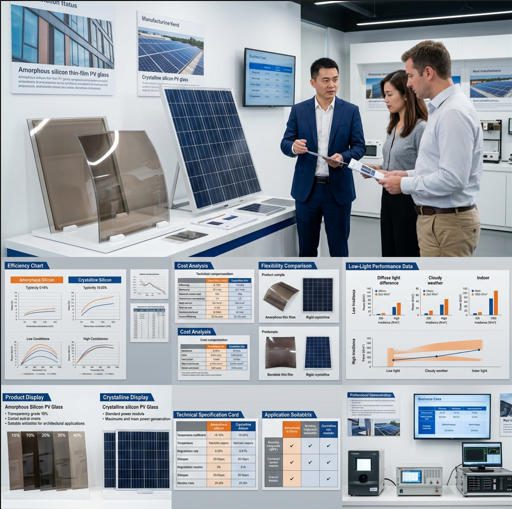
The Great PV Glass Showdown: Amorphous vs. Crystalline Silicon
A data-driven comparison guide for solar distributors, agents, and commercial builders — covering efficiency, cost, flexibility, low-light performance, and how to recommend the right technology for every project.

The choice between amorphous and crystalline silicon PV glass defines how a project balances output, aesthetics, flexibility, and cost — and the wrong choice costs distributors both margin and client trust. Source: Unsplash
Introduction: Why This Comparison Matters to Your Business
Every week, solar distributors face a version of the same question: “Should this project use amorphous or crystalline silicon glass?” The wrong answer costs your client money, erodes your credibility, and walks revenue to a competitor who knew the answer. The right answer — backed by data — builds the kind of trust that turns a project sale into a five-year supply relationship.
The global thin-film PV market was valued at USD 6.2 billion in 2024 and is projected to reach USD 12.4 billion by 2029 at over 16% CAGR (MarketsandMarkets, 2024). Meanwhile, crystalline silicon continues to command 95%+ of global solar module shipments, with monocrystalline panels alone representing ~80% of all installed capacity. Both technologies are growing — but they are growing in different market segments, at different price points, for different buyers.
This guide gives your sales team a concrete, data-backed framework for advising commercial clients — architects, developers, builders, and facility managers — on which technology serves each project type. We cover efficiency benchmarks, real-world performance data, cost structures, ideal use cases, and how to handle the objections you hear most often.
The BIPV (Building-Integrated Photovoltaics) thin-film segment is growing at 20.16% CAGR within the broader BIPV market (Fortune Business Insights). Distributors who can confidently specify the right PV glass technology for each project are capturing this growth. Those who treat both technologies as interchangeable are leaving significant margin on the table.
Understanding PV Glass Technology Fundamentals
What Is Amorphous Silicon?
Amorphous silicon (a-Si)A non-crystalline form of silicon where atoms lack a regular repeating lattice structure. Deposited as an ultra-thin film (~1 µm) via plasma-enhanced chemical vapor deposition (PECVD) onto glass, plastic, or metal substrates. is the non-crystalline form of silicon used in thin-film solar panels. Unlike the ordered atomic lattice of crystalline silicon, amorphous silicon has a disordered structure — atoms are positioned randomly, without the precise geometric arrangement that defines crystalline materials.
This structural disorder is not a flaw — it is an engineered advantage in specific contexts. Because amorphous silicon absorbs light across a broader spectrum of wavelengths (including near-infrared and diffuse visible light), it harvests energy from conditions that crystalline cells largely ignore: overcast skies, artificial interior lighting, and heavily shadowed urban environments.
The manufacturing process involves depositing silane gas (SiH₄) in a vacuum chamber using plasma-enhanced chemical vapor deposition (PECVD) at relatively low temperatures (150–300°C). This results in a film roughly 1 micrometer thick — approximately 150× thinner than a human hair, and about 1% of the silicon used in crystalline wafers. The substrate can be glass, flexible stainless steel, or plastic, enabling configurations impossible with brittle wafer-based cells.
What Is Crystalline Silicon?
Crystalline silicon solar cells are built from silicon with a precise, repeating atomic lattice — the same structure that makes silicon the backbone of modern electronics. Two commercial variants dominate the market:
Monocrystalline silicon (mono-Si) is grown as a single continuous crystal using the Czochralski process — slow rotation of a silicon seed crystal through molten silicon at 1,414°C. The result is a highly ordered lattice with minimal electron-trapping defects, enabling commercial module efficiencies of 20–25% (lab records exceeding 26.8%). Premium architectures — HJT (Heterojunction Technology)A cell architecture combining crystalline silicon wafers with ultra-thin amorphous silicon passivation layers, achieving temperature coefficients as low as -0.26%/°C and commercial efficiencies above 23%. e TOPCon (Tunnel Oxide Passivated Contact)Next-generation monocrystalline cell technology using tunnel oxide layers to reduce recombination losses, pushing commercial efficiencies beyond 23% in mass production by 2024–2025. — push commercial efficiencies above 23%.
Polycrystalline silicon (poly-Si) is cast from molten silicon that forms multiple randomly oriented crystal grains. The grain boundaries trap electrons, reducing efficiency to 15–20%. Lower manufacturing cost historically made poly-Si competitive, but rapidly falling mono-Si prices have largely displaced polycrystalline technology in premium applications.
The Critical Differences at a Glance
| Characteristic | Amorphous Silicon (a-Si) | Monocrystalline (c-Si) | Polycrystalline (mc-Si) |
|---|---|---|---|
| Atomic Structure | Disordered, random | Single crystal lattice | Multi-grain lattice |
| Film / Wafer Thickness | ~1 µm thin film | 150–180 µm wafer | 150–180 µm wafer |
| Module Efficiency (STC) | 6–14% | 20–25% | 15–20% |
| Weight (per m²) | 2–3 kg/m² | 10–15 kg/m² | 10–14 kg/m² |
| Physical Flexibility | Alta | Rigid only | Rigid only |
| Low-Light Performance | Excelente | Moderado | Moderado |
| Temperature Coefficient | -0.16 to -0.25%/°C | -0.35 to -0.45%/°C | -0.38 to -0.45%/°C |
| Market Share (2025) | ~3–5% | ~80% | ~12% |
| Typical Warranty | 20–25 years | 25–30 years | 25 anos |
| Wholesale Price/Watt | $0.40–$0.80/W | $0.10–$0.15/W | $0.10–$0.14/W |
Sources: Jia Mao BIPV comparison guide; SolarTechOnline crystalline silicon guide; Market.us thin-film market report (2024)
Efficiency Rates — The Performance Comparison

Amorphous Silicon Efficiency Metrics
Commercially available a-Si modules achieve 6–14% efficiency under Standard Test Conditions (STC: 1,000 W/m², 25°C, AM 1.5 spectrum). Single-junction designs reach 7–10%; tandem-junction configurations (a-Si combined with microcrystalline silicon, often called “micromorph”) push toward 11–14%.
These numbers require context. The STC efficiency figure captures only one operating condition. In practice, amorphous silicon’s broader spectral response — its ability to absorb wavelengths that crystalline cells cannot — means it harvests energy from diffuse sunlight, overcast skies, and even indoor artificial lighting at levels where crystalline panels produce negligible output. Research from PowerFilm Solar documented a-Si panels outperforming crystalline alternatives by up to 4× under indoor lighting conditions.
Key variables that determine real-world a-Si output include: substrate quality (glass vs. flexible polymer), cell thickness (thicker films absorb more light but require higher voltages), hydrogenation level of the a-Si:H film (hydrogen passivates dangling bonds, improving efficiency by 2–3%), and ambient temperature — a-Si panels retain more output at elevated temperatures due to their superior temperature coefficient.
Crystalline Silicon Efficiency Metrics
Monocrystalline panels represent the current commercial efficiency benchmark. Standard mono-Si modules achieve 20–22% efficiency; premium HJT and TOPCon architectures exceed 23–25% in mass production. The US Department of Energy’s crystalline silicon R&D program notes lab cell records exceeding 27%.
In terms of degradation, crystalline silicon is among the most stable commercial solar technologies. A comprehensive study published in MDPI Sustainability analyzing 25-year warranty claims found average degradation rates of 0.4–0.6% per year, with quality modules retaining 87–93% of original output at Year 25. Modern crystalline modules carry 25–30 year performance warranties as standard.
Polycrystalline modules deliver 15–20% efficiency at lower manufacturing cost than monocrystalline. Their grain boundaries increase electron recombination losses, limiting efficiency ceiling. Annual degradation runs 0.5–0.7%/year. While poly-Si dominated the market through the 2010s, plummeting mono-Si prices have reduced its market share significantly since 2020 — most major manufacturers have shifted primary production to monocrystalline.
PV Module Efficiency by Technology — Commercial Products (2024/2025)
Efficiency range under Standard Test Conditions (STC): 1,000 W/m², 25°C, AM 1.5 spectrum
Sources: NREL Best Research-Cell Efficiency Chart; Jia Mao BIPV product data; GreenMatch efficiency report (2025); DOE Crystalline Silicon R&D
Making the Efficiency Argument to Clients
When a client asks “which is more efficient?”, the honest answer is: crystalline silicon, in bright sunlight on a fixed surface. But that is not the complete question. The right question is: which technology is more efficient for this specific project, on this specific surface, in this specific climate?
A commercial greenhouse in the Netherlands with 60% cloud cover annually will see a-Si panels close the gap on crystalline significantly. A south-facing glass atrium in Dubai will favor a-Si’s temperature coefficient. A logistics warehouse rooftop in California with zero shading wants mono-Si crystalline every time. Teaching your sales team to ask the right qualifying questions before recommending a technology is worth more than any product specification sheet.
Flexibility and Design Advantages
Amorphous Silicon Flexibility Benefits
Amorphous silicon’s defining physical advantage is mechanical flexibility. Because a-Si is deposited as a continuous thin film on flexible substrates — stainless steel, plastic, or flexible glass — the resulting panels bend, curve, and conform to non-flat surfaces. Rigid crystalline panels are built from brittle 150–180 µm silicon wafers that fracture under bending stress.
Commercially available flexible a-Si panels can bend to radii as tight as 25 mm without measurable power loss. Weight drops to just 2–3 kg/m² compared to 10–15 kg/m² for standard crystalline glass modules. For a 500 m² roof installation, this represents a structural dead load difference of 3,500–6,000 kg — enough to require expensive structural reinforcement for crystalline panels on many existing commercial buildings.
For architects, the freedom to specify solar panels on curved facades, barrel-vault roofs, cylindrical canopies, and irregular building forms is transformative. Thin-film a-Si can follow building geometry rather than dictating it. The panels produce a uniform, subtly tinted appearance — more aesthetically cohesive than the visible cell patterns of crystalline panels — and can be manufactured in semi-transparent configurations with 10–35% visible light transmittance (VLT).
Jia Mao BIPV’s glass-integrated facade systems offer both thin-film and crystalline BIPV glass options, with custom tint levels, transparency ranges, and panel dimensions tailored to architectural specifications. Their a-Si glass products achieve excellent temperature coefficients of -0.19%/°C, maintaining strong output in real-world operating temperatures.
Crystalline Silicon Rigidity Considerations
Standard crystalline modules weigh 10–15 kg/m² and require rigid mounting frames — aluminum railing systems, ballasted flat-roof mounts, or custom facade brackets. This imposes structural load requirements that must be verified by structural engineers on every project. For retrofit installations on older buildings, this step frequently uncovers the need for costly reinforcement — a project cost that can swing ROI calculations significantly.
The boundary between “flexible” and “rigid” is becoming less clear. Perovskite-silicon tandem cells — with Trinasolar reporting a lab record of 30.6% efficiency (Solar Power World, 2025) — are being developed in semi-flexible configurations. Mass-market perovskite BIPV glass is still 3–5 years from commercial scale, but early-positioning distributors will capture first-mover advantages when it arrives.


Low-Light Performance — The Hidden Advantage
Amorphous Silicon in Shaded Environments
This is where amorphous silicon’s structural “disadvantage” — its disordered atomic lattice — becomes its biggest commercial differentiator. The same disorder that limits peak efficiency enables a-Si to absorb a broader spectrum of light wavelengths, including diffuse visible light and near-infrared radiation that crystalline cells reflect or ignore.
Under partial shading conditions, a-Si modules retain 60–70% of rated output. Crystalline panels drop to 20–30% under the same shading because series-connected cell strings are limited by the lowest-performing shaded cell. A single shaded cell throttles the entire string — a well-documented phenomenon that crystalline installers typically address with string optimizers or microinverters, adding $50–$200 per module in balance-of-system costs.
Onyx Solar’s commercial a-Si glass documentation confirms that amorphous silicon “offers better performance under diffuse light conditions or partial shading” — a straightforward acknowledgment of a key application advantage.
Consider a commercial office building in London, Hamburg, or Seattle — cities where annual diffuse radiation exceeds 60% of total irradiance. A standard 10%-efficient a-Si glass facade installation may deliver annual energy yields closer to 85–95% of its STC-based projection, because it harvests diffuse light that STC conditions don’t simulate. A crystalline panel in the same conditions underperforms its STC projections by a larger margin.
Documented application areas where this advantage is commercially decisive include: urban BIPV facades surrounded by taller buildings, greenhouse and agrivoltaic installations where partial shading from structure framing is unavoidable, and bus shelters, canopies, and covered walkways where overhead obstructions create continuous partial shade.
Crystalline Silicon Low-Light Limitations
The crystalline industry has developed effective mitigation strategies for shade sensitivity. MicroinversoresIndividual inverters mounted on each solar panel, converting DC to AC at the module level. They eliminate the series-chain shading problem by making each panel electrically independent. Cost: $50–$150 per module additional over string inverter systems. e DC optimizersPower electronics attached to each crystalline panel that independently maximize output from each module using maximum power point tracking (MPPT), reducing shading losses without converting to AC at the module level. (from manufacturers like Enphase and SolarEdge) effectively eliminate shading losses in crystalline systems — but add $50–$200 per module in hardware cost. In projects where shading is a factor and crystalline technology is preferred for efficiency, these electronics are a worthwhile investment. For distributors, they also represent an additional margin opportunity.
Cost Analysis and Pricing Strategy
Amorphous Silicon Cost Structure
Amorphous silicon uses less than 1% of the silicon required for crystalline wafer production. Silicon is one of solar manufacturing’s largest material inputs, so this reduction has significant cost implications. Combined with lower-temperature PECVD deposition (150–300°C vs. 1,400°C+ for crystalline ingot growth), a-Si manufacturing costs approximately $0.73/Wp for 10%-efficient glass modules — roughly $73/m².
However, the cost-per-watt comparison is more nuanced. Because a-Si produces fewer watts per square meter, the total system costs — mounting hardware, wiring, inverters, installation labor, and permitting — that are roughly proportional to array area (not wattage) dilute the manufacturing cost advantage. A system needing 2× more panels to reach the same output also needs 2× more mounting rails and wiring runs.
Where a-Si wins definitively on installed cost is in BIPV applications where panels replace building materials rather than being added to them. When a-Si PV glass replaces conventional architectural glazing ($80–$200/m²), the incremental cost of adding power generation is the difference between PV glass and standard glass — not the full PV glass price. A 1,000 m² facade upgrade from conventional glazing to a-Si PV glass at $350/m² represents a $150–$270/m² premium over the glazing it replaces. That premium generates electricity for 25 years.
Crystalline Silicon Cost Structure
Crystalline wholesale module prices have fallen from approximately $8.00/W in 2010 to $0.10–$0.15/W by early 2026 — one of the most dramatic cost reductions in industrial history. At this pricing level, crystalline technology consistently delivers the lowest cost per kilowatt-hour of electricity generated over a system’s lifetime for standard rooftop and ground-mount installations.
The 25-year ownership calculation consistently favors crystalline for standard applications: higher annual energy yield, lower degradation rate (0.3–0.5%/year vs. 0.5–1.0% for a-Si), longer warranted lifespan (25–30 years vs. 20–25 years), and established maintenance practices. A well-installed crystalline system retains 87–93% of original output at Year 25 (MDPI Sustainability, 2024).
| Cost Factor | Amorphous Silicon (a-Si) | Monocrystalline (c-Si) | Notes |
|---|---|---|---|
| Wholesale Module Price | $0.40–$0.80/W | $0.10–$0.15/W | a-Si at premium for specialized form factors |
| Installed Cost (BIPV glass) | $300–$550/m² | $480–$850/m² | BIPV glass formats; includes framing |
| Installed Cost (standard module) | $0.80–$1.50/W | $0.80–$1.20/W | Standard rack-mount systems |
| Manufacturing Energy Payback | 1–2 years | 2–4 years | a-Si advantage: less energy-intensive mfg |
| Structural Cost Premium | Low (2–3 kg/m²) | High (10–15 kg/m²) | Older buildings may need reinforcement |
| Shading Mitigation Hardware | None needed | $50–$200/module extra | For shaded sites: optimizers or microinverters |
| Annual Degradation | 0.5–1.0%/yr | 0.3–0.5%/yr | c-Si delivers more lifetime energy |
| Payback Period (standard) | 8–14 years | 5–10 years | Varies by location, electricity rate, incentives |
| Payback (BIPV material substitution) | 8–15 years | 10–18 years | Against conventional glazing replacement cost |
Sources: MarketsandMarkets Thin-Film PV (2024); Jia Mao BIPV price guide; Terli crystalline vs. amorphous comparison; IEA-PVPS Technical Guidebook
Cost Comparison Framework for Your Sales Team
The most common mistake in distributor sales conversations is comparing cost per panel or cost per watt without accounting for the total installed system economics. Train your team to present cost per kWh delivered over 25 years — the metric that aligns with how sophisticated commercial buyers evaluate capital equipment. A slightly more expensive module with better efficiency and lower degradation often wins the 25-year cost-per-kWh comparison even when it loses on upfront module price.
Ideal Use Cases — Matching Technology to Projects
- Project requires curved, flexible, or non-flat surfaces
- Building structure has limited load capacity (<10 kg/m²)
- Significant shading from surrounding structures or trees
- Cloudy climate: >50% diffuse radiation annually
- Semi-transparent glazing is required (10–35% VLT)
- BIPV application replacing conventional glazing
- Hot climate: cell temps regularly exceeding 55°C
- Agricultural/greenhouse integration needed
- Indoor light harvesting (IoT, sensors, displays)
- Aesthetics demand uniform, unobtrusive appearance
- Maximum power output per m² is the primary goal
- Rooftop area is limited (residential or small commercial)
- Unshaded south/southwest-facing surface available
- Fastest ROI and payback period required
- Utility-scale or ground-mount system
- Standard residential rooftop installation
- Client wants 25–30 year performance warranty
- High-efficiency BIPV facade with maximum generation
- Bifacial installation for additional rear-surface gain
- Budget-constrained project at lowest $/kWh installed
Specific Application Examples: A-Si
BIPV Facades and Skylights: A 2,400 m² commercial office atrium project in Northern Europe installed semi-transparent a-Si PV glass as the primary skylight material. At 34 Wp/m² and 16% VLT, the system generated approximately 81.6 kWp while providing natural daylight to retail tenants below — dual function impossible with conventional panels. The project, similar in concept to the Bell Works reference installation (60,000 sq ft of Onyx Solar a-Si glass), generated press coverage that drove two additional project inquiries from the same developer.
Agricultural Greenhouse: A commercial tomato greenhouse in the Netherlands replaced 40% of its polycarbonate roof with 18% VLT semi-transparent a-Si glass, generating 120 kWp while retaining 88% of crop yields. The dual-revenue story — electricity generation plus full crop production — produced an ROI calculation with a payback period of under 7 years when both income streams were included. Research published in MDPI Agronomy confirmed the viability of semi-transparent a-Si photovoltaic greenhouse integration for commercial crop production.
Specific Application Examples: Crystalline
Commercial Rooftop: A 10,000 m² distribution warehouse in Germany installed 850 kWp of mono-Si bifacial panels. At $0.12/W wholesale with 25-year warranties and a 0.4%/year degradation rate, the project achieves a simple payback of 6.2 years — a clear case where crystalline technology’s power density and proven economics are unbeatable.
High-Performance BIPV Facade: For projects that demand both architectural integration AND maximum energy output, crystalline-based BIPV glass wins. Jia Mao BIPV’s crystalline facade panels use strategically spaced monocrystalline cells within architectural glass laminates, achieving 140–200 Wp/m² — 3–5× the output of a-Si alternatives — while maintaining visual transparency and architectural integration.
Global Solar Module Market Share by Technology (2025)
Share of total global PV module shipments — showing crystalline dominance and thin-film’s specialty positioning
Sources: MarketsandMarkets (2024); Coherent Market Insights Thin Film Solar (2024); Fortune Business Insights BIPV Report; Market.us a-Si Market (2024)
Hybrid Approaches and Mixed System Solutions
Some of the most elegant commercial projects combine both technologies: crystalline modules on south-facing rooftop areas where maximum power density matters most, paired with a-Si glass on facades, skylights, or overhead canopies where transparency and flexibility are required. This hybrid approach captures the efficiency advantages of crystalline where conditions suit it, and the form-factor advantages of thin-film where they are architecturally necessary.
Bifacial crystalline panels — now representing over 95% of production cells in 2023 according to IEA-PVPS Task 13 — can also complement a-Si facade systems: bifacial panels capture reflected light from light-colored building envelopes (including semi-transparent a-Si glass facades), adding 10–30% to energy yield from the same panel footprint.
Watch: Understanding Building-Integrated PV Technology
Source: YouTube — “Understanding Building-Integrated Photovoltaics.” This reference video explains how BIPV facade systems work, covers both thin-film and crystalline glass options, and walks through LEED certification implications — ideal for sharing with architects and developers in your sales pipeline.
Environmental and Durability Factors
Amorphous Silicon Durability Profile
The Staebler-Wronski effect is the single most-cited technical concern about amorphous silicon. Discovered in 1977, it describes light-induced degradation that reduces output by 10–30% in the first 6–12 months of operation as photon absorption creates defect states in the disordered silicon lattice.
The practical takeaway for distributors: reputable manufacturers rate their a-Si panels at stabilized output — the wattage printed on the label already accounts for this drop. PowerFilm Solar’s published data shows that “commercially available amorphous silicon products typically see a 10–15% degradation” before stabilization. After stabilization, modern a-Si modules degrade at approximately 0.5–1.0% per year — within the range of polycrystalline silicon panels.
Physically, a-Si thin-film is highly resilient. Its monolithic construction eliminates the solder joint failures and micro-crack propagation that can afflict crystalline panels after thermal cycling. There are no brittle wafers to fracture. Flexible a-Si panels routinely survive impact forces that would shatter conventional glass-fronted panels. In coastal environments, the absence of silver paste contacts (prone to corrosion in saline atmospheres) gives thin-film an additional durability advantage.
Crystalline Silicon Durability Profile
Crystalline silicon holds the durability benchmark in the solar industry. Field installations from the 1990s are still generating power at measurable percentages of original output. The industry standard 25-year performance warranty — now extending to 30 years from premium manufacturers — is backed by decades of field validation. A study in MDPI Sustainability (2024) evaluating 25-year warranty credibility found that well-manufactured crystalline panels degrade at 0.4–0.6%/year, confirming industry performance guarantees are achievable.
Modern crystalline modules incorporate tempered glass, advanced encapsulants (POE replacing EVA in premium lines), and anodized aluminum framing that resists corrosion across 25+ year exposure to UV, temperature cycling, and moisture. The industry’s rigorous qualification testing under IEC 61215 (crystalline) e IEC 61646 (thin-film) — which include thermal cycling (200 cycles from -40°C to +85°C), humidity-freeze, damp heat (1,000 hours at 85°C/85% RH), and UV exposure tests — provides a rigorous baseline for both technologies.
Sustainability and Environmental Impact
| Environmental Metric | Amorphous Silicon | Monocrystalline Silicon |
|---|---|---|
| Energy Payback Period | 1–2 years | 2–4 years |
| Silicon Usage per Wp | <1% of c-Si | 150–180 µm wafer |
| Manufacturing Temperature | 150–300°C | 1,400°C+ (ingot growth) |
| Carbon Footprint (gCO₂/kWh) | ~15–25 gCO₂/kWh | ~20–35 gCO₂/kWh |
| Toxic Materials | Minimal (no heavy metals) | Minimal (silver paste, lead solder concern) |
| End-of-Life Recyclability | Glass, frame recoverable | Glass, silicon, frame recoverable |
| Operational Lifespan | 20–25 years | 25–30+ years |
| Lifetime Net Energy Generation | Moderate (lower yield, shorter life) | Higher (better efficiency, longer life) |
Sources: Jia Mao BIPV module comparison; US DOE Energy Payback Time data; IEC certification standards (Sinovoltaics)
Market Trends and Future Outlook
Current Market Dynamics
Technological Advancements
Research into tandem cell architectures is gradually improving a-Si efficiency ceilings. Multi-junction designs stacking a-Si with microcrystalline silicon (the “micromorph” cell) have demonstrated efficiencies approaching 12–14% in commercial production. The EU’s PERSEUS project (2025–2027) is developing optically transparent perovskite modules explicitly for building integration — when these reach commercial scale, they will likely share distribution channels with existing a-Si BIPV products. Distributors with established a-Si product expertise will be natural first-movers.
The crystalline efficiency frontier continues advancing rapidly. Perovskite-silicon tandem cells — with Trinasolar reporting a record-setting 30.6% efficiency in laboratory conditions — are moving toward commercial production. Mass-market tandem panels exceeding 28% efficiency are projected for 2026–2028. IES-UPM reports efficiencies exceeding 24% have been achieved in recent commercial prototypes, marking perovskite-silicon as a commercial reality in 2025. Bifacial TOPCon panels — already generating 25–30% energy yield gains in optimal installations — are rapidly becoming the new commercial standard.
The market is bifurcating: crystalline silicon continues to commoditize in standard rooftop applications (margins compressing), while BIPV glass — both thin-film and crystalline — holds premium pricing and margins due to customization, specification complexity, and lower competition. Smart distributors are shifting portfolio emphasis toward BIPV glass products where technical competence protects margin. Jia Mao BIPV supplies both crystalline and thin-film BIPV glass options, enabling partners to serve the full spectrum of project requirements.

The premium BIPV segment — where both amorphous and crystalline glass technologies serve architectural integration projects — is growing at over 20% CAGR and represents the highest-margin opportunity for solar product distributors. Source: Unsplash
Decision-Making Framework for Your Sales Team
Qualifying Questions for Clients
Flat roof → c-Si. Curved facade, skylight, atrium → a-Si or crystalline BIPV glass. Greenhouse → semi-transparent a-Si. The surface geometry is often the most decisive factor before any efficiency conversation begins.
Run a shading analysis. If annual shading loss exceeds 15–20% without mitigation, a-Si’s shade tolerance becomes a compelling economic argument. If the site is unshaded, crystalline wins on efficiency.
If the existing roof or facade structure cannot support 10–15 kg/m² of crystalline panels without reinforcement, the structural engineering cost must enter the ROI calculation. a-Si at 2–3 kg/m² often sidesteps this cost entirely.
Hot desert or tropical climate: a-Si’s temperature coefficient advantage narrows the real-world efficiency gap. Cloudy northern climate: a-Si’s diffuse light advantage is meaningful. Temperate, clear climate: crystalline’s efficiency advantage is fully expressed.
Both technologies contribute to LEED and BREEAM credits. If achieving LEED Gold or BREEAM Excellent is a client requirement, confirm the certification strategy with your LEED AP contact and select the technology that maximizes the specific credit categories targeted.
If the architect or developer requires visual uniformity, semi-transparency, or custom color/tint — and this is a hard design requirement — a-Si BIPV glass is the pathway. If aesthetics are flexible, crystalline BIPV can offer higher output with acceptable visual integration.
Handling Objections and Building Confidence
Reframe the comparison. When a-Si glass replaces conventional architectural glazing, you are not comparing it to a crystalline rooftop panel — you are comparing it to glass that generates zero electricity. A 1,000 m² facade of a-Si glass at $350/m² versus conventional glass at $200/m² represents a $150,000 premium that generates approximately 40 kWp × 1,400 sun hours = 56,000 kWh/year. At €0.18/kWh, that is €10,080/year — a 14.9-year simple payback on the premium, not the full glass cost. Frame the incremental investment, not the total material cost.
Set expectations correctly. The effect is real, documented, and well-understood — which is why quality manufacturers rate their panels at stabilized output. The panel label already accounts for the initial drop. After stabilization, degradation rates are comparable to polycrystalline silicon. Modern tandem-junction a-Si designs have also meaningfully reduced initial degradation severity. Frame it as a managed, predictable characteristic — not a defect — and confirm that warranties are written around stabilized performance.
Thin-film amorphous silicon has been commercially deployed in building applications since the early 2000s. The Bell Works skylight (60,000 sq ft of a-Si glass, operational since 2018) is one of dozens of documented large-scale commercial references. The technology is listed under IEC 61646, carries UL certification, and is supported by 20+ years of field performance data. “Proven” applies to both technologies; the correct question is “proven for this application type.”
Practical Tools and Resources for Distributors
Sales Enablement Materials
Ready-to-present efficiency, cost, and application matrix for client meetings. Download from your supplier’s portal.
Input: m², location, electricity rate, shading factor. Output: annual kWh, payback period, 25-year NPV. Build in Excel or use web-based tools.
Six qualifying questions (surface, shading, load, climate, certifications, aesthetics) standardized for field use by any sales team member.
Pre-written glass spec clauses for skylights, facades, and greenhouses that architects can insert directly into project specs.
3–5 local reference projects with quantified outcomes: m² installed, kWp, annual kWh, payback, certification achieved.
Internal training on Staebler-Wronski, temperature coefficients, IEC certification standards, and LEED credit mapping.
Key Supplier and Reference Links for Your Team
Equip your sales team with these verified, live resources for technical questions and client-facing documentation:
| Resource | Purpose | Link |
|---|---|---|
| Jia Mao BIPV — Full BIPV Product Range | Product specs, pricing, customization | www.jmbipvtech.com |
| Amorphous vs. Crystalline Module Comparison | Technical comparison guide | jmbipvtech.com — Module Comparison |
| a-Si Pros, Cons & Real Use Guide | Client-ready technical explainer | jmbipvtech.com — a-Si Guide |
| BIPV Facade Panel Comparison | Facade system selection tool | jmbipvtech.com — Facade Comparison |
| BIPV Installation Design Guide | Specification and installation reference | jmbipvtech.com — Design Guide |
| IEC Certification Standards Explained | Certification compliance reference | Sinovoltaics — IEC Standards |
| NREL Efficiency Chart | Current lab efficiency records | NREL — Cell Efficiency Chart |
| IEA-PVPS BIPV Technical Guidebook | Engineering reference for BIPV specifications | IEA-PVPS Task 15 |
| DOE Crystalline Silicon PV R&D | Technology roadmap and efficiency data | US DOE — c-Si R&D |
| Temperature Coefficient Performance | Hot-climate client conversations | PowerFilm Solar — Temp Performance |
Conclusion — Making the Right Choice for Every Project
The amorphous vs. crystalline decision is never about which technology is universally “better.” It is about which technology is right for this project’s specific combination of surface geometry, shading conditions, climate, structural constraints, aesthetic requirements, and financial parameters.
Crystalline silicon dominates standard rooftop and ground-mount installations on pure energy economics — highest efficiency, lowest $/kWh, fastest payback, longest proven lifespan. Amorphous silicon earns its place in BIPV applications demanding flexibility and transparency, cloudy or hot climates where its performance characteristics close the efficiency gap, and architecturally sensitive projects where uniform semi-transparent glass integration is a hard requirement.
The distributors and agents who master both technologies — who can recommend the right product based on a six-question site assessment rather than a default to whichever they stock — are the ones building trusted, long-term relationships with architects, developers, and facility managers. Jia Mao BIPV provides both crystalline and thin-film BIPV glass solutions across the full spectrum of commercial applications.
Ready to Build Your PV Glass Sales Capability?
Access Jia Mao BIPV’s full technical specifications, custom pricing, and distributor support resources for both amorphous silicon and crystalline BIPV glass products.
Explore Jia Mao BIPV Products →FAQs — Addressing Common Questions from Distributors and Sellers
These 15 questions represent the most common technical and commercial queries from solar distributors, agents, builders, and architects evaluating amorphous vs. crystalline silicon PV glass.