Master the messaging strategies that turn prospects into committed solar customers — backed by behavioral research and field-tested tactics your team can implement immediately.
 The distributors and agents who consistently outperform in solar aren’t selling better products — they’re delivering better-framed conversations. Photo: Unsplash
Why Your Messaging Matters More Than Your Product Specs
You already know your products work. You’ve seen the performance data. You’ve walked commercial rooftops and explained system specs to procurement managers. You’ve defended your pricing against cheaper imports. And you’ve still lost deals you shouldn’t have.
Here’s the uncomfortable truth: most of those losses weren’t about the product at all.
A landmark field experiment published in Nature Communications (Bär et al., 2023) tested four different message frames on 26,873 real customers making real solar purchase decisions — not survey respondents, not hypothetical buyers. The result was unambiguous: the cost-savings framing produced a 40% higher commitment rate compared to the baseline, and outperformed the next-best frame by 30%. The products were identical. The price was identical. Only the framing changed.
If you’re a solar distributor, agent, or regional reseller, that number should stop you mid-sentence during your next team meeting. Because it means your sales team is almost certainly leaving 30–40% of convertible prospects on the table every single week — not from poor prospecting, and not from product shortcomings, but from misaligned messaging.
This guide is not for retail solar buyers. It is written specifically for the B2B professionals who train sales teams, manage distribution networks, and close deals worth $50,000 to $500,000+. Every framework, every diagnostic tool, and every script in this guide is calibrated for that context.
Frame Theory (Definition): Frame theory in sales psychology describes how the same factual information can produce different behavioral responses depending on how it is presented. Two prospects hearing identical product data will make different purchase decisions based on which frame — cost savings, environmental impact, or energy independence — is applied to that data.
The Three Core Messaging Frameworks That Drive Solar Conversions
Understanding Frame Theory and Customer Decision-Making
Your prospects are not making rational decisions. They believe they are — they’ll cite payback periods, warranty terms, and system efficiency — but the behavioral science is clear: the decision to commit to a solar investment is made emotionally, then justified logically.
Kahneman and Tversky’s Prospect Theory, the foundational work in behavioral economics, demonstrated that people evaluate outcomes not in absolute terms, but relative to a reference point — and that losses feel approximately twice as painful as equivalent gains feel pleasurable. When you pitch solar as a gain (“earn more, save more”), you trigger a different psychological response than when you pitch it as loss prevention (“stop paying for rate increases you can’t control”).
This is frame theory in commercial application. The same 280 W/m² module, the same 25-year warranty, the same 30% federal Investment Tax Credit — framed differently, they produce measurably different commitment rates.
The three frames that matter for solar distribution:
- The Cost-Savings Frame: Anchors the conversation to financial ROI, payback timelines, and bill reduction
- The Environmental Impact Frame: Anchors to measurable sustainability outcomes and brand/ESG positioning
- The Energy Independence Frame: Anchors to autonomy, grid resilience, and protection from utility rate volatility
No single frame works for every prospect. The distributors who consistently outperform are not the ones who have the best product — they’re the ones who diagnose which frame to use before they start pitching.
How Frames Override Product Quality in Customer Minds
When two solar systems offer identical performance specifications, the one with better-framed messaging wins the majority of deals. This is not conjecture — it is what the research shows.
An NREL-referenced study found that pitches emphasizing ROI convert 47% better than those focusing exclusively on environmental benefits. A separate analysis by the Solar Energy International Institute found that including specific dollar amounts in proposals — not ranges, but specific figures like “$1,340/year in avoided electricity costs” — increases perceived credibility by 68%.
For your distribution network, this means: specificity is a conversion tool, not a detail. Vague promises about savings erode trust. Precise, verifiable projections — ideally drawn from comparable installations in the prospect’s geography — close deals.
The Neuroscience Behind Commitment Bias
Once a prospect accepts your framing in conversation one, something important happens: they begin unconsciously defending that frame. This is commitment bias — the documented psychological tendency to remain consistent with positions already taken, even when new information would suggest reconsidering.
In practical terms: if you successfully establish in your first meeting that a prospect’s primary concern is protecting themselves from 8% annual utility rate increases, they will enter every subsequent conversation through that lens. They’ll evaluate competing bids, discuss the project with colleagues, and eventually make their purchase decision — all filtered through the frame you set.
This is why the first conversation is disproportionately important. Set the wrong frame early, and every subsequent conversation works against you. Set the right frame, and the prospect becomes your most effective internal advocate.
Commitment Bias (Definition): The psychological tendency to remain consistent with previous decisions or stated positions, even under pressure to reconsider. In solar sales, once a prospect publicly commits to a frame (e.g., “This is primarily a financial protection decision”), they will resist contradictory information that challenges that framing.
The Cost-Savings Frame — Your Fastest Path to Deal Closure
Why Financial ROI Messaging Works Best for Deal-Focused Prospects
The Nature Communications field study is definitive on this point: for large-scale investment decisions like solar installations, cost-savings framing outperforms every other message type. The Self-Save condition — framing the decision as avoiding costs — generated 40% higher commitment rates than the baseline and 30% higher than the next-best frame.
For your commercial and industrial prospects — building owners, property managers, commercial developers — this is your primary frame. They make decisions on spreadsheets, not on sentiment.
The critical nuance: “save money on energy” is not a financial ROI message. It is a vague directional statement. A genuine cost-savings frame looks like this:
“Your current electricity spend at this facility is running approximately $8,400/month based on the usage data you shared. A 450 kW BIPV rooftop installation at this site would offset 72% of that load. At current rates, that’s $72,576/year in avoided costs. After the 30% federal ITC and five-year MACRS depreciation, your net investment drops to approximately $890,000 with a simple payback of 10.4 years and a 25-year NPV of +$1.2M.”
That is a financial ROI message. It contains a specific number tied to the prospect’s actual situation — not a national average or a generic percentage.
Building Credible Savings Projections Your Customers Will Trust
Distributors and agents who try to build savings models on the fly in front of a prospect consistently underperform those who arrive with pre-calculated scenarios drawn from comparable local installations.
The three inputs that make savings projections credible:
| Input | Why It Matters | Where to Get It |
|---|---|---|
| Actual utility bills (last 12 months) | Grounds the model in the prospect’s real cost structure | Ask for 12 months of bills during qualification |
| Local irradiance data | Determines actual system output for that geography | NREL PVWatts Calculator — free, precise |
| Local utility rate escalation history | Shows the prospect what they’re protecting against | EIA data by region, state utility commission filings |
| Comparable local installation performance | Third-party validation of your output estimates | Your own install portfolio; SEIA state data |
When a prospect can see that your savings projection is built on their actual bill, their actual location’s solar resource, and validated by a comparable local installation — not a national average printed on a brochure — the credibility gap collapses.
The “Break-Even Moment” Psychology: Making Abstract Savings Feel Immediate
Here is a conversion-killing pattern that appears in almost every solar distributor’s pitch materials: the 25-year savings projection.
“Over 25 years, this system will save you $340,000.”
That number is accurate. It is also psychologically inert for most commercial decision-makers. Twenty-five years is beyond most property holding periods, most depreciation schedules, and most executive planning horizons.
The reframe that works: compress the timeline to the decision window that matches your prospect’s psychology.
For a commercial developer with a 10-year hold horizon:
“By year 3, the ITC recovery and avoided energy costs will have returned your net cash investment. From year 4 through your exit, this system generates positive cash flow. When you sell the asset, the system adds approximately $4–$5/W to the building’s valuation — on a 450 kW system, that’s $1.8–$2.25M in incremental property value at exit.”
For a property manager with a 2-year P&L focus:
“In month 1, your electricity line item drops by $6,300. That’s $75,600 in the first year — straight to operating income. The ITC benefit hits your tax liability in year 1. Your NOI improvement is immediate, not hypothetical.”
The savings are the same. The frame matches the prospect’s decision window.
Avoiding the Cost-Frame Trap: When Cheap Messaging Commoditizes Your Product
The cost-savings frame has a failure mode that destroys margins: when you lead with price instead of ROI.
“Our panels are the most competitively priced in the market” is not a cost-savings frame. It is a price-competition frame — and it selects for exactly the customer segment you don’t want: price-sensitive buyers who will re-bid your proposal the moment a cheaper option appears.
The distinction is critical:
- Price frame: “We offer the best price per watt.” → Attracts price-sensitive buyers, compresses margins, creates commodity positioning
- ROI frame: “This system delivers the lowest net cost per kWh over the building’s life, including avoided roof replacement, ITC, and MACRS.” → Attracts value-focused buyers, defends margins, creates advisor positioning
Every time your sales team leads with price, they are selecting against the customers who would accept your full margin and selecting for the customers who will squeeze you on every renewal.
The Environmental Impact Frame — Attracting Premium Customers and Building Brand Loyalty
How Purpose-Driven Messaging Creates Emotional Commitment
Not all customers respond to spreadsheets. A segment of your prospect universe — typically corporate real estate, institutional clients, hospitality groups, and publicly traded companies with ESG reporting obligations — makes solar decisions that are substantially driven by environmental and sustainability positioning.
These customers are worth identifying and cultivating carefully, because they exhibit consistent behavioral patterns that make them your most valuable long-term accounts:
- They accept higher system pricing because their purchase decision is not purely price-driven
- They refer more frequently, because solar adoption is part of their public sustainability narrative and they have an incentive to talk about it
- They stay longer and upgrade more readily, because their commitment is values-based rather than financial
- They expand scope, because a positive installation experience on building one leads directly to specifications on buildings two and three
The Nature Communications research found that while the environmental frame produced lower commitment rates than the cost-savings frame in the aggregate sample, it produced the highest commitment rates among environmentally self-identified customers. The key is identification — wasting environmental framing on cost-motivated prospects kills conversion. Applying it correctly to values-motivated prospects closes deals nothing else can.
Identifying Which Customer Segments Respond to Environmental Messaging
The qualifying signals that indicate a prospect is environmentally motivated:
- They mention ESG reporting, sustainability targets, or carbon neutrality commitments without being asked
- Their company has a published sustainability report or net-zero pledge
- They are pursuing LEED, BREEAM, or Green Star building certification on the project
- They have a Chief Sustainability Officer or sustainability department making or influencing the decision
- Their sector carries inherent ESG expectations: hospitality, healthcare, higher education, publicly traded companies
If none of these signals appear in your first conversation, do not lead with environmental messaging. You are not dealing with an environmentally motivated prospect.
Translating Environmental Benefits Into Measurable Customer Impact
Abstract environmental claims kill credibility faster than no environmental messaging at all. “Help the planet” is not a frame. It is a platitude, and sophisticated B2B buyers — the only kind worth pursuing — dismiss platitudes immediately.
The environmental frame works when it is concrete, measurable, and tied directly to the prospect’s specific project:
Weak environmental messaging:
“Going solar reduces your carbon footprint and demonstrates environmental leadership.”
Strong environmental messaging:
“A 450 kW installation at this facility will offset approximately 623 metric tons of CO₂ annually — equivalent to removing 135 passenger vehicles from the road every year. That’s the number that goes into your Scope 2 emissions reporting, your annual sustainability report, and your CDP disclosure. It moves you from 68% of your science-based target to 94% in year one.”
That second version is a frame. It connects the physical system to the prospect’s specific ESG reporting obligation, gives them the exact number they’ll use in their next sustainability report, and positions you as a partner in their compliance and disclosure process — not just a product vendor.
Building a Sustainability Narrative That Differentiates Your Brand
The distributors and agents who have built durable competitive positions in the commercial solar market typically own a specific vertical’s sustainability narrative. They are not general solar distributors — they are the solar partner for hospitality groups, or the preferred solar provider for healthcare systems in their region, or the BIPV specialist that architects specify when they’re designing institutional buildings.
This vertical specialization allows you to develop case studies, reference customers, and framing language that is precisely calibrated to how that sector thinks about sustainability. When a hotel chain’s corporate sustainability director receives a proposal that speaks their language, references their CDP category, and includes performance data from three comparable hospitality installations — that’s not generic solar sales. That is a locked account.
Jia Mao BIPV supports this positioning for distributors working in the architectural and commercial construction sectors — where BIPV products like photovoltaic glass and solar façade panels serve dual functions as both building materials and ESG-qualifying energy infrastructure.
The Energy Independence Frame — The Emerging Powerhouse Messaging Strategy
Why “Freedom from the Grid” Resonates With Today’s Customers
Something shifted in commercial real estate buyers’ psychology after 2022. Grid reliability events — extreme weather-driven outages, rolling blackouts in California and Texas, winter storms that left commercial facilities dark for days — gave buyers a visceral reference point for what grid dependence actually costs.
Add to that a sustained period of utility rate increases (EIA data shows commercial electricity prices increased approximately 15% from 2021 to 2024 in the United States), and you have a prospect population that is increasingly motivated not just by financial savings, but by the desire to reduce their exposure to an uncertain external system.
Energy independence messaging — solar as a hedge against grid volatility, utility monopoly pricing, and weather-driven business disruption — is the fastest-growing conversion driver in commercial solar sales post-2023.
The Psychology of Autonomy: Why Independence Messaging Triggers Action
The psychological mechanism underlying energy independence messaging is the human desire for autonomy and control — specifically, the aversion to dependence on external systems that the individual cannot influence.
A prospect who has experienced a 72-hour power outage at their commercial facility does not need to be educated about the value of energy independence. They have a vivid emotional memory attached to that experience: the cost of lost operations, the difficulty of customer communication, the liability exposure, the generator fuel bills.
Your job in this frame is to activate that memory and connect it to the specific protections your solar-plus-storage solution provides:
“When the grid went down in February 2024, the facility three blocks from here was offline for 61 hours. Their operations loss was north of $400,000. With the battery storage component we’re including in this design, your critical loads — data center, refrigeration, security systems — stay on for 18 hours minimum. That’s not a comfort feature. That’s business continuity insurance.”
That is energy independence messaging. It is specific, it references a real local event, it connects the product to a concrete operational risk, and it quantifies the protection.
Positioning Solar as Insurance Against Rising Energy Costs
The loss aversion reframe is the most powerful tool in the energy independence messaging toolkit. Research consistently shows that people are approximately twice as motivated to avoid a loss as they are to acquire an equivalent gain.
Applied to solar messaging:
Gain frame (weaker): “This system will save you $78,000 per year.”
Loss frame (stronger): “At the current rate trajectory — historical average of 4.3% annual commercial electricity rate increases — you will pay an additional $580,000 in electricity costs over the next 10 years compared to today’s rates. This system locks in your energy cost today and eliminates that exposure entirely.”
Both statements represent the same financial reality. The loss frame converts better because it activates the prospect’s aversion to a specific, quantified loss — not a generic aspiration toward savings.
Loss Aversion (Definition): The psychological principle, established by Kahneman and Tversky, that people feel the pain of a loss approximately twice as intensely as they feel the pleasure of an equivalent gain. In solar sales, messaging that frames the purchase as protecting against specific future losses consistently outperforms messaging that frames it as generating equivalent gains.
Combining Independence With Battery Storage: The Complete Control Narrative
The energy independence frame reaches its maximum conversion power when solar is paired with battery storage, because storage eliminates the one legitimate objection to independence framing: “Solar doesn’t work when the sun isn’t shining, so I’m still grid-dependent.”
The solar-plus-storage pitch for energy independence:
“The 450 kW solar array handles 72% of your load during grid-connected operation. The 2.4 MWh battery system gives you 18 hours of critical-load coverage during grid outages. Combined, you’re looking at 87% reduction in grid dependence in normal operations, and full operational continuity for your critical systems during any outage under 18 hours. Your facility is no longer at the grid’s mercy.”
For distributors representing manufacturers with BIPV product lines, like Jia Mao BIPV’s integrated photovoltaic roofing and façade systems, the storage-plus-BIPV combination is also a differentiation opportunity: the building itself generates power, the storage system holds it, and the combined system eliminates two separate capital expenditures (roof replacement and energy system) that would otherwise occur at different budget cycles.
Research-Backed Conversion Data — What Actually Works in the Field
The Studies Your Sales Team Should Know (And How to Use Them)
The following data is drawn from peer-reviewed research and field-validated industry studies. These are not marketing statistics — they are empirical findings that your sales team can use to calibrate their approach by customer segment and market condition.
Study 1: Nature Communications Field Experiment (Bär et al., 2023) N = 26,873 customers | Randomized controlled trial | Real commitment outcomes
| Message Frame | Commitment Rate vs. Baseline | Key Finding |
|---|---|---|
| Self-Save (cost savings framing) | +40% | Highest performer by significant margin |
| Environment-CO₂ (reduce emissions) | +12% | Effective but not dominant |
| Environment-Green (generate green energy) | +10% | Similar to CO₂ frame |
| Self-Earn (earnings framing) | +8% | Weakest self-interest frame |
| Baseline (no framing) | 0% | Reference condition |
Takeaway for your team: Lead with cost-savings framing as default. It works across the broadest customer population and produces the highest aggregate commitment rates. Layer in environmental and independence frames only after qualifying for specific motivational profiles.
Source: Nature Communications — Message framing to promote solar panels
Study 2: NREL Solar Pitch Effectiveness Analysis
- ROI-focused pitches convert 47% better than environment-only messaging
- Including specific dollar amounts increases proposal credibility by 68%
- Local installation references boost trust by 53%
- “Your neighbor went solar” type references decrease sales resistance by 40%
Takeaway for your team: Specificity is not a detail. It is a conversion mechanism. Build every proposal around exact numbers tied to the prospect’s specific situation and geography.
Study 3: Peer Effects in Solar Adoption (Barnes et al., OSTI, 2022)
Research on rooftop solar adoption confirmed that peer effects — knowing that neighbors or comparable businesses have adopted solar — significantly accelerate the adoption decision. In early-adopter markets, active peer referrals increased conversion rates by 30–40% in adjacent zip codes.
Takeaway for your team: Social proof is not a nice-to-have closing technique. In commercial markets, it is the fastest trust-building tool available. Build a reference library of comparable local installations and lead with it.
Study 4: Aurora Solar — Theory of Planned Behavior Applied to Solar
Aurora Solar’s analysis of the Theory of Planned Behavior in solar adoption found a critical insight: even when social norms strongly support solar adoption, conversion fails when a prospect believes they are unable to adopt. Perceived behavioral control — the belief that “this is something I can actually do” — is a prerequisite for conversion, not an assumption.
Takeaway for your team: Before any frame can work, the prospect must believe adoption is feasible for them specifically. Address financing options, permitting complexity, and installation timelines early to establish feasibility — then apply your frame.
Source: Aurora Solar — Solar Sales Insights from the Theory of Planned Behavior
The “Loss Aversion” Principle: Why Protecting What They Have Beats Gaining Something New
The practical application of loss aversion for your sales team is one of the simplest but most consistently underused tools in commercial solar messaging.
Compare these two statements:
| Gain Message | Loss Message |
|---|---|
| “Save $78,000 per year on electricity” | “Stop paying $78,000 per year in preventable electricity costs” |
| “Add $1.8M to your building’s value” | “Don’t exit this asset at a $1.8M discount to comparable solar-equipped buildings” |
| “Earn an additional 6% return on your building” | “Protect your NOI from the utility rate increases that are already eroding your margin” |
| “Qualify for the 30% federal tax credit” | “This ITC window closes at the end of your fiscal year — after that, the math changes significantly” |
The loss-framed versions activate a different, more powerful psychological mechanism. They require no additional data — you simply reframe the identical information from a gain perspective to a loss-prevention perspective.
Train your team to write both versions of every key claim in your proposals and pitches. Then use the loss version as the primary statement and the gain version as confirmation.
Social Proof Research: How Peer Adoption Messaging Amplifies All Three Frames
Social proof operates differently depending on which primary frame you’re using:
- In the cost-savings frame, social proof sounds like: “The logistics facility two miles from here installed a comparable system 18 months ago. Their most recent annual energy spend was $41,000 lower than the year before installation.”
- In the environmental frame, social proof sounds like: “The two hotels in this portfolio have both published their Scope 2 reduction data from BIPV installations. Their sustainability reports cite specific tonnage numbers that have strengthened their ESG ratings.”
- In the energy independence frame, social proof sounds like: “During the February outage event, three of our clients with storage-plus-solar installations maintained full operations. Every one of them has since referred us to a comparable property in their portfolio.”
In every case, the social proof is specific, local where possible, and tied directly to the primary frame. Generic testimonials don’t convert. Specific reference scenarios drawn from comparable installations in the prospect’s sector close deals.

Diagnostic Framework — Identifying Which Frame Works for Each Prospect
Your Sales Team’s Quick-Reference Guide to Prospect Segmentation
The most common mistake sales teams make with frame-based messaging: they pick a frame they’re comfortable with and use it on everyone. The second most common mistake: they mix all three frames in a single pitch, trying to appeal to everyone simultaneously.
Both approaches underperform a simple diagnostic approach executed consistently. Here is the framework your team can use from the first conversation.
The Five Qualifying Questions That Reveal Which Frame Will Convert
Ask these questions in the first 15 minutes of any qualified prospect conversation. Listen for the language they use in their responses — it will tell you which frame to anchor the rest of the conversation in.
Question 1: “What’s your biggest operational concern about your energy situation right now?”
- If they answer with bill amounts, rate increases, or budget pressure → Cost-Savings Frame
- If they answer with outages, grid reliability, or business continuity → Energy Independence Frame
- If they answer with ESG targets, carbon reporting, or sustainability commitments → Environmental Frame
Question 2: “When you think about the next 5–10 years of owning this building, what keeps you up at night about energy costs?”
- Concern about rising rates → Cost-Savings/Loss Aversion Frame
- Concern about grid instability → Energy Independence Frame
- Concern about regulatory compliance or stakeholder expectations → Environmental Frame
Question 3: “Has your organization set any sustainability or carbon reduction targets that your facilities need to contribute to?”
- Strong yes with specific targets → Environmental Frame (primary)
- General yes without specifics → Environmental Frame (secondary, after cost savings)
- No → Do not use Environmental Frame as primary
Question 4: “If electricity rates in your area increased 10% this year, how would that affect your operation?”
- Describes specific financial impact or operational disruption → Loss Aversion Frame (Cost or Independence)
- Dismisses the concern → This prospect may need more education before any frame works; assess feasibility first
Question 5: “What would success look like for you personally at the end of this project?”
- Mentions numbers, payback, or board approval → Cost-Savings Frame
- Mentions autonomy, resilience, or operational control → Energy Independence Frame
- Mentions sustainability report, ESG score, or external recognition → Environmental Frame
Creating Customer Personas Based on Frame Responsiveness
Based on these diagnostic questions, your team can segment every qualified prospect into one of three primary personas:
| Persona | Primary Motivator | Primary Frame | Typical Sector | Deal Size Tendency |
|---|---|---|---|---|
| The CFO Buyer | Financial ROI, payback period, board justification | Cost-Savings + Loss Aversion | Manufacturing, logistics, retail property | Medium-Large |
| The ESG Director | Carbon targets, sustainability reporting, stakeholder credibility | Environmental (with financial validation) | Corporate real estate, hospitality, healthcare, education | Medium-Large |
| The Resilience Buyer | Grid independence, operational continuity, risk management | Energy Independence + Storage | Data centers, healthcare, food processing, government | Large |
Each persona responds to different proposal formats, different metrics, and different closing language. A proposal designed for the CFO Buyer that leads with carbon tonnage numbers will underperform. A proposal designed for the ESG Director that leads with payback period analysis will feel tone-deaf.
Build persona-specific proposal templates for each. This takes one afternoon. The conversion improvement pays back within the first two uses.
Red Flags: When a Prospect Isn’t Responding to Any Frame
Not every lead is qualified, and recognizing disqualification signals early is as valuable as recognizing conversion signals.
The primary disqualification signals:
- No decision authority: The prospect can’t name the decision-maker or won’t confirm who else is involved. No frame works without access to the actual decision-maker.
- Active frame rejection: The prospect explicitly rejects cost savings (“price isn’t really the issue”), environmental messaging (“that’s not a priority for us”), and independence framing (“we’ve never had issues with our grid”). If all three frames land flat, either the prospect has a constraint that no frame can overcome (e.g., they’re planning to sell the building), or this is not a qualified opportunity.
- Endless information-gathering without movement: Some prospects use the sales process as free consulting. If you’re on the fourth detailed technical conversation and there’s been no movement toward a site assessment or a proposal request, diagnose the real obstacle — it’s usually feasibility (financing, ownership structure, or board approval complexity), not frame mismatch.
- Pure price focus with no interest in ROI context: A prospect who will only discuss price per watt, with no engagement on system output, avoided costs, or incentive recovery, is looking for a commodity quote. This is not your customer.
Exit these conversations efficiently. The time you spend trying to convert a fundamentally unqualified prospect is time you’re not spending converting a qualified one.
Avoiding the Messaging Mistakes That Kill Conversions
Mixing Frames in a Single Pitch: Why Conflicting Messages Trigger Decision Paralysis
This is the most common and most costly conversion mistake in solar distribution sales: the everything-pitch.
It sounds like: “Our solar system will save you money, help the environment, and give you energy independence. Plus it’s great for your ESG score and your property value and you’ll never have to worry about grid outages again.”
Every individual claim is true. Delivered together in the first conversation, they collectively produce decision paralysis — not enthusiasm.
The psychological mechanism: when a prospect is presented with multiple competing frames simultaneously, they have no clear motivational anchor. They can’t identify why they specifically should buy. They become uncertain about which benefit applies to them. And uncertainty produces hesitation, not commitment.
The correct structure is sequential, not simultaneous:
- Open with diagnostic questions to identify the primary frame
- Lead with the primary frame for 80% of the pitch
- Validate the primary frame with specific data and social proof
- Layer in secondary frames as supporting evidence only after the primary frame is established
“This is primarily a financial protection decision for your building — we’ve established that the ROI works on your specific numbers. The ESG contribution is an additional benefit your sustainability team will appreciate, and the grid resilience gives you operational continuity as a bonus. But the primary case is financial.”
That sequencing creates clarity. Clarity creates commitment.
Over-Relying on Technical Specifications When Psychology Drives Decisions
A spec sheet is not a sales tool. It is a verification tool — something a prospect uses to confirm a decision they’ve already made emotionally.
If you’re leading with efficiency ratings, temperature coefficients, and bifacial gain percentages, you’re delivering information that does nothing to advance the purchase decision. You’re also implicitly communicating to your prospect that they should evaluate your product the same way they’d evaluate a commodity — by comparing specifications against alternative specifications.
The specification conversation belongs after the frame is established, the financial case is accepted, and the prospect is in evaluation mode — not before. In the first meeting, the only specification your prospect needs is the one that directly validates the financial or operational claim that anchors your frame.
For BIPV products — including the integrated solar roofing and photovoltaic glass panels available through Jia Mao BIPV — the spec conversation is particularly important to sequence correctly, because BIPV products carry both building-material specifications and PV performance specifications. Leading with dual-glass construction details when the prospect is trying to understand their payback period is a guaranteed way to slow the decision process.
Failing to Anchor Your Frame Early: Why Late-Stage Messaging Pivots Lose Deals
First impressions in sales operate according to the same primacy effect that governs all human memory: the information presented first disproportionately influences how all subsequent information is interpreted.
If you open your first prospect conversation by talking about your company’s history and product range, you’ve set a vendor frame — and the prospect will evaluate everything that follows through the lens of “which vendor should I choose?” That’s a commodity evaluation.
If you open by asking about their energy costs and the operational impact of their electricity bill trajectory, you’ve set a consultative frame — and the prospect will evaluate everything that follows through the lens of “is this person helping me solve a problem?” That’s an advisor evaluation.
Once a frame is established in conversation one, pivoting to a different frame in conversation three is extremely difficult. The commitment bias that works in your favor when you set the right frame early works against you when you need to reframe a misaligned first conversation.
The rule: set the frame in the first 15 minutes, or spend the rest of the sales cycle fighting against the frame that formed by default.
The Credibility Collapse: When Unsupported Claims Undermine All Three Frames
One exaggerated claim destroys the credibility of your entire pitch. This is the negative version of the halo effect — call it the credibility collapse.
The scenario: your sales rep tells a prospect their system will generate “around $90,000 per year in savings.” The prospect’s engineer analyzes the proposal and determines that a realistic figure, given their actual usage pattern and local irradiance, is $61,000. The prospect now discounts every other claim in the proposal by approximately 30%, because the inflated savings figure has made them skeptical of the entire document.
The cost of that one unsupported claim: a $500,000 deal at risk, plus potential referral network damage.
The solution is not to be conservative in your financial projections. It is to be precise and to show your work. A projection of $61,000 per year in avoided costs, with the utility rate data, irradiance data, and system output calculation visible and verifiable, is more persuasive than an unsupported $90,000 claim — even though $90,000 sounds better.
Prospects who can verify your methodology trust the number. Prospects who can only accept your word for it remain skeptical regardless of what number you use.
Implementation Strategy — Rolling Out Frame-Based Messaging Across Your Team
Auditing Your Current Messaging: Where Are You Leaving Conversions on the Table?
Before you can improve your team’s frame-based messaging, you need an honest assessment of where current messaging is failing. This audit takes one afternoon.
Step 1: Review your last 10 proposals. What frame does each one lead with? Is there a consistent frame, or does it vary by sales rep? If you’re leading with product specifications and company credentials rather than a clear prospect-specific frame, you have a materials problem.
Step 2: Listen to three recent sales calls. With permission, review recorded calls or conduct ride-along observations. In the first 15 minutes of each call: Did the sales rep ask diagnostic questions, or did they go straight to product presentation? Which frame, if any, was established? Was the frame consistent through the rest of the conversation?
Step 3: Categorize your last 20 lost deals. Was the loss on price (wrong frame — price should not be the primary decision variable), on competitor preference (possible frame mismatch — the competitor framed better), or on “no decision” (probable feasibility problem — frame can’t work without perceived feasibility)?
The patterns in these three exercises will tell you exactly where your team’s frame-based messaging is breaking down.
Creating Frame-Specific Sales Collateral for Your Distribution Network
Every frame needs dedicated supporting materials. A single generic proposal template does not serve a frame-based sales approach.
For the Cost-Savings Frame:
- A one-page savings calculator pre-populated with local utility rate data
- A reference sheet showing actual annual savings from 5–10 comparable local installations (dollar amounts, system size, install date)
- A loss-frame version of every key claim on your standard proposal
For the Environmental Frame:
- A carbon offset calculator that outputs metric tons of CO₂ avoided per year and cumulative total over 25 years
- A LEED/ESG credit summary specific to solar and BIPV products
- Case studies from 2–3 installations in comparable ESG-focused sectors, with sustainability report language already drafted
For the Energy Independence Frame:
- A grid reliability risk assessment template based on local historical outage data
- An operational continuity calculation showing hours of critical-load coverage per battery system size
- A rate escalation protection analysis showing 10-year and 20-year exposure under current utility rate trajectory vs. solar
These materials don’t replace your standard proposal — they supplement it with frame-specific evidence that closes the particular gap preventing commitment from your specific prospect type.
Role-Playing Scenarios: Building Frame-Switching Fluency in Your Sales Team
Knowing which frame to use and being able to deploy it fluidly under the pressure of a real sales conversation are different skills. The second requires practice.
Build a monthly 90-minute role-play session into your team’s routine. Structure:
- 30 minutes: Diagnostic question practice. One rep plays a specific prospect persona (CFO Buyer, ESG Director, Resilience Buyer), and their partner runs through the five qualifying questions. Debrief: Did the questioner correctly identify the persona from the answers? Did they pick the right frame?
- 30 minutes: Frame delivery practice. Using the identified frame, the sales rep delivers the first 10 minutes of their pitch. Debrief: Was the frame consistent? Was the data specific? Was the loss-aversion language used?
- 30 minutes: Objection handling within frame. The prospect persona raises the three most common objections for that persona type. The sales rep handles them without abandoning the primary frame. Debrief: Did the response reinforce or undermine the frame?
After six months of consistent practice, your sales team’s frame-switching fluency becomes a genuine competitive advantage — because it cannot be replicated by a competitor who hasn’t done the same work.
Measuring Frame Effectiveness: Which Messaging Drives Conversions in Your Market?
Track the following data points for every qualified prospect conversation, recorded in your CRM within 24 hours of the call:
- Which primary frame was used (Cost-Savings / Environmental / Energy Independence)
- Which customer persona was identified
- Deal outcome: Closed, Lost, In Progress, No Decision
- If Closed: Deal size, time from first contact to close
- If Lost: Primary stated reason for loss
After 30–50 data points per frame, the patterns become statistically meaningful. You’ll know which frame closes most reliably in your specific market, which persona type has the shortest sales cycle, and which frame produces the largest average deal sizes.
This data is worth more than any external market research. It is specific to your geography, your customer base, and your team’s execution — and it continuously improves your conversion approach.

Advanced Tactics — Combining Frames for Maximum Conversion Impact
The “Frame Stacking” Technique: Leading With One Frame, Reinforcing With Another
Frame stacking is the advanced technique that elite solar distributors and agents use on large commercial deals. The principle: once a primary frame is established and the prospect has made an initial commitment to that frame, secondary frames can be layered in as confirming evidence — not competing arguments.
The correct sequence for a large commercial installation:
Conversation 1 (First meeting): Establish primary frame through diagnostic questions. Deliver the primary frame pitch. End with a specific next step (site assessment, proposal request, financial modeling meeting). Do not introduce secondary frames.
Conversation 2 (Proposal presentation): Lead with primary frame validation (updated numbers, local references). Introduce secondary frame as bonus confirmation: “In addition to the financial case we’ve built, I want to show you the ESG reporting impact — because your sustainability team will need this for their Q4 report regardless.”
Conversation 3 (Decision meeting): Primary frame is now the anchor. Confirm the primary frame numbers have held up. Use secondary and tertiary frames to address remaining objections and strengthen commitment. End with loss-aversion closing language tied to the primary frame.
Timing the Frame Pivot: When to Shift From Cost to Independence to Environment
The frame pivot — shifting primary emphasis from one frame to another within a single sales cycle — is occasionally necessary and, when executed correctly, accelerates commitment.
The most common legitimate pivot: starting with cost-savings (because it converts the broadest audience) and pivoting to energy independence when grid reliability enters the conversation.
The trigger for the pivot: a prospect makes a spontaneous comment about a reliability concern — a recent outage experience, concern about an upcoming season, or a business continuity requirement that’s emerged in conversation. At that point:
“You just mentioned the February outage. Can I take a moment to show you how this system’s storage component would have handled that specifically? Because the financial case we’ve built is strong on its own — but what you just described is actually a separate and equally compelling reason this decision makes sense for you right now.”
This is not frame abandonment. The cost-savings frame stays intact. Energy independence is added as a confirming layer that speaks to a newly surfaced motivation. The prospect now has two independent reasons to commit — and the combination is stronger than either frame alone.
Customizing Frame Sequences for Different Deal Sizes
The frame sequence that closes a $50,000 residential system is not the same sequence that closes a $500,000 commercial installation or a $5,000,000 BIPV façade contract.
| Deal Size | Decision Cycle | Primary Frame | Sequence |
|---|---|---|---|
| $10K–$80K (small commercial) | 2–4 meetings | Cost-Savings | Frame → Validate → Close |
| $80K–$300K (mid commercial) | 4–8 meetings | Cost-Savings + Independence | Frame → Validate → Add secondary → Close |
| $300K–$1M (large commercial) | 8–16 meetings | All three frames, sequenced | Diagnose → Primary Frame → Financial case → ESG case → Resilience case → Close |
| $1M+ (institutional/BIPV) | 6–18 months | Environmental + Independence | ESG positioning → Operational case → Financial validation → Peer reference → Close |
For institutional-scale BIPV projects — where the product is integrated into the architectural specification of a new building — the environmental and operational frames often dominate because the financial case is evaluated in a different budget cycle than a pure energy decision. The building’s architect and sustainability team influence specification before the CFO’s ROI analysis begins.
For this project type, the BIPV installation and design support resources at Jia Mao BIPV are a practical reference for building both the technical specification language and the financial modeling that eventually needs to satisfy the CFO’s review.
Using Objection Handling to Reinforce Your Primary Frame
Every objection in a solar sales conversation is an opportunity to deepen the primary frame — if your team handles it correctly.
The wrong way to handle a cost objection when using the cost-savings frame:
Prospect: “The upfront cost is too high.” Sales rep: “Well, we also have the environmental benefits and you get energy independence too.”
This is frame abandonment. The rep has responded to a financial objection by pivoting away from the financial frame — which signals to the prospect that the financial case isn’t strong enough to stand on its own.
The right way:
Prospect: “The upfront cost is too high.” Sales rep: “I understand. Let me be specific about net cost, because gross system cost and net investment are very different numbers here. After the 30% ITC, after the first-year avoided energy cost, and after the MACRS depreciation benefit in years 1 and 2, your actual cash-out-of-pocket in year 3 is $287,000 — not $610,000. And that’s before we’ve discussed C-PACE financing, which takes the upfront cost to zero. Can I show you that calculation?”*
The objection is addressed with financial specifics that reinforce the cost-savings frame. The frame is strengthened, not abandoned.
Building Your Competitive Advantage — Long-Term Frame Mastery
Developing Proprietary Messaging Frameworks Specific to Your Market
National-level solar messaging research establishes which frames work in general. Your competitive advantage comes from customizing those frames to your specific market — where utility rates, grid reliability history, local ESG reporting norms, and customer sector concentration differ significantly from national averages.
A distributor in Texas has a different energy independence pitch than a distributor in Vermont. The Texas pitch references the February 2021 winter storm grid failure and the 2023 summer demand curtailment events — specific, local, visceral references that a Vermont prospect has no emotional connection to. The Vermont pitch references the state’s aggressive renewable portfolio standard and the ESG reporting expectations of the institutional clients that dominate the regional commercial real estate market.
Spend 4 hours developing a market-specific frame reference document for your region:
- The 3 most significant local grid reliability events in the past 5 years
- The current local commercial electricity rate and the 5-year trajectory
- The top 5 local sectors and which frame each responds to most strongly
- The 5 most relevant local comparable installations, by sector and deal size
This document becomes the foundation of your team’s frame-specific pitches and proposals. It is proprietary to your market and cannot be replicated by a national competitor who isn’t doing local market development work.
Creating a Messaging Feedback Loop: Continuous Improvement Through Conversion Data
The distributors who build durable frame mastery don’t optimize once. They optimize continuously, because customer priorities shift, market conditions change, and new conversion data reveals patterns that weren’t visible earlier.
Build a quarterly messaging review into your team’s rhythm:
- What frame closed the most deals this quarter? Is this consistent with previous quarters, or has something shifted?
- What objection appeared most frequently? Is your frame-specific objection handling working, or does the response need to be updated?
- What was the average deal size by frame? If one frame consistently produces larger deals, should you be prioritizing that prospect type more actively?
- What did lost deals have in common? Was it frame mismatch, feasibility barriers, or competitive pricing? Each has a different solution.
This review takes 60–90 minutes per quarter. The cumulative improvement in conversion rates from three years of consistent quarterly optimization is worth significantly more than any single training program or messaging update.
Training Your Entire Distribution Network: Making Frame Mastery Scalable
If you manage multiple dealers, agents, or channel partners, the challenge is ensuring that frame-based messaging is executed consistently across your network — not just by your top two salespeople.
The scalable training structure:
Level 1 — Frame Awareness (2 hours): All dealers and agents understand the three frames, can name the five diagnostic questions, and can identify which frame applies to a given prospect description. This is knowledge.
Level 2 — Frame Fluency (1 day): Dealers and agents can execute the diagnostic conversation, select the correct frame, and deliver the primary frame pitch for their most common prospect type. This requires practice, not just knowledge.
Level 3 — Frame Mastery (3–6 months of field application): Dealers and agents can frame-stack, execute the frame pivot, and use objection handling to reinforce the primary frame under real sales pressure. This develops through experience with coaching.
Don’t try to push your entire network to Level 3 simultaneously. Identify your top-performing 20% of dealers first, invest in taking them to Level 3, use their conversion data to build the business case for the investment with the rest of your network, then roll out systematically.
Staying Ahead of Market Shifts: How to Evolve Your Frames as Customer Priorities Change
Energy independence is the fastest-growing frame today. Environmental messaging is evolving as ESG regulatory requirements become more specific. Cost-savings framing remains the broadest converter but its specific language needs to account for new incentive structures (domestic content adders, accelerated depreciation updates, state-level incentive changes).
The mechanism for staying current: maintain active connections to the market intelligence sources that signal priority shifts before they become obvious.
- SEIA quarterly market insight reports track commercial solar adoption patterns and buyer motivation shifts (seia.org)
- DSIRE (Database of State Incentives for Renewables and Efficiency) tracks incentive changes that directly affect your cost-savings frame numbers
- Your own customer conversations — a quarterly pattern across 20 conversations will reveal priority shifts before any industry report does
The distributors and agents who won in 2023 by leading with cost savings will need to master energy independence framing to win in 2025 and beyond. The ones leading on energy independence today should be watching for the next shift — which, based on regulatory trajectory, is likely to be ESG-driven as carbon reporting obligations expand to mid-market commercial real estate.
Watch: Solar Sales Psychology and Message Framing in Practice
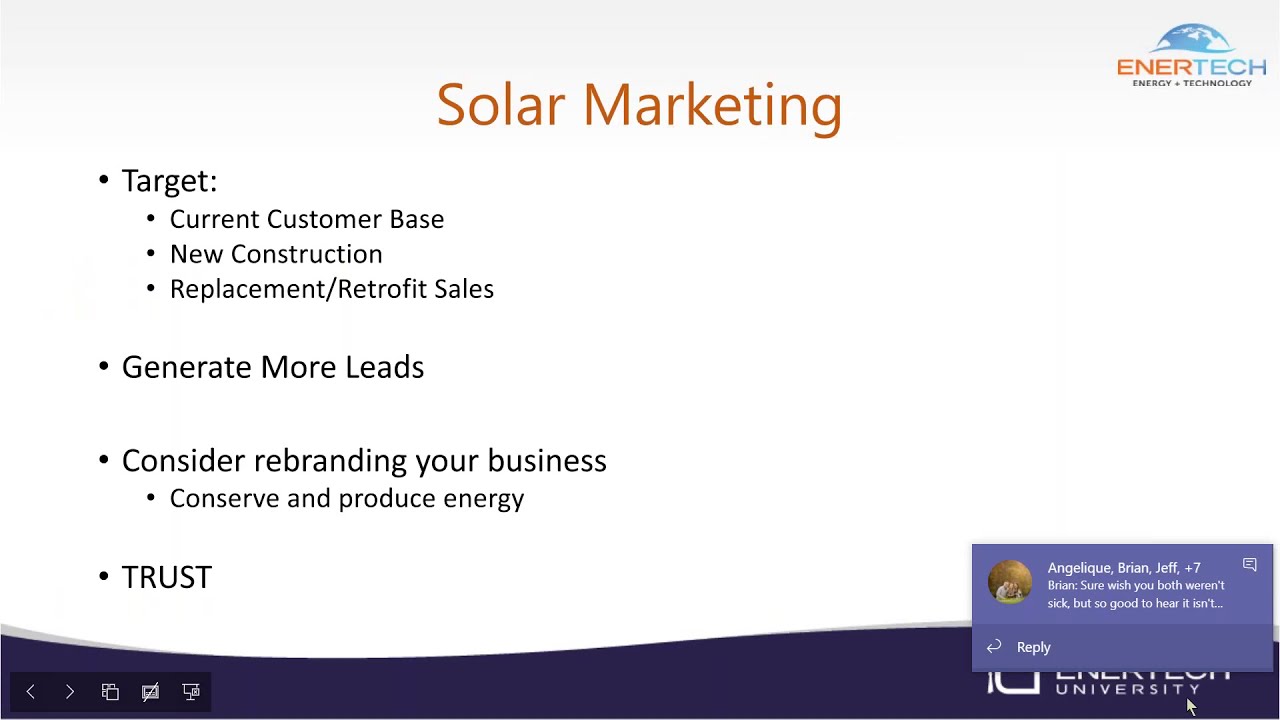
This six-part solar sales and marketing webinar series covers how distributors and agents can structure their messaging to drive consistent conversions — including financing options, prospect qualification, and proposal framing. Watch on YouTube →

Your Next Step to Higher Conversion Rates
You now understand the psychology driving solar purchase decisions. You have the three frames, the diagnostic tools, the research data, the implementation framework, and the advanced stacking techniques.
The question is not whether this works. The Nature Communications randomized controlled trial on 26,873 real customers already answered that — a 40% higher commitment rate from the right frame versus no frame. The NREL data confirmed it. The field results from the distributors who’ve built this into their sales culture confirmed it again.
The question is whether you implement it — or watch the distributors who do pull ahead of you in the markets you share.
The distributors and agents winning in commercial solar right now are not necessarily the ones with the best products or the lowest prices. They are the ones who have built a diagnostic sales culture: ask first, diagnose early, frame precisely, validate with specifics, and reinforce with social proof.
Start with your highest-volume prospect type. Identify which frame their profile suggests. Build the two or three specific data points that make that frame concrete in their context. Deploy it in your next five conversations.
Then measure. Adjust. Repeat.
Your conversion rates will follow.
Ready to transform your team’s messaging? Start with your own prospect pipeline this week:
- Pull your last five proposals and identify which frame (if any) each one leads with
- Listen to your next sales call with the diagnostic framework active
- Build a prospect persona map for your top three customer sectors
For distributors and agents sourcing BIPV products that require a distinct architectural framing approach, explore the Jia Mao BIPV product portfolio — where photovoltaic glass, solar roof tiles, and integrated façade systems open the ESG and architectural value conversation that standard rack-mount solar cannot.
For detailed installation and system design information that supports your technical pitch across all three frames, the BIPV installation design guide is a practical field reference for your team and your installer customers.
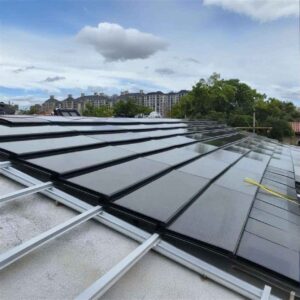
 BIPV installations in commercial architecture create a distinct multi-frame sales opportunity — financial ROI, ESG positioning, and architectural differentiation simultaneously. Photo: Unsplash
Key Terms Glossary
| Term | Definition | Sales Application |
|---|---|---|
| Frame Theory | How the same information produces different behavioral responses depending on its presentation context | The foundational principle underlying all three conversion frames |
| Loss Aversion | People feel losses approximately twice as intensely as equivalent gains | Reframe savings as “preventing a quantified future loss” rather than “earning a gain” |
| Commitment Bias | The tendency to remain consistent with previously stated positions | Set the right frame early; the prospect will defend it for you throughout the sales cycle |
| Primary Frame | The dominant psychological motivator that anchors your pitch to the prospect’s core concern | Identified through diagnostic questioning; used for 80% of your conversation |
| Frame Stacking | Layering secondary frames as confirming evidence after the primary frame is established | Used in large deals after the primary frame is accepted; never simultaneously |
| The Theory of Planned Behavior | Adoption depends on attitude, social norms, and perceived behavioral control | Feasibility must be established before any frame can work |
| Social Proof | Evidence that comparable peers have made the same decision | Specific local references, not generic testimonials |
| MACRS (Modified Accelerated Cost Recovery System) | US tax depreciation system allowing solar assets to be depreciated over 5 years | Key component of commercial solar financial framing |
| ESG (Environmental, Social, Governance) | Non-financial corporate performance metrics increasingly required by investors and regulators | The Environmental Frame’s primary application in institutional and corporate real estate |
| C-PACE (Commercial Property Assessed Clean Energy) | Off-balance-sheet financing for commercial energy improvements, repaid through property tax | Addresses feasibility objections in the cost-savings frame |
Perguntas frequentes
1. Can I use all three frames with the same prospect?
Not effectively, and not simultaneously. Mixing frames in a single pitch creates decision paralysis — the prospect has no clear anchor and no dominant reason to commit. The correct approach is to diagnose which frame resonates through qualifying questions, lead with that frame for 80% of the conversation, then layer in secondary frames only after the primary frame is established and the prospect has signaled acceptance. Sequencing matters more than quantity. A prospect who has committed to the cost-savings frame will hear the environmental and independence benefits as confirmation — not as competing arguments.
2. Which frame converts best overall — cost, environment, or independence?
The Nature Communications field study (N=26,873) is definitive: cost-savings framing produces the highest aggregate commitment rates — 40% above baseline and 30% above the next-best frame. NREL data confirms that ROI-focused pitches convert 47% better than environment-only approaches. However, “best overall” is a market-level answer. In your specific territory, with your specific customer base and local market conditions — rising rates, recent grid reliability events, ESG regulatory environment — the ranking may differ. Track your own data. After 30 conversations per frame, the pattern for your market will be clear.
3. How do I know which frame to use with a new prospect?
Use the five diagnostic questions in the first 15 minutes of your first conversation: What’s their biggest energy concern right now? What keeps them up at night about energy costs over the next 5–10 years? Do they have formal sustainability or carbon reduction targets? How would a 10% rate increase affect their operation? What does success on this project look like personally? The language they use in their answers — financial burden, operational disruption, or sustainability reporting — tells you which frame to anchor the rest of the conversation in.
4. What if my prospect responds to multiple frames equally?
Genuinely equal frame responsiveness is rare in practice, but when it occurs, it’s actually a commercial opportunity. Lead with the frame that produces the strongest emotional response — usually evident in the specificity and intensity of their answers to diagnostic questions. Then layer in secondary frames after the primary is established. A prospect motivated by both financial ROI and energy independence will commit more strongly than one motivated by either alone — provided you sequence correctly rather than delivering both simultaneously.
5. How long does it take to see conversion improvements after implementing frame-based messaging?
Your technically strongest salespeople will see results within 2–3 qualified conversations — frame diagnosis is an immediately applicable skill that doesn’t require weeks of practice to deploy at a basic level. Rolling out consistently across an entire team — including role-play practice and CRM-based tracking — typically takes 4–6 weeks. Most distribution organizations report measurable conversion rate improvements within 90 days of full implementation, with 15–30% improvement being the commonly reported range.
6. Does frame-based selling work for commercial and utility-scale projects, or just residential?
It works for all segments, with frame emphasis shifting by project scale. For small commercial ($10K–$80K), cost-savings framing dominates and the sales cycle is short. For mid-to-large commercial ($80K–$500K), cost-savings plus energy independence is a common winning combination. For institutional and BIPV-scale projects ($500K+), environmental and operational frames become primary because financial decisions are evaluated in a different budget cycle than energy decisions, and the specification process involves architects and sustainability teams before the CFO’s ROI analysis begins.
7. What if a prospect explicitly rejects my primary frame?
Don’t push it. Pivot immediately and cleanly: “That’s helpful to understand — let me ask a different question about your situation.” Then deploy a secondary frame diagnostic question. If they reject cost-savings, test energy independence. If they reject energy independence, test environmental. If all three land flat, diagnose for a feasibility obstacle — they may believe solar is not achievable for them specifically, which is a different problem that no frame can solve without first establishing feasibility.
8. How do I handle price objections when using frame-based messaging?
A price objection almost always signals that the frame hasn’t yet established enough value — not that the price is genuinely too high. Before responding to the objection with net-cost math, diagnose: is this a gross-cost concern (they’re comparing sticker price to their current electricity bill), a budget-cycle concern (the capital isn’t available in this fiscal year), or a genuine financing constraint? Each has a different response. A gross-cost concern is resolved by walking through ITC, MACRS, and avoided costs to get to net investment. A budget-cycle concern is resolved by introducing C-PACE or PPA financing structures. A genuine financing constraint may be a disqualification signal.
9. Can I use frame-based messaging with price-sensitive customers without eroding margins?
Yes — and this is critical: margin erosion comes from price-frame selling, not from frame-based selling. Cost-savings framing is not price framing. Cost-savings framing anchors value to the prospect’s long-term avoided costs and incentive recovery. Price framing anchors value to per-unit cost. A cost-savings frame should lead your prospect to evaluate your proposal against their electricity bill trajectory — not against a competitor’s price-per-watt. When you successfully anchor to the right reference point, your full margin is defensible because the comparison is no longer “your price vs. competitor price” but “your total value vs. the cost of inaction.”
10. How do I train distribution partners or agents on frame-based selling if they’re skeptical?
Start with data from their own market, not theory. Show them conversion rates from agents using frame-based messaging versus those running traditional product-feature pitches. If you don’t have this data yet, reference the Nature Communications field study (40% higher commitment from cost-savings framing) and the NREL ROI pitch effectiveness data (47% better conversion). Once skeptical partners see the mechanism and the evidence, ask them to test it on their next three qualified prospects with deliberate diagnostic questioning. The results from three conversations are more persuasive than any training presentation.
11. What’s the difference between frame-based messaging and traditional benefit selling?
Traditional benefit selling lists product attributes (“high efficiency, 25-year warranty, Tier-1 manufacturer”) and connects them to generic benefits (“lower energy costs, long-term reliability”). Frame-based selling anchors those same attributes to the specific psychological need the prospect has already revealed. The difference is the anchor point: benefit selling starts with the product and points toward the customer; frame-based selling starts with the customer’s existing motivation and points toward the product as the solution. Frames are more powerful because they connect to a psychological need the customer already experiences — rather than trying to create a new one.
12. How do I know if my frame is working, or if I just got lucky with a sale?
Track systematically. Note which frame you led with for every qualified prospect conversation in your CRM, tagged against the deal outcome. After 20–30 data points per frame, patterns become statistically meaningful. You’ll see which frames produce higher close rates, which produce larger average deal sizes, and which produce shorter sales cycles in your specific market. A single closed deal proves nothing — but 30 data points per frame over a quarter tell you exactly where your conversion advantage is, and where your team needs to develop.
13. Should I use different frames for different seasons or market conditions?
Absolutely — and this is one of the highest-leverage optimizations available to an active distribution network. Energy independence messaging spikes during grid reliability events and after extreme weather incidents. Environmental framing strengthens during ESG reporting season (Q1/Q2 for most corporate clients) and during climate-focused regulatory announcements. Cost-savings framing gains additional urgency during tax credit step-down windows and year-end budget cycles. Your primary frame should be calibrated to the dominant market condition in your region at any given time — while remaining anchored in the diagnostic conversation that reveals each individual prospect’s actual primary motivation.
Data sources: Bär et al. (2023), “Message framing to promote solar panels,” Nature Communications; NREL Solar Pitch Effectiveness Analysis; Barnes et al. (2022), “Passive and Active Peer Effects in the Spatial Diffusion of Residential PV,” OSTI; Aurora Solar — Theory of Planned Behavior Applied to Solar Sales; SEIA Solar Market Insight Q2 2025; EIA Commercial Electricity Price Data 2021–2024. For BIPV product information and distributor partnership resources, visit www.jmbipvtech.com.