How to Evaluate Commercial Solar Panel Companies: A Practical Guide

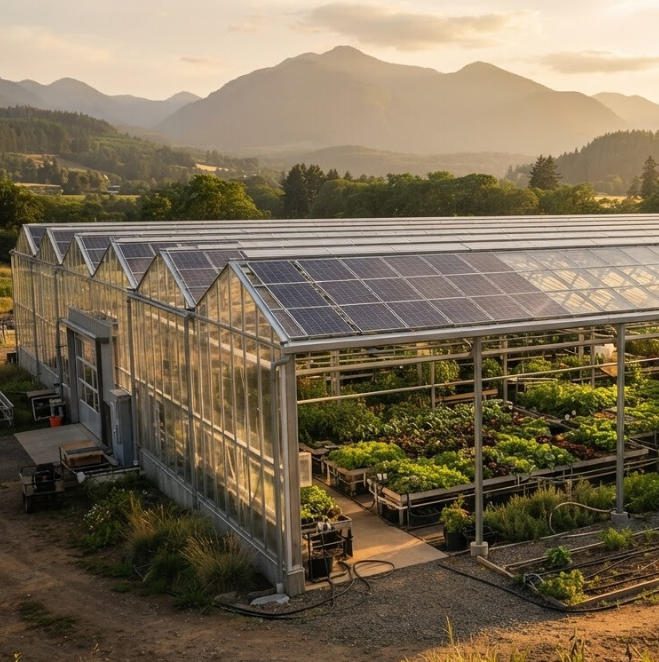
Image: A rooftop solar array on a commercial storage building in Gilroy, California. Author: Roofjockey, licensed under CC BY-SA 4.0, via Wikimedia Commons.
Quick answer: To evaluate commercial solar panel companies, work through five checks in order. First, confirm the company assessed your site and roof properly. Second, compare proposals on the same line items. Third, ask hard questions before you shortlist anyone. Fourth, verify their reputation and equipment. Fifth, run the incentive math. Price matters, but it should be the last tiebreaker, not the first filter.
Why Choosing a Solar Partner Is Harder Than Choosing a Product
You can swap a bad supplier of steel studs. Swapping a solar company after the array is on the roof is a different story.
The panels are only part of the job. You are also trusting the company with roof penetrations, electrical design, utility paperwork, and a warranty that has to outlast the company’s sales team.
That is the situation for many of the people reading this. You might be a curtain wall or roofing contractor bringing in a solar subcontractor. You might be a PV EPC (engineering, procurement, and construction firm) choosing a module or racking supplier. Or you might be an architect or consultant helping a client pick a partner.
Your name goes on the project, so their mistakes become your mistakes.
This guide gives you a structured way to compare companies. It covers site and roof factors, a proposal checklist, shortlist questions, incentives, reputation, and equipment quality. It also answers the “just pick the cheapest” argument head-on.
Quick Glossary: Terms You Will See in Solar Proposals
Bookmark this table. Each term is defined once here and again in plain words when it first appears below.
| Term | Plain-English Meaning | Why It Matters to You |
|---|---|---|
| EPC | Engineering, Procurement, and Construction. One firm designs, buys, and builds the system | Decides who carries schedule and cost risk |
| ITC | Investment Tax Credit. A federal credit that reduces tax owed based on the system’s cost | Can cut a big share of the net price |
| PPA | Power Purchase Agreement. A third party owns the system and sells you the power | Lets a client go solar with no upfront cash |
| Degradation | The slow yearly drop in panel output | A small yearly gap adds up over 25 years |
| Production guarantee | A written promise of minimum yearly kWh | Protects you if the system underperforms |
| Onduleur | The device that turns the panels’ DC power into AC power the building can use | Often the first component to fail |
| Ballasted mount | A racking system held down by weight instead of roof bolts | Common on flat roofs, but adds load |
| Interconnection | The utility’s approval to connect your system to the grid | The most common cause of project delays |
| LCOE | Levelized Cost of Energy. Total lifetime cost divided by total lifetime kWh | The fairest way to compare two systems |
| BIPV | Building-Integrated Photovoltaics. Solar products that replace roofing, glass, or facade materials | Matters when the design brief rules out racked panels |
Step 1: Site and Roof Assessment Factors
A serious solar company starts with your building, not with a price. If a bid arrives without a site visit or roof review, treat it as a marketing estimate.

Image: Solar panels on a roof. Public domain, via Wikimedia Commons.
The five factors that decide whether a roof works
Orientation. In the Northern Hemisphere, south-facing surfaces usually produce the most power. East and west faces still work well, especially for buildings that use most of their power in the morning or late afternoon.
Shading. A vent stack, parapet wall, or neighboring building can cut production more than you expect. Shade on a few panels can pull down a whole string of panels wired together, depending on the inverter design.
Roof material. A membrane roof, standing seam metal, and concrete tile each need a different mounting method. Standing seam metal often allows clamps that do not drill through the roof. Membrane roofs may need ballast or adhered systems.
Structural integrity. The roof must carry the added weight plus wind and snow loads. This calls for a licensed structural engineer, not a sales rep’s opinion.
Local climate. Heavy snow, coastal salt air, hail, and high heat all change equipment choices and expected output.
You can check a company’s output claims against independent data. NREL’s PVWatts calculator estimates production for any address using historical weather data.
A site-visit checklist you can copy into Excel
| Facteur | What to Ask the Company | Good Sign | Red Flag |
|---|---|---|---|
| Roof age and condition | Did you inspect the roof, or just view satellite images? | Written roof report with photos | “The roof looks fine from above” |
| Remaining roof life | Will the roof outlast the solar system? | Repair or re-roof plan included in the bid | Panels on a roof with 5 years left |
| Structural capacity | Who signed off on the load calculation? | Engineer’s stamped letter | No engineer named |
| Shading analysis | Which tool did you use, and what were the results? | Month-by-month shading report | Only a single “shade %” number |
| Roof penetrations | How many, and how are they sealed? | Detailed flashing drawing | Vague waterproofing plan |
| Access and safety | Where do the crane and crew stage? | Site logistics plan | Not discussed |
| Utility capacity | Have you checked the local grid connection? | Early utility contact | “We’ll handle it later” |
Industry insight: The roof, not the solar equipment, causes most warranty arguments on commercial rooftop jobs. If the solar company blames the roofer and the roofer blames the solar company, your client is stuck in the middle. Ask each bidder to state in writing who owns roof leaks near the array, and for how many years.
Step 2: The Proposal and Contract Checklist
Comparing solar bids is hard because every company formats them differently. One lists a price per watt. Another lists a lump sum. A third leaves out interconnection fees entirely.
Fix that by putting every bid into the same template.
Five sections every proposal should include
- Pricing transparency. Equipment, labor, permits, interconnection, engineering, and contingency should each appear as separate lines.
- Warranty terms. Separate coverage for panels, inverters, racking, and workmanship, with start dates and who pays for labor on a repair.
- Maintenance commitments. Cleaning, inspections, monitoring, and response times if the system goes down.
- Expected energy output. Year-one kWh, the modeling tool used, the assumptions, and whether any of it is guaranteed.
- Installation timeline. Dated milestones from contract signing through utility approval and commissioning.
Side-by-side comparison sheet
Copy this into a spreadsheet and fill in one column per bidder.
| Line Item | Company A | Company B | Company C |
|---|---|---|---|
| System size (kW) | |||
| Total installed price | |||
| Price per watt | |||
| Panel brand and model | |||
| Inverter brand and model | |||
| Racking system | |||
| Product warranty (years) | |||
| Workmanship warranty (years) | |||
| Year-one energy estimate (kWh) | |||
| Production guarantee? (Y/N) | |||
| Monitoring included? (Y/N) | |||
| Interconnection fees included? (Y/N) | |||
| Estimated start and finish dates | |||
| Payment schedule |
How to score the bids
Weight the categories by what matters on your project. This pie chart shows a reasonable starting split.
These weights are a starting point. Raise “Timeline and support” if the project has a hard opening date. Raise “Equipment quality” for long-hold assets.
The contract clauses people forget
Read the contract, not just the proposal. Look for these items:
- A clear definition of “substantial completion,” so payment triggers are not arguable.
- A penalty or remedy if the utility approval is delayed by the company’s paperwork errors.
- Who pays if the roof needs repairs discovered during installation.
- What happens to the warranty if the company sells its business or closes.
- A step-in right or escrow arrangement for warranty documents.
Step 3: Questions to Ask Before You Shortlist
Ten minutes of good questions will remove half your candidates. Ask them by phone or in a short meeting, and ask for documents, not promises.
Here are the four areas to cover.
Experience with similar projects
Ask: “Show me three completed projects of similar size, roof type, and use.” A company that mostly does homes is a different animal from one that installs on warehouse roofs.
Then ask for a reference you can call. Ask that reference what went wrong and how fast it was fixed. The answer to that second question tells you more than a case study.
Certifications and licensing
Ask for the electrical contractor license number and confirm it with your state board. Then ask about individual credentials. The NABCEP board certifications are a common industry benchmark for solar professionals. They show that specific people on the crew passed a formal exam. They are not a guarantee of quality, but they do show commitment.
Also ask how the company handles permits. Some jurisdictions accept SolarAPP+ for automated permit review, though availability for larger commercial systems varies. A company that already uses the tool in your area can save weeks.
Financing options
Ask which structures they offer: cash purchase, loan, lease, or PPA. The U.S. Department of Energy explains the basics of leases, loans, and PPAs. It is written for homeowners, but the mechanics carry over to business owners.
One key difference: with a lease or PPA, the third-party owner usually claims the tax credit, and your client pays a lower price for power instead. With a purchase, your client claims it.
After-installation support
Ask: “If the system stops producing at 2 p.m. on a Friday, who answers, and how fast?” Look for named contacts, a service response time in writing, and remote monitoring that alerts the company (not just the client) when output drops.

Image: PV panels on a roof mount and rack in Berkeley, California. Public domain (CC0), via Wikimedia Commons.
Step 4: Understanding Financial Incentives
Incentives can move the numbers more than the choice of panel brand, and the rules changed a lot recently. Check the current rules with a tax advisor before you promise a client anything.
What the federal credit looks like now
The federal solar ITC for businesses now sits under Section 48E. According to SEIA’s tax policy overview, the base credit is 6%. It rises to 30% if the project meets prevailing wage and apprenticeship rules. For systems under 1 MW, the base credit is 30%.
Bonus credits can add 10 percentage points each. These include domestic content, energy communities, and certain low-income locations.
The deadline that matters right now
As of late September 2026, the timing rule is the biggest issue. Solar projects that began construction after July 4, 2026 must be placed in service by December 31, 2027 to keep the credit. This is covered in detail in pv magazine’s report on the start-of-construction rules.
There is also a new set of foreign-entity sourcing rules. SEIA notes that projects now face “Prohibited Foreign Entity” screening tests, which look at ownership, financing, and how much of the supply chain comes from restricted sources.
That creates a practical set of questions for every bidder:
- Did this project, or the equipment order, begin construction before July 4, 2026?
- If not, what is the realistic date we can be placed in service, including utility approval?
- How do you document that your equipment and contracts pass the foreign-entity tests?
Industry insight: With a hard 2027 in-service date, interconnection is the schedule killer. A company that can build in 10 weeks but waits 9 months for the utility does not help your client. Ask every bidder for their current average utility approval time in your service territory.
State and local programs
Many states add their own rebates, grants, or production payments. The DSIRE database lists state and local incentives by location. Check it before the first bidder meeting, so you know what to ask about.
A worked payback example
Suppose a client is considering a 200 kW rooftop system. These numbers are for illustration only. Your real numbers will differ.
| Saisie | Example Value |
|---|---|
| System size | 200 kW |
| Installed price | $1.80 per watt |
| Production | 1,300 kWh per kW per year |
| Electricity rate | $0.12 per kWh |
| ITC rate (system under 1 MW) | 30% |
First, the gross cost and yearly savings:
Then the payback with and without the credit:
The credit shortens payback by about three and a half years in this example. That is why a bidder’s tax-credit knowledge is not a side skill. It is part of the product.
For a cost reality check, the National Laboratory of the Rockies (formerly NREL) publishes installed system cost benchmarks for commercial rooftop systems. Use them to test whether a bid is far out of range in either direction.
Step 5: Assessing Company Reputation and Experience
Reviews and case studies help, but only if you read them with a purpose. Look for detail, not adjectives.
Where to look
- Online reviews. Read the 3-star and 2-star reviews first. They usually describe what actually happened.
- Case studies. A good one lists system size, roof type, dates, and actual first-year output versus the estimate.
- Testimonials. Prefer named clients at named locations you can visit or call.
- Industry credentials. Check certifications, state licensing, and insurance certificates.
- Financial stability. Ask how long the company has operated and whether it has audited financials or a bonding capacity.

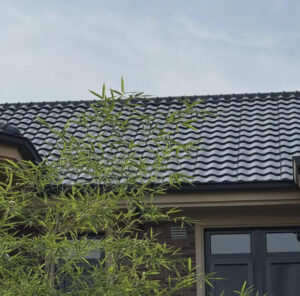
Image: Solar photovoltaic modules on a tiled rooftop. Author: Marta Victoria, licensed under CC BY-SA 4.0, via Wikimedia Commons.
A red-flag list from real project pain points
- The company only shows renderings, never photos of finished jobs.
- Every reference is “under NDA.”
- Production estimates are much higher than PVWatts or your own modeling, with no explanation.
- The sales rep dodges questions about subcontractors. Many solar companies subcontract installation, and you need to know who is actually on your roof.
- They push for a large deposit before design or permits begin.
A short video to share with your team
This walkthrough from EnergySage covers what to look at when choosing an installer, including reviews, experience, certifications, and subcontractors.
Watch: “How to Choose a Solar Installer” (EnergySage, YouTube). It is aimed at general buyers, but the checklist applies to commercial bids too.
Step 6: Evaluating Technology and Equipment Quality
The equipment list in a proposal is where cheap bids often hide their savings. Look at panels, inverters, and mounting one at a time.
Solar panels
Compare five numbers on every datasheet: efficiency, temperature coefficient (how much output drops as panels heat up), yearly degradation, product warranty length, and performance warranty at year 25.
Degradation looks small but compounds. Assume a simple straight-line loss each year:
Here, is the yearly degradation rate as a decimal. The chart below compares three rates.
Method: simple straight-line degradation, compared with a panel that never loses output. Real curves vary, including a larger first-year drop on some technologies.
A panel at 0.4% per year produces about 10% more energy over 25 years than one at 1.2% per year. On a system earning $31,200 a year, that gap is worth tens of thousands of dollars.
Also check the certifications. IEC 61215 tests how well a panel survives heat, cold, humidity, and mechanical stress. IEC 61730 covers electrical and fire safety. TÜV explains the revised versions in its guide to the updated IEC 61215 and IEC 61730 standards.
Finally, check whether the manufacturer will still exist to honor its warranty. The BloombergNEF Tier 1 list is one commonly used signal of whether lenders accept a brand. It measures financing acceptance, not build quality, so use it with test data instead of on its own.
For a deeper look at this step, Jia Mao Bipv has published a guide on how to vet the panel manufacturer behind the quote.
Inverters
The inverter converts DC to AC. It has moving parts, fans, and electronics, so it is the component most likely to need replacement during the system’s life.
Ask which type the bid uses, string inverter or microinverter. Ask about the warranty length and whether it can be extended. Ask how the system reports faults.

Image: A solar inverter installed on a wall. Author: RickyCourtney, licensed under CC BY-SA 4.0, via Wikimedia Commons.
Mounting systems
Racking holds everything up against wind and snow. A weak clamp or poorly sealed bracket becomes a leak years later.
Ask for the wind and snow load rating, the corrosion protection (especially near coasts), and the flashing detail for every roof penetration.

Image: A roof bracket for solar panels. Author: Stefan Thiesen, licensed under CC BY-SA 3.0, via Wikimedia Commons.
When racked panels are not the right answer
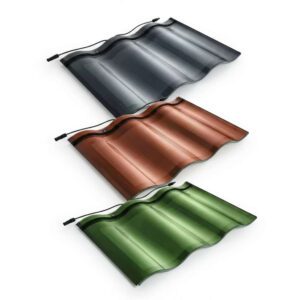
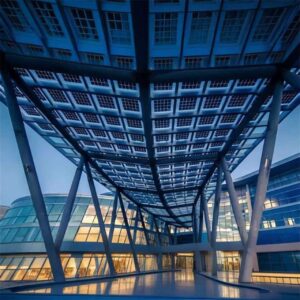
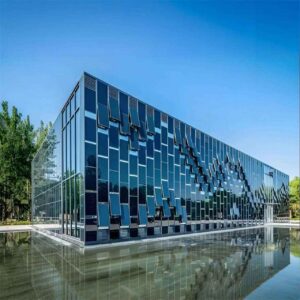
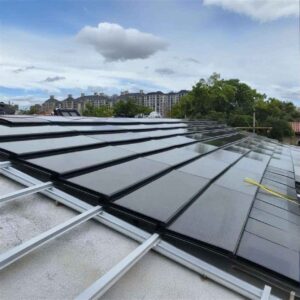
Some projects cannot use panels bolted on top of a roof. Heritage rules, design review boards, curtain wall systems, and skylights all push toward BIPV (Building-Integrated Photovoltaics), where the solar product is part of the building envelope.
In that case, the supplier’s manufacturing control matters even more. Jia Mao Bipv, for example, runs a 3 GW annual production facility with a digital manufacturing system that lets each module be traced back to its production batch. Ask any supplier you consider for the same kind of traceability data.
For product options, see this overview of BIPV product price ranges. For glass-based systems, browse verre photovoltaïque. And for installation sequencing on integrated projects, read the BIPV installation and design steps.
Equipment quality quick table
| Component | Ask For | Strong Answer | Warning Sign |
|---|---|---|---|
| Panels | Datasheet, test reports, degradation warranty | Model-specific IEC certificates and linear warranty | “Same as the other brand, but cheaper” |
| Onduleur | Warranty length, replacement process | 10+ years with extension option | Unnamed brand |
| Racking | Wind and snow rating, corrosion data | Engineered layout for your roof | Generic layout |
| Suivi | What the system alerts and to whom | Alerts reach the installer automatically | Client must check an app |
| Wiring and safety | Rapid shutdown and code compliance | Named code standard and inspection plan | “Standard practice” |
The Counterargument: “Just Pick the Lowest Price”
This argument sounds practical, and sometimes the low bid is fine. If two companies quote identical equipment, warranties, and scope, take the cheaper one.
The problem is that bids are rarely identical. A lower price often means:
- A smaller warranty scope, such as no labor coverage.
- An inverter or racking brand that costs less and fails sooner.
- Missing lines like interconnection fees, engineering, or roof repair.
- A production estimate that assumes a best-case year.
Take a simple case. Bid A costs $12,000 less on a $360,000 project. But the panels degrade 0.8 percentage points faster per year than Bid B’s, which we can estimate from the chart above. That gap costs roughly 10% of lifetime energy. On $31,200 in yearly savings, the “cheaper” bid can give back much more than $12,000 over the system’s life.
A structured scorecard does not ignore price. It puts price next to the things that decide whether the system pays off.
A Repeatable Way to Choose
Evaluating commercial solar panel companies comes down to a process you can repeat. Check the site and roof first. Put every bid into the same template. Ask direct questions before shortlisting. Run the incentive numbers with current rules. Verify reputation with calls, not testimonials. And read the datasheets on panels, inverters, and mounting.
Do that, and you can defend your recommendation to a client, a lender, or a project owner. You also protect your own reputation, since the solar partner you pick becomes part of your project record.
Your next step: Take the comparison sheet above and send it to every bidder on your current project. Ask them to fill it in before you meet. The companies that answer clearly, and quickly, have usually earned a place on your shortlist.
Frequently Asked Questions (FAQs)
1. What are the most important factors to consider when assessing a site for solar panel installation?
Check roof orientation, shading, roof material, structural capacity, and local climate. Confirm the roof will outlast the solar system, and ask how the utility connection will be handled. A written site report with photos is a good sign of a serious bidder.
2. How can I determine if my roof is suitable for solar panels?
Have a roofer inspect the condition and remaining life, and a licensed structural engineer check the load capacity. Then run a shading analysis. If the roof needs replacement within about five to ten years, fix that before or during the solar project.
3. What should be included in a solar panel proposal?
A good proposal lists system size, itemized pricing, equipment models, warranties, expected yearly energy output, monitoring, maintenance terms, and a dated timeline. It should also say who pays for interconnection and permits.
4. How can I compare different solar panel companies effectively?
Put every bid into the same spreadsheet template and score each category with weights. Compare price per watt, but also compare warranty coverage, equipment quality, output assumptions, and references. Call at least two past clients for each finalist.
5. What are common financing options available for commercial solar installations?
Businesses typically use a cash purchase, a loan, a lease, or a power purchase agreement (PPA). With a lease or PPA, a third party owns the system, so your client usually pays less upfront but does not keep the tax credit. Compare the total cost over the contract term.
6. How do I verify the reputation of a solar panel company?
Check the state license, insurance, and certifications such as NABCEP credentials for key staff. Read mixed reviews for real details, and ask for references from projects of a similar size. Also ask who will actually do the installation, since many firms subcontract.
7. What warranties should I expect from a solar panel provider?
Expect separate warranties for panels (often 10 to 25 years for defects), power output (commonly a guaranteed level at year 25), inverters, racking, and workmanship. Ask whether labor for replacements is covered, and what happens if the company closes.
8. Are there incentives available for businesses installing solar panels?
Yes. The federal Section 48E investment tax credit can apply, with rates depending on system size and project conditions, and many states add rebates or grants. Federal timing rules tightened recently, so confirm current eligibility with a tax advisor. The DSIRE database lists state programs.
9. How long does the installation of commercial solar panels typically take?
Physical installation on a mid-size rooftop often takes weeks, but design, permits, and utility approval can add months. The utility connection is the most common delay, so ask each bidder for realistic dates and their recent approval times.
10. What maintenance is required after installing solar panels?
Most systems need periodic visual inspections, cleaning where dust or debris builds up, and remote monitoring to catch drops in output. Inverters may need service or replacement during the system’s life. Ask for maintenance terms and response times in writing.
11. How can I assess the energy output of the solar panels I am considering?
Ask for the year-one kWh estimate and the modeling method. Then run the same address through a free tool such as PVWatts. If the company’s number is far higher, ask for the assumptions. A production guarantee is the strongest proof.
12. What types of solar panels are best suited for commercial properties?
Monocrystalline panels, including PERC and TOPCon designs, are the common choice for commercial roofs because of their efficiency and track record. Where design rules limit visible racks, BIPV products such as solar glass or roof-integrated modules may be a better fit.
13. How do I calculate the return on investment for solar panel installations?
Divide the net cost (after incentives) by yearly energy savings to get simple payback. For a fuller picture, compare lifetime cost per kWh (LCOE) across bids, and include degradation, maintenance, and inverter replacement in the math.
14. What questions should I ask references provided by solar companies?
Ask whether the project finished on time and on budget, how actual output compares with the estimate, and how quickly the company fixed any problems. Also ask whether the roof stayed watertight and whether they would hire the company again.