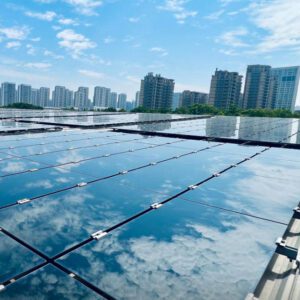
Understanding the revolutionary potential of SolarWindow technology and how it transforms building-integrated photovoltaics into a superior revenue opportunity for solar distributors and agents

For most of the last two decades, “going solar” has meant one thing to nearly every distributor, installer, and property owner: panels on a roof. That mental model has served the industry well, but it has also quietly capped how much revenue distributors can generate from any single building. A roof is finite. A building’s vertical surface — its windows, curtain walls, and cladding — is not, and it is almost entirely untapped.
This is the gap that SolarWindow technology is built to close. Rather than treating windows as passive, energy-losing surfaces, this class of building-integrated photovoltaics (BIPV — a technology category where solar-generating materials are built directly into the building envelope, like glass, roofing, or facade panels, instead of being bolted on top of it) treats every pane of glass as a potential power source. For distributors and agents who have spent years selling the same rooftop systems into an increasingly saturated market, that shift represents one of the more significant expansions of addressable market the solar sector has seen since the panel-price collapse of the mid-2010s.
The purpose of this guide is not to romanticize the technology — it’s to give distributors, agents, and building-solutions resellers a working understanding of how transparent solar glass performs, where it beats rooftop systems, where it doesn’t, and how to build a defensible revenue channel around it. Throughout this article, we’ll reference how a manufacturer like Jia Mao Bipv approaches product specification, certification, and distributor support for this category, since the commercial mechanics of BIPV distribution differ meaningfully from selling standard rooftop modules.
Quick Glossary for This Article
| Term | Plain-Language Definition |
|---|---|
| BIPV | Building-Integrated Photovoltaics — solar cells built into construction materials (glass, roofing, cladding) rather than mounted on top of them |
| OPV | Organic Photovoltaic — a thin-film solar technology using carbon-based compounds instead of silicon wafers, which can be made semi-transparent |
| WWR | Window-to-Wall Ratio — the percentage of a building’s exterior that is glass versus solid wall |
| NPV | Net Present Value — the value today of a stream of future cash flows, used to judge whether a long-term investment is worthwhile |
| TAM | Total Addressable Market — the total revenue opportunity available if a product captured 100% of its potential market |
| ESG | Environmental, Social, and Governance — a framework investors and regulators use to score a company’s sustainability performance |
The Fundamental Technology Behind SolarWindow Innovation
H2: How SolarWindow Technology Works at the Molecular Level
The core innovation isn’t a bigger panel — it’s a coating. SolarWindow-class products apply an ultra-thin organic photovoltaic (OPV) layer, often just a few hundred nanometers thick, onto or between panes of standard architectural glass. Because the active layer is thinner than a human hair, it can be tuned to let visible light pass through while capturing the ultraviolet and infrared wavelengths that the human eye doesn’t need anyway.
Transparent Photovoltaic Coating Architecture
The coating itself is built from stacked organic semiconductor layers, each engineered to absorb a narrow slice of the light spectrum. This layered approach lets manufacturers dial in a specific transparency level — typically somewhere between 40% and 70% visible light transmission — while directing the remaining spectrum toward energy conversion rather than letting it simply pass through unused. Researchers at institutions tracked by the U.S. Department of Energy’s organic photovoltaics research program have pushed lab-scale efficiencies for these transparent cells past 12% in the past two years, a meaningful jump from the 6-8% range that was standard just five years ago.
The balance between light transmission and energy conversion is the central engineering trade-off of this entire product category. A completely opaque coating would generate more power per square foot but would defeat the purpose of using windows at all — occupants need daylight for comfort, productivity, and to avoid triggering additional artificial lighting load. Manufacturers solve this by shifting harvesting toward the UV and near-infrared bands, which contributes almost nothing to human vision but still carries roughly half of the sun’s total energy.
Key Technical Differentiators from Traditional Solar
Traditional silicon panels are wavelength-agnostic within their absorption range — they try to capture as much of the visible and infrared spectrum as possible, which is exactly why they’re opaque. SolarWindow-class coatings are wavelength-selective by design, and that selectivity is what allows the dual functionality of “still a window” and “still a power source” to coexist on the same pane.
A second differentiator that distributors should highlight to commercial property clients is the self-cleaning surface treatment used on most transparent PV glass. These hydrophobic or photocatalytic coatings cause rainwater to sheet off the surface and take dust and grime with it, which matters because dirty glass loses transmission and energy output far faster than a slightly soiled rooftop panel does. This translates directly into lower ongoing service costs — a detail we’ll quantify with real numbers in Section 5.
Finally, because the active layer sits on standard glass substrates, it integrates with the curtain wall systems, insulated glazing units, and window frames that glaziers already install every day. There’s no new mounting hardware category to learn, which is a genuinely underrated sales advantage when you’re trying to get a general contractor or architect comfortable with a new product line.

The 50-Fold Efficiency Advantage Explained
H2: Comparative Analysis: SolarWindow vs. Rooftop Solar Systems
The “50-fold” figure that gives this article its title isn’t a single lab measurement — it’s the product of three compounding factors: available surface area, light-capture efficiency in real-world conditions, and daily generation duration. When these multipliers are stacked, the theoretical ceiling on facade-based generation dwarfs what a roof alone can produce on the same building footprint.
Surface Area Multiplication Factor
Roofs are, by definition, a single flat plane. Facades wrap around the entire perimeter of a structure on every floor. For a typical mid-rise or high-rise commercial building, the combined window and wall surface area is commonly 5 to 10 times larger than the roof’s footprint — and that ratio only grows with building height, since roof area stays fixed while facade area scales with every additional floor.
Academic research on window-to-wall ratio (WWR) backs this up with hard numbers. Studies referenced in peer-reviewed window-to-wall ratio energy research show that commercial office buildings in the U.S. average a WWR between 30% and 60%, with some fully glazed towers exceeding 80%. The U.S. Department of Energy separately estimates that window-related surfaces account for roughly 34% of total commercial building energy exchange — meaning that surface is already doing significant environmental work; it’s simply not generating power yet.
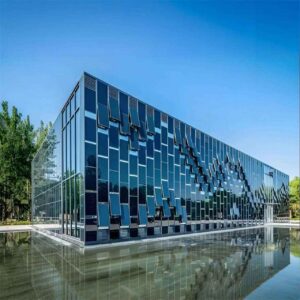
Consider a 50-story office tower with a floor plate of roughly 20,000 square feet and a conservative 40% window-to-wall ratio. The roof offers about 20,000 square feet of usable area (minus mechanical equipment, typically closer to 12,000-14,000 sq ft net). The facade, by contrast, offers somewhere in the range of 250,000 to 400,000 square feet of glazed surface across all floors and orientations. That is the surface area multiplier in concrete terms, and it’s the single largest contributor to the 50-fold framing.
| Building Element | Approx. Usable Surface Area (50-Story Tower) | Relative Share |
|---|---|---|
| Rooftop (net of mechanicals) | 12,000 – 14,000 sq ft | ▓▓ 4% |
| Facade / Window Glazing | 250,000 – 400,000 sq ft | ▓▓▓▓▓▓▓▓▓▓▓▓▓▓▓▓▓▓ 96% |
Light Capture and Utilization Efficiency
The second multiplier is less intuitive but equally important: transparent OPV glass captures diffuse light — the scattered, indirect sunlight present on cloudy days or in shaded urban canyons — more effectively relative to its rated output than crystalline silicon does. Rooftop silicon panels are optimized for direct-beam sunlight hitting them at a near-perpendicular angle; when skies are overcast, their output can fall by 50-80%. Transparent OPV cells, because they’re engineered for lower absorption per unit area to begin with, show a comparatively smaller percentage drop under the same diffuse-light conditions.
Pilot installations in northern European and North American markets have reported 15-20% higher annual output relative to rated capacity in cloudy climates compared to equivalent rooftop arrays, simply because the facade doesn’t experience the same steep performance cliff that shading and cloud cover cause on a roof-mounted system.
Energy Generation Timeline Advantages
The third multiplier is time-of-day exposure. A south-facing rooftop array in the Northern Hemisphere generates its peak output for a few concentrated hours around solar noon and tapers off sharply toward morning and evening. A building with glazing on all four facades, by contrast, has east-facing windows catching strong morning sun, west-facing windows catching strong afternoon sun, and south-facing glass catching midday sun — effectively extending the useful generation window across more hours of the day, even though no single facade ever matches a perfectly-angled rooftop panel at its peak moment.
Watch: researchers explain how transparent solar cell efficiency has climbed past 12% power conversion — a useful technical primer to share with skeptical clients.
Real-World Building Scenarios and ROI Calculations
H2: Commercial Office Complex Case Study
Energy Demand Profile and Generation Capacity
Take a representative 15-story commercial office building in a mid-latitude U.S. market, with average annual electricity consumption around 3.2 million kWh (a fairly typical figure for a Class A office tower of that size). A rooftop-only system on this building, limited by usable roof area after accounting for HVAC equipment and setbacks, might top out at 180-220 kW of installed capacity, generating roughly 250,000-300,000 kWh per year in a sun-moderate climate — covering perhaps 8-10% of the building’s total load.
A SolarWindow retrofit across the south, east, and west facades of the same building, using a 50% transparency glazing product, can realistically install 1.2-1.8 MW of equivalent capacity across the available glazed area, generating an estimated 900,000-1,300,000 kWh annually depending on orientation mix and local irradiance. That’s roughly 4-5 times the rooftop-only generation on the identical structure, without requiring any additional land or roof reinforcement.
Financial Performance Metrics
Installed costs for SolarWindow-class glazing currently run $2.50-$3.50 per watt, compared to $2.00-$3.00 per watt for conventional rooftop systems — a modest premium on a per-watt basis. But because the total addressable wattage on a facade is so much larger, and because retrofit installation avoids the crane work, structural engineering review, and roof penetration costs that rooftop systems require, the blended cost-per-kWh-generated frequently comes out favorably for the facade approach on taller buildings.
| Financial Metric | Rooftop Solar (Reference) | SolarWindow Facade System |
|---|---|---|
| Cost per Installed Watt | $2.00 – $3.00 | $2.50 – $3.50 |
| Typical Payback Period | 8 – 15 years | 6 – 12 years |
| Annual Maintenance Cost (vs. system value) | Baseline | 50-70% lower |
| 25-Year NPV (illustrative, 1 MW system) | Moderate | 20-30% higher lifetime value |
These figures aren’t universal — local electricity rates, incentive structures, and building orientation all move the numbers meaningfully. But the directional pattern (higher upfront cost per watt, offset by far greater total addressable wattage and lower maintenance drag) holds across most of the commercial case studies distributors are likely to encounter.
Distributor Revenue Opportunity
For a distributor, the unit volume math changes substantially compared to a rooftop deal. A single mid-rise facade retrofit can require several thousand individual glazing units rather than a few hundred rooftop panels, which changes both the order size and the margin structure per project. Distributors working with a manufacturer partner like Jia Mao Bipv typically see meaningfully larger per-project contract values on facade retrofits than on comparable rooftop jobs, simply because of the volume of glazing units involved — a dynamic worth modeling explicitly when building sales projections for this category.

Why Rooftop Solar Has Inherent Limitations
H2: Structural and Geographic Constraints of Traditional Systems
Space Limitations and Roof Saturation
In dense urban cores, usable rooftop area is one of the most contested resources on a commercial building — HVAC units, elevator machine rooms, communication equipment, and required fire-code setbacks routinely consume 30-40% of gross roof area before a single panel is installed. Add structural load limits on older buildings, and many properties simply cannot fit a system large enough to meaningfully offset their consumption, regardless of budget.
Directional and Seasonal Performance Variability
A fixed rooftop array is optimized for one tilt angle and one azimuth. That’s a compromise by design — the ideal angle for December sun differs from the ideal angle for June sun, so every rooftop installation accepts some seasonal underperformance in exchange for simplicity. Latitude compounds this: a rooftop system in Chicago or Toronto will show far larger swings between summer and winter output than an equivalent system in Phoenix or Miami, and in snow-prone climates, accumulated snow load can knock out generation entirely for days at a time until it melts or is cleared.
Aesthetic and Architectural Integration Issues
Perhaps the most persistent commercial barrier is aesthetics. Many architects and property owners actively resist visible rooftop arrays, particularly on trophy office assets, hospitality properties, and historic buildings where preservation boards restrict any visible alteration to the roofline. This isn’t a minor objection — for a meaningful share of premium commercial real estate, the rooftop conversation simply never gets past the design review stage, which represents lost revenue for distributors who only sell rooftop solutions.
Technical Advantages for Distributors and Installers
H2: Installation and Maintenance Superiority
Simplified Deployment Processes
Because SolarWindow-class glazing is manufactured to standard glass dimensions, it can be retrofitted into existing window frames during routine glass replacement cycles without triggering the structural engineering review that a rooftop array requires. This shortens the typical project timeline and — because glaziers already know how to handle and install glass units — reduces the specialized labor training burden compared to rooftop mounting crews.
Operational and Maintenance Benefits
The self-cleaning surface referenced in Section 1 does real work here: fewer service calls, less accumulated soiling loss, and — because there are no moving parts, tracking motors, or ground-mounted junction boxes exposed to weather — a lower overall failure rate across the installed base. Manufacturers typically warranty these products for 25+ years, with expected performance retention above 80% of original output at the end of that period, comparable to premium monocrystalline rooftop panels but with a lower maintenance cost curve throughout the product’s life.
Performance Monitoring and Optimization
Modern SolarWindow installations ship with IoT-enabled monitoring hardware (Internet of Things — small networked sensors that report performance data automatically) that feeds real-time generation data into a building’s energy management dashboard. This allows facility managers to catch underperforming panes early, and it gives distributors a valuable post-sale touchpoint: predictive maintenance alerts and performance reporting are a natural upsell into ongoing service contracts, not just a one-time equipment sale.

Market Positioning and Competitive Strategy
H2: Differentiation Opportunities for Solar Distributors
Target Market Segmentation
The clearest early adopters for this category are commercial real estate developers and property managers overseeing Class A office assets, retrofit projects in older buildings where roof space is already spoken for or structurally limited, government and institutional buildings under mandate to hit sustainability targets, and hospitality or retail properties where a highly visible, architecturally clean sustainability statement carries real brand value.
Value Proposition Development
For most commercial buyers, the pitch that resonates isn’t “50-fold more efficient” in the abstract — it’s energy independence, ESG compliance documentation their sustainability officer needs for investor reporting, and an aesthetic outcome that doesn’t compromise the building’s design intent the way visible rooftop racking often does. Distributors who can quantify these points with building-specific numbers close deals faster than those relying on generic sustainability messaging.
Sales Channel Optimization
The most efficient path into this market for most distributors runs through architectural firm partnerships (architects are often the first to hear about a facade retrofit or new-build glazing decision), building management company relationships (who control the maintenance and capex conversation for existing assets), and general contractor integration during the design-build phase of new construction, where glazing specifications are locked in early and rarely revisited later. For distributors evaluating supplier relationships in this space, reviewing a manufacturer’s BIPV product portfolio and pricing structure is a useful first step before committing to a channel strategy.
Financial Modeling for Distributor Business Plans
H2: Revenue Stream Analysis and Profitability Projections
Unit Economics and Margin Structure
Wholesale pricing on transparent PV glazing typically scales meaningfully with order volume, and distributors who commit to multi-project pipelines rather than one-off orders generally secure the better tier pricing that makes facade projects competitive against rooftop alternatives on a total-project basis.
Market Size and Growth Projections
The building-integrated photovoltaics market is one of the faster-growing subsegments of the broader solar industry. Independent market research from Fortune Business Insights’ BIPV market forecast projects the global BIPV market growing from roughly $28.3 billion in 2026 to $85.9 billion by 2034. Separately, Mordor Intelligence’s BIPV market analysis puts 2026 market size near $16.7 billion, with continued double-digit compound annual growth (CAGR — the average annual growth rate over a multi-year period) through the next decade. The spread between these estimates reflects differing scope definitions across research firms, but the directional signal — sustained double-digit growth for at least the next eight years — is consistent across every major report we reviewed.
| Market Research Source | 2026 Estimate | Long-Term Projection |
|---|---|---|
| Fortune Business Insights | $28.33 Billion | $85.9 Billion by 2034 |
| Mordor Intelligence | $16.66 Billion | $47.02 Billion by 2031 |
| Market.us (Facade segment only) | ~$5 Billion | $28.3 Billion by 2034 |
Customer Lifetime Value Optimization
Because facade systems carry longer service relationships (monitoring, self-cleaning system checks, and warranty administration over 25 years), distributors have a natural opportunity to build recurring revenue beyond the initial installation — something the one-and-done nature of many rooftop sales doesn’t offer as cleanly.
Overcoming Implementation Challenges
H2: Technical and Regulatory Considerations for Distributors
Building Code Compliance and Certification
Transparent PV glazing must clear the same UL electrical safety certification standards (Underwriters Laboratories — the primary independent safety testing body referenced in North American building codes) that any grid-connected solar product requires, plus wind load, thermal stress, and fire safety testing specific to glazing products. Distributors should confirm certification documentation before quoting any project, since building inspectors will require it at permitting.
Supply Chain and Inventory Management
Manufacturing lead times for custom-specified glazing currently run 6-8 weeks for standard configurations, which distributors should factor into project timelines when quoting commercial clients with fixed occupancy or opening dates. Reviewing a supplier’s documented BIPV installation and design process ahead of a bid can help avoid timeline surprises later in the project.
Customer Education and Sales Support
Because this is still an emerging category for most commercial buyers, technical training for sales teams and ready-made ROI calculator tools matter more here than they typically do for standardized rooftop quotes. Buyers ask more questions about a technology they haven’t seen before, and sales teams who can answer confidently close faster.
Future-Proofing Your Distribution Strategy
H2: Emerging Trends and Long-Term Market Evolution
Technological Advancement Roadmap
Lab research is already pushing toward the next efficiency threshold. Teams working on next-generation transparent organic PV windows have demonstrated the largest fully transparent OPV panes produced to date, and the IEA-PVPS technical guidebook on BIPV documents a clear industry trajectory toward higher conversion efficiency without sacrificing transparency — suggesting today’s “50-fold” framing may look conservative within five years.
Regulatory and Policy Tailwinds
Building energy codes in a growing number of jurisdictions now favor or require renewable integration for new commercial construction, and green financing structures increasingly reward developers who can document verifiable on-site generation as part of ESG reporting. These policy shifts function as a demand accelerant for distributors positioned early in this category.
Partnership and Ecosystem Development
The strongest long-term distributor positions will likely come from integration with HVAC and smart building platforms, since a facade generating real-time energy data is far more valuable to a building operator when it talks directly to the building management system rather than operating as an isolated asset.
Action Plan for Distributors to Capture Market Opportunity
H2: Implementation Roadmap for Sales and Marketing Success
Phase 1: Foundation Building (Months 1-3). This period should focus on product training and technical certification for the sales team, development of comparative sales collateral against rooftop alternatives, and identification of two or three target account types (office developers, hospitality groups, or institutional buyers) to concentrate early efforts on.
Phase 2: Market Entry (Months 4-6). With foundational training in place, distributors should launch targeted outreach to architectural and general contractor partners, secure a pilot installation — even a modest one — to generate real performance data, and begin documenting that data into a case study that can support future sales conversations.
Phase 3: Scaling and Optimization (Months 7-12). By this stage, distributors with early pilot data and initial customer references are positioned to expand their sales pipeline, refine pricing tiers based on real project margins, and begin layering in recurring monitoring and maintenance revenue as a standard part of every contract going forward.
The Distributor’s Competitive Edge
H3: Why SolarWindow Technology Represents the Next Wave of Solar Growth
Rooftop solar isn’t going away, and it shouldn’t — it remains the right answer for a large share of buildings, particularly low-rise residential and light industrial properties with abundant roof area. But for the commercial and high-rise segment, where roof space is scarce and facade area is abundant, transparent solar glazing addresses a structural limitation that rooftop-only distributors simply cannot solve with their current product mix.
The market is still early. That’s precisely the opportunity: distributors who build technical fluency, pilot project data, and channel relationships now — while competitive density in this specific category is still low — are positioned to hold a meaningful head start once broader awareness catches up with the technology’s actual performance. Working with an established manufacturing partner such as Jia Mao Bipv on product specification, certification support, and distributor onboarding can meaningfully shorten that learning curve for teams entering the category for the first time.
Call-to-Action
Ready to position your distribution business at the forefront of building-integrated solar innovation?
Download our comprehensive SolarWindow Distributor Playbook, schedule a technical consultation with our sales engineering team, join our exclusive distributor partner program for priority inventory access, or request a customized ROI analysis for your specific target markets. Explore our solar glass types and specification guide or review our step-by-step BIPV installation guide to get started, and check our latest BIPV industry updates for ongoing market developments.
Questions fréquemment posées
1. How exactly does SolarWindow technology achieve a 50-fold advantage over traditional rooftop solar? The 50-fold advantage is a compounding calculation, not a single measurement. It combines roughly 5-10x more available surface area on facades versus roofs, higher relative efficiency in diffuse and low-angle light conditions, and extended daily generation from multi-directional exposure. Multiplying these three factors together is what produces the large aggregate advantage on tall buildings specifically.
2. Can SolarWindow technology be retrofitted to existing buildings, or does it require new construction? It works for both. Existing windows can be replaced with SolarWindow units during standard glazing replacement without structural modification, which makes the large existing-building retrofit market fully addressable. New construction offers an added advantage since glazing specifications can be locked in during design rather than adjusted later.
3. What is the actual payback period for SolarWindow installations compared to rooftop solar systems? Typical payback periods run 6-12 years depending on local electricity rates, building orientation, and system size — generally 2-4 years faster than comparable rooftop systems on tall buildings, largely because of the much larger addressable generating surface.
4. How does weather and cloud cover affect SolarWindow performance? Transparent OPV glass performs comparatively well in diffuse light, which makes it a stronger fit than rooftop silicon in cloudy climates. Pilot data from northern-latitude installations shows 15-20% higher annual output relative to rated capacity compared to equivalent rooftop systems in the same climate.
5. What are the maintenance requirements and long-term durability expectations for SolarWindow installations? Expected lifespan is 25+ years with performance retention above 80% of original output. Self-cleaning surface technology and the absence of moving mechanical parts typically bring annual maintenance costs in 50-70% lower than comparable rooftop systems.
6. How does SolarWindow technology integrate with existing building management and energy systems? IoT-enabled monitoring units feed real-time generation data directly into building management systems (BMS) and HVAC controls, supporting predictive maintenance scheduling and detailed energy analytics for facility managers.
7. What certifications and building code compliance does SolarWindow technology meet? Products in this category are tested to UL electrical safety standards along with wind resistance, thermal stress, and fire safety requirements specific to glazing. Distributors should confirm regional building code documentation before bidding any specific project.
8. What is the cost difference between SolarWindow and traditional rooftop solar on a per-watt basis? Current installed costs run $2.50-$3.50 per watt for SolarWindow glazing versus $2.00-$3.00 per watt for rooftop systems. Once maintenance, land requirements, and installation complexity are factored across a 25-year lifecycle, total cost of ownership on tall buildings often favors the facade approach by 20-30%.
9. Which market segments represent the highest opportunity for SolarWindow distribution? Commercial office towers with significant facade exposure, hospitality and retail properties valuing aesthetic enhancement, institutional buildings under sustainability mandates, and urban retrofit projects where roof space is already constrained collectively represent the strongest near-term opportunity.
10. How can distributors differentiate their offerings and build competitive advantage in the SolarWindow market? Effective differentiation comes from specialized technical certification, turnkey partnerships with glazing contractors, custom ROI modeling for prospective clients, and architectural consultation services — since this remains an early-stage category where buyer education is still a competitive advantage.
11. What is the supply chain and inventory management strategy for SolarWindow distribution? Manufacturing lead times currently run 6-8 weeks for standard configurations. Distributors should build project timelines and inventory commitments around that window, and confirm order-minimum flexibility directly with their supplier.
12. How do regulatory trends and sustainability mandates support SolarWindow market adoption? Building energy codes increasingly require renewable integration for new commercial construction, and ESG-linked green financing rewards verifiable on-site generation. Both trends function as structural demand accelerants for the category over the next decade.