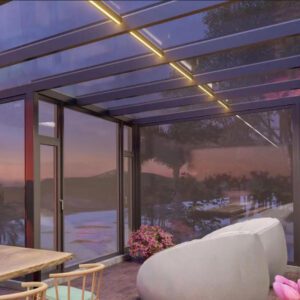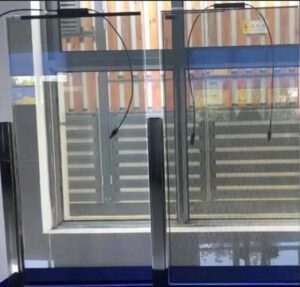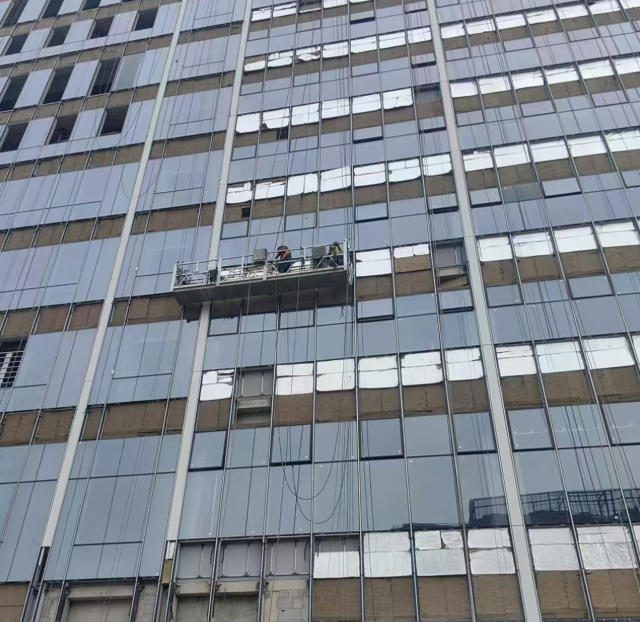
A Strategic Guide for EPCs, Curtain Wall Contractors, Building Material Distributors, Architects, and Design Institutes

Transparent solar glass turns the building envelope into an active energy asset — the defining specification shift in commercial construction for the next decade. For industry professionals evaluating BIPV projects, understanding where transparent solar outperforms traditional PV — and where it does not — is the difference between winning premium projects and watching competitors do it.
1. Executive Insight: Why Transparency Matters in the Next Wave of Building-Integrated Solar
Most commercial buildings built in the last 30 years have a significant blind spot — not in their design, but in their economics. Thousands of square metres of glass sit on facades, rooftops, and atriums, managing light and weather but generating nothing. For decades, the solar industry responded to this with a workaround: mount opaque panels on the roof and call the building solar-powered.
That workaround is becoming obsolete.
The global BIPV (Building-Integrated Photovoltaics) market was valued at USD 34.78 billion in 2025 and is projected to reach USD 250.91 billion by 2035, growing at an 18.3% CAGR (Precedence Research). Transparent and semi-transparent solar technologies — which convert glass surfaces themselves into generating elements — are the primary growth engine inside that expansion. The transparent solar cells market specifically is forecast to grow from USD 16.47 million in 2023 to USD 57 million by 2030 at a 19.4% CAGR (Maximize Market Research), as product maturity improves and commercial project pipelines build globally.
Three market forces are making transparent solar a strategic imperative rather than a design novelty.
Net-zero building mandates are tightening globally. The EU Energy Performance of Buildings Directive (EPBD) requires all new buildings in EU member states to be zero-emission by 2030. California’s Title 24 mandates solar-ready construction for commercial projects. The IEA targets zero-carbon-ready building energy codes in all countries by 2030. These are not aspirational targets — they are legislative timelines that are reshaping procurement specifications right now.
Urban density constraints mean rooftop area is limited. A 20-story office tower may have 500 m² of accessible rooftop and 4,000 m² of south-facing facade. The arithmetic is unavoidable: if solar energy generation must scale with commercial construction, vertical glass surfaces are the only viable expansion zone.
Facade performance expectations have shifted. Institutional clients, ESG-driven corporate tenants, and premium developers now evaluate the building envelope as a financial and environmental asset — not just a physical barrier. Transparent solar glass allows contractors and developers to deliver energy generation, daylighting optimization, thermal management, and architectural continuity in a single material specification.
For curtain wall contractors, EPC firms, building material distributors, and design consultants, this convergence creates a clear commercial opportunity — for those who understand what transparent solar actually is, how it compares to conventional panels, and where it genuinely earns its specification premium.
2. Technology Breakdown: Transparent Solar Cells vs. Conventional PV Panels
Transparent solar is not a single product. It is a family of technologies united by one goal: harvesting energy from sunlight while allowing visible light to pass through. Understanding the differences between these technologies — and how each compares to crystalline silicon panels — is essential for making specification decisions that hold up under scrutiny from structural engineers, MEP consultants, and project owners.
How Conventional PV Works — and Why It Cannot Be Transparent
A standard crystalline silicon solar panel absorbs as much of the solar spectrum as possible. Silicon’s bandgap (the minimum photon energy needed to excite an electron and generate current) sits at approximately 1.12 eV — which means it absorbs UV, visible, and near-infrared light efficiently. The result is an opaque, dark-colored module that maximizes energy conversion but blocks all daylight.
This is not a design failure — it is the correct engineering approach for a panel whose only job is to generate electricity. The problem arises when that panel is placed on a surface — a window, a skylight, a curtain wall spandrel — where light transmission is also a building requirement.
How Transparent Solar Cells Work: Selective Wavelength Absorption
Transparent PV technologies take a different approach. Instead of absorbing the full solar spectrum, they selectively harvest UV (below 400 nm wavelength) and near-infrared (700–2500 nm wavelength) radiation while allowing visible light (400–700 nm) to pass through undisturbed.
UV and near-IR together represent approximately 56% of total solar energy reaching the Earth’s surface, based on NREL standard spectrum data. Transparent panels capture that fraction, leaving visible light — the 44% that makes a space feel bright — to pass through the glazing.
This selective absorption is achieved through one of four main technology approaches:
Luminescent Solar Concentrators (LSC): These use a luminescent dye embedded in a transparent polymer or glass matrix. The dye absorbs UV/near-IR photons and re-emits them at a different wavelength toward the panel edges, where conventional PV cells are mounted. The visible portion of the spectrum is barely touched, giving very high VLT (Visible Light Transmittance — the percentage of visible light passing through). Lab efficiencies for LSC devices have reached 7.6% (Nature Photonics, 2024), though commercial field performance is typically lower.
Organic Photovoltaics (OPV): Carbon-based semiconductor molecules are deposited as ultra-thin films on glass substrates. By choosing organic molecules with bandgaps tuned to UV and IR wavelengths, manufacturers can achieve meaningful VLT with modest power output. Current commercial OPV products achieve 5–8% efficiency with VLT of 40–70%. They are flexible, printable, and well-suited to curved or custom-geometry glass applications.
Perovskite Thin Films: Perovskite semiconductors — named after their crystal structure — can be engineered with precisely tuned bandgaps by varying material composition. A transparent tandem perovskite cell achieved a record 12.3% efficiency at 30% transparency in March 2025 (PV Magazine). An independent research team (Cell/Joule, 2025) demonstrated a hybrid solar window achieving 75.6% VLT and 8.29% efficiency simultaneously — a combination that would have been considered impossible five years ago. Stability and moisture resistance remain the primary commercial hurdles, though 10-year warranted perovskite products are now entering the market from select manufacturers.
Thin-Film Amorphous Silicon / CdTe / CIGS: Established thin-film technologies applied to glass substrates. Commercial performance is well-characterized: 8–13% efficiency with VLT of 10–40% depending on cell density. These are the most commercially mature transparent PV products available today, with the longest field track record and the most complete certification portfolio for building applications.
The VLT vs. Efficiency Trade-Off: What It Means for Specifications
The inverse relationship between transparency and power output is the defining physical constraint of this technology category. More light that passes through means less available for energy conversion. This is not a product quality issue — it is fundamental physics.
The practical implication for professionals:
The correct specification metric is not efficiency in isolation. It is the best balance of energy output, daylight quality, thermal control, and architectural intent for the specific glazing zone.
A south-facing office curtain wall may accept 40% VLT — similar to standard tinted commercial glazing — to maximize generation. A hospital atrium skylight may require 70% VLT to maintain the healing environment that clinical staff depend on, accepting a lower power density as a result. These are design decisions, not product limitations.
3. Efficiency Trade-Offs: Real-World Performance Metrics You Cannot Ignore
Clients will cite the efficiency gap between transparent solar and conventional panels. Your response needs to be grounded in real data — and reframe the comparison correctly.

Side-by-Side Performance Data (2025 Benchmarks)
| Technology | Cell Efficiency | Module Power Density | VLT Range | Best Application |
|---|---|---|---|---|
| Premium Monocrystalline Si | 20–23% | 175–220 Wp/m² | 0% (opaque) | Rooftop arrays, ground mount |
| Standard Polycrystalline Si | 15–18% | 150–175 Wp/m² | 0% (opaque) | Rooftop, industrial |
| Thin-Film (CdTe / CIGS) | 10–14% | 100–130 Wp/m² | 0–15% | Rooftop, some BIPV |
| Semi-Transparent Thin-Film | 8–13% | 70–120 Wp/m² | 15–50% | Skylights, spandrels, canopies |
| OPV (Commercial) | 5–9% | 40–80 Wp/m² | 40–80% | Vision glazing, atriums, facades |
| LSC (Lab / Early Commercial) | 3–8% | 20–60 Wp/m² | 60–90% | Specialty glazing, research buildings |
| Perovskite Transparent (Lab) | 8–12.3% | 60–100 Wp/m² | 25–76% | Near-term commercial BIPV |
Sources: NREL Efficiency Chart 2025; PV Magazine March 2025; Fraunhofer ISE Photovoltaics Report 2025; Cell/Joule 2025.
The “Effective Efficiency” Reframe
Here is the insight that changes the conversation with technically sophisticated clients: for any glazing application, the relevant efficiency metric is not watts per m² of PV cell — it is energy value delivered per unit of total architectural function provided.
A south-facing curtain wall spandrel zone fitted with semi-transparent BIPV glass at 10% efficiency generates 100–140 kWh/m²/year. That same zone fitted with standard opaque glass generates zero kWh — but also costs $80–$150/m² as a building material. When the BIPV glass replaces the conventional glazing rather than being added on top of it, the cost comparison shifts from “transparent solar versus conventional solar” to “transparent solar versus glass that does nothing.”
Worked example — a 500 m² south-facing commercial facade in Frankfurt:
- Annual irradiance: ~1,150 kWh/m²/year
- Semi-transparent thin-film at 10% efficiency, 40% VLT: ~115 kWh/m²/year
- Total annual generation: 57,500 kWh
- At €0.18/kWh commercial rate: €10,350 annual energy value
- Avoided conventional glazing cost (not installed if BIPV glass is used): ~€75/m² × 500 m² = €37,500 material credit
- Net incremental cost of BIPV glass over conventional specification: typically €80–€150/m² (Europe, 2025 market data)
This calculation puts payback in a fundamentally different light than a raw efficiency comparison.
4. Architectural Integration: From Cladding to Canopies — Design Freedom Meets Function
The most common objection to BIPV glazing among architects is aesthetic: “It will look like a solar panel.” The most effective response is to bring a sample panel to the meeting, hold it up against a window, and let them look through it.
Modern semi-transparent BIPV glass at 50–70% VLT is visually comparable to standard tinted commercial glazing. Occupants in a Frankfurt commercial building fitted with BIPV glass reported in a 2024 survey that they could not identify which floors had BIPV glazing versus standard Low-E glass — even though those floors were generating an average of 18 kWh per day from the facade.
Primary Integration Zones for BIPV Glass
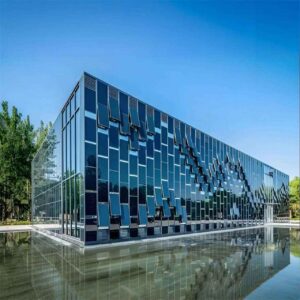
Curtain wall vision zones: VLT 50–70%, power density 60–90 Wp/m². Maintains occupant connection to exterior views while generating base-load electricity from the largest available facade area on any commercial building.
Curtain wall spandrel zones: VLT 0–20%, power density 120–180 Wp/m². These opaque bands between floors are ideal for high-density BIPV glass — the architectural function (covering the floor slab edge and mechanical zone) is unchanged, and higher cell density maximizes generation.
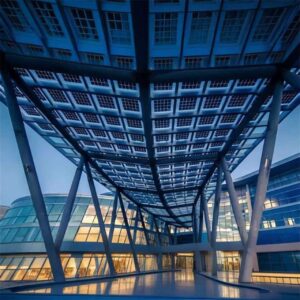
Skylights and atrium roofing: VLT 30–60%, power density 80–120 Wp/m². Semi-transparent BIPV skylights simultaneously reduce glare (compared to clear glass), lower cooling load, and generate power from a high-irradiance overhead surface. A commercial building study from ACEEE found that dynamic skylight systems reduced electric energy consumption by 77% compared to baselines without skylights — BIPV skylight glass adds active power generation to that efficiency stack.
Balcony glazing and solar shading: VLT 20–50%, power density 80–130 Wp/m². External shading fins or balustrade panels using BIPV glass serve a structural function (safety glazing) while generating electricity and reducing solar heat gain on the floor below.
Canopy and entrance canopy roofing: VLT 30–60%, power density 70–110 Wp/m². Covered walkways and building entrances receive high direct irradiance with no shading conflicts — a reliable generation zone that also provides branded architectural identity for corporate and institutional clients.
LEED and BREEAM Credit Contribution
Transparent BIPV glass contributes to LEED v4.1 credits across Energy and Atmosphere (EA Credit: Renewable Energy Production, 1–5 points; EA Credit: Optimize Energy Performance, up to 18 points) and Sustainable Sites (SS Credit: Heat Island Reduction). For BREEAM projects, BIPV glass contributes directly to the Energy category through on-site renewable generation and to Materials credits through Environmental Product Declarations (EPDs). Buildings with certified BIPV facades have documented 7–12% valuation premiums in major European commercial property markets (2024 cross-market study, Germany, France, Netherlands) — a figure that transforms the BIPV conversation from a cost discussion to an asset management discussion.
5. Structural and Installation Realities: What Contractors Need to Know
Understanding the physics of transparent solar is step one. Understanding the installation requirements — and what distinguishes a smooth BIPV project from an expensive change-order process — is what separates firms that deliver these projects profitably from those that learn by absorbing cost.

Transparent BIPV glass installation follows curtain wall sequencing — but requires coordination of two additional trades (electrical and commissioning) before the glazing system is closed. Firms that plan for this coordination at design development avoid the most expensive field-level conflicts.
Load and Structural Requirements
Transparent BIPV glass panels for facade applications typically weigh 25–45 kg/m² for laminated safety glass configurations — heavier than standard IGU (Insulated Glass Unit — a sealed multi-pane glass assembly) units at 15–20 kg/m². The additional dead load must be confirmed against the existing or proposed curtain wall framing system by the facade structural engineer before any product is specified.
At the curtain wall bracket level, confirm that the dead load path from the glass panel through the bracket to the primary building frame is within rated capacity — including the increased load of BIPV glass. Wind uplift calculations at upper building stories and corners are typically the governing case, not gravity load. Use ASCE 7-22 design wind pressures specific to the project location and building exposure category — not generic catalog load tables.
For skylight applications, overhead glazing must additionally satisfy code requirements for impact resistance, post-breakage safety, and protection against glass fallout. Laminated safety glass is mandatory for all overhead glazing; verify that the BIPV laminate configuration meets ASTM C1172 or equivalent.
Thermal Expansion and Sealing
Solar glass panels generate heat during operation — their surface temperature can reach 60–75°C on summer afternoons, compared to 45–55°C for conventional Low-E glazing under the same conditions. This increased thermal movement range must be accommodated by the gasket and sealant system at the panel perimeter.
Specify silicone sealants rated to –40°C to +85°C with documented UV resistance over 25-year service life. Movement joints must accommodate ±6–10 mm of thermal expansion across the glazing span — verify the framing system’s movement joint capacity against the actual calculated thermal expansion for the project-specific glass dimensions and climate range.
Electrical Integration: The Step Most Commonly Missed
Every BIPV glass panel has at minimum one DC cable penetration through the frame — and this penetration must be sealed, labeled, and accessible without removing the glazing panel. In practice, the most expensive installation conflicts on BIPV projects arise from this requirement being identified late.
The correct sequencing: The electrical engineer and glazing subcontractor must coordinate cable routing through the mullion cavity system before curtain wall shop drawings are approved — not as a post-installation field resolution. Mullion cavities must have verified capacity for the DC cable bundle (typically one to two cables per panel, 4–6 mm diameter, plus earthing conductor), junction box locations must be identified in the shop drawing submittal, and access panels for future maintenance must be incorporated into the facade design before the aluminum framing is fabricated.
Post-installation electrical routing through closed curtain wall framing has cost contractors $60,000–$90,000 in change orders on first-time BIPV projects — a figure confirmed by project managers on multiple mixed-use BIPV installations. The fix is always the same: coordinate earlier.
Jia Mao Bipv provides complete BIPV facade design, module selection, and electrical integration guidance — including inverter architecture options, weatherproofing details, and cable routing drawings — as part of their technical support package for contractor and EPC clients.
6. Durability and Lifecycle Analysis: Will It Last as Long as Glass or Traditional PV?
The lifecycle question is where building owners focus most intensely — and where too many BIPV proposals fail to provide satisfying answers. Here is the honest, data-supported picture.
UV Degradation and Encapsulant Performance
Transparent BIPV glass uses organic encapsulant layers (EVA or POE — Polyolefin Elastomer — resin) to bond the semiconductor film between glass panes. UV exposure over time can degrade EVA encapsulant, causing discoloration (yellowing) that reduces both VLT and power output. POE encapsulant significantly outperforms EVA in long-term UV resistance — specify POE encapsulant for all exterior-facing BIPV glass applications, and request the accelerated UV aging test data (IEC 61215 UV pre-conditioning test) from the manufacturer.
Moisture Resistance and Edge Seal Performance
The edge seal is the most vulnerable point in any transparent BIPV glass unit — the primary pathway for moisture infiltration that leads to delamination and PV cell corrosion. Specify edge seal systems rated to damp heat testing (IEC 61215 Damp Heat Test: 1,000 hours at 85°C / 85% RH) and confirm the full BIPV glass unit passes this test as an assembled product, not just the individual materials.
For coastal and high-humidity environments, frame systems must use marine-grade aluminum alloy (6063-T5 minimum) and stainless steel fasteners. Salt spray testing per ASTM B117 (1,000 hours minimum) should be requested for frame components — standard aluminum hardware in coastal installations can show corrosion damage within 3–5 years that compromises the structural connection and the waterproofing detail simultaneously.
Warranty Benchmarks: The Honest Comparison
| Warranty Type | Traditional Crystalline PV | Thin-Film Semi-Transparent BIPV | OPV / LSC (Emerging) |
|---|---|---|---|
| Power output (year 10) | ≥90% | ≥87–90% | ≥80% (where warranted) |
| Power output (year 25) | ≥80–82% | ≥78–80% | Typically 10–15 yr warranty |
| Product / module warranty | 10–15 years | 10–25 years (varies by manufacturer) | 5–10 years (improving) |
| Annual degradation rate | 0.3–0.5%/yr | 0.4–0.7%/yr | 0.7–1.2%/yr (emerging) |
| Safety glass warranty | N/A (separate) | Typically 10 yr (full unit) | Varies |
The warranty gap between established thin-film BIPV glass and perovskite or OPV products is real — and it matters for commercial project specifications where building owners expect 25-year performance assurance. For current commercial projects, specify products with IEC 63092-1:2020 certification (the dedicated BIPV standard combining PV performance and building material requirements) and a minimum 10-year product warranty from a manufacturer with auditable financial stability.
Life Cycle Cost (LCC): The Calculation Clients Need
For a 500 m² south-facing facade in London at €200/m² net incremental BIPV cost, generating 120 kWh/m²/year at £0.25/kWh commercial rate:
The 30-year LCC decisively favors BIPV glass for any glazing zone with meaningful solar exposure — even at current premium pricing. Present this calculation to clients before they frame the conversation as “expensive glass.”
7. Regulatory and Code Compliance: Navigating Fire Safety, Building Codes, and Grid Interconnection
This is the section where BIPV proposals most commonly stall — not because the products do not comply, but because the specification team does not have a clear compliance roadmap before the project reaches the permit stage.
Fire Rating Requirements for Vertical Solar Installations
In the United States, all commercial buildings over 40 feet in height must have exterior wall assemblies that comply with NFPA 285 — the Standard Fire Test Method for Exterior Non-Load-Bearing Wall Assemblies. This is a full-assembly test, not a product-level certification. The tested assembly includes the BIPV glass panel, the framing system, the insulation layer, and any air and weather barrier — all in the specific configuration proposed for the project.
Requesting a manufacturer’s NFPA 285 test report is not sufficient unless that report covers the specific assembly configuration being specified. If your project uses a different framing system, different insulation type, or different panel-to-panel junction detail than the tested assembly, the compliance must be re-evaluated — typically through a code analysis by a qualified fire protection engineer.
Additionally, all solar glass in building facade applications must meet Class A fire rating (flame spread index ≤25, smoke development index ≤450 per ASTM E84). Tempered and laminated safety glass typically exceeds this standard, but confirm with the manufacturer’s test certificate for the specific laminate configuration.
Under the International Building Code (IBC), solar PV glazing used as safety glazing (in locations where human impact is a risk — balconies, sidelights, overhead glazing) must also meet CPSC 16 CFR Part 1201 requirements. Verify that the BIPV glass laminate configuration satisfies safety glazing requirements for the specific installation location.
Electrical Code and Grid Interconnection
Transparent BIPV glass systems installed on commercial buildings in the U.S. must comply with NEC Article 690 (Solar Photovoltaic Systems) — covering DC circuit design, grounding, labeling, rapid shutdown, and inverter requirements. Rapid shutdown compliance (NEC 690.12) requires that all DC conductors within 1 foot of the roof or within the building be de-energized within 30 seconds of initiating shutdown — for facade-integrated BIPV, this typically means module-level power electronics (MLPE — microinverters or DC optimizers) are the correct electrical architecture.
Grid interconnection for commercial BIPV systems follows IEEE 1547-2018 requirements and utility-specific interconnection procedures. Timeline from application to authorization: 10 business days to 90 days, depending on utility and system size. Build interconnection timeline uncertainty into project schedules — particularly for projects over 1 MW AC where full interconnection studies may be required.
Key Certification Matrix
| Standard | Scope | Required For |
|---|---|---|
| IEC 61215 | PV module electrical performance | All commercial BIPV glass |
| IEC 61730 | PV module electrical safety | All commercial BIPV glass |
| IEC 63092-1:2020 | BIPV combined building + PV standard | All building-envelope BIPV |
| EN ISO 12543 | Laminated safety glass | All laminated BIPV glass assemblies |
| NFPA 285 | Exterior wall assembly fire | High-rise facade BIPV (US, >40 ft) |
| UL 61730 | PV module safety (US) | US commercial projects |
| ASTM E84 | Surface burning characteristics | US facade applications |
| EN 13501-1 | Fire classification (EU) | EU facade BIPV |
8. Supply Chain and Procurement: Sourcing Materials and Managing Lead Times
The supply chain for transparent BIPV glass operates on fundamentally different parameters than commodity crystalline silicon panels. Professionals who manage it with the same approach they use for standard solar procurement will encounter expensive surprises.
Key Manufacturers and Technology Positioning
The transparent solar product landscape in 2025 includes several distinct supplier categories:
Established thin-film BIPV glass manufacturers — including established European and Asian BIPV specialists — supply semi-transparent and opaque BIPV glass units in repeatable formats with full IEC certification portfolios. Lead times: 8–14 weeks for standard configurations. These are the appropriate suppliers for the majority of current commercial projects.
Research spinouts and next-generation technology companies — Ubiquitous Energy (MIT spinout, OPV technology achieving 10%+ efficiency with 90% VLT) was a leading innovator in this category, though the company faced operational challenges in 2025 highlighting the financial risk of specifying early-stage suppliers. Polysolar (UK, perovskite thin-film) and Physee (Netherlands, LSC-based products) represent this category’s ongoing development. These suppliers are appropriate for pilot projects and performance demonstration applications where innovation value justifies the procurement risk — they are not appropriate as sole-source suppliers for large commercial projects where schedule certainty and long-term warranty backstop are critical.
Integrated BIPV system suppliers — companies like Jia Mao Bipv that supply complete BIPV glass units alongside technical support, installation documentation, and project engineering services. The transparent BIPV glass product range from Jia Mao Bipv covers facade and architectural applications with VLT, power density, and glass make-up options confirmed at the inquiry stage.
Scalability and Regional Availability
According to the IEA Solar PV Global Supply Chains analysis, the global solar PV supply chain remains heavily concentrated in China for core manufacturing. For BIPV glass specifically, custom dimensions, VLT specifications, and electrical configurations are typically manufactured to order — which means standard solar panel procurement practices (spot purchasing, commodity pricing) do not apply.
Regional availability considerations for global EPC firms:
- Europe: Strong BIPV glass supplier base (Germany, Netherlands, Spain, Italy). Typically 8–14 week lead times for standard sizes, 14–22 weeks for custom configurations.
- Middle East and Asia-Pacific: Supply chain typically sourced from European or East Asian manufacturers. Add 4–8 weeks shipping plus clearance to lead time.
- North America: Domestic transparent BIPV glass manufacturing capacity is limited; most product is imported, creating both lead time and tariff risk that should be built into procurement plans.
Dual-Sourcing and Qualification Protocol
For any commercial project where BIPV glass represents more than $500,000 in material value or is on the critical path of a fixed-deadline schedule, implement a dual-source strategy: qualify two manufacturers against the performance specification before awarding to either. Qualification testing should include: dimensional tolerancing verification, laminate construction inspection, VLT and power density verification at independent test lab, electrical connection review, and reference project site visit.
A project that discovers mid-construction that its sole-source BIPV glass supplier cannot meet the specified dimensions has no good options. The dual-source approach costs 3–5% more in procurement overhead but eliminates supply chain single points of failure that can delay a project by 6–12 weeks at the most expensive point in the construction schedule.
9. Project Economics: ROI, Incentives, and Value Beyond kWh
 This video provides a clear breakdown of the cost, efficiency, and ROI comparison between solar glass and conventional PV panels — recommended for EPC firms preparing client presentations on BIPV specification decisions.
Payback Period Modeling: Transparent Solar vs. Traditional PV
| Project Scenario | Traditional Rooftop PV | Transparent BIPV Glass Facade |
|---|---|---|
| Typical installed cost (per kWp) | $1,400–$2,500/kWp (commercial) | $3,500–$6,000/kWp (facade system) |
| Avoided material cost credit | None (additive installation) | $80–$200/m² (replaces conventional glazing) |
| Annual energy yield (south-facing) | 1,200–1,700 kWh/kWp/yr (rooftop) | 700–1,100 kWh/kWp/yr (vertical facade) |
| Federal ITC (30%) | ✓ Applicable | ✓ Applicable |
| Simple payback (before incentives) | 5–10 years | 10–18 years |
| Simple payback (after ITC + glazing credit) | 4–7 years | 6–12 years |
| 25-year IRR (commercial) | 8–14% | 6–12% |
| Applicability to urban high-rises | Limited (roof area) | High (large facade area) |
Sources: EnergySage commercial data 2025; BIPV LinkedIn analysis referencing <4-year payback for high-irradiance markets; Metsolar BIPV cost analysis 2024 (€200–€625/m² installed, 10–15-year ROI in European markets); SolarReviews 2025.
Industry insight: In markets with high commercial electricity rates and strong solar resources, payback periods compress significantly. A 500 m² BIPV facade in Los Angeles (electricity rate $0.22–$0.28/kWh, peak sun hours 5.3–5.7/day) generating 100 kWh/m²/year saves $11,000–$14,000 annually — at a net incremental cost over standard glazing of approximately $100,000–$150,000, the energy-only payback is 7–14 years. Stack the 30% ITC credit and avoided glazing cost, and the net investment in transparent solar pays back in 4–8 years in high-performance markets.
Non-Energy Benefits: The Value Your ROI Model Is Missing
Most transparent solar ROI models capture only one of the four value streams these systems deliver. Complete financial modeling should account for all four:
Facade material cost offset: BIPV glass replacing conventional spandrel cladding, opaque glazing, or standard IGU units eliminates the cost of those materials from the project. On a large commercial facade, this offset can represent $200,000–$600,000 in avoided material procurement — a figure that transforms the BIPV economics when included.
LEED/BREEAM certification premium: Buildings achieving LEED Gold or Platinum certification — to which BIPV glass directly contributes — command 6–18% higher sale prices and 3–7% rent premiums in US commercial markets (US Green Building Council), and similar premiums in European markets under BREEAM. For a $50 million commercial building, a 3% rent premium represents $1.5 million/year in additional revenue — a figure that makes BIPV glass look inexpensive.
Tenant ESG premium and retention: Corporate tenants under Science-Based Targets Initiative (SBTi) commitments or investor-grade ESG reporting requirements actively seek buildings with documented on-site renewable generation. Buildings that can report verifiable solar generation data from a BIPV system have a measurable advantage in lease renewal conversations.
Carbon credit value: Under verified carbon markets and regional compliance schemes (UK ETS, EU ETS), commercial buildings with documented on-site renewable generation can generate carbon credits with current market value of €15–€65 per tonne CO₂ avoided — adding a monetizable income stream to the BIPV system’s financial profile.
Federal and State Incentive Summary
The Investment Tax Credit (ITC) under IRS Section 48E provides a 30% direct tax credit on the total installed cost of qualifying solar energy systems, including BIPV facade glass. According to SEIA’s tax policy analysis, the ITC is applicable to BIPV systems where the primary purpose is electricity generation. For a $1 million commercial BIPV facade project, the ITC alone delivers $300,000 in direct tax liability reduction.
The 48C Advanced Energy Manufacturing Tax Credit (up to 30%) applies to manufacturing investments in advanced energy property — relevant for building material brands and distributors investing in BIPV product manufacturing capability domestically.
State and utility-level incentives — PACE financing, green bonds, feed-in tariffs, and net metering — vary significantly by jurisdiction. Use the DSIRE database for authoritative, regularly updated incentive information before finalizing any client financial model.
Note: Tax policy in the U.S. is subject to legislative change. Verify current incentive status with a qualified tax professional before including specific credits in client proposals — recent legislative changes have created uncertainty around long-term ITC availability for some project categories.
10. Readiness for Mainstream Adoption: A Decision Framework for Professionals
The most important question professionals face when evaluating transparent solar is not “Is this technology good?” — it clearly is. The question is: “Is this the right product for this specific project, at this specific time?”

Go/No-Go Decision Checklist for EPCs, Contractors, and Architects
Use this framework at schematic design — before glazing specifications are locked:
| Criterion | Go ✅ | Evaluate Further ⚠️ | No-Go for BIPV ❌ |
|---|---|---|---|
| Building type | Commercial high-rise, institutional, premium mixed-use | Low-density residential, industrial, warehouse | Buildings where glazing area is minimal |
| Facade orientation | South- or west-facing, minimal shading | East-facing, partial shading | North-facing, heavily shaded |
| Client hold period | 10+ years | 7–10 years | Less than 7 years |
| Glazing replacement needed? | Yes (retrofit) or new-build | New-build (no glazing credit) | Existing glazing mid-life, no replacement needed |
| Budget flexibility | 15–25% premium over standard glazing accepted | 10–15% premium acceptable | Hard budget with no flexibility |
| Regulatory environment | LEED/BREEAM targeted, net-zero code applies | Green certification desirable | No sustainability requirement |
| Aesthetic requirement | Design-sensitive, rack-mounted panels restricted | Aesthetic preference, not requirement | No aesthetic restriction (rooftop panels acceptable) |
Urban High-Rise: The Strongest Case for Transparent Solar
Urban commercial towers have limited rooftop area relative to their energy demand. A 25-story office building with 400 m² of accessible roof and 5,000 m² of south-facing curtain wall facade has 12.5× more generating surface available on the facade than the roof. For these buildings, transparent BIPV glass is not an alternative to rooftop solar — it is the only path to meaningful on-site generation at the scale the building’s energy footprint requires.
3–5 Year Technology Forecast
The trajectory is clear and well-supported by the research pipeline:
Efficiency: Commercial thin-film BIPV glass at 12–15% efficiency is achievable within 3 years as perovskite-silicon tandem technology commercializes. The transparent tandem record of 12.3% (PV Magazine, March 2025) at 30% VLT represents the near-term commercial target — a ~50% improvement over today’s best commercial semi-transparent products.
Cost: Manufacturing scale and process optimization are driving transparent BIPV glass material costs toward $100–$150/m² (installed component cost, not full facade system) within 5 years — from $150–$250/m² today. This trajectory compresses payback periods toward 5–8 years in most commercial markets.
Code integration: The IEC 63092-1:2020 BIPV standard is being adopted in national codes across Europe and increasingly referenced in North American building code updates. Within 3 years, BIPV glazing will have a well-established code compliance pathway in all major markets — removing the current burden of project-specific fire and structural reviews that add cost and timeline to early-adopter projects.
Smart integration: Combined electrochromic-PV glass (dynamic tinting plus power generation) is in commercial pilot in Germany and Singapore as of 2025. Full commercial products are 3–7 years from mainstream availability but should be tracked in product planning roadmaps now.
The shift from rooftop-bolted solar to building-integrated transparent photovoltaics is not a product category upgrade — it is a fundamental change in how the building envelope is valued and specified. The data in this guide makes three things clear.
First, the efficiency comparison between transparent solar and conventional panels is the wrong frame. The correct comparison is between a BIPV glass specification that generates energy, manages heat gain, contributes to certification, and replaces material that would otherwise have zero energy function — versus glass that does none of those things. On that basis, transparent solar wins in every glazing-intensive commercial building application where aesthetics, design sensitivity, or density constraints limit conventional panel deployment.
Second, the technology is ready. IEC-certified thin-film semi-transparent BIPV glass products with 25-year performance warranties and a growing commercial track record are available today. Perovskite and OPV technologies with breakthrough performance characteristics are 3–5 years from mainstream commercial availability. Firms building BIPV specification capability now will be positioned to capture the premium projects when those technologies arrive.
Third, the market incentives are real and substantial. The 30% federal ITC, state-level PACE financing, LEED/BREEAM rent premiums, and carbon credit value together create a financial case that is consistently compelling for commercial projects with 10+ year hold periods — particularly in high-electricity-rate markets.
The professionals who own this market in 2030 are the ones who start building specification expertise, supplier relationships, and client education programs today.
Ready to specify transparent BIPV glass on your next commercial project?
🔎 Explore the full transparent BIPV glass product range — VLT options, power density specifications, glass make-up configurations, and technical documentation for facade and skylight applications: www.jmbipvtech.com
📊 Review the glass-integrated solar facade systems comparison — covering technical performance, installation considerations, and procurement guidance for EPC firms and contractors: glass-integrated solar panel facade systems review
📋 Understand the transparent PV glass science for distributor client conversations — VLT definitions, spectrum absorption data, and application-by-application performance benchmarks: transparent solar panels photovoltaic glass science guide
🔗 Compare transparent solar panel options by application — windows, skylights, facades, and atriums with a specification decision framework: compare transparent solar panels for windows and skylights
Glossary of Key Terms
BIPV (Building-Integrated Photovoltaics): Solar modules that replace conventional building materials — glazing, roofing tiles, facade cladding — while generating electricity. Distinct from BAPV (Building-Applied PV), which adds solar elements on top of existing materials.
VLT (Visible Light Transmittance): The percentage of visible light (380–780 nm wavelength) that passes through a glazing material. 70% VLT = 70 out of every 100 visible light photons pass through — comparable to lightly tinted commercial glazing.
SHGC (Solar Heat Gain Coefficient): The fraction of solar energy that passes through glazing and becomes interior heat load. A value of 0.25 means 25% of incident solar energy enters the building as heat. Lower SHGC is desirable in hot climates; higher SHGC can assist passive heating in cold climates.
LSC (Luminescent Solar Concentrator): A transparent panel containing luminescent dye that absorbs UV/IR photons, re-emits them at a shifted wavelength, and guides them to PV cells at the panel edges. Allows very high VLT (60–90%) with modest power output.
OPV (Organic Photovoltaics): Solar cells using carbon-based organic molecules as the semiconductor. Lightweight, flexible, and tunable for transparent applications. Lower efficiency than silicon, but compatible with curved and custom-geometry glass substrates.
Perovskite Solar Cell: A PV cell using a perovskite-structured semiconductor (typically lead halide compound) with a tunable bandgap. Record lab efficiency of 12.3% at 30% transparency (2025); commercialization expected within 3–5 years for building applications.
Bandgap: The minimum energy a photon must have to excite an electron in a semiconductor. Materials are selected so their bandgap matches UV/IR photon energies, leaving visible-spectrum photons to pass through the device.
IGU (Insulated Glass Unit): A sealed multi-pane glass assembly used in windows and curtain walls. In BIPV applications, the PV layer is laminated into one pane of the IGU, creating a single integrated unit that functions as both glazing and solar generator.
MLPE (Module-Level Power Electronics): Microinverters or DC power optimizers installed at each individual PV module. Prevents performance reduction from one shaded or underperforming unit affecting the entire string — essential for complex facade geometries.
Effective Efficiency: A comparative metric for BIPV glazing applications that accounts for energy generated per total value delivered (energy + glazing function + architectural benefit), rather than energy per m² of PV cell alone. Corrects for the misleading use of raw efficiency percentage when comparing BIPV glass to conventional panels in glazing applications.
IEC 63092-1:2020: The International Electrotechnical Commission’s dedicated standard for BIPV modules, combining PV electrical performance requirements with building material structural and safety requirements. The current authoritative standard for commercial BIPV glazing specification.
PACE Financing (Property Assessed Clean Energy): A financing mechanism that funds solar and energy efficiency improvements through a property tax assessment, repaid over 10–25 years and transferable to the next owner upon property sale.
NFPA 285: Standard Fire Test Method for Exterior Non-Load-Bearing Wall Assemblies — a full-assembly fire test required for BIPV glass and other cladding systems on commercial buildings over 40 feet in the U.S. An assembly-level test, not a product certification.
Frequently Asked Questions
1. Can transparent solar panels replace traditional PV in large-scale energy generation projects?
Not at utility scale — transparent PV is not designed to compete with ground-mount or large rooftop arrays where opaque panels at 20–23% efficiency are the appropriate technology. Its value is specifically in distributed generation from existing glazing surfaces in urban buildings where opaque panels cannot be used. A 20-story office tower with 4,000 m² of south-facing curtain wall can generate 400,000–500,000 kWh annually from transparent BIPV glass — energy volume that simply is not achievable from rooftop solar on the same building. In urban environments where the building envelope IS the solar resource, transparent solar is not a compromise — it is the only viable path to meaningful on-site generation.
2. How do transparent solar cells affect natural daylighting and occupant comfort in commercial offices?
High-VLT variants (60–80% VLT) maintain daylight quality comparable to standard commercial tinted glazing while reducing glare and solar heat gain. The SHGC reduction from transparent BIPV glass (typically SHGC 0.25–0.45) compared to standard clear glass (SHGC 0.60–0.87) meaningfully reduces peak cooling loads — an effect that mechanical engineers should model when sizing chiller plants on glazing-intensive buildings. For occupant comfort, the relevant metrics are illuminance (lux levels at the work plane), glare probability (DGP — Daylight Glare Probability — modeling), and color rendering (CRI — Color Rendering Index — typically Ra ≥80 for commercial BIPV products). Request mock-up evaluation under real daylight conditions for any glazing zone where occupant comfort is critical.
3. Are transparent solar modules compatible with standard curtain wall systems?
Yes — leading semi-transparent BIPV glass products are engineered as drop-in replacements for standard IGU units in pressure-plate and structural silicone curtain wall systems. Panel dimensions can be customized to match the module grid of the specified curtain wall system, and dead load compatibility must be confirmed against the framing system’s rated capacity. The non-standard element is electrical: DC cable routing through the mullion cavity must be planned at shop drawing stage, not resolved in the field. Coordinate the glazing subcontractor and electrical contractor at design development — the 2 hours spent in that coordination meeting eliminates 2–6 weeks of potential installation conflict.
4. What is the expected lifespan and warranty of transparent photovoltaic glazing?
Certified thin-film semi-transparent BIPV glass products from established manufacturers carry 25-year power output warranties (minimum 80% of rated output at year 25) and 10–25-year product warranties covering delamination, seal failure, and manufacturing defects. Annual power output degradation runs 0.4–0.7%/yr — slightly higher than premium monocrystalline silicon (0.3–0.5%/yr) but within acceptable commercial thresholds for a 30-year building asset. The operational lifespan of quality BIPV glass units — 30+ years — is consistent with commercial building glazing replacement cycles, making warranty transfer protocols at property sale an important but manageable documentation requirement.
5. Do transparent solar facades require special maintenance compared to standard glazing?
Maintenance requirements are similar to conventional commercial glazing. Standard facade cleaning (water and mild non-abrasive detergent, 1–2 times per year in urban environments, more frequently in coastal or high-particulate locations) maintains both optical clarity and electrical output. Self-cleaning hydrophobic coatings are available from several BIPV glass manufacturers, extending effective cleaning intervals by approximately 30% — well-suited to high-rise facades where access is expensive. Annual remote performance monitoring via the inverter communication interface (Modbus TCP or SunSpec protocol) provides early detection of output deviations that may indicate soiling, shading changes, or electrical issues — typically flagging anomalies within days of occurrence.
6. How does energy output vary by building orientation, height, and glazing zone?
South-facing facades at 60–90° from horizontal (near-vertical) receive approximately 60–75% of the annual irradiance that an optimally tilted rooftop array receives in the same location. West-facing facades receive approximately 50–65%. East-facing approximately 45–60%. North-facing facades (Northern Hemisphere) receive 25–40% of optimal and are generally not economically viable for BIPV specification. At height, upper building stories receive marginally higher irradiance due to reduced atmospheric attenuation and lower obstruction probability — but the effect is small (2–5%) compared to orientation. Expected annual yields for south-facing transparent BIPV glass in key markets: Phoenix 150–200 kWh/m²; New York 100–140 kWh/m²; London 80–120 kWh/m²; Singapore 130–160 kWh/m².
7. Can transparent solar be successfully used in historical building retrofits?
Yes — for preservation projects where visible alteration restrictions limit conventional solar options, semi-transparent BIPV glass offers a specification pathway that satisfies both energy performance and preservation intent. At 50–70% VLT, BIPV glass closely resembles existing clear or lightly tinted glazing — making it possible to upgrade a heritage building’s windows or atrium glazing to energy-generating elements without the visible intrusion of rack-mounted panels. Request a physical sample mock-up for review by the heritage authority before the specification is finalized — the actual transmitted light color and reflectance of the proposed BIPV glass must be evaluated by the preservation reviewer under real lighting conditions.
8. What fire safety certifications are required for transparent solar panels on high-rise buildings?
For high-rise commercial buildings in the US (>40 feet), transparent BIPV glass in exterior facade applications must be incorporated into a wall assembly that complies with NFPA 285. This is an assembly-level compliance requirement — the BIPV glass panel, framing system, insulation, and air/weather barrier must all be tested together as the specified configuration. Additionally, all glass must achieve Class A fire rating per ASTM E84. For EU high-rise projects, EN 13501-1 fire classification (minimum Class B-s1,d0 for most facade applications) applies. In seismic regions with specific local code amendments, additional structural and glazing integrity requirements may apply — confirm with the project’s building official at permit submission.
9. Are there financing options or incentives specific to BIPV and transparent solar?
Multiple incentive categories are applicable to commercial transparent BIPV glass installations. The 30% federal ITC (Section 48E) applies to BIPV systems where electricity generation is the primary purpose. PACE financing allows the BIPV investment to be repaid through the property tax assessment over 10–25 years — transferable to future owners, which removes the payback period as a client objection for shorter hold-period investors. Green bonds and sustainability-linked loans are increasingly available to commercial real estate owners with documented on-site renewable generation, typically at 25–75 basis points below market rate. LEED incentives and green building grants vary by jurisdiction but are catalogued in the DSIRE database. The 179D Commercial Buildings Energy Efficiency Tax Deduction (up to $5.00/sq ft) can stack with the ITC for projects achieving qualifying energy performance improvements — confirm applicability with a tax advisor.
10. How do professionals collaborate effectively with architects and engineers during transparent solar specification?
Early integration is the single most effective practice — and the single most commonly missed. Introduce transparent BIPV glass as a specification option at schematic design, not during design development or construction documents. At the schematic design stage, three decisions can be made simultaneously with minimal cost impact: glazing zone identification (which facade zones will receive BIPV glass), structural parameter establishment (BIPV glass dead load inputs to the structural frame and curtain wall framing design), and electrical routing conceptual layout (inverter location, conduit pathway, panel junction box positions). Each of these decisions costs nothing to make correctly at schematic design and becomes progressively more expensive to change as the design advances. Firms that have standardized this early-integration practice report materially lower change order rates and higher project-level margins on BIPV specifications than those who treat solar glazing as a late-stage add-on.
11. Can transparent solar glass be combined with Low-E or electrochromic (smart) coatings?
Low-E coatings (thin metallic layers that reflect infrared radiation to reduce heat transfer) are compatible with most thin-film BIPV glass products when applied to the correct surface within the IGU assembly — specifically, Low-E coatings should not be applied to the same surface as the PV semiconductor layer, as they can interfere with light absorption. Specify the Low-E and BIPV layer positions in the glass make-up with the manufacturer at the outset. Combined electrochromic-PV glass (dynamic tinting plus simultaneous power generation) is in commercial pilot as of 2025 but not yet at full commercial scale — anticipate commercial availability within 3–7 years. For current projects, electrochromic and BIPV glass should be treated as separate products in separate glazing zones.
12. Is transparent solar glass viable in cold or consistently low-sunlight climates?
Yes — with appropriate technology selection and realistic performance expectations. Thin-film semiconductor technologies used in transparent BIPV glass (amorphous silicon, CdTe, CIGS) harvest a higher proportion of diffuse light relative to their rated peak output than crystalline silicon — making them comparatively better performers in overcast and low-irradiance conditions. In consistently overcast climates (UK, Pacific Northwest USA, Scandinavia), transparent BIPV glass generates approximately 20–35% of its rated annual output in the October–March period and 65–80% during April–September. Annual yields in these markets (80–120 kWh/m²/year for south-facing) remain sufficient for positive financial outcomes when the avoided glazing cost and applicable incentives are properly credited in the lifecycle analysis. For cold climates specifically, the IR-absorbing semiconductor layer in transparent panels reduces SHGC, which may increase heating loads in climate zones where passive solar gain is desirable — specify the SHGC carefully against the heating vs. cooling balance in the building energy model.
13. How do procurement teams verify performance claims from transparent solar suppliers?
Three verification layers are appropriate for commercial project procurement. First, request third-party test reports from accredited independent laboratories — NREL (US), Fraunhofer ISE (Germany), or Bureau Veritas / TÜV / Intertek — confirming electrical performance (IEC 61646 or IEC 61215), safety (IEC 61730), and where applicable, BIPV assembly performance (IEC 63092-1). A manufacturer’s own test data is not sufficient; independent test laboratory reports are the minimum standard for commercial BIPV specification. Second, request field performance data from completed reference projects under comparable climate and orientation conditions — including actual measured annual yield versus modeled annual yield for at least 2 full calendar years of operation. Third, for projects over $500,000 in BIPV material value, commission an independent technical due diligence review of the proposed product by a qualified PV engineering firm before awarding the purchase order. The cost of that review ($5,000–$15,000) is insurance against specifying a product that cannot deliver its claimed performance in the actual installation conditions.
14. How can building material distributors accelerate transparent solar adoption in their regional market?
The most effective distributor strategy has three components that together build specification-stage market position. First, invest in technical depth before price competition — transparent BIPV glass is a specification-driven product, not a commodity. The distributor who can walk into an architectural practice and conduct a credible technical presentation on VLT options, SHGC implications, fire compliance pathways, and electrical integration requirements will be specified before the project goes to tender. Second, create a demonstration capability — physical samples at multiple VLT levels, a small working panel connected to a monitoring display, and a portfolio of reference project photographs under real lighting conditions are the tools that convert specification-stage conversations into purchase orders. Third, partner with BIPV manufacturers that provide genuine technical backstop — including project-specific engineering support, documentation for code compliance, and warranty protection that is credible over the 25-year product life. Distributors who build this capability in the current market growth phase will hold a first-mover advantage that is difficult for later entrants to overcome.
15. Can transparent solar glass contribute to net-zero energy building certification?
Yes — and for urban commercial buildings where rooftop area is limited, it may be the primary path to meeting on-site renewable energy requirements for certification. Under LEED v4.1, on-site renewable energy meeting 5% of annual building energy consumption earns 1 point; meeting 100% earns 5 points. For a building where BIPV glass generates 10–30% of total energy demand (achievable on high-glazing-ratio commercial towers with south and west facade BIPV specification), the contribution to the Optimize Energy Performance credit stack (up to 18 points) can be decisive in reaching Gold or Platinum certification thresholds. Critically, BIPV glass also simultaneously reduces energy demand through SHGC management — reducing cooling loads that would otherwise require the renewable generation to offset. This dual effect (demand reduction + supply addition) makes BIPV glass one of the most point-efficient investments a project team can make for high-level LEED certification.
This guide is authored for decision-makers in commercial construction, building systems integration, and renewable energy deployment — EPCs, curtain wall and roofing contractors, building material brands and distributors, architects, and design consultants. Every statistic and specification cited reflects published 2025 industry data; verify current product availability, incentive rates, and code requirements with your project team before finalizing any specification or financial analysis.