Aesthetic BIPV: Color and Finish Options for Facades

The solar facade of Copenhagen International School. Photo: Marta Victoria, CC BY-SA 4.0, via Wikimedia Commons.
Quick answer: Aesthetic BIPV (building-integrated photovoltaics) is solar that works as a finished building material. It is made in custom colors, textures, and transparency levels, so it can replace cladding, roof tiles, or glass. With the best color methods, you keep about 93–95% of the power of a standard module. With heavy filters, you can lose 40% or more.
In this guide: color options, material mimicry, power-loss math, installation, design workflow, codes, economics, and future trends. A glossary and 12 client questions close the article.
I. The Paradigm Shift in Solar Integration
For years, solar was something you added after the building was done. A crew bolted racks to the roof, and the architect hoped nobody would look up. That “bolt-on” approach is giving way to something different. Solar is becoming a finished surface, like stone, metal, or glass.
From bolt-on to building finish
The U.S. Department of Energy describes building-integrated photovoltaics as solar that replaces conventional materials in the roof, skylights, awnings, facades, or windows. The key word is replaces. A rack-mounted panel sits on top of a finished roof. A BIPV tile is the roof.
| Bolt-on solar (BAPV) | Integrated solar (BIPV) | |
|---|---|---|
| Role in the building | Adds power only | Adds power and works as the roof, wall, or glass |
| Look | Visible rails and gaps | Flush with the surface |
| Who installs it | PV installer, after the roof is done | Roofer or glazier and electrician, together |
| Design control | Low | High, if specified early |
The conflict: energy efficiency vs. architectural intent
Here is the problem you probably know well. A design team writes a sustainability target, then rejects the only product that meets it because it looks like a 1990s rooftop array. The IEA PVPS Task 15 team says this directly: architectural goals can conflict with energy goals, such as views and daylight versus maximum power.
The solution: BIPV as a design asset
Modern BIPV answers that conflict with color science and surface finish. Color can come from a fired glass coating, a printed layer, or a thin interference film. Texture can come from etched or patterned glass. At Jia Mao Bipv, our customers often start with a simple request: “Make it disappear into the facade.” This guide shows how that works and what it costs in power.
The value for developers
Aesthetic BIPV helps in two ways. First, it can get approved where racks would be refused, such as heritage zones, design-controlled campuses, and high-visibility sites. Second, it replaces a material you were going to buy anyway, so part of the cost is offset. Later sections put numbers on both points.
Industry insight: In multi-story buildings, the roof is too small to meet energy codes. IEA PVPS notes that offices need more power than their roofs can hold, so solar moves onto the facade. Once solar is on the facade, how it looks stops being optional.
II. Overcoming the “Blue/Black” Stigma: The Evolution of BIPV Color Palettes
Advanced coating technologies now let solar modules blend into almost any building palette. The old blue-and-black look came from the cell itself. Bare silicon reflects about 30% of light, so cell makers add an anti-reflective coating. That coating gives the cell its blue or black tone.
How color is made (and what it costs in power)
The IEA PVPS Task 15 report on coloured BIPV finds that every part of a module can be colored: the cell coating, the glass, the polymer layers, and the active layer. Each method trades some power for color.
| Method | How it works | Power kept | Best for |
|---|---|---|---|
| Interference coating (morpho-type) | A thin layered coating on the glass reflects only one color band | About 94–95% | Facades that need vivid, stable color |
| Ceramic or printed glass | Pigment or ink is fired or printed on the glass | Depends on coverage and color | Custom RAL and branded looks |
| Colored interlayer | A tinted film is laminated inside the module | Test data needed | Economical colored facades |
| Colored cell coating | Coating thickness is changed to shift the color | Test data needed | Small, special runs |
| White selective filter | Reflects visible light, passes infrared | About 60% | Projects where white is a must |
The numbers come from Fraunhofer ISE, a glass industry report on the “Solarcolor Morpho” coatings, and the IEA report. The Fraunhofer team reports that its MorphoColor coating reaches about 95% of the power of an uncoated panel. It borrows its idea from morpho butterfly wings, which make bright color through light interference instead of pigment.
Sources: Fraunhofer ISE (MorphoColor, about 95%), Glass on Web (Solarcolor Morpho, 94%), a 2025 Energy and Buildings review (about 7% loss), IEA PVPS Task 15 (white filter, about 40% loss), and Jia Mao product data (25 W colored vs. 32 W black CIGS tile).
Custom color matching (RAL and Pantone) for branding and urban harmony
Architects usually specify color with RAL (a paint color system common in European construction) or Pantone (a printing color system used in branding). Glass makers match these by firing ceramic pigment into the glass or by printing it. Our BIPV colored glass panels use ceramic pigment and are offered with transparency from 10% to 90% and smooth, textured, or patterned surfaces. The product page states 30-year color retention with a color drift (called ΔE, a number for how different two colors look) below 3. That is a manufacturer claim, so ask for the test report.
Color matching is not paint matching. Glass color shifts with viewing angle and with the cells behind it. Agree on a tolerance (for example, ΔE ≤ 3 against an approved sample) and not an “exact match.”
Industry insight: Custom color needs one production batch. If you order a facade in two runs, you may see a color band between them. Buy the full quantity plus a 3–5% spare stock from the same batch.
Textured surfaces: less glare, more material feel
Textured and etched glass scatters reflected light. That matters in dense cities, where a mirror-like facade can throw glare onto neighbors. Texture also hides the cell grid, so the surface reads as stone or fabric and not as electronics. Fraunhofer’s newer ShadeCut technology cuts patterns into a color film, so modules can look like masonry or roof tiles, or carry a logo.
Case study: successful integration in high-profile facades
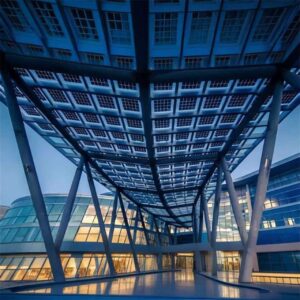
The Copenhagen International School uses 12,000 individually tilted solar panels over 6,048 m². The tilt makes the surface shimmer, so the facade reads as a design feature and not as a power plant. The IEA report lists other proven examples, including a green-cell facade for the Fondation Abbé Pierre in Paris.
For a designer’s view, this workshop recording includes a talk on colored modules (jump to 1:14:30):
III. Material Mimicry: BIPV as a Substitute for Traditional Building Envelopes
BIPV is no longer just a panel. It can replace stone, terracotta, and slate. That changes how you buy it: you compare it with the material it replaces, not with a rooftop array.
| Traditional material | BIPV replacement | What to check |
|---|---|---|
| Clay or concrete roof tile | Solar roof tile | Roof pitch, flashing kit, single-tile replacement |
| Spandrel glass or metal panel | Opaque solar glass | Color match with vision glass |
| Vision glass | Semi-transparent solar glass | Daylight level and power trade-off |
| Stone or ceramic rainscreen | Printed or textured solar cladding | Ventilated cavity, cable routing |
Solar shingles and tiles: new roofing, same roofline
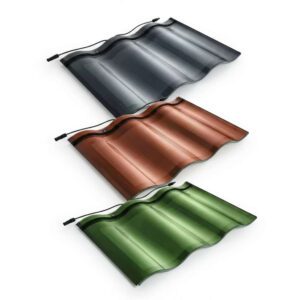
Solar tiles keep the roofline and the texture, so planners are often more open to them. Our CIGS curved solar roof tiles use thin-film CIGS (copper indium gallium selenide) cells, which handle curves and low light well. They come in black, brick red, and emerald green. The black tile is rated at 32 W and the colored ones at 25 W, which is about 22% less per tile. Each tile weighs 6.5 kg, or about 22 kg/m², compared with 40–60 kg/m² for ceramic tile.
That weight gap matters on heritage retrofits, where the structure often cannot take extra load. Our commercial solar roof tiles guide covers where tiles fit and where racks are still the better choice. Large flat warehouse roofs, for example, usually stay with racks.

Thin-film solar shingles. Photo: NREL, public domain, via Wikimedia Commons.
Solar glass and curtain walls: transparency and tint close to architectural glass
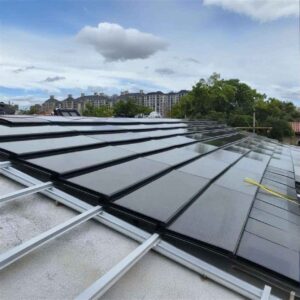
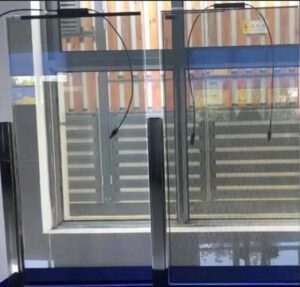
A curtain wall is a non-structural outer wall, usually aluminum framing with glass infill. Solar glass drops into that frame the same way as any other infill. Our standard tempered glass reaches up to 91.5% light transmittance, which is about 8% higher than standard glass. Our transparent solar panels page explains how transparency and power trade off.
Opaque zones (spandrels and parapets) are the easy win. They need no daylight, so they can run at full power density. Vision zones need more careful choices of cell spacing and tint.

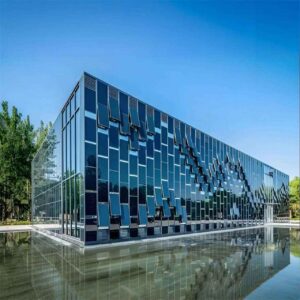
A BIPV facade delivered in Norway. Photo: Sipetro, CC BY-SA 4.0, via Wikimedia Commons.
Reducing material layers: the cost-benefit of an energy-generating skin
The fair comparison is not “BIPV vs. nothing.” It is BIPV against the cladding plus a separate solar system. Our curtain wall guide notes that BIPV can cost two to three times standard architectural glass, but the net extra cost narrows to roughly 30–60% once you credit the material it replaces. The BIPV versus traditional solar panels article walks through that comparison in more detail.
IV. Technical Synergy: Balancing Aesthetic Finishes with Energy Yield
The main pain point for EPCs is the trade-off between color and efficiency. A prettier module makes less power. The question is how much less, and whether the loss changes the business case.
Analysis of “efficiency loss vs. aesthetic gain” ratios
Here is a simple model. Assume a 500 m² south facade that makes about 110 kWh per m² per year (the middle of the 80–150 kWh/m² range we use for south-facing BIPV glass) and power priced at $0.15 per kWh. Base output is 55,000 kWh.
| Finish | Power kept | Annual output (kWh) | Lost output (kWh) | Lost value per year |
|---|---|---|---|---|
| Uncolored reference | 100% | 55,000 | 0 | $0 |
| Interference-coated glass | 95% | 52,250 | 2,750 | $413 |
| Morpho-type colored glass | 94% | 51,700 | 3,300 | $495 |
| High-saturation colored PV | 93% | 51,150 | 3,850 | $578 |
| Colored CIGS tile (vs. black) | 78% | 42,900 | 12,100 | $1,815 |
| White selective filter | 60% | 33,000 | 22,000 | $3,300 |
You can paste this table into Excel and swap in your own area, yield, and tariff. The math for one row looks like this:
For a well-made colored glass, the yearly loss is a few hundred dollars on a facade that costs six figures. That is usually a fair price for design approval. The white filter is a different story. Use it only when white is non-negotiable.
Industry insight: Do this math before the design review, not after. Teams that arrive with a loss table in dollars win the “can we afford color?” argument. Teams that arrive with “efficiency drops a bit” do not.
Innovations in selective filtering and nano-coatings
Selective filters reflect one slice of visible light and let the rest through to the cell. Thin interference coatings, like the morpho-type coatings above, are the best at this. Fraunhofer notes they can work with standard cells and with future cell types, and they suit cells that look uniform, such as back-contact cells. Cells with few visible metal lines hide better behind color. Our modules use invisible busbar technology and cells above 22% efficiency, so less of the cell pattern shows through.
Guidance on orientation and tilt to compensate for colored overlays
You cannot tilt a curtain wall, but you can choose where color goes. Vertical facades lose output compared with a tilted roof, and orientation matters a lot.
Midpoints of ranges in Jia Mao’s curtain wall guide (east/west 60–70% and north 20–30% of south, in the northern hemisphere). Run a site simulation for real numbers.
Four practical moves help recover what color takes away:
- Put the most saturated colors on south and west faces, and use lighter or lower-loss finishes on weaker faces.
- Keep a ventilated cavity behind the modules so they run cooler. Our colored glass has a temperature coefficient of about -0.4% per °C, so every degree of heat costs 0.4% of power.
- Use module-level electronics (microinverters or optimizers) where neighboring buildings cast moving shadows.
- On pitched roofs, aim for about 20–40° in mid-latitudes, and use matching non-solar tiles in shaded zones.
V. Integration Strategies for Curtain Wall and Roofing Contractors
Seamless installation needs a shift from traditional mounting to integrated framing. If your crew treats a BIPV unit like a solar panel, you will fight leaks and rework. If they treat it like a glass unit that also makes power, the job goes smoothly.
Transitioning from “solar racks” to “solar envelopes”
A rack system adds a layer on top of a roof that already works. A solar envelope is the weather barrier. That means flashing, drainage, and sealant details matter first, and wiring comes second. The IEA PVPS technical guidebook has more than 50 reference drawings for roofs, rainscreens, curtain walls, and double-skin facades. Our own installation and design guide uses the same envelope-first sequence.
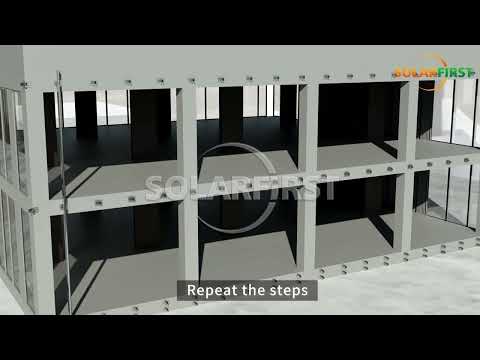
Video: a standardized installation process for BIPV curtain wall, useful for crew briefings.
Waterproofing and thermal expansion challenges in BIPV cladding
Aluminum framing expands and shrinks more than glass. Curtain wall systems handle this with slotted anchors and gaps between units that are sealed with gaskets. BIPV adds two risks: the sealant must be compatible with the module’s edge seal, and every cable hole is a possible leak path. Our modules use structural adhesive strips rated for 25 years and integrated drainage channels. Even so, only use sealants the manufacturer approves.
| Risk | What goes wrong | Prevention |
|---|---|---|
| Wrong sealant | Edge seal breaks down, moisture gets in | Use only manufacturer-approved silicone |
| Fixed frame, no movement | Glass cracks or seals tear | Slotted anchors and movement joints |
| Cable penetrations | Water tracks inside the wall | Seal and drain every entry point |
| Hot, closed cavity | Power drops, cables age | Ventilate the cavity |
Coordination workflows between the glazing contractor and the electrical engineer
The most common source of rework is an unclear boundary between trades. Write down, before the bid, who does each task:
| Task | Glazing contractor | Electrical contractor |
|---|---|---|
| Conduit sleeves through mullions | Installs | Specifies size and route |
| Junction box connections | Supports access | Makes connections |
| String voltage and current tests | Assists | Performs and records |
| Waterproofing check after wiring | Owns | Reviews |
| DC cable to the inverter room | — | Owns |
Our curtain wall guide estimates that fixing conduit routing after shop drawings are approved can cost 8–15% of the curtain wall contract. A half-day interface meeting before drawings are issued costs far less. For more detail on wiring, see our guides on wiring and electrical integration, curtain wall design, and BIPV glass integration for specialized contractors.
Industry insight: A contractor’s first BIPV job rarely makes money. The second and third do, once the crew knows the details. Pick a simple first project, with one wall or one roof plane, and treat it as training.
VI. The Architect’s Toolkit: Designing for BIPV from the Concept Phase
Adding solar at the schematic design phase prevents costly retrofits and aesthetic compromises. By the time shop drawings arrive, panel size and color are locked, and the cheapest changes are gone.
| Design stage | Decide this | Why it matters |
|---|---|---|
| Concept | Which surfaces will be solar | Sets energy target and look |
| Schematic | Module size, color, transparency | Avoids tiny cut panels and grid clashes |
| Design development | Cable routes, junction access | Prevents conduit rework |
| Construction documents | Samples, tolerances, spare stock | Locks color and lead time |
Utilizing BIM for solar heat gain and energy yield simulation
Building Information Modeling (BIM) is a shared 3D model that holds geometry and data for the whole building. With it, you can check clashes between conduit and framing and test shading from nearby towers. Pair it with a yield tool such as PVsyst and a daylight tool, then compare options by zone.

An architectural BIM model. Image: Archdraw, CC BY-SA 4.0, via Wikimedia Commons.
Designing for “Invisible Solar”: opaque and semi-transparent modules for shading and privacy
“Invisible solar” means the solar part does a job you already needed. Opaque modules cover spandrels and parapets. Semi-transparent modules act as shading and privacy screens. Vision zones usually need about 30% or more visible light transmittance (VLT, the share of daylight that passes through). Our guide notes that opaque solar cladding produces roughly 150–200 Wp/m², about 30–40% more than semi-transparent glass, so keep opaque modules wherever daylight is not needed.
Creating a cohesive visual language across the building skin
Group solar zones into deliberate fields. Scattered single modules look like confetti and add edges that collect shade. Use the same fixing grid for active and dummy (non-solar) modules so joint lines stay straight. Our design tips for architects explain how to set up that grid.
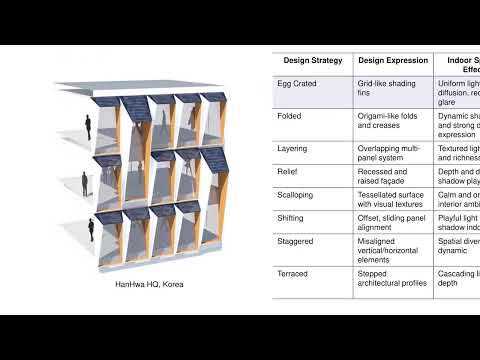
This video shows eight facade typologies, including folded, layered, and relief patterns:
VII. Regulatory Compliance and Certification: Solving the Permitting Headache
Aesthetic BIPV helps projects meet strict urban planning and historic preservation codes. Planners often refuse visible racks but approve a flush, color-matched surface. The IEA report points to European projects that fit solar into heritage settings without breaking conservation rules.
Navigating LEED, BREEAM, and local zoning laws on facade appearance
Green rating systems reward on-site renewable energy. LEED awards points across energy, materials, and other categories, with levels from Certified (40+ points) to Platinum (80+). BREEAM is the UK-born equivalent and is used worldwide. For zoning, bring the planner samples, a color and glare note, and photos of similar projects before the formal filing.
Fire safety ratings and structural load certifications
A BIPV product has to pass two test families: solar product standards and building product standards. UL notes that BIPV must be evaluated as a roofing or wall material, with fire, impact, wind, and wind-driven rain tests, in addition to the electrical tests. Its BIPV testing and certification page explains the process.
| Topic | Common standard | What it checks |
|---|---|---|
| Module durability | IEC 61215 | Heat, humidity, UV, mechanical stress |
| Module safety | IEC 61730 | Electrical and fire safety |
| BIPV-specific | IEC 63092-1 | Building-function requirements |
| U.S. roof-integrated | UL 7103 | BIPV roof coverings |
| Exterior wall fire (U.S.) | NFPA 285 | Fire spread on a full wall assembly |
| European fire class | EN 13501-1 | Reaction to fire |
A key detail: NFPA 285 covers the complete assembly (glass, framing, insulation, and cavity). A report for a different build-up does not transfer to yours. Our laminated PV glass page lists structure details such as 11 mm glass build and 5,400 Pa wind loading for reference, but you must still match tests to your own assembly and local code.
Streamlining approval through documented aesthetic compatibility
Package the approval file so reviewers can say yes quickly: color samples with ΔE tolerance, a glare and reflectance note, test certificates for the exact configuration, and a one-page replacement plan. Reviewers approve what they can verify.
Industry insight: More tenders now ask for a compliance matrix before technical scoring. A supplier who hands over certificates, BIM objects, and an Environmental Product Declaration (EPD, a verified report on a product’s environmental impact) in one package often passes prequalification while others are still gathering paper.
VIII. Economic Value Proposition for Developers and Distributors
BIPV transforms a capital expenditure (CapEx) into a long-term asset with several revenue streams: avoided material cost, energy savings, and higher building appeal.
Reducing overall material costs by combining cladding and energy generation
Build the comparison like this. Paste it into a spreadsheet and fill in your own prices:
| Cost line | Option A: cladding + rooftop solar | Option B: BIPV cladding |
|---|---|---|
| Cladding material and install | Your price | Replaced by BIPV |
| Rooftop solar system | Your price | Not needed (or smaller) |
| Extra electrical and test work | Included above | Your price |
| Spare modules (3–5%) | None | Your price |
| Annual energy value | Your estimate | Your estimate |
| Net 25-year cost | Total | Total |
In our own modeling for opaque cladding, payback on the extra cost over conventional cladding falls between about 4 and 10 years, and for semi-transparent glazing between about 7 and 15 years. These ranges depend heavily on tariffs, incentives, and orientation, so treat them as a starting point. Our 10-point evaluation framework shows how to build the full model.
Increasing “Green Premium” rental yields and property valuation
Green-certified buildings often earn stronger rents and valuations, but the size of the premium varies by market and lease type. Ask your valuer for local data and do not borrow a headline number. A visible, attractive solar skin also gives tenants and investors a simple story for ESG (environmental, social, and governance) reports.
Market positioning for distributors: from selling “panels” to selling “intelligent building skins”
Panel buyers compare price per watt. Envelope buyers compare risk, lead time, and support. Distributors who stock samples, hold spare batches, and bring a technical rep to the design meeting move into the second group. Europe is a good place to see why: IEA PVPS estimated that Europe held about 44% of the global BIPV market in 2020, driven by building energy rules.
Source: IEA PVPS Task 15 coloured BIPV report (Europe, Asia-Pacific, and U.S. shares); “rest of world” is the remainder.
Lead time is the other selling point. Custom color and size usually take 12–20 weeks from confirmed order, so the order must go in around 30–40% design completion. Distributors who say this on day one avoid angry calls later. Browse our full BIPV product range to see which items are standard and which are custom.
IX. Future Trends: Smart Skins and Dynamic Aesthetics
The next generation of BIPV will move beyond static colors to responsive environments. Some of this is already built; some is still in the lab.
| Trend | Status today | What to watch |
|---|---|---|
| Organic PV (OPV) | Niche, pilot buildings | Durability and sealing, per IEA |
| Perovskite-silicon tandem | Lab record of 34.85%; pilot production | Commercial facade modules by about 2027–2028 |
| Smart (electrochromic) glass + PV | Early commercial pilots | Cost and joint warranties |
| Moving shading skins | Built for shading, not yet for PV | Maintenance access |
Integration of organic photovoltaics (OPV) for flexible, curved surfaces
Organic photovoltaics (OPV) use thin printed layers that are light, flexible, and available in colors. The IEA report shows OPV on a German pavilion at Expo Milano 2015 and an ETFE membrane facade. It also notes that durability remains an open question, so treat OPV as a pilot choice and demand test data.
Kinetic BIPV: facades that move to optimize light intake and visual appeal
The best-known moving facade is Abu Dhabi’s Al Bahr Towers, where about 2,000 shading elements open and close with the sun and cut solar heat gain by up to 50%. Its screens shade rather than generate power, but the same logic points to future solar skins. Moving parts add maintenance, so ask for the service interval before you specify.
The rise of “Energy-Positive” landmarks as a tool for corporate ESG storytelling
An energy-positive building makes more energy than it uses. Norway’s Powerhouse Brattørkaia, at 63°N, shows that this works even at high latitude when demand is cut first. For corporate owners, such a landmark is a story that investors can verify with meter data. The lesson for your project: reduce demand first, then size the solar skin.
X. Redefining the Modern Building Envelope
The convergence of energy and design is no longer optional. It is a competitive necessity.
For contractors, the installation pain comes down to clear scope, matched sealants, and early electrical coordination. For architects, the aesthetic pain comes down to color, texture, and a grid that works at concept stage. Both problems have practical answers today, and the power cost of good color is often only a few percent.
Your next steps:
- Pick the surfaces that will be solar at concept stage.
- Request 600 × 600 mm samples in your target color and finish.
- Run the loss table above with your own area, yield, and tariff.
- Hold an interface meeting for glazing and electrical trades before shop drawings.
- Order long-lead items at 30–40% design completion.
If you want help with any of these steps, contact the Jia Mao engineering team with your elevations and target color. Send your drawings early, and we will tell you what the color costs in power before you commit.
Glossary: Key Terms in Plain English
| Term | Plain meaning | Example |
|---|---|---|
| BIPV | Solar that is the building material | A solar tile that replaces a clay tile |
| BAPV | Solar mounted on a finished building | Racked panels on a metal roof |
| VLT | Share of daylight that passes through glass | 30% VLT lets in about a third of daylight |
| g-value (SHGC) | Share of solar heat that gets into the room | Clear glass 0.86; BIPV units can reach 0.15–0.30 |
| U-value | How fast heat leaks through; lower is better | A triple-pane unit has a lower U-value |
| ΔE | A number for how different two colors look | ΔE below 3 is hard to see |
| Ceramic frit | Glass paint fired into the glass surface | A printed stone pattern on solar glass |
| Spandrel | The opaque band between floors on a facade | Best place for full-power solar |
| kWp | Rated power under lab test conditions | A 100 kWp system peaks near 100 kW |
| MLPE | Electronics on each module that limit shade loss | Microinverters |
| BIM | Shared 3D model with building data | A Revit model of the facade |
Frequently Asked Questions
1. How much energy efficiency is lost when choosing a custom color over standard blue/black?
It depends on the color method. Interference-coated glass keeps about 94–95% of power, so the loss is 5–6%. High-saturation colored PV loses around 7%. A white selective filter loses about 40%. In our own range, the red and green CIGS roof tiles are rated at 25 W compared with 32 W for black, a drop of about 22%. Always ask for measured data on the exact color you plan to use.
2. Can BIPV modules be matched exactly to existing RAL or Pantone architectural colors?
They can be matched closely, but not “exactly” the way paint is. Glass color changes with viewing angle, light, and the cells behind it. Agree on a tolerance such as ΔE ≤ 3 against an approved physical sample, and buy the whole order from one production batch to avoid bands.
3. How do colored BIPV finishes handle UV degradation and color fading over 25 years?
Ceramic pigments fired into the glass are very stable, because there is no organic dye to fade. Our colored glass product page states 30-year color retention with ΔE below 3, which is a manufacturer claim. Ask for UV exposure test reports, and check that the encapsulant film is UV-resistant too, since it protects the cells behind the color.
4. What is the installation difference between traditional curtain wall systems and BIPV systems?
The framing and glazing steps are similar. BIPV adds cable routes through the mullions, junction boxes, string testing, and DC electrical safety rules. The biggest change is organizational: glazing and electrical trades must share one written scope. Pre-wired, unitized panels cut site work but have longer lead times, often 12–20 weeks for custom specs.
5. Can BIPV be integrated into curved facades or non-linear architectural shapes?
Yes, in three ways. Roofs can use curved thin-film tiles, like our CIGS tiles. Facades can use many flat modules arranged in a faceted curve. Custom-shaped or bent glass is possible but adds cost and lead time and may limit your cell choice. Ask the supplier early.
6. How do we handle the electrical wiring and cabling within a high-end aesthetic facade?
Plan the routes at design development. Hide cables in mullions or the ventilated cavity, use UV-resistant PV wire, and keep junction boxes reachable from the front or from a service cavity. Invisible busbar technology keeps the glass face clean. Settle who installs conduit sleeves before the shop drawings are issued.
7. Are BIPV materials compatible with standard waterproofing and flashing techniques?
Yes, with care. Use drained and ventilated details, manufacturer-approved sealants, and slotted anchors for movement. Wrong sealants can attack the module’s edge seal. Test the finished wall for wind-driven rain, and seal every cable entry.
8. What are the fire safety certifications (e.g., UL, EN) for BIPV cladding compared to traditional aluminum composite panels?
BIPV glass is tested under IEC 61730 for module safety, UL 7103 for roof-integrated products in the U.S., EN 13501-1 for European fire class, and NFPA 285 for full wall assemblies on taller U.S. buildings. Aluminum composite panels (ACP) are tested on their core material, and polyethylene cores are a known concern. BIPV has no plastic core, but its polymer encapsulants and junction boxes must be assessed. Compare full-assembly test reports, not panel names.
9. How does the cost of BIPV compare to the combined cost of traditional cladding plus a separate rooftop solar array?
Compare total cost, not unit cost. BIPV can cost two to three times standard architectural glass, but once you credit the cladding it replaces and the rooftop system you no longer need, the net extra cost often narrows. Use the cost table in section VIII with your own prices, and include spare modules and extra electrical work.
10. What is the maintenance protocol for cleaning and repairing a single damaged aesthetic module in a large facade?
Clean on a schedule that matches local dust and pollution. Keep 3–5% spare modules from the same batch, because color-matched replacements may not be available years later. Mechanical clip fixings let you swap one module in hours, while structural silicone needs cutting and resealing. Make sure junction boxes are reachable, and use monitoring that flags drops in output.
11. How do we simulate the visual impact and energy yield of BIPV during the early design phase?
Build the facade in BIM, then run a yield simulation such as PVsyst with nearby buildings included. Run a daylight study for each transparency zone. Back this up with physical samples at least 600 × 600 mm, viewed outdoors at the site’s orientation. Renders alone often hide color shifts.
12. Does the use of colored overlays affect the thermal performance (U-value) of the building envelope?
The overlay itself changes the U-value very little, because U-value is set mainly by the glass build-up, cavity, gas, and coatings. Color does change how much solar heat gets in (the g-value) and how hot the outer glass runs. A well-specified BIPV unit can reach a g-value of 0.15–0.30, compared with 0.86 for clear glass. Ask the supplier for whole-unit U and g values from a recognized test method.