The Ultimate Guide for Industry Professionals in Solar Roofing and Building Integration

A general contractor and design consultant review solar tile specifications on-site. Accurate upfront cost modeling is the single biggest competitive differentiator in solar roofing proposals today.
1. Executive Summary: Why This Guide Matters for Your Business
The solar tile roofing market is no longer a niche curiosity. The global BIPV (Building-Integrated Photovoltaics — a category where the solar module replaces a conventional building material rather than sitting on top of it) market was valued at USD 23.41 billion in 2025 and is projected to reach USD 28.33 billion in 2026, according to Fortune Business Insights. In the U.S. alone, the BIPV sector is expanding at an estimated 22.1% compound annual growth rate (CAGR) through 2030, driven by tightening net-zero building codes, federal tax incentives, and client demand for architecturally integrated renewable energy.
For curtain wall contractors, EPC (Engineering, Procurement, and Construction) firms, roofing specialists, building material distributors, and design consultants, this growth creates a genuine commercial opportunity — and a real execution risk. Solar tile roof projects are structurally and electrically more complex than standard rooftop panel installations. They demand precise cost forecasting, deep coordination across trades, and a working knowledge of incentive structures that vary state by state.
The professionals who are winning solar tile work right now share three capabilities: they model total project costs with defensible accuracy before bid submission, they understand lifecycle value well enough to reframe client conversations away from upfront price, and they know which regulatory and incentive variables can move a project from marginal to highly profitable.
This guide delivers all three of those capabilities in one place. It covers cost drivers, financial modeling frameworks, real case studies, regulatory navigation, technology selection, and strategic positioning — written exclusively for B2B industry professionals, not homeowners. Every number in this guide reflects 2025 market data from published industry sources.
2. Understanding Solar Tile Roof Systems: A Technical Overview
Before you can price a solar tile project accurately, your entire project team needs to speak the same technical language. Miscommunication between roofing contractors, PV engineers, and architects at the specification stage is the most common cause of costly scope changes during installation.
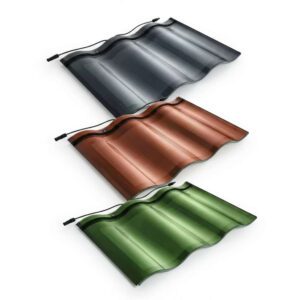
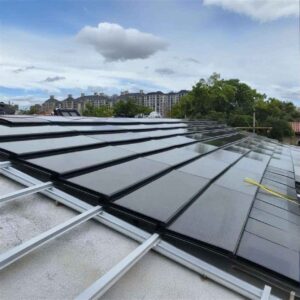
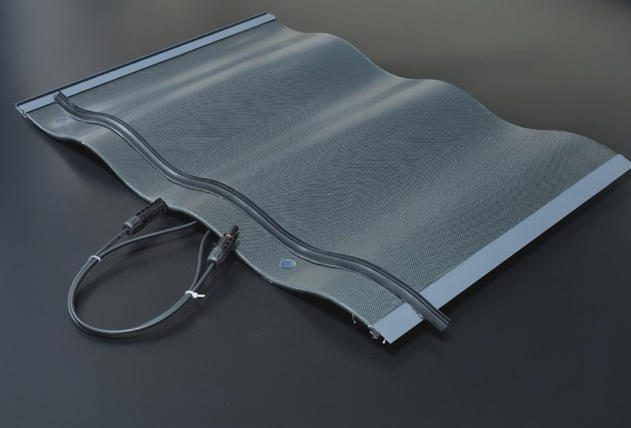
Solar tiles (also called solar shingles or solar roofing tiles) are photovoltaic modules designed to function simultaneously as the primary weather barrier of a roof and as an electricity-generating surface. They differ from conventional rooftop solar in one fundamental way: they replace roofing material rather than being mounted above it. This distinction drives every cost, aesthetic, and structural implication downstream.
Three system types compete in this market:
- Solar tiles / shingles (e.g., Tesla Solar Roof, GAF Timberline Solar, CertainTeed Apollo) — integrated at the shingle level; the PV cells are embedded in each roofing unit.
- Traditional rooftop PV panels — racked above an existing or new conventional roof; lower upfront cost but no aesthetic integration.
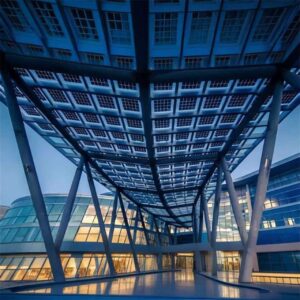
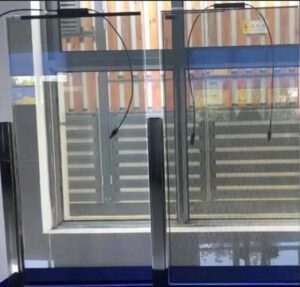
- BIPV facade/curtain wall systems — PV modules integrated into vertical glass or cladding elements; relevant for mixed-use and commercial buildings where Jia Mao Bipv and similar manufacturers supply custom-engineered glazing solutions.
Key system components your estimators and project managers must account for in every budget:
The photovoltaic tiles themselves (typically monocrystalline silicon cells laminated between tempered glass layers), the mounting and racking system (often proprietary to each tile brand), the inverter (string or microinverter — critical choice for shaded roofs), DC combiners and AC disconnects, the monitoring system (hardware + software subscription), and the balance of system (BOS) — all the wiring, conduit, labeling, and interconnection hardware that ties it together.
For curtain wall and facade integration, the component list expands significantly: structural framing, mullion and transom systems, sealant systems, electrical cable management through framing cavities, and potentially MLPE (Module-Level Power Electronics — microinverters or DC optimizers at each glass unit to prevent shading losses). This is the territory where BIPV specialists like Jia Mao Bipv provide critical technical support for architects and facade contractors specifying custom integrated systems.
Compatibility check — the question most contractors miss: Solar tiles add significant dead load (weight) to the roof structure. A standard asphalt shingle roof carries approximately 2–4 lbs/sq ft. A solar tile system can add 8–15 lbs/sq ft depending on product and configuration. For BIPV glazing in curtain wall applications, individual panel weights can reach 50–55 kg/m². This load delta requires structural assessment before any product is specified — a step that belongs in schematic design, not during construction documents.
3. Breakdown of Cost Drivers: What Influences Total Project Price
Solar tile project costs are not a single number — they are a stack of variables, each of which can shift the total budget significantly. Understanding each layer gives you the forecasting accuracy to write competitive, profitable bids.
Material Costs: Product Tier Determines the Starting Point
The solar tile market currently spans three distinct price tiers:
| Product | Installed Cost Range | Cost Per Watt | Cell Efficiency | Warranty |
|---|---|---|---|---|
| Tesla Solar Roof | $6.00–$8.00/W | Highest tier | ~22% (monocrystalline) | 25 yr product + weatherization |
| GAF Timberline Solar | $4.00–$5.50/W | Mid-to-high tier | ~22% | 25 yr product, 10 yr weatherization |
| CertainTeed Apollo | $4.50–$5.50/W | Mid tier | ~20% | 25 yr module |
| Generic BIPV glazing tile | $2.50–$4.50/W | Mid tier | 15–22% | 10–25 yr (varies by manufacturer) |
| Traditional rooftop PV + conventional roof | $2.75–$3.50/W | Lowest tier | 20–23% | 25 yr panel + separate roof warranty |
Sources: SolarReviews 2025, Reddit solar community verified pricing threads, solartechonline.com, EnergySage 2025 market data.
The $15–$35 per square foot installed cost range you’ll see cited for solar tile roofs reflects this entire spectrum. A residential retrofit with Tesla Solar Roof on a 2,000 sq ft roof can realistically land at $40,000–$70,000 before incentives. A GAF Timberline Solar installation on the same roof may come in at $25,000–$45,000.
Labor and Installation Complexity
Labor typically represents 30–40% of total installed cost on solar tile projects — significantly higher than standard rooftop PV because of the precision required in tile integration, weatherproofing, and electrical routing.
The three factors that drive labor cost upward on any specific project are: roof pitch (steep pitches above 6:12 require fall protection equipment and slow the installation rate significantly), accessibility (multi-story buildings, limited staging areas, and urban sites with crane restrictions all add cost), and integration complexity (mixing solar tiles with conventional dormers, valleys, skylights, and penetrations demands skilled labor and detailed coordination).
For commercial projects, add the cost of Trade coordination — the electrical contractor, roofing contractor, and general contractor must be on the same installation sequence to avoid the most common expensive mistake: glazing going in before electrical rough-in is complete, forcing destructive access later.
Electrical Balance of System (BOS)
BOS — wiring, conduit, inverters, combiners, disconnects, monitoring, and utility interconnection — accounts for 20–30% of total project cost on most solar tile installations. Key variables include:
- Inverter type: String inverters are less expensive upfront; microinverters (e.g., Enphase) or DC optimizers (e.g., SolarEdge) add $0.20–$0.50/W but significantly improve performance on shaded or complex roofs.
- Service panel upgrades: Many projects require a main panel upgrade to accommodate solar generation — add $2,000–$5,000 for residential, $5,000–$20,000+ for commercial.
- Grid interconnection fees: Utility-specific and highly variable — from a few hundred dollars to several thousand, with timelines of 10 business days to 90 days depending on jurisdiction and utility queue.
Regional Variations: The Variable Nobody Budgets Adequately
Permitting, inspection, and interconnection costs vary more than any other line item in solar tile budgets — and they are the hardest to forecast without local expertise. According to the National Renewable Energy Laboratory’s permitting research, permit review times range from same-day in jurisdictions using automated tools like SolarAPP+ to 60–90 days in overloaded interconnection queues. Timeline uncertainty alone can make or break project cash flow for smaller contractors.
EPC firms managing multi-jurisdictional projects need a jurisdiction-by-jurisdiction cost and timeline database, updated annually. This is one of the most defensible competitive advantages an EPC firm can build: knowing the permitting landscape better than your competitors means your timelines are more accurate, your contingencies are right-sized, and your client relationships survive the permitting process intact.
4. Comparative Analysis: Solar Tiles vs. Traditional Rooftop PV Systems
This is the conversation that defines which product you recommend — and therefore, which margin you make. Getting it wrong costs you client trust. Getting it right positions you as the advisor, not just the vendor.

Cost Per Watt: The Headline Number That Needs Context
Traditional rooftop solar panels currently install at $2.75–$3.50/W for residential and $1.40–$2.50/W for commercial scale. Solar tiles run $4.50–$8.00/W depending on brand — representing a 40–180% premium over conventional panels.
That premium is only defensible to clients when you frame it correctly: solar tiles are not just solar panels, they are simultaneously the roofing material. The comparison is not “solar tiles vs. panels” — it is “solar tiles vs. panels plus conventional roof.” When a building needs a new roof anyway (as it does on most retrofit projects), the net incremental cost of solar tiles over the conventional roofing alternative narrows dramatically.
Lifetime Value: Where Solar Tiles Recover Their Premium
| Metric | Traditional Panel + Conventional Roof | Solar Tile System |
|---|---|---|
| Upfront cost (2,000 sq ft residential) | $8,000 roof + $18,000 panels = $26,000 | $40,000–$55,000 |
| System efficiency (typical monocrystalline) | 20–23% | 20–22% |
| Roof warranty | 20–30 yr (separate) | 25 yr (integrated) |
| Panel/tile warranty | 25 yr | 25 yr |
| Aesthetics / HOA compatibility | Visible rack and panel array | Flush integrated appearance |
| Building permit complexity | Standard roofing + electrical | Combined roofing/PV permit |
| Resale value impact | Documented +4.1% (Zillow study) | Same or higher (HOA-friendly markets) |
| Maintenance access | Easy panel-level replacement | Tile-level replacement; more complex |
Sources: SolarReviews, EnergySage, Zillow Research, industry installation data.
The key decision criterion for your clients is hold period. If a commercial or residential client plans to hold the property for 7+ years and is replacing the roof anyway, the financial case for solar tiles is strong. If they plan to sell in 3 years or the existing roof has 15+ years of life remaining, conventional racked panels typically deliver better near-term ROI.
Aesthetic and Architectural Integration
For architects and design consultants, this dimension often overrides pure financial analysis. HOA restrictions, historic district requirements, premium residential markets, and design-forward commercial developers all place high value on rooflines that do not look like industrial solar installations. Solar tiles eliminate the visual disruption of racked panels — and in some markets, that aesthetic premium commands a higher sale or lease price that justifies the cost difference outright.
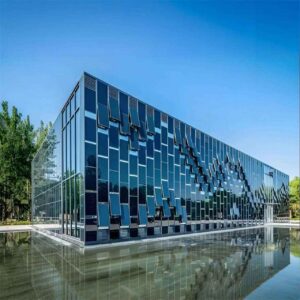
This is where BIPV systems in curtain wall and facade applications add another dimension: for commercial buildings where the roof is invisible from street level but the facade is the architectural statement, BIPV facade integration delivers both the aesthetic outcome and the energy performance without any roof penetration.
5. Regional and Regulatory Cost Variations: Planning Across Markets
Regulatory complexity is where solar tile projects either get executed efficiently or turn into margin-destroying change order battles. Professionals who have built jurisdiction-specific expertise in this area consistently outperform those who treat permitting as a back-office function.
Building Codes, Fire Ratings, and Wind Load Requirements
Solar tile systems must simultaneously comply with three regulatory frameworks that are often administered by different bodies:
Energy code compliance: ASHRAE 90.1-2022 (for commercial) and IECC (for residential) set the performance floor for building envelope and mechanical systems. California’s Title 24 now mandates solar-ready construction for virtually all new residential buildings and has extended requirements into commercial. Colorado, Delaware, and a growing list of states have adopted similar solar-ready codes.
Structural requirements: Solar tiles must meet local wind uplift requirements under ASCE 7-22 — particularly critical in hurricane zones (Florida, Gulf Coast, Carolinas) and high-wind regions. The structural load calculation must be completed by a licensed PE before any solar tile product is specified. Add $3,000–$8,000 to project costs for the structural engineering assessment on commercial projects.
Fire classification: BIPV glass and solar tile systems used on commercial buildings must meet NFPA 285 (Standard Fire Test Method for Exterior Non-Load-Bearing Wall Assemblies) — a full-assembly test, not a product-level test. This is the most frequently missed compliance requirement in solar tile specifications for commercial projects. Request the NFPA 285 test report from your supplier before finalizing any commercial spec.
Incentives and Rebates: The Numbers That Change the Client Conversation
The federal Investment Tax Credit (ITC) under the Inflation Reduction Act provides a 30% tax credit on the total installed cost of a qualifying solar system — and solar tiles and shingles explicitly qualify as “qualified solar photovoltaic equipment” according to the IRS. For a $50,000 commercial solar tile project, the ITC alone reduces the net cost to $35,000 before any state or utility incentives are applied.
The 179D Energy-Efficient Commercial Buildings Deduction provides up to $5.00/sq ft in tax deductions for commercial buildings that meet specific energy performance thresholds. Solar tile roofs that contribute to these thresholds can stack 179D deductions on top of the ITC — a combination that substantially compresses payback periods on commercial projects.
State and utility incentive programs are tracked in the DSIRE (Database of State Incentives for Renewables & Efficiency) — the most comprehensive and regularly updated source for jurisdiction-specific programs. Every EPC firm and building material distributor should have DSIRE bookmarked and checked before every client proposal.
6. Long-Term Financial Modeling: ROI, Payback Period, and Lifecycle Savings
This is the section that separates advisors from vendors. Clients who receive a defensible 30-year financial model from a contractor close faster, argue less about price, and refer more business. Clients who receive only a per-square-foot price comparison shop on cost alone.
Calculating NPV, IRR, and Payback Period
Net Present Value (NPV) — the present value of all future energy savings minus the upfront investment cost — is the metric institutional investors and commercial property owners use to evaluate capital allocation decisions. A positive NPV means the investment creates value; a higher NPV means more value per dollar invested.
Internal Rate of Return (IRR) — the annualized return on investment — allows comparison with alternative capital uses. A solar tile project returning 12% IRR competes favorably with most commercial real estate improvement categories.
Simple Payback Period — upfront cost divided by annual savings — is the metric that most building managers and residential clients actually use. For solar tile projects:
Most commercial solar tile projects achieve payback in 5–12 years depending on electricity rates, system size, and incentive stacking. Residential projects typically run 7–15 years given smaller scale and lower demand charge exposure.
Energy Production Estimates by Geography
A solar tile system’s annual energy output depends on five variables: geographic solar irradiance, roof orientation, shading, system efficiency, and local temperature. The table below provides planning benchmarks for key U.S. markets:
| Market | Annual Peak Sun Hours | Typical System Yield (kWh/kWp/yr) | Commercial Electricity Rate | Estimated Annual Savings per 10 kWp System |
|---|---|---|---|---|
| Phoenix, AZ | 5.5–6.0 | 1,650–1,800 | $0.10–$0.13/kWh | $1,815–$2,340 |
| Los Angeles, CA | 5.3–5.7 | 1,590–1,710 | $0.22–$0.28/kWh | $3,500–$4,800 |
| Miami, FL | 5.0–5.5 | 1,500–1,650 | $0.11–$0.13/kWh | $1,650–$2,145 |
| Dallas, TX | 4.8–5.2 | 1,440–1,560 | $0.09–$0.12/kWh | $1,296–$1,872 |
| Chicago, IL | 4.0–4.4 | 1,200–1,320 | $0.10–$0.13/kWh | $1,320–$1,716 |
| New York, NY | 4.2–4.6 | 1,260–1,380 | $0.16–$0.22/kWh | $2,016–$3,036 |
| Seattle, WA | 3.8–4.2 | 1,140–1,260 | $0.10–$0.12/kWh | $1,140–$1,512 |
Sources: NREL PVWatts national irradiance data; EIA commercial electricity rates, July 2026.
For any specific project, run the calculation through the NREL PVWatts Calculator using the actual roof coordinates, tilt, azimuth, and shading inputs — generic regional averages are planning benchmarks, not proposal numbers.
Monetizing Energy Savings Over 30 Years
The most powerful financial argument for solar tile roof systems is the long-term cumulative savings against rising electricity costs. U.S. commercial electricity rates have increased at an average of 3–5% annually over the past decade. At a conservative 3% annual rate escalation, a system generating $10,000 in Year 1 savings produces:
This figure — nearly $270,000 in cumulative savings from an annual Year 1 baseline of $10,000 — is the number that reframes the entire cost conversation. For commercial clients with 20+ year hold periods, the glass premium, the tile premium, the inverter cost — all of it shrinks to rounding error against the lifecycle savings stack.
7. Budgeting Strategies for Contractors and Developers

Effective solar tile budgeting requires coordinating material procurement, labor sequencing, permitting timelines, and incentive capture into a single integrated financial model.
Phased Installation to Manage Cash Flow
For commercial developers and large-scale residential contractors, phased solar tile installation — completing one building or one roof section at a time rather than the full project simultaneously — reduces peak capital exposure and allows cash flow from completed phases to fund subsequent ones. It also allows the project team to troubleshoot installation details on the first phase before replicating across the full scope.
A practical phasing strategy: specify the south- and west-facing roof sections in Phase 1 (highest-yield orientation), capture the energy savings and operational learnings from Phase 1 before committing Phase 2 capital, and use the documented Phase 1 performance data to support financing for subsequent phases.
Partnering with Distributors for Volume Pricing
Solar tile material costs are negotiable at volume. General contractors and EPC firms that aggregate purchasing across multiple projects — even from different clients — can negotiate distributor pricing that meaningfully moves the material cost line. Building material distributors and brands that maintain preferred supplier relationships with solar tile manufacturers (including BIPV specialists like Jia Mao Bipv for facade-integrated applications) provide their contractor clients with unit cost advantages that solo purchasers cannot access.
For specialized contractors moving into solar tile work, establishing a distributor relationship before the first project is more important than finding the lowest spot price on a single order. The volume discount, technical support, lead time certainty, and warranty backstop that come with a distributor relationship are worth more than the margin on any single purchase.
Risk Mitigation: Contingency Planning for Supply Chain and Labor
BIPV solar glass and premium solar tile products — particularly custom-specification or non-standard configurations — carry lead times of 10–24 weeks from order to delivery. For commercial projects on fixed completion schedules, a supply chain delay that pushes glazing delivery by 6 weeks can cascade into $50,000+ in downstream schedule impact costs.
The risk mitigation protocol that experienced solar tile contractors follow: issue purchase orders at 60% construction documents — before full design is complete — with clear performance specification language that allows minor field adjustments without requiring a formal change order. Build a 10–15% contingency into all solar tile project budgets (compared to the 5–8% typical for conventional construction), and document the contingency basis explicitly in your client proposal so it does not become a negotiating vulnerability.
8. Working with Architects and Design Firms: Aligning Aesthetics with Performance
The single biggest source of rework cost on solar tile projects is the late involvement of the PV engineer in the architectural design process. When solar tiles are treated as a product specification decision made during construction documents rather than an integrated design element established during schematic design, the result is predictable: roof geometries that create shading problems for the PV system, structural details that cannot accommodate the solar tile load without expensive reinforcement, and electrical routing paths that conflict with the architectural intent.
Early-Stage Collaboration: What It Looks Like in Practice
The project team meeting where solar tile integration succeeds is held at schematic design — not during design development. At that meeting, three decisions are made simultaneously:
Roof geometry and orientation are optimized for solar yield, not just aesthetics. This does not mean sacrificing design quality; it means ensuring that the architect understands the yield impact of different roof configurations before the design is locked. A hip roof that fragments the solar array across four orientations produces 30–40% less annual yield than a simple gable with south-facing primary slope — and that yield difference translates directly to payback period.
Structural design parameters are established with the solar tile system’s confirmed dead load, wind uplift resistance requirement, and thermal movement accommodation built into the structural engineer’s initial calculations — not added as a shop drawing revision.
Electrical routing is sketched into the building section so that conduit pathways through insulation layers, framing cavities, and roof penetrations are coordinated before the architecture freezes. Every electrical penetration through the roof plane is a potential water infiltration point that requires detailed flashing design — and that detail is far less expensive to design correctly the first time than to remediate post-installation.
Structural Integrity and Thermal Performance
For architects specifying BIPV curtain wall or facade solar tile systems, the SHGC (Solar Heat Gain Coefficient — the fraction of solar radiation that passes through the glazing and enters as heat) and U-value of the solar glass must be confirmed by the manufacturer before the mechanical engineer sizes the HVAC system. Curtain wall BIPV glass at SHGC 0.25 versus standard glass at SHGC 0.70 may allow the chiller plant to be sized 20–30% smaller on a high-glazing-ratio commercial building — a capital cost saving that partially offsets the premium cost of BIPV glass.
For roofing applications, solar tiles must maintain the building’s thermal envelope continuity. The insulation strategy beneath the solar tiles — typically rigid foam above the structural deck — must be detailed to prevent thermal bridging at the mounting attachment points and maintain the required assembly R-value specified by local energy codes.
9. Case Studies: Real-World Cost Scenarios Across Project Types
Case Study 1: Residential Retrofit — 2,500 sq ft Home, Tesla Solar Roof
Project context: A homeowner in Scottsdale, Arizona with a 22-year-old conventional tile roof approaching end of life. The existing roof needed replacement regardless; the question was whether to replace with conventional tile or upgrade to Tesla Solar Roof.
System specs: 10.2 kWp Tesla Solar Roof system; 64 active tiles plus non-active architectural tiles for full coverage; Powerwall 2 battery storage added.
Financial breakdown:
| Line Item | Cost |
|---|---|
| Tesla Solar Roof (tiles + installation) | $52,000 |
| Powerwall 2 battery | $11,500 |
| Panel upgrade + electrical BOS | $3,200 |
| Permitting and interconnection | $1,800 |
| Gross Total | $68,500 |
| Federal ITC (30%) | –$20,550 |
| Arizona state solar tax credit | –$1,000 |
| Net Cost After Incentives | $46,950 |
Performance outcome: At Phoenix irradiance levels (5.7 peak sun hours), the 10.2 kWp system generates approximately 17,400 kWh/year. At the homeowner’s APS rate of $0.12/kWh, annual bill reduction is approximately $2,088. With Powerwall time-of-use optimization, actual savings are estimated at $2,600–$3,000/year.
Payback period: ~16–18 years before battery credit. When the avoided cost of the conventional roof replacement (comparable tile roofing at $18,000–$22,000) is subtracted from the net cost, the effective solar tile premium drops to approximately $24,950–$28,950 — yielding a 9–11 year payback on the solar energy component specifically.
Lesson for contractors: Always present the “roof replacement net cost” comparison to homeowners. The gross solar tile price loses deals; the net premium over the inevitable roof replacement cost wins them.
Case Study 2: Commercial Low-Slope Roof with Integrated Photovoltaic Tiles
Project context: A 45,000 sq ft single-story distribution center in Dallas, Texas. The owner was expanding the facility and needed to reroof two existing sections while adding 150 kWp of solar capacity to meet a corporate sustainability target.
System choice: GAF Timberline Solar on accessible low-slope sections (15° pitch sections at perimeter); conventional monocrystalline panels on the primary low-slope interior zones where aesthetics were not a priority.
Key challenge: The low-slope sections of the roof were not ideal for solar tile products (most solar shingles are optimized for 15–45° pitches). The project team worked with the roofing contractor to create a raised-pitch framing system on the perimeter sections — adding $12,000 in framing cost but enabling the Timberline Solar product at an effective 18° pitch.
Financial outcome:
| Line Item | Cost |
|---|---|
| GAF Timberline Solar (perimeter zones, 50 kWp) | $280,000 |
| Conventional panels (interior, 100 kWp) | $175,000 |
| Framing adaptation | $12,000 |
| Electrical BOS + inverters + monitoring | $85,000 |
| Permitting, inspection, interconnection | $18,000 |
| Gross Total (150 kWp) | $570,000 |
| Federal ITC (30%) | –$171,000 |
| Net Cost | $399,000 |
| Annual energy savings | $31,500 |
| Simple Payback | 12.7 years |
Lesson for EPCs: Low-slope commercial applications require product selection that matches pitch requirements. A hybrid approach — premium solar tiles where visibility matters, conventional panels where performance-per-dollar matters — often produces the best combined financial and aesthetic outcome.
Case Study 3: Mixed-Use Development with Curtain Wall Integration
Project context: A 12-story mixed-use tower in Austin, Texas — ground-floor retail, commercial office floors 2–8, residential condominiums floors 9–12. The developer wanted LEED Gold certification and a net-zero energy target for the commercial floors.
System integration: BIPV solar glass in the south and west curtain wall spandrel zones (floors 3–8) — replacing conventional opaque spandrel panels with solar-generating glass modules. Rooftop conventional solar array supplementing the facade generation.
Why curtain wall BIPV was specified: The south and west spandrel zones totaled 2,800 m² of facade area that would have been conventional cladding. Using BIPV glass modules (supplied through a specialized BIPV manufacturer providing custom glazing units with IEC 61215 and NFPA 285 certifications) replaced the conventional spandrel material while adding 280 kWp of generating capacity. The material offset credit — the cost of the conventional spandrel panels that BIPV glass replaced — reduced the net incremental cost of the BIPV system by approximately $380,000.
Specialized installation note: The facade contractor and electrical contractor held a Facade-Electrical Interface Meeting at design development, resolving cable routing through mullions and junction box placement before curtain wall shop drawings were produced. This coordination step, commonly skipped on first-time BIPV projects, eliminated what the project manager estimated would have been $60,000–$90,000 in change orders if discovered during installation.
Result: Net incremental cost of curtain wall BIPV over conventional spandrel specification was $420,000 after the material offset credit and ITC. Annual generation from the facade BIPV: approximately 308,000 kWh (at Austin’s 4.9 peak sun hours/day for vertical south facade). At Austin Energy commercial rates of $0.085/kWh plus demand charge avoidance: $36,000+ annual savings. Payback: 11.7 years. The project achieved LEED Gold at first submission, with the BIPV system contributing 9 LEED points across Energy and Atmosphere categories.
10. Future-Proofing Your Projects: Trends, Technology, and Market Shifts
The solar tile roofing market in 2025 is not the same market it will be in 2030 — and the contractors and developers who understand the trajectory now will be positioned to capture the best opportunities as the market matures.

Next-generation solar roofing systems are converging with smart building technology, battery storage, and EV charging infrastructure — creating integrated energy systems that go well beyond today’s single-function solar tiles.
Emerging Technologies: Higher Efficiency, Smarter Systems
Perovskite solar cells — a class of crystalline structures with remarkable light-conversion properties — have achieved laboratory efficiencies of 26%+ as of 2025, compared to the 20–23% typical of commercial monocrystalline silicon tiles today. Commercial perovskite BIPV products are expected to enter the market at scale within 2–4 years, with tandem perovskite-silicon cells projected to push practical module efficiencies toward 30% — which will either increase power density per square foot at the same tile cost, or reduce the required system size for a given energy target.
Transparent and ultra-low-transparency BIPV glazing is advancing rapidly. Products from manufacturers including Jia Mao Bipv now achieve Visible Light Transmittance (VLT — the percentage of visible light that passes through the glass) of 30–70% while maintaining meaningful power generation. This range means that transparent solar panels for skylights and vision glazing are no longer theoretical — they are commercially available, IEC-certified products that architects can specify today.
Battery storage integration is shifting from optional add-on to standard specification on commercial solar tile projects. The combination of Inflation Reduction Act incentives (which extend the 30% ITC to standalone storage systems when charged from solar), falling battery costs, and rising utility demand charges is making solar-plus-storage the financially superior option over solar-only on most commercial projects. EPC firms and contractors who can design, install, and commission integrated solar-plus-storage systems will command better margins and longer client relationships than those who install solar tiles in isolation.
Regulatory Trends: Net-Zero Mandates Driving Demand
The IEA has set a target of zero-carbon-ready building energy codes in all countries by 2030. In the U.S., California already mandates solar PV on virtually all new residential buildings under Title 24. Colorado has adopted a Model Solar-Ready Code. Delaware required all new residential construction to be zero-net-energy capable by December 31, 2025.
This regulatory pressure is structural demand for solar tile and BIPV products — not cyclical demand driven by incentive program timing. Every jurisdiction that adopts a solar-ready or net-zero mandate creates a mandatory customer base for solar-integrated roofing and facade systems. Contractors and building material distributors who establish product expertise, installer certification, and supplier relationships now will hold a first-mover advantage when these mandates hit their local markets.
Strategic Positioning: The Next 5 Years
The professionals who will dominate the solar tile roofing market in 2030 are those who make three strategic investments now. First, invest in workforce certification — NABCEP (North American Board of Certified Energy Practitioners) certification for solar installers, glazing contractor licensing for facade BIPV work, and manufacturer-specific training for the product lines you plan to represent. Second, build a project documentation library — case studies with real performance data, real cost outcomes, and real client testimonials are the most valuable sales assets in a market where credibility determines who gets the call. Third, establish supplier partnerships that go beyond transaction pricing — BIPV projects require technical support from specification through commissioning; suppliers who provide that support are partners, not vendors, and they give your team a competitive depth that spot-market procurement never will.
Watch: Solar Tiles vs. Traditional Panels — What the Numbers Actually Show

This video breaks down the real cost-per-watt comparison between solar tiles and conventional racked panels — and explains when each system wins on financials. Essential viewing for contractors preparing client proposals.
Solar tile roof installation is no longer a specialty niche — it is a mainstream commercial and residential product category attracting serious capital, serious regulatory attention, and serious competition. The contractors, EPC firms, architects, and distributors who establish expertise now will capture disproportionate market share as the BIPV market grows toward $28+ billion in 2026 and beyond.
The fundamental truth this guide demonstrates: the clients who stall on solar tile decisions do not lack interest — they lack a credible financial model. When you deliver an accurate cost forecast, a defensible ROI projection, and a clear regulatory roadmap, you transform a “maybe” into a purchase order. That capability is what separates the firms that grow with this market from those that watch it from the sidelines.
Ready to put this framework to work on your next project?
🔎 Explore product specifications and technical documentation for BIPV solar glass, curtain wall integration systems, and custom solar tile solutions at www.jmbipvtech.com.
📊 Calculate your project ROI with climate-zone-specific energy savings modeling — visit the solar control glass ROI calculator and energy savings guide to build a client-ready financial analysis.
📋 Review the complete BIPV installation design guide for commercial projects at jmbipvtech.com/bipv-solar-panel-installation-design-guide — covers everything from structural assessment through commissioning documentation.
🔗 Verify supplier certifications and understand what to look for in a solar glass RFP at jmbipvtech.com/solar-windows-help-buildings-save-energy-and-money.
Glossary of Key Terms
Understanding these terms precisely will improve your client communications and reduce specification errors.
BIPV (Building-Integrated Photovoltaics): PV modules that replace conventional building materials (roof tiles, facade cladding, glazing) while simultaneously generating electricity. The key distinction from BAPV (Building-Applied PV), which adds solar modules on top of an existing envelope.
BOS (Balance of System): All components of a solar installation other than the PV modules themselves — wiring, conduit, inverters, combiners, disconnect switches, monitoring hardware, and interconnection hardware.
SHGC (Solar Heat Gain Coefficient): A dimensionless number between 0 and 1 describing how much of the sun’s energy passes through glazing and becomes heat inside the building. Lower SHGC = less solar heat admitted. Critical for hot-climate facade specifications.
VLT (Visible Light Transmittance): The percentage of visible light (380–780 nm wavelength) that passes through glazing. Higher VLT = brighter interior without requiring artificial lighting.
ITC (Investment Tax Credit): The federal tax credit currently set at 30% of the total installed cost of a qualifying solar energy system. Applies to both commercial and residential solar installations, including solar tiles.
179D Deduction: The Energy-Efficient Commercial Buildings Deduction — a federal tax deduction of up to $5.00/sq ft for commercial buildings achieving specific energy performance improvements. Can stack with the ITC.
NPV (Net Present Value): The present value of all future cash flows (energy savings) from an investment, minus the upfront cost. A positive NPV indicates the investment creates value in today’s dollars.
IRR (Internal Rate of Return): The annualized return on an investment; the discount rate at which the NPV equals zero. Used to compare solar investment returns against other capital uses.
MLPE (Module-Level Power Electronics): Microinverters or DC power optimizers installed at each individual solar module. Prevent shading or underperformance of one module from reducing the output of the entire array. Essential for complex rooflines and partially shaded facades.
NFPA 285: Standard Fire Test Method for Exterior Non-Load-Bearing Wall Assemblies. Required fire classification for BIPV glass and solar tile systems on commercial building facades. A full-assembly test — not a product-level certification.
ASHRAE 90.1: The American Society of Heating, Refrigerating and Air-Conditioning Engineers’ energy standard for commercial buildings. The 2022 edition mandates SHGC ≤0.25 for fixed commercial glazing in Climate Zones 1–3.
Frequently Asked Questions (GEO-Optimized for Solar Tile Roof Professionals)
1. What is the average cost per square foot for solar tile roof installation in 2025?
For residential projects, solar tile installation costs range from $15–$35 per square foot installed, depending on product tier and roof complexity. Tesla Solar Roof lands at the high end ($21–$35/sq ft); GAF Timberline Solar and CertainTeed Apollo typically install at $15–$22/sq ft. Commercial projects are typically quoted per watt — solar tile systems for commercial applications range from $4.50–$8.00/W installed, compared to $1.40–$2.50/W for conventional commercial racked panels. Regional labor rates, permitting fees, and utility interconnection costs can add $1.50–$4.00/sq ft to any of these baselines depending on jurisdiction.
2. How do solar tile costs compare to traditional asphalt shingles with mounted PV panels?
When both systems are evaluated on a replacement-roof basis — where the comparison is “solar tiles vs. new shingles plus mounted panels” rather than “solar tiles vs. panels alone” — the cost gap narrows considerably. A conventional asphalt shingle re-roof averages $8,000–$15,000 on a 2,000 sq ft residential roof. Adding a comparable solar panel system at $2.75–$3.50/W brings the total to approximately $26,000–$35,000. A solar tile system covering the same roof runs $40,000–$55,000 gross, or $24,950–$40,000 net after the ITC and the avoided shingle cost — a premium of $5,000–$15,000 for the aesthetic integration and unified warranty. For commercial budgeting: use a net incremental cost calculation that credits the conventional roofing material the solar tile replaces.
3. Are solar tiles viable for commercial curtain wall applications?
Yes — but the correct product for curtain wall applications is BIPV solar glass, not shingle-format solar tiles. BIPV glazing units that replace conventional spandrel panels or vision glass zones are the standard approach for commercial facades. These units are engineered to meet curtain wall structural, water penetration, and fire classification (NFPA 285) requirements that shingle-format products are not designed for. The economic case for curtain wall BIPV is strongest when BIPV glass replaces conventional opaque spandrel panels — the material offset credit (avoided cost of conventional spandrel cladding) typically reduces the net incremental cost of BIPV glass by 30–50%, improving payback periods to 10–14 years in most U.S. markets.
4. What are the structural load considerations when installing solar tiles?
Solar tiles add approximately 2.5–5 lbs/sq ft of dead load to a residential roof structure, compared to 1.5–2.5 lbs/sq ft for standard asphalt shingles. For most residential roofs built after the 1980s, this load is within structural capacity — but a PE-stamped structural assessment is required before specifying any solar tile product on a commercial or large residential project. For BIPV curtain wall glass, panel weights of 30–55 kg/m² require structural engineering review of floor edge brackets, mullion sizes, and primary building frame capacity — ideally confirmed at schematic design to avoid costly design changes during construction documents.
5. How do local permitting and interconnection processes affect project timelines and costs?
Permitting timelines for solar tile projects range from same-day in jurisdictions using automated tools like SolarAPP+ to 60–90 days in overloaded utility interconnection queues. On average, U.S. jurisdictions process residential solar permits in 1–3 business days; commercial permitting typically runs 2–6 weeks for building permits plus an additional 10–90 days for utility interconnection review. For EPC firms managing multi-jurisdictional commercial portfolios, maintain a jurisdiction database tracking permit fees ($500–$5,000 typical range), utility interconnection fees (variable; request from the local utility before finalizing project budgets), and timeline benchmarks for each market you operate in. This database is a genuine competitive asset that improves bid accuracy and client trust.
6. Which solar tile brands offer the best balance of cost, efficiency, and durability for commercial projects?
For commercial-scale projects, the evaluation matrix differs from residential purchasing. GAF Timberline Solar is the only solar shingle product currently installed by GAF-certified roofing contractors nationwide — the broadest installer network of any solar tile brand, which matters for large commercial portfolios and multi-site projects. CertainTeed Apollo offers compatibility with its existing shingle product line and a well-established distributor network. For commercial facade and curtain wall applications, BIPV glass manufacturers with IEC 61215, IEC 61730, and NFPA 285 certifications and a documented commercial project track record are the appropriate specification tier — product selection for curtain wall work should always be driven by these certifications rather than by marketing materials.
7. Can solar tiles be integrated into retrofit roofing projects without full roof replacement?
Not typically for shingle-format solar tiles — most solar shingle products require installation as the entire roof covering, not as a partial replacement integrated with conventional shingles. The exception is certain BIPV panel systems designed for direct-attach or over-roofing applications, which can be installed over an existing weatherproof roof membrane without full tear-off. For commercial buildings with existing curtain wall glazing in good condition, BIPV solar shading fins or spandrel-zone BIPV modules mounted externally are a viable retrofit path that does not require removing existing glazing. Consult with the specific product manufacturer before specifying any solar tile product for a retrofit application — warranty coverage is typically void when product installation deviates from the specified system configuration.
8. What maintenance costs should clients expect over the 25-year lifespan of solar tiles?
Solar tile maintenance costs are substantially lower than conventional rooftop solar because there are no roof penetrations (mounting holes) that can leak over time, and the integrated tile surface has no elevated racking system to inspect for structural integrity. Expected maintenance cost benchmarks over 25 years: annual monitoring and performance review: $0–$300/year (many manufacturers include remote monitoring); panel cleaning (climate-dependent): $150–$500/year for residential, $500–$2,000/year for commercial; inverter replacement at years 12–15: $1,500–$4,000 for string inverters, $3,000–$8,000 for microinverter replacement on larger systems; tile replacement (damage or underperformance): $200–$800 per tile depending on product and labor access. Total 25-year O&M budget: $8,000–$18,000 residential; $25,000–$60,000 commercial for a well-maintained system.
9. How does the federal ITC impact the net cost of solar tile installations?
The 30% federal Investment Tax Credit directly reduces tax liability dollar-for-dollar (not just as a deduction) for solar tile projects that begin construction before the ITC phase-down schedule triggers. On a $50,000 installed solar tile system, the ITC provides $15,000 in direct tax credit — reducing the effective net cost to $35,000. For commercial projects, the ITC can be combined with the 179D deduction (up to $5.00/sq ft for qualifying commercial buildings) and state-level incentive programs tracked in the DSIRE database. Important note for commercial EPCs: the ITC is claimed by the entity that owns the system — on third-party-owned systems (PPA or lease), the developer captures the ITC, not the building owner. Structure the ownership arrangement to maximize incentive capture for the client relationship you want to preserve.
10. What are the insurance and warranty implications of solar tile roofs?
Solar tiles carry two interacting warranty systems that contractors must communicate clearly to clients: the product warranty (typically 25 years for tile structural integrity and weatherization) and the power output warranty (typically 90% of rated output at year 10, 80–85% at year 25). Insurance implications: most property insurers will cover solar tile roofs under standard homeowner or commercial property policies, though some insurers add a riders or exclusion for “solar equipment” that requires a separate equipment floater — advise clients to review their policy before installation. For commercial projects, confirm with the building owner’s insurer that the BIPV system is covered under the building’s property policy and that the installation does not inadvertently void any existing roofing or building envelope warranty.
11. How do shading and roof orientation affect energy output and system sizing?
South-facing roof sections (in the Northern Hemisphere) at 30–35° tilt produce the highest annual yield — the benchmark against which all other orientations are measured. East and west-facing sections produce approximately 75–85% of south-facing yield. North-facing sections produce 40–55% of south-facing yield and are generally not worth the investment unless the client has a specific reason (e.g., aesthetic completeness). Shading is more damaging to solar tile systems than orientation: even partial shading on 5% of a string-wired system can reduce total string output by 20–40%. For complex roof geometries with chimneys, dormers, skylights, or neighboring tree shading, specifying microinverters or DC optimizers is the technically correct choice — the added cost ($0.20–$0.50/W) is recovered within 2–4 years in avoided shading losses.
12. Can solar tiles be combined with battery storage for off-grid or resilience applications?
Yes — and the combination is increasingly the financially optimal specification for commercial projects in high-rate markets. The 30% ITC applies to battery storage systems when 100% of the charging power comes from the co-located solar system. For commercial clients with critical loads (data centers, medical facilities, food processing), solar-plus-storage provides both energy cost savings and resilience value — the ability to maintain operations during grid outages. Sizing the storage system for a commercial solar tile project requires a load analysis identifying which circuits are “critical” (must stay on during outages) and sizing the battery to serve those loads for the specified backup duration. For EPC firms, solar-plus-storage is also a higher-margin product than solar-only — the additional design complexity justifies a higher project management fee.
13. What training or certifications are required for installers working with solar tiles?
NABCEP (North American Board of Certified Energy Practitioners) PV Installation Professional certification is the industry standard credential for solar installers — and is increasingly required by commercial project owners and LEED certification documentation. For solar tile-specific training, each major manufacturer (Tesla, GAF, CertainTeed) operates its own certified installer program with product-specific training requirements. For BIPV curtain wall installation, the installer must also hold applicable glazing contractor licenses in the project jurisdiction — typically administered by state contractor licensing boards. Contracting companies expanding into solar tile work should budget $2,000–$5,000 per installer for NABCEP certification prep courses plus manufacturer training programs, plus the certification exam fee ($500–$750). This investment is non-negotiable for accessing commercial project opportunities where owner-contractors require certified installer documentation.
14. How do bulk purchasing agreements with manufacturers affect project margins?
Volume purchasing agreements with solar tile manufacturers or distributors typically provide 10–20% discounts off list price for annual volume commitments above defined thresholds. For a contractor installing 15–20 residential solar tile systems per year, the difference between spot pricing and a volume agreement can represent $3,000–$7,000 in additional margin per project — a material number that compounds across a full year’s work. Beyond price, volume agreements often include priority production scheduling (shorter lead times), technical support access, and co-marketing provisions. The strategic value of a volume agreement with a quality BIPV manufacturer is not just the unit price — it is the supply chain reliability that allows you to commit to construction schedules with confidence.
15. What are the aesthetic limitations of current solar tile technology?
Current solar tile technology has three notable aesthetic limitations that architects and design consultants should plan around. First, color uniformity: monocrystalline silicon solar tiles produce a characteristic dark blue or black color with subtle cell pattern visible on close inspection — the visual result is high-quality but not identical to conventional roofing materials. Thin-film and amorphous silicon tiles offer more uniform appearance and can be produced in a broader color range, at the cost of lower efficiency. Second, ridge and valley detailing: solar tiles require conventional (non-generating) capping tiles at ridges, hips, and valleys — these transitions must be designed carefully to maintain visual continuity. Third, custom geometry: complex roof forms with multiple pitches, dormers, and unusual geometry require more conventional capping area, which increases the proportion of non-generating roof surface and reduces overall system yield. For design-sensitive projects, submit the roof geometry to the solar tile manufacturer for a coverage and yield assessment before including the product in the architectural specification.
This guide is designed exclusively for professionals shaping the future of solar-integrated building envelopes — curtain wall and roofing contractors, PV EPC and energy service firms, building material brands and distributors, and architects and design consultants. From initial budgeting to final commissioning, mastering solar tile roof costs positions your firm to deliver high-performance, sustainable solutions that meet both technical and financial expectations — and to build the client relationships that generate the next project before the current one is complete.