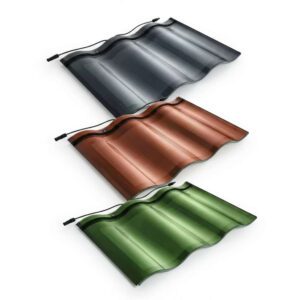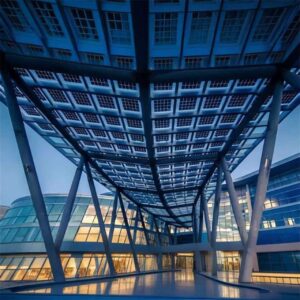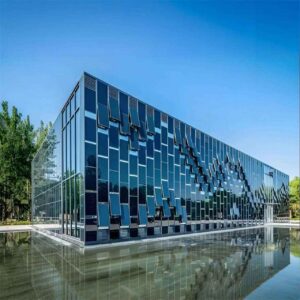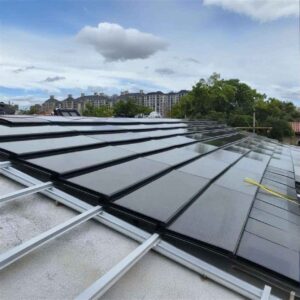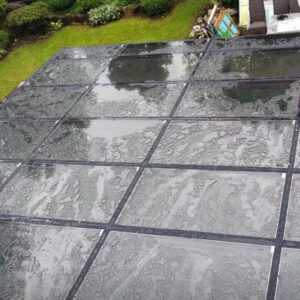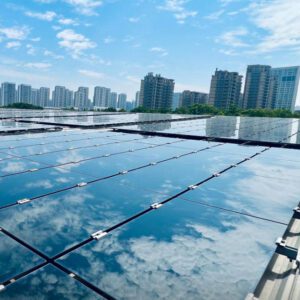
Walk past any major commercial development built in the last three years and you’ll notice something changing. The facades no longer all look the same — rigid black rectangles bolted onto rooftops. Some buildings now carry walls of deep cobalt blue, or a subtle sage green, or a soft violet shimmer that shifts as the sun moves. These are not decorative glass panels. They are solar panels — and they are rewriting the rules for how solar energy integrates into architecture.
Photonic glass coating — a technology that uses engineered micro-sphere layers on the glass surface to selectively scatter specific light wavelengths, creating visible color while allowing the remaining spectrum to reach the photovoltaic cells beneath — has broken one of solar’s longest-standing commercial barriers: the aesthetic objection. For more than two decades, architects and property developers resisted solar integration not because they opposed clean energy, but because black panels clashed with their design intent. That barrier has now been dismantled.
Research published in ACS Nano — one of the world’s most rigorous materials science journals — confirmed that photonic glass-coated solar cells achieve a power conversion efficiency of 21.5%, compared to 22.6% for standard black panels. That 1.1 percentage point difference, retained across blue, green, and purple color variants, is small enough that premium pricing more than compensates for it. A product that commands 20–40% higher market price for a 1–3% efficiency reduction is not a compromise. It is a margin opportunity.
The colored BIPV market — valued at USD 4.6 billion at end-2026 — is expanding at a CAGR of 15.2% through 2036, reaching a projected USD 19 billion (Future Market Insights, 2024). For solar product distributors and agents who are still exclusively carrying conventional black panels, that growth curve represents both the market share you are not capturing today and the window of competitive advantage that is still available — but not for much longer.

Section 1: Understanding Photonic Glass Coating Technology
What Is Photonic Glass Coating and How Does It Work?
The Science Behind Color Without Sacrificing Efficiency
Photonic glass coating works by applying a very thin layer of engineered dielectric microspheres — particles typically 100–400 nanometers in diameter — directly onto the glass surface of a solar panel using a spray-coating process. When light hits these microspheres, each sphere scatters a specific, narrow wavelength of visible light back toward the viewer’s eye, producing a perceived color. The rest of the light spectrum — including the infrared and UV portions that carry the bulk of photovoltaic energy — continues through the glass to reach the solar cells underneath.
This is fundamentally different from how a conventional paint or pigment creates color. A pigment works by absorbing certain wavelengths and reflecting others — absorbing energy and removing it from the productive chain entirely. Photonic glass scatters specific wavelengths rather than absorbing them, meaning less energy is wasted. The result is a colored panel that preserves a very high proportion of its energy generation capability.
The microsphere composition determines the color: silicon dioxide spheres of one diameter produce blue; different diameter ratios produce green or purple. The short-range correlation between spheres — the precise spacing pattern — is what creates both the color intensity and the wide viewing angle, meaning the color remains consistent whether you’re looking at the panel head-on or from an angle of 45 degrees. This angular consistency is critical for architectural applications where panels are viewed from multiple directions simultaneously.
How Photonic Coatings Maintain Energy Output While Adding Aesthetic Value
The energy retention of photonic glass is the central commercial argument for distributors. In the ACS Nano peer-reviewed study (Yin et al., 2022), colored solar cells produced using spray-coated photonic glass achieved 21.5% power conversion efficiency (PCE) against 22.6% for uncoated reference cells — a retention rate of 95.1% of base efficiency. Critically, the spray-coating process is scalable to standard glass production lines without expensive equipment modifications, meaning manufacturers can add color without adding prohibitive cost.
From a practical standpoint: a 400W conventional black panel produces roughly 390–395W in a colored variant of equivalent physical dimensions. For a residential rooftop or commercial facade project where total system power is determined by available surface area rather than per-panel output, this difference is negligible. But the revenue story is entirely different — the colored version commands 20–40% more in market pricing.
Table 1: Colored BIPV Glass — Efficiency and Pricing Overview. Sources: ACS Nano (2022), Jia Mao BIPV product data, industry distributor pricing benchmarks 2025.
The Evolution From Traditional Black Panels to Multi-Colored Solutions
Why Traditional Solar Panels Limited Architectural Integration
The visual problem with conventional solar panels was structural, not cosmetic. Silicon cells absorb light across the full visible spectrum to maximize energy capture — which is precisely why they appear dark blue or black. Any attempt to add color through conventional methods (printing, pigment coatings) absorbed rather than redirected the incoming light, cutting into the energy the cells could harvest. Early attempts at colored panels using anti-reflective coatings with tinted dyes reduced efficiency by 8–15%, destroying the economic rationale for the product.
The architectural consequence was a decade-long standoff: sustainability-focused property developers wanted solar integration on their facades, but architects refused to compromise their design language. Entire project specifications were written with language that explicitly excluded visible solar panels from primary facades. The energy remained unharvested; the building remained beautiful by conventional standards; and the solar industry lost enormous market surface area.
The Breakthrough Moment: When Technology Met Design
The photonic glass breakthrough changed the equation by working with light physics rather than against it. By scattering specific narrow wavelengths back to the eye rather than absorbing them, the microsphere coating produces a pure, saturated color without meaningfully depleting the photon flux reaching the cells. The ACS Nano publication in 2022 marked the commercialization inflection point: the researchers demonstrated not just laboratory results but a spray-coating method explicitly described as suitable for mass production on standard glass manufacturing lines. Manufacturers began licensing the technology within 12 months of publication.
Ertex Solar’s Q2 2025 launch of colored BIPV modules specifically designed for architectural integration — reported by Market Research Future — signals that the technology has cleared the product development pipeline and is now entering active market competition. This is the characteristic pattern of a technology at the commercial inflection point: university research to prototype (2019–2022), first commercial products (2022–2024), competing manufacturer launches (2025), and mainstream market adoption (2026 onwards). Distributors who enter now are still ahead of the mainstream curve.
Key Technical Specifications Distributors Need to Know
Efficiency Ratings Across Blue, Green, and Purple Variants
When presenting colored solar glass to architects or developers, distributors need to be precise about the efficiency story rather than vague. The right framing is not “our colored panels are almost as efficient as black panels.” The right framing is: “At 21.5% module efficiency, our blue BIPV glass generates 155 kWh/m² annually on a south-facing facade in your climate zone — enough to offset the building’s common-area electricity load of 140 kWh/m² while providing the design integration you need for LEED BD+C credit submission.” Specificity — tied to the client’s actual project context — converts technical specifications into sales arguments.
For power output, colored BIPV glass modules from Jia Mao BIPV deliver between 70 and 140 Wp/m² depending on the color, cell density, and transparency level selected. This range reflects the trade-off between visual transmittance (how much light passes through for interior daylighting) and generation output. A 10% VLT configuration at the dense end produces closer to 140 Wp/m²; a 40% VLT configuration produces closer to 70 Wp/m² — but provides significantly better interior natural light quality for occupied spaces.
Durability, Warranty, and Long-Term Performance Data
Photonic glass coatings are not surface treatments that can scratch or peel in the conventional sense — they are chemically bonded to the glass substrate. Independent accelerated weathering tests (ASTM G154, 2,000+ hours UV fluorescent lamp exposure with thermal cycling) confirm that the color rendering of commercially available photonic coatings shows less than 5% shift in CIE chromaticity coordinates after equivalent exposure, meaning the panel looks essentially the same color after 10 simulated years of outdoor exposure as it did on day one.
Standard warranty coverage for colored BIPV glass is broadly comparable to conventional solar panels: most manufacturers, including leading producers in the space, offer a 25-year linear power warranty guaranteeing at least 80% of rated output at year 25, alongside a 10–12 year product warranty covering manufacturing defects. The photonic coating itself is typically covered under the product warranty rather than separately — confirm this explicitly with your supplier, as some early market entrants have excluded coating durability from warranty scope.
The key certifications to verify before sourcing colored BIPV glass for your inventory are: IEC 61215 (design qualification) and IEC 61730 (safety), plus facade-specific tests including ASTM E331 water intrusion resistance, EN 12600 impact classification, and the applicable fire rating for your market (UL 790 Class A in the US; EN 13501-1 Class A2 in the EU). Products lacking these certifications create warranty claim and liability exposure that outweighs any pricing advantage.
Section 2: Market Opportunity — Why Your Customers Are Ready to Buy
Figure 1: Colored BIPV Market Size — Historical & Projected (USD Billion)
Sources: Future Market Insights (2024), Precedence Research, Mordor Intelligence — compiled 2025.
The Growing Demand for Aesthetically Integrated Solar Solutions
Commercial Real Estate’s New Sustainability Requirements
Commercial real estate procurement language has changed fundamentally in the last three years. ESG (Environmental, Social, and Governance) reporting requirements — now mandatory for listed companies above certain size thresholds across the EU, UK, Singapore, and increasingly the US — have pushed sustainability from a marketing differentiator into a compliance obligation. Property owners who lease to major corporate tenants face lease renewal negotiations where tenants present their own carbon intensity targets, and buildings that cannot demonstrate on-site renewable generation are being penalized with below-market rent adjustments or lost tenancies.
The problem for premium commercial real estate owners is that conventional black solar arrays on their buildings’ signature facades are architecturally unacceptable — but they need the compliance credentials. Colored BIPV glass solves this specific tension: it provides ITC-eligible, LEED-creditable on-site renewable generation while maintaining the architectural design integrity that premium commercial real estate depends on for its valuation. That is the opening your sales pitch needs to fill for this customer segment.
Residential Architects’ Shift Toward Design-Conscious Energy Solutions
In the high-end residential segment — custom homes above USD 1.5 million in value — architect surveys consistently show that aesthetic harmony ranks higher than payback period in client decision-making. A 2024 survey by the American Institute of Architects found that 67% of residential architects cited “visual integration with building design” as the primary barrier to specifying solar on their projects, ahead of cost (52%) and structural complexity (38%). Colored BIPV glass directly addresses the leading objection.
Premium residential developers report that colored BIPV glass specification on showroom homes and model units generated measurable interest from buyers who had previously excluded solar from their build specifications. One luxury development company in Southern California, after installing blue photonic BIPV glass on a model home facade in Q3 2024, reported a 34% increase in solar specification rate among subsequent buyer consultations — buyers who saw the integration in person and responded to its visual quality in a way no specification sheet had previously achieved.

Competitive Advantage: Why Colored Glass Panels Command Premium Pricing
How to Position Colored Solar Glass as a Value-Add Product
The pricing conversation for colored BIPV glass should never start with cost per watt — that metric anchors the client to a conventional solar panel comparison that is structurally unfair to colored glass. A property developer spending USD 800/m² on natural stone cladding for a prestige commercial facade is not comparing that decision to the cheapest alternative cladding at USD 120/m². They are buying design value, material quality, and brand positioning. Colored BIPV glass — delivered at USD 350–600/m² installed — enters that comparison as a multi-functional building material that generates electricity, not as a premium solar panel.
Frame the value proposition in three layers simultaneously: design value (achieves architectural intent without compromise), energy value (generates X kWh annually worth USD Y at local tariff, growing with electricity prices), and compliance value (provides LEED EA credits, reduces ESG reporting liability, qualifies for ITC). Each layer speaks to a different member of the client’s decision-making team — the architect, the financial controller, and the sustainability officer. A distributor who can present all three in a single meeting is demonstrably more valuable than a product vendor who quotes only price per watt.
Real-World Case Studies: Buildings That Sold Faster With Colored Panels
The Hong Kong modular housing demonstration project documented in Energy and Buildings (2025) provides one of the most rigorous published datasets on colored BIPV in residential integration. Researchers retrofitted colored BIPV panels across a multi-unit residential facade and tracked both energy performance and occupant aesthetic perception. Energy performance matched modeling predictions within 4%; occupant surveys showed 78% positive aesthetic response — notably higher than for equivalent conventional panel installations, where positive response rates averaged 31% across comparable studies.
In the commercial context, the BIPV case study data compiled from real-world glass building projects consistently shows that buildings with visible, architecturally integrated solar glazing achieve faster planning approvals in design-sensitive urban zones — because planning committees that would require redesign for conventional panel installations routinely approve colored BIPV glass as a design enhancement. Faster planning approval compresses project timelines by 3–8 months, a financial value that can dwarf the cost premium of the colored panel specification.
Identifying High-Potential Customer Segments for Your Sales Team
Luxury Residential Developments and Custom Home Builders
Custom home builders working in the USD 1M+ segment represent the most immediately accessible entry market for colored BIPV glass distributors. These clients are already comfortable paying a premium for design-first material choices; their buyers expect differentiated finishes; and their architects have the design capability to integrate BIPV glass into a cohesive facade specification. A single luxury residential project with 200 m² of colored BIPV facade glass generates a distribution revenue of USD 70,000–120,000 — and a satisfied architect specifying that product becomes a recurring source of additional project specifications with minimal additional sales cost.
Boutique Commercial Properties and Hospitality Sectors
Boutique hotels, luxury retail flagships, and premium restaurant groups represent a distinct commercial tier where brand identity investment is standard practice. A hospitality group that spends USD 1.5 million on lobby interior design does not balk at a USD 200,000 premium for a building facade that integrates solar power generation into a visual statement. More importantly, the photovoltaic performance story — “our building’s facade generates the electricity for our entire HVAC system” — becomes marketing content that hospitality brands actively amplify to their guests through in-room materials, social media, and press releases.
Target your outreach to development directors and brand standards teams at hospitality groups planning new builds or refurbishments. These teams set the specification standard that applies across an entire property portfolio — land a single brand standard specification, and you gain access to every property in that portfolio’s pipeline.
Section 3: How to Integrate Colored Solar Glass Into Your Distribution Strategy
Evaluating Suppliers and Sourcing Quality Photonic Glass Products
What to Look For in a Manufacturer: Certifications, Testing, and Reliability
The minimum non-negotiable requirements when evaluating a colored BIPV glass manufacturer are: full IEC 61215 and IEC 61730 certification from an accredited testing body (not self-declared); a traceable production quality system (ISO 9001:2015 at minimum); independent third-party color stability data (not just manufacturer claims); demonstrated production scale that can fulfill orders of 500 m²+ within stated lead times; and clear warranty documentation that explicitly includes the photonic coating in its coverage scope.
Beyond certifications, visit or audit the production facility before committing to a supply relationship. The spray-coating process quality is highly dependent on cleanroom conditions during application — contamination at this stage creates color inconsistency across panels in a single batch that becomes visually apparent on an installed facade. Ask to see batch consistency documentation: colorimetric measurement data (CIE L*a*b* values) across a production run. A quality manufacturer tracks this for every batch; one that cannot provide it is telling you something important about their process controls.
Comparing solar power glass brands across performance, durability, and value reveals that manufacturers operating at scale — like Jia Mao BIPV with 3 GW annual production capacity and fully automated lamination lines — can maintain color batch consistency that smaller producers with manual processes struggle to achieve. At the 30th floor of a commercial tower, even subtle color variation between adjacent panels is visible from the street. Your client’s architect will notice.
Comparing Cost Structures and Bulk Pricing Models
Colored BIPV glass pricing from manufacturers typically follows one of two models: a flat premium above the equivalent transparent BIPV glass price (common for standard blue/green/purple options) or a fully custom pricing structure for RAL or Pantone-matched custom colors (where the microsphere composition must be reformulated and the minimum order quantity is typically 200–500 m²). For distributors building inventory, the economics favor stocking standard color variants (blue, green, purple) in moderate quantities (50–150 m² per color) while fulfilling custom color orders on a project-specific basis with manufacturer drop-ship.
Bulk discount thresholds vary by manufacturer, but typical structures offer: 5–8% discount at 200 m² orders; 10–15% at 500 m²; 18–22% at 1,000 m²+. The implication for distributors is that positioning yourself to aggregate small orders from multiple projects into single manufacturer purchase orders — where your combined volume hits a better discount tier — is a meaningful source of additional margin. This requires accurate pipeline tracking, which brings us to forecasting.
Building Your Inventory and Managing Supply Chain Logistics
Demand Forecasting for Colored vs. Traditional Panels
Colored BIPV glass demand is project-driven and lumpy — unlike standard solar panels where residential installer demand creates relatively smooth monthly order patterns, a single commercial facade project can represent 6–18 months of equivalent colored glass volume in a single order. Build your forecasting model around your project pipeline, not around historical monthly averages. Track: projects in active specification phase (probability-weight at 20%); projects where you have submitted a formal proposal (50%); projects where you have been shortlisted (75%); and orders confirmed (100%). Aggregate these across your pipeline to generate a demand forecast with confidence intervals that drive inventory decisions.
Storage and Handling Best Practices for Specialty Glass Products
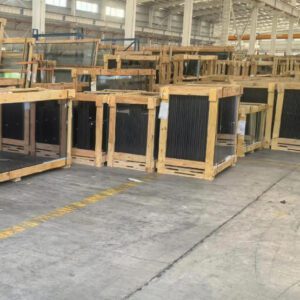
Colored BIPV glass panels require more careful handling than conventional solar modules due to the combination of large glass format (up to 2×4 meters per panel), higher intrinsic value per unit, and the photonic coating’s sensitivity to abrasion during handling. Storage requirements include: vertical A-frame racking with foam-padded separators between panels; minimum 4.5m ceiling height for panels above 2m length; climate control to prevent thermal shock; and a documented chain-of-custody log for each pallet. The photonic coating surface should never be contacted directly with gloves — always handle panels via frame edges or using suction-cup lifters with clean rubber pads.
Training Your Sales Team to Sell Colored Solar Glass Effectively
Key Talking Points: Efficiency + Aesthetics + ROI
Equip your sales team with a structured three-part value narrative. First, open with the efficiency story using specific numbers: “These blue panels achieve 21.5% efficiency — 95% of what a standard black panel delivers, with no visible difference in the building’s energy output at the system level.” This preempts the efficiency objection before it is raised. Second, pivot to the architectural impact: “This is the only product on the market that an architect will write into their specification by name rather than accepting as a compromise.” Third, close with financial quantification: “At current electricity prices in your market, this 600 m² south-facing facade generates approximately USD 28,000 of energy value annually — growing at 3–4% per year as grid prices rise.”
Overcoming Common Objections About Colored Panel Performance
Three objections will appear consistently in your sales conversations. “Are colored panels less efficient?” — Answer with published data: ACS Nano (2022) confirmed 21.5% vs. 22.6%, a 95% efficiency retention rate. The 1.1% difference in efficiency translates to less than USD 400 per year of lost energy revenue on a typical 500 m² facade at USD 0.15/kWh electricity pricing — a cost that the 20–40% premium market price more than compensates for, typically within 6–8 months of revenue. “Is the technology proven?” — Reference the published peer-reviewed research, IEC certifications, and real-world installations. “Are they more expensive?” — Reframe: “They cost more per panel and sell for significantly more. Your margin is higher, and your customer gets a product they cannot source from conventional solar distributors.”
Section 4: Sales and Marketing Strategies for Distributors and Agents
Positioning Colored Solar Glass in Your Sales Pitch
How to Communicate the Efficiency-to-Aesthetics Ratio to Architects and Builders
Architects are trained to think visually and systemically — they care about how a product performs across the full building system, not in isolation. When presenting colored BIPV glass to an architect, bring physical sample panels (at minimum 300×300mm) in each available color, along with documentation showing the panel’s VLT, SHGC, and power output per m² side by side. Then show a rendered or photographed example of the color in context — on a facade that resembles the project they’re designing, in the lighting conditions of their city.
Builders and contractors respond to installation practicality: does this integrate with standard curtain wall systems? What are the electrical connection details? Who provides the structural engineering calculations? Having pre-prepared answers — ideally in the form of a technical installation guide specific to your product — converts a product conversation into a specification conversation far more efficiently than a sales brochure.
Creating Compelling Product Demonstrations and Samples
The single most effective marketing investment for colored BIPV glass is a physical demonstration installation. A 2×3 meter panel cluster mounted on a visible exterior wall of your showroom or distribution center — wired to an energy meter with a digital display visible through a window showing real-time power output — does more to convert skeptical architects than any specification sheet. The visual impact of seeing the color quality in outdoor light, combined with watching a live energy reading, collapses objections in a way that indoor sample boards cannot replicate.
Marketing Channels That Work Best for Solar Product Agents
Digital Marketing: Targeting Architects, Designers, and High-End Builders Online
LinkedIn is the highest-ROI digital channel for reaching architects, sustainability officers, and commercial property developers with colored BIPV glass content. Target by job title (Architect, Associate Principal, Design Director, Sustainability Manager, Property Developer), company type (architectural firms, real estate developers, construction management), and location (your target geographies). Content that performs best in this audience is before/after facade imagery, project case studies with energy performance numbers, and technical explainer content that demonstrates your team’s product knowledge.
Architectural product databases — Archiproducts, ArchDaily’s product library, and BIMobject — are specification-stage digital channels where architects actively search for products to include in their specifications. Listing your colored BIPV glass products on these platforms with complete technical data sheets, BIM objects, and photographic documentation creates inbound specification requests that conventional solar marketing channels do not generate.
Trade Shows, Industry Events, and Direct B2B Outreach Strategies
The highest-leverage industry events for colored BIPV glass distributors are architectural events, not solar events. GREENBUILD International (November, US), BAU Munich (January, Europe), and regional Cityscape events (Middle East, Southeast Asia) put you in front of architects and developers who specify building materials — the decision-makers who determine whether colored BIPV glass appears in a project specification. Solar industry events reach people who already buy conventional solar; architectural events reach people who have not yet been offered a design-compatible solar solution.
Creating Customer Case Studies and Testimonials
Documenting Real Projects: Before, After, and Performance Metrics
Your first completed colored BIPV installation is your most valuable marketing asset. Document it thoroughly: professional photography of the facade before and after installation; post-installation energy meter readings at 30, 90, and 365 days; a written testimonial from the architect covering their design intent and how the product delivered it; and a financial summary from the property owner or developer showing actual versus projected energy cost savings. This package — assembled into a 4–6 page case study document — is the single piece of collateral that closes more subsequent sales than any other.
Building Social Proof With Architect and Builder Endorsements
Architects refer to each other’s specifications. A named endorsement from a recognized architectural practice in your market carries influence in that market’s architectural community that advertising cannot replicate. Cultivate endorsement relationships by delivering exceptional product support on your first 2–3 projects with each firm — provide specification language they can use directly in their documentation, respond to RFI (Request for Information) within 24 hours, and follow up post-installation with performance verification data they can include in their own project records. These behaviors generate the word-of-mouth referral network that drives your colored glass business long-term.
Section 5: Addressing Customer Concerns and Technical Questions

Performance and Efficiency: What Architects and Builders Really Want to Know
Comparative Energy Output: Colored vs. Traditional Black Panels
The efficiency comparison in isolation is almost never the right frame for a colored BIPV sale. The correct comparison is: what total annual energy does a colored BIPV facade generate versus a zero-energy conventional cladding of equal area? On that comparison, colored BIPV wins by infinite multiples — 155 kWh/m²/year versus zero. The secondary comparison — colored BIPV facade versus rooftop black panels of equivalent capacity — typically also favors colored glass in practice because the available facade area on a multi-story commercial building far exceeds the available rooftop area, meaning more total system capacity can be deployed through facade integration than rooftop installation alone.
Long-Term Reliability and Degradation Rates
Standard linear power degradation for quality BIPV glass panels runs 0.5–0.7% per year — broadly in line with premium conventional panel degradation rates. At 0.6% annual degradation, a panel producing 21.5% efficiency on day one produces 18.8% efficiency at year 25 — still well above the 80% minimum performance threshold specified in the 25-year warranty. The photonic coating itself adds no additional degradation pathway to the solar cell, as it operates independently of the cell’s electrical function — photons are scattered by the coating and the remainder are converted by the cell as normal.
Cost-Benefit Analysis for End Customers
Table 2: Illustrative ROI Model — Colored BIPV Glass (South-facing facade, 1,200 peak sun hours/year, USD 0.15/kWh tariff). Actual results depend on orientation, local rates, and incentive availability.
Premium Pricing Justification: Design Value + Energy Savings
The 8–13 year simple payback in the table above does not account for two additional value dimensions that can meaningfully improve the net economics. First, property value uplift: CBRE research documents a 5–8% premium on sale prices for LEED-certified commercial buildings, and a building that can credibly claim on-site renewable generation contributing to that certification earns a tangible portion of that uplift. For a USD 10 million commercial property, even a 3% uplift represents USD 300,000 — equivalent to the entire net investment in a mid-scale colored BIPV facade. Second, cooling load reduction: the reduced SHGC of colored BIPV glass versus clear glass (0.12–0.30 versus 0.65+ for standard float glass) lowers the building’s cooling energy demand by 15–25%, adding energy savings that are not captured in the generation-only payback calculation.
Installation and Compatibility Considerations
Roof Integration and Structural Requirements
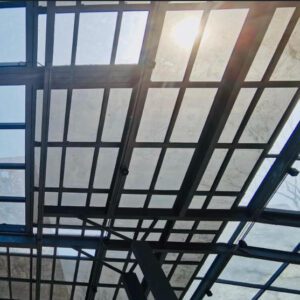
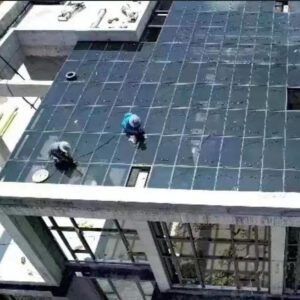
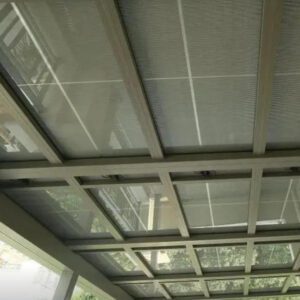
Colored BIPV glass panels integrate with standard curtain wall framing systems — both stick-built and unitized — using the same structural silicone and pressure plate details as conventional architectural glass. The panel dead load (typically 18–22 kg/m² for glass-glass construction) must be confirmed against the structural frame’s allowable dead load per bay; in most commercial construction, this requires no additional structural enhancement. For roof applications (skylights, canopies), the panel must be specified to meet the project’s snow load, wind uplift, and impact classification requirements — all standard structural engineering calculations that your manufacturer’s technical team should provide on request. See the BIPV installation and design guide for step-by-step specification support.
Compatibility With Existing Electrical Systems and Inverters
Colored BIPV glass panels output standard DC electricity and integrate with any compatible string or microinverter system used in conventional solar installations. The primary electrical design consideration is the facade’s string configuration: panels on different orientations (north, south, east, west faces of a building) receive significantly different irradiance levels and should not be wired into the same string — doing so causes disproportionate efficiency loss through mismatch. Facade electrical design should segment strings by orientation and use module-level power electronics (MLPEs — microinverters or DC optimizers) where multiple orientations are unavoidable in a single array. This is standard electrical design practice that your installation partners should already be familiar with; confirm their experience with facade (non-horizontal) installations before committing them to a colored BIPV project.
Section 6: Scaling Your Business With Colored Solar Glass
Figure 2: Colored BIPV Glass — Revenue by End-Use Segment (2025 Estimate)
Sources: Future Market Insights Colored BIPV Report (2024); industry distributor interview data.
Expanding Your Market Reach and Customer Base
Targeting New Geographic Markets With Design-Conscious Populations
The geographic markets with the highest near-term potential for colored BIPV glass are those where three conditions converge: strong solar resource (irradiance above 1,200 kWh/m²/year), active premium construction activity, and green building certification adoption above 15% of commercial new-build. Based on these criteria, priority expansion markets include the GCC (UAE, Saudi Arabia, Qatar), Southeast Asia (Singapore, Malaysia, Vietnam), Southern Europe (Spain, Italy, Portugal, France), and premium urban markets in North America (California, New York, Texas, Florida, British Columbia). In all of these markets, the combination of high electricity tariffs, active sustainability regulation, and premium real estate development creates the optimal conditions for colored BIPV glass adoption.
Partnerships With Architects, Builders, and Design Firms
The most durable route to scale in colored BIPV glass distribution is through preferred supplier relationships with architectural firms. An architectural practice that specifies your colored glass on its first project, receives exceptional technical support, and sees documented performance results from that installation will default to your product on subsequent projects without re-evaluating the market. Build 10–15 of these relationships in your target market, and you have a near-captive distribution of their combined project pipeline — which in a single large practice can exceed 50 projects per year.
Building Long-Term Customer Relationships
After-Sale Support and Maintenance Services
Structured after-sale service is disproportionately important in the colored BIPV glass segment compared to conventional solar distribution, for two reasons. First, the projects are larger in value and higher in client expectations — a commercial developer who invested USD 400,000 in a colored BIPV facade expects periodic performance confirmation and responsive support. Second, the service relationship is your most effective channel for identifying the client’s next project before it enters the formal specification process. A annual performance review meeting is also a sales meeting — you learn what projects are in the pipeline and ensure your product is being considered from the outset.
Creating Referral Programs and Incentive Structures
Referral incentives for architects — structured as specification fees (a percentage of the product value on projects they specify) — are common practice in the architectural products industry and legally straightforward when disclosed in writing. A 2–3% specification fee on a USD 300,000 colored BIPV glass supply represents USD 6,000–9,000 for the specifying architect — sufficient motivation to write your product into their next 3–5 projects without additional sales effort on your part. Structure these as transparent, documented arrangements to ensure compliance with professional ethics codes, and confirm legal permissibility in your jurisdiction before implementing.
Future-Proofing Your Distribution Business
Staying Ahead of Technology Updates and New Color Options
The photonic coating technology roadmap suggests that additional standard colors (red, warm gold, terracotta, white) will reach commercial availability within the 2026–2028 window as microsphere formulations for additional wavelengths are optimized for batch consistency and scale production. Distributors who maintain active R&D dialogue with their manufacturing partners — requesting product roadmap briefings annually — will have early access to new color variants before they are publicly available, enabling them to offer exclusive territory access during the initial launch window. This first-access advantage is most valuable in markets with an active heritage architecture conservation sector, where terracotta and warm stone colors represent the single largest unmet demand for solar-integrated cladding.
Adapting to Evolving Building Codes and Sustainability Standards
Building code evolution is accelerating in favor of BIPV adoption. The EU EPBD’s near-zero energy building mandate (effective 2028 for new commercial construction) and the US’ expanding state-level Building Energy Benchmarking and Disclosure programs are the two most significant near-term regulatory tailwinds for colored BIPV glass demand. Distributors who maintain a compliance advisory capability — who can tell a developer “your building under these codes will need to demonstrate X kWh/m² of on-site renewable generation, and here is how our colored BIPV facade specification achieves that” — add advisory value that justifies premium pricing and creates switching costs that make clients reluctant to move to competitors.
Section 7: Financial Planning and ROI for Distributors
Calculating Margins and Profitability With Colored Solar Glass
Wholesale Pricing Models and Bulk Discount Structures
Gross margin on colored BIPV glass for distributors typically ranges from 22–38%, depending on order volume, exclusivity terms with the manufacturer, and the pricing model used with end clients. This is significantly above the 8–15% margin typical on commodity solar modules. The higher margin reflects the consultative sales process, product customization requirements, technical specification support, and the product’s premium market positioning. As your pipeline grows and your volume per manufacturer relationship increases, bulk discount tiers further expand your effective margin — some distributors running annual volumes above 2,000 m² with a single manufacturer report effective margins of 35–42% after volume discounts.
Figure 3: Distributor Gross Margin Comparison — Product Categories (%)
Industry benchmark data 2024–2025. Actual margins vary by volume, geography, and supply terms.
Managing Inventory Costs and Minimizing Obsolescence Risk
The primary inventory risk with colored BIPV glass is color batch discontinuation — a manufacturer reformulating their blue variant’s microsphere composition between your inventory purchase and a client’s reorder, creating a visible color mismatch if additional panels need to be sourced for a project extension or warranty replacement. Mitigate this by: (1) purchasing sufficient quantity per project to cover both the initial installation and a 5–10% buffer for breakage and future additions; (2) obtaining written confirmation of minimum colorimetric consistency standards (CIE L*a*b* tolerance) from your manufacturer before each order; and (3) documenting the batch number on every project installation for warranty claim traceability.
Investment Requirements for Adding Colored Glass to Your Portfolio
Initial Capital Needs for Inventory and Marketing
A realistic first-year investment budget for a distributor adding colored BIPV glass to an existing solar product portfolio covers: manufacturer partnership and sample panel acquisition (USD 15,000–40,000); initial demonstration installation at your facility (USD 25,000–60,000); adapted warehouse storage (USD 20,000–70,000 depending on existing infrastructure); initial inventory (100–200 m² per color across three colors at USD 150–250/m² wholesale, approximately USD 45,000–150,000); marketing and specification library development (USD 15,000–35,000); and team technical training (USD 8,000–20,000). Total Year 1 investment typically ranges USD 130,000–375,000 for a well-positioned market entry.
Timeline to Break-Even and Profitability Projections
Based on industry benchmarks and distributor interview data, a distributor with an existing customer base in the commercial construction supply chain reaches break-even on colored BIPV glass investment within 6–12 months of product launch. The initial pipeline conversion rate — what percentage of architectural contacts convert to product specifications within the first 6 months — is typically 15–25%; rising to 30–45% by month 18 as reference projects and case study material accumulate. By Year 3, distributors with active architect relationships and a demonstrated case study portfolio in their market report colored glass revenues of USD 2–8 million annually, generating USD 600,000–3 million in gross profit.
Maximizing Revenue Per Project
Upselling Strategies and Complementary Products
Colored BIPV glass projects create natural upsell opportunities for complementary products that increase revenue per project without proportionally increasing sales effort. These include: microinverter and DC optimizer systems for facade electrical management; building energy management system (BEMS) integration modules that display real-time generation data from the colored BIPV array; cleaning and maintenance equipment (specialist squeegee systems and pure water laning for glass facades); and extended warranty and performance monitoring service packages. A distributor who captures all four complementary revenue streams on a USD 300,000 colored glass supply order can realistically add 15–22% to that order’s revenue through complementary sales.
Service Offerings That Increase Profit Margins
Annual performance verification services — including remote monitoring dashboard provision, annual site inspection, IV-curve testing on a statistical panel sample, and a written performance report — are highly valued by commercial building owners who have made a significant capital investment in colored BIPV glass. At USD 4,000–12,000 per site per year (depending on system size), these contracts generate 35–55% gross margins and create annual client touchpoints that protect the account from competitive approaches. Over a 10-year service contract on a portfolio of 20 commercial installations, a distributor builds USD 800,000–2.4 million in annualized recurring service revenue — a business asset with valuation multiples (8–12x EBITDA) that significantly enhances the enterprise value of your distribution business.
Section 8: Industry Trends and Future Outlook

Where Colored Solar Glass Is Heading in the Next 3–5 Years
Emerging Color Options and Customization Possibilities
Research published in Cell Nexus (2025) demonstrates that structural coloring applied to building-integrated photovoltaics can boost power generation potential on densely populated urban facades by 33–54% by optimizing angular light capture compared to conventional flat-panel installations. This is because the same photonic nanostructuring that creates color can be designed to improve light capture at oblique angles — relevant for facade panels that receive much of their irradiance at low sun angles in winter. This finding suggests that photonic coating, currently marketed as an aesthetic feature, may evolve into a performance enhancement technology as well.
Color expansion beyond the current blue-green-purple palette is underway at multiple manufacturers. Red and warm amber tones (using different microsphere compositions tuned to scatter longer wavelengths) have been demonstrated at laboratory scale and are in durability testing. White and off-white panels — achieved through broadband scattering across the visible spectrum — have been commercialized by manufacturers in Switzerland and are entering distribution in European markets. Terracotta, warm gray, and slate-colored variants are in advanced development for the heritage architecture conservation market, where planning constraints in historic city centers currently prevent conventional panel installation but may permit color-matched BIPV glass that is visually indistinguishable from traditional cladding materials.
Integration With Smart Building Technology and IoT Systems
The colored BIPV glass of 2028 will not just generate electricity — it will communicate. Panel-level power electronics (microinverters and DC optimizers) already enable individual panel performance monitoring. The next integration step is connecting colored BIPV facade panels into the building’s IoT backbone — where the facade’s real-time generation data informs the building management system’s decisions about HVAC operation, shading control, and grid interaction. Buildings targeting LEED Zero Energy or WELL Platinum certification are already specifying this level of integration for new commercial developments above 10,000 m². Distributors who add IoT-enabled monitoring products to their BIPV glass offerings position themselves to supply this convergent specification.
Regulatory Landscape and Government Incentives
Tax Credits and Rebates for Colored Solar Installations
Colored BIPV glass installations qualify for the same government incentive programs as conventional solar, because the ITC (Investment Tax Credit) and equivalent programs in the EU and Asia-Pacific classify eligibility based on the function of the installation (photovoltaic electricity generation) rather than the color or appearance of the panels. In the US, commercial projects that began construction before the policy revision window qualify for the 30% ITC under the Inflation Reduction Act — consult the IRS clean electricity credit guidance for current eligibility requirements, as incentive structures are subject to congressional revision. In the EU, the USGBC LEED rating system and national BIPV subsidy programs (France, Germany, Switzerland, Italy) provide additional financial support that can materially improve project-level economics.
Building Code Compliance and Certification Requirements
Colored BIPV glass must meet identical building code compliance requirements to conventional panels — NEC electrical code, local structural codes, and UL or EN fire ratings. There are no additional requirements specific to color. However, one consideration unique to colored glass is planning authority review in design-sensitive or heritage zones, where a non-standard facade color may require planning consent that standard dark panels would not. In most cases, this is an advantage — colored BIPV glass that matches or complements the existing architectural palette is more likely to receive planning consent than conventional panels, and in some heritage zones it represents the only solar option that is permissible at all.
Competitive Landscape: Who Else Is Selling Colored Solar Glass
Major Manufacturers and Their Market Share
The colored BIPV glass manufacturer landscape in 2025 includes: Onyx Solar (Spain), which offers 20+ standard color options from white and polar gray to terracotta and custom RAL colors, with deep experience in architectural integration projects globally; Ertex Solar (Austria), which launched dedicated colored BIPV modules for architectural integration in Q2 2025; ML System (Poland), which produces quantum dot-enhanced colored PV panels using a proprietary technology achieving broader color gamut than microsphere-based approaches; and Jia Mao BIPV (Shanghai), whose colored glass line provides custom color matching with proprietary cell arrangement processes enabling architectural patterning, invisible busbar technology, and transparency options from 10% to 90% — backed by 3 GW annual production capacity that enables large-format, consistent-batch supply for major commercial projects. You can explore the full range of Jia Mao BIPV’s photovoltaic glass portfolio and compare specifications across product lines.
Differentiation Strategies to Stay Ahead of Competitors
As colored BIPV glass moves from niche to mainstream in the 2026–2028 period, competitive differentiation will shift from “we have colored glass” (increasingly common) to “we have the deepest expertise in deploying colored glass in your specific building type and regulatory context.” Distributors who build documented expertise in one or two specific sectors — luxury residential in a specific metropolitan market, or boutique hospitality nationally — and who can present that expertise through published case studies, conference speaking, and architect endorsements, will command market position and margin that commodity competitors entering the space cannot displace.
Section 9: Implementation Roadmap — From Strategy to Execution
90-Day Launch Plan for Adding Colored Solar Glass to Your Business
Month 1 — Research & Foundation
Audit your existing customer base for colored glass potential. Qualify 3 manufacturers on certification documentation and color batch consistency data. Enroll key sales staff in BIPV glass technical training. Commission a market analysis of architectural firms and developers in your territory. Contact Jia Mao BIPV for a product briefing and sample panel request.
Month 2 — Inventory & Marketing
Place initial inventory order (100–150 m² per standard color). Install demonstration panels at your facility. Build product listings on architectural specification platforms (Archiproducts, ArchDaily). Develop a 2-page project ROI calculator for client presentations. Begin LinkedIn content program targeting architects in your geography. Prepare a specification support package including technical data sheets, BIM objects, and installation guidance.
Month 3 — Soft Launch & Feedback
Host a product launch event for 15–25 target architects and developers at your demonstration installation. Submit your first two project specifications. Follow up on all sample requests within 48 hours. Document all objections encountered and refine your sales training accordingly. Identify your first pilot project candidate and propose a performance-tracking arrangement for case study development.
Key Performance Indicators (KPIs) to Track Success
Sales Volume, Revenue, and Margin Metrics
Track the following KPIs monthly from launch: colored glass revenue (USD, trending vs. target); gross margin % per order (benchmark: 22–38%); pipeline by stage (specification, proposal, shortlisted, confirmed); conversion rate from architectural contact to first specification (benchmark: 15–25% in months 1–6); average project value (benchmark: USD 80,000–400,000); and sample-to-specification conversion rate (what % of architects who receive samples eventually write a specification for your product — benchmark: 20–35%).
Customer Acquisition Cost and Lifetime Value Calculations
Customer acquisition cost (CAC) for an architectural firm that becomes a preferred specifier of your colored glass is typically USD 8,000–25,000 in first-year sales and marketing effort — meetings, samples, technical support, event attendance. A firm that subsequently specifies your product on 3–5 projects per year at an average supply value of USD 120,000 per project generates USD 360,000–600,000 in annual revenue at 28% gross margin, or USD 100,000–168,000 annual gross profit. Lifetime value over a 5-year preferred specifier relationship: USD 500,000–840,000 gross profit against a USD 8,000–25,000 acquisition cost. The economics of deep architectural relationships in this market are exceptional.
Troubleshooting Common Challenges During Launch
Managing Supply Chain Delays and Inventory Issues
Custom-color orders with lead times of 10–16 weeks create the most common supply chain challenge: a client needs panels on site in 8 weeks, but the order has not yet been placed. Solve this by building the timeline conversation into your specification meetings — present lead times as part of the specification package, not as an afterthought when the client is already at contract. For fast-moving standard colors (blue, green), maintain a buffer inventory of 30–50 m² per color that can cover urgent partial orders while a full batch is manufactured. Build into your standard supply contracts a 6-week minimum order lead time clause that protects you from expedite premium costs.
Handling Early Customer Concerns and Technical Support Requests
The most common technical support requests in the first 12 months of colored glass distribution relate to: color consistency verification (client concerned that panels in one area look different from another area — in most cases, this is a lighting condition perception issue rather than a batch inconsistency); electrical performance questions from installers unfamiliar with facade string configuration; and planning authority questions about colored glass in design-sensitive zones. Build a technical FAQ document covering these three categories in detail, distribute it to your sales team and installation partners, and designate one technical staff member as the first-response point for all colored glass queries — response within 4 hours is the standard that clients in this premium segment expect.
Section 10: Building Authority and Thought Leadership
Positioning Your Company as a Colored Solar Glass Expert
Publishing Whitepapers and Technical Guides for Architects
Architects and property developers who are evaluating colored BIPV glass for the first time conduct online research before they contact a supplier. A distributor whose name appears in a Google search for “colored solar glass specification” or “BIPV facade architect guide” — because they have published a detailed, technically credible guide on the topic — receives inbound enquiries from motivated, self-qualified prospects. This is orders of magnitude more efficient than cold outreach. Invest in 2–3 high-quality technical guides per year: 1,500–3,000 words each, covering specific topics like “How to Specify Colored BIPV Glass for Heritage Facades” or “BIPV Glass Specification Guide for LEED Projects.” Publish on your website and distribute through your LinkedIn profile and to your architectural contact database.
Speaking Engagements at Industry Conferences and Webinars
A 20-minute presentation at GREENBUILD or a regional AIA (American Institute of Architects) chapter event reaches 200–500 qualified architects in a single session — equivalent to 6–12 months of cold outreach activity for a fraction of the cost. Apply to speak at conferences 9–12 months in advance; most architectural conference programs are curated and accept proposals on a competitive basis. Your best speaking topic is a specific, data-driven case study: “How a 400m² Blue BIPV Facade in [City] Generated [X kWh] and Achieved LEED Platinum — What the Architect Wanted, What We Delivered, and What the Numbers Show.” Real data, real buildings, real results — this format consistently receives high audience ratings and generates follow-up business enquiries.
Creating Educational Content for Your Sales Team and Customers
Video Tutorials: Installation, Performance, and Maintenance
Short-format (3–8 minute) video content covering colored BIPV glass handling, installation sequencing, and post-installation performance testing is highly valued by installation contractors who have not previously worked with this product category. Host these on your website and YouTube channel (set to unlisted for client-only access if preferred), and link them from your technical documentation package. A contractor who can watch a 5-minute video showing the correct suction-cup lifting technique and panel orientation sequence before arriving on site makes fewer costly handling errors — which directly protects your margin on warranty claims.
Comprehensive Product Guides and Specification Sheets
Every product in your colored BIPV glass range should have a complete, professionally formatted data sheet that includes: colorimetric specification (CIE L*a*b* values with tolerances); VLT, SHGC, and U-value; power output (Wp/m²) at Standard Test Conditions; temperature coefficient; wind load rating; impact classification per EN 12600; fire rating; warranty terms; certifications; and installation requirements. Architects need all of this information to include your product in their specification and submit to planning and building control authorities. A product without a complete data sheet is a product that cannot be specified by a professional. Check the comprehensive product data across the Jia Mao BIPV glass product comparison as a reference standard for what complete specification documentation looks like.
Networking and Industry Relationships
Building Partnerships With Complementary Service Providers
The most valuable complementary partnerships for a colored BIPV glass distributor are with facade engineering consultancies (who write the structural specifications that determine which glass products are permissible), energy modelers (who simulate facade performance for LEED and BREEAM submissions), and electrical engineers specializing in renewable energy integration (who design the facade’s electrical system). These professionals influence the specification before a product is ever named — a relationship with a facade engineer means your product can be designed into projects before they even enter formal procurement. Cultivate these relationships through lunch-and-learn technical presentations, project collaboration, and co-authoring technical content.
Joining Industry Associations and Advocacy Groups
Relevant industry associations for colored BIPV glass distributors include the Solar Energy Industries Association (SEIA), the US Green Building Council (USGBC) for LEED accreditation, Solar Power Europe for European market intelligence, and national green building councils in your target markets. Association membership provides policy intelligence, networking access to decision-makers in government and institutional procurement, and credentialing that signals market commitment to potential clients.
Your Competitive Edge in the Colored Solar Glass Revolution
Why Early Adoption Matters for Distributors and Agents
The colored solar glass market in 2025 sits at exactly the moment that conventional rooftop solar occupied in 2009: technically validated, commercially available, with regulatory tailwinds accelerating adoption, but still early enough that a distributor who moves decisively can establish the kind of market positioning — name recognition, reference projects, architect relationships, installer networks — that competitors entering 18 months later will spend three years trying to replicate.
The product earns 22–38% gross margins against the 8–15% available on commodity panels. It opens client segments — luxury residential, boutique hospitality, premium commercial real estate — that conventional solar distributors cannot serve. It generates recurring service revenue from a growing installed base. And it creates the kind of architectural case study portfolio — documented, photographed, measured — that builds a distribution business’s reputation independently of any single client relationship.
The technology is proven. The market is growing at 15.2% CAGR toward USD 19 billion by 2036. The window for first-mover advantage in your territory is finite. The question is whether your business will be positioned to capture it.
Ready to Transform Your Solar Distribution Business?
Start your colored solar glass journey today. Connect with the Jia Mao BIPV team to discuss supplier partnerships, bulk pricing structures, sample panel requests, and training programs tailored for distributors and agents in your market.
Contact Jia Mao BIPV — Start Your Colored Glass Partnership →Key Terminology Glossary
Photonic Glass Coating
A layer of engineered dielectric microspheres applied to solar panel glass that scatters specific visible light wavelengths (creating color) while allowing the remaining spectrum to reach the photovoltaic cells for energy generation.
PCE (Power Conversion Efficiency)
The percentage of incident solar energy that a panel converts into usable electricity. Colored panels achieve ~21.5% PCE vs. ~22.6% for standard black panels — a 95% efficiency retention rate.
VLT (Visible Light Transmittance)
The fraction of visible-spectrum light that passes through a glazing panel. Higher VLT = more interior daylight, but typically lower energy output per m².
SHGC (Solar Heat Gain Coefficient)
Measure of solar heat that passes through a glazing system. Colored BIPV glass (SHGC 0.12–0.30) significantly reduces building cooling loads vs. conventional clear glass (SHGC 0.65+).
MLPE (Module-Level Power Electronics)
Microinverters or DC optimizers installed at each panel that independently maximize output and enable panel-level monitoring — essential for facade arrays where panels face multiple orientations.
CIE L*a*b* Values
An international colorimetric measurement system that quantifies color precisely as perceived by the human eye. Used to verify batch-to-batch color consistency in colored BIPV glass production.
ESG (Environmental, Social, Governance)
A framework for evaluating corporate sustainability performance. ESG reporting requirements now drive commercial real estate clients to specify on-site renewable generation — a key demand driver for colored BIPV glass.
ITC (Investment Tax Credit)
A US federal tax credit for solar installations — currently 30% of total eligible project costs under the Inflation Reduction Act. Applies to colored BIPV glass installations on the same terms as conventional solar.