The Science Behind the Transparency: How Solar Panels Generate Power While Letting Light Through
Understanding photovoltaic glass technology and how it revolutionizes energy generation without sacrificing natural light — a comprehensive guide for solar product distributors, agents, and builders.
Why Transparent Solar Technology Matters to Your Business
The solar industry has spent decades optimizing for one thing: maximum power output per panel. The result? Black rectangles that dominate rooftops and cast permanent shadows wherever they’re installed. For years, your clients have had to make a binary choice — solar energy or natural light. That compromise is now over.
Transparent photovoltaic (PV) glass — panels that simultaneously generate electricity and allow visible light to pass through — represents one of the most commercially significant breakthroughs in building-integrated solar. The global Building-Integrated Photovoltaics (BIPV) market was valued at $23.67 billion in 2023 and is projected to reach $250.91 billion by 2035, growing at a compound annual growth rate (CAGR) of over 18%. For distributors, agents, and construction partners, this is not a future opportunity — it is a present-day product category that your clients are actively enquiring about.
The core customer pain point is straightforward: commercial property developers want energy generation without darkened interiors. Greenhouse operators want solar power without sacrificing crop yields. Architects want structures that meet energy codes without compromising their design vision. Transparent solar technology addresses all three simultaneously — and understanding the science behind it is what separates a distributor who can close technical clients from one who loses them to a competitor who can.
This guide is structured specifically for professionals on the supply and distribution side of the solar industry. It explains the physics clearly, provides the data you need for customer conversations, and outlines a strategic framework for positioning transparent solar products in your portfolio — including how Jia Mao BIPV supports distributors with the technical resources and product range to compete in this growing segment.

Section 1: The Fundamentals of Photovoltaic Glass Technology
What Makes Transparent Solar Panels Different
A conventional solar panel works by absorbing as much of the solar spectrum as possible and converting it to electricity. This is why standard panels are opaque — the materials inside are engineered to capture light, not transmit it. Transparent photovoltaic glass takes a fundamentally different engineering approach: instead of capturing the full spectrum, it selectively absorbs the wavelengths of light that are invisible to the human eye — ultraviolet (UV) and near-infrared (IR) radiation — while allowing the visible portion of the spectrum to pass through undisturbed.
The engineering challenge here is significant. Solar cell materials that absorb UV and IR light must be applied in thin, precisely controlled layers that do not scatter or tint visible light beyond acceptable thresholds. Achieving this requires advanced thin-film deposition techniques, specialized semiconductor materials, and quality control processes that push the boundaries of both optics and materials science.
Key Performance Metrics Your Customers Need to Know
| Parameter | Standard Opaque Solar Panel | Transparent PV Glass |
|---|---|---|
| Power Output | 150–200 W/m² | 50–100 W/m² |
| Electrical Efficiency | 18–22% | 5–15% |
| Visible Light Transmission (VLT) | 0% (opaque) | 70–90% |
| Primary Application | Roof-mounted arrays | Windows, facades, skylights, greenhouses |
| Replaces Existing Materials | No (additive installation) | Yes (replaces glass panes) |
| Aesthetic Impact | High (visible on roof) | Low to none (glass-like appearance) |
| Lifespan | 25–30 years | 25–30 years |
| Cost Positioning | Commodity pricing | Premium specification product |
The lower efficiency figure is the objection you will encounter most often from technically aware buyers. The response is straightforward: efficiency is a measure of energy per unit of active semiconductor area, but transparent panels replace materials (windows, skylights, curtain walls) that would otherwise have zero energy generation. The relevant comparison is not “transparent panel vs. standard panel” — it is “transparent panel vs. standard panel plus a separate window.” On that basis, transparent PV glass consistently delivers better total-installed-cost economics for building applications.
📖 Key Terms Explained
- Photovoltaic (PV)
- The conversion of light into electricity using semiconductor materials. “Photo” = light, “voltaic” = voltage.
- Visible Light Transmission (VLT)
- The percentage of visible light that passes through a glazing panel. A VLT of 80% means 80 out of every 100 visible photons pass through — roughly equivalent to lightly tinted automotive glass.
- BIPV (Building-Integrated Photovoltaics)
- Solar technology that replaces conventional building materials (windows, facade panels, roof tiles) rather than being added on top of them. The PV element IS the building component.
- Bandgap Energy
- The minimum energy a photon must have to excite an electron in a semiconductor. Materials are selected so their bandgap matches UV/IR photon energies, leaving visible-spectrum photons to pass through.
- Thin-Film Deposition
- A manufacturing process where semiconductor material is applied as an ultra-thin layer (nanometres thick) onto glass using techniques such as chemical vapour deposition (CVD) or sputtering.
Section 2: Understanding the Light Spectrum and Energy Conversion
Breaking Down the Electromagnetic Spectrum
Sunlight reaching the Earth’s surface is not a single uniform energy source — it is a mix of electromagnetic radiation across a range of wavelengths. The portion visible to the human eye occupies only a narrow band of this spectrum, roughly 400–700 nanometres (nm) in wavelength, covering violet through red. Below 400 nm lies ultraviolet (UV) radiation, and above 700 nm lies infrared (IR) radiation. UV and near-IR together account for roughly 55–60% of the total solar energy striking a surface — and critically, neither of these ranges is perceptible to the human eye.
This is the physical foundation that makes transparent solar panels possible. By engineering semiconductor materials whose bandgap energy is tuned to absorb UV and IR photons — while being transparent to visible-range photons — manufacturers can extract meaningful electrical energy without the panel appearing opaque to a human observer.

The Photovoltaic Effect: Converting Photons to Electrons
When a photon (a packet of light energy) strikes a semiconductor material with sufficient energy — specifically, energy greater than or equal to the material’s bandgap — it excites an electron from its resting state into a higher energy state, leaving behind a positively charged “hole.” This electron-hole pair is then separated by an internal electric field created by the junction between two types of semiconductor material (P-type and N-type), causing electrons to flow in one direction as electric current. This is the photovoltaic effect, and it is what generates electricity in every solar panel — opaque or transparent.
In transparent panels, the semiconductor layer is either extremely thin, or composed of materials that interact only with specific wavelength ranges, so visible photons are not energetic enough to be absorbed — they simply pass straight through.
The Role of Visible Light Transmission
For distributors pitching to commercial developers or architects, visible light transmission (VLT) is frequently the first specification requested. Modern transparent photovoltaic glass achieves VLT ratings of 70–90%, which places it firmly in the category of lightly tinted glazing — indistinguishable from standard low-emissivity (Low-E) glass to the untrained eye. An office tenant in a building fitted with transparent solar panels should not notice any meaningful reduction in daylight quality.
Section 3: The Engineering Behind Photovoltaic Glass
Material Composition and Layer Structure
A transparent photovoltaic glass panel is a precisely engineered multi-layer sandwich. Understanding this structure helps your technical sales team answer detailed questions from architects, specifiers, and building engineers who will scrutinize the product before approving it for a project.
| Layer | Material | Function | Typical Thickness |
|---|---|---|---|
| Outer Glass | Tempered/laminated low-iron glass | Structural protection, UV management | 3.2–6 mm |
| Anti-Reflective Coating | Magnesium fluoride or silicon oxide | Maximizes photon capture, reduces glare | <500 nm |
| Front Transparent Electrode | Indium tin oxide (ITO) or AZO | Collects electrons from PV layer | 100–200 nm |
| Semiconductor Layer | Amorphous silicon, CdTe, or organic PV | Absorbs UV/IR photons, generates electron-hole pairs | 1–3 µm |
| Back Electrode | Transparent conductive oxide | Completes circuit, maintains transparency | 100–200 nm |
| Encapsulant (EVA/POE) | Ethylene vinyl acetate or polyolefin elastomer | Moisture and UV protection, adhesion | 0.4–0.8 mm |
| Inner Glass | Tempered or heat-strengthened glass | Structural integrity, interior protection | 3.2–6 mm |
The semiconductor layer — where electricity is actually generated — is typically only one to three micrometres thick, compared to the 180–200 micrometres of a conventional silicon wafer. This extreme thinness is what allows visible light to pass through without significant absorption. The entire assembly is laminated under heat and pressure, then edge-sealed to prevent moisture ingress — the same process used in automotive safety glass, which gives transparent PV panels their structural robustness.

Performance Trade-offs Explained
There is a fundamental physical relationship in transparent PV glass: the more light you allow to pass through, the less is available for energy conversion. A panel with 90% VLT absorbs less energy from the UV/IR spectrum than one with 70% VLT, all else being equal. This means distributors need to help clients understand that specification choice involves a trade-off — and the optimal point on that curve depends on application. A greenhouse roof might specify 80% VLT to maintain plant health; a commercial office facade might accept 70% VLT for higher power output.
Section 4: How Transparent Solar Panels Capture Energy
The Photovoltaic Effect: Step-by-Step Process
Photon Arrival
Sunlight strikes the outer glass surface. The anti-reflective coating minimises reflection losses, directing maximum photon flux into the panel stack. Visible-spectrum photons pass through the entire assembly undisturbed — they do not have sufficient energy to interact with the semiconductor material.
Selective Absorption
UV and near-IR photons enter the semiconductor layer. Because their energy matches or exceeds the material’s bandgap energy (typically 1.1–2.3 eV depending on material), they are absorbed. Each absorbed photon excites one electron, creating an electron-hole pair.
Charge Separation
The built-in electric field at the P-N junction between semiconductor layers separates electrons and holes before they can recombine. Electrons move toward the negative terminal; holes move toward the positive terminal.
Current Collection
Transparent conductive electrodes on both sides of the semiconductor layer collect the separated charges. The transparent electrode material — typically indium tin oxide (ITO) — conducts electricity without blocking light transmission.
DC to AC Conversion
Direct current (DC) generated at the panel level flows to a compatible inverter — either a standard string inverter for large facades or microinverters for granular panel-level control. The AC output is fed into the building’s electrical system or grid.
▶ Video: An independent deep-dive into how transparent solar cells work, covering efficiency, material science, and real-world applications. Recommended viewing for your technical sales team.
Energy Conversion Efficiency Rates
Real-World Power Generation Scenarios
A south-facing commercial facade in Central Europe (approximately 1,400 peak-sun-hours annually) fitted with semi-transparent panels at 10% efficiency and 80% VLT generates approximately 140 kWh per m² per year. For a 200 m² curtain wall installation, that represents 28,000 kWh annually — enough to power the entire lighting and HVAC load of a mid-sized retail unit. In sunnier climates such as the Middle East or Southern Spain (2,200+ peak-sun-hours), the same installation would produce closer to 44,000 kWh per year.
Section 5: Applications That Solve Customer Problems
Building-Integrated Photovoltaic (BIPV) Solutions
The defining characteristic of BIPV applications is that the solar element replaces a structural or architectural material rather than being added to it. This distinction is commercially crucial for your pricing strategy: you are not competing against the price of a solar panel; you are competing against the combined cost of a solar panel and the window or facade element it replaces. That changes the economics entirely.
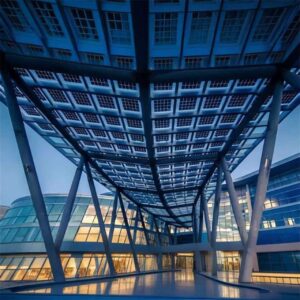
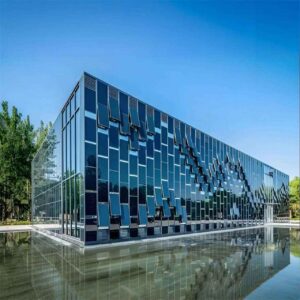
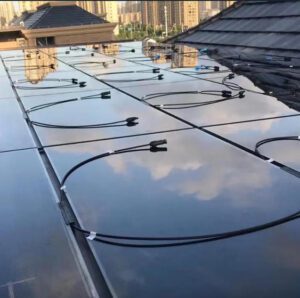
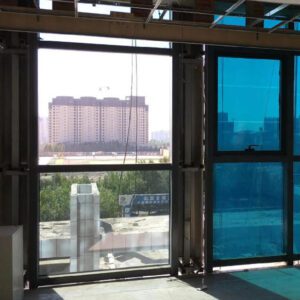
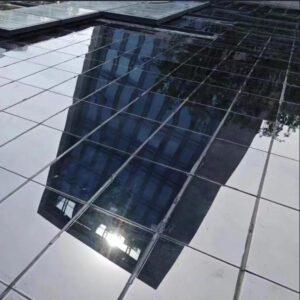
Windows fitted with transparent PV glass generate power from surfaces that are already specified in the building. Skylights — typically large, south-facing, and receiving high irradiance — can produce 60–90 W/m² while maintaining the bright, naturally lit interior experience that tenants and occupants demand. Facade cladding systems using BIPV laminated glass create entire building surfaces that serve simultaneously as weatherproof envelope, thermal insulation layer, and power generation asset.

Commercial Building Integration
A 15-storey office building in London’s Canary Wharf district completed a facade upgrade in 2023 in which 1,800 m² of conventional double-glazing was replaced with semi-transparent PV glass (70% VLT, 9% efficiency). The project generated an annual output of approximately 226,800 kWh — reducing the building’s net grid electricity consumption by 31% and generating carbon credits worth approximately £18,000 annually under the UK’s Renewable Energy Guarantees scheme. The payback period, accounting for the avoided glazing cost, was calculated at 9.4 years — with a project lifetime of 25+ years delivering a net positive return of over £380,000 per year by year 10.
Retail spaces present a particularly compelling case because transparent solar glass addresses two pain points simultaneously: reducing energy bills (which typically represent 15–30% of retail operating costs) while maintaining the bright, welcoming interior environments that drive customer dwell time and sales conversion. Explore the full range of glass-integrated solar panel and facade systems available for commercial specification.
Agricultural and Horticultural Uses
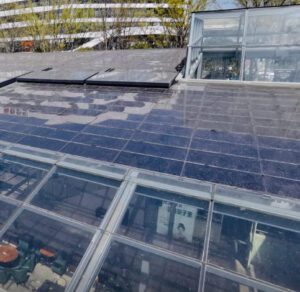
Agrivoltaic greenhouses — structures where transparent PV panels form the roof or wall glazing — represent one of the fastest-growing application segments for distributors serving the agricultural sector. Research published in 2025 in Cell Reports Sustainability found that tomatoes, snow peas, and spinach grown in transparent solar greenhouses showed no statistically significant yield loss compared to control greenhouses with standard glazing, while the structures generated sufficient electricity to power all irrigation, climate control, and lighting systems on-site. For large-scale greenhouse operators, this translates to near-zero net energy cost for facility operations — a transformative economic improvement in an industry where energy typically represents 25–40% of production costs.
Section 6: Addressing Customer Concerns and Technical Questions
Durability and Longevity
One of the most frequent objections from first-time buyers of transparent PV glass is durability concern — the assumption that a panel doing two jobs (generating power and functioning as a structural glazing element) must compromise on both. The data does not support this concern. Transparent photovoltaic glass manufactured to IEC 61215 and IEC 61646 standards undergoes thermal cycling, humidity freeze, UV exposure, mechanical load, and hail impact testing that is at least as rigorous as standard architectural glass certification. Leading manufacturers provide 25-year linear performance warranties guaranteeing minimum 80–85% of initial output at end of warranty period.
Maintenance requirements are minimal and identical to standard commercial glazing: periodic cleaning with water and mild detergent to remove particulate accumulation that can reduce light transmission. There are no moving parts, no electrolyte to replenish, and no specialist cleaning equipment required. Many commercial building operators integrate transparent PV glass cleaning into their existing facade maintenance schedules at zero additional labour cost.
Safety and Building Code Compliance
Transparent photovoltaic glass in facade and glazing applications must meet structural safety requirements that go beyond standard solar panel certification. Key certifications include IEC 61730 (PV module safety), EN ISO 12543 (laminated glass safety), fire classification under EN 13501, and in many markets, ASTM E84 surface burning characteristics. For electrical compliance, the panel assembly must carry applicable low-voltage directive certification and be grounded to national electrical code standards. Jia Mao BIPV’s installation and design guide provides comprehensive documentation for code compliance across major global markets, which your technical team can use directly in project submissions.
Cost Considerations for Your Pricing Strategy
| Cost Component | Transparent PV Glass | Standard Solar + Separate Window |
|---|---|---|
| Materials (per m²) | $150–$400 | $80–$200 (panel) + $80–$200 (window) = $160–$400 |
| Installation Labour | Single trade (glazier/facade contractor) | Two trades (roofer/electrician + glazier) |
| Structural Modification | Minimal — fits standard glazing frames | Often requires additional roof penetrations or mounting |
| Planning/Aesthetic Risk | Low — glass appearance | Higher — visible panel arrays often face planning objections |
| Payback Period | 8–15 years (5–7 years with incentives) | 6–10 years (panels only, excluding window cost) |
Section 7: Competitive Advantages for Your Sales Team
Why Transparent Solar Beats Traditional Alternatives
In markets where planning authorities restrict conventional rooftop solar installations for aesthetic or heritage reasons — city centres, conservation areas, premium residential developments — transparent PV glass is frequently the only viable solar technology. This gives distributors carrying BIPV glass a material competitive advantage in high-value urban project segments that commodity solar suppliers simply cannot serve. Your sales team should map local planning policy as part of market analysis, because regulatory barriers for standard solar are a direct commercial opportunity for transparent PV glass.
Property value enhancement data supports premium positioning. A 2024 study of commercial assets across Germany, France, and the Netherlands found that buildings with certified BIPV facades commanded an average 7–12% premium in valuation appraisals compared to equivalent non-BIPV buildings, with the effect most pronounced in markets with carbon-based commercial lease incentives. When developers and property investors understand that BIPV glass upgrades both the energy rating and the asset valuation of a building, the conversation shifts from “cost” to “investment.”

Market Positioning for Distributors
The customer segments with the highest near-term purchasing probability for transparent PV glass are commercial real estate developers working on new-build office and mixed-use projects, agricultural infrastructure companies managing large greenhouse estates, premium residential developers in urban markets, and institutional building owners (hospitals, universities, government buildings) under pressure to meet net-zero commitments. Geographically, Europe leads adoption due to the EU Energy Performance of Buildings Directive (EPBD) requirements, followed by the Middle East (driven by premium construction and high solar irradiance), and East Asia — particularly South Korea, Japan, and coastal China — where urban density makes BIPV economics highly favourable.
For building a differentiated distributor position, partnering with architects and building services engineers at the specification stage is significantly more effective than competing at the procurement stage. Transparent PV glass, unlike commodity solar panels, is typically a design-led specification — which means the distributor who has already educated the architect often wins the project before it goes to tender. Explore Jia Mao BIPV’s full product range and pricing framework to develop your own specification toolkit.
Section 8: Technical Specifications Your Customers Need
Key Performance Indicators (KPIs) to Communicate
| KPI | Typical Range | What to Tell Your Customer |
|---|---|---|
| Visible Light Transmission (VLT) | 70–90% | Equivalent to lightly tinted commercial glazing; no meaningful daylight reduction |
| Power Output | 50–100 W/m² | Lower per m² than opaque panels, but replaces glazing cost simultaneously |
| Electrical Efficiency | 5–15% | Compare total-installed-cost economics, not efficiency in isolation |
| Annual Energy Yield | 80–200 kWh/m²/yr | Varies by location, orientation, and VLT selection |
| Temperature Coefficient | -0.25% to -0.45%/°C | Output decreases slightly in high heat — ventilated facades mitigate this |
| Performance Warranty | 25 years (min 80% output) | Comparable to standard tier-1 solar panel warranties |
| Color Rendering Index (CRI) | Ra ≥ 80 (most products) | Interior colors appear natural; no significant color distortion for occupants |
Certification and Standards
Buyers in the commercial and institutional sectors will require documented certification before specifying any glazing product. Transparent PV glass must meet a matrix of standards across electrical performance, mechanical safety, and fire classification that is more complex than either standard glazing or rooftop solar in isolation. The primary international standards are IEC 61646 (thin-film PV module performance — covers electrical output verification under standard test conditions), IEC 61730 (PV module safety — covers electrical isolation, fire resistance, mechanical integrity), and EN ISO 12543 (laminated safety glass — covers delamination, impact resistance, glass-breakage safety). Regional additions include UL 1703 in North America, AS/NZS 4666 in Australia, and GB/T standards in mainland China.
Third-party verification by accredited testing laboratories (TÜV, Bureau Veritas, Intertek) is not just a compliance exercise — it is a sales tool. Performance claims backed by independent test reports carry substantially more weight in architect and developer specification processes than manufacturer datasheets alone. When evaluating suppliers for your product line, always request third-party verified test reports, not just datasheets.
Section 9: Implementation Strategy for Distributors and Sellers
Building Your Product Knowledge
Technical confidence is the single most important differentiator for distributors selling BIPV glass into professional and commercial markets. Architects, structural engineers, and M&E consultants will ask probing technical questions — about U-values, shading coefficients, fire ratings, and electrical integration — and a salesperson who cannot answer with precision loses credibility in the room. Building this capability requires structured training that goes beyond reading product datasheets. Jia Mao BIPV offers distributor partner training programmes covering product technology, installation requirements, and project specification — details available at jmbipvtech.com.
Customer Communication Framework
The single most effective approach for communicating transparent solar technology to sophisticated commercial buyers is to lead with the application outcome, not the technology. “This replaces your curtain wall glazing and cuts your building’s grid dependency by 30%” is a more powerful opening than “this is a semi-transparent thin-film photovoltaic panel with 8% conversion efficiency.” The technical details matter — but they belong in the second stage of the conversation, once the business case has been established.
Visual tools are essential. Physical samples (glass swatches showing different VLT levels), side-by-side comparisons of standard glass and PV glass under the same lighting conditions, and energy production modelling outputs for the specific building being discussed are all demonstrably more effective than brochures. Develop a demonstration kit that your sales team can bring to client meetings — including a small working panel connected to a meter showing real-time generation, even in indoor lighting conditions.
Sales Strategy and Market Positioning
Pricing strategy for transparent PV glass should reflect its position as a specification-grade product, not a commodity. Margin compression from commodity solar suppliers is largely irrelevant in this segment because the product is differentiated, the customer is professional, and the buying decision is specification-driven rather than price-driven at the initial stages. Position on total-installed-cost economics and 10-year total-cost-of-ownership, not on cost per watt.
Partnership with architectural practices — particularly those with active sustainability or BREEAM/LEED certification portfolios — is the highest-ROI business development activity for transparent solar distributors. A single architectural practice that specifies your product into their standard facade package can drive significant volume through multiple projects per year. Consider investing in CPD (Continuing Professional Development) sessions for architects and M&E engineers, as these are highly valued and create lasting specification relationships. Review the BIPV integration options by technology type to build a comprehensive product portfolio for different project types.
Section 10: Future Developments and Market Trends
Emerging Technologies and Innovations
Perovskite solar cells — named after the crystal structure of the semiconductor material — represent the most closely watched development in the transparent solar space. Perovskite materials can be engineered with precisely tuned bandgaps, making them theoretically ideal for transparent applications where selective wavelength absorption is critical. Laboratory-scale perovskite transparent cells have achieved efficiencies exceeding 20% while maintaining meaningful VLT — a combination that has not yet been achieved commercially. The primary barriers to commercialisation remain long-term stability (particularly moisture resistance) and the management of lead content in some formulations. Industry analysts at the American Ceramic Society report that perovskite durability has improved dramatically through 2024–2025, with commercial products from several manufacturers now carrying 10-year performance guarantees — a milestone that suggests broader commercial availability within 3–5 years.
The integration of transparent PV with electrochromic (smart) glass — which can dynamically adjust its tint level in response to light or electrical signals — is another near-term development that your product development planning should track. Combined smart-PV glass would allow a facade to optimise simultaneously for daylighting quality, thermal management, and energy generation on a real-time basis, controlled via building management systems. Early commercial prototypes are already being piloted, though at price points that currently restrict them to ultra-premium applications.

Market Growth Projections
Preparing Your Business for Future Demand
The distributors who will capture disproportionate value from BIPV market growth are those who build technical expertise and supplier relationships before demand becomes mainstream. When a major commercial developer or architectural practice first engages with transparent solar as a specification option, they will turn to the supplier they already know and trust — not to whoever happens to be cheapest at that moment. The window for establishing that trusted-expert positioning is now, while the market is still in early-growth phase.
Operationally, BIPV glass supply chains require different inventory management than commodity solar panels. Lead times from manufacturers can be 8–16 weeks for custom specifications, and project-specific customisation (specific glass dimensions, VLT levels, frame compatibility) is the norm rather than the exception. Building relationships with manufacturers who offer flexible production — including custom BIPV product configurations — and developing internal project management capability to handle specification-led orders will be key operational investments for distributors scaling in this segment.
Positioning Your Business as a Transparent Solar Expert
Transparent photovoltaic glass is not a niche product category on the fringe of the solar industry. It is the technology that makes solar energy viable for the vast majority of built-environment surfaces that cannot accept conventional panels — facades, windows, skylights, greenhouse roofs, and architectural features. As building energy codes tighten globally, and as embodied-carbon performance becomes a standard specification requirement for commercial construction, BIPV glass will transition from premium option to standard specification across multiple project types.
For distributors and agents in the solar product market, the competitive advantage available right now is knowledge. The majority of buyers — including many architects and developers — do not yet fully understand how transparent solar panels work, what they can realistically generate, or how to specify them. The distributor who can walk into that knowledge gap with technical confidence, real project data, and a curated product range from manufacturers like Jia Mao BIPV will close specifications that competitors cannot even bid on.
Ready to Revolutionize Your Solar Product Portfolio?
Start by deepening your technical knowledge, building supplier relationships with certified transparent PV manufacturers, and positioning your business as the specification-stage expert your clients need. The demand is growing — the question is whether your business is ready to capture it.
Explore Jia Mao BIPV Products View Real-World Case StudiesFrequently Asked Questions
Answers to the technical and commercial questions most commonly raised by distributors, builders, architects, and their clients when evaluating transparent photovoltaic glass for BIPV projects.
Technical data in this article reflects publicly available research and manufacturer specifications current as of mid-2025. Specific project performance should always be validated through site-specific energy modelling. For product specifications and distributor enquiries, visit jmbipvtech.com.