Solar Roof Tiles: A Strategic Guide for Contractors, EPC Firms, and Architects

Solar roof tiles are no longer a residential novelty. They are a commercially proven, code-compliant building envelope system that replaces conventional roofing material while generating electricity — and the professionals who specify them correctly are winning projects that competitors cannot match.
The solar roof tiles market hit $3.59 billion globally in 2024 and is on track to reach $8.88 billion by 2030, growing at a 10.8% CAGR according to For Insights Consultancy. In the U.S. alone, the solar roofing product segment is forecast to reach $965 million in 2025, driven by mandatory green building codes, favorable replacement economics, and escalating commercial ESG requirements.
This guide is written for the professionals who actually deliver these projects — not for retail homeowners, and not for search engines. If you manage a curtain wall subcontract, run an EPC firm, specify materials for institutional projects, or distribute building envelope products, every section here addresses a real decision you face on real projects.
1. The Evolution of Building-Integrated Photovoltaics: What Solar Roof Tiles Actually Are
Building-Integrated Photovoltaics (BIPV) — pronounced “B-I-P-V” — is solar technology that replaces conventional building materials rather than mounting on top of them. The solar element is the roofing material, the cladding, or the glazing. Solar roof tiles are the most widely deployed BIPV product category: they replace asphalt shingles, concrete tiles, or metal panels at the roofing layer while simultaneously generating electricity from sunlight.
This is fundamentally different from BAPV (Building-Applied Photovoltaics) — the rack-mounted panel systems that sit above a finished roof surface. BAPV systems require separate waterproofing beneath them, create visible racking hardware, and add dead load without replacing any existing building material. BIPV tiles eliminate the racking, eliminate the separate roofing material cost on replacement projects, and create a uniform visual appearance that neither racks nor panels can replicate.
The positioning shift matters for every professional in this chain. Architects who specify solar tiles are not specifying a solar add-on — they are selecting a roofing material with integrated generation capability. Roofing contractors who install them are not doing solar work — they are doing advanced roofing work with an electrical component. EPC firms who deliver them are not commoditized panel installers — they are building envelope specialists with energy performance guarantees.
That distinction is worth real money at the bid table.
The demand drivers reshaping specifications right now:
- California’s 2025 Title 24 Energy Code updates photovoltaic and battery energy storage standards for nonresidential buildings — effective for projects permitted from January 1, 2026. Projects that do not plan for integrated solar from schematic design will face expensive redesigns at CD phase.
- The EU’s Energy Performance of Buildings Directive (EPBD) mandates zero-emission standards for new buildings, with member states progressively integrating solar-ready requirements into building codes.
- Commercial tenants and institutional building owners now require LEED, BREEAM, and ESG-aligned building performance documentation as a lease and financing condition — solar roof tiles contribute directly to certification points in categories that rack-mounted systems cannot reach.
- The 30% federal Investment Tax Credit (Section 48E) remains available for commercial BIPV projects beginning construction before July 4, 2026, making the financial case for commercial solar tile integration measurably stronger than it was three years ago.
Manufacturers like Jia Mao BIPV have built product lines specifically for this professional market — engineered photovoltaic glass and solar tile systems with IEC certifications, BIM documentation, and commercial-scale technical support that residential product brands do not provide.
2. Solar Roof Tiles vs. Traditional PV Panels: A Technical and Design Comparison
The efficiency question comes up in almost every client conversation. The honest answer requires more precision than a single percentage comparison provides.
Cell efficiency for premium rack-mounted monocrystalline panels reaches 20–22%. Solar roof tiles typically achieve 14–20%, with premium products in the 19–22% range. That gap is real. But it is the wrong metric for the project economics conversation.
The correct metric for roofing decisions is watts per square foot of roof area occupied — because the roof area is fixed, and what you need to know is how much power you can extract from it. A GAF Energy Timberline Solar ES2 tile at 22.6% efficiency and 57 watts per shingle delivers approximately 14.3 W/ft². In a prime solar market like Dallas (4.9 peak sun hours/day), a 1,000 ft² active solar zone generates roughly 25,500 kWh over 25 years at that density — value that comes from a surface that would otherwise generate zero energy as conventional shingles.
The structural integration comparison is equally important for contractors evaluating specifications.
| Feature | Rack-Mounted PV (BAPV) | Solar Roof Tiles (BIPV) |
|---|---|---|
| Roofing function | No — separate roofing material required underneath | Yes — tile is the primary weather barrier |
| Visible hardware | Aluminum racking, visible from street | None — flush to roofline |
| Dead load added | 3–5 lbs/ft² (panels + racking) | 8–15 lbs/ft² (tiles replace existing material) |
| Wind uplift design | Racking-dependent; gap creates uplift risk | Tile-integrated; engineered uplift resistance |
| Waterproofing | Separate membrane required | Tile system + underlayment = primary barrier |
| Installation trades | Roofer (existing roof) + solar installer (panels) | Roofing crew + electrician (integrated scope) |
| Re-roof cost offset | None — roof and solar are separate line items | Yes — tile replaces conventional roofing material |
| BIM integration | Panel families widely available | System-specific; confirm with manufacturer |
| Aesthetic outcome | Visible panel array above roofline | Flush, uniform appearance matching roofline |
| Best application | Low-slope commercial, simple pitched roofs | Pitched roofs, new construction, re-roofing, LEED |
Wind uplift resistance is one area where solar tiles have made significant technical progress. Products like Luma Solar carry a 166 mph wind rating — meeting Miami-Dade’s Notice of Acceptance (NOA) requirements, the most demanding residential roofing standard in the United States. Standard rack-mounted systems on most residential roofs are designed for 130 mph. For coastal and hurricane-prone markets, this difference is a specification decision, not a marketing distinction.
Underlayment compatibility is where structural integration gets specific. Solar tiles are the primary weatherproofing layer — which means the waterproofing performance of the assembly depends on the tile-underlayment combination, not on a separate roofing material. Most manufacturers specify self-adhering peel-and-stick membranes meeting ASTM D1970 as the required underlayment, rather than felt paper. Using a non-specified underlayment is a common warranty-voiding condition and a source of post-installation leaks that are expensive to diagnose and repair.
3. Key Benefits for Modern Buildings: Beyond Energy Generation
A solar roof tile system delivers four categories of value simultaneously. Understanding how to present each of these to different decision-makers — owner, architect, lender, tenant — is what separates a winning specification from a lost bid.
Aesthetic Integration
The most common objection to solar on premium residential and commercial projects is visual disruption. Conventional rack-mounted panels raise the solar array above the roofline, creating visible hardware, uneven shadow lines, and a visual profile that conflicts with architectural intent in HOA-restricted communities, historic districts, and design-forward developments.
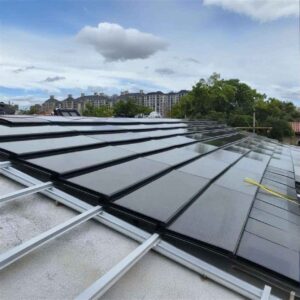
Solar tiles eliminate this objection entirely. They sit flush with the roofline. From street level, a well-installed Tesla Solar Roof or GAF Timberline Solar installation reads as a premium glass or dark shingle roof — not as a solar installation. For developers positioning a mixed-use project as a premium property, or for architects maintaining design continuity on a campus specification, this visual integration is worth a meaningful premium over conventional options.
Durability and Weather Resistance
Leading solar tile systems carry Class A fire ratings under ASTM E108 — the highest available classification, indicating effective resistance to severe fire exposure from outside the building. This is not a marketing claim; it is a standardized test result required for commercial occupancies under the International Building Code.
Hail resistance under UL 2218 / ANSI FM 4473 Class 4 — which simulates 2-inch hailstones at impact speeds above 51 mph — is now standard for premium products. In Colorado, Texas, and Kansas, where hail events cause hundreds of millions in annual roofing claims, Class 4 ratings are increasingly required by property insurers and are explicitly preferred in commercial re-roofing specifications.
Expected physical service life for tempered glass and quality metal solar tile products is 30–50 years in non-extreme climates — significantly longer than the 15–25 year lifespan of asphalt shingles they replace.
Lifecycle Cost Efficiency
The financial case for solar tiles is consistently misrepresented when the solar cost is compared against a PV-only baseline. The correct comparison is solar tiles versus (conventional roofing + separate PV system) — because on any project where the roof is being replaced or newly built, the conventional roofing cost is unavoidable. The incremental cost of solar tiles over that baseline is typically 20–40% of the gross tile system cost — not 100%.
A 10 kW GAF Timberline Solar system on a residential re-roof in Dallas costs approximately $38,000–$42,000 gross installed. The same roof area using conventional shingles costs $12,000–$16,000 for roofing. The net solar premium — the actual incremental investment in energy generation — is $22,000–$30,000 before the 30% ITC. After incentives, the net solar premium drops to $15,400–$21,000, with a simple payback of 10–14 years and 25-year cumulative savings of $40,000–$55,000 at current and projected Dallas electricity rates.
Regulatory Advantage
Solar roof tiles directly support compliance with the regulatory landscape that is reshaping commercial specifications. California’s Title 24 Part 6 — effective for projects permitted from January 1, 2026 — updates PV and battery storage standards for nonresidential buildings. LEED v4.1 EA Credit: Renewable Energy awards points for on-site generation as a percentage of total building energy use, a threshold that solar tiles on pitched-roof commercial buildings contribute to meeting. WELL Building Standard credits for air quality and thermal comfort are supported by reduced HVAC loads from BIPV glass systems with low SHGC values.
For any project pursuing LEED certification, the BIPV specification strategy should be discussed with the LEED consultant at schematic design — not at the CD phase when material choices are locked.
4. Solving Contractor Pain Points: Installation, Logistics, and Project Management
The contractors who struggle with solar tile projects are almost always the ones who treated them as a standard roofing project with an electrical subcontract bolted on. The contractors who win these projects consistently are the ones who planned the multi-trade integration before the first drawing was issued.
The Three-Trade Coordination Problem
Solar tile installation involves at minimum three trades: roofing (underlayment, tile installation, flashing, weatherproofing), electrical (conduit, junction boxes, DC wiring, inverter, AC interconnection), and structural (load assessment, any supplemental framing). On commercial projects, a fourth trade — facade or glazing — may be involved.
When these trades work sequentially without a defined handoff protocol, the most expensive field problems occur. The electrical rough-in that does not coordinate with the tile layout forces re-routing after tiles are installed. Junction boxes placed without regard for tile clearances end up buried. Conduit penetrations through the deck are made after the waterproof membrane is installed, compromising the assembly.
The practical solution is a BIPV Kickoff Coordination Meeting — a single four-hour session before design development is complete, including the architect, structural engineer, MEP engineer, solar product specifier, roofing subcontractor, and electrical subcontractor. The deliverable from that meeting: a confirmed tile layout drawing, confirmed conduit routing, confirmed junction box locations, and a defined sequence of work with hold points and inspection gates.
Four hours at schematic design prevents the field change orders that routinely cost $30,000–$90,000 on mid-size commercial projects.
Modular Design and Installation Efficiency
Modern solar tile systems have been redesigned around contractor workflows — not around laboratory performance optimization. GAF Energy Timberline Solar tiles nail directly to the roof deck using standard roofing tools alongside conventional GAF Timberline HDZ shingles. A GAF-certified roofing crew can be operational on solar tile installations with a training period measured in days, not weeks.
Field labor data from contractor networks shows representative installation times for a 10 kW system:
| System Type | Typical Install Time (10 kW) | Labor Hours/kW | Crew Requirement |
|---|---|---|---|
| GAF Energy Timberline Solar | 2–4 days | 3.5–5 hr/kW | 3-person roofing crew + electrician |
| Tesla Solar Roof | 10–17 days (full roof) | 6.9+ hr/kW | Tesla-certified crew only |
| Luma Solar | 3–6 days | 4–6 hr/kW | Clip-and-adhesive system; standard roofers |
| SunStyle | 4–8 days | 4.5–7 hr/kW | Proprietary interlocking hardware |
| BIPV Glass (curtain wall) | 2–4 weeks (facade) | 8–14 hr/kW | Glazing contractor + electrician |
Source: Manufacturer installation guides; field data from contractor networks.
Pre-Installation Logistics Checklist
Every solar tile project needs these items confirmed before the first material order is placed — not after the crew is on site:
- Structural PE-stamped load calculation confirming framing adequacy for tile dead load
- Manufacturer-specified underlayment confirmed and procured (not substituted in the field)
- Permit set submitted: building permit (structural + roofing), electrical permit, utility interconnection application
- Lead time confirmed with manufacturer: standard products 8–12 weeks; custom colors or sizes 14–24 weeks
- 5% tile overage ordered for breakage and future replacement matching
- Electrical subcontractor scheduled to be on-site during tile installation, not as a follow-on trade
- Storage plan confirmed: glass-based BIPV tiles must be stored vertically in A-frame crating; horizontal stacking causes glass breakage
Crane and Roof-Time Comparison
For commercial projects, the equipment logistics comparison is significant. Rack-mounted systems require a roof crane or personnel hoist for panel delivery to the elevated work surface, followed by separate racking installation, panel placement, and rail alignment. Solar tile systems, particularly interlocking and shingle-style formats, are smaller and lighter per unit — delivered to the roof as standard roofing material in manageable bundles. Contractors on comparative projects report 15–30% reduction in crane time on solar tile installations versus equivalent-capacity rack-mounted systems on pitched commercial roofs.
5. Value Proposition for EPC and Energy Service Providers
The commoditization of rack-mounted panel installation has compressed EPC margins on standard solar projects. Solar roof tiles provide a concrete path out of that margin compression — not through marketing language, but through measurable project economics.

For EPC firms, solar roof tiles unlock project types and client relationships that commoditized panel installation simply cannot reach.
Higher Project Margins Through Value-Added Integration
A standard 100 kW rack-mounted commercial installation generates a gross project value of roughly $250,000–$350,000 at $2.50–$3.50/W installed, with EPC margins typically compressed to 8–15% in competitive bid markets. The same 100 kW equivalent in an integrated BIPV roof or curtain wall specification generates $450,000–$700,000 in project value at $4.50–$7.00/W, with margins typically in the 18–28% range — because the project complexity requires engineering capability that most competitors cannot match.
The margin difference is not from charging more for the same work. It is from doing work that requires real technical expertise: multi-trade coordination, structural load analysis, thermal performance modeling, and integrated monitoring commissioning. EPC firms that build this capability differentiate on every RFP where conventional panel bidders cannot.
Performance Guarantees and Monitoring Integration
Solar tile systems with module-level monitoring — using microinverters or MLPE (Module-Level Power Electronics: devices installed at each individual tile that maximize output independently) — support performance guarantees that string-inverter systems cannot underwrite with the same confidence. A 25-year performance guarantee backed by tile-level monitoring data is a materially stronger commercial offer than a guarantee backed only by inverter-level data that cannot identify individual underperforming tiles.
For ESCO (Energy Service Company) and PPA (Power Purchase Agreement) project structures, this monitoring granularity matters to project lenders. Lenders financing solar projects through C-PACE (Commercial Property Assessed Clean Energy) or tax equity structures increasingly require P90 yield analysis — a statistical assessment confirming that the system has a 90% probability of achieving the projected energy output. P90 modeling requires accurate performance data inputs, and tile-level monitoring provides the data density that supports credible P90 analysis.
PPA and ESCO Financial Models
Under a typical commercial PPA structure, the EPC firm or a financial partner owns the solar tile system, installs it at no upfront cost to the building owner, and sells the electricity to the building owner at a contracted rate below the local utility tariff — typically 10–20% below the current rate with a defined annual escalation (usually 1–3%/year) for 15–25 years.
For a 200 kW solar tile system on a commercial office building in New York City (average commercial rate approximately $0.20/kWh):
| PPA Model Parameter | Value |
|---|---|
| Annual generation (est.) | 240,000 kWh |
| PPA rate (10% below utility) | $0.18/kWh |
| Annual PPA revenue | $43,200 |
| Gross system cost | $900,000 |
| ITC (30% Section 48E) | $270,000 |
| MACRS 5-yr depreciation benefit (est.) | $126,000 |
| Net developer cost | $504,000 |
| Simple payback (developer) | 11.7 years |
| 25-yr cumulative PPA revenue | $1.28M |
| 25-yr net developer return | $776,000 |
The building owner receives a guaranteed energy discount for 25 years with zero capital outlay, and the EPC developer captures a long-term contracted revenue stream backed by a physical asset embedded in the building envelope. For EPC firms with access to capital or tax equity partners, this model converts individual project relationships into long-term asset management portfolios.
Thermal Management and Energy Performance
BIPV glass tile systems — particularly semi-transparent and colored glass products from manufacturers like Jia Mao BIPV — deliver measurable HVAC load reduction in addition to energy generation. By controlling the Solar Heat Gain Coefficient (SHGC — the fraction of solar heat that passes through the glazing into the building), photovoltaic glass facades reduce summer cooling loads in ways that conventional glazing cannot match.
A south-facing commercial curtain wall in Phoenix, AZ, replacing standard low-e glazing (SHGC 0.27) with BIPV glass (SHGC 0.12) on a 1,000 m² facade reduces cooling energy by approximately 85,000 kWh per year — worth roughly $17,000 annually at $0.20/kWh commercial rates. When that is added to the solar generation value of the same facade, the combined energy benefit substantially improves the project’s payback and NPV relative to generation-only analysis.
EPC firms that model and present both benefits — generation and thermal load reduction — in project proposals consistently win over competitors who present only the solar generation calculation.
6. Strategic Opportunities for Building Material Brands and Distributors
For distributors operating in the roofing and building envelope market, solar roof tiles represent a structural shift in product line strategy — not a niche addition. The market dynamics favor distributors who move early.
Differentiating in a Commoditized Market
Standard roofing materials — asphalt shingles, concrete tiles, TPO membranes — are commodity products where distributor margins are compressed by multi-channel competition and price transparency. Solar roof tiles are premium, specification-driven products where the value is in technical capability, lead-time reliability, and application support — not in who has the lowest price per square.
A distributor carrying a validated solar tile line with certified technical training and field support can hold gross margins of 22–35% on BIPV products in markets where standard roofing material margins have compressed to 8–15%. The differentiation is sustainable because it requires investment in technical capability that commodity distributors will not make.
Co-Branding and Technical Training Programs
The manufacturers whose distribution partnerships perform best — including Jia Mao BIPV — invest in co-branded technical training that gives the distributor’s team and their contractor customers the specification and installation knowledge to win projects. This is not a product catalog and a price sheet. It is training on structural load documentation, permit package preparation, electrical interface coordination, and the specific technical objections that architects and building officials raise.
Distributors who provide this level of technical support to their contractor customers become a preferred partner for specification-driven projects — the contractor brings the project to the distributor because the distributor makes the bid process easier, not just cheaper.
Pre-Configured Kits and Regional Warehousing
Solar tile projects have tighter logistics requirements than standard roofing. Glass-based products require vertical A-frame storage and careful handling. Lead times from offshore manufacturers run 8–16 weeks for standard products. The distributor who carries strategic regional inventory of the most-specified SKUs — the top three or four tile configurations for the local climate and code environment — eliminates a 4–8 week schedule risk that contractors experience when ordering direct from manufacturers.
Pre-configured project kits — tiles, manufacturer-specified underlayment, flashing components, junction boxes, and connector hardware in a single order — reduce the contractor’s procurement complexity and reduce the risk of field substitutions that void manufacturer warranties.
7. Design and Specification Guidance for Architects and Consultants
Architects who specify solar roof tiles effectively treat them as a roofing material selection — with the same rigor applied to color, pitch compatibility, structural data, and code compliance as any other envelope product. Architects who struggle with the specification treat it as a solar project they are not qualified to design, and defer to a solar contractor who does not understand architectural intent.
The right approach is in the middle: the architect specifies the performance requirements and aesthetic parameters, and the solar product manufacturer provides the technical documentation to support that specification.
Material Selection Parameters
The primary specification parameters for solar tiles, in the order they typically constrain the selection:
- Roof pitch range: Most solar tile systems require a minimum slope of 2:12. Confirm the specific product’s minimum pitch before specifying on low-slope commercial applications.
- Wind zone compliance: Specify by ASCE 7-22 design wind speed for the project location. Products for coastal markets (HVHZ) must carry Miami-Dade NOA or equivalent third-party wind resistance certification.
- Fire classification: Class A is required for most commercial occupancies under IBC 2021 and 2024. Confirm that the complete assembly — tile, underlayment, deck — carries the Class A rating, not just the tile in isolation.
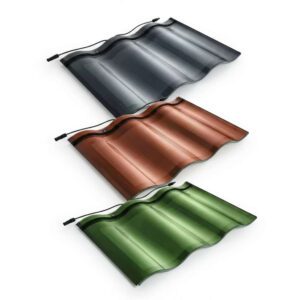
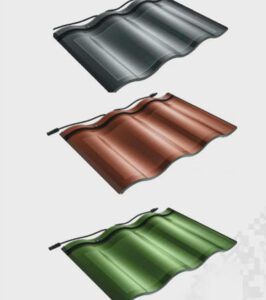
- Color and texture: Available in a range from near-black tempered glass (Tesla, Onyx Solar) to textured asphalt shingle appearance (GAF Timberline Solar) to natural slate profile (SunStyle). Specify ΔE < 2.0 for color batch consistency on large commercial projects where visual uniformity across hundreds of tile units matters.
- Efficiency and watt-density: For projects with energy performance targets (LEED EA, Title 24 compliance), specify minimum watt-per-square-foot density. Ask the manufacturer for the performance data at your project’s specific tilt and azimuth — not the rated efficiency at STC (Standard Test Conditions), which is always measured at optimal angles that your specific roof may not provide.
BIM Object Availability
For commercial projects above approximately 50 kW, or any project using BIM coordination in Revit or Navisworks, verify that the specified solar tile manufacturer provides BIM-compatible geometry families before design development. Finding at the shop drawing stage that no Revit family exists for the specified product costs 2–4 weeks in BIM reconstruction — time that is almost never in the schedule budget.
GAF Energy, SunStyle, Onyx Solar, and Jia Mao BIPV all provide BIM object libraries for their commercial products. For custom sizes and colors — common in commercial BIPV glass projects — allow 3–4 weeks for the manufacturer to prepare and deliver a project-specific BIM family.
LEED, WELL, and Living Building Challenge Alignment
Solar roof tiles contribute to multiple certification credit categories simultaneously:
| Certification | Credit Category | Solar Tile Contribution |
|---|---|---|
| LEED v4.1 | EA Credit: Renewable Energy Production | On-site generation as % of building energy use |
| LEED v4.1 | MR Credit: Building Product Disclosure | EPD (Environmental Product Declaration) if available |
| LEED v4.1 | SS Credit: Heat Island Reduction | Dark tiles reduce heat island contribution (reflectance matters) |
| WELL Building Standard | Energy sub-concept | Reduced grid demand supports WELL Energy optimization |
| Living Building Challenge | Energy Petal | On-site net-zero energy — solar tiles contribute to this requirement |
| BREEAM | Energy credit | On-site renewable energy generation |
For LEED EA Credit: Renewable Energy, the credit awards points based on the percentage of the building’s annual energy use offset by on-site renewable generation. The calculation uses measured or modeled annual kWh from the solar tile system, divided by the total building energy use from the energy model. Even partial coverage — 10–25% of building energy — can contribute 1–2 LEED points that affect the certification level.
Coordinate the BIPV specification with the LEED consultant at schematic design, not at CD phase when material choices are largely locked.
8. Debunking Common Myths That Stall Project Adoption
Decision-makers who have heard the wrong information about solar tiles — from competitors, from uninformed colleagues, or from outdated trade press — need specific, data-backed responses. These are the myths that most often stall project adoption and the factual responses that move projects forward.
Myth #1: “Solar tiles are less efficient than panels, so they generate less power.”
This statement is factually incomplete. Solar tiles achieve 14–20% cell efficiency compared to 18–22% for premium rack-mounted panels. But the relevant comparison for a roofing decision is energy per square foot of roof occupied — not energy per watt of rated capacity.
On a 1,000 ft² active solar zone in Dallas (4.9 peak sun hours/day), a GAF Timberline Solar tile system at 14.3 W/ft² generates approximately 25,500 kWh over 25 years. A rack-mounted system on the same area at 18 W/ft² generates approximately 32,100 kWh. The rack-mounted system generates more energy per square foot — but it requires a separate, functioning conventional roof beneath it. When the roof replacement cost is subtracted from the solar tile installation, the net energy cost per kWh generated over 25 years is often lower for solar tiles than for the rack-mounted system plus separate roofing, particularly in markets where electricity rates are above $0.15/kWh.
The honest specification conversation acknowledges both the efficiency gap and the material offset — not just the efficiency gap.
Myth #2: “Solar tiles are only viable for new construction.”
Retrofit applications are well-established for GAF Energy Timberline Solar, Luma Solar, and CertainTeed Solstice. These systems can replace existing shingles in the active solar zones while conventional matching shingles remain in non-viable areas (valleys, north-facing sections, shade-affected zones). The retrofit requires a tear-off of existing shingles in the solar zone, installation of the manufacturer-specified underlayment, and tile installation — all within the skill set of a certified roofing contractor.
Tesla Solar Roof requires a complete roof replacement — full tear-off across the entire roof area, not partial overlay. This makes Tesla the right specification when the entire existing roof is at end of life, but not the right choice for a building with a sound existing roof where only the solar zone needs replacement.
The retrofit constraint that actually matters is structural: the existing framing must be assessed and confirmed adequate for the tile dead load before installation begins. On buildings with framing designed for asphalt shingles (2–3 lbs/ft²), upgrading to glass-based solar tiles (12–15 lbs/ft²) may require supplemental framing — a one-time cost that should be budgeted in the project pro forma from the beginning.
Myth #3: “Nobody will want to service these systems — they’re too complicated for standard maintenance crews.”
The maintenance protocol for solar tile systems is straightforward for credentialed roofing contractors. Non-electrical maintenance — cleaning, flashing inspection, visual tile inspection for cracks or delamination, gutter clearance — requires no high-voltage exposure and no solar-specific training beyond basic safety orientation. Cleaning protocol: pH-neutral solution (pH 6–8), soft brush or squeegee, water pressure below 40 psi. Schedule: 2–4 times per year in urban environments, 1–2 times in rural or low-particulate areas.
Electrical maintenance — inverter diagnostics, string-level output review, rapid shutdown system test — should be performed by licensed electricians with solar experience. This is not specialized beyond what any commercial building’s electrical maintenance contractor can provide.
Individual tile replacement — the maintenance scenario that most concerns building owners — is designed for in leading systems (GAF Energy, CertainTeed) without requiring removal of adjacent tiles. The O&M manual should document the replacement procedure, batch number of installed tiles (for color matching), and manufacturer spare parts ordering process before the project is commissioned. Planning for eventual tile replacement at the specification stage costs nothing and prevents the expensive improvisation that occurs when a tile fails five years after installation and nobody knows the product’s ordering details.
How Solar Roof Tiles Work: A Visual Overview
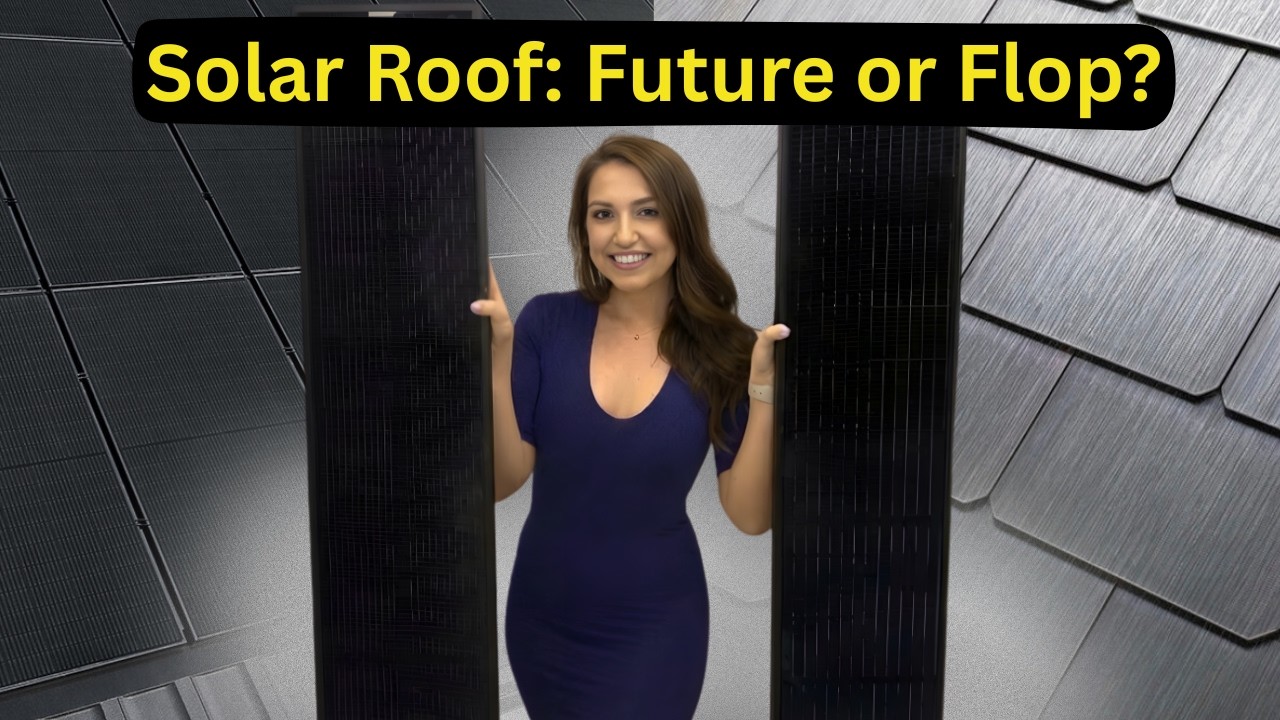
Watch: Solar Shingles vs Traditional Solar Panels (2025) — Efficiency, cost, and performance compared for roofing professionals. A useful resource for contractor and client education sessions.
Product Selection Reference: Leading Solar Tile Systems Compared
Product selection for solar roof tiles is not a one-size-fits-all decision. The right system depends on project type, installer capability, wind zone, and client priorities.
| Specification | Tesla Solar Roof | GAF Timberline Solar ES2 | Luma Solar | SunStyle | Jia Mao BIPV Glass |
|---|---|---|---|---|---|
| Tile Type | Tempered glass | Asphalt shingle | Galvalume steel panel | Interlocking slate | Photovoltaic glass |
| Module Efficiency | ~19.5% | 22.6% | ~20% | ~17–18% | 6–24% (by VLT) |
| Power per Unit | ~45 W (solar tile) | 57 W | 100 W | 84–115 W | 80–180 Wp/m² |
| Wind Rating | 130 mph | 130 mph | 166 mph (NOA) | 130+ mph | Per ASCE 7/EN 1991 |
| Fire Rating | Class A | Class A (UL 790) | Class A | Class A | Class A / EN 13501 |
| Installed Cost | $6.00–$8.00/W | $3.80–$5.50/W | $5.00–$7.00/W | $5.50–$8.00/W | $4–$12/m² (varies) |
| Product Warranty | 25 years | 25 years | Lifetime (metal substrate) | 25 years | 10–12 years |
| Power Warranty | 25 yr (80%) | 25 yr (80%) | 25 yr (80%) | 25 yr / 90% @10 yr | 25 yr (80%) |
| Key Certifications | UL 7103, IEC 61215 | UL 790, UL 7103, IEC 61215 | UL 7103, ASTM E108 | IEC 61215, IEC 61730 | IEC 61215, IEC 61730, CE, IEC 63092-1 |
| Installer Requirement | Tesla-certified only | GAF EnergyPRO certified | Luma-certified | General + training | Glazing contractor + electrician |
| BIM Available | Limited | Yes | Yes (on request) | Yes | Yes |
| Best Application | Premium new builds | Residential re-roofing | Coastal, curved roofs | Alpine, commercial | Curtain wall, LEED high-rise |
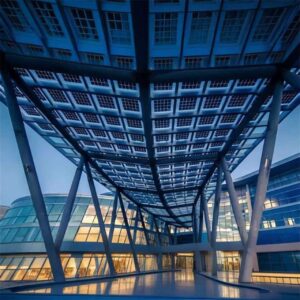
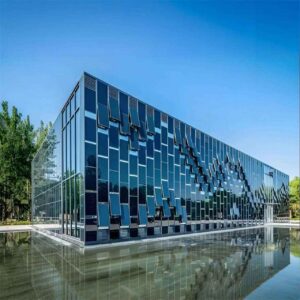
For large commercial and institutional projects requiring engineered photovoltaic glass — curtain walls, skylights, canopies, atrium glazing — standard roofing tile formats are not the appropriate product category. Jia Mao BIPV manufactures BIPV glass modules specifically for curtain wall and facade integration, with custom dimensions, transparency levels, cell colors, IEC 63092-1 certification (the BIPV-specific product standard), and a technical support team providing project-specific facade engineering documentation, BIM objects, and NFPA 285 fire compliance support for commercial specifications.
ROI and Incentive Reference Table
| Incentive | Type | Value | Who Qualifies | Status |
|---|---|---|---|---|
| Commercial ITC (Sec. 48E) | Federal tax credit | 30% of installed cost | Commercial building owners, EPCs | Active through 2032 |
| Residential Clean Energy Credit (Sec. 25D) | Federal tax credit | 30% | Residential homeowners | Expired Dec 31, 2025 |
| MACRS 5-Year Depreciation | Federal tax benefit | ~10–15% effective value | Commercial/EPC tax equity | Active |
| 179D Commercial Buildings Deduction | Federal tax deduction | Up to $5.00/ft² | Commercial building owners | Active through 2032 |
| NY-Sun Program | State cash incentive | $0.20–$0.40/W | NY residential and commercial | Active |
| California SGIP | State rebate | $0.15–$1.00/Wh (storage) | CA commercial storage | Active |
| Net Metering | Utility credit | Varies by state/utility | All grid-tied systems | State-by-state |
| Property Tax Exemption | State tax benefit | 100% exemption on added value | Most U.S. states | Check DSIRE |
| C-PACE Financing | Financing mechanism | 100% project financing | Commercial building owners | Available in 37+ states |
For current state and utility incentive data, use DSIRE — updated in real time as programs open and close.
9. Frequently Asked Questions: Industry-Specific Answers
1. Can solar roof tiles be installed on commercial low-slope roofs?
Standard interlocking solar tile systems require a minimum slope of 2:12 and are not designed for flat or low-slope commercial roofs. For low-slope commercial applications, the appropriate specification depends on the specific project. Ballasted or mechanically-attached rack-mounted systems are the most economical choice for low-slope roofs without architectural visibility constraints. For low-slope applications where BIPV integration, green certification, or aesthetic continuity is required, BIPV glass in a rooflight or canopy configuration may be appropriate. Jia Mao BIPV’s solar glass glazing systems are designed for commercial overhead glazing applications where pitched tile products cannot be used.
2. What are the wind uplift certifications for solar tiles in hurricane-prone zones?
In High Velocity Hurricane Zone (HVHZ) markets — primarily South Florida — roofing products must carry Miami-Dade Notice of Acceptance (NOA) certification, which requires passing TAS 110 wind uplift testing and TAS 100 impact testing. Luma Solar is currently the only residential solar tile system with documented NOA-compatible wind ratings at 166 mph. For HVHZ commercial projects, verify product certification against Miami-Dade’s product approval database before specifying. Outside HVHZ, ASTM D3161 Class F (110 mph) is the minimum acceptable threshold for most U.S. jurisdictions — confirm the specific local AHJ requirement before finalizing specifications.
3. How do solar tiles interface with metal roofing or curtain wall transitions?
Transitions between solar tile zones and adjacent metal roofing or curtain wall systems are the highest-risk waterproofing details on mixed-system projects. The manufacturer must be consulted on approved transition flashing details before the project moves to construction documents. Most manufacturers provide proprietary flashing components for standard transitions; for non-standard transitions, request a project-specific detail review from the manufacturer’s technical team before approving the shop drawings. For curtain wall transitions on commercial projects, the solar tile manufacturer and the curtain wall subcontractor must review and approve the joint detail together — not in sequence.
4. Are there fire code concerns when integrating solar tiles with combustible substrates?
Yes. The Class A fire classification applies to the complete roofing assembly — tile, underlayment, and deck — not to the tile in isolation. When solar tiles are installed over combustible wood decking (the most common residential application), the fire rating depends on the full tested assembly. Using an underlayment or deck configuration that was not part of the tested assembly may invalidate the Class A rating of the finished system. For commercial projects, also confirm NFPA 285 compliance for any BIPV glass installed on exterior walls with combustible insulation in the wall assembly — this is a separate fire test from the UL 790 roof covering test, and both may be required depending on the building construction type.
5. What is the expected degradation rate over 25 years?
Premium monocrystalline solar tile products — GAF Timberline Solar, Luma Solar, Tesla Solar Roof — specify linear degradation of approximately 0.3–0.55% per year, with a warranty floor of 80% of rated output at year 25. A 10 kW system rated at 80% output in year 25 is delivering 8 kW — and at the electricity rates projected for 2049–2050, the value of that 8 kW is substantially higher than the value of 10 kW today, because electricity rates have historically escalated at 2–4% per year. For financial modeling purposes, use a 0.45–0.5%/year degradation rate as a conservative planning assumption. Well-maintained systems retain significantly more output — Jia Mao BIPV’s maintenance guidance documents that systems on regular O&M programs consistently maintain 92–95% of original output at year 20 compared to 85–88% for systems without structured maintenance.
6. Can solar tiles be combined with traditional roofing on the same structure?
Yes. This is the standard installation configuration for any project where the full roof area is not viable for solar — shade-affected zones, north-facing sections, valleys, and areas restricted by penetrations. GAF Timberline Solar tiles are specifically designed to install alongside conventional GAF Timberline HDZ shingles as the non-solar material in the same system. Tesla Solar Roof uses visually identical non-solar “dummy” tiles in non-generating zones, maintaining a uniform appearance across the entire roofline. SunStyle and Luma Solar also provide matching non-solar tiles or panels for transition zones. The key specification requirement: confirm that mixing solar and non-solar tiles from the same manufacturer in the same assembly does not affect the warranty coverage of either product.
7. Do local jurisdictions require special permits for BIPV systems?
Yes, in virtually every U.S. jurisdiction. BIPV roof tile systems typically require both a building permit (covering structural loads, roofing assembly, and building code compliance) and a separate electrical permit (covering the DC wiring, inverter, AC interconnection, and rapid shutdown system). The building permit requires PE-stamped structural calculations confirming framing adequacy. The electrical permit requires a complete single-line diagram meeting NEC Article 690 requirements. A utility interconnection application must also be submitted — in parallel with building permitting, not after construction completion, because interconnection approval in some jurisdictions takes 60–90 days and is the most common cause of commissioning delays on otherwise complete systems.
8. How is electrical grounding achieved across the tile matrix?
Electrical grounding for solar tile systems must comply with NEC Article 690 Part V (PV-specific grounding requirements) and NEC Article 250 (general grounding and bonding). The specific grounding method depends on the tile system design and the inverter architecture. Microinverter-based systems typically ground the AC output circuit at the inverter; the DC side of each tile is inherently low-voltage and managed at the tile-level. String inverter systems require equipment grounding conductors (EGCs) sized per NEC 250.122, bonding of all exposed metallic components, and a grounding electrode system meeting NEC 690.47. Confirm the grounding design with the electrical engineer of record before installation — grounding errors are among the most common causes of failed electrical inspections on solar tile projects.
9. What O&M protocols are recommended for long-term performance?
A structured O&M program for commercial solar tile systems should include: annual thermal drone inspection (infrared imaging to identify hotspots — cells 10°C or more above the array average indicate cell damage, bypass diode failure, or delamination), quarterly visual inspection for debris accumulation and physical tile damage, semi-annual cleaning (urban environments) using pH-neutral cleaning solution and soft brush at less than 40 psi water pressure, and annual review of monitoring data for string-level performance trends. For systems with microinverters, tile-level monitoring alerts should be configured at commissioning to notify the O&M manager when any tile’s output drops more than 15% below its expected value for three consecutive days. Post-storm inspections after any wind event exceeding 60 mph should be conducted within 72 hours to identify and address potential uplift damage before water infiltration occurs.
10. Are there union labor considerations for installation crews?
In union-represented construction markets, solar roof tile installation typically falls under the jurisdictional scope of two trades: roofers (United Union of Roofers, Waterproofers & Allied Workers) for the tile installation, flashing, and waterproofing scope, and IBEW (International Brotherhood of Electrical Workers) for the DC wiring, inverter, and AC interconnection scope. The jurisdictional boundary between these trades — specifically, whether the tile-level DC connectors are roofer work or IBEW work — varies by local union agreement and requires pre-construction clarification with the relevant local business agents. Projects that do not resolve this boundary before mobilization risk jurisdictional work stoppages. For commercial projects in union markets, address trade jurisdiction as a pre-bid clarification item, not a field problem.
11. How do solar tiles perform in snow-prone regions with ice damming risks?
Solar tiles perform well in cold climates when installed with adequate attic insulation and ventilation to prevent the thermal differential that causes ice dam formation. The glass surface of solar tiles sheds snow more readily than textured asphalt shingles — the smooth face provides less adhesion for wet snow accumulation. For pitched roofs (4:12 or steeper), most snow load slides off the tile surface within hours of accumulation, clearing the generating surface without manual intervention. Ice dam risk is primarily managed through the building envelope — not the tile product — by ensuring continuous attic insulation at the R-value required by IECC for the climate zone, and maintaining adequate eave ventilation. In Climate Zones 6–8 (northern U.S. and Canada), consult the tile manufacturer’s cold-climate installation guidance for eave flashing and underlayment requirements specific to ice dam protection.
12. Can tiles be removed and reinstalled during roof repairs or skylight additions?
Yes, for most leading systems. Individual tile removal and reinstallation is documented in manufacturer installation guides for GAF Energy, Luma Solar, and CertainTeed Solstice systems. The procedure requires: tile removal using the manufacturer’s specified tool, visual inspection of the removed tile for damage, and reinstallation with a replacement tile if the removed tile shows any delamination or cell damage. Reinstallation of an undamaged tile preserves the weatherproofing and warranty coverage of the assembly. For Tesla Solar Roof, individual tile replacement requires coordination with Tesla’s service team and may involve a service appointment — the independent replacement capability is more limited than for contractor-installed competing products.
13. What warranties are provided for both energy output and weatherization?
The standard warranty structure for premium solar tile systems includes: 25-year product warranty (manufacturer replaces defective tiles at no cost), 25-year power output warranty (minimum 80% of rated output at year 25, with linear degradation guarantee), and installer workmanship warranty (typically 2–10 years depending on installer, covering water intrusion and installation defects). Luma Solar provides a lifetime warranty on the metal substrate of its tiles, separate from the power warranty. SunStyle provides a 10-year 90% power guarantee in addition to the standard 25-year 80% guarantee — a stronger near-term commitment than the industry standard. Request copies of the full warranty documents before specifying; the limitations and exclusions in the fine print (underlayment substitutions, non-certified installers, unregistered systems) are often more significant than the headline coverage period.
14. How do you handle penetrations for chimneys, vents, or rooftop equipment?
Every penetration through the solar tile layer must use manufacturer-specified flashing components installed per the manufacturer’s detail drawings. Field-fabricated flashing at penetrations is a warranty-voiding condition and the most common source of post-installation leaks. For chimneys, most manufacturers provide step-flashing and counter-flashing details that integrate with the tile system; these must be reviewed and approved by the manufacturer’s technical team if the penetration geometry differs from the standard detail. For rooftop mechanical equipment added after solar tile installation, the penetration must be flashed using the same manufacturer-approved protocol — which may require partial tile removal in the affected zone. Plan all rooftop penetrations before tile installation begins; adding penetrations to a completed tile installation is significantly more costly and complex than including them in the original installation scope.
15. Is there compatibility with smart building energy management systems?
Yes. Most commercial-grade solar tile inverters output monitoring data via Modbus TCP, BACnet/IP, or Sunspec Modbus protocols — the same communication standards used by commercial building management systems (BMS) for HVAC, lighting, and access control. Integration allows the BMS to display solar generation data alongside building load data on a unified energy dashboard, enabling demand response strategies — for example, pre-cooling the building during peak solar generation hours to reduce peak demand charges. For projects pursuing LEED EA credits, integrated monitoring that logs both generation and building consumption data is required documentation. Specify the communication protocol and monitoring integration requirements in the electrical scope at schematic design, not as a post-commissioning add-on; retrofitting BMS integration after the system is commissioned typically costs $5,000–$15,000 more than specifying it correctly at design.
10. Pathway to Specification and Project Execution

The difference between a solar tile project that delivers on schedule at target margin and one that does not is almost always in the pre-design coordination — not in the installation.
The step-by-step project workflow below reflects what consistently works across residential, commercial, and institutional solar tile projects. Every stage has specific deliverables that gate the next stage — because the most expensive problems in solar tile projects are almost always caused by starting the next stage before the current one is resolved.
Stage 1: Initial Design Consultation and Feasibility
The feasibility conversation has three components: energy analysis, structural confirmation, and code/permitting pre-check.
Energy analysis begins with a solar resource assessment using NREL PVWatts — a free, web-based tool that generates site-specific annual kWh estimates in 15 minutes. Input the roof area, orientation (azimuth), tilt angle, location, and system losses. The output is a monthly and annual generation profile that becomes the basis for all financial modeling. For commercial projects above 100 kW, or any project with significant shading, follow PVWatts with a full PVsyst analysis including 3D shading modeling.
Structural confirmation requires engaging a licensed structural engineer to review existing framing (for retrofits) or design new framing (for new construction) for the solar tile dead loads. Do not proceed past feasibility without a written structural opinion — the cost of discovering a structural deficiency after tile procurement is a significant multiple of the cost of the engineer’s assessment.
Code and permitting pre-check should include a call to the local AHJ (Authority Having Jurisdiction) to confirm permit requirements, plan check turnaround times, and any local amendments to NEC 690 or IBC that affect the installation. In California, check whether SolarAPP+ (the state’s automated permit platform) is available in the jurisdiction — it can reduce permit review time from weeks to days on qualifying systems.
Stage 2: Material Selection and Procurement
Select the solar tile system based on the criteria in Section 7 above, confirmed against the feasibility findings. Request from the manufacturer: full technical data sheet, installation manual, BIM objects (for commercial projects), sample warranty documents, and the product certifications relevant to your jurisdiction (UL 7103, IEC 61215, IEC 61730, Class A fire rating certification, wind test reports).
Place the material order no later than 12 weeks before the planned installation start for standard products; 16–20 weeks for custom configurations. Order a 5% tile overage above the calculated quantity for breakage and future replacement stock. Confirm storage requirements with the manufacturer before materials arrive on site.
Stage 3: Pre-Installation Site Audit
Two weeks before installation, conduct a full pre-installation site audit with the roofing subcontractor, electrical subcontractor, and manufacturer’s field representative (if available). The audit confirms: deck condition (no rot, delamination, or structural damage), existing penetration locations documented on the tile layout drawing, confirmed conduit routing that clears structural members and does not conflict with other MEP systems, and all materials on site and verified against the BOM.
Any discrepancy found at the site audit — a structural member in the planned conduit path, an undocumented penetration in the solar zone, a deck condition requiring replacement — is resolved at this stage, not discovered during installation.
Stage 4: Installation and Commissioning
Execute installation per the sequence in Section 4 above: electrical rough-in (conduit, junction boxes, cable trays) → underlayment and flashing → tile installation → DC wiring completion → AC interconnection → commissioning.
Commissioning deliverables: IV-curve trace for each string (confirming output matches specification), insulation resistance test (confirming no ground faults), rapid shutdown functional test, inverter startup and monitoring dashboard verification, and positive-pressure water test of the completed assembly.
Stage 5: Handover and O&M Onboarding
The O&M package delivered to the building owner at commissioning should include: tile layout drawing (as-built, with tile batch numbers), electrical single-line diagram (as-built), inverter settings and monitoring login credentials, manufacturer warranty documents (registered with the manufacturer), installer workmanship warranty documentation, O&M protocol (cleaning schedule, inspection checklist, emergency contact list), and the spare parts ordering guide (manufacturer part numbers, lead times, color batch reference for future tile matching).
For commercial projects, conduct an O&M training session with the building’s facilities management team before commissioning closeout. The investment in O&M onboarding — typically two hours — prevents the expensive maintenance errors and warranty disputes that result from facilities staff managing a system they were never trained on.
Glossary of Key Terms
Understanding the technical language on solar tile projects prevents miscommunication between trades, clients, and manufacturers. The terms below appear frequently in specifications, permit submissions, and manufacturer documentation.
BIPV (Building-Integrated Photovoltaics): Solar technology embedded into the building envelope — roof, facade, or glazing — replacing conventional materials while generating electricity. Solar roof tiles are the most common BIPV format.
BAPV (Building-Applied Photovoltaics): Conventional rack-mounted solar panels installed on top of an existing roof. Simpler and lower-cost than BIPV, but without the material replacement value or architectural integration.
Class A Fire Rating: The highest fire resistance classification under ASTM E108 / UL 790, indicating effective resistance to severe fire exposure from outside the building. Required for most commercial occupancies under IBC.
SHGC (Solar Heat Gain Coefficient): The fraction of solar heat that passes through glazing into the building. Lower values mean less heat gain. Relevant for BIPV glass products used in facades and skylights.
UL 7103: The U.S. standard specifically for building-integrated photovoltaic roofing systems, combining electrical safety, fire performance, and structural requirements in a single listing.
IEC 63092-1: The international standard specifically for BIPV products (distinct from standard PV module standards), defining the requirements for PV modules intended to replace conventional building materials.
NEC 690: The National Electrical Code article governing all PV system electrical requirements — wiring, overcurrent protection, rapid shutdown, grounding, and inverter interconnection.
Rapid Shutdown (NEC 690.12): The requirement that solar system conductors outside the array boundary be de-energized to 30V or less within 30 seconds of shutdown initiation, ensuring firefighter safety.
MLPE (Module-Level Power Electronics): Microinverters or DC power optimizers installed at each individual solar tile or module, preventing shading or mismatch losses from reducing the output of an entire string.
ITC (Investment Tax Credit): The 30% federal tax credit for commercial solar energy systems under Section 48E of the Inflation Reduction Act. Available for commercial BIPV projects through 2032.
C-PACE (Commercial Property Assessed Clean Energy): A financing mechanism available in 37+ U.S. states that allows building owners to finance solar tile and other clean energy improvements through property tax assessments, enabling 100% project financing without traditional bank debt.
P90 Yield Analysis: A statistical energy production analysis confirming a 90% probability that the solar system will achieve or exceed the projected annual energy output — required by lenders for project-financed solar installations.
Performance Ratio (PR): The ratio of actual system output to theoretical maximum output, accounting for temperature, wiring losses, shading, and inverter efficiency. A well-designed solar tile installation typically achieves PR of 0.75–0.85.
AHJ (Authority Having Jurisdiction): The local building or electrical inspection authority responsible for reviewing and approving permit applications. AHJ requirements vary by jurisdiction and can include local amendments to national codes.
For project specifications, technical documentation, BIM objects, and direct consultation on commercial BIPV glass and solar tile systems, visit Jia Mao BIPV’s full product and resource library or explore the complete range of BIPV solar panel solutions for your next building envelope specification.