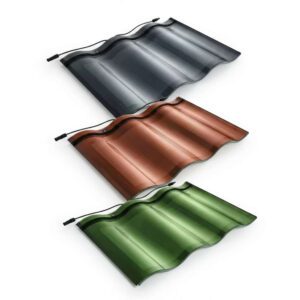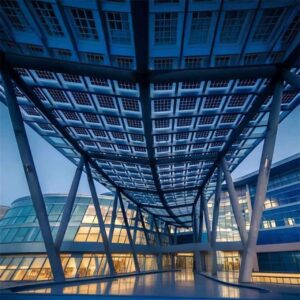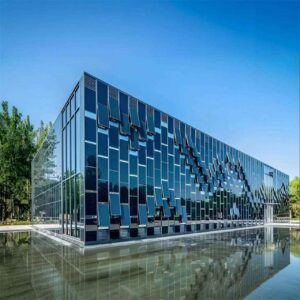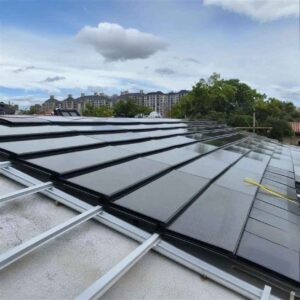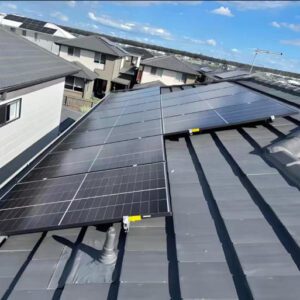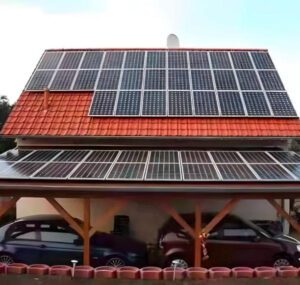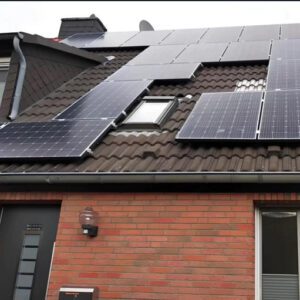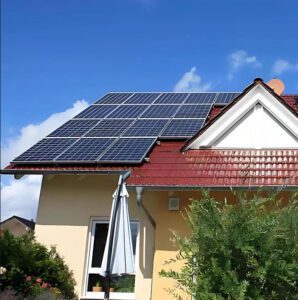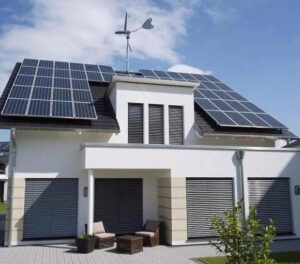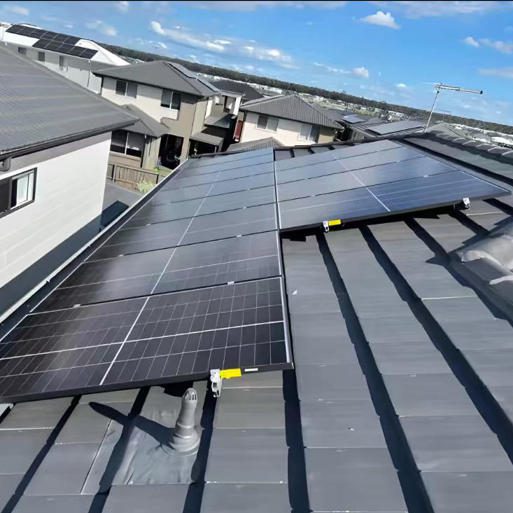

A pitched roof finished with solar roof tiles in Onalaska, Wisconsin. Photo: Wikideas1, CC0, via Wikimedia Commons.
Picture a 1,200 m² school roof that needs replacing. The owner wants lower power bills. The planning office does not want to see racks on the skyline.
You can re-roof and then bolt panels on top. Or you can lay one roof that also makes power. That choice shapes your crew mix, your risk, your permit path, and your margin.
This guide walks through that choice step by step. It is written for curtain wall and roofing contractors, PV EPC teams, material distributors, and architects.
Quick answer: Solar roof tiles are roofing material with solar cells built in. They replace the roof covering instead of sitting on top of it. They cost more per watt and make less power per square meter than racked panels. They win when looks, zoning rules, or a roof replacement are already part of the project.
Key Facts at a Glance
| Question | Short answer |
|---|---|
| What is a solar roof tile? | A roofing unit with PV cells inside, so it works as both weather barrier and power source |
| Power density | About 120–170 W/m² for tiles vs. 190–230 W/m² for racked panels |
| Price range (installed, residential-scale quotes) | $3.80–$7.00 per watt for tiles vs. $2.50–$3.50 for panels |
| Weight of a glass-glass tile roof | Roughly 20–22 kg/m² |
| Minimum roof slope | Usually 2:12 (about 9.5°) |
| Key safety rule | NEC 690.12 rapid shutdown: 30 V outside the array, 80 V inside, within 30 seconds |
| Best fit | Pitched roofs, new builds, re-roofs, heritage and design-controlled zones |
I. The Evolution of Building-Integrated Photovoltaics (BIPV)
What Is a Solar Roof Tile?
A solar roof tile is a roofing unit that has photovoltaic (PV) cells built into it. PV cells turn sunlight into electricity. The tile keeps rain out and makes power at the same time.
This puts solar roof tiles inside a wider group called building-integrated photovoltaics (BIPV). BIPV means the solar part is the building material itself. It might be a roof tile, a glass wall panel, or a skylight.
You will also hear the term solar shingles. Shingles and tiles are close cousins. Both replace the roof covering.
From “Bolt-On” to Built-In
For two decades, rooftop solar meant adding panels to a finished roof. This is called building-attached PV, or BAPV. Racks are fixed to the roof deck, and panels are clipped on top.
BIPV flips the order. The roof and the power plant become one layer. As the U.S. Department of Energy explains, BIPV replaces conventional building materials with solar-generating ones. That includes roofs, skylights, awnings, facades, and windows.
Here is the insight many teams miss. The shift is not mainly about technology. It is about who owns the roof detail. With racked panels, the roofer finishes first and the solar crew arrives later. With tiles, both trades work as one team on one assembly.
Why Now?
Rules and markets are pushing in the same direction:
- The solar roof tile market was estimated at about $3.56 billion in 2024 and is forecast to pass $8.8 billion by 2030, according to Grand View Research figures summarized in what solar roof tile companies do for commercial projects.
- In Europe, EU zero-emission building rules start in 2028 for new public buildings and 2030 for all new buildings.
- Design review boards and historic districts increasingly refuse visible racks.
Indicative split compiled in Jia Mao Bipv’s BIPV guide for homes and businesses. Roofing is the largest slice, but treat the exact percentages as a guide, not a census.
What This Means for Your Team
| Your role | Your common pain point | What tile systems offer |
|---|---|---|
| Roofing / curtain wall contractor | Competing on price for commodity re-roofs | A premium scope you can own end to end |
| PV EPC / energy service provider | Roof owners who refuse visible racks | A way to say “yes” to design-controlled sites |
| Building material brand / distributor | A catalog that looks the same as everyone else’s | A technical product line with real margin |
| Architect / consultant | Energy targets vs. roof appearance | One surface that satisfies both |
Thesis in one line: Solar roof tile systems turn solar from an add-on into part of the building envelope. That gives contractors and architects a high-performance alternative to panels by merging roof integrity with energy production.
Jia Mao Bipv builds this kind of integrated product. You can see the full range at Jia Mao Bipv, and later sections show where its specifications fit your decisions.
II. Technical Differentiation: Solar Roof Tiles vs. Traditional PV Panels
Structural Integration: Replace vs. Install On Top
With panels, the roof stays as it is. Rails are fixed through the roofing into the deck. Each fixing point must be flashed and sealed.
With tiles, the old roof covering comes off, or the project starts from bare deck. The tiles overlap and interlock like normal roofing. Fewer holes go through the roof surface, which helps in wet climates.
The trade-off is crew skill. Tile work needs roofing and electrical skills at the same time. Our deeper comparison of solar roof tiles vs traditional panels covers cost and payback scenarios in more detail.

Solar roof tiles on a pitched roof. Photo: Helena Wright, CC BY 2.0, via Wikimedia Commons.
Side-by-Side Comparison
| Factor | Solar roof tiles | Rack-mounted panels |
|---|---|---|
| Role in the building | Replaces the roof covering | Sits on top of the roof covering |
| Typical roof | Pitched, about 15–60° | Flat or pitched |
| Power density | 120–170 W/m² | 190–230 W/m² |
| Module efficiency | 17–22% | 20–23% |
| Install time, home-size system | 5–14 days | 1–3 days |
| Installed price per watt | $3.80–$7.00 | $2.50–$3.50 |
| Crew | Roofer and electrician working as one team | Racking crew plus electrician |
| Power warranty | 25–30 years | 25–30 years |
| Expected life | 30–50 years (vendor claims) | 25–35 years |
Sources: Jia Mao Bipv’s commercial solar roof tile guide and its tile vs. panel comparison. Price ranges are residential-scale; large commercial bids can land differently.
The chart tells the honest story. A tile roof delivers roughly 63–74% of the power per square meter that a panel roof does. Do not promise equal output. Promise a roof that looks right and performs as a roof.
Aesthetic Impact: Keeping the Building’s Silhouette
Racked panels rise a few inches above the roofline. They create shadows, gaps, and visible rails. On a heritage building or a design-controlled campus, that can kill the permit.
Tiles sit flush with the roof surface. From the street, a dark tile roof often reads like slate. Color and finish options matter here, and we cover them in Section IX.
Weight and Load Distribution
Dead load is the permanent weight a roof must carry. A glass-glass solar tile assembly weighs about 20–22 kg/m², according to Jia Mao Bipv’s permitting guide.
Whether that is a problem depends on what you remove:
- Replacing asphalt shingles: the roof gets heavier. Check the framing.
- Replacing heavy clay or concrete tile: the roof may get lighter.
- Adding racked panels on top of a full roof: the roof carries both the covering and the panels.
In every case, a licensed engineer must check wind uplift as well. The edges and corners of a roof face much higher uplift than the middle, and that is where tile attachment details matter most.
III. Core Components and System Architecture
The Photovoltaic Cell: Silicon Inside Glass or Ceramic
Most solar tiles use monocrystalline silicon cells. Monocrystalline cells are cut from a single silicon crystal, so they convert light more efficiently than polycrystalline cells, which are cast from many crystals. Wikipedia notes that current shingle makers mostly use these industry-standard silicon cells. Early products used thin-film technology instead.
The cells are sealed between layers of tempered glass, polymer, or ceramic-like surfaces. Tempered glass is heat-treated glass that is several times stronger than normal glass and breaks into small, blunt pieces.

Thin-film BIPV solar shingles from the early 2000s. Photo: National Renewable Energy Laboratory (NREL), public domain, via Wikimedia Commons.
A typical shingle-format product measures about 300 mm × 2,180 mm and carries up to roughly 100 W. Glass-based commercial tiles come in other sizes.
For glass-faced products, clarity matters. Jia Mao Bipv uses ultra-clear tempered glass rated at 91.5% light transmittance and 4.0 kPa wind pressure. It pairs that with monocrystalline cells above 22% cell efficiency and imported POE encapsulant film, which it says improves UV aging resistance by 40%. These are manufacturer figures, so ask for the test reports when you specify.
Where a project needs light to pass through, such as a glazed canopy or skylight band, transparent PV glass can be offered at different see-through levels.
Interconnects and Wiring: Less Work on the Roof
Interconnects are the cables and connectors that link tiles into strings. A string is a group of modules wired in series.
Pre-integrated cables mean the crew clicks connectors together instead of cutting and crimping wire in the wind. Fewer field connections also means fewer places for a fault.
Module-level power electronics (MLPE) are small devices, such as microinverters or optimizers, fitted to each module. They help meet rapid shutdown rules, and they stop one shaded tile from dragging down a whole string.
Mounting and Fastening: Interlocking and Sealing
Tile systems use mechanical interlocking, hidden fixings, and sealed overlaps. Never drill through a tile. Drilling can crack the glass and create a leak path.
As one example, Jia Mao Bipv’s installation guide for its tile system specifies M20 anchor screws, four per column, spaced 150 mm apart, with 70 mm left exposed and double nuts for locking. Your own project will follow the manufacturer’s drawings, but the point stands: fastening is engineered, not improvised.
IV. The Installation Workflow: From Blueprint to Grid Connection
Design review before install: structural, electrical, and fire checks come first.
Step 1: Site Assessment and Structural Load Calculation
Start with three checks: structure, electrical, and fire safety.
- Structure: confirm the framing can carry the tile weight plus wind uplift.
- Electrical: confirm inverter location, conduit routes, and utility service size.
- Fire: confirm roof fire rating and firefighter access setbacks.
Do these in parallel with design, not after it. Jia Mao Bipv’s permitting process guide reports that late fixes can cost three to five times more than early ones, because drawings must be redone.
For the structural check, many teams use a simple wind pressure estimate to sanity-check numbers before the engineer’s final calculation:
$$q = 0.613 \times V^2$$
Here q is wind pressure in pascals and V is wind speed in meters per second. At 45 m/s, that gives about 1,241 Pa. Real design values come from ASCE 7 or your local code, and they add zone factors and building height.
Step 2: Installation Sequence
The usual order for a new roof is:
- Prepare the substrate and check slope. Most products need 2:12 (about 9.5°) or steeper.
- Lay waterproof underlayment across the whole area.
- Fit flashing at edges, penetrations, and valleys.
- Fix the mounting system to the structure.
- Lay tiles from the bottom row upward, connecting cables as you go.
- String, label, and test each circuit before closing up.
- Inspect every seam and sealant line.
Labor runs about 6.9 worker-hours per kW installed, and a standard home takes 5 to 10 days, according to Jia Mao Bipv’s step-by-step installation guide. New construction goes faster than retrofit.
Watch: Modular Solar Roof Tile Installation

A manufacturer demonstration of how BIPV roof tiles are installed in modules. Click the image to play on YouTube. Other makers’ details differ, so always follow the drawings for your own product.
Step 3: Final Integration, Inverter Sync, and Utility Connection
The building permit and the utility approval are two separate approvals. Start both at the same time.
- Rapid shutdown: under NEC 690.12, voltage must drop to 30 V outside the array boundary and 80 V inside it within 30 seconds of activation.
- Anti-islanding: inverters must disconnect when the grid goes down. UL 1741 and IEEE 1547-2018 are the usual references.
- Utility timelines: systems under 200 kW often take 30–90 days. Larger projects can take 6–18 months.
A pre-inspection walk-through catches missing labels and setback errors before the inspector does.
Pre-certified products move through review faster. The same permitting guide reports first-submission approval of 70–85% for pre-certified tile systems, against 40–60% for custom-engineered ones. For help with automated residential permits, see SolarAPP+; it does not yet cover most commercial jobs.
V. Engineering Challenges and Technical Solutions (Addressing Contractor Pain Points)
Waterproofing and Leak Prevention
Most leaks trace back to two causes: poor flashing and missed sealant. The fix is process, not luck.
- Use multi-layer underlayment with a water-blocking layer.
- Flash every edge, chimney, and roof opening.
- Seal every cut and seam with a sealant approved by the tile maker.
- Hold the roofer responsible for waterproofing in writing, and the electrical contractor responsible for wiring.
- Inspect each row before the next one covers it.
On low-slope roofs, standard tile overlaps do not shed water well. Use a product made for low slope, or choose another roof type. Do not stretch a pitched-roof product onto a flat roof.
For wall and canopy conditions, the same principles apply but the details differ. Our facade weatherproofing and inverter guide covers that side.
Thermal Management: Keeping Tiles Productive
Solar cells lose power as they heat up. Most silicon modules lose roughly 0.35–0.40% of output for every degree Celsius above 25°C.
Here is what that means. A cell at 65°C is 40°C over the test condition. Multiply: 40 × 0.35% = 14%, and 40 × 0.40% = 16%. So a very hot day can cost you 14–16% of rated output.
Tiles lie flush to the roof, so they get less airflow than racked panels. That is one reason real-world tile output sits below panel output. To help:
- Leave a ventilated air gap beneath the tiles where the design allows.
- Ask for the temperature coefficient on the datasheet and compare vendors.
- Model output with local weather data using NREL PVWatts before you quote.
Maintenance and Replaceability
Tiles are modular, so one damaged unit can be swapped without stripping the roof. A single tile typically takes one to three hours to replace. The wiring must be disconnected, the flashing re-sealed, and the circuit tested afterward.
Plan ahead:
| Task | Who does it | How often |
|---|---|---|
| Dashboard check | Facility team | Monthly |
| Visual walk-around, debris, gutters | Facility team | Quarterly |
| Cleaning with soft brush and deionized water | Facility team or cleaning vendor | Twice a year |
| Electrical inspection, insulation resistance, thermal scan | Qualified technician | Yearly |
| Post-storm check | Facility team, then specialist if needed | Within 48 hours of hail or high wind |
Dirt is not a small issue. In Jia Mao Bipv’s example, a 300 kW roof producing about 330,000 kWh a year lost roughly 15,000 kWh between a never-cleaned roof and one cleaned twice a year. That is about 4.5%. You can share the full maintenance routine with your clients.
Keep 2–3% spare tiles on site or in the distributor’s warehouse. Colors and dye lots drift over time, and a replacement tile from a new batch may not match.
VI. Commercial Application: Scale and Performance
Warehouses, Factories, and Commercial Hubs
Here is an industry reality check. Solar tiles are a pitched-roof product at heart. A large flat warehouse roof is usually better served by racked panels or by integrated standing-seam systems.
Tiles make the most sense on:
- Retail flagships and hotels where the roof is part of the brand
- Office campuses and schools with design review
- Car dealerships and showrooms
- Distribution buildings with pitched or sloped roofs
- Heritage zones where racks are not allowed
A Worked Example: The 1,200 m² Roof
Let’s use one set of numbers throughout. These are planning figures from Jia Mao Bipv’s commercial guide, not a quote.
- Roof area: 1,200 m²
- Active (power-producing) area: 70%, or 840 m²
- Tile power density: 150 W/m²
- System size: 840 × 150 W = 126 kWp
- Yield: about 1,200 kWh per kWp per year
- Annual output: 126 × 1,200 ≈ 151,200 kWh
- Value at $0.15 per kWh: about $22,680 a year
Self-consumption is what makes the numbers work. Power you use on site is worth the retail rate. Power you export is often worth far less.
Cost-Benefit: BIPV vs. a Traditional Commercial Array
Now the part most brochures skip. We took the same 126 kWp system and priced it at three points in the tile price range. We assumed $100 per m² for a standard roof replacement ($120,000), which the tile system would avoid. That roof figure is our assumption, so replace it with your own local number.
| Scenario | Tile price per watt | System cost | Less avoided roof | Net cost | Payback at $0.15/kWh | Payback at $0.25/kWh |
|---|---|---|---|---|---|---|
| Low | $3.80 | $478,800 | $120,000 | $358,800 | 15.8 years | 9.5 years |
| Mid | $5.40 | $680,400 | $120,000 | $560,400 | 24.7 years | 14.8 years |
| High | $7.00 | $882,000 | $120,000 | $762,000 | 33.6 years | 20.2 years |
Before incentives. Uses residential-scale price ranges as a stand-in, so real commercial bids may be lower. Annual savings are $22,680 at $0.15 per kWh and $37,800 at $0.25 per kWh.
What the chart means for you:
- Price per watt and electricity rate decide almost everything. At $0.25 per kWh, the low-price case pays back in under 10 years.
- Tiles do not beat panels on energy per dollar. They win when the roof must be replaced anyway, or when racks are not allowed.
- Sell the avoided cost and the design approval, not an energy miracle.
Incentives: Check the Dates
Under the 2025 federal budget law, the commercial solar credit (Section 48E) generally requires construction to start by July 4, 2026, or the system to be in service by the end of 2027. The July date has now passed, so confirm your project’s status with a tax advisor. Search the DSIRE database for state and utility programs, because they change often. Also ask how the credit applies to the roofing portion of a tile system, since allocation rules matter.
LEED and ESG
On-site renewable energy can earn credit in the energy categories of LEED and BREEAM. Confirm the exact credit and documents with your rating-system coordinator early. Corporate ESG reports also ask for the on-site renewable share, and a roof that generates power gives a clean, countable number.
VII. Residential Application: Luxury and Sustainability
HOA and Historic Preservation Rules
Many homeowner associations and historic boards ban visible racked panels. A tile roof that matches the roofline often passes where panels fail. Meet the review board early and bring samples, not only data sheets.
Practical tips:
- Show a full-size sample tile next to the existing roof material.
- Submit elevations that show the tile roof from street level.
- Offer matte or dark finishes that blend with slate or dark shingle.
- Check local rules, because they vary widely.
Property Value Through “Invisible” Energy
Buyers value lower bills and also a roof that looks normal. Research from Lawrence Berkeley National Laboratory has found that homes with owned solar systems sell at a premium. A tile roof helps because the solar is part of the house, not an add-on a buyer might want to remove.
One more point on cost: for U.S. homeowners, the federal residential credit (Section 25D) covered systems placed in service through December 31, 2025. Check current state and local programs before you quote a homeowner.
Customization for Pitch and Style
Slope matters for both leaks and yield:
- Below 2:12: most tile products do not fit.
- About 20–40°: usually the best range for energy and water shedding.
- Up to about 60°: possible, with attention to snow, wind, and cable routing.
Ask the manufacturer about flat, textured, and curved profiles, plus size, color, and output options. Jia Mao Bipv offers custom sizing, color, light transmittance, and power output on its products.
VIII. Strategic Sourcing and Material Selection for Distributors
Evaluate Durability With Evidence
Do not accept “tested to standards” as an answer. Ask for the actual test reports, not a summary letter.
Fake or recycled certificates are a real risk. A forged IEC certificate on a large BIPV order can mean $200,000 or more in rework, so verify each report with the issuing lab.
| Document to request | What it proves | Red flag |
|---|---|---|
| IEC 61215 report | The module survives heat, cold, damp heat, hail, and mechanical load | Report covers a different model or glass thickness |
| IEC 61730 report | The module is electrically and fire safe | Certificate has expired |
| IEC 63092-1 report | The product meets the standard written for PV used in buildings | Vendor only offers standard panel reports |
| UL 7103 listing | The product is listed as a BIPV roofing material in North America | Listing covers a different assembly |
| Class A fire rating (UL 790 / ASTM E108) | The roof assembly resists spread of flame | Rating applies to a different slope or underlayment |
| Wind test or product approval | Uplift resistance for your zone | Rated value is lower than your design pressure |
| Warranty text | Who pays for tile, labor, and re-roofing | Labor is excluded from the product warranty |
For a wider view of how the industry certifies integrated products, see UL’s page on BIPV system testing and certification.
Warranty Overlaps: Who Pays When a Tile Leaks?
A tile roof has two warranties. The roofing warranty covers water. The electrical warranty covers power output. A leak that damages a cell sits in the gap between them.
Close the gap before the contract is signed:
- Name one party as the single point of contact for any claim.
- State in writing who removes and replaces tiles during a repair.
- Keep installation photos and commissioning records. Warranty claims are decided by paperwork.
Lead Times and Stock
Lead times vary by product and by how custom the order is. Standard items often ship in a few weeks. Custom colors or sizes can take 12 to 20 weeks, according to Jia Mao Bipv’s top solar roof tiles guide. Always get a delivery date in writing.
Here is the practical insight for distributors. The money in this category is in availability. A contractor who needs three replacement tiles after a storm will remember the supplier who had them on the shelf.
Distributor Playbook
| Move | Why it matters |
|---|---|
| Stock 2–3% spare tiles for each active project | Matches dye lots and speeds up warranty repairs |
| Keep a small set of sample boards in your showroom | Architects and design boards want to touch the material |
| Offer a one-day training for subcontractors | Trained crews cause fewer callbacks, and callbacks cost you reputation |
| Share BIM families and installation drawings | Specifiers choose products that are easy to draw |
| Build a referral list of architects, EPCs, and roofers | Each group sends work to the others |
Trained crews pay for themselves. One cost-saving guide estimates that training adds about $8–$15 per m² to a job, while a single avoided rework on a 500 m² roof can save $15,000–$40,000. The full list of savings tactics is in Jia Mao Bipv’s guide to cutting solar tile roof costs. For crew credentials, NABCEP certification is the common benchmark for PV installers in the U.S.
On margin, one source puts distribution margins for solar tile products at about 22–35%. Treat that as a starting point for negotiation, not a promise.
IX. The Architect’s Perspective: Design Flexibility and Urban Integration
Zoning, Active and Inactive Tiles
Architects face a simple problem. The client wants energy, the planning office wants a quiet roof, and the roof has dormers, valleys, and chimneys.
The answer is zoning. Put active (power-producing) tiles on the sunniest, simplest roof planes. Use inactive “dummy” tiles of the same look on the rest. The roof reads as one surface, and you only pay for power where it counts.

Copenhagen International School: the facade carries about 12,000 colored PV panels over roughly 6,000 m². The same design thinking, color-matched cells that read as architecture, now applies to roofs. Photo: Marta Victoria, CC BY-SA 4.0, via Wikimedia Commons.
Tile-Mimicking Technology
Today’s tiles imitate slate, clay, and dark shingle. Options include matte finishes, dark monochrome cells, and hidden busbars. A busbar is the thin metal line that collects current from a cell, and hiding it gives a cleaner look.
Color has a cost. Colored and patterned layers reduce light reaching the cell, so expect some power loss. Ask the maker for the numbers per color before the client falls in love with a shade.
Design Review Timing
Late changes are the number one source of cost overruns. Use this simple schedule:
- Concept stage: decide roof zones and slope.
- About 30% design development: hold a three-party review with the architect, roofer, and electrical contractor.
- About 60% construction documents: order custom colors and long-lead items.
- Before shop drawings: confirm flashing details with the manufacturer.
Code and Fire Checks
Your design package should show fire rating, wind uplift, snow load, and thermal movement. The ASCE 7 standard is the usual starting point for load rules in the U.S. For a broader overview of how integrated PV meets building requirements, see the Whole Building Design Guide’s page on BIPV.
If your team works on facades as well as roofs, the IEA PVPS technical guidebook on BIPV gives detailed drawings and case studies for both.
Urban Integration
Think about the neighborhood, not just the building:
- Glare: dark, matte tiles reflect less light toward neighbors than shiny panels.
- Skyline: flush tiles do not change the roof silhouette.
- Heat: dark roofs absorb heat, so consider ventilation and insulation under the tiles.
- Resilience: on-site power plus battery storage can keep key loads running during outages.
X. The Future of the Integrated Building Envelope
Solar roof tiles are not the answer for every roof. They make less power per square meter and cost more per watt than racked panels. Anyone who tells you otherwise is selling.
They are the right answer when three things line up: the roof needs replacing, the design cannot tolerate racks, and the owner values one clean assembly over the lowest price per watt.
For contractors, that is a premium scope you can own. For EPCs, it is a way to say yes to sites that used to say no. For distributors, it is a technical category with real margin. For architects, it is one surface that meets energy targets and design intent.
How to Start
- Pick one pilot. Choose a mid-size pitched roof with a supportive owner. Expect the first project to be a learning job, not a profit job.
- Choose one manufacturer and learn it well. Switching products between projects multiplies mistakes.
- Train the team together. Roofers learn electrical basics, and electricians learn flashing.
- Write the responsibility lines into the contract. Roofer owns waterproofing. Electrical contractor owns wiring and commissioning.
- Record everything. Photos, test results, and commissioning data protect your warranty.
For a wider look at what is coming, read Jia Mao Bipv’s overview of 2026 BIPV technology trends.
Have a roof in mind? Send the roof plan, slope, and local rate, and the team at Jia Mao Bipv will model yield and cost for your case. Contact the Jia Mao Bipv team.
Glossary: Terms Used in This Guide
| Term | Plain-English meaning | Example |
|---|---|---|
| BIPV | Solar built into a building material | A roof tile that also makes power |
| BAPV | Solar added on top of a finished building | Rack-mounted panels on a shingle roof |
| Dead load | Permanent weight a structure must carry | Roof covering and tiles |
| Wind uplift | Suction that tries to lift roofing off | Strongest at roof corners and edges |
| String | Group of modules wired in series | One row of tiles feeding one inverter input |
| MLPE | Small electronics fitted to each module | Microinverter on a tile |
| Rapid shutdown | Fast voltage drop for firefighter safety | 30 V outside the array within 30 seconds |
| Temperature coefficient | Output lost per degree above 25°C | −0.35%/°C means 14% loss at 65°C cell temperature |
| Flashing | Waterproof metal or membrane at roof edges and openings | Around chimneys and valleys |
| Underlayment | Waterproof layer beneath the roof covering | Self-adhered membrane |
| AHJ | Authority Having Jurisdiction, the office that approves permits | City building department |
| Specific yield | Annual energy per kW installed | 1,200 kWh/kWp |
| Payback | Years until savings equal net cost | 15.8 years in the low-price scenario above |
| Active / inactive tiles | Tiles that make power vs. look-alike tiles that do not | Active on south slope, inactive on north |
Related FAQs for Professional Stakeholders
1. What structural load-bearing requirements should we check for solar roof tiles?
A glass-glass tile assembly weighs about 20–22 kg/m². That is heavier than asphalt shingles and often lighter than concrete or clay tile. Have a licensed engineer check dead load, snow load, and wind uplift. Edges and corners need extra attention because uplift is highest there.
2. How does the energy conversion efficiency of solar roof tiles compare with high-efficiency panels?
Tile modules typically run 17–22% efficient, while premium panels run 20–23%. The bigger gap is power per square meter: roughly 120–170 W/m² for tiles vs. 190–230 W/m² for racked panels. Tiles also run hotter because they have less airflow behind them.
3. How is waterproofing integrity maintained at the joints?
Through layers: waterproof underlayment, flashing at every edge and opening, interlocking tile overlaps, and manufacturer-approved sealant. Check slope against the product’s minimum, usually 2:12. Inspect each row before the next one covers it.
4. What is the projected lifecycle compared with a standard asphalt or clay roof?
Asphalt shingles commonly last 15–25 years. Clay and slate can last 50 years or more. Solar tile makers claim 30–50 years of roof life with 25–30 year power warranties, but long-term field data is still limited. Plan on an inverter replacement around years 10–15.
5. Can individual damaged tiles be replaced?
Yes. Tiles are modular, and a single tile often takes one to three hours to replace. The installer must disconnect the wiring, swap the tile, re-seal the flashing, and test the circuit. Keep spare tiles from the same batch for color matching.
6. Which certifications matter most: UL, IEC, ASTM?
Ask for IEC 61215 and IEC 61730 for module safety and performance, IEC 63092-1 for building-integrated PV, and UL 7103 in North America. Add a Class A fire rating (UL 790 or ASTM E108) for the roof assembly. Inverters should carry UL 1741, and the system must follow NEC Article 690.
7. How does installation time compare with a traditional roof plus separate PV?
A tile system replaces two jobs with one. You have one mobilization and one inspection sequence instead of two. A typical home-size tile install runs about 5–14 days, compared with 1–3 days for adding panels to an existing roof. The real saving shows up when the roof needs replacing anyway.
8. Can solar tiles be integrated into curtain wall systems on high-rise buildings?
Tiles are roof products. For walls and curtain walls, use PV glass or facade modules designed for vertical use. Watch fire rules, because buildings above about 40 feet often require NFPA 285 testing for wall assemblies. See Jia Mao Bipv’s guide to solar facade panels and mounting systems for wall options.
9. How do solar roof tiles perform in extreme climates, such as high heat or heavy snow?
Heat reduces output by about 0.35–0.40% per degree above 25°C, so ventilation matters. Snow loads must be included in the structural design, and steeper slopes shed snow faster. For hail and wind, request test results for your zone. In hurricane regions, look for local product approvals.
10. What is the ROI timeline for commercial contractors?
It depends on price per watt, electricity rate, and incentives. In the worked example above, simple payback runs from about 9.5 years (low price, $0.25 per kWh) to over 30 years (high price, $0.15 per kWh), before incentives. Avoided roof cost and tax credits shorten it. Run PVWatts numbers before quoting.
11. Can solar tiles be installed over existing roofing, or is a full tear-off required?
Most tile systems need the old covering removed down to a sound deck, because the tiles are the weather layer and must be fixed to the structure. Some products nail directly to the deck. Check the manufacturer’s installation manual, and have the deck inspected before ordering.
12. How do solar tile systems integrate with the smart grid and building energy management systems (BEMS)?
Use inverters that support smart-grid functions under IEEE 1547-2018 and that report data over standard protocols such as Modbus or BACnet. Add string-level or module-level monitoring so the BEMS can see faults early. Confirm utility requirements before ordering equipment, because interconnection rules vary.