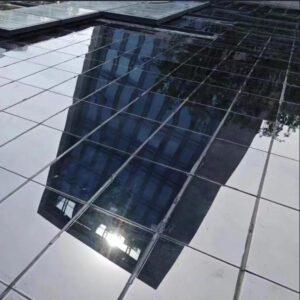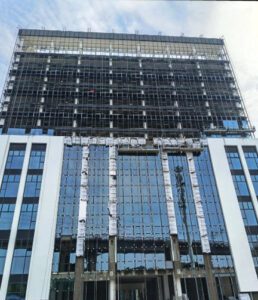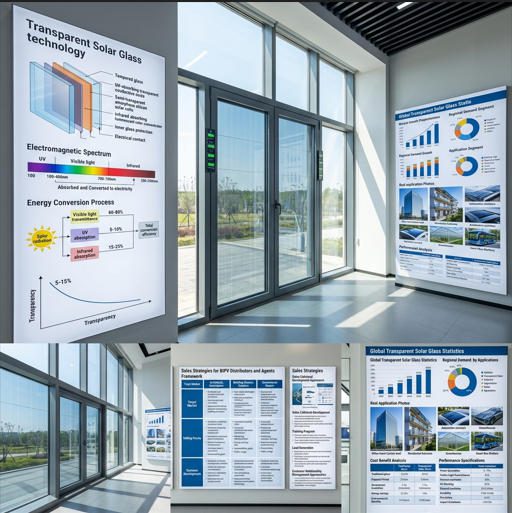
Industry Insight for Solar Distributors & Agents
The Transparency Paradox: Why Solar Glass Works Better Than You’d Think
Understanding the science behind transparent solar technology — and how it resolves the objections that stall your biggest B2B deals.
The Misconception That’s Costing You Sales
Picture this: a procurement manager at a commercial developer sits across from your sales rep, arms folded, and delivers the line you’ve heard a hundred times — “If the glass is see-through, how can it possibly generate real energy?” The meeting stalls. The deal drifts. A competitor with conventional rooftop panels wins the contract by default.
That moment — that single misconception — is the transparency paradox. And it’s quietly costing distributors, agents, and building-material suppliers significant revenue every quarter.
The paradox sounds intuitive: solar panels are black or dark blue because they need to absorb light, so something you can see through must be inferior. The logic feels airtight — but it’s built on a fundamental misunderstanding of how sunlight actually works. Sunlight is not just the visible spectrum. It is a vast electromagnetic band that includes ultraviolet (UV) and infrared (IR) wavelengths that are invisible to the human eye — and those wavelengths are precisely what advanced transparent solar technology captures.
This article exists to arm you — the distributor, the agent, the building-materials consultant — with the scientific clarity and commercial talking points you need to convert sceptical buyers into confident customers. We’ll move through the physics, the market data, the application landscape, and the go-to-market strategy, so that the next time a prospect challenges you with the transparency paradox, your answer is so grounded and specific that it closes the room.
Structure 1: The Science of Light Spectrum and Solar Capture

Understanding the Complete Light Spectrum
The light that strikes a window on a clear afternoon is not a single thing — it is a mixture of electromagnetic waves spanning a wide range of wavelengths. Solar energy professionals already know this, but buyers outside the industry rarely do, and that gap in understanding is where the transparency paradox lives.
Visible Light vs. Invisible Light Wavelengths
The human eye perceives light in the wavelength range of roughly 400 nm to 700 nm. This is what we see as colour — violet at one end, red at the other. But the sun radiates energy well beyond this narrow band. Ultraviolet radiation (10–400 nm) carries high-energy photons capable of damaging skin cells and fading furniture. Infrared radiation (700 nm to 1 mm) is the warmth you feel through a car window. Together, UV and IR account for roughly 46% of the total solar energy reaching Earth’s surface.
The Solar Electromagnetic Spectrum at Earth’s Surface
Why Opaque Panels Miss Critical Energy Opportunities
Traditional crystalline silicon panels are designed to absorb across the full spectrum — including visible light — which is why they appear dark. This works beautifully on a rooftop where nobody needs to look through them. But the moment a building has facades, windows, skylights, or canopies that require transparency, those conventional panels are simply the wrong tool. They block daylight, requiring buildings to compensate with artificial lighting — which erodes the very energy savings the panels are supposed to provide.
Transparent solar technology solves this by selectively harvesting the UV and IR bands while allowing visible light to pass through at rates of 60–90%, depending on the product specification. No view is sacrificed. No daylight is lost. And the building generates clean energy from surfaces that would otherwise be passive glass.
How Transparent Solar Cells Operate Differently
The Perovskite Revolution in Solar Technology
Perovskite solar cells have emerged as the defining technology enabling true transparency at commercially relevant efficiencies. Unlike silicon — which has a fixed bandgap that absorbs across the visible spectrum — perovskite materials can be chemically tuned to target specific wavelength bands. Research published in the AIP Applied Physics Reviews (2025) demonstrates perovskite transparent solar cells achieving average visible transmittance (AVT) above 70%, while still delivering power conversion efficiencies in the 12–13% range for semi-transparent configurations. This is a profound leap from the 2–4% figures that many buyers still cite from decade-old references.
Multi-Layer Light Absorption Without Opacity
The architecture of a transparent solar cell typically involves multiple ultra-thin functional layers — a transparent conductive oxide (TCO) front electrode, the active light-absorbing layer, and a transparent rear electrode — all engineered to be optically clear in the visible band. The active layer is where the magic happens: organic salts, perovskite crystals, or quantum-dot materials absorb UV and near-infrared photons and convert them to electron-hole pairs that drive current through the external circuit. To the eye, the glass simply looks slightly tinted, like a high-quality architectural glass — while silently generating electricity.
Structure 2: Debunking the “Opaque Equals Efficient” Myth

The Historical Context of Solar Panel Design
Why First-Generation Panels Were Opaque
The dominance of dark, opaque silicon panels was never about physics dictating that opacity equals efficiency. It was about economics and manufacturing maturity. When the solar industry scaled commercially through the 1980s and 1990s, crystalline silicon was the only technology with proven durability, established supply chains, and a path to cost reduction. Silicon happens to absorb visible light along with UV and IR — making it opaque — but opacity was a consequence of material choice, not a requirement for energy conversion.
The “opaque equals efficient” belief became embedded in the market’s mental model because for three decades, it was statistically true simply because no competitive transparent alternative existed at scale. That era is now ending.
How Technology Has Evolved Beyond That Limitation
Between 2015 and 2025, investment in thin-film, organic, and perovskite photovoltaics accelerated dramatically. The MIT Energy Initiative’s transparent solar cell programme demonstrated that selective UV and near-infrared absorption — with minimal visible-light impact — could be achieved using organic luminescent solar concentrator coatings. Michigan State University researchers hit a milestone 8% efficiency for fully transparent solar windows. These are not lab curiosities; they are now moving into commercial production at scale, with manufacturers like those in Jia Mao BIPV’s supply chain bringing certified products to market for distributor channels globally.
Real-World Efficiency Comparisons
Transparent Solar vs. Traditional Silicon Panels
| Parameter | Traditional Silicon (Opaque) | Semi-Transparent Solar | Fully Transparent Solar |
|---|---|---|---|
| Power Conversion Efficiency | 15–22% | 10–13% | 5–8% |
| Visible Light Transmission (VLT) | <5% | 30–60% | 60–90% |
| Primary Application | Rooftops, ground-mount | Skylights, canopies, facades | Windows, curtain walls, automotive |
| Архитектурная интеграция | Very Limited | Умеренный | Превосходно |
| Price per Watt (2025 estimate) | $0.25–$0.40 | $0.70–$1.20 | $1.50–$2.50 |
| Degradation Rate (annual) | 0.5–0.7% | 0.5–0.8% | 0.5–0.8% |
| Typical Warranty | 25–30 years | 25–30 years | 25–30 years |
| Dual-Purpose Value | None (energy only) | Partial (energy + partial light) | Full (energy + full transparency) |
Performance Metrics Your Customers Need to Know
The critical insight for your sales conversations is this: efficiency comparisons in isolation are misleading for transparent solar applications. A rooftop is optimised for energy density — so a 20% efficient opaque panel wins there. But a curtain wall, a skylight, or a car sunroof has two simultaneous functions: transmitting light and generating energy. Transparent solar is the only technology that fulfils both. Measured against dual-function performance rather than raw watt-per-square-metre output, transparent solar has no competitor.
One commercial building project in South Korea documented building energy offset improvements of 8–14% from transparent facade integration alone — without compromising any interior daylighting standard. That kind of data point resonates with facilities managers and ESG compliance officers in a way that raw wattage comparisons never will.
Structure 3: The Physics of UV and Infrared Capture
▲ An accessible technical breakdown of how transparent solar cells capture UV and near-infrared energy while remaining visually clear.
Ultraviolet Light Absorption in Transparent Cells
How UV Wavelengths Contribute to Energy Generation
Ultraviolet photons carry more energy per quantum than visible-light photons — this is why UV causes sunburn while ordinary indoor lighting does not. In transparent solar cells, organic luminescent materials or specially engineered perovskite compositions absorb these high-energy UV photons and re-emit them at longer wavelengths toward embedded thin-film photovoltaic elements at the glass edges or within the coating stack. The result is electricity generation with no visible impact on the glass appearance.
Because UV radiation is present even on overcast days — UV index readings are recorded even under heavy cloud cover — this component of transparent solar provides a baseline energy contribution regardless of direct sunlight availability. For buyers in northern European markets or rainy tropical climates, this is a particularly important data point.
The Role of Selective Light-Absorbing Materials
Luminescent Solar Concentrators (LSCs) and organic photovoltaic (OPV) materials are two of the primary material platforms enabling selective UV absorption. LSCs use fluorescent dye molecules dissolved within or coated onto glass. These dyes absorb UV photons, re-emit them as longer-wavelength photons, and guide them via total internal reflection to small PV strips at the glass perimeter. MIT’s Energy Initiative has published extensively on this approach, demonstrating systems that maintain greater than 70% visible light transmission while still generating measurable power from window-sized panels.
Infrared Light Harvesting Without Blocking Visibility
Thermal Energy Conversion in Transparent Systems
Infrared wavelengths account for approximately 51% of the solar energy reaching Earth’s surface. Standard window glass already absorbs much of the far-infrared band, converting it to heat — which is why a closed car gets hot in summer. Transparent solar technology intercepts near-infrared radiation (NIR, approximately 700–1400 nm) before it becomes waste heat, converting it instead to electrical current. This dual benefit — energy generation plus reduced solar heat gain — is particularly compelling for commercial buildings in hot climates where air conditioning loads dominate energy expenditure.
A 5,000 m² commercial glass facade in a city like Dubai or Singapore, retrofitted with NIR-absorbing transparent solar coating, could simultaneously reduce cooling loads by an estimated 15–20% и generate on-site renewable electricity. The combined financial value, correctly modelled and presented, substantially narrows the cost premium of transparent solar versus conventional glass replacement.
Maintaining Visual Clarity While Capturing Heat Energy
The engineering challenge is precise spectral tuning — designing active materials that have a strong absorption cross-section in the NIR band but minimal absorption in the 400–700 nm visible window. This is achieved through quantum-dot engineering, where the particle size of semiconductor nanocrystals is precisely controlled to dictate absorption wavelength. Quantum dots of different compositions and sizes can be mixed to create a “cocktail” absorption profile that maximally covers UV and NIR while leaving the visible window clear — like a precision optical filter built into the glass itself.
📖 Quick-Reference Glossary for Sales Teams
- Bandgap
- The energy threshold that a photon must exceed to be absorbed by a semiconductor material. Silicon’s fixed bandgap causes it to absorb visible light; perovskite bandgaps are tunable.
- AVT (Average Visible Transmittance)
- The percentage of visible-spectrum light (400–700 nm) that passes through a material. Higher AVT = more see-through. Premium transparent solar targets AVT ≥ 60%.
- Power Conversion Efficiency (PCE)
- The fraction of incident solar energy converted to electricity. Expressed as a percentage. A 10% PCE panel converts 10 W for every 100 W of sunlight hitting its surface.
- BIPV (Building-Integrated Photovoltaics)
- Solar PV technology physically integrated into the building envelope (windows, facades, roofs) rather than added on top. Transparent solar glass is BIPV by definition.
- NIR (Near-Infrared Radiation)
- Electromagnetic radiation with wavelengths between ~700–1400 nm. Invisible to the eye, but detectable as heat. A key target for transparent solar energy harvesting.
- LSC (Luminescent Solar Concentrator)
- A type of transparent solar device where embedded dye molecules absorb and re-direct specific photons to edge-mounted PV cells. Enables energy-generating windows with high clarity.
Structure 4: Visible Light Transmission Explained
How Transparent Solar Maintains See-Through Capability
The Engineering Behind Partial Light Transmission
The key performance parameter that buyers ask about most is AVT — Average Visible Transmittance. This is simply the percentage of light in the 400–700 nm range that passes through the solar glass. Standard clear architectural glass has an AVT of around 85–90%. Standard tinted or low-E glass runs 50–70%. Transparent solar products sit along a design spectrum that trades AVT against power output — a product engineered for maximum transparency (AVT 80–90%) will have lower efficiency than one with AVT 50–60%, but it will look virtually identical to standard glass from both sides.
The decision about where on this spectrum to specify a product is one that your technical sales team should make jointly with the architect or building specifier. A skylight over a museum gallery has different light requirements than a south-facing curtain wall on an office tower. Getting this consultation right is where specialist distributors add value that commodity solar suppliers cannot replicate.
Optical Transparency Levels and Energy Trade-offs
AVT vs. Power Conversion Efficiency — The Design Trade-off Spectrum
Applications Where Visibility Matters Most
Building-Integrated Photovoltaics (BIPV) Use Cases
BIPV is the primary commercial market for transparent solar glass, and it is growing explosively. The global BIPV market reached USD 31.1 billion in 2025 (IMARC Group) and is forecast to expand at 15.8% CAGR through 2034. Office tower curtain walls, retail atrium skylights, airport terminals, and hospital facades are all active target segments. These projects are typically specified two to three years before construction, which means distributors who are building architect and engineer relationships now are positioning for significant order flow in 2027–2029.
For more information on how transparent BIPV glass integrates into facades and curtain walls, Jia Mao BIPV provides detailed product specifications and application guidance for professional distributors and project specifiers.
Automotive and Window Applications for Your Market
The automotive sector represents the next frontier. EV manufacturers are actively trialling solar-generating sunroofs and rear windows that extend driving range without increasing battery weight. The global automotive smart glass market is projected to reach USD 5.0+ billion by 2031. While full-scale automotive rollout is still 3–5 years from mainstream adoption, distributors supplying tier-2 automotive component manufacturers should begin building product knowledge and supplier relationships now. Early movers will define the supply chain for this application.
Structure 5: Real-World Applications for Your Distribution Network

Commercial Building Integration
Transparent Solar in Office Windows and Skylights
Consider the case of a 20-storey commercial office tower with 4,000 m² of south- and west-facing glass facade. At current conventional glazing, that surface contributes nothing to the building’s energy balance — and in summer, it’s actually a net negative, adding cooling load. Replacing it with a glass-integrated solar panel facade system with 7% PCE and 70% AVT generates approximately 70,000–100,000 kWh annually — enough to power 30–40 average European apartments — while maintaining full visual transparency for occupants.
Skylights are equally compelling. A shopping mall with 500 m² of skylight glazing sees both energy generation and HVAC benefits from NIR-absorbing transparent solar. Retailers in the UK, Germany, and South Korea are already specifying this in new development projects. Comparing products for skylight and window applications requires careful attention to structural load ratings, frame compatibility, and local building codes — expertise that specialist distributors with the right supplier partner can provide.
Energy Savings Without Aesthetic Compromise
One of the most powerful B2B arguments is the elimination of the aesthetics-versus-sustainability trade-off. Green building certification schemes — LEED, BREEAM, EDGE — reward both energy generation and daylighting quality. A transparent solar facade simultaneously contributes to both criteria, whereas conventional rooftop panels contribute to energy generation while potentially conflicting with architectural design intent. For the premium commercial property market, where landlords compete on LEED Platinum and net-zero credentials to attract corporate tenants paying premium rents, this dual contribution is worth real money.
Residential Market Opportunities
Greenhouse and Conservatory Applications
Research published in ScienceDirect (2025) demonstrated that a fully glazed solar greenhouse with semi-transparent PV modules can theoretically offset up to 100% of its energy consumption in high-irradiance global locations. Even in more conservative European scenarios, researchers found that well-designed agrivoltaic greenhouses covering 1,000 m² could generate 30,000–60,000 kWh annually without statistically significant impact on crop yield for most common cultivars. For your distributor network, this translates to a compelling pitch to horticultural suppliers, managed growing operations, and premium home conservatory installers — all of whom have significant untapped appetite for this product category.
Balcony and Terrace Solar Solutions
Urban residential is the segment growing fastest in terms of inquiry volume. In high-density cities where rooftop access is shared or unavailable to individual apartment dwellers, balcony-mounted transparent solar railings and balustrades represent the only viable personal solar option. South Korea’s recent residential building programmes have made transparent solar balconies a headline feature in new apartment marketing materials — a trend that is beginning to replicate in European and Southeast Asian markets. For balcony BIPV solar railing costs, codes, and ROI data, Jia Mao BIPV’s technical documentation provides installers and distributors with the specification detail needed to quote confidently.
Emerging Automotive Sector
Vehicle Window Integration Potential
Toyota, Hyundai, and several European EV startups have publicised transparent solar roof panels as a range-extension feature. Real-world testing data from Hyundai’s solar roof programme showed that a full-coverage vehicle solar roof could add approximately 30–60 km of additional range per day under ideal conditions — not enough to replace charging, but enough to meaningfully reduce charging frequency for urban commuters. The component-level supply chain for these systems runs through specialist glass fabricators and thin-film coating suppliers, a space where well-positioned distributors with transparent solar product lines will have significant first-mover advantage.
Market Growth Projections for Automotive Solar
Transparent Solar Market by Application Segment — 2025 Estimated Share
Structure 6: The Competitive Advantage for Your Sales Team
Addressing Customer Objections with Science
“Won’t Transparent Solar Be Less Efficient?” — The Data-Driven Response
Your prospect is not wrong that the raw PCE number is lower. The correct response is never to dispute that — it is to reframe the comparison. Try this framing: “You’re right that a transparent solar panel generates fewer watts per square metre than a conventional silicon panel. But that comparison only makes sense when both products are competing for the same rooftop space. Transparent solar glass is not competing with rooftop panels — it’s competing with ordinary window glass, which generates zero watts. Compared to the glass it replaces, transparent solar’s efficiency is essentially infinite.”
This reframe works because it is logically airtight. The procurement manager has been comparing the wrong products. Once that mental model shifts, the conversation moves from “is it efficient enough” to “how much can we capture from this facade area” — and that is a much more productive sales conversation.
“How Does It Compare to Traditional Panels?” — The Honest Comparison
Where traditional panels genuinely outperform on energy density, say so. Integrity builds trust with technical buyers. The honest answer is: for dedicated energy generation on available non-architectural surfaces, conventional silicon wins on pure watt-per-dollar economics today. But where the surface serves a dual function — thermal management, daylight admission, architectural aesthetics, noise insulation — transparent solar changes the economic equation entirely by adding value that conventional panels cannot provide. This positions you as a knowledgeable partner rather than a salesperson pushing a product, which is exactly the credibility profile that wins long-term distribution relationships.
Positioning Transparent Solar as a Premium Solution
Higher Margins and Differentiation Strategy
Transparent solar glass commands a price premium — and for distributor margins, that is good news. Commodity crystalline silicon panels are a ruthlessly competitive market where Chinese manufacturers compete on fractions of a cent per watt. Transparent solar, especially BIPV-grade products with architectural certifications, competes in a specification-driven market where technical expertise, product knowledge, and installation support are differentiators that justify margin. A distributor who positions themselves as a transparent solar specialist can realistically maintain 25–40% gross margins on BIPV glass products, compared to 8–15% on conventional panel supply.
Customer Segments Most Receptive to This Innovation
Based on procurement pattern data across active BIPV markets, the highest-conversion customer segments are: (1) Premium commercial real estate developers targeting LEED Platinum or net-zero building certifications; (2) Architectural glazing contractors seeking product differentiation for high-value tender submissions; (3) Agricultural operators with large greenhouse footprints and high energy costs; (4) Automotive Tier-2 suppliers building component portfolios for EV programmes; and (5) Urban residential developers in markets with strict renewable energy mandates (EU, South Korea, Japan). These segments have in common a buyer who is already motivated by factors beyond pure price — aesthetics, certification, innovation positioning — which means the transparent solar conversation is already half-won before it starts.
Structure 7: Installation and Technical Specifications
Compatibility with Existing Infrastructure
Integration with Current Electrical Systems
Transparent solar glass modules output DC electricity in the same way as conventional PV panels. They connect to standard inverter systems — string inverters, microinverters, or DC optimisers — without requiring proprietary hardware in most cases. The primary technical consideration is that facade and window installations introduce different cable management requirements compared to rooftop systems: conduit must be routed within curtain wall mullions or hidden within wall cavities rather than run across roof surfaces. This requires coordination with the facade contractor during project design, which is a service-level capability that separates qualified BIPV distributors from general solar suppliers.
Retrofitting Opportunities for Your Existing Customers
For existing customers with already-installed conventional solar systems, transparent solar represents an additive revenue opportunity, not a cannibalisation risk. A commercial building with rooftop panels can add facade-integrated transparent solar to generate additional capacity from previously passive surfaces. This “solar everywhere” approach is increasingly being written into building energy standards in the EU under the revised Energy Performance of Buildings Directive (EPBD 2024), which requires new and renovated buildings to use all technically feasible building surfaces for energy generation. Distributors with both conventional and transparent solar product lines can offer turnkey multi-surface solar solutions that competitors with single-product portfolios cannot.
For a step-by-step overview of the BIPV installation and design process, including structural, electrical, and code compliance checkpoints, Jia Mao BIPV’s technical documentation is an excellent resource to share with your project management teams.
Performance Metrics Distributors Should Know
Efficiency Ratings and Certification Standards
When sourcing transparent solar products, ensure your supplier can provide documentation for the following certifications: IEC 61215 (design qualification for crystalline silicon modules), IEC 61646 (thin-film module performance), and UL 1703 (US safety standard for flat-plate PV modules). For architectural glazing applications specifically, additional certifications covering structural performance — impact resistance, wind load, and fire classification — are required in most markets. The EU’s Construction Products Regulation (CPR) and CE marking requirements apply to BIPV glass used as a structural building component. Understanding the full certification landscape for BIPV glass is essential for distributors entering regulated construction markets.
Durability, Warranty, and Long-Term Performance Data
| Performance Metric | Transparent Solar Glass | Conventional Silicon Panel | Verdict |
|---|---|---|---|
| Product Warranty | 25–30 years | 25–30 years | Comparable ✓ |
| Power Output Warranty | ≥80% at year 25 | ≥80–83% at year 25 | Comparable ✓ |
| Annual Degradation Rate | 0.5–0.8% | 0.5–0.7% | Comparable ✓ |
| Impact Resistance (laminated) | Excellent (laminated safety glass) | Good (tempered glass front) | Transparent Solar Advantage ✓ |
| Maintenance Frequency | Quarterly cleaning | Quarterly cleaning | Comparable ✓ |
| Temperature Coefficient | -0.20 to -0.35%/°C | -0.35 to -0.45%/°C | Transparent Solar Advantage ✓ |
| Salt Mist / Humidity Resistance | IEC 61701 (certified products) | IEC 61701 standard | Comparable ✓ |
Structure 8: Market Trends and Growth Opportunities
Global Adoption Rates for Transparent Solar Technology
Regional Market Leaders and Emerging Markets
Europe currently leads in BIPV adoption, driven by the EU’s aggressive building energy standards and the revised EPBD mandating solar-ready building envelopes by 2030. Germany, France, the Netherlands, and the UK have active BIPV projects across commercial, educational, and public sector buildings. Asia-Pacific is the fastest-growing region: China has integrated BIPV requirements into several provincial green building standards, while South Korea and Japan have active government incentive programmes specifically for building-integrated solar.
The Middle East represents a high-growth emerging market that is systematically underestimated. Countries like the UAE and Saudi Arabia have extremely high solar irradiance, ambitious net-zero timelines (UAE Net Zero 2050, Saudi Vision 2030), and massive planned urban construction programmes. The combination of high UV intensity, large glazed building envelopes (for thermal isolation), and government-backed sustainability mandates creates near-ideal demand conditions for transparent solar glass. Distributors with GCC-region presence should be actively building product portfolios now.
Transparent Solar BIPV Adoption Index by Region (2025) — Relative Market Maturity Score
Investment and R&D Trends in the Sector
Global R&D investment in transparent and semi-transparent photovoltaics exceeded USD 2.4 billion in 2024 across government programmes, corporate labs, and venture capital. The US Department of Energy’s Building Technologies Office has funded multiple transparent solar demonstration projects. In Europe, Horizon Europe programmes are actively funding BIPV standardisation and certification work. This level of institutional investment signals strong confidence that efficiency and cost-reduction trajectories will continue — meaning products available to your customers in 2027–2028 will have meaningfully better performance than what you’re selling today. Building your distributor position now, during the market development phase, is the strategy that delivers the best long-term return.
Future Innovations on the Horizon
Next-Generation Transparent Solar Cells
The most closely watched development is the commercialisation of tandem perovskite-silicon transparent cells — stacking a perovskite top cell tuned for UV/blue and a silicon bottom cell tuned for red/NIR into a single transparent module. Early tandem prototypes from research groups in Germany and South Korea have demonstrated efficiencies above 15% with AVT above 30%, and several manufacturers are targeting commercial pilot production by 2026–2027. If tandem transparent technology reaches scale at commercially viable costs, it will fundamentally reshape the value proposition — offering efficiency figures competitive with conventional silicon while maintaining meaningful transparency.
Integration with Smart Glass and IoT Technologies
Transparent solar is increasingly being designed as one layer in a multi-functional smart glass stack. Photovoltaic smart glass can combine energy generation with electrochromic dimming (electrically controlled tinting), real-time energy monitoring via embedded sensors, and direct integration with Building Management Systems (BMS) through IoT protocols. A single smart glass panel might simultaneously generate electricity, modulate glare, transmit occupancy data, and adjust in response to weather forecasts — all managed by the building’s AI-driven energy management platform. This convergence of transparent solar with smart building technology is where the product category transitions from “interesting specialty product” to “essential building systems infrastructure.” Distributors who establish themselves in the BIPV space now will be positioned to supply this converged product category as it matures.
Structure 9: Training Your Sales Team and Customers
Educational Talking Points for Your Agents
The Elevator Pitch: Explaining Transparent Solar in 60 Seconds
“Solar panels work by converting light into electricity. The reason conventional panels are black is that silicon absorbs all visible light. But sunlight also contains ultraviolet and infrared radiation — invisible to the human eye — that carry just as much energy. Transparent solar glass targets only those invisible wavelengths, letting visible light pass straight through. So you get glass that looks like glass, allows daylight in, and still generates clean electricity. It’s not replacing your rooftop solar — it’s turning surfaces that were previously just glass into additional energy-generating assets. The building code is increasingly requiring it, architects are specifying it, and tenants are asking for it.”
Deep-Dive Technical Explanations for Technical Decision-Makers
For structural engineers, MEP consultants, and building energy modellers, the conversation needs more precision. Key technical points to master: (1) The specific wavelength bands targeted by the product you’re selling — UV-selective, NIR-selective, or broadband UV+NIR; (2) the exact AVT value and how it compares to the project’s daylighting performance target; (3) the module’s rated power output per m² at standard test conditions (STC: 1000 W/m² irradiance, 25°C cell temperature, AM1.5 spectrum); (4) the temperature coefficient — how output changes per degree above 25°C, which matters greatly in tropical and desert climates; and (5) the structural properties of the glass — laminated composition, thickness, wind and impact resistance ratings.
Preparing a one-page technical data sheet comparison for your key product lines — organised around these five parameters — will pay dividends in shortening the technical review cycle in commercial specification processes.
Visual Aids and Demonstration Materials
Creating Effective Infographics for Your Sales Materials
The most effective single sales aid for transparent solar is a physical glass sample pair: one piece of conventional tinted glass and one piece of your transparent solar product, held up side by side in natural light. The visual similarity is more persuasive than any chart or slide deck — it immediately shows that the transparency claim is real. Pair this with a small demonstration module connected to a multimeter or a small LED light, so the prospect can see electrical output in real time. This tangible demonstration converts scepticism into curiosity in a way that data alone cannot.
Video Content That Converts Prospects to Customers
For digital marketing and pre-meeting nurturing, short-form video content (60–90 seconds) explaining the UV and infrared capture mechanism performs exceptionally well with technical B2B audiences on LinkedIn. Use simple animations showing the light spectrum, a visualisation of which wavelengths the glass captures versus transmits, and a real-world building footage example. Testimonial video from a contractor who has installed a completed project — with specific kWh generation data and client satisfaction commentary — is the highest-converting content format for procurement decision-makers evaluating transparent solar for the first time. MIT’s transparent solar cells research page also provides credible third-party scientific validation that you can reference in your digital content.
Structure 10: Implementation Strategy for Distributors
Building Your Product Portfolio Strategy
Which Transparent Solar Products Should You Stock?
Avoid the trap of trying to carry every transparent solar product variant from day one. The most effective portfolio entry strategy for a distributor is to identify the one or two application segments with the highest demand in your territory, and stock depth — not breadth — in those applications. If commercial office development is strong in your region, prioritise facade-grade BIPV glass in the 30–60% AVT range with relevant wind-load certifications. If agricultural greenhouse development is prominent, prioritise semi-transparent modules with agricultural light transmission data.
Reviewing the top BIPV products with pricing and installation guidance from a specialist manufacturer perspective can help distributors understand which product configurations drive the most project wins in each application category. Jia Mao BIPV offers distributor partners exactly this kind of application-specific guidance, with technical support teams available to assist in specification decisions for individual project tenders.
Pricing Strategy and Margin Optimisation
| Product Tier | AVT Range | Typical PCE | Est. Price/m² (FOB) | Target Application | Distributor Gross Margin |
|---|---|---|---|---|---|
| Semi-Transparent (Entry) | 30–50% | 10–13% | USD 80–130 | Skylights, canopies, greenhouses | 28–35% |
| Transparent Standard | 50–70% | 7–10% | USD 130–200 | Office facades, commercial glazing | 30–40% |
| High-Clarity Architectural | 70–90% | 4–7% | USD 200–380 | Premium facades, luxury residential | 35–45% |
| Smart Glass Integration | Variable (electrochromic) | 5–9% | USD 350–600+ | High-spec commercial, automotive | 40–50% |
*Estimated price and margin ranges based on current market data; actual figures vary by supplier, order volume, and regional market conditions. Contact your supplier for specific quotations.
Go-to-Market Plan for Your Distribution Network
Launch Timeline and Territory Rollout
A realistic 12-month market entry timeline for a distributor adding transparent solar to their portfolio should be structured in three phases. During months 1–3, the focus is on product certification and technical training: ensure your team has completed product training with your supplier, received sample kits, and built a reference data sheet library for your key SKUs. During months 4–6, the priority shifts to market development: identify the top 10 architectural firms, glazing contractors, and building developers in your territory and set up technical briefings. Offer free sample glazing units for project mock-up evaluation. During months 7–12, the transition to commercial deployment occurs: first projects go through specification, tender, and order, with intensive after-sales support to generate the reference site case studies that will fuel subsequent sales cycles.
Support Systems and Customer Service Excellence
The most common distributor failure mode in technical product categories is insufficient post-sale support. A commercial building contractor who encounters an unexpected installation challenge and cannot reach a knowledgeable technical support contact will not reorder — and will tell colleagues. Build a simple technical support capability before your first project goes to site: a WhatsApp group or dedicated email channel with your supplier’s technical team included, a library of installation guides and FAQs in the local language, and a clear escalation path for performance monitoring questions. Jia Mao BIPV’s distributor partner programme is designed to support exactly this level of post-sale technical engagement, enabling your team to deliver the project confidence that converts one-time buyers into repeat accounts.
Turning the Transparency Paradox Into Your Competitive Edge
The science is clear and settled: sunlight is not just visible light. UV and infrared radiation — invisible to the eye — carry nearly half of all solar energy reaching Earth’s surface. Transparent solar technology captures precisely those bands, leaving visible light free to pass through unimpeded, while generating clean electricity from surfaces that were previously passive glass. The efficiency numbers that worry prospects are real, but they are the wrong numbers for the wrong comparison. Compared to the conventional glass they replace, transparent solar panels deliver effectively infinite improvement in energy performance.
The market is following the technology. The global BIPV market is a USD 31-billion and rapidly growing category. The transparent solar panel segment is expanding at 21% annually. Building energy codes in Europe, Asia, and increasingly the Americas are mandating solar integration across all viable building surfaces — not just rooftops. The demand is being built into the regulatory environment. The question is not whether your market will adopt transparent solar, but whether you will be the distributor positioned to supply it when the adoption curve accelerates.
Distributors and agents who understand the physics, speak the language of the architecture and construction industry, carry certified products with proper technical documentation, and deliver the after-sales support that complex projects require — those are the partners who will define the transparent solar supply chain in their regions for the next decade. The transparency paradox is your competitive asset. Use it.
Часто задаваемые вопросы
Comprehensive answers to the questions your customers — and your sales team — ask most about transparent solar technology.
How much energy can transparent solar cells actually generate compared to opaque panels?
Will transparent solar panels block the view through windows and glass surfaces?
What wavelengths do transparent solar cells capture if they let visible light through?
Are transparent solar cells more expensive than traditional solar panels?
Can I install transparent solar on existing windows without full replacement?
What’s the lifespan and warranty of transparent solar products?
How does weather and temperature affect transparent solar performance?
Which industries and applications are best suited for transparent solar?
Do transparent solar cells require special maintenance or cleaning?
How do transparent solar cells work with smart building systems?
What certifications and standards should I look for when sourcing transparent solar products?
Can transparent solar be combined with other renewable technologies?
What’s the ROI timeline for transparent solar installations?
How does transparent solar perform in different climate zones?
What’s the difference between transparent solar and semi-transparent solar products?
Ready to Lead Your Market Into the Future of Solar?
As a distributor, agent, or building-materials contractor, mastering transparent solar technology positions you ahead of competitors and prepares your business for the next decade of solar innovation. Connect with Jia Mao BIPV — a specialist BIPV manufacturer with certified transparent solar glass products, full technical documentation, and a distributor support programme designed for serious channel partners.