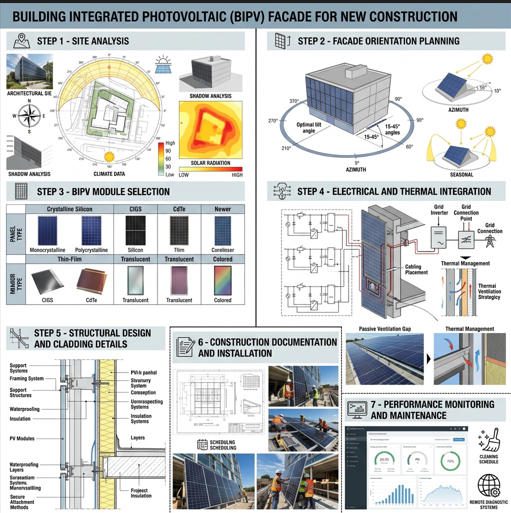

Between 2020 and 2025, the global building-integrated photovoltaics (BIPV) facade market surged from roughly $2.1 billion to an estimated $4.5 billion, with industry analysts projecting a compound annual growth rate above 13% through 2035. Those numbers are not abstract — they represent thousands of real construction projects in which architects, developers, and general contractors replaced conventional cladding with energy-generating facade panels and, in many cases, achieved payback periods under eight years while earning LEED or BREEAM certification credits.
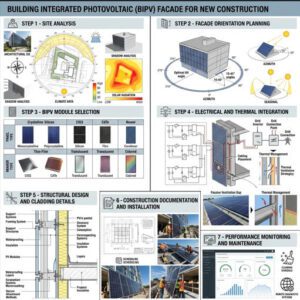
This guide walks through every decision point you will face when integrating BIPV into a new-build facade — from defining performance targets in the earliest schematic design meetings to writing the maintenance plan that keeps panels producing electricity decades after the ribbon cutting. Each of the ten steps below includes quantifiable benchmarks, code references, and field-tested recommendations drawn from published case studies and manufacturer data. By the end, you will have a repeatable workflow that any design team can adopt, whether the project is a 6-story office block in Rotterdam or a 40-story mixed-use tower in Shanghai.
Three considerations thread through every step: aesthetics (because a facade that looks like an afterthought will never win planning approval), performance (because the electricity generated must justify the investment), and lifecycle (because a 25-year power warranty is meaningless if the waterproofing fails in year five).
1) Define Project Goals, Constraints, and Success Metrics
Align with Architectural Vision and User Needs
Before a single module datasheet appears on anyone’s desk, the project team needs to answer a deceptively simple question: Why does this building need a BIPV facade? The answer shapes every downstream decision. A developer pursuing net-zero certification will prioritize maximum power density. A cultural institution may weight visual transparency at 40% or higher to maintain interior daylighting. A hospital with strict fire-safety codes in a seismic zone will constrain framing choices to steel-backed unitized curtain-wall systems rated for wind pressures above 4.0 kPa.
Documenting these priorities in a formal design brief — shared among the architect, facade consultant, MEP engineer, and BIPV supplier — prevents the costly mid-project scope changes that derailed at least 23% of BIPV facade projects surveyed by IEA-PVPS Task 15 between 2018 and 2024. Include explicit ranking of goals: Is energy yield more important than transparency? Is color uniformity more important than cost per watt-peak?
Establish Performance Targets (Energy, Daylight, Insulation)
Quantify your targets early. A well-defined project brief should specify the annual energy yield target in kWh/m² of facade area, the required thermal transmittance (U-value) — typically ≤ 0.30 W/m²·K for cold climates — and the visible light transmittance (VLT) percentage for any semi-transparent zones. For context, an opaque monocrystalline BIPV facade panel oriented due south in central Europe can produce 80–120 kWh/m² per year, while a semi-transparent panel at 20% transparency will yield roughly 40–65 kWh/m², according to data published by the Fraunhofer Institute for Solar Energy Systems.
Manufacturers such as Jia Mao Bipv, whose Shanghai factory operates at an annual capacity of 3 GW, supply facade modules with monocrystalline cell efficiencies above 22% and transparency options ranging from 10% to 90% — a range wide enough to satisfy most architectural briefs without resorting to custom cell layouts.
2) Assess Site, Climate, and Building Envelope Context
Climate Data and Solar Access Analysis
Facade-mounted BIPV operates under very different irradiance conditions than a tilted rooftop array. A vertical south-facing wall in Frankfurt, Germany, receives approximately 60–70% of the annual irradiation that falls on an optimally tilted rooftop surface at the same latitude. East and west facades capture roughly 40–50%, and a north facade in the northern hemisphere may collect as little as 20–30%. These ratios shift significantly near the equator, where east and west facades can rival south-facing surfaces during equinox months.
Run a site-specific irradiance simulation using tools such as PVsyst, Ladybug/Honeybee for Grasshopper, or Autodesk Insight. Feed in TMY (Typical Meteorological Year) data from the nearest weather station. The output — a heat map of annual kWh/m² on every facade surface — becomes the foundation for deciding which elevations justify the investment in BIPV and which are better served by conventional cladding.
Existing Site Constraints and Shading Analysis
Adjacent buildings, street trees, overhead bridges, and even the project’s own balconies or protruding floor slabs cast shadows that reduce BIPV output disproportionately. A shadow covering just 10% of a crystalline-silicon module surface can reduce its output by 30–50% unless bypass diodes or module-level power electronics are specified. Map all near-field and far-field obstructions, model their shadow paths across all seasons, and identify facade zones where annual shading losses exceed 25% — these zones are typically poor candidates for BIPV.

3) Select BIPV Technology and Module Types
Transparent vs. Opaque Modules, Aesthetics, and Transparency Targets
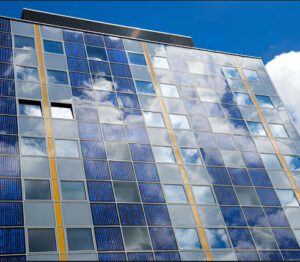
The choice between opaque, semi-transparent, and fully transparent BIPV modules is the single decision that most visibly defines the building’s character. Opaque modules — typically monocrystalline silicon cells laminated behind colored or textured glass — deliver the highest power density (up to 200 Wp/m²) and are ideal for spandrel panels and solid wall sections. Semi-transparent modules use spaced crystalline cells or patterned thin-film coatings to admit 10–40% visible light, making them suitable for vision-glass zones, atria, and lobbies. Fully transparent photovoltaic glass, often based on organic PV or luminescent solar concentrator technology, transmits 50–70% of visible light but currently generates only 20–50 Wp/m².
For a practical reference, the table below compares the four most common BIPV cell technologies used in facade applications:
| Technology | Cell Efficiency | Transparency Range | Typical Facade Yield (kWh/m²/yr)* | Relative Cost Index | Best Application |
|---|---|---|---|---|---|
| Monocrystalline Silicon (c-Si) | 20–24% | 0–40% | 80–120 | 1.0× (baseline) | Spandrel, opaque cladding |
| CdTe Thin-Film | 13–19% | 10–50% | 50–85 | 0.8× | Vision glass, curtain wall |
| CIGS Thin-Film | 14–20% | 10–30% | 55–90 | 0.9× | Colored/curved facades |
| Organic PV / DSC | 8–13% | 30–70% | 20–50 | 1.3× | High-transparency glazing |
| *South-facing vertical facade, central Europe latitude (~50°N). Source: Fraunhofer ISE, IEA-PVPS Task 15, manufacturer datasheets. | |||||
If you are evaluating transparent and semi-transparent options specifically, this transparent solar module selection guide provides a decision matrix that compares efficiency, haze factor, color rendering index, and cost per watt across the leading technologies available today.
Electrical Performance, Lifetime, and Warranty Considerations
BIPV modules function simultaneously as building materials and electrical generators, so their warranty structure is inherently dual. The industry standard product warranty covers manufacturing defects for 10–12 years, while the power performance warranty guarantees at least 80% of rated output at year 25. In practice, field data from the IEA-PVPS program shows crystalline-silicon BIPV modules degrading at 0.4–0.7% per year — meaning a well-maintained facade should still deliver 82–90% of its original output after a quarter century.
When evaluating suppliers, ask for IEC 61215 (design qualification) and IEC 61730 (safety qualification) test certificates. For facade-specific applications, EN 50583-1 and EN 50583-2 define additional requirements for BIPV modules used as building products. Jia Mao Bipv modules, for instance, carry both IEC certifications and meet the B1-grade flame retardancy classification required by Chinese and EU building material standards, backed by their proprietary double-layer POE encapsulation process that improves UV aging resistance by 40% compared to standard EVA encapsulant.
4) Envelope Integration: Structure, Airtightness, and Thermal Bridging
Structural Attachment and Load Paths for BIPV
A BIPV module must carry its own dead load plus wind suction and pressure loads — which on a high-rise facade at 150 meters elevation can exceed 3.5 kPa — through a clearly defined load path to the primary structure. The two dominant integration strategies are unitized curtain-wall systems, where BIPV glass is factory-assembled into aluminum-framed cassettes that bolt directly to embedded steel brackets at floor-slab edges, and stick-built systems, where mullions and transoms are installed on site and BIPV panels are glazed into them one by one.
Unitized systems reduce on-site labor by 30–45% and virtually eliminate weather-dependent delays because the cassettes are sealed in the factory. For projects above ten stories, or in regions with annual typhoon or hurricane risk, unitized integration is strongly recommended. Structural silicone glazing (SSG) can be used for frameless BIPV panels, but the adhesive must be validated for the specific glass-to-aluminum thermal expansion mismatch — a failure point that caused delamination in at least two documented European BIPV pilot projects between 2019 and 2022.
Sealing, Drainage, and Thermal Bridging Strategies
The junction between a BIPV module and the surrounding facade framing is a critical waterproofing interface. Specify EPDM gaskets rated for 25-year UV exposure, combined with pressure-equalized drainage channels that allow any water penetrating the outer seal to drain harmlessly to the building exterior. The thermal break between aluminum framing and the interior structure must achieve a minimum of 20 mm of polyamide or polyurethane insulation to prevent condensation on the interior face — a requirement codified in EN 13947 for curtain-wall thermal performance testing.

5) Electrical Design, Interconnection, and Energy Modeling
Array Layout, Inverters, Combiner Boxes, and AC/DC Considerations
Unlike rooftop arrays where modules share uniform tilt and orientation, a BIPV facade typically spans multiple elevations — south, east, and west — each receiving different irradiance profiles. Connecting modules from different orientations on a single string causes mismatch losses that can reach 15–20%. The solution is to design separate string circuits per elevation, each feeding its own MPPT (Maximum Power Point Tracker) input on a multi-MPPT string inverter, or to deploy module-level power optimizers that allow every panel to operate at its individual maximum power point regardless of neighbors.
Route DC wiring through concealed channels within the curtain-wall mullions, using fire-rated conduit (typically rated to 120 minutes in accordance with local building codes). Combiner boxes should be accessible from interior maintenance corridors, not buried behind sealed drywall. Voltage design must stay within the limits defined by NEC Article 690 (or IEC 62548 outside North America), which for most commercial installations means a maximum system voltage of 1,000 V DC in the U.S. and 1,500 V DC in Europe.
Grid Interconnection, Standards Compliance, and Safety
Before a BIPV facade system can export power to the grid — or even offset building loads through net metering — it must comply with the local utility’s interconnection requirements and relevant national electrical standards. In the United States, BIPV installations fall under NEC 690 (Solar Photovoltaic Systems) and NEC 705 (Interconnected Electric Power Production Sources). In the European Union, EN 50549-1 governs the connection of generation systems to the low-voltage distribution network. Rapid-shutdown requirements — mandated by NEC 2020 Section 690.12 — require that all conductors within 305 mm of the array boundary are de-energized to 80 V or less within 30 seconds of initiating shutdown, a requirement that heavily influences inverter and optimizer selection.
Watch: BIPV Design Principles — 8 Solar Facade Typologies Explained
Source: YouTube — covers egg-crated, folded, layered, and terrace facade typologies with real project case studies.
6) Building Energy Performance, Codes, and Certification Pathways
Compliance with Local Energy Codes and Green Standards
BIPV facades must satisfy two parallel regulatory tracks: the building material track (structural integrity, fire performance, weatherproofing) and the electrical equipment track (PV safety, grid connection, rapid shutdown). In the United States, the International Building Code (IBC) Section 1505 and the International Residential Code (IRC) Section R329 contain BIPV-specific provisions for wall coverings and fenestration. The 2025 California Building Code (CBC Title 24, Part 6) further requires whole-building energy modeling that accounts for the electricity generated by any BIPV elements when calculating compliance margins.
Fire classification is a non-negotiable gate. Facade BIPV modules used as exterior wall cladding in buildings over 12 meters must typically achieve a reaction-to-fire classification of B-s1,d0 or better under EN 13501-1 in Europe, and must pass NFPA 285 (Standard Fire Test Method for Evaluation of Fire Propagation Characteristics of Exterior Wall Assemblies) in the United States. Request the full fire-test report — not just the classification letter — from your module supplier before specifying any product.
Modeling to Verify Performance and Payback
Whole-building energy modeling software such as EnergyPlus, IES-VE, or DesignBuilder can simulate the combined thermal and electrical performance of a BIPV facade across an entire year. The model should capture the reduction in cooling loads caused by the BIPV panels absorbing and converting a portion of solar radiation that would otherwise heat the interior (a benefit quantified at 10–22% cooling load reduction in published studies of opaque BIPV spandrel panels in tropical climates), as well as the electricity generated and either consumed on-site or exported to the grid.
Feed the model outputs into a financial pro-forma that calculates net present value (NPV), internal rate of return (IRR), and simple payback period. The chart below illustrates a representative payback scenario for a BIPV facade on a mid-rise commercial office building:
Chart 1 — Estimated Simple Payback Period by Facade Orientation (Mid-Rise Office, Central Europe)
South Facade
East Facade
West Facade
North Facade
Assumptions: 10-story office, 50°N latitude, opaque c-Si modules at 190 Wp/m², electricity price €0.22/kWh, 0.5%/yr degradation, no incentives applied. Source: Compiled from Fraunhofer ISE benchmarks and IEA-PVPS Task 15 case studies.
7) Construction Sequencing, Integration with Trades, and Procurement
Installation Workflow and Site Logistics
BIPV facade installation sits at the intersection of three trades that rarely share a Gantt chart: the curtain-wall installer, the electrician, and the commissioning engineer. Coordination failures — such as the electrician arriving to pull DC cables two weeks after the curtain-wall crew has sealed all mullion cavities — are the leading cause of schedule overruns on BIPV projects. The solution is a single integrated installation sequence that is signed off by all three trade supervisors before any facade panel is lifted.
A typical workflow proceeds floor-by-floor from the bottom up: (1) install anchor brackets at floor-slab edges, (2) hang vertical mullions and horizontal transoms, (3) route DC conduit and pull home-run cables within mullion cavities, (4) glaze BIPV panels and non-PV infill panels, (5) make module-to-module series connections at each floor, (6) connect floor-level string cables to riser conduit, (7) seal all exterior joints and test waterproofing, (8) repeat on the next floor. Electrical testing — including insulation resistance, open-circuit voltage, and string polarity verification — should happen at step 5 before the joints are sealed, because accessing a miswired connection after sealing is ten times more expensive.
Procurement Strategy for Modules, Inverters, and Balance of System
BIPV modules have lead times of 8–16 weeks for standard catalog products and 12–24 weeks for custom-dimensioned or custom-colored panels. Ordering modules late is one of the most frequent procurement mistakes; it can push the entire facade schedule by months. Lock in module specifications and issue the purchase order no later than the 50% construction-document milestone. For inverters and power optimizers, lead times are shorter (4–8 weeks) but compatibility with the specific module voltage and current characteristics must be verified before ordering.
Working with a manufacturer that controls both the cell-lamination line and the glass-processing line — as Jia Mao Bipv does at its Shanghai facility — compresses lead times because there is no hand-off between separate glass fabricator and PV laminator. Their MES (Manufacturing Execution System) provides real-time production tracking, which allows the project manager to monitor exact panel completion dates against the facade-installation schedule.
8) Maintenance, Warranty, and Lifecycle Considerations
Cleaning, Access, and Protection During Use
Soiling reduces BIPV facade output by 2–8% annually depending on location, urban pollution levels, and facade tilt angle (vertical facades shed rain more effectively than tilted surfaces, but also accumulate more bird droppings and airborne particulate at lower floors). A cleaning schedule of one to two washes per year using deionized water and soft brushes — the same protocol used for high-end glass curtain walls — is sufficient for most urban sites. Self-cleaning coatings based on titanium dioxide (TiO₂) photocatalysis, like those available as a factory-applied option from Jia Mao Bipv, can reduce cleaning frequency by approximately 30%, cutting long-term maintenance costs.
Design facade access into the building from the start. Roof-mounted BMU (Building Maintenance Unit) davit systems, recessed balcony-level access hatches, or telescopic mast platforms should be specified in the facade consultant’s scope, not added as an afterthought during the fit-out phase.
Warranty Scope, Serviceability, and End-of-Life Plan
A robust warranty package for BIPV facade modules includes three distinct guarantees: a product warranty (10–15 years against manufacturing defects such as delamination, cell cracking, or junction-box failure), a power performance warranty (25–30 years guaranteeing ≥80% of rated output), and a weatherproofing warranty from the curtain-wall fabricator (typically 10 years for water and air infiltration). Request that all three warranties are co-terminous or, at minimum, that the interfaces between them are clearly documented so that a water-intrusion claim is not denied by the PV supplier because the framing gasket failed, and vice versa.
At end of life — anticipated at 30–40 years for crystalline-silicon modules — BIPV panels should be recycled through established PV recycling channels (the EU’s WEEE Directive already mandates producer take-back of PV modules). Plan for this from day one by selecting module constructions that can be disassembled from the curtain wall without destroying adjacent panels.
9) Cost Estimation, Value Proposition, and Financing Options
Upfront Costs vs. Long-Term Savings and Payback Period
The most common objection to BIPV facades is cost — and the objection is rarely based on accurate accounting. When evaluating BIPV economics, you must subtract the cost of the conventional cladding material that the BIPV replaces. A high-performance unitized glass curtain wall with ceramic frit printing, insulated glazing units, and factory-applied coatings already costs $450–$700 per m² installed in major North American and European markets. A comparable BIPV curtain-wall cassette with opaque monocrystalline modules adds $150–$350 per m² on top of that baseline, depending on module efficiency, transparency level, and customization. The net BIPV premium — the additional cost attributable solely to the PV functionality — is therefore $150–$350/m², not the $600–$1,000/m² figures sometimes quoted when BIPV is compared to bare concrete or brick.
The pie chart below breaks down the typical cost components of a BIPV facade system for a new commercial building:
Incentives, Rebates, and Procurement Efficiencies
In the United States, BIPV facade systems installed on commercial buildings qualify for the Federal Investment Tax Credit (ITC) under Section 48 of the Internal Revenue Code, which currently provides a 30% tax credit on total installed system cost — including the modules, inverters, wiring, and a proportional share of the structural framing required for the PV integration. Additional state-level incentives vary: New York’s NY-Sun program, California’s Self-Generation Incentive Program (SGIP), and Massachusetts’ SMART program each offer per-kWh or per-kW incentives that can shorten the payback by 1–3 years.
In the European Union, member states offer feed-in tariffs, tax deductions, or capital grants for BIPV. Germany’s KfW development bank provides low-interest loans for energy-efficient construction that includes BIPV. In China, the Ministry of Housing and Urban-Rural Development has issued subsidy guidelines for BIPV demonstration projects in select provincial capitals. BIPV facades also contribute directly to green building certifications: up to 18 points toward LEED v4.1 (across the Energy & Atmosphere and Materials & Resources categories), and credits toward USGBC’s framework for sustainable design and BREEAM’s Ene 01 and Ene 04 criteria.
| Region | Incentive Program | Benefit | Payback Reduction |
|---|---|---|---|
| United States (Federal) | ITC Section 48 | 30% tax credit on system cost | 2–4 years |
| Germany | KfW Loan + Feed-in Tariff | Low-interest financing + €0.06–0.08/kWh | 1–3 years |
| China | Provincial BIPV Demonstration Subsidy | ¥0.3–0.5/Wp capital grant (varies by province) | 1–2 years |
| United Kingdom | Smart Export Guarantee (SEG) | Export tariff £0.03–0.15/kWh | 1–2 years |
| Australia | STCs + State Rebates | ~$35–40 per STC + state-level grants | 1–3 years |
10) Knowledge Transfer, Case Studies, and Design Guidelines
Lessons Learned from Prior Projects
A 2025 case study published in the journal Energies (MDPI) documented the full-year performance of a crystalline-silicon BIPV facade installed on a multi-story building in Germany. The south and west elevations achieved payback within the modules’ 25-year guaranteed lifetime, while the north facade did not — confirming the simulation-based guidance in Step 2. The study also found that natural rear ventilation behind the modules (a 40 mm air gap) reduced cell operating temperatures by 8–12 °C compared to fully sealed installations, which translated directly into a 3–5% improvement in annual energy yield.
Another documentation effort by IEA-PVPS Task 15 surveyed more than 60 BIPV facade installations worldwide and identified four recurring lessons: (1) involve the BIPV supplier in the design team from the schematic phase, not as a late sub-consultant; (2) specify module dimensions that align with the curtain-wall grid to avoid costly custom sizing; (3) design the DC wiring routing before finalizing the facade cross-section, not after; and (4) include a 5% module attic stock (spare inventory stored on-site or at a nearby warehouse) to replace any panels damaged during construction or in the first years of operation.
Practical Checklists and Decision Trees
For teams implementing their first BIPV facade, the decision tree below provides a simplified starting framework. Begin by establishing whether the facade zone is a spandrel (opaque) area or a vision-glass (transparent) area. For spandrel zones, opaque monocrystalline modules with colored glass covers offer the best balance of cost and power density. For vision-glass zones, determine whether the required VLT is above or below 30%: below 30%, semi-transparent crystalline modules with spaced cells are the most cost-effective choice; above 30%, CdTe or CIGS thin-film modules provide a smoother, more uniform appearance. In either case, verify that the selected module carries IEC 61730, EN 50583, and the fire classification required by your jurisdiction.
Jia Mao Bipv’s solutions and applications catalog organizes their product range by building type and facade zone — residential rooftop, commercial spandrel, high-rise curtain wall, skylight — which can accelerate the module-selection step for design teams unfamiliar with the full breadth of available BIPV form factors.
Watch: Structural & Electrical Safety for Solar Facades
Source: YouTube — covers structural loading, fire testing, and electrical safety requirements for BIPV facade systems.
Designing a BIPV facade is not a single discipline’s task — it is a structured, ten-stage collaboration among architects, facade engineers, MEP consultants, electrical designers, and the BIPV manufacturer. The earlier that collaboration begins, the fewer compromises the final building will carry. Projects that introduce BIPV during schematic design typically achieve 15–25% higher energy yields and 10–20% lower installed costs compared to those that retrofit PV functionality into a facade already designed around conventional cladding.
Every step involves trade-offs. Maximizing transparency reduces power density. Prioritizing the lowest upfront cost may mean accepting longer payback periods. Choosing custom module dimensions unlocks architectural freedom but extends procurement lead times. There is no universally “right” answer — only the answer that best serves the specific building’s program, location, and client objectives. The structured workflow in this guide is designed to surface those trade-offs early, quantify them with data, and resolve them through informed team decisions rather than last-minute field improvisations.
If you are embarking on your first BIPV facade project, consider starting with a focused pilot — a single elevation of a mid-rise building, using a proven opaque module product with standardized curtain-wall framing — before scaling to multi-elevation, multi-technology installations. The data collected from that first project will be invaluable for calibrating your simulation models, training your installation crews, and building the internal confidence needed to propose BIPV on every new-build project that crosses your desk.
Frequently Asked Questions About BIPV Facade Design
What are the most common BIPV module types for facades?
The four most widely used technologies in BIPV facade applications are monocrystalline silicon (c-Si), CdTe thin-film, CIGS thin-film, and organic photovoltaic (OPV) modules. Monocrystalline silicon dominates the opaque spandrel segment due to its 20–24% cell efficiency and established supply chain. CdTe and CIGS thin-film modules are preferred for semi-transparent vision-glass zones because they can be deposited as uniform coatings on large glass substrates, offering transparency levels from 10% to 50%. OPV modules are emerging in high-transparency applications (50–70% VLT) but currently have lower efficiency (8–13%) and shorter track records. Manufacturers like Jia Mao Bipv offer monocrystalline-based facade modules with customizable cell spacing to achieve transparency targets between 10% and 90%.
How does BIPV affect building codes and fire safety?
BIPV facades must comply with both building-material regulations and electrical-equipment codes. In the United States, facade-integrated PV modules must pass NFPA 285 fire propagation testing and satisfy NEC 690 electrical safety requirements, including rapid shutdown provisions. In the EU, BIPV modules used as cladding above 12 meters must achieve a reaction-to-fire rating of at least B-s1,d0 under EN 13501-1. The IEC 61730 standard governs the electrical and mechanical safety qualification of PV modules worldwide. Always request full fire-test reports and IEC certificates from the module manufacturer before specifying any BIPV product for a facade application.
What is a typical payback period for BIPV facades in new construction?
For opaque monocrystalline BIPV modules on a south-facing facade in central Europe (approximately 50°N latitude), the simple payback period is typically 7–10 years when the net premium over conventional curtain-wall cladding is calculated (i.e., subtracting the cost of the replaced conventional material). East and west facades extend to 10–13 years. With the U.S. Federal ITC at 30%, payback on a south-facing commercial facade can drop to 5–7 years. In high-irradiance regions such as the Middle East, southern China, or Australia, payback periods under 6 years have been documented for well-optimized installations.
Can BIPV facades contribute to LEED or BREEAM certification?
Yes. BIPV facades can contribute up to 18 points toward LEED v4.1 certification, primarily through the Energy & Atmosphere credits (on-site renewable energy generation, optimized energy performance) and Materials & Resources credits (building product life-cycle impact reduction). In BREEAM, BIPV facades score under Ene 01 (Reduction of Energy Use and Carbon Emissions) and Ene 04 (Low and Zero Carbon Technologies). The specific credit value depends on the proportion of building energy demand offset by the BIPV system and the whole-building energy model results submitted during the certification process.
How much electricity can a BIPV facade generate per square meter?
Annual electricity generation from a BIPV facade ranges from 20 kWh/m² (north-facing transparent OPV panels at high latitude) to 120 kWh/m² (south-facing opaque monocrystalline panels in a high-irradiance location). A representative benchmark for a vertical south-facing facade at 50°N latitude using opaque c-Si modules at 190 Wp/m² is 80–100 kWh/m²/year. Semi-transparent modules with 20–30% light transmittance typically generate 40–65 kWh/m²/year on the same orientation.
What is the lifespan of a BIPV facade system?
Crystalline-silicon BIPV modules carry industry-standard power performance warranties of 25–30 years (guaranteeing ≥80% of rated output). Field degradation rates of 0.4–0.7% per year mean most modules will still produce above 80% at year 30. As a building material, well-engineered BIPV curtain-wall assemblies are designed for a 50–60 year service life. Inverters and power optimizers have shorter lifespans (10–15 years) and should be budgeted for one mid-life replacement. End-of-life recycling is governed by the EU’s WEEE Directive in Europe and by state-level e-waste regulations in the U.S.
Is BIPV more expensive than conventional curtain-wall cladding?
The net cost premium of BIPV over a high-performance glass curtain wall is typically $150–$350 per m² of facade area, not the $600–$1,000 per m² sometimes quoted when BIPV is compared to low-cost cladding materials like brick or aluminum composite panels. When the 30-year electricity revenue and avoided utility costs are factored in — along with incentives such as the U.S. 30% ITC — the lifecycle cost of a BIPV facade can be lower than that of a conventional curtain wall plus a separate rooftop PV system of equivalent capacity.
How do you maintain and clean a BIPV facade?
BIPV facade cleaning follows the same protocols as standard glass curtain-wall maintenance: one to two washes per year using deionized water and non-abrasive tools, typically performed by the building’s existing BMU (Building Maintenance Unit) system. Soiling losses on vertical facades average 2–8% per year depending on urban pollution levels. Factory-applied self-cleaning coatings based on TiO₂ photocatalysis — available from suppliers such as Jia Mao Bipv — can reduce cleaning frequency by roughly 30%. Electrical monitoring via string-level or module-level inverters identifies underperforming panels for targeted inspection.
What software tools are used to model BIPV facade performance?
The most widely used tools for BIPV facade performance modeling include PVsyst (for detailed electrical yield simulation with shading analysis), EnergyPlus and DesignBuilder (for combined thermal and electrical building energy modeling), and Ladybug/Honeybee within the Grasshopper environment for Rhino (for parametric irradiance mapping on complex facade geometries). Autodesk Insight integrates with Revit for early-stage energy analysis. For financial modeling, tools like SAM (System Advisor Model) from NREL provide NPV, IRR, and payback calculations tailored to photovoltaic projects.
Should BIPV be considered only at the beginning of a new construction project?
Introducing BIPV during the schematic design phase of new construction is strongly recommended because it allows the facade grid, structural brackets, electrical risers, and inverter rooms to be designed as an integrated system from the start. Projects that add BIPV after the design-development phase typically incur 10–20% higher installed costs due to redesign, additional structural reinforcement, and rerouted wiring. That said, BIPV can also be integrated during major facade renovations of existing buildings — a growing market segment — provided the existing structure can support the additional dead loads and the electrical infrastructure can accommodate the new generation capacity. For a detailed walkthrough of the new-construction integration process, see this guide to integrating BIPV into new construction.


-300x300.jpg)