Best Solar Roof Tiles for Homes: Professional Buyer Guide for Industry Experts
A specification and ROI guide for roofing contractors, EPC firms, curtain-wall specialists, architects, building material distributors, and design consultants.
Strategic Importance of Solar Roof Tiles in Modern Construction
The global solar roof tile market hit $3.59 billion in 2024 and is on track to reach $8.88 billion by 2030, growing at a 10.8% CAGR (For Insights Consultancy). In the U.S. alone, the solar roofing product segment is projected to surpass $965 million in 2025 — driven by mandatory green building codes, roof-replacement economics, and rising ESG requirements from institutional and corporate clients.
But market size does not tell you what you actually need to know. What matters for your business is this: how solar roof tiles change the project scope, the bid structure, and the delivery risk compared to what you already know how to build.
Solar roof tiles — also called BIPV tiles (Building-Integrated Photovoltaics, meaning the solar component is the building material, not an add-on) — replace conventional roofing entirely. The tile serves as both the weatherproofing envelope and the power-generating system. That dual function changes the procurement decision, the installation workflow, the permitting pathway, and the ROI model.
Why this matters right now for your pipeline:
For roofing and curtain-wall contractors, solar tiles require holding both a roofing and an electrical license — or managing a subcontractor relationship that keeps you in the GC seat. Projects that straddle both scopes carry a coordination risk most mono-trade contractors underestimate.
For EPC firms, solar tiles require coordinating glazing, structural, and MEP scopes from day one — not after design development.
For architects and design consultants, solar tile specification is increasingly driven by green certification requirements. LEED v4.1 EA credit (on-site renewable energy), BREEAM Ene 04, and Living Building Challenge Petal requirements all incentivize building-integrated generation over roof-mounted panels. Selecting the right product means specifying by performance class — efficiency (W/m²), VLT (Visible Light Transmittance — the percentage of daylight passing through a glass product), fire rating, and wind load — not by brand familiarity.
For building material distributors, solar tiles carry 8–16 week lead times on standard products and up to 20 weeks for custom profiles or colors. Stocking decisions, framework agreements, and pre-qualification of project pipelines are the margin protection strategies that separate distributors who grow in this category from those who give quotes and lose to suppliers who planned ahead.
The compliance shift. LEED v4.1, California Title 24, New York Local Law 97, the EU’s Energy Performance of Buildings Directive (EPBD 2026), and the UK’s Future Homes Standard are all pushing new construction and major retrofits toward net-zero performance envelopes. Solar roof tiles are a direct response to that regulatory direction — and for contractors and EPCs who learn to deliver them well, they represent a differentiated bid position that competitors without BIPV experience cannot easily replicate.
This guide gives you the technical specification data, financial models, coordination frameworks, and procurement strategies to make that differentiated position real.
Key Selection Criteria: 10 Critical Evaluation Structures for Professionals
Professionals who consistently win BIPV projects apply the same evaluation framework — and they apply it in the right order. Here are the ten criteria that matter, and what to actually look for in each.
1. Energy Efficiency & Power Output (W/m²)
What it is: The amount of electrical power a solar tile produces per unit of roof area, measured in watts per square meter (W/m²) or watts per square foot (W/ft²).
Why W/m² matters more than efficiency %: Module efficiency percentage is useful for comparing two tiles of the same size. But your client’s available roof area is fixed. The decision-relevant metric is how much power you can extract from a given surface — and that is W/m².
| Product | Эффективность | Выходная мощность | W/ft² |
|---|---|---|---|
| GAF Timberline Solar ES2 | 22.6% | 57 W/tile | 14.3 W/ft² |
| Luma Solar | ~20% | 100 W/tile | 16.1 W/ft² |
| Tesla Solar Roof (Gen 3) | ~19.5% | ~45 W/tile | ~12.8 W/ft² |
| SunStyle PowerHouse | ~17–18% | 84–115 W/tile | 12.8–16.1 W/ft² |
| Onyx Solar BIPV Glass | 6–24% (by VLT) | 80–180 Wp/m² | Варьируется |
| Jia Mao BIPV Tiles | 17.3%+ | Custom | Варьируется |
In a Dallas climate (4.9 peak sun hours/day), the 1.5 W/ft² difference between GAF and Tesla translates to roughly 2,684 kWh/year of additional generation — approximately $350/year at $0.13/kWh. Over 25 years, that compounds significantly.
For EPC firms modeling system performance, use NREL PVWatts for site-specific yield estimates. Confirm all manufacturer efficiency ratings against STC (Standard Test Conditions) certified results — not marketing summaries.
2. Durability & Weather Resistance (IEC 61215, IEC 61730)
IEC 61215 tests long-term performance under thermal cycling, humidity freeze, UV exposure, and mechanical stress. IEC 61730 covers safety — insulation, ground fault protection, fire resistance. Both are minimum requirements for professional specification.
Beyond these baseline certifications, evaluate three climate-specific benchmarks:
- Wind resistance: ASTM D3161 Class F (110 mph) is the minimum. Coastal and high-wind markets require UL 580 Class 90 (130+ mph). For Miami-Dade compliance, only products with a Notice of Acceptance (NOA) qualify — currently Luma Solar at 166 mph is the only solar tile meeting this standard.
- Hail resistance: UL 2218 Class 4 (2-inch hailstones at 51+ mph) is required by many insurers in Colorado, Texas, and Kansas. Confirm this independently — not all Class F wind-rated products carry Class 4 hail ratings.
- Thermal cycling: Products without documented IEC 61215 thermal cycling test results should not be specified in climates with wide temperature swings. Thermal expansion failures cause delamination, loose connections, and voided waterproofing — precisely the warranty disputes no one wants to manage three years post-handover.
3. Aesthetic Integration & Architectural Flexibility
The reason clients choose solar tiles over conventional panels is aesthetics. Your job is to match the product’s visual language to the project’s design intent — not to use the same tile on every project.
Key matching dimensions:
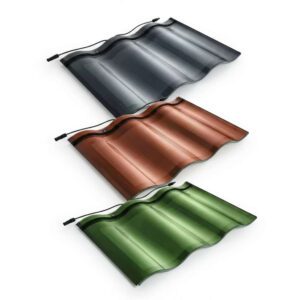
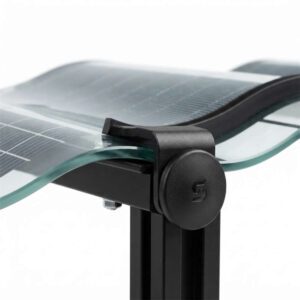
- Tile profile: Asphalt shingle (GAF), glass tile (Tesla), metal standing-seam tile (Luma), interlocking slate tile (SunStyle), BIPV glass panel (Onyx Solar, Jia Mao BIPV)
- Color options: Black (all), dark grey (most), terracotta, slate, and custom colors (Jia Mao BIPV and SunStyle offer the widest custom palette — note that colored coatings reduce efficiency by 4–15% depending on wavelength filter)
- HOA and historic district compatibility: Projects in covenant-governed communities or historic preservation zones require written approval before specification. Solar tiles have a significantly higher approval rate than rack-mounted panels in these contexts — especially glass and slate-profile products that are visually indistinguishable from conventional materials at street level.
For historic districts, SunStyle’s BIPV roof has received approvals in multiple European preservation zones. In U.S. historic districts, the Denver Landmark Preservation office provides a model for how preservation reviews handle solar tile applications.
4. Installation Compatibility & Speed
Labor cost is the largest variable in your BIPV bid margin. And the largest driver of labor cost is how well the product fits the workflow your crew already runs.
| System | Typical Install Time (10 kW) | Labor Hours/kW | Specialized Requirements |
|---|---|---|---|
| GAF Timberline Solar ES2 | 2–4 days | 3.5–5 hr/kW | Standard roofing tools + electrical |
| Солнечная крыша Tesla | 10–17 days (full roof) | 6.9+ hr/kW | Factory certification required |
| Luma Solar | 3–6 days | 4–6 hr/kW | Clip-and-adhesive learning curve |
| SunStyle | 4–8 days | 4.5–7 hr/kW | Proprietary interlocking hardware |
| Onyx Solar BIPV Glass | 2–4 weeks (façade) | 8–14 hr/kW | Curtain wall framing + electrical |
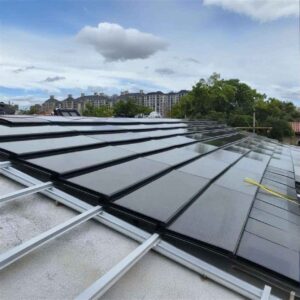
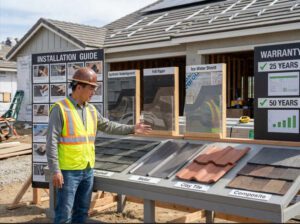
GAF Timberline Solar nails directly to the deck alongside standard GAF shingles — the same tools, substantially the same sequence. For roofing contractors already running GAF re-roofing projects, the transition to solar tile installation is measured in days of training, not months.
Tesla Solar Roof requires a complete roof tear-off and replacement. No hybrid installation is possible. The closed installer network means you cannot independently certify a crew without Tesla factory training.
5. Fire Rating & Safety Compliance (Class A, NEC, IFC)
Class A fire rating under UL 790 / ASTM E108 is the minimum requirement for most commercial and multi-family roofing in the U.S. All five major products reviewed in this guide carry Class A. But the rating applies to the complete roof assembly — tiles, underlayment, and deck — not the tile in isolation.
For commercial projects above 40 feet with BIPV on exterior walls, NFPA 285 fire propagation test compliance is required for the complete wall assembly. This is commonly overlooked in early specification — discovering a missing NFPA 285 test certificate during permit review adds 4–8 weeks to your schedule.
NEC Article 690 governs all PV electrical requirements. Three compliance points contractors most frequently miss:
- NEC 690.12 (Rapid Shutdown): Required for all residential and most commercial rooftop PV. Requires the array to de-energize to below 30V within 30 seconds when the utility or main breaker is opened. Confirm your inverter and rapid-shutdown device combination meets this standard before ordering.
- NEC 690.11 (AFCI — Arc Fault Circuit Interrupter): Required for all DC circuits on rooftops under NEC 2023. Not all existing string inverters include AFCI; confirm compatibility.
- IFC Section 605: Requires fire department notification and access pathways for commercial rooftop PV systems. Ignoring this during design review results in mandatory redesigns — typically adding 3–6 weeks and $8,000–$25,000 in rework cost.
For a complete compliance reference, see NFPA 70 (NEC) Article 690.
6. Warranty & O&M Support (Product vs. Performance)
There are two types of solar warranties and confusing them is an expensive mistake.
Product warranty covers manufacturing defects — delamination, cell cracking, junction box failure. Typical duration: 10–15 years.
Performance warranty guarantees a minimum power output floor at year 25 — usually 80% of original rated power. This is the number that matters for energy modeling and EPC performance guarantees.
| Бренд | Product Warranty | Performance Warranty | Year-25 Output Floor |
|---|---|---|---|
| Солнечная крыша Tesla | 25 год | 25 год | 80% |
| GAF Timberline Solar | 25 год | 25 год | 80% |
| Luma Solar | Lifetime (metal substrate) | 25 год | 80% |
| SunStyle | 25 год | 25 yr (+ 10 yr at 90%) | 80% (90% at yr 10) |
| Onyx Solar | 10–12 yr | 25 год | 80% |
| Jia Mao BIPV | 15 yr | 25 год | 80%+ |
The warranty question to ask every manufacturer: “What is your claims process if a tile underperforms at year 12 — specifically, who pays for labor to remove adjacent tiles to access the failed unit, and what is your response SLA?”
Products designed for individual tile replacement without disturbing adjacent tiles — including select Jia Mao BIPV photovoltaic tile configurations — dramatically reduce the labor cost of localized warranty repairs. On a 300-tile system, that design choice can mean the difference between a $200 tile swap and a $3,000 warranty claim.
7. System Voltage & Inverter Compatibility
Solar tiles produce DC electricity. The inverter converts that DC output to AC power for building use. The two main inverter options — string inverters и microinverters — have fundamentally different implications for a BIPV roof.
String inverters connect multiple tiles in series (a “string”). The output of the entire string is limited by the weakest tile — meaning a single shaded or underperforming tile reduces the output of every tile in that string. On complex roofs with dormers, chimneys, or varied orientations, string inverters consistently underperform relative to their rated capacity.
Микроинверторы (e.g., Enphase IQ series) attach to each tile individually. Each tile operates at its own maximum power point independently of its neighbors. For any roof with partial shading, complex geometry, or mixed orientations, microinverters deliver meaningfully higher yield — typically 8–15% more annual energy in shaded installations compared to string inverters.
The trade-off: microinverters cost $0.25–$0.45/W more than string inverters in installed cost, and add complexity to the electrical design. For a 10 kW system, that is a $2,500–$4,500 premium — justified when partial shading is present, less clearly justified on a simple south-facing single-plane roof with no obstructions.
Inverter compatibility check: Not all solar tiles are compatible with all inverters. Confirm string voltage range, MPPT (Maximum Power Point Tracking — the inverter circuit that continuously finds the optimal operating voltage for maximum output) input range, and rapid-shutdown device compatibility before specifying. Tesla Solar Roof uses a proprietary inverter system. GAF Timberline Solar is compatible with most major third-party string and microinverter brands.
8. Weight Load & Structural Impact (kg/m²)
Dead load (the permanent, static weight of roofing materials on the structure) is the structural variable most commonly underestimated in solar tile retrofit projects.
| Roofing Type | Typical Dead Load |
|---|---|
| Asphalt shingles | 1.5–2.0 kg/m² |
| Clay/concrete tiles | 30–55 kg/m² |
| Metal roofing | 5–12 kg/m² |
| Solar glass tiles (BIPV) | 15–25 kg/m² |
| GAF Timberline Solar |
On most wood-frame residential roofs designed for asphalt shingles, glass-based solar tiles require a structural engineering review before installation. This is not optional — it is legally required in most U.S. jurisdictions. A PE-stamped structural letter costs $500–$1,500 and eliminates the liability exposure that comes from proceeding without one.
Three conditions most commonly trigger required structural upgrades:
- Existing framing that is undersized or shows signs of deterioration
- High-snow-load climates where combined dead and live loads approach ASCE 7-22 code limits
- Prior water damage affecting rafter or sheathing integrity
For curtain-wall contractors, the structural load interface between BIPV glass panels (typically 22–26 kg/m²) and the mullion-and-transom framing system must be resolved in design development — not at the shop drawing stage.
9. Certifications & Building Code Alignment
The minimum certification stack for U.S. roofing projects:
- UL 7103 — Integrated BIPV roofing system (combines electrical safety, fire performance, and structural requirements in a single listing)
- IEC 61215 — Module performance and durability (thermal cycling, humidity freeze, UV)
- IEC 61730 / UL 61730 — PV module safety (insulation, ground fault, mechanical)
- Class A under UL 790 / ASTM E108 — Fire rating for the complete roof assembly
- NFPA 285 — Required for BIPV on exterior walls of commercial buildings above 40 feet
For EU and international projects:
- CE marking и EN 13501-1 fire classification
- IEC 63092-1 — The BIPV-specific product standard (covers building-functional requirements that IEC 61215/61730 do not)
How to verify certification claims: Request actual test certificates — not marketing references to them. The certificate should include the testing laboratory name, test standard, date, and certificate number. Cross-check certificate numbers with the issuing lab’s database. UL’s product iQ database и Intertek’s certification directory are the two primary verification sources for U.S.-market PV products.
10. Supply Chain Reliability & Lead Times
Lead time is the procurement risk that most directly threatens project schedules — and most project teams do not account for it until it is too late.
| Product Type | Standard Lead Time | Custom Profile/Color | What Triggers Custom |
|---|---|---|---|
| GAF Timberline Solar | 4–8 weeks | Not applicable (standard shingle format) | Н/Д |
| Солнечная крыша Tesla | 6–18 months (varies by market) | Н/Д | Limited capacity, closed installer network |
| Luma Solar | 8–12 weeks | 12–16 weeks | Custom dimensions, non-standard profiles |
| SunStyle | 10–14 weeks | 14–20 weeks | European alpine profile in non-standard markets |
| Onyx Solar / Jia Mao BIPV (glass) | 12–20 weeks | 14–24 weeks | Custom size, VLT, color, or cell pattern |
For 50+ unit residential developments, framework purchase agreements with a manufacturer or regional distributor are the only reliable way to secure pricing and production slots simultaneously. Without a framework agreement, lead times on large orders can extend by 6–10 weeks beyond standard, particularly for products manufactured in Asia where per-project production scheduling is the norm.
Jia Mao BIPV — with 3 GW annual production capacity — provides project-specific lead-time commitment letters, standard and custom tile profiles, and dedicated technical account support for multi-project contractors and distributors. For EPC firms managing pipeline forecasts, securing an annual volume agreement with a manufacturer of that scale eliminates the reactive procurement problem that erodes margin on time-sensitive projects.
When Premium Solar Tiles Deliver ROI: Use Cases for Contractors & Designers
Not every project justifies solar tiles. Premium tile systems deliver their strongest ROI in specific project contexts — and recognizing those contexts early is what determines whether you bid competitively or overbid on the wrong product for the job.
High-end residential developments where aesthetics drive purchase decisions. When a buyer is comparing two otherwise identical townhomes — one with visible panel arrays and one with flush solar tile roofing — and the developer can charge $15,000–$30,000 more per unit for the tile version, the premium is self-funding.
Government and institutional projects requiring BIPV compliance. Federal building standards (including the Federal Energy Management Program), state sustainability mandates, and university campus sustainability targets increasingly specify building-integrated generation by design intent — not rack-mounted addition. EPC firms that can deliver BIPV are the only firms that can bid these projects competitively.
Urban infill projects with visual impact restrictions. In dense urban environments, planning departments frequently restrict or prohibit visible rack-mounted panels on street-facing elevations. Solar tiles are the only technology that passes visual impact review in these jurisdictions.
EPC contracts with performance-based incentives. For projects where the EPC firm retains a kWh production guarantee — with liquidated damages for underperformance — the reliability of a well-specified, certified BIPV tile system is a risk management tool, not just an aesthetic choice. Document your yield assumptions with a PVsyst simulation and tie your tile specification to a manufacturer performance warranty that matches your guarantee terms.
Projects targeting premium green certifications. Living Building Challenge (Petal 09: Beauty) and the Petals approach to net-positive energy require on-site generation from the building envelope. LEED v4.1 EA Credit (Renewable Energy Production) awards credits for on-site generation as a percentage of energy cost. BIPV tile systems are the most direct path to these credits in projects where roof area is limited.
Common Procurement & Installation Pitfalls: Risk Mitigation for Contractors
The following pitfalls are not theoretical. They are compiled from documented project disputes, warranty claim records, and contractor field feedback. Understanding them before bidding protects your margin and your client relationship.
Assuming all solar tiles are code-compliant. Certification claims on manufacturer websites do not substitute for actual certificates. A product marketed as “UL 7103 compliant” that holds only IEC 61215 certification will fail the permit review in most U.S. jurisdictions — and you will be the contractor responsible for the schedule delay and cost of substitution.
Overlooking thermal expansion in metal roof integrations. Metal tile products (Luma Solar) expand and contract with temperature cycles. In climates with wide daily temperature swings, splice joints in the mounting system that do not accommodate 10–15 mm of movement cause stress cracking in adjacent materials within two to three seasons. Verify that the manufacturer’s installation manual addresses thermal expansion explicitly — and that your crew follows it.
Miscalculating shading losses due to tile layout constraints. Unlike rack-mounted panels, solar tiles cannot be repositioned after installation to optimize shading avoidance. A chimney that shades 12% of the active tile zone during morning hours is a permanent yield loss — it cannot be adjusted. Run shading analysis (PVsyst or Aurora Solar) on the final tile layout before ordering, not after the roof is built.
Ignoring inverter pairing limitations with low-voltage tiles. Some solar tile products output lower DC voltage strings than standard panels. Confirm that your string inverter’s MPPT input voltage range covers the string design voltage at the minimum operating temperature — if it does not, the inverter will not operate at maximum efficiency during winter mornings, reducing annual yield by 5–12%.
Underestimating lead times for custom color or profile orders. A curtain-wall contractor who orders custom-color BIPV tiles six weeks before the glazing installation date — when lead time is 14–20 weeks — either pays premium airfreight costs or delays the project. Trigger custom material orders at 60% construction documents, not at issue for construction. For large residential developments (50+ units), place a non-binding Letter of Intent with your manufacturer at design development to secure production capacity.
Skipping structural assessment on retrofits. An experienced roofing contractor who skips the structural review because “we’ve done hundreds of re-roofs here” is not protected when a PE-stamped analysis would have caught compromised rafters from a 2019 water event. The structural review costs $500–$1,500. The liability exposure from a failed roof structure under a 25-year warrantied BIPV system is effectively unlimited.
Integration with Curtain Walls & Hybrid Roofing Systems
For contractors and EPCs working on commercial and mixed-use projects, solar tiles rarely exist in isolation. They integrate with curtain wall systems, photovoltaic spandrel panels, flat-roof BAPV arrays, and green roof membranes. Getting those interfaces right is where project schedules are won or lost.
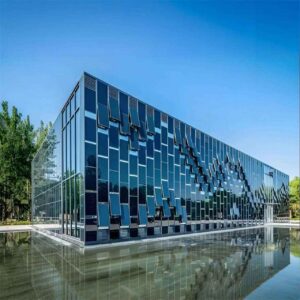
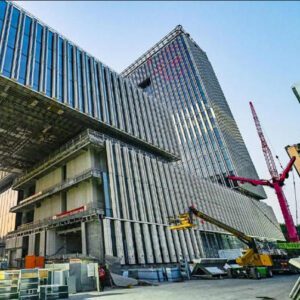
Technical considerations for combining solar tiles with unitized curtain walls. BIPV glass panels — the product category used by Onyx Solar and Jia Mao BIPV’s commercial façade glass range — integrate directly into standard unitized curtain wall framing (50mm, 65mm, or 85mm mullion systems). The electrical connection routes through the mullion cavity to junction boxes in the pressure plate zone. Confirm that the curtain wall contractor’s unitized framing system accommodates the MC4 connector clearance — a detail that consistently surfaces as an interference at the shop drawing stage on first-time BIPV curtain wall projects.
Waterproofing and drainage interface protocols. At the junction between a solar tile roof zone and a conventional roof covering — valley flashing, ridge, hip, and eave transitions — the waterproofing must be designed for the tile product’s flashings, not generic roofing flashings. Manufacturer-specific valley and ridge flashing kits are not optional accessories; they are the warranty-preserving elements of the roof system. Substituting generic flashings voids the product warranty.
Coordination between façade engineers and PV specialists. On commercial projects, the structural façade engineer, the PV system designer, and the curtain wall fabricator are rarely from the same firm. The critical coordination meeting that almost never happens early enough: the three-party interface review where the façade engineer confirms load capacity, the PV designer confirms electrical routing paths, and the fabricator confirms fabrication tolerances for the integrated electrical components. Schedule this meeting at 30% design development — not at 90%.
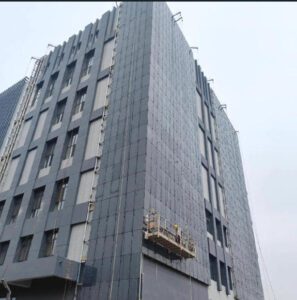
Case example: Mixed-use tower with solar tile roof and photovoltaic spandrels. A 12-story mixed-use tower in Boston specified GAF Timberline Solar on the residential roof zones (levels 9–12) and Jia Mao BIPV semi-transparent glass spandrels on the commercial floors (levels 2–8). The solar roof tiles (8.7 kW effective) generate residential common-area electricity. The BIPV spandrels (62 kWp) generate approximately 68,000 kWh/year, offsetting 31% of the building’s commercial electricity load and contributing 8 LEED EA credit points toward the building’s Platinum certification target. The two systems used separate string inverter banks but shared a single SCADA monitoring platform — a detail the EPC firm specified from day one to simplify O&M handover.
Collaboration Framework: Aligning Architects, EPCs, and Distributors
The single most consistent cause of BIPV project overruns is not product failure — it is coordination failure. Three separate professional silos — architecture, construction, and supply chain — make decisions in sequence that should be made in parallel.
Early-stage coordination to avoid redesigns and RFI delays. A BIPV kickoff coordination meeting — with the architect, structural engineer, MEP engineer, roofing contractor, electrical subcontractor, and manufacturer’s technical representative — held during schematic design prevents 70–80% of the field coordination problems that generate RFIs during construction. Four hours at that stage resolves routing conflicts, load questions, and product compatibility issues before they become change orders.
Shared BIM modeling standards for solar tile placement and electrical routing. Commercial BIPV projects above approximately 100 kW — or any project requiring PE-stamped structural drawings — require BIM coordination. GAF Energy, SunStyle, and Onyx Solar all provide downloadable Revit BIM families and CAD details. Jia Mao BIPV provides project-specific BIM objects, PVsyst component files, and EPD (Environmental Product Declaration) documentation for LEED material credits. Confirm BIM object availability before the project reaches design development — discovering a missing Revit family at the shop drawing stage is a 3–4 week delay.
Distributor vetting: Ensure technical support, training, and logistics capacity. A distributor who can deliver product on time but cannot support the installer’s technical questions during installation is a liability, not an asset. The distributor vetting checklist for BIPV:
| Criterion | What to Ask | Red Flag |
|---|---|---|
| Technical support | Do you have a technical team that can answer field installation questions same-day? | “Email us and we’ll get back to you” |
| Training | Do you provide on-site crew training before the first project? | No structured training program |
| Logistics | Can you provide a project-specific lead-time commitment letter? | “We’ll do our best” |
| Documentation | Can you supply IEC 61215/61730 test certificates, not just datasheets? | Datasheet references only |
| Warranty support | Who handles warranty claims — you or the manufacturer directly? | Unclear escalation path |
Joint specification writing to lock in performance and compliance criteria. For large projects, a co-authored specification section (Division 07 for roofing, Division 16 for electrical) that names the performance standard rather than the brand protects the project from substitution risk. Specify: minimum module efficiency (%), minimum wind rating (mph), required certifications (UL 7103, IEC 61215, Class A fire), lead-time commitment capability, and warranty terms — then evaluate submittals against those criteria.
Leading Solar Tile Brands: Comparative Analysis for Professionals

Master Comparison Table
| Технические характеристики | Солнечная крыша Tesla | GAF Timberline Solar ES2 | Luma Solar | SunStyle | Onyx Solar / Jia Mao BIPV |
|---|---|---|---|---|---|
| Tile type | Tempered glass tile | Asphalt shingle | Metal panel tile | Interlocking slate | Фотоэлектрическое стекло |
| Module efficiency | ~19.5% | 22.6% | ~20% | 17–18% | 6–24% (by VLT) |
| Power per tile | ~45 W | 57 W | 100 W | 84–115 W | 80–180 Wp/m² |
| Installed $/W | $6.00–$8.00 | $3.80–$5.50 | $5.00–$7.00 | $5.50–$8.00 | $4–$12/m² range |
| Wind rating | 130 mph | 130 mph | 166 mph | 130+ mph | 3.5–4.0 kPa |
| Fire rating | Class A | Class A (UL 790) | Class A | Class A | Class A / EN 13501 |
| Product warranty | 25 год | 25 год | Lifetime (metal) | 25 год | 10–15 yr |
| Power warranty | 25 yr (80%) | 25 yr (80%) | 25 yr (80%) | 25 yr (90% @ yr 10) | 25 yr (80%) |
| Key certifications | UL 7103, IEC 61215 | UL 790, UL 7103, IEC 61215 | UL 7103, ASTM E108 | IEC 61215, IEC 61730 | IEC 61215, IEC 61730, CE, IEC 63092-1 |
| Best fit | Design-forward new builds | Re-roofing, residential | Coastal, curved roofs | Alpine/European, commercial | Commercial curtain wall, LEED high-rise |
| BIM/CAD available | Limited | Да | Yes (on request) | Да | Да |
Tesla Solar Roof (Gen 3)
Honest assessment for professionals. Tesla Solar Roof is the product clients request by name. That brand recognition creates specification pull that no competitor currently matches in the residential market — and for developers using it as a marketing differentiator, that pull has measurable value.
The product delivers ~19.5% efficiency from monocrystalline cells in a tempered glass tile format. Active tiles (containing cells) mix with inactive tiles (glass only, visually identical) across the roof area. The result at street level is a roof with no visible hardware — the defining aesthetic advantage.
Installation reality. Field reports from U.S. roofing contractors consistently document 10–17 day installation windows for typical residential roofs. Tesla’s closed installer certification network limits competitive bidding — independent contractors cannot install and warranty the system without Tesla factory authorization. For GC firms who need to manage three-trade coordination on a fixed-price contract, the limited installer pool creates margin risk.
Ideal for: Net-zero custom homes, HOA-restricted communities, design-forward mixed-use projects where the Tesla brand serves as a marketing asset, and full roof replacement projects where unified manufacturer warranty coverage is the priority.
GAF Energy Timberline Solar ES2
The contractor’s solar shingle. GAF Energy Timberline Solar ES2 achieves the highest efficiency rating in the asphalt shingle category at 22.6%, producing 57 W per shingle. It nails directly to the roof deck with standard roofing tools, alongside conventional GAF Timberline HDZ shingles.
Real-world performance data. An Austin, TX installation documented a crew of three completing an 8.7 kW system in 3 days. Real-world module efficiency achieved 22.1% against the 22.6% rated — one of the tightest specification-to-performance gaps in the category. Monthly electricity bills dropped from $165 to $22 in the first six months.
Cost benchmark. Installed at $3.80–$5.50/W, GAF Energy is the most accessible solar tile on a per-watt basis in this comparison. For roofing contractors adding solar to their service offering, the GAF EnergyPRO certification program provides co-marketing resources, project leads through GAF’s homeowner portal, and manufacturer-backed warranty coverage that gives clients the confidence to proceed.
Ideal for: Re-roofing on residential and light commercial. Roofing contractors entering the solar tile market with the lowest training investment. Any project where the client wants aesthetic improvement over visible panels without the Tesla price premium.
Luma Solar
The wind-rated choice for demanding climates. Luma Solar is the only residential solar tile currently rated to 166 mph, meeting Miami-Dade’s Notice of Acceptance (NOA) requirements. In coastal markets where 130 mph-rated products fail the wind specification, Luma is frequently the only viable solar tile option.
At 100 W per tile и 16.1 W/ft², it delivers the highest power density of any residential solar tile in this comparison. The 24-gauge Galvalume steel substrate provides a lifetime warranty on the roof material — longer than any glass-based product in this review.
Ideal for: Coastal markets (Florida, Gulf Coast, Pacific Northwest). Architects specifying curved roof sections where standard shingle format cannot conform. Northern climates where low-light performance is a primary selection driver.
SunStyle
European engineering for high-performance buildings. SunStyle’s overlapping diamond-profile tiles are validated in Alpine and coastal European climates — environments that routinely impose snow loads exceeding 50 lbs/ft², sustained wind stress, and aggressive freeze-thaw cycling.
The SunStyle PowerHouse Tile achieves 84–115 Wp per tile using PERC monocrystalline cells (the same cell architecture underlying the most efficient rack-mounted panels currently on the market). The 10-year 90% power guarantee is a stronger near-term commitment than the industry-standard 25-year 80% alone.
For commercial passive house projects targeting PHIUS or Living Building Challenge certification, SunStyle’s documentation package supports the energy and material credit requirements of those standards.
Ideal for: Mountain climate residential and resort projects. High-performance commercial buildings. Design-led builds where the distinctive tile profile is part of the architectural identity.
Onyx Solar & Jia Mao BIPV (Commercial BIPV Glass)
The commercial-scale specification tool. Onyx Solar and Jia Mao BIPV occupy the same product category — photovoltaic glass for commercial curtain walls, skylights, canopies, and overhead glazing — but serve different supply chain roles.
Onyx Solar is an established European BIPV glass manufacturer with a documented project portfolio across institutional and corporate buildings. The Seneca College CITE building installation — a 47.4 m² photovoltaic curtain wall generating 34,570 kWh/year and reducing CO₂ by 23 metric tons annually — is one of the most-cited real-world BIPV performance benchmarks in commercial construction.
Jia Mao BIPV provides the same commercial BIPV glass specification capability with direct-from-manufacturer pricing at 3 GW annual production capacity. For curtain wall contractors and distributors who need BIPV glass for multiple concurrent projects — without routing every specification through a single European manufacturer’s backlog — building a Jia Mao supply relationship alongside an Onyx specification adds supply chain resilience and competitive pricing leverage.
Both products carry IEC 61215, IEC 61730, IEC 63092-1 (the BIPV-specific standard), and CE marking. Both support custom dimensions, VLT, and cell pattern design. Both integrate into standard unitized curtain wall framing.
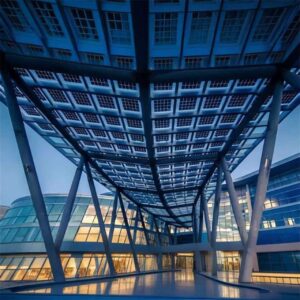
Ideal for: Curtain wall contractors on LEED-certified commercial high-rises. EPCs working on institutional or corporate campuses. Architects specifying skylights, atriums, and canopies where daylight, energy, and aesthetics must coexist simultaneously.
YouTube: How BIPV Solar Roof Tiles Work in Real Buildings

Watch: A visual comparison of solar tiles vs. traditional panels — how each technology generates electricity, what real-world efficiency looks like, and where each fits in contemporary building design. Useful for team training and client presentations.
Cost-Benefit Analysis: Total Installed Cost vs. Lifecycle Value

The headline installed cost of solar tiles is the number that most commonly derails the sales conversation. The number that closes it is the lifecycle value calculation — which tells a fundamentally different story when done correctly.
The “Roof Replacement Offset” That Changes the Math
The most important financial insight in solar tile specification: the comparison is not solar tiles vs. conventional panels. It is solar tiles vs. conventional roofing plus conventional panels.
When a building needs a roof replacement anyway, the incremental cost of upgrading to solar tiles is the solar tile cost minus the cost of the conventional roof that solar tiles replace. In most U.S. markets, a new asphalt shingle roof for a 2,000 ft² home costs $12,000–$20,000. Applying that offset to the solar tile cost changes the payback calculation materially.
Residential Cost-Benefit Example (Dallas, TX — 8.7 kW GAF Timberline Solar ES2)
| Line Item | Amount |
|---|---|
| Gross installed cost | $41,850 |
| Less: roof replacement offset (existing roof at EOL) | –$14,000 |
| Net pre-incentive cost | $27,850 |
| Federal ITC (30%) — for systems placed in service by Dec 31, 2025 | –$8,355 |
| Net effective cost | $19,495 |
| Annual energy savings @ $0.13/kWh (9,600 kWh/yr) | $1,248 |
| Annual utility rate escalation (2.5%/yr, 25-yr avg) | Adds ~$18,000 cumulative value |
| Simple payback on net cost | ~11.8 years |
| 25-year net gain | ~$30,000+ |
Commercial BIPV Example (500 m² Curtain Wall, New York — Jia Mao BIPV Semi-Transparent Glass)
| Line Item | Amount |
|---|---|
| Gross BIPV system cost | $210,000 |
| Less: conventional curtain wall cost offset | –$75,000 |
| Net BIPV premium (pre-incentive) | $135,000 |
| Commercial ITC (Section 48E, 30%) | –$40,500 |
| MACRS 5-year depreciation benefit (est.) | –$22,000 |
| Net effective BIPV premium | $72,500 |
| Annual electricity value @ $0.20/kWh (NYC commercial) | $19,193 |
| Annual HVAC savings (reduced SHGC) | $4,800 |
| Combined annual benefit | $23,993 |
| Simple payback on BIPV premium | ~3.0 years |
Soft-Cost Savings Contractors Rarely Quantify
Beyond the energy value, solar tiles deliver measurable soft-cost savings:
- Faster aesthetic approvals in HOA-governed communities: solar tile projects require 2–4 weeks for HOA approval vs. 6–12 weeks for rack-mounted panels in design-controlled communities — saving 4–8 weeks of pre-construction schedule.
- Higher resale premiums: Research consistently shows solar installations increase home values by 4–6%. In a $500,000 market, that is $20,000–$30,000 of additional equity — often exceeding the net solar tile premium after ITC.
- LEED certification uplift: Commercial buildings with LEED Platinum certification command documented 3–5% higher asset values in transaction data. On a $10M building, a 4% uplift is $400,000 — often exceeding the total net BIPV system cost.
Current Federal Incentive Status
⚠️ Important: The Residential Clean Energy Credit (Section 25D) at 30% expired for systems placed in service after December 31, 2025 under current legislation. For 2026 residential projects, confirm current federal incentive status with a tax professional. The Commercial ITC (Section 48E) remains available for commercial BIPV projects through 2032. Check DSIRE for current state-level incentives by ZIP code.
Future-Proofing Projects: Smart Integration & Grid Readiness
A solar tile system designed only for today’s grid connection is already partially obsolete. Projects that will be delivered in 2025–2027 will be operated for 25 years — in a grid environment that will include widespread battery storage, EV charging load, demand response programs, and building-to-grid services that barely exist today.
Battery storage compatibility. All five major products reviewed here are compatible with grid-tied battery systems. Tesla Solar Roof has native integration with Tesla Powerwall 3 (a single hybrid inverter, unified app). GAF, Luma, and SunStyle connect to third-party systems including Enphase IQ Battery, sonnen, and Franklin Electric. Pre-wiring for battery storage during tile installation costs $1,500–$3,000 in conduit and junction box positioning. Retrofitting that same pre-wiring after installation costs $8,000–$20,000 — the conduit must route through completed tile zones.
DC optimization and MLPE (Module-Level Power Electronics). On complex roofs with shading, mixed orientations, or multiple roof planes, MLPE — microinverters or DC power optimizers — provides panel-level performance data and independent maximum power point tracking for each tile. This both maximizes annual yield and enables fault detection at the individual tile level. For EPC firms with performance-based contracts, MLPE is a risk management tool: it makes underperforming tiles immediately visible in monitoring data.
EV charging and demand response pre-wiring. A 200A panel serving a 10 kW solar tile system and one EV charger is adequately sized today. Adding a second EV charger, a battery system, and a heat pump in year 7 will exceed that panel capacity. Specifying a 225A or 400A service from day one, and routing a dedicated EV-ready circuit from the main panel to the garage, adds $800–$2,000 at installation and avoids a $4,000–$8,000 service upgrade later.
Designing for future upgrades. The unitized panel format used by Jia Mao BIPV and Onyx Solar in commercial curtain wall applications is specifically designed for future module-level replacement — individual panels can be extracted from the curtain wall framing and replaced with higher-efficiency future modules without disturbing adjacent units. For 25-year system lifecycle planning, design-for-disassembly is a meaningful long-term value proposition for building owners.
Steps for Contractors, EPCs, and Design Firms
The following five steps are the sequence that separates successful BIPV project delivery from the projects that generate RFIs, schedule delays, and margin erosion.
Step 1: Conduct site-specific feasibility with solar access and structural audit.
Before any product selection or pricing conversation, run:
- A PVWatts simulation (free, 15 minutes) using the specific address, roof orientation, and tilt
- A roof condition and structural assessment — confirm whether the existing structure requires upgrade for solar tile dead load
- A shading analysis confirming that the active tile zones achieve a minimum annual irradiance of 1,000 kWh/m² (for temperate climates) or 1,400 kWh/m² (for Sun Belt markets)
If the irradiance analysis shows the south-facing roof zone achieves less than 900 kWh/m² due to shading, conventional panels with MLPE or a different installation approach will outperform solar tiles — and your client deserves to know that before committing.
Step 2: Engage certified solar tile suppliers early in design development.
Product selection at schematic design (not design development) gives you:
- BIM objects and CAD details for coordination before drawings are complete
- Lead-time commitment letters for procurement planning
- Technical support during structural load and electrical routing design
- Manufacturer-provided warranty documentation for permit submissions
Step 3: Validate all performance claims with independent data.
Manufacturer efficiency claims are STC (Standard Test Conditions — 25°C cell temperature, 1,000 W/m² irradiance, 1.5 air mass) figures measured in laboratory conditions. Real-world operating conditions — higher temperatures, actual shading, DC wiring losses, inverter efficiency — reduce real output by 10–25% compared to STC ratings.
Use PVsyst for commercial system design above 100 kW. Use PVWatts for residential feasibility. Do not present manufacturer energy yield estimates to clients without independent simulation validation — the liability exposure when a project underperforms a marketing claim is significant.
Step 4: Train installation crews on manufacturer-specific protocols.
Solar tile installation crew errors — incorrect alignment tolerance (BIPV glass panels require ±1mm), improper sealant application, reversed polarity on DC connections — are the primary cause of early system failures and warranty disputes. Manufacturer-specific training before the first project is not optional; it is the mechanism by which warranty coverage attaches to your installation work.
For NABCEP certification (the industry-recognized professional credential for solar installers, though not legally required in most states), see NABCEP.org. Several tile manufacturers — including GAF Energy — require NABCEP or their own manufacturer certification to validate workmanship warranty claims.
Step 5: Document compliance for warranties, incentives, and handover packages.
The handover package for a BIPV project should include:
- As-built drawings (electrical single-line, roof plan with tile zones, inverter wiring diagram)
- Commissioning report (IV curve test results, insulation resistance test, rapid-shutdown verification, performance ratio measurement)
- Manufacturer product certificates (IEC 61215, IEC 61730, UL 7103, fire rating)
- Warranty registration confirmation from manufacturer
- Monitoring platform login credentials and alert configuration
- Permit closeout documentation (building inspection sign-off, utility interconnection approval)
- O&M manual with cleaning protocol, inspection schedule, and emergency contacts
A complete handover package is the difference between a client who calls you for the next project and a client who calls their lawyer when year-3 output is 18% below their expectation.
Glossary of Key Terms
BIPV (Building-Integrated Photovoltaics): Solar technology that replaces conventional building materials — roofing, glazing, cladding — rather than mounting on top of them. The solar element is the building material.
BAPV (Building-Applied Photovoltaics): Conventional rack-mounted solar panels installed on top of an existing roof or building surface.
VLT (Visible Light Transmittance): The percentage of visible daylight passing through a glass product. 0% = fully opaque; 40% = similar to office tinted glazing.
SHGC (Solar Heat Gain Coefficient): The fraction of solar heat that passes through the glazing into the building. Lower SHGC reduces cooling loads. BIPV glass typically delivers SHGC of 0.15–0.35.
STC (Standard Test Conditions): Laboratory testing conditions used to rate solar module output: 25°C cell temperature, 1,000 W/m² irradiance, 1.5 air mass. Real-world output is typically 10–25% lower.
UL 7103: The U.S. standard for integrated BIPV roofing systems, combining electrical safety, fire performance, and structural requirements in a unified listing.
MLPE (Module-Level Power Electronics): Microinverters or DC power optimizers that attach to each solar tile or panel individually, enabling independent maximum power point tracking and panel-level monitoring.
NEC 690.12 (Rapid Shutdown): National Electrical Code requirement that all rooftop PV systems de-energize to below 30V within 30 seconds of utility or main breaker disconnect.
AFCI (Arc Fault Circuit Interrupter): A protection device required under NEC 690.11 (NEC 2023) for DC circuits on rooftops. Detects and interrupts arc faults that could cause fires.
PERC Cell (Passivated Emitter and Rear Cell): A monocrystalline cell architecture that reduces electron recombination on the rear surface, improving efficiency and reducing temperature coefficient. Used in SunStyle and premium tile products.
Performance Ratio: Actual system output divided by theoretical maximum output, accounting for temperature, wiring losses, shading, and inverter efficiency. Target: ≥0.75 for well-designed BIPV systems.
Miami-Dade NOA (Notice of Acceptance): Product approval confirming compliance with Miami-Dade County’s hurricane wind resistance requirements — the most demanding roofing standard in the U.S.
IEC 63092-1: The BIPV-specific product standard that covers building-functional requirements (weatherproofing, structural, thermal) that IEC 61215/61730 do not address. Required for complete BIPV certification.
Frequently Asked Questions (FAQs)
1. What are the structural load implications of solar roof tiles on retrofit projects?
Solar roof tiles typically add 15–25 kg/m² of dead load — comparable to clay or concrete tile roofing, and significantly more than asphalt shingles (3–4 kg/m²). For retrofit projects, a PE-stamped structural engineering review is legally required in most U.S. jurisdictions and should be budgeted at $500–$1,500 for residential scale. Three conditions most commonly trigger required structural upgrades: undersized or deteriorated framing, high-snow-load climates, and prior water damage to structural members. Running the assessment before procurement — not after materials arrive on site — is the only way to avoid costly delays.
2. How do solar tiles compare to traditional PV panels in kWh/kWp performance?
Standard monocrystalline solar tiles achieve 14–22% module efficiency (vs. 19–23% for premium rack-mounted panels). In practical installations, solar tiles typically produce 85–92% of the annual output of an equivalent conventional panel system on the same roof. The efficiency gap narrows in hot climates because solar tiles — mounted flush to the roof with better heat conduction to the roof deck — can dissipate heat differently than air-gap-mounted panels. The performance gap is most significant on complex roofs with partial shading, where MLPE-equipped tile systems may actually outperform un-optimized conventional panel strings.
3. Can solar roof tiles be integrated with metal curtain wall systems?
Yes — BIPV glass products (Onyx Solar, Jia Mao BIPV) are specifically engineered for integration into aluminum curtain wall framing. The BIPV glass panel replaces the standard insulated glazing unit (IGU) in the curtain wall frame. Electrical connections route through the mullion cavity. The critical interface detail is MC4 connector clearance within the pressure plate zone — this must be designed into the curtain wall shop drawings, not resolved on site. For rooftop tile products (GAF, Tesla, Luma), integration with metal standing-seam roofing systems is possible but requires manufacturer-specific flashing details to maintain both the roofing warranty and the PV product warranty.
4. What fire ratings do solar tiles need to meet for high-rise residential buildings?
Class A under UL 790 / ASTM E108 is the minimum for all commercial and multi-family projects in the U.S. All five major products reviewed here carry Class A. For high-rise residential buildings above 40 feet with BIPV on exterior walls, NFPA 285 fire propagation testing is required for the complete wall assembly — not just the BIPV panel in isolation. In EU markets, EN 13501-1 Class B or better is typically required for commercial and multi-family applications. Confirm NFPA 285 compliance documentation during the specification phase — discovering a missing test certificate during permit review is a 4–8 week schedule impact.
5. Are there BIM object libraries available for major solar tile manufacturers?
Yes. GAF Energy, SunStyle, and Onyx Solar all provide downloadable Revit families and CAD details. Jia Mao BIPV provides project-specific BIM objects for commercial curtain wall integrations. Tesla provides structural load tables but limited BIM library support. The BIMobject platform и ARCAT BIM Library host solar tile BIM content from multiple manufacturers. For any commercial project requiring BIM coordination, confirm BIM object availability before design development — not at the shop drawing stage.
6. How do I verify if a solar tile is UL 7103 or IEC 61215 certified?
Request the actual test certificate — not a datasheet reference to it. The certificate should include the testing laboratory name, standard version, test date, and certificate number. Cross-check certificate numbers against the issuing laboratory’s online database: UL’s product iQ database (iq.ul.com) for UL certificates; the IEC’s IECEE CB Scheme database for IEC 61215/61730 certificates. Intertek’s certification directory also covers a large share of BIPV products. If a manufacturer cannot provide a certificate number, the certification claim is unverified.
7. What is the average installation time per m² compared to rack-mounted PV?
Solar tile installation requires 3.5–7 labor hours per kW installed, depending on product and roof complexity — compared to 1.5–3 hours per kW for conventional rack-mounted panels. The premium reflects the dual roofing-and-electrical scope. On a 10 kW residential project, the differential is roughly 15–40 additional labor hours — typically adding $1,500–$4,000 to installation cost compared to a rack-mounted system on the same roof area. Projects with dormers, valleys, and complex geometry add time disproportionately — the correct approach is a complexity-adjusted labor estimate, not a flat per-kW rate.
8. Do solar tiles require special flashing or waterproofing details?
Yes — and this is non-negotiable from a warranty perspective. All solar tile manufacturers supply proprietary flashing kits for valleys, ridges, hips, and penetrations. Substituting generic roofing flashings for manufacturer-specific flashings voids both the roofing and the PV warranty simultaneously — the two components of the system that are most expensive to repair when they fail. Underlayment selection also matters: premium solar tile systems specify synthetic underlayment rated for 50+ years. Using standard 30-year felt underlayment under a 25-year warrantied tile system creates a maintenance liability at year 12–15 when the underlayment requires replacement beneath completed tile zones.
9. How do shading and partial soiling affect solar tile arrays differently than standard panels?
The fundamental constraint with solar tiles is that you cannot reposition them after installation to optimize for shading avoidance. A string of tiles running through a shaded zone is a permanent yield loss. For string-inverter systems, a single shaded tile reduces the entire string’s output — by 20–50% during the shaded hours, depending on shading severity. The mitigation is twofold: (1) shading analysis before tile layout is finalized — not after ordering; and (2) microinverters or DC optimizers on complex or partially shaded roofs. Soiling (dust, bird droppings, organic matter) affects tiles and conventional panels similarly, but tiles flush to the roof surface can be harder to access for cleaning on steep pitches — budget for professional cleaning at $150–$400 per visit in arid climates.
10. What inverter manufacturers support direct integration with solar roof tiles?
GAF Timberline Solar is compatible with most major third-party inverter brands including SolarEdge, Enphase, Fronius, and SMA. Luma Solar and SunStyle are similarly open-platform. Tesla Solar Roof uses a proprietary hybrid inverter (Tesla Solar Inverter) — third-party inverter substitution is not supported and voids the system warranty. For commercial BIPV glass projects, Jia Mao BIPV panels are compatible with SMA Sunny Tripower, Fronius Symo, and SolarEdge commercial inverters — confirm string voltage and MPPT input range against the specific panel configuration before ordering.
11. Can solar tiles be used in historic district renovations with strict aesthetic codes?
Yes — this is one of the strongest use cases for premium solar tiles. Glass-profile solar tiles (Tesla, SunStyle European slate) and metal tiles (Luma) are visually indistinguishable from conventional materials at street level — the primary requirement for most historic preservation review boards. In Denver, the Landmark Preservation office has approved solar tile installations in historic districts where conventional rack-mounted panels were denied. SunStyle has documented approvals in Swiss and French Alpine preservation zones. The key documentation requirement for most historic district reviews: photographs or physical samples showing the proposed tile profile and color from the same viewing angle as the preservation board’s assessment criteria specify.
12. What maintenance protocols are recommended for long-term performance?
Annual visual inspection of flashing, sealant joints, and visible cable routing is good baseline maintenance — less than an hour per visit. In arid climates, professional cleaning 1–2 times per year at $150–$400 per visit prevents the 5–15% annual yield loss from dust accumulation. Every 5 years: electrical inspection using thermal imaging to identify degraded connections and hot spots before they become failures. Every 10 years: full IV curve test (measuring actual panel output against original rated output to confirm degradation rate is within warranty terms). Products designed for individual tile replacement — including select Jia Mao BIPV photovoltaic tile configurations — significantly reduce the labor cost of localized repairs and make O&M economically predictable over a 25-year system life.
13. How do warranties handle workmanship vs. material defects in installed systems?
Manufacturer product warranties cover material defects — delamination, cell cracking, junction box failure. Installer workmanship warranties cover damage caused by incorrect installation. The critical gap: most manufacturer warranties exclude labor costs for removal and replacement of adjacent tiles to access the failed unit. If a tile at position [row 5, column 8] fails due to a manufacturing defect, the manufacturer will supply a replacement tile — but the labor cost to remove tiles in rows 3–7 to access it may fall on the installer’s workmanship warranty or the building owner. Design-for-replacement tile systems close this gap. Request explicit written clarity on tile access labor responsibility before specifying any product on a large residential development.
14. Are there government incentives specific to BIPV or solar roofing materials?
The federal Investment Tax Credit (30%, Section 48E) applies to commercial BIPV projects and covers the full installed cost including tiles, electrical BOS, and labor. The Residential Clean Energy Credit (30%, Section 25D) covered residential solar tiles for systems placed in service by December 31, 2025. For 2026 and beyond, confirm current residential incentive availability with a tax professional. State-specific incentives vary widely: New York offers a 25% state credit (capped at $5,000), California offers net metering and SGIP battery rebates, and Oregon offers a residential tax credit. The DSIRE Database is the most current source for state and local program details.
15. What training or certification is required for installers to maintain warranty validity?
Requirements vary by manufacturer. GAF Energy requires EnergyPRO certification — available through GAF Energy’s training program — to validate the workmanship warranty. Tesla Solar Roof requires factory authorization. Luma Solar requires manufacturer-specific installation training. Onyx Solar and Jia Mao BIPV commercial projects typically require demonstration of prior BIPV curtain wall installation experience plus manufacturer-provided installation training before the first project. NABCEP certification (PVIP — Photovoltaic Installation Professional) is the recognized industry credential across all installer categories, and several manufacturers require it for large-scale project warranty coverage. It is not a legal license requirement in most states, but it is increasingly a client specification requirement on institutional and government projects.
16. How do I coordinate between roofing subcontractors and electrical teams during installation?
The one rule that resolves 80% of trade coordination problems: schedule the electrical contractor to be on site during tile installation, not after. Conduit routing, junction box placement, and rapid-shutdown device positioning happen concurrently with tile placement. A roofing crew that completes the tile installation before the electrical team has run conduit requires partial demolition to access the routing path — adding 3–7 days to the schedule and eliminating a significant portion of the labor margin. Schedule the three-trade coordination meeting (roofing, electrical, structural) during design development. Confirm electrical pre-routing is complete before the first tile goes on the roof.
17. Can solar tiles be combined with green roofs or cool roofing membranes?
Yes — with careful detailing. Research from ScienceDirect (Cavadini et al., 2021) documents that combining solar PV with cool roofs improves PV efficiency by 3–5% by reducing panel operating temperature. Green roofs improve PV efficiency by a similar mechanism — evapotranspiration reduces roof surface temperature. For solar tile roofs, the more common hybrid is combining active tile zones (south-facing slopes) with green roof zones (north-facing slopes or flat areas), maximizing both energy generation and biodiversity performance. The interface between solar tile zones and vegetative roof zones requires explicit waterproofing coordination — the drainage plane for both systems must integrate at the valley and ridge without compromising either warranty.
18. What are the lead times for large-scale residential developments (50+ units)?
For 50+ unit residential developments using standard-format products (GAF Timberline Solar), budget 8–12 weeks from confirmed purchase order to on-site delivery. Custom-profile or custom-color products (Jia Mao BIPV, SunStyle in non-standard colors) require 14–24 weeks. For phased developments where units are completed over 12–18 months, a framework purchase agreement with the manufacturer is the procurement tool that secures both pricing and production slot allocation. Place the framework agreement at schematic design phase — not when the first units are ready for roofing. For Tesla Solar Roof on large developments, supply chain uncertainty and the closed installer network make project timeline predictability significantly more challenging than other products in this comparison.
19. How do I handle warranty claims when multiple contractors are involved?
Document the division of responsibility in writing before the project starts — not after a failure occurs. The standard BIPV warranty responsibility matrix:
| Component | Responsible Party | Warranty Coverage |
|---|---|---|
| PV tile module (manufacturing defect) | Производитель | Product warranty |
| PV output (performance below guarantee) | Производитель | Performance warranty |
| Electrical installation (wiring, inverter, rapid-shutdown) | Electrical subcontractor | Workmanship warranty |
| Waterproofing, flashing, underlayment | Roofing contractor | Workmanship warranty |
| Structural damage related to dead load | Structural engineer / GC | Professional indemnity |
For residential homeowners, the warranty claim process should be explained during handover — specifically: who to call first (usually the GC), what documentation to provide (monitoring data, photographs, system performance history), and what the response timeline commitment is. Homeowners who call a manufacturer directly with an undocumented claim face a significantly slower resolution than those working through the installing contractor with complete system records.
20. Are there lifecycle assessment (LCA) reports available for environmental product declarations (EPDs)?
Yes — and for LEED v4.1 Materials and Resources credits, EPDs are increasingly required, not optional. GAF Energy provides EPDs for the Timberline Solar system. Onyx Solar and Jia Mao BIPV provide EPDs for their photovoltaic glass products — required for LEED MR Credit: Environmental Product Declarations (up to 2 credits for products with third-party certified EPDs). For projects targeting BREEAM Outstanding or Living Building Challenge Materials Petal, request Type III EPDs (ISO 14044-compliant, third-party verified). If a manufacturer cannot supply an EPD, budget $8,000–$25,000 and 12–18 months for independent LCA development — or specify a manufacturer who has already done this work.
Positioning Solar Roof Tiles as a Strategic Advantage
For contractors, EPCs, and design professionals, selecting the right solar roof tile is no longer just about energy generation. It is about risk management, compliance delivery, aesthetic integration, and long-term value creation for the building owners you serve.
The technical data in this guide gives you the specification confidence to evaluate products by performance class — not by marketing familiarity. The financial models give you the numbers to build an honest client conversation around lifecycle value, not headline price. The coordination frameworks give you the workflow to deliver BIPV projects on schedule without the RFI cascade that erodes margin on unfamiliar project types.
Three actions that set your firm apart in the next bid cycle:
First, run a shading and irradiance analysis on every project where a client mentions solar tiles — before any product discussion. The data either validates the opportunity or prevents a misspecification. Either outcome serves your client better than a quote based on assumptions.
Second, secure a manufacturer relationship — ideally with a supplier like Jia Mao BIPV who provides BIM objects, certification documentation, EPDs, and technical support as part of the standard delivery — not as premium add-ons. That package is what you need to win commercial bids and deliver institutional projects.
Third, document one completed BIPV project with real kWh performance data, real payback timeline, and real client testimony. That reference project is worth more in your next bid than any marketing material.
The solar roof tile market is growing at 10.8% annually. The contractors, EPCs, and architects who build BIPV competency now will be the specification preference for the institutional and commercial clients who drive the most valuable projects in this market. The technical foundation is in this guide. The rest is execution.
For technical product specifications, BIM objects, and project support resources, visit Jia Mao BIPV’s product catalogue or explore their photovoltaic glass curtain wall integration guide.
Additional Resources
- NREL PVWatts Calculator — Free site-specific solar yield estimation
- DSIRE Incentive Database — State and local solar incentives by ZIP code
- NFPA 70 Article 690 — National Electrical Code for PV systems
- UL PV Module Certification — UL 7103 and UL 61730 certification verification
- BIMobject Solar Panel Library — Free BIM objects for solar products in Revit and other platforms
- NABCEP Installer Certification — Industry credential for solar installation professionals
- IRS Residential Clean Energy Credit — Federal ITC eligibility and current status