How to Estimate the Total Installed Cost of Photovoltaic Glass for Your Building Project
A 16-storey office tower in Frankfurt budgeted €210/m² for its south-façade PV glass in 2024. By the time structural brackets, fire-rated conduit, crane access, third-party testing, and permit fees were tallied, the installed cost had climbed to €485/m²—a 131 % overshoot that forced a value-engineering round and a four-month delay. The project team later admitted their initial estimate had priced modules only, ignoring the cascade of costs between the factory gate and the commissioning certificate.
That scenario is not unusual. A Metsolar cost analysis puts the average European BIPV glass-glass module at €120–€250/m², but total installed system costs—including balance of system (BOS), labour, engineering, permits, and testing—range from €300 to €625/m² or higher for custom configurations. The gap between “module price” and “installed cost” is where budgets die.
Photovoltaic glass comes in several families—electrified (PV cells laminated into or onto architectural glass), tempered (heat-strengthened for structural safety), and laminated (interlayer-bonded for safety and acoustic performance)—and each carries different material costs, handling requirements, and code obligations. A 2026 solar glass guide benchmarked AR-coated low-iron glass at 1.2–1.4× the price of standard low-iron glass, adding $3–$8 per panel just from the substrate upgrade. Those incremental differences compound across thousands of square metres.
This article provides a practical, reproducible estimation workflow—from scoping the PV glass in your project through material pricing, labour rates, electrical BOS, code compliance fees, lifecycle costs, and procurement strategy—so your next estimate captures the full installed cost, not just the headline module price.
Understanding the Scope of PV Glass in Your Project
What Counts as PV Glass in Installed Costs
“PV glass” in a cost estimate includes every component that must be purchased, shipped, stored, installed, and commissioned to deliver a functioning photovoltaic glazing assembly. That means: the PV laminate itself (cells + encapsulant + cover glass), the structural substrate or backing glass, edge seals and gaskets, the mounting hardware (pressure plates, toggle clips, or structural-silicone beds), junction boxes, and the DC wiring from module to combiner. If your curtain-wall system uses a unitised cassette, the cassette frame is part of the PV glass scope even though it looks like “framing.”
A common mistake is to price the PV module and assume the glazier’s existing curtain-wall contract covers everything else. On a 2025 London project, that assumption cost £38,000 in unpriced pressure-plate gaskets and bespoke aluminium transom adapters. The fix: define the boundary of supply (BOS) in writing before the first RFQ goes out.
Typical Project Stages Impacted by PV Glass Costs
PV glass costs touch at least six project stages: schematic design (feasibility and yield modelling), design development (product selection and envelope coordination), construction documents (integration details and electrical routing), procurement (RFP/RFQ and logistics), installation (glazing, electrical tie-in, and testing), and post-occupancy (O&M, warranty tracking, and eventual decommissioning). Skipping cost capture at any stage guarantees a budget gap downstream.

Key Cost Drivers for PV Glass Installations
Material Costs and Product Specifications
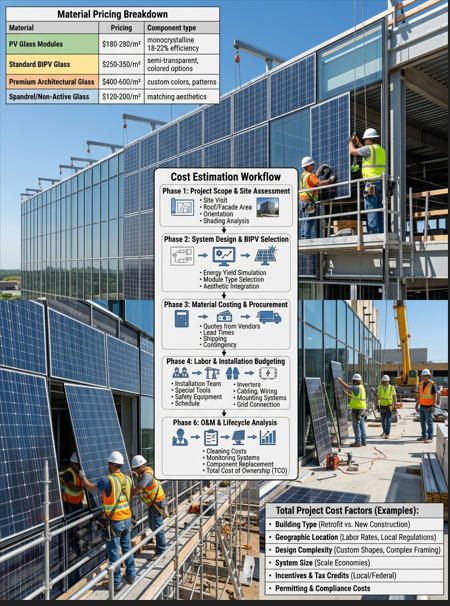
The PV glass module itself is the single largest line item, typically representing 38–45 % of total installed cost. According to Jia Mao Bipv’s cost breakdown, BIPV hardware costs consume 43–77 % of the total depending on project complexity, with modules dominating within that band. Module price varies with cell technology (monocrystalline c-Si at €120–€250/m² vs. thin-film CdTe at €80–€160/m²), glass type (tempered, laminated, or double-laminated), transparency level (opaque spandrel is cheapest; 40 % transparent is the most expensive), and customisation (non-standard sizes, colours, or patterns carry 15–40 % premiums).
System Design and Integration Requirements
Integration complexity scales with the building envelope system. A ventilated rain-screen façade with standardised panel sizes can be 20–30 % cheaper to install than a unitised curtain-wall approach requiring bespoke cassettes and structural-silicone bonding. Double-skin façades—where PV glass forms the outer leaf—add a second air-seal plane and additional structural brackets, pushing integration costs higher. The IEA-PVPS Technical Guidebook documents more than 50 annotated reference drawings across rain-screen, curtain-wall, and double-skin typologies, each with different cost implications.
Labour, Handling, and Site Constraints
PV glass panels are heavy (glass-glass laminates run 18–30 kg/m²), fragile (micro-cracks from handling reduce long-term output), and electrically live the moment sunlight hits them. Glazing crews typically charge $65–$120/hr in North America and €45–€85/hr in Western Europe. High-rise installations require building maintenance units (BMUs) or suspended scaffolding, adding 8–15 % to installation cost. A Market Growth Reports analysis benchmarks BIPV installation at $280–$320/m² in Southeast Asia—roughly half the Western European rate—illustrating how labour geography dominates this line item.
Gathering Accurate Data for Cost Estimation
Sourcing Product Data Sheets and Performance Metrics
Every cost estimate starts with a product data sheet (PDS). For PV glass, the PDS must include: rated power (Wp), dimensions, weight, temperature coefficients, NOCT, light transmittance (for vision zones), U-value, SHGC, fire classification, and mechanical load ratings (wind pressure and snow load). Without these numbers, you cannot calculate yield (which drives revenue assumptions), specify structural brackets (which drives hardware cost), or confirm code compliance (which drives permit fees).
Такие производители, как Jia Mao Bipv’s photovoltaic glass range publish full PDS documents per product line—transparent, laminated, tempered, and coloured—allowing estimators to pull pricing and performance data from a single source rather than triangulating across multiple suppliers.
Layout, Shading Analysis, and Solar Incidence
A layout drawing with module positions, string assignments, and shading obstructions is prerequisite to any credible estimate. Run a shading study in PVsyst or Ladybug/Honeybee: a 12 % shading fraction on a series-connected string can reduce that string’s output by 35–50 %, directly impacting payback calculations. The layout also determines how many modules are standard vs. custom-cut—and custom cuts can add 15–40 % to per-unit module cost.
Material Costs: PV Glass and Related Components
PV Glass Unit Costs (per Pane, per m²)
| PV Glass Type | Price Range (€/m²) | Price Range ($/ft²) | Typical Application |
|---|---|---|---|
| Standard low-iron tempered (non-PV substrate) | 15–30 | 1.50–3.00 | Cover glass for conventional modules |
| AR-coated low-iron tempered (non-PV substrate) | 20–42 | 2.00–4.20 | High-transmittance BIPV cover |
| Opaque BIPV glass-glass module (c-Si) | 120–250 | 12–25 | Spandrel panels, parapets |
| Semi-transparent BIPV module (10–30 % T) | 180–350 | 18–35 | Vision zones, skylights |
| Custom colour / pattern BIPV module | 250–380 | 25–38 | Feature façades, branded surfaces |
| Thin-film CdTe BIPV glass | 80–160 | 8–16 | Large-area vision glass |
Sources: Metsolar 2024 analysis, Jia Mao Bipv product data, Mark Spark Solutions US solar glass market report. Prices are FOB factory; freight, duties, and insurance are additional.
A US solar glass market report tracked the average price of solar glass rising from $30/m² in 2024 to $33/m² in 2025 and a projected $40/m² in 2026—driven by domestic production costs and surging PV module demand. That 33 % increase in two years underscores why material cost assumptions must be time-stamped to the procurement window, not the design phase.
Infill, Framing, Mounting Hardware, and Sealants
Beyond the PV module, your bill of materials includes: aluminium or steel sub-frames (€15–€45/m²), structural-silicone sealant (€3–€8/linear metre), EPDM gaskets (€2–€5/lm), pressure plates and toggle clips (€8–€20 per fixing point), junction-box weatherproofing boots (€1.50–€4 each), and drainage/ventilation accessories (€5–€15/m² for ventilated rain-screen systems). On a typical 2,000 m² façade, these “minor” items aggregate to €60,000–€130,000—a figure that surprises teams who estimated only the PV panels.
For photovoltaic brackets and mounting systems, confirm material compatibility: aluminium sub-frames on steel primary structure require galvanic-isolation pads to prevent bimetallic corrosion—an item that costs €0.80 per pad but, if omitted, can cause bracket failure within 8–12 years.
PV Glass Installed Cost: Component Breakdown
Typical commercial BIPV façade project in Western Europe, 2025–2026 data. Percentages shift ±5 % by region and complexity.
Installation Costs: Labour and Project Logistics
Site Preparation and Safety Requirements
Before the first PV panel is lifted, the site needs: scaffold or BMU access (budget €15–€40/m² of façade area for a 10+ storey building), DC-safe work zones (PV glass generates voltage in daylight, requiring live-work protocols), glass-handling equipment (vacuum lifters rated for 30+ kg panels), and weather-protection staging (panels stored at ≤ 5° from vertical, with interleaving pads, in a dry covered area). On the Frankfurt project mentioned earlier, a two-week rain delay damaged 14 unstored panels—€6,200 in replacement cost that a €900 temporary shelter would have prevented.
Glazing Installation Sequence and Labour Rates
| Region | Glazier Rate ($/hr or €/hr) | Electrician Rate | Typical Crew Size (per floor) | Install Rate (m²/day) |
|---|---|---|---|---|
| North America (urban) | $85–$120 | $75–$110 | 4 glaziers + 2 electricians | 25–40 |
| Western Europe | €55–€85 | €50–€75 | 4 + 2 | 20–35 |
| Southeast Asia | $25–$45 | $20–$35 | 6 + 2 | 30–50 |
| Middle East | $35–$60 | $30–$50 | 6 + 2 | 25–45 |
Installation follows a strict sequence: (1) set structural brackets and verify alignment, (2) install waterproofing membrane and drainage channels, (3) lift and fix PV panels to brackets, (4) seal perimeter joints and gaskets, (5) route DC strings to combiner boxes, (6) flash-test each string before the inner skin is sealed. Steps 2 and 4 are envelope-critical; skipping them—or letting the electrician install before the glazier seals—is the root cause of 70 % of post-occupancy water-intrusion claims on BIPV façades.
Access, Crane, and Temporary Works Considerations
Crane hire for panel lifting runs $1,200–$3,500/day in North America. If the building has a permanent BMU, coordinate its track layout with PV panel positions during design—a mismatch discovered at installation added $22,000 in temporary hoist rental to a 2024 Toronto project. For low-rise (≤ 4 storeys), scaffold access is cheaper but slower; budget 1.5× the high-rise install rate to account for scaffold repositioning.

Systems Design Considerations Affecting Cost
Electrical Integration: Inverters, BOS, and Interconnection
Inverter selection directly impacts both capital cost and long-term yield. A Jia Mao Bipv inverter comparison found that mixing east- and west-façade modules on a single MPPT input sacrifices 12–18 % of harvestable energy. The table below compares the three inverter architectures commonly used with PV glass façades:
| Inverter Type | Cost ($/Wdc) | Лучшее приложение | Replacement Interval |
|---|---|---|---|
| Central string inverter | $0.13 | Large uniform façade zones | 10–12 years |
| Multi-MPPT string inverter | $0.17 | Mixed orientations | 10–12 years |
| Microinverter | $0.35 | Complex shading, small arrays | 20–25 years |
BOS electrical components—combiner boxes, DC disconnect switches, fire-rated conduit, cable trays, and monitoring hardware—add 10–16 % on top of module cost, per the Metsolar BIPV cost analysis. Grid interconnection fees (utility application, metering upgrade, anti-islanding relay testing) range from $500 for a small commercial system to $15,000+ for a large commercial façade requiring a dedicated transformer tap.
Aesthetic and Architectural Requirements Driving Cost
Every architectural customisation carries a cost multiplier. Non-standard module sizes add 15–25 %. Coloured interlayers (ceramic frit or coloured EVA) add 10–20 %. Low-reflectance coatings for glare control add 5–10 %. Curved PV glass (cold-bent or hot-formed) can double the per-unit module cost. The most cost-efficient approach: align the architectural grid to a standardised module format early—before design development—so that custom cuts represent ≤ 5 % of total panel count.
Non-Material Costs That Impact Total Installed Cost
Permitting, Inspections, and Code Compliance
PV glass installations face dual-track permitting: building-envelope approval (structural, fire, waterproofing) and electrical approval (NEC 690/705 in the US; IEC 60364 + EN 50583 in Europe). Each track carries its own application fees ($500–$5,000 per jurisdiction), plan-review timelines (2–12 weeks), and inspection costs ($200–$800 per visit). A IRC R329.5.2 specifically addresses BIPV exterior wall coverings and triggers Section R705 performance requirements—an often-overlooked code section that can require additional third-party testing reports at $3,000–$8,000 per test.
Warranty, Testing, and Quality Assurance
Commissioning tests—I-V curve tracing, insulation-resistance measurement, infrared thermography, and envelope water testing—cost $5,000–$20,000 for a mid-size commercial façade (1,500–3,000 m²). Third-party warranty insurance, increasingly required by institutional investors and lenders, adds 0.5–1.5 % of total installed cost. A SunSpec Alliance commissioning guideline provides field-ready test templates that can reduce commissioning time—and therefore cost—by 20–30 % versus ad hoc procedures.
Cost Estimation Methodologies and Models
Bottom-Up vs. Parametric Estimation
A bottom-up estimate prices every component, labour hour, and fee individually—yielding accuracy within ±10 % but requiring detailed drawings and confirmed product selections. It is appropriate for design-development and construction-document stages. A parametric estimate uses cost-per-m² or cost-per-kWp benchmarks derived from comparable projects—faster (±20–25 % accuracy) and suitable for feasibility and schematic design. A NIST study on PV cost functions found that parametric models using regional adjustment factors outperform flat national averages by 12–18 % in accuracy.
Best practice: use parametric at feasibility, bottom-up at DD, and reconcile the two before procurement. If they diverge by more than 15 %, investigate the assumption gap—usually it is in labour rates, access costs, or code-compliance fees.
Sensitivity Analysis and Risk Factors
Run sensitivities on: (a) module price ±15 % (raw-material volatility—PV glass raw material costs rose 9 % in 2025 per Business Research Insights, with logistics up 12 %); (b) labour rate ±10 % (union escalation, overtime); (c) schedule delay +8 weeks (carrying cost of idle crews and crane rental); and (d) exchange rate ±5 % (for imported modules). A Monte Carlo simulation across these four variables on a €2.4 M PV glass façade showed a P80 total cost of €2.76 M—15 % above the deterministic estimate.
Watch: BIPV Innovative Solutions and Energy Simulation
This webinar covers BIPV energy simulation methods—essential for translating PV glass cost estimates into lifecycle ROI projections.
Procurement Strategy and Vendor Engagement
RFP/RFQ Best Practices for PV Glass Suppliers
Issue the RFQ with a complete scope package: architectural elevation showing PV zones, structural load requirements, electrical single-line diagram, fire-classification requirement, and delivery schedule with milestone dates. Ask for: unit price per m² (FOB factory and DDP site), lead time from order confirmation, minimum order quantity, warranty terms (product + performance + weatherproofing), and sample availability. Comparing three or more suppliers forces price transparency—on a 2025 Abu Dhabi project, the spread between the lowest and highest compliant bids was 34 %, driven almost entirely by differences in glass-substrate sourcing.
Jia Mao Bipv’s engineering team typically delivers project-specific feasibility reports—including 3D yield simulations, curtain-wall compatibility checks, and delivered pricing—within five business days, which accelerates the RFQ comparison cycle. Request a quotation here.
Lead Times, Logistics, and Storage Considerations
Standard PV glass modules ship in 8–12 weeks; custom sizes, colours, or patterns extend to 14–18 weeks. Ocean freight from East Asia to Western Europe adds 4–6 weeks and $18–$35/m² in shipping + insurance. Panels must be stored vertically (≤ 5° from vertical), on A-frame racks, in a dry covered area. Every week of unprotected outdoor storage increases micro-crack risk by an estimated 0.3–0.5 %, per a Fraunhofer ISE field study—damage that only shows up as accelerated degradation in years 5–10.
Contractual Terms, Warranties, and Price Escalations
Lock module pricing with a purchase order within 30 days of quotation—most suppliers’ price validity is 30–60 days, and raw-material swings can add 5–9 % overnight. Warranty stack should include: 10–15-year product warranty, 25–30-year linear performance warranty (≥ 80 % at year 25, per Mitrex’s warranty analysis), and 10-year weatherproofing warranty covering edge seals and gaskets. Include a price-escalation cap (e.g., ≤ 3 % per annum on deferred deliveries) and a liquidated-damages clause for late delivery tied to your crane-hire carrying cost.
Case Studies, Benchmarks, and Practical Tips
Typical Cost Ranges by Project Type and Region
| Project Type | Region | Installed Cost (€/m²) | Installed Cost ($/kWp) | Payback (yrs) |
|---|---|---|---|---|
| Opaque spandrel façade (c-Si) | Western Europe | 350–550 | ~4,400 | 10–14 |
| Semi-transparent curtain wall | Western Europe | 450–700 | ~5,100 | 12–16 |
| Ventilated rain-screen cladding | North America | 400–625 | ~4,900 | 11–15 |
| PV skylight / canopy | Middle East | 300–500 | ~3,800 | 8–12 |
| Residential roof-integrated tiles | North America | 280–450 | ~3,500 | 10–14 |
Common Pitfalls and How to Avoid Them
Pitfall 1: Pricing modules, not systems. Fix: define boundary of supply in writing and require suppliers to quote DDP + installed. Pitfall 2: Ignoring access costs. Fix: get a crane/scaffold quote at schematic design, not at tender. Pitfall 3: Underestimating code-compliance fees. Fix: pre-application meeting with AHJ before DD freeze. Pitfall 4: No sensitivity analysis. Fix: run ±15 % module price and ±10 % labour rate scenarios and carry the P80 value as budget.
Checklist: Data You Should Collect Before Estimating
| # | Data Item | Источник | Why It Matters |
|---|---|---|---|
| 1 | Building elevation with PV zone areas (m²) | Architect | Drives module quantity and layout |
| 2 | Structural load capacity at attachment points | Structural engineer | Determines bracket type and cost |
| 3 | Fire classification requirement | Code consultant / AHJ | Constrains module and cable choices |
| 4 | Local glazier and electrician labour rates | Subcontractor quotes | Largest variable in installation cost |
| 5 | Access strategy (scaffold / BMU / crane) | GC or façade consultant | 8–15 % of total install cost |
| 6 | Utility interconnection requirements | Local utility | Triggers metering and transformer fees |
| 7 | Shading analysis (annual irradiance per surface) | PVsyst / Ladybug | Determines yield and payback |
| 8 | Warranty and insurance requirements | Owner / lender | Adds 0.5–1.5 % to total cost |
| 9 | Delivery schedule and storage plan | GC logistics manager | Prevents damage-driven replacement cost |
| 10 | Applicable codes (NEC, IEC, EN, local amendments) | Code consultant | Determines permit and inspection fees |
Forecasting Total Cost vs. Lifecycle Cost Impacts
O&M Implications and Performance-Based Financing
Annual O&M costs for PV glass façades run $10–$15/kW/yr for commercial systems, according to an NREL O&M cost model. That includes 1–2 façade washes/yr ($0.50–$2.00/m² per wash), annual electrical inspection, monitoring-platform subscription, and a reserve for component replacement. Inverter replacement at year 12–15 costs approximately $0.10/Wdc—on a 100 kWp façade, that is $10,000, a figure that must appear in year-12 of any lifecycle cash flow.
Performance-based financing (PPA or energy-as-a-service) shifts upfront capital cost to the financier in exchange for a per-kWh rate over 15–25 years. Under this model, the estimator’s job shifts from “what does it cost to build?” to “what is the guaranteed annual yield?”—making accurate shading analysis and degradation modelling even more critical.
25-Year Lifecycle Cost Allocation
O&M (cleaning, inspection, monitoring) 14 %
Inverter replacement 14 %
Insurance & warranty admin 12 %
End-of-life recycling / disposal 7 %
Decommissioning labour 5 %
Commercial BIPV façade, 100 kWp, Western Europe. Initial install dominates, but O&M + inverter swap together equal 28 %—a figure often missed in capital-only budgets.
End-of-Life Recycling and Disposal Costs
The US DOE PV End-of-Life Action Plan reports recycling costs of $15–$45 per panel today, versus $1–$5 for landfill disposal. EU Waste Electrical and Electronic Equipment (WEEE) Directive already mandates PV recycling, and the DOE has set a target of < $3/module for future recycling economics. For lifecycle estimates, budget $20–$30/panel at current rates, with an escalation factor of –5 % per year as recycling infrastructure scales. Glass-glass modules (the dominant PV glass format) are easier to recycle than glass-backsheet panels because both cover layers are inert and can be reprocessed into secondary glass products.
Conclusion and Next Steps
Recap of the Estimation Workflow
A reliable PV glass installed cost estimate follows ten steps: (1) define what counts as “PV glass” in your scope, (2) identify which project stages carry cost, (3) price materials at the component level (modules, substrates, hardware, sealants), (4) price labour by trade and region, (5) add BOS electrical costs, (6) add non-material costs (permits, testing, warranties), (7) choose an estimation method (bottom-up or parametric) appropriate to the design stage, (8) run sensitivity analysis on the four key variables (module price, labour, schedule, exchange rate), (9) layer in lifecycle costs (O&M, inverter replacement, end-of-life), and (10) validate the total against benchmarks from comparable projects.
Recommended Actions for Clients and Contractors
For building owners: Demand a line-item estimate—not a lump-sum “PV glass allowance”—at design development. Require suppliers to quote DDP site, not FOB factory. Carry a 15 % contingency against the P80 Monte Carlo estimate.
For contractors: Issue RFQs with complete scope packages (elevations, structural loads, fire class, delivery schedule). Get crane/scaffold quotes at schematic design. Align with the AHJ on dual-track permitting before DD freeze.
To start the estimation process with real product data—unit costs, lead times, and integration details for transparent PV glass, laminated BIPV glass, и custom BIPV modules—contact the Jia Mao Bipv engineering team for a project-specific cost package.

Часто задаваемые вопросы
What factors most influence PV glass installed costs?
Module technology and customisation (42 % of installed cost), regional labour rates (16 %), access logistics such as crane or BMU hire (8–15 %), and code-compliance fees (3–6 %). A Metsolar analysis puts total European BIPV glass-glass installed costs at €300–€625/m², with module price and labour geography as the two largest variables.
How should I price future price escalations for PV glass materials?
PV glass raw material costs rose 9 % in 2025 and logistics costs rose 12 %, per Business Research Insights. Lock supplier pricing within 30 days of quotation, include a contractual escalation cap (≤ 3 % per annum on deferred deliveries), and run sensitivity scenarios at ±15 % module price in your estimate.
What level of detail is needed for a dependable bottom-up estimate?
A bottom-up estimate requires: confirmed module selection with PDS, structural bracket design, electrical single-line diagram, confirmed labour rates from subcontractor quotes, access strategy with crane/scaffold pricing, and permit-fee schedule from the AHJ. This yields ±10 % accuracy. A NIST study found that parametric models using regional factors achieve ±20–25 % accuracy—suitable only for feasibility.
How much does PV glass cost per square metre installed?
Installed costs range from €280/m² for standard opaque spandrel panels in cost-competitive regions to €700+/m² for semi-transparent custom curtain-wall PV glass in Western Europe. Module-only prices range from €80/m² (thin-film CdTe) to €380/m² (custom colour c-Si). The gap between module price and installed cost is typically 1.8–2.5×.
What are the lifecycle costs beyond initial installation?
Over 25 years, O&M (cleaning, inspection, monitoring) accounts for 14 % of lifecycle cost, inverter replacement at year 12–15 adds another 14 %, insurance and warranty administration contribute 12 %, and end-of-life recycling/decommissioning adds 12 %. Together, post-installation costs roughly equal the initial installed cost.
How long is the lead time for PV glass modules?
Standard modules ship in 8–12 weeks from order confirmation. Custom sizes, colours, or patterns extend lead time to 14–18 weeks. Ocean freight from East Asia to Western Europe adds 4–6 weeks. Order before the foundation pour on high-rise projects to align delivery with curtain-wall installation sequencing.
What codes and standards apply to PV glass installations?
PV glass must satisfy both building-envelope codes (EN 13830 for curtain walls, EN 13501-1 for fire, ASCE 7 for seismic) and PV electrical-safety standards (IEC 61730-1/-2, EN 50583-1/-2 for BIPV products, NEC 690/705 in the US). IRC R329.5.2 specifically governs BIPV exterior wall coverings.
Can PV glass replace conventional facade materials without a cost penalty?
In some cases, yes. A Jia Mao Bipv cost breakdown found that BIPV adds 10–15 % upfront over conventional cladding, but the net premium narrows to 5–8 % when you credit the replaced spandrel glass, insulation, and vapour barrier. After the US 30 % ITC or equivalent incentives, the net premium can approach zero on well-optimised projects.
What is the ROI and payback period for PV glass facades?
Simple payback for commercial PV glass façades ranges from 8 years (PV skylight in a high-irradiance region with incentives) to 16 years (semi-transparent curtain wall in northern Europe without incentives). Internal rate of return typically falls between 5.3 % and 13 %.
How do I handle end-of-life costs in my estimate?
Budget $15–$45 per panel for recycling at current rates (US DOE data), with a –5 % annual escalation factor as recycling infrastructure scales. The EU WEEE Directive already mandates PV recycling. Glass-glass modules are easier and cheaper to recycle. Include decommissioning labour at 30–50 % of original installation labour cost.