
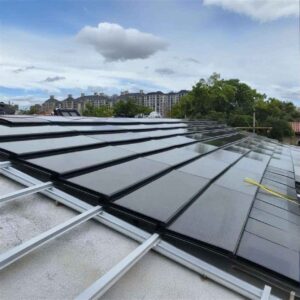
 Large-scale solar PV glass installation — the frontline of the fastest-growing segment in renewable energy.
The numbers are not projections built on optimism. The solar PV glass market is sitting at $8.5 billion today and is on a verified trajectory to reach $114.5 billion by 2034—a compound annual growth rate (CAGR) of 29.7%, making it one of the fastest-expanding material segments in the entire clean energy industry.
For distributors, agents, and regional supply chain partners, what matters isn’t the headline figure. What matters is where the margin flows, where the supply gaps are forming right now, and which moves made in the next 12–24 months will determine whether you capture a disproportionate share of this growth—or spend the next decade competing on price with a dozen others who moved first.
This is a market where early positioning is worth more than scale. And that window is closing faster than most distributors realize.
Why Now Is Critical for Distributors and Agents
Understanding the Market Explosion:
The 29.7% CAGR driving the solar PV glass market is not a single-factor story. It is the convergence of several structural trends arriving simultaneously—and each one is independently powerful.
Global solar installation capacity continues to surge. The International Energy Agency reported that solar PV added more new power capacity in 2023 than all other electricity sources combined. Every gigawatt of installed solar capacity requires approximately 5–7 million square meters of PV glass. As utility-scale solar farms scale up across India, Southeast Asia, the Middle East, and Latin America, the demand for glass substrate simply multiplies.
At the same time, energy policies in over 60 countries have introduced mandates requiring new commercial buildings to integrate renewable energy generation into their facades and rooftops. This doesn’t just grow demand for standard PV glass—it opens entirely new application categories, each with higher price points and longer contract cycles than traditional panel supply.
The result: traditional supply chains built for a slower market are now visibly struggling. Lead times that used to run 4–6 weeks are stretching to 12–16 weeks in high-demand regions. Manufacturers are running near capacity. And distributors who locked in supply agreements 12–18 months ago are now commanding the room in conversations with solar installers who are scrambling for product.
The Supply Chain Bottleneck You Need to Know About:
Solar glass manufacturing is not a plug-and-play business. It requires float glass furnaces running continuously at temperatures exceeding 1,000°C, precision tempering lines, and specialized coating equipment. New capacity cannot be switched on in weeks—capital investment cycles for new manufacturing lines run 18–36 months. This structural lag between demand acceleration and supply capacity expansion is the distributor’s most powerful ally right now.
In practical terms: manufacturers are prioritizing relationships. They are allocating constrained output to distributors who have demonstrated volume commitments, stable payment terms, and credible market coverage. The distributors sitting on the sidelines, waiting to “see how the market develops,” will discover that by the time they decide to act, the best supplier relationships are already locked in.
Gross margins on volume solar PV glass typically sit at 15–25%. But in constrained supply environments—which the next 24–36 months almost certainly represent—distributors with secured inventory and reliable allocation are commanding spot premiums of 20–35% above contract pricing. That’s not a theoretical opportunity. That’s what’s happening in Vietnam, India, and parts of the Middle East right now.
Geographic Hotspots Where Demand Outpaces Supply:
Asia-Pacific accounts for over 60% of concentrated market growth, but the geography within that region matters enormously for distribution strategy.
China represents the largest absolute volume but is the most contested market—hundreds of domestic distributors, razor-thin margins, and manufacturers who are vertically integrated into distribution in many channels. It’s a market where scale wins, and most regional distributors cannot compete on scale alone.
India is the accelerating opportunity. The country’s solar capacity addition reached a record 22 GW in the first half of 2025 alone—the highest-ever six-month installation figure. The national renewable energy target is ambitious enough that domestic glass supply cannot keep pace. The distribution infrastructure, by contrast, is underdeveloped. Distributors establishing presence in Gujarat, Rajasthan, and Tamil Nadu—where solar installation density is highest—are finding themselves with more demand than they can comfortably fulfill.
Southeast Asia—Vietnam, Thailand, Indonesia, and the Philippines—is arguably the most strategically attractive entry point for new distributors. Solar adoption is accelerating, local distribution networks are fragmented and immature, and competition from established players remains limited. Vietnam’s solar capacity has grown more than fivefold in four years. Indonesia’s government has set targets that will require sustained glass imports for the next decade. First-mover distributors in these markets are not just capturing margin—they are defining the supply chain architecture for an entire region.
Emerging Applications Beyond Traditional Solar Panels
Building-Integrated Photovoltaics (BIPV)—Your New Market Vertical:
 BIPV glass facades are transforming commercial architecture — and creating premium distribution opportunities.
Building-Integrated Photovoltaics, or BIPV (solar technology embedded directly into architectural building materials—glass facades, roofing systems, skylights—rather than mounted on top of them), is where the economics of solar glass distribution get genuinely interesting.
The global BIPV market was valued at approximately $28.7 billion in 2024 and is growing at a CAGR of over 21% toward $89.8 billion by 2030. But for distributors, the BIPV opportunity isn’t just about market size—it’s about margin architecture.
Standard PV glass is a commodity product in the eyes of large solar farm developers. They buy on price per watt, they negotiate hard on volume, and they switch suppliers when someone offers $0.02 per square meter less. The BIPV customer is a fundamentally different buyer. Architects and commercial developers are specifying glass for a mixed-use tower or an airport terminal—they need precise dimensions, specific light transmittance values, custom color profiles, and performance certification aligned with building codes. They are buying a building material that generates electricity, not an electricity component that happens to be made of glass.
That distinction is worth 40–60% higher margins compared to standard PV glass supply. Projects like the solar glass facades documented in Jia Mao BIPV’s real-world case study library demonstrate what commercial-grade BIPV glass performs like in deployed projects—energy yields, transmittance specifications, and the installation logistics that contractors need to plan around.
Why BIPV Margins Are 40–60% Higher Than Standard PV Glass:
The premium isn’t arbitrary—it reflects the complexity of the product and the value delivered to the end customer. A standard solar panel goes on a rooftop and generates power. A BIPV glass panel replaces a conventional architectural facade element (which the developer was paying for anyway), generates power, provides thermal insulation, meets building code safety standards, and contributes to the project’s green building certification score. The developer is effectively getting the glass curtain wall for near-zero net cost when energy value is accounted over the building’s life.
This shifts the conversation from “what’s the price per square meter of glass?” to “what’s the total project economics?” Distributors who understand how to frame BIPV proposals in terms of energy output, LEED or BREEAM certification contribution, and facade cost offset are closing deals at margins that volume solar glass businesses cannot approach.
Long-term contracts with construction firms and developers are standard in BIPV—project timelines span 18–36 months from specification to installation completion. That means predictable revenue, advance purchase commitments, and the ability to lock in supply from manufacturers with genuine lead time. Working with a supplier like Jia Mao BIPV, whose BIPV glass offers up to 91.5% light transmittance, monocrystalline cell efficiency exceeding 22%, and a 25-year performance guarantee, gives distributors the technical specifications architects need to make specification decisions with confidence.
Targeting the Right BIPV Customers:
The BIPV sales cycle is longer than standard solar glass—but the customer relationships it creates are far more durable. The most productive customer segments for BIPV distribution are:
- Commercial real estate developers executing green-certified commercial towers, mixed-use developments, and corporate headquarters—where facade aesthetics and energy performance are both design priorities
- Green building contractors who hold LEED or BREEAM certification and are actively sourcing compliant building materials to meet project targets
- Net-zero architects and design firms who are specifying BIPV early in the design process and need a technical partner who can support material selection
- Government infrastructure projects—airports, transit hubs, public buildings—where renewable energy integration is a procurement mandate, not an option
Perovskite and Tandem Solar Technologies—The Next Wave
Why Next-Gen Solar Glass Is Different (And More Profitable):
Perovskite solar cells (a class of photovoltaic technology using a crystalline mineral structure that can be deposited as a thin film onto glass substrates, achieving efficiencies competitive with traditional silicon at significantly lower manufacturing cost) represent the most significant shift in solar glass demand composition expected over the next decade.
The efficiency numbers are compelling: LONGi currently holds the world record for perovskite-tandem solar cell efficiency at 34.6% for a two-terminal device—compared to the 22–23% ceiling for conventional monocrystalline silicon. For any glass substrate in the stack, this means more power output per square meter of glass deployed. For distributors, it means the glass going into perovskite or tandem panels commands a fundamentally different price point.
Perovskite solar cells require glass substrates with tighter tolerances than conventional PV glass—ultra-flat surfaces (surface roughness below 0.5 nm in research applications), specific alkali content control to prevent ion migration into the perovskite layer, and dimensional precision that exceeds what commodity solar glass producers typically guarantee. Tandem solar architectures—pairing perovskite top cells with silicon bottom cells—also require specialized encapsulation glass that maintains optical clarity across a wider spectrum while meeting durability standards for field deployment.
These specifications translate directly into price. Substrates for perovskite and tandem applications currently command 2–3x the price per unit area compared to conventional solar glass. The addressable market for these substrates is growing from a small research-driven base to meaningful commercial volumes—IDTechEx projects perovskite PV installations will reach nearly 85 GW annually by 2035.
Positioning Your Business for the Perovskite Boom:
The distributors who will capture outsized margin in the perovskite segment are those building manufacturer relationships now—before commercial-scale perovskite production is commoditized. Manufacturers currently producing perovskite-grade glass substrates are research-oriented, often operating at lower volumes, and genuinely need distribution partners who understand the technical requirements and can connect them to an emerging customer base.
The certification landscape for perovskite glass is still forming—IEC is actively developing new standards for perovskite modules. Distributors who invest in understanding these standards now, and who build supplier relationships with manufacturers already working toward compliance, will be positioned as technical authorities when the perovskite market reaches mainstream commercial scale.
The Timeline: When Perovskite Goes Mainstream (And What You Should Do Now):
Commercial perovskite production is no longer theoretical—multiple manufacturers announced initial commercial production lines in 2024–2025. Meaningful market penetration, defined as perovskite and tandem products accounting for a measurable percentage of new solar installations, is expected between 2028 and 2030. The distributors with supply relationships and customer awareness built by 2026 will have an 18–24 month head start over those who wait for the market to obviously materialize.
It will not represent 50% of distribution revenue for five or more years. But as a high-margin niche running alongside the core business—and developing into a major revenue stream within the decade—perovskite glass distribution is worth deliberate investment now.
Geographic Opportunities—Where Distributors Should Expand
Asia-Pacific: The Undisputed Growth Engine:
 Asia-Pacific solar farm expansion is creating structural glass demand that domestic supply cannot match.
Asia-Pacific is forecast to account for the majority of global solar PV glass demand growth through 2034. But understanding the nuance within that region is what separates strategic distribution expansion from speculative market entry.
China is both the world’s dominant solar glass manufacturer and its largest consumer. Domestic players like Xinyi Solar and Flat Glass Group control a substantial share of global production capacity. For foreign or regional distributors, the China opportunity is less about competing domestically and more about leveraging Chinese manufacturing relationships for export-oriented supply—understanding which manufacturers have available capacity for international orders, which quality tiers they produce for export versus domestic markets, and how to navigate logistics and payment terms.
India is the market where distribution infrastructure most dramatically lags demand. The government’s target of 500 GW of renewable energy capacity by 2030 requires solar installation rates that domestic glass manufacturing cannot sustain. Distributors who establish credible import logistics—handling customs, quality certification, and last-mile delivery to installation sites in Rajasthan or Gujarat—are commanding margins that would be impossible in more mature distribution markets.
Southeast Asia’s emerging solar markets are the most underpenetrated relative to their growth trajectory. Vietnam deployed solar at extraordinary speed between 2019 and 2022. Thailand, the Philippines, and Indonesia are now at similar inflection points. Local distribution networks in these countries are fragmented, dominated by generalist trading companies without solar glass specialization. A distributor with genuine product knowledge, reliable supply relationships, and the ability to provide technical support to local installers is operating in nearly uncontested territory.
Why Establishing Distribution Networks Now Secures Your Future:
The economic logic of first-mover advantage in underpenetrated distribution markets is straightforward: installer relationships formed when a market is emerging become structural advantages when the market matures. Solar installers who build their supply chain around a reliable distributor don’t switch unless the relationship fails them. The switching cost is real—new supplier qualification, logistics setup, payment terms negotiation, product spec verification. Distributors who are present and reliable at the market formation stage inherit customer loyalty that outlasts the growth phase.
Strategic Entry Points for Distributors:
The most effective entry strategies into new geographic markets share three characteristics. First, they begin with local installer partnerships—working alongside the installers who are already present and growing, rather than trying to displace existing supply relationships. Second, they prioritize exclusive or preferred distribution agreements with one or two manufacturer partners, creating a defensible supply position rather than competing as one of many intermediaries. Third, they build inventory ahead of demand spikes, using government solar installation targets and project pipeline data as leading indicators of when demand will materialize.
The Supply Chain Reality Check—What Distributors Must Prepare For
Why Raw Material Constraints Will Define Your Competitive Edge:
Solar glass begins with silica—specifically, high-purity quartz sand with low iron content (which is what allows solar glass to achieve the optical clarity needed for maximum light transmission). High-purity silica deposits are geographically concentrated, and processing capacity to convert raw silica into the ultra-clear glass substrate solar panels require is limited to a relatively small number of facilities globally.
The iron content benchmark that separates standard float glass from solar-grade glass is typically below 0.015% by weight—a specification that sounds minor but eliminates the majority of global silica sand sources. Low-iron solar glass, sometimes called “extra-clear” or “ultra-white” glass, transmits roughly 91–92% of incident light versus 80–85% for standard glass, translating directly to higher panel efficiency. This premium specification drives premium pricing, but the raw material constraint behind it is structural and not easily resolved by simply adding manufacturing capacity.
The second constraint is coating capacity. Anti-reflective (AR) coatings applied to solar glass surfaces can increase light transmission by an additional 2–4%—compounding the efficiency advantage. AR-coated low-iron glass adds approximately 5–10% to module manufacturing cost compared to uncoated standard glass, but it commands a significantly higher price premium in the market than that cost differential suggests. The specialized equipment and chemistry required for AR coating application creates an additional supply bottleneck that benefits distributors holding inventory of coated product.
Securing Reliable Supply in a Constrained Market:
The strategic choice between long-term supply contracts and spot purchasing has rarely been more consequential than in the current solar glass market. Spot purchasing preserves flexibility but exposes distributors to price spikes and allocation shortfalls exactly when customer demand is highest—which is precisely when spot supply is tightest and most expensive.
Long-term contracts (typically 2–3 year agreements) with tier-1 manufacturers offer preferential allocation, price predictability, and the kind of relationship depth that results in early access to new product specifications. Manufacturers are actively seeking distribution partners willing to commit to volume—in exchange for supply security that spot-market distributors cannot access.
The relationship with a manufacturer like Jia Mao BIPV illustrates what tier-1 partnership looks like in practice: an annual production capacity of 3 GW, an intelligent MES (Manufacturing Execution System) production management system providing fully traceable manufacturing processes, and a product portfolio spanning transparent solar panels, photovoltaic glass, and solar roof tiles. For distributors, this means both the volume capacity to fulfill large projects and the quality documentation needed to satisfy commercial building specifications.
Hedging Your Risk in a Fast-Growing Market:
No single supplier relationship eliminates supply risk in a market growing at 29.7% annually. A diversified supplier base—two or three manufacturer relationships covering different product types or geographic origins—provides resilience against any single manufacturer’s capacity constraints or quality issues. Price escalation clauses in supply agreements should be negotiated with clear indexing mechanisms (tied to silica or energy price indices) so that cost increases can be passed through to customers transparently, without renegotiation friction.
Revenue Diversification Strategies for Your Distribution Business
Moving Beyond Volume—Capturing Higher-Margin Opportunities:
The solar PV glass market, like most industrial materials markets, will ultimately stratify into commoditized volume at thin margins and specialized applications at premium margins. The distribution businesses that capture value over the long term are those that move up the value chain before commoditization reaches their core product.
The value-add opportunity set in solar glass distribution is genuinely broad. Technical support—helping installers and contractors understand glass specifications, select the right product for their application, and troubleshoot installation challenges—is valued by customers who are often technically under-resourced. Distributors who provide reliable technical guidance build customer relationships that survive price competition from less knowledgeable competitors.
The following table illustrates the margin and contract structure differences across the key product and service categories available to solar glass distributors:
| Product / Service Category | Typical Gross Margin | Contract Duration | Customer Type |
|---|---|---|---|
| Standard solar panel glass (volume) | 15–25% | Spot to 12 months | Volume solar installers |
| Low-iron, AR-coated glass | 25–38% | 12–24 months | Mid-tier commercial installers |
| BIPV architectural glass | 40–60% | 24–48 months | Developers, architects, contractors |
| Perovskite-grade substrates | 45–70% (current niche) | Project-based | R&D manufacturers, pilot producers |
| Technical consulting services | 60–80% | Project-based | All segments |
| Training programs | 70–85% | Recurring annual | Installer teams |
| Supply chain financing | Fee-based, variable | 12–36 months | SME installers |
Bundling Services to Increase Deal Size:
A distributor selling glass to a solar installer who also offers technical specification support, supply chain financing for the purchase order, and QA documentation for the completed installation is no longer a glass supplier—they are a project partner. The relationship is stickier, the deal size is larger, and the margin on the bundled offering exceeds what any single component could achieve. Installers and contractors in growth markets are often cash-constrained; distributors who offer supply chain financing or payment term flexibility are accessing customer segments that pure-product competitors cannot reach.
Building Recurring Revenue Streams:
Long-term supply agreements with committed volume tiers create predictable revenue that makes business planning straightforward and bank financing accessible. Maintenance and replacement contracts—for BIPV installations where the building owner needs ongoing supply for damage replacement or expansion—create revenue streams that last the life of the building, often 25–40 years. Training programs for installer technical teams, covering glass handling, specification selection, and installation best practices, generate recurring annual revenue while deepening the customer relationship below the procurement decision-maker.
Competitive Positioning—How to Win Against Larger Distributors
Why Specialization Beats Scale in Emerging Markets:
Larger distribution businesses have purchasing power, logistics infrastructure, and brand recognition. What they typically lack is the granular market knowledge, customer intimacy, and application specialization that defines the best regional solar glass distributors. In a market growing at nearly 30% annually, the pie is expanding faster than any single player can capture—which means specialization in a niche or geography is a more powerful competitive strategy than trying to match scale with scale.
A distributor who is known as the definitive source for BIPV glass in the Vietnamese commercial construction market, who can provide specifications, technical support, and reliable supply for curtain wall projects, is nearly impervious to competition from a larger generalist who also happens to list solar glass in their catalog. The architect who has specified your glass on three projects in a row is not switching to a competitor who saved $0.50 per square meter.
 Technical expertise and customer intimacy are what separates premium solar glass distributors from price-competing generalists.
The Distributor’s Playbook for Market Penetration:
Identifying underserved customer segments requires looking past the obvious—the large solar farm developers are already well-served by incumbent distributors. The more attractive initial targets are mid-size installers building their project pipeline, OEM manufacturers integrating glass into their own products, and construction contractors who have BIPV specifications on upcoming projects but no established glass supplier relationship.
Educational content—market analysis, specification guides, BIPV project case studies—is one of the most cost-effective market penetration tools available. Installers and contractors who encounter genuinely useful technical content from a distributor arrive at the first commercial conversation already positioned to trust that distributor’s expertise. Platforms like BIPV technology blogs and industry publications are excellent channels for distributing this content to a technically sophisticated audience.
Digital Tools That Give You a Competitive Edge:
Inventory management systems that provide real-time visibility into stock levels, inbound shipments, and customer allocation prevent the stockouts that permanently damage customer relationships in a supply-constrained market. CRM platforms that track customer project pipelines, specification timelines, and purchase patterns enable proactive outreach at exactly the moment a customer is moving toward a purchase decision. Demand forecasting tools that incorporate government installation targets, project announcements, and regional solar capacity data allow distributors to build inventory ahead of demand spikes rather than responding to them after the fact.
Regulatory and Quality Standards—Your Compliance Roadmap
Why Quality Certifications Are Your Competitive Weapon:
In any industrial materials market, certification functions as the primary risk management mechanism for buyers who cannot independently verify product quality. An installer who purchases solar glass from an uncertified supplier and encounters performance failures six months into a project faces warranty claims, project delays, and customer relationship damage that can be business-threatening. A distributor who carries only certified product, can provide the documentation to prove it, and stands behind that certification with their own warranty terms is offering a form of insurance that customers will pay for.
The key certification framework for solar PV glass distributor operations includes:
- ISO 9001 (quality management systems) — the baseline credential that demonstrates your quality processes are documented and audited
- IEC 61215 (design qualification and type approval for crystalline silicon PV modules) — the international standard that confirms modules will survive 25-plus years of field deployment without infancy failure issues, typically required for any grid-connected solar project
- IEC 61646 (thin-film PV modules) — relevant for BIPV glass and emerging next-generation technologies
- CE marking (Europe), CEC listing (Australia), and regional equivalents — market access requirements in key export destinations
For distributors, carrying certified product from manufacturers who already hold these certifications—and being able to provide test reports, declarations of conformity, and traceability documentation on demand—is the fastest path to capturing commercial project supply contracts.
Staying Ahead of Evolving Standards:
The IEC technical committee responsible for solar module standards is actively developing requirements for perovskite and tandem technologies. Durability testing protocols are being revised to reflect the different degradation mechanisms in thin-film architectures. Distributors who track these developments and communicate proactively with customers about upcoming standard changes are positioning themselves as compliance partners rather than product vendors. In regulated procurement environments (government projects, green building certifications), this positioning is worth substantial margin premium.
Documentation and Traceability—What Customers Actually Need:
Commercial developers and government procurement agencies are increasingly requiring supply chain transparency—origin documentation, manufacturing audit records, and chain of custody for glass substrates. This is partly driven by ESG reporting requirements and partly by the practical reality that a failed panel on a commercial building needs a warranty claim trail. Distributors who maintain rigorous documentation systems, and who work with manufacturers that provide full manufacturing traceability (like the digitalized MES tracking systems used by manufacturers such as Jia Mao BIPV), can fulfill these requirements without friction—and use them as a differentiator against competitors who cannot.
Pricing Strategy in a High-Growth Market
Capturing Value Without Losing Market Share:
Solar PV glass pricing is not uniform across customer segments, and treating it as if it were is one of the most common revenue leakage mistakes in distribution. An architect specifying BIPV glass for a net-zero commercial tower has a fundamentally different price sensitivity than a volume solar installer buying standard glass in container-load quantities. Both are important customers; neither should be priced the same way.
The key insight is that price elasticity varies dramatically by application and customer sophistication. Volume installers will switch suppliers for a 3–5% price difference on a commodity product—margin in that segment is built through operational efficiency, not pricing power. BIPV customers are selecting based on specification match, supply reliability, and technical support capability; a 10–15% price premium is invisible against the risk cost of specification failure on a complex construction project.
Dynamic Pricing for Different Customer Tiers:
| Customer Tier | Pricing Approach | Margin Target | Key Value Driver |
|---|---|---|---|
| BIPV architects & developers | Premium pricing, project-based quotation | 40–60% | Technical specification, reliability, certification |
| Commercial solar installers | Contract pricing, volume discounts | 25–35% | Supply reliability, lead time, documentation |
| Perovskite / R&D manufacturers | Premium niche pricing | 45–70% | Substrate specification, quality consistency |
| Volume solar farm developers | Competitive volume pricing | 15–22% | Price, lead time, allocation security |
Managing Customer Expectations During Price Volatility:
In a market where raw material prices can move 10–15% in a quarter, transparent communication about cost drivers is the foundation of customer trust. Distributors who attempt to absorb all cost increases erode their own margins; those who pass through increases without explanation erode customer trust. The middle path—proactive communication explaining what is driving price changes, offering fixed-price contract structures for customers who value predictability, and honoring commitments even when spot market pricing would allow a higher price—builds the kind of loyalty that survives market volatility.
Building Your Go-to-Market Strategy for the Next 3 Years
The 90-Day Action Plan for Distributors:
The first 90 days are about establishing your baseline and identifying your highest-leverage opportunities—not making major capital commitments.
Start with a rigorous audit of your current supplier relationships. For each supplier: what is their current capacity utilization, what allocation are they willing to commit to you on a 12–24 month basis, and what new product lines are they developing? For your customer base: which segments are growing fastest in your region, which are most underserved by current supply, and where are the specification conversations happening that you are not yet part of?
Identify your top three geographic or application-based growth opportunities with specificity. “BIPV in commercial construction” is a direction; “BIPV glass supply to commercial developers in the Hanoi market for projects targeting LEED certification” is an addressable market. Map the specific customer segments, their project pipelines, their current glass suppliers, and the switching opportunity available to you.
🎥 Watch: How the Solar PV Glass Market Is Evolving

This video walks through the key dynamics driving solar PV glass market expansion—relevant context for distributors building their market entry strategy.
Securing Supplier Commitments Before the Rush:
Negotiating long-term supply agreements with favorable terms requires approaching manufacturers as partners, not just vendors. Come prepared with: a market analysis showing demand in your region, evidence of your distribution capacity and customer relationships, and a credible volume commitment backed by the customer pipeline data you’ve developed. In exchange, push for preferential allocation guarantees, price stability clauses, and first-look access to new product specifications.
Build inventory of high-demand products—low-iron glass, AR-coated panels, BIPV architectural glass—ahead of the demand curves that government solar installation targets and announced commercial projects predict. In markets where demand is accelerating, the distributor who is in stock when competitors are on a 10-week lead time owns the market for the duration of that shortage.
Establishing exclusive or preferred distributor status with one or two manufacturer partners creates a defensible market position that is worth investing in. Jia Mao BIPV’s product portfolio—covering transparent BIPV glass panels, solar roof tiles, and photovoltaic glass facades, with an annual production capacity of 3 GW and a 25-year performance guarantee—represents the kind of manufacturer partnership that gives distributors a technically differentiated product to position against commodity competitors.
Customer Acquisition Focused on High-Value Segments:
For most regional distributors, the highest-return customer acquisition investment is focused on BIPV contractors and commercial developers. These customers have longer sales cycles but larger deal sizes, longer contract durations, and lower price sensitivity than volume solar installers. Once won, they generate predictable revenue that justifies the investment in technical support and specification documentation.
Emerging solar installers in high-growth markets—the companies that are currently small but growing fast with the market—are equally valuable. They are forming supply chain habits now that will persist as they scale. A distributor who supports them with supply reliability, technical guidance, and flexible payment terms when they are building their business will be their first call when they become a significant buyer.
Concluding Insights—Your Window of Opportunity:
 The window of opportunity for distributors to establish position in the solar PV glass supply chain is open—but it won’t stay open.
The solar PV glass market’s growth from $8.5 billion to $114.5 billion by 2034 is not a scenario. It is a trajectory backed by installed solar capacity data, policy mandates across 60+ countries, architectural code changes driving BIPV adoption, and a technology pipeline—perovskite, tandem architectures—that will add entirely new demand categories within the decade.
For distributors and agents, the next 12–24 months are definitional. The companies capturing disproportionate market share over this growth cycle will be those who secured supplier relationships before capacity constraints fully tightened, positioned themselves in Asia-Pacific’s high-growth geographies with genuine local market knowledge, specialized in BIPV and emerging applications rather than competing in the commoditized volume segment, and built customer loyalty through supply reliability and technical expertise rather than price.
The question is not whether the market will reach $114.5 billion. The question is whether you will be the distributor your customers call first when they need product—or whether you will be one of many competing on price because someone else built the relationship first.
Take Action Now:
Your next step: Schedule a strategy session with the Jia Mao BIPV market intelligence team to:
- Assess your current position in the solar PV glass supply chain
- Identify the 2–3 highest-impact opportunities for your distribution business
- Create a 12-month action plan to capture market share in your region
→ Visit www.jmbipvtech.com to schedule your strategy session
Limited availability for distributors serious about capturing position in the $114.5B solar PV glass market before competition intensifies.
Glossary of Key Terms
Understanding the technical language of solar PV glass is essential for building credibility with customers. Here are the core terms every distributor needs to master:
BIPV (Building-Integrated Photovoltaics): Solar technology embedded directly into architectural building materials—glass facades, roofing systems, skylights—that serves the dual function of generating electricity and functioning as a structural building component.
Low-Iron Glass: Solar-grade glass produced from silica sand with iron content below 0.015%, enabling light transmittance of 91–92% versus 80–85% for standard glass. The preferred substrate for high-efficiency PV modules.
Anti-Reflective (AR) Coating: A nano-scale coating applied to the glass surface that reduces light reflection and increases transmission by 2–4%, directly improving module power output.
Perovskite Solar Cells: A class of photovoltaic technology using a crystalline mineral structure deposited as a thin film onto glass substrates. Capable of efficiency above 34% in tandem configurations, requiring specialized glass substrates with tighter tolerances than conventional PV glass.
Tandem Solar Architecture: A solar cell design stacking two photovoltaic layers (e.g., perovskite over silicon) to capture different parts of the solar spectrum, achieving efficiencies beyond what either layer could reach independently.
IEC 61215: The international design qualification standard confirming that crystalline silicon PV modules can withstand 25+ years of field deployment without infancy failure.
CAGR (Compound Annual Growth Rate): The annualized rate of return or growth over a specified period. A 29.7% CAGR means the market value nearly triples every four years.
MES (Manufacturing Execution System): A digitalized production tracking system that provides real-time visibility into manufacturing processes, enabling full traceability of materials and quality data—critical for supply chain transparency documentation.
Perguntas frequentes
1. How much of the $8.5B to $114.5B market growth will actually flow to distributors—and what margins should I realistically target?
The distribution channel controls the critical middle layer between manufacturers focused on production and installers focused on project delivery. Expect 15–25% gross margins on volume standard glass, 25–38% on low-iron and AR-coated product, and 40–60% on BIPV architectural glass. Specialized applications like perovskite substrates currently command 45–70% margins for distributors who can source them. The largest share of margin opportunity flows through the distribution channel precisely because manufacturers and installers are each focused on their own core operations—leaving distribution as the value-capture layer.
2. Which geographic market should I prioritize first—India, Southeast Asia, or the Middle East?
The answer depends on your existing relationships and logistics infrastructure, but the general framework is: India offers the fastest growth rate (the solar energy market is forecast to expand from $30 billion in 2025 to $538 billion by 2034) with significant distribution infrastructure gaps; Southeast Asia—particularly Vietnam, Thailand, and Indonesia—offers high growth with minimal established competition among specialist distributors; the Middle East offers large project scale and government-backed procurement. Start where you have a relationship to leverage; expand to the next market within 12 months.
3. Should I prioritize traditional PV glass volume or pivot to BIPV and emerging applications?
Both play essential roles in a resilient distribution business. The recommended portfolio is approximately 65–70% traditional glass for volume, cash flow, and market presence, with 30–35% allocated to BIPV and specialized applications for margin and differentiation. Traditional glass without a premium application layer leaves you perpetually competing on price; BIPV without volume base leaves you with insufficient cash flow to sustain operations during project gaps.
4. What minimum inventory level do I need to stay competitive in a supply-constrained market?
Plan for 60–90 days of inventory based on your customer base’s consumption patterns. In high-growth markets where stockouts cause permanent customer relationship damage, 90 days is the safer target. In more stable markets, 60 days balanced against working capital constraints is defensible. The more important metric is having inventory in the specific SKUs your key customers need—having 90 days of standard glass while being out of stock on low-iron AR-coated product doesn’t protect your most valuable customer relationships.
5. How do I approach a manufacturer about a long-term supply agreement when I’m still building my market position?
Manufacturers in a growing market need reliable distribution partners more than distributors need any single manufacturer. Approach the conversation with a credible market analysis demonstrating demand in your region, documentation of your logistics and customer relationship infrastructure, and a volume commitment tied to the customer pipeline you can substantiate. Offer a 2–3 year agreement in exchange for preferential allocation and pricing. Manufacturers who are expanding capacity—like Jia Mao BIPV with 3 GW annual production—are actively seeking partners who can deliver that market coverage.
6. Which quality certifications should I require from my glass suppliers, and how do I communicate their value to customers?
The baseline certification requirement is IEC 61215 for crystalline silicon glass applications and ISO 9001 for the manufacturer’s quality management system. For European project work, CE marking is a market access requirement. For BIPV applications, regional building code certifications vary—your architect and contractor customers will specify what’s required for their projects, and your job is to ensure your supplier holds or can provide those certifications. To customers, frame certifications as risk reduction: an IEC 61215-certified product has been independently tested to survive 25+ years of deployment without failure. That’s not a marketing claim; it’s a warranty foundation.
7. When will perovskite solar glass become a meaningful part of my revenue—and what should I be doing right now to prepare?
Perovskite commercial production launched in 2024–2025, with meaningful market penetration expected between 2028 and 2030. IDTechEx projects annual perovskite PV installations approaching 85 GW by 2035. The glass substrates for these applications command 2–3x conventional glass pricing today. Your preparation: build one manufacturer relationship now for perovskite-grade substrate sourcing, start educating your existing customers on the technology and its advantages, and track IEC standards development for perovskite modules so you can communicate compliance requirements before competitors are even aware of them.
8. How do I compete effectively against larger, better-resourced distributors entering my market?
Larger competitors have scale but lack local market expertise, customer intimacy, and application specialization. Win by selecting a niche where your knowledge is genuinely superior—a specific geography, a customer segment like BIPV commercial contractors, or a technical specialty like perovskite substrates. Provide technical support depth that generalist competitors cannot match. Build customer relationships at multiple levels within each account—procurement, engineering, project management—so no single relationship change puts the account at risk. In emerging markets, speed and expertise consistently outperform scale.
9. What are my biggest supply chain risks over the next 2–3 years, and how do I hedge against them?
The primary risks are raw material constraints (silica sand, specialty coatings), manufacturing capacity bottlenecks as demand outpaces new production lines, and geopolitical disruptions to trade flows affecting import-dependent markets. Mitigation: maintain relationships with two to three manufacturer suppliers across different geographies, hold 60–90 days of inventory in your highest-demand SKUs, include price escalation clauses in customer contracts indexed to published raw material price data, and maintain transparent communication with customers about supply challenges before stockouts occur.
10. Should I invest in building BIPV inventory before demand in my region materializes?
Yes—with the discipline to base the investment on leading indicators rather than speculation. The leading indicators worth tracking are: announced BIPV projects in your region (construction permit filings, government green building mandates, architect specification announcements), government renewable energy targets with specific BIPV components, and the project pipelines of your top contractor and developer customers. Building inventory 6–12 months ahead of demonstrable demand positions you as the first-call supplier when projects go live; waiting until demand is obvious means competing with new entrants who have already secured manufacturer allocations.
11. How do I identify and target the highest-value customer segments for my distribution business?
Established solar installers with track records of completed projects (they have cash flow and predictable repeat demand), commercial developers and contractors working on green building projects (BIPV projects mean higher margins and longer contracts), and government agencies with renewable energy procurement mandates (long-term contracts and stable demand). Avoid heavily residential-focused installers as your primary customer base early—they are price-sensitive and have high switching rates, which makes customer retention difficult and margin defense nearly impossible.
12. What role should digital tools play in my distribution operations?
Digital tools are essential for competing in a fast-growing market where decisions need to be made ahead of demand. Inventory management systems prevent the stockouts that permanently damage customer relationships. CRM platforms track customer project timelines and buying patterns, enabling proactive outreach when customers are approaching purchase decisions. Demand forecasting tools—incorporating government capacity targets, project announcements, and regional solar installation data—allow you to build inventory ahead of demand rather than reacting to it. Distributors using data to drive decisions will consistently outperform those relying on intuition in a market moving at 29.7% annually.
13. How do I create educational content that positions me as an expert and attracts premium customers?
The most effective content addresses the specific decisions your target customers face. For architects and commercial developers: technical guides on BIPV glass selection, specification compliance for LEED certification, and energy output calculations by facade orientation. For solar installers: product selection guides matching glass specifications to installation environments, handling and installation best practices, and quality verification checklists. Publish this content through industry associations, LinkedIn, and your own website. Customers who find your content useful before they need your product arrive at the sales conversation already predisposed to trust you.
14. How should I structure my pricing to protect margins during raw material price volatility?
Build price escalation mechanisms into your customer contracts from the outset—indexed to a published silica or float glass price benchmark that both parties can verify. Offer fixed-price contracts for customers who prioritize price certainty over optimum pricing, but price that certainty at a premium that reflects the risk you’re absorbing. For your highest-value BIPV customers, project-based pricing that reflects the full specification and service bundle prevents commodity price comparisons. Monitor competitor pricing monthly, but resist the instinct to match every downward move—margin erosion in a growing market is a permanent loss.
15. What is the concrete 12-month action plan I should follow to capture market share before competition intensifies?
The framework by phase: Months 1–2 — audit all current supplier relationships and capacity commitments; map your customer base by segment, margin contribution, and growth trajectory; identify your top three geographic or application growth opportunities with specific customer targets. Months 2–3 — approach two to three tier-1 manufacturers with long-term supply agreement proposals; initiate conversations with BIPV-focused customers in your target segments. Months 3–4 — close supplier agreements and begin inventory build for high-demand SKUs. Months 4–6 — launch technical content and customer education program; establish preferred supplier status with your top 20 accounts. Months 6–9 — formally launch BIPV or specialized application offering with full technical support capability. Months 9–12 — evaluate geographic expansion or new customer segment entry; measure against volume, margin, and customer retention targets set at the outset.
For distributors and agents ready to establish position in the solar PV glass supply chain, visit www.jmbipvtech.com to explore product specifications, review technical documentation, and connect with the Jia Mao BIPV supply team. Additional resources on BIPV technology and market applications are available through Glass-Integrated Solar Panels & Facade Systems Review, the IEA Solar PV Global Supply Chains Reporte Grand View Research’s BIPV Market Analysis.




-300x300.jpg)