In 2026, the commercial solar panel market has reached a point where efficiency differences between leading brands are measured in fractions of a percent — yet those fractions, compounded across a 100kW rooftop array over 25 years, translate into tens of thousands of dollars in cumulative energy output. Picking the right panel for a commercial project is no longer about choosing “the best brand” in the abstract. It requires matching specific datasheet metrics — efficiency, temperature coefficient, degradation rate, mechanical load ratings, and warranty structure — to specific building conditions, energy consumption patterns, and financial models.
This article evaluates the leading commercial solar panel brands of 2026 across four performance dimensions: efficiency, real-world output, durability and warranty, and cost-to-value ratio. Every ranking is grounded in published specifications and field-validated data, not marketing claims. Whether you are procuring panels for a warehouse rooftop, a multi-story commercial facade, or a large-scale ground-mount installation, the comparison tables and charts below are designed to make your procurement decision faster and more defensible.
Image: Commercial-scale solar installations demand panels optimized for output density, heat tolerance, and long-term warranty coverage. (Source: Pexels – Free to use)
Leading Commercial Solar Panel Brands 2026
Top Brands Overview
The commercial solar panel landscape in 2026 is dominated by manufacturers who have transitioned fully to N-type cell architectures — primarily TOPCon, HJT (heterojunction), and back-contact (XBC) designs. The older P-type PERC technology, which powered the industry’s expansion from 2018 to 2022, has been largely phased out of premium product lines. According to Clean Energy Reviews, polycrystalline panels are no longer manufactured by any major brand, and monocrystalline N-type cells now form the baseline for all top-tier commercial modules.
The brands that consistently rank at the top of independent evaluations — including those by EnergySage, Clean Energy Reviews, and NRG Clean Power — include Maxeon (formerly SunPower), REC Group, Canadian Solar, Qcells, Silfab Solar, Jinko Solar, Trina Solar, LONGi Solar, Aiko Solar, and Hyundai Energy Solutions. Each occupies a slightly different position on the performance-cost spectrum, and the right choice depends on whether your project prioritizes maximum efficiency per square meter, lowest cost per watt, best hot-climate performance, or the longest warranty horizon.
Why These Brands Stand Out
What separates these ten manufacturers from the dozens of other panel makers worldwide is a combination of verified performance data, bankability (the ability to secure project financing based on brand reputation), and warranty enforceability. A 25-year warranty means nothing if the manufacturer lacks the financial stability or service infrastructure to honor claims in year 18. Every brand on this list either carries Tier-1 Bloomberg New Energy Finance (BNEF) status, maintains regional service centers with domestic inventory, or is backed by a parent corporation with a multi-billion-dollar balance sheet.
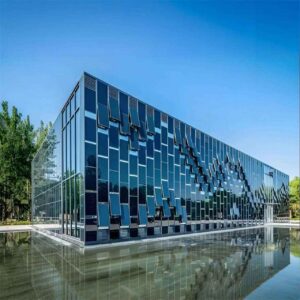
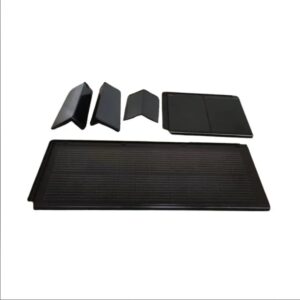
For commercial projects involving building-integrated photovoltaic (BIPV) applications — where panels serve double duty as both building envelope and power generator — specialized manufacturers such as Jia Mao Bipv are increasingly specified. With an annual production capacity of 3GW and monocrystalline cell efficiencies exceeding 22%, Jia Mao Bipv offers BIPV modules customized in size, color, and transparency — a capability that standard panel manufacturers do not provide.
Commercial Solar Panel Performance Criteria
Solar Panel Efficiency and Output
Efficiency is the most-cited metric in solar panel comparisons, and for good reason: it directly determines how many kilowatt-hours a given roof area can produce. In 2026, commercial-grade panels from leading brands range from approximately 21% to 25% module efficiency under Standard Test Conditions (STC). That 4-percentage-point spread may sound small, but on a 500m² commercial rooftop, it represents the difference between a 90kW system and a 112kW system — a 24% capacity increase from the same physical footprint.
Durability and Warranty
Commercial solar investments are evaluated on 25- to 30-year financial models. Warranty terms are the contractual backstop that protects those projections. In 2026, the industry standard is a 25-year product warranty and 25-year performance warranty, but premium brands now extend to 30-year performance guarantees (Hyundai, SEG, Silfab) and even 40-year comprehensive coverage (Maxeon). The critical comparison point is not just warranty length, but the guaranteed output percentage at year 25 and year 30 — and the annual degradation rate that determines it.
Cost and ROI
Commercial solar panel pricing in 2026 ranges from $1.40 to $1.80 per watt (DC) for the modules alone, according to GreenLancer’s 2026 cost breakdown. Fully installed system costs (including inverters, racking, wiring, labor, and permitting) range from $1.80 to $2.55 per watt for small-to-mid-sized commercial projects. With the 30% federal Investment Tax Credit (ITC) still available for projects beginning construction in 2026, and rising electricity rates shortening payback timelines, Wood Mackenzie reports that commercial solar payback periods have dropped by 33% compared to two years ago, now averaging 3–5 years in many U.S. markets.
User Satisfaction
Independent review platforms like SolarReviews and the Better Business Bureau aggregate thousands of installer and end-user reviews. Across these platforms, the brands that consistently score highest for post-sale support — warranty claim resolution speed, replacement panel availability, and technical documentation quality — are REC, Maxeon, Qcells, and Silfab. Canadian Solar and Jinko Solar score well on product reliability but receive more mixed feedback on warranty claim processing times in North American markets.
Solar Panel Efficiency Comparison
Efficiency Ratings of Top Brands
The following table consolidates the latest verified efficiency ratings for the top commercial solar panel brands in 2026. All figures are based on manufacturer datasheets for residential-format modules (54–66 cell), except where noted for commercial-format (72+ cell) modules.
| Rank | Marca | Modelo | Power (W) | Eficiência (%) | Cell Type | Temp Coeff. (%/°C) |
|---|---|---|---|---|---|---|
| 1 | Aiko Solar | Neostar 3P54 | 500 | 25.0% | N-type ABC (Back Contact) | −0.29 |
| 2 | Recom Tech | Black Tiger Series | 495 | 24.8% | N-type Back Contact | −0.28 |
| 3 | LONGi Solar | Hi-MO X10 Explorer | 495 | 24.3% | N-type HPBC 2.0 | −0.29 |
| 4 | Maxeon | Maxeon 7 (Gen 7) | 445 | 24.1% | N-type IBC | −0.27 |
| 5 | Jinko Solar | Tiger Neo III | 520 | 24.0% | N-type TOPCon | −0.29 |
| 6 | Trina Solar | Vertex S+ | 475 | 23.8% | N-type TOPCon | −0.30 |
| 7 | Silfab Solar | SIL-440 QD | 440 | 22.6% | N-type TOPCon | −0.29 |
| 8 | Hyundai | HiS-T440NF(BK) | 440 | 22.53% | N-type TOPCon Bifacial | −0.29 |
| 9 | Qcells | Q.TRON BLK M-G2+ | 440 | 22.5% | N-type TOPCon | −0.30 |
| 10 | REC Group | Alpha Pure-RX | 460 | 22.1% | N-type HJT | −0.24 |
Table: Top 10 commercial solar panel brands ranked by module efficiency in 2026. Data from Clean Energy Reviews, EnergySage, and manufacturer datasheets (Feb 2026).
Technology Trends (TOPCon, Bifacial)
Two technology shifts define the 2026 commercial panel market. The first is the near-universal adoption of N-type TOPCon cells as the high-volume production standard. TOPCon (Tunnel Oxide Passivated Contact) adds an ultra-thin oxide layer to the cell’s rear surface, reducing electron recombination and boosting voltage output. According to the Solar Energy Industries Association (SEIA), bifacial installations — which capture reflected light from the rear of the panel — grew 300% year-over-year, driven largely by TOPCon’s inherently high bifacial factor of approximately 85% (compared to ~70% for older PERC cells).
The second shift is the emergence of back-contact (XBC) cell architectures at commercial scale. By moving all electrical contacts to the rear of the cell, XBC designs eliminate busbar shading losses on the front surface, pushing module efficiency above 24%. Aiko Solar, LONGi, and Recom Technologies are the current leaders in this category. While back-contact panels command a price premium, their higher power density makes them the cost-effective choice for commercial rooftops where space is constrained and every square meter of panel area must maximize output.
Efficiency Comparison: Top 10 Brands (Bar Chart)
2026 Commercial Solar Panel Efficiency by Brand (%)
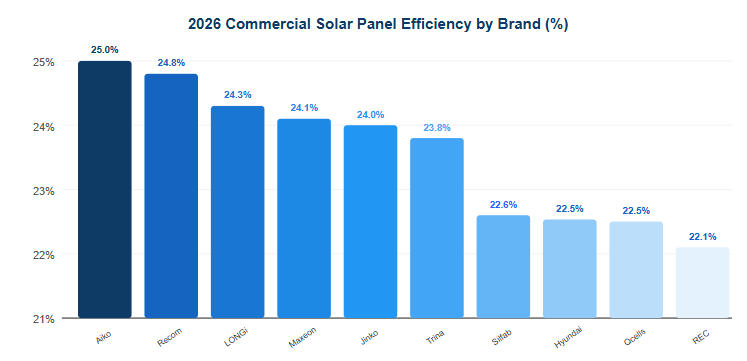
Bar Chart: Module efficiency comparison of the top 10 commercial solar panel brands in 2026. Sources: Clean Energy Reviews, EnergySage, manufacturer datasheets.
Output and Real-World Performance
Output in Commercial Installations
STC efficiency is a laboratory benchmark. What businesses actually experience on their rooftops is shaped by temperature, shading, panel orientation, dust accumulation, and inverter clipping. In a 100kW commercial installation in Dallas, Texas — where summer cell temperatures routinely reach 65°C — a panel with a −0.24%/°C temperature coefficient (REC Alpha Pure-RX) would lose approximately 9.6% of its rated output on a peak summer day. A panel with a −0.30%/°C coefficient (Qcells Q.TRON) would lose 12.0% under identical conditions. On a 100kW system, that 2.4% gap translates to roughly 2.4kW of lost capacity at peak — equivalent to approximately 1,200 kWh per year, or $150–$200 annually at commercial electricity rates.
Multiply that across 25 years, and the panel with the better temperature coefficient delivers an additional $3,750–$5,000 in lifetime electricity value from the same installation. This is why temperature coefficient — not just STC efficiency — should be a primary selection criterion for commercial projects in hot climates.
Factors Affecting Real-World Results
Beyond temperature, three factors disproportionately affect commercial rooftop output. The first is shading from rooftop HVAC units, parapets, and adjacent buildings — a problem that can be mitigated by using module-level power electronics (MLPEs) such as microinverters or DC optimizers, but cannot be eliminated entirely. The second is soiling: dust, bird droppings, and industrial particulate accumulation can reduce output by 5%–15% annually if panels are not cleaned at least twice per year. The third is inverter sizing: oversizing the DC array relative to the AC inverter capacity (a practice called “clipping”) intentionally sacrifices peak output to capture more energy during morning, evening, and cloudy periods — a trade-off that varies by project economics.
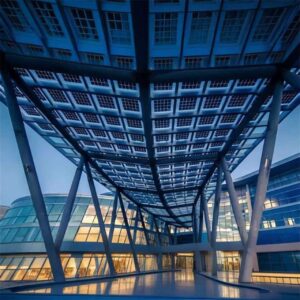
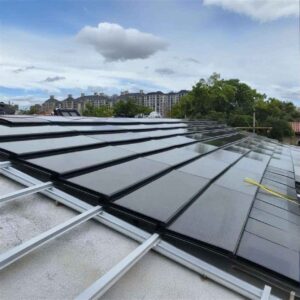
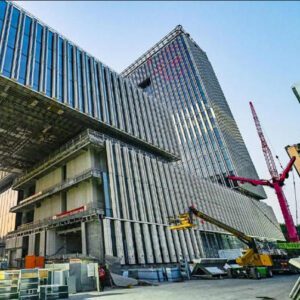
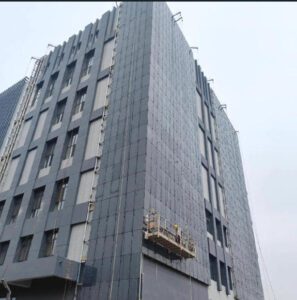
For commercial buildings where the rooftop is only one of several energy-producing surfaces, BIPV solutions add a critical advantage: facade panels, skylights, and canopy structures that generate power from surfaces that standard rooftop-only installations cannot reach. Jia Mao Bipv’s industrial and commercial roof PV panels achieve ≥21.8% module efficiency with Grade 14 wind resistance and a non-penetrating installation method that eliminates the roof leak risk that concerns many commercial building owners.
Image: Commercial rooftop solar installations must account for HVAC obstructions, wind loads, and structural weight limits that residential projects rarely encounter. (Source: Pexels – Free to use)
Durability and Warranty Comparison
Lifespan and Degradation
All silicon-based solar panels degrade over time — the question is how fast. Premium panels using N-type cells (HJT, TOPCon, or back-contact) degrade at 0.25%–0.35% per year after a first-year drop of 1%–2%. Budget panels using older P-type PERC cells may degrade at 0.45%–0.55% per year. According to PV Magazine citing NREL data, premium manufacturers achieve degradation rates as low as 0.25%/year, while some brands degrade at rates as high as 0.80%/year.
Over 25 years, this difference compounds dramatically. A panel degrading at 0.25% per year retains approximately 94% of its original rated output at year 25. A panel degrading at 0.50% per year retains only 87.5%. On a 200kW commercial system, that 6.5-percentage-point gap represents 13kW of lost capacity — roughly $2,600–$3,400 per year in unrealized electricity revenue at the end of the system’s warranted life.
Year-25 Output Retention: Premium vs. Budget Panels
Year-25 Output Retention
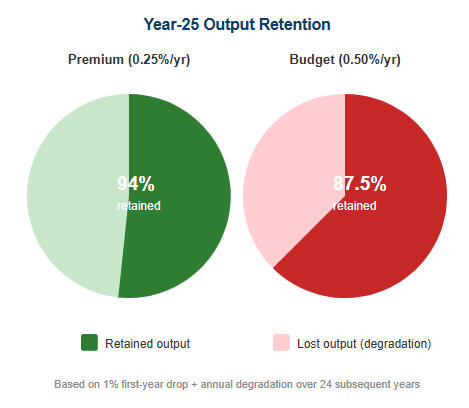
Pie Chart: After 25 years, premium N-type panels retain ~94% of rated output while budget panels retain only ~87.5%. Source: NREL, PV Magazine, SolarLove brand comparison tool.
Warranty Terms
| Marca | Product Warranty | Performance Warranty | Year-25 Guarantee | Year-30 Guarantee | Annual Degradation |
|---|---|---|---|---|---|
| Maxeon | 40 years | 40 years | 92.0% | 90.0% | 0.25% |
| REC Group | 20–25 years* | 25 anos | 92.0% | — | 0.25% |
| Silfab Solar | 25 anos | 30 anos | 90.8% | 89.3% | 0.33% |
| Hyundai | 25 anos | 30 anos | 89.4% | 87.4% | 0.40% |
| SEG Solar | 30 anos | 30 anos | 89.4% | 87.4% | 0.40% |
| Qcells | 25 anos | 25 anos | 90.58% | — | 0.33% |
| Canadian Solar | 25 anos | 30 anos | 87.4% | 84.8% | 0.40% |
| Jinko Solar | 25 anos | 30 anos | 87.4% | 84.8% | 0.40% |
| Trina Solar | 25 anos | 25 anos | 87.4% | — | 0.45% |
| LONGi Solar | 25 anos | 25 anos | 87.4% | — | 0.40% |
Table: Warranty comparison of leading commercial solar panel brands in 2026. *REC’s extended warranty requires certified installer + registration. Data sourced from manufacturer datasheets and NRG Clean Power (Feb 2026).
Cost Analysis for Commercial Solar Panels
Price per Watt Comparison
Module pricing in the commercial segment varies based on cell technology, brand tier, and order volume. Based on 2026 market data from EnergySage and distributor pricing, the approximate cost per watt for each brand tier breaks down as follows: premium back-contact modules (Aiko, Maxeon) at $0.35–$0.45/W, premium TOPCon/HJT modules (REC, Silfab, Hyundai) at $0.28–$0.38/W, and mainstream TOPCon modules (Jinko, Trina, Canadian Solar, LONGi) at $0.14–$0.22/W. The fully installed system cost, including balance of system and labor, adds $1.00–$1.60/W on top of module pricing.
ROI and Payback Period
For a hypothetical 200kW commercial rooftop system installed in 2026 at $2.00/W total system cost ($400,000 before incentives), the federal 30% ITC reduces the net cost to $280,000. If the system generates 280,000 kWh per year and the commercial electricity rate is $0.12/kWh, the annual savings equal $33,600. Payback period: approximately 8.3 years before accounting for accelerated depreciation (MACRS), which can reduce payback to approximately 4–6 years for tax-paying businesses. According to a Commercial Solar Guy analysis, projects in states with additional incentives (Massachusetts SMART Program, New York VDER) achieve payback as fast as 3–4 years.
| System Size | Installed Cost (pre-ITC) | Net Cost (30% ITC) | Annual Savings | Simple Payback | Payback w/ MACRS |
|---|---|---|---|---|---|
| 50 kW | $100,000 | $70,000 | ~$8,400 | ~8.3 years | ~5 years |
| 100 kW | $190,000 | $133,000 | ~$16,800 | ~7.9 years | ~4.5 years |
| 200 kW | $360,000 | $252,000 | ~$33,600 | ~7.5 years | ~4 years |
| 500 kW | $800,000 | $560,000 | ~$84,000 | ~6.7 years | ~3.5 years |
Table: Commercial solar ROI estimates for 2026 by system size. Assumes $0.12/kWh electricity rate, 1,400 kWh/kW annual production, and 30% federal ITC. Larger systems benefit from lower per-watt installation costs.
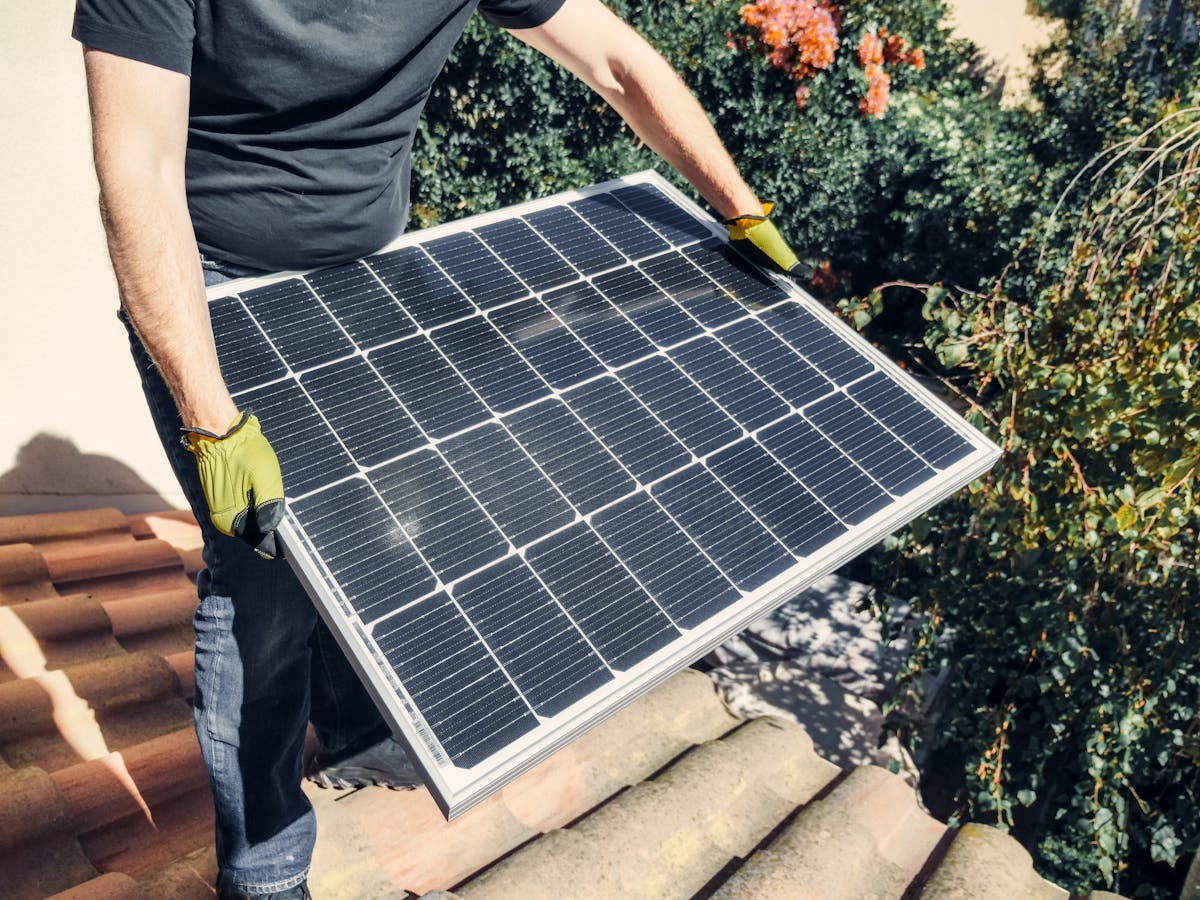
Image: Skilled installers connect commercial solar panels — proper wiring design and inverter matching directly impact lifetime system performance. (Source: Pexels – Free to use)
User Reviews and Satisfaction
Business Owner Feedback
Across platforms like SolarReviews, EnergySage, and the BBB, the recurring themes in commercial user satisfaction data are clear. Business owners who selected REC and Maxeon panels report the lowest rate of warranty claims — under 0.5% of installed panels requiring replacement within the first 10 years, according to aggregated installer feedback. Qcells receives consistently high marks for mechanical durability, with installers in snow-heavy regions (Minnesota, Michigan, Colorado) citing zero frame-failure incidents even under multi-day snow loading exceeding 5,000 Pa.
Jinko Solar and Trina Solar dominate positive feedback for “best value” — delivering measurably strong output-per-dollar for large-scale installations. A 500kW warehouse rooftop project in New Jersey using Jinko Tiger Neo panels, documented by a regional installer, produced 103% of the PVsyst-modeled first-year output — a result attributed to Jinko’s strong bifacial gain on the white TPO membrane roof.
Support and Service Quality
Service quality varies sharply between brands with domestic U.S. operations and those relying on overseas-headquartered support teams. Silfab Solar, manufactured in Washington state, and Qcells, with U.S. assembly in Georgia, both receive above-average support scores for warranty claim turnaround time (typically 10–15 business days to ship replacement panels). Chinese-headquartered brands — Jinko, Trina, LONGi — have improved service infrastructure in North America significantly since 2023, but commercial customers still report longer resolution times (20–40 business days) for non-standard claims.
Emerging Brands and Innovations
New Entrants in 2026
The most talked-about new entrant in 2026 is Oxford PV, which holds the record for the most efficient commercial-sized perovskite-silicon tandem solar panel at 26.8% cell efficiency. In September 2024, Oxford PV secured its first commercial delivery deal in the U.S. at 24.5% module efficiency. While production volumes remain small, the technology — layering a perovskite light-absorbing layer on top of a silicon cell to capture a wider spectrum of sunlight — is projected to push commercial module efficiencies past 27% once manufacturing scales.
Trina Solar announced in early 2026 that its research lab achieved 35% efficiency on small-area perovskite-silicon tandem cells, setting a new world record. LONGi Solar’s 33% large-area tandem cell, certified by NREL, represents another milestone. While neither is commercially available at scale, these lab results signal that the next generation of commercial panels — likely available by 2028–2029 — will operate in an efficiency regime that current silicon-only technology cannot reach.
Notable Technological Advances
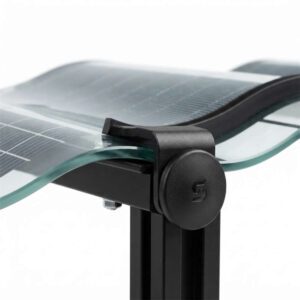
Beyond perovskite tandem, three technology advances are reshaping the 2026 commercial landscape. First, AI-optimized cell arrangement processes that maximize power density within irregularly shaped modules — a capability particularly relevant for BIPV applications where panels must conform to non-standard building geometries. Jia Mao Bipv’s transparent solar glass, for example, uses proprietary cell arrangement processes to maintain high efficiency even in custom-shaped curtain wall modules with variable transparency from 10% to 90%.
Second, smart monitoring integration — panels with embedded sensors and module-level communication that report real-time performance, hotspot detection, and degradation tracking directly to building management systems. Third, anti-soiling coatings using hydrophobic nano-surface treatments that reduce cleaning frequency by up to 30%, a feature that directly impacts maintenance costs for commercial installations.
Watch: Best Solar Panels in 2026 — 6 Key Metrics Compared
This video breaks down how to evaluate the best solar panels for 2026 across six critical metrics including efficiency, temperature coefficient, degradation rate, and warranty structure:
Video: “What’s The Best Solar Panel In 2026? 6 Key Metrics” — a datasheet-focused comparison of leading panels. (YouTube)
Best Commercial Solar Panel Choices by Business Need
Large-Scale Installations
For warehouses, distribution centers, and manufacturing facilities with 500kW+ capacity, the dominant procurement logic is lowest levelized cost of energy (LCOE). Jinko Tiger Neo and Trina Vertex S+ panels deliver the strongest combination of high wattage (475–585W per panel in commercial format), competitive pricing ($0.14–$0.22/W at volume), and 30-year performance warranties. Bifacial variants on white or light-colored roofing membranes can add 5%–10% additional energy capture from rear-side gain, further improving LCOE.
Small to Mid-Sized Businesses
Office buildings, retail stores, and light-industrial facilities with 25–200kW capacity face a different calculus. Roof space is typically limited, and aesthetics may matter (especially for customer-facing businesses). Qcells Q.TRON and Silfab QD panels offer the best balance of high efficiency (22.5%+), compact residential-format sizing that accommodates complex roof geometries, and strong 25–30 year warranty coverage. For businesses that want maximum long-term protection, REC Alpha Pure-RX delivers the industry’s best temperature coefficient (−0.24%/°C) and an ultra-low 0.25%/year degradation rate.
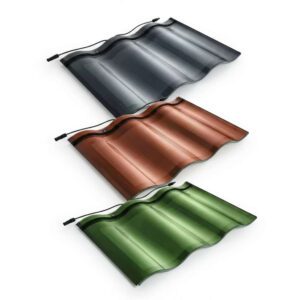
For businesses seeking to integrate solar directly into the building envelope — replacing conventional facade cladding, skylights, or canopy structures with photovoltaic materials — Jia Mao Bipv’s full product line covers photovoltaic glass, transparent solar panels, solar roofing tiles, and even walkable photovoltaic floor tiles. With 23.3% peak efficiency on their N-type monocrystalline modules and documented first-year degradation of ≤1.0%, these panels serve as both building material and revenue-generating asset — a dual function that standard rooftop panels cannot replicate.
Challenging Environments
Commercial projects in extreme environments — coastal salt-air zones, high-altitude snow regions, desert heat, or hurricane-prone areas — require panels specifically rated for those conditions. Qcells stands out with 8,100 Pa front-load and 3,600 Pa rear-load ratings, making it the strongest mechanical performer among residential-format panels. For high-heat environments, REC’s HJT-based Pure-RX (−0.24%/°C) maintains the most output at elevated temperatures. For corrosive coastal environments, glass-glass bifacial modules (Hyundai, SEG Solar) provide superior moisture and salt-spray resistance compared to glass-backsheet designs.
Image: Large-scale ground-mounted commercial solar farms prioritize cost-per-watt and total energy yield over aesthetics. (Source: Pexels – Free to use)
The commercial solar panel market in 2026 offers more high-performance options than at any previous point — but more choices also mean more complexity in procurement. The brands that deliver the strongest combination of verified efficiency, long-term durability, and enforceable warranty coverage are Maxeon (highest warranty horizon at 40 years), REC Group (best temperature coefficient and lowest degradation at 0.25%/year), Qcells (strongest mechanical ratings for extreme weather), and Jinko Solar / Trina Solar (best value for large-volume deployments). For BIPV applications that require custom sizing, color matching, and building-envelope integration, specialized manufacturers like Jia Mao Bipv fill a gap that mainstream panel brands do not address.
The right panel for your business depends on three project-specific variables: your available roof or facade area (which determines whether you need maximum efficiency per square meter or can optimize for cost-per-watt), your local climate (which determines how much temperature coefficient matters), and your investment horizon (which determines whether a 25-year or 30-year warranty justifies the premium). Use the comparison tables and charts in this article as your starting framework, confirm final specifications against the manufacturer’s datasheet for the exact model number quoted, and verify inverter compatibility with your installer before signing a purchase order.
Frequently Asked Questions (FAQ)
1. Which commercial solar panel brand has the highest efficiency in 2026?
Aiko Solar’s Neostar 3P54 leads at 25.0% module efficiency using All Back Contact (ABC) cell architecture. For commercially-available modules widely distributed in North America, Maxeon’s Gen 7 at 24.1% and Jinko’s Tiger Neo III at 24.0% are the most accessible high-efficiency options. Efficiency rankings are based on Standard Test Conditions (STC) and may differ from real-world output depending on climate and installation factors.
2. What is the average payback period for commercial solar panels in 2026?
Most commercial solar systems break even within 3–5 years when federal ITC (30%), accelerated depreciation (MACRS), and state incentives are factored in. Simple payback without depreciation benefits averages 6–8 years. A Wood Mackenzie report found that rising electricity rates cut commercial solar payback periods by 33% compared to 2024.
3. How much do commercial solar panels cost per watt in 2026?
Module-only pricing ranges from $0.14/W (mainstream TOPCon panels from Jinko, Trina) to $0.45/W (premium back-contact panels from Maxeon, Aiko). Fully installed commercial system costs average $1.80–$2.55/W for systems between 25kW and 500kW, depending on project complexity and regional labor rates.
4. What is TOPCon technology and why does it matter for commercial solar?
TOPCon (Tunnel Oxide Passivated Contact) is an N-type solar cell technology that adds an ultra-thin oxide layer and passivated contacts to the cell’s rear surface, reducing electrical losses and boosting efficiency to 23%–24.5%. TOPCon cells also have a high bifacial factor (~85%), making them ideal for commercial installations on reflective roofing membranes where rear-side light capture adds 5%–10% extra output.
5. Should I choose bifacial panels for a flat commercial rooftop?
Bifacial panels on white or light-colored TPO/PVC roofing membranes can generate 5%–10% more energy than monofacial equivalents due to rear-side light capture. On dark asphalt or EPDM roofs, rear-side gain is typically under 3% and may not justify the cost premium. Ground-mounted systems with elevated racking and reflective ground cover can see bifacial gains of 10%–20%.
6. What warranty should I expect from a commercial solar panel in 2026?
The industry standard is a 25-year product warranty and 25-year performance warranty guaranteeing approximately 87%–90% output. Premium brands like Maxeon offer 40-year coverage, while Silfab, Hyundai, SEG Solar, and Jinko offer 30-year performance warranties. When evaluating warranties, focus on the guaranteed output percentage at year 25 and the annual degradation rate — not just the number of years.
7. What is the difference between product warranty and performance warranty?
A product warranty covers manufacturing defects, material failures, and premature degradation — essentially a guarantee that the panel won’t physically fail. A performance warranty guarantees a minimum power output level over time (e.g., 90% at year 25). If a panel produces below the guaranteed level, the manufacturer must repair, replace, or compensate the difference. Both warranties matter; a strong product warranty with a weak performance guarantee (or vice versa) leaves gaps in coverage.
8. Can commercial buildings use BIPV panels instead of standard rooftop panels?
Yes. Building Integrated Photovoltaic (BIPV) panels replace conventional building materials — facades, skylights, curtain walls, floor tiles — with photovoltaic surfaces that generate electricity. Manufacturers like Jia Mao Bipv produce BIPV modules with N-type monocrystalline cells exceeding 22% efficiency. BIPV is especially valuable for commercial buildings where rooftop area alone cannot meet energy goals, or where architectural design requirements preclude visible rooftop panel arrays.
9. How do I compare solar panels from different brands fairly?
Compare panels using five datasheet metrics: (1) STC efficiency (%), (2) temperature coefficient of Pmax (%/°C), (3) annual degradation rate (%), (4) guaranteed output at year 25 (%), and (5) mechanical load ratings (Pa). These five numbers, combined with warranty terms and module pricing, give you a complete picture. Avoid comparing wattage alone — a 500W panel is not necessarily better than a 440W panel if it is physically larger and less efficient per square meter.
10. When should a business install commercial solar — is 2026 a good year?
2026 is one of the strongest years on record for commercial solar economics. The 30% federal ITC remains available, module prices have dropped significantly due to manufacturing overcapacity, and rising commercial electricity rates are shortening payback periods. According to industry analysts, the ITC is scheduled to step down to 26% in 2033 under current legislation, but political uncertainty means that businesses installing in 2026 lock in the maximum incentive with the least policy risk.