Transparent Solar Glass: From Lab Curiosity to Architectural Standard
A practical guide for curtain wall and roofing contractors, PV EPCs, distributors, and architects.

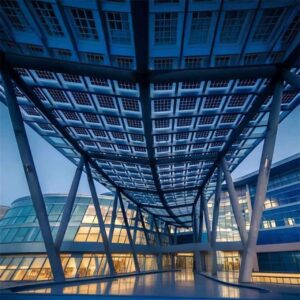
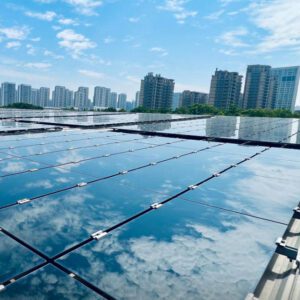
Powerhouse Brattørkaia in Trondheim, Norway. According to its architects at Snøhetta, almost 3,000 m² of solar panels clad the skewed roof and upper facade. Photo: Ryan Hodnett, CC BY-SA, via Wikimedia Commons.
At a Glance
Transparent solar glass is glazing that generates electricity and still lets daylight through. It is a type of Building-Integrated Photovoltaics (BIPV). BIPV means solar technology that replaces a building material instead of being bolted on top of it.
Here is the short version for busy project teams:
- The technology has moved from lab prototypes to certified, warrantied products.
- Transparency and power output still pull against each other. You choose a balance, not a winner.
- The hardest part is not the glass. It is the wiring, waterproofing, and coordination between trades.
- The best business case combines electricity savings with lower cooling loads.
- Decisions made in concept design cost far less than fixes made at shop drawings.
I. The Convergence of Aesthetics and Energy Generation
Ten years ago, a “solar window” meant a university poster. Today it appears in tender documents.
The reason is simple. Energy codes keep tightening, and roofs alone can’t hold enough panels for a tall building. A 30-storey tower has a small roof and a huge facade. Glass is the largest surface on most commercial buildings, and until recently it produced nothing.
Researchers at Michigan State University estimate that the United States has between 5 and 7 billion square meters of glass surface. They say transparent solar could cover around 40% of national energy demand. Pair it with rooftop solar and storage, and they say the figure approaches 100% (MSU Today). Treat that as a ceiling, not a forecast, but it shows why glass is getting attention.
From opaque panels to transparent BIPV
Early rooftop solar was opaque and sat above the building. Transparent BIPV takes a different approach. The solar layer sits inside the glazing, so the glass does two jobs. It keeps weather out and lets light in, and it generates power.
The efficiency vs. transparency trade-off
A solar cell works by absorbing light. A window works by letting light through. Both can’t happen to the same photon.
That is why a semi-transparent crystalline silicon module and a nearly clear organic film perform so differently. The more visible light you pass, the less power you make per square meter. Every specification sits somewhere on that curve.
Upper end of typical efficiency ranges by technology family, based on the technology comparison in Jia Mao Bipv’s transparent solar panel guide. Verify values against each product’s tested datasheet.
Who gains what
- Contractors get a product that fits standard glazing pockets, if the wiring is planned early.
- EPCs and energy service providers get a new revenue surface, plus a cooling-load benefit that rooftop PV can’t offer.
- Architects keep their design intent. The building skin becomes part of the energy system.
II. The Laboratory Era: Foundational Science and Early Limitations
To trust today’s products, it helps to know why the early ones disappointed.
Transparent conductors and thin films
Every solar cell needs electrodes to collect current. On a window, those electrodes can’t be opaque metal. The answer was the transparent conducting oxide (TCO): a thin ceramic-like coating that conducts electricity and still passes light. A good TCO transmits more than 80% of visible light.
Indium tin oxide (ITO) became the standard. It has a supply problem, though. Indium is rare, with about 6,000 metric tons worldwide in 2006, and it traded above $800/kg. Alternatives such as aluminum-doped zinc oxide were developed to ease that dependence (Wikipedia: Transparent conducting film).
Thin-film cells, like amorphous silicon, were the first practical way to deposit a semi-clear solar layer on glass.
Why early products failed
The first generation ran into three walls:
- Low conversion rates. Early thin-film glazing converted only a small share of sunlight to power. At that yield, the extra cost was hard to justify.
- Poor durability. Facades must survive 25+ years of heat, humidity, and UV. Many early modules degraded quickly.
- Weak building integration. Products were treated as solar panels first and windows second.
“Adding solar to a window” vs. “creating a solar window”
That last point was the real turning point. Early teams stuck a PV product onto a glazing system. Modern teams design the glass unit as a whole. Cell layout, laminate, edge seal, junction box, and frame are engineered together.
That shift is why today’s products can carry IEC certificates and 25-year power warranties.
III. Engineering the Breakthrough: Overcoming the Transparency Barrier
For architects, the biggest complaint was always how the glass looked. A dark blue tint over every window was a hard sell. Materials science has improved that.
OPV and perovskites
Organic photovoltaics (OPV) use carbon-based materials that can be tuned to absorb mostly invisible light. Perovskites are a family of crystal-structured materials that also tune well. Perovskite lab efficiency rose from 3.8% in 2009 to about 27% for single-junction cells in 2025. Perovskite-silicon tandems have reached 34.85% in the lab (Wikipedia: Perovskite solar cell).
Semi-transparent perovskite cells for windows are also being studied. One research group reported 13.3% efficiency while reflecting much of the near-infrared (Phys.org).
A caution for specifiers: perovskites still face open questions on long-term stability, moisture sensitivity, and lead content. Ask for outdoor test data and warranty terms before you design a facade around them.
Spectral splitting
Spectral splitting means sending different parts of sunlight to different jobs. The idea is to let the visible light pass into the room and send the invisible parts (ultraviolet and infrared) to the solar cells.
The MSU team built a transparent luminescent solar concentrator. Its organic molecules absorb UV and near-infrared light, then re-emit it at longer wavelengths toward the film edges, where thin PV strips collect it. The film looks like clear glass. The reported efficiency is above 5%, versus 15–18% for conventional panels (MSU Today).
VLT across generations
Visible Light Transmittance (VLT) is the percentage of visible daylight that passes through the glass. A higher VLT means a brighter room and a less visible solar layer.
| Generation | Typical technology | Typical VLT | Typical efficiency | Status |
|---|---|---|---|---|
| Gen 1 | Amorphous silicon thin film | 10–40% | 6–12% | Commercial, tinted look |
| Gen 2 | Semi-transparent crystalline silicon | 5–40% | 14–22% | Mature, widest supply |
| Gen 3 | OPV / dye-based films | 30–70% | 12–15% | Niche commercial |
| Gen 4 | Perovskite, luminescent concentrators | 20–90%+ | Pilot: up to ~24%; clear films: >5% | Emerging |
Ranges compiled from the Jia Mao Bipv technology comparison and MSU research. Always request tested, product-specific values.
IV. Integration Logistics: Solving the Contractor’s Installation Pain Points
A curtain wall crew is used to setting glass, not terminating cables. This section is where most BIPV projects win or lose time.
Power electronics inside mullions and transoms
A mullion is a vertical frame member, and a transom is a horizontal one. In a BIPV wall, cables run through these hollow sections to reach the inverter room.
Check three things before shop drawings are final:
- The mullion cavity is deep enough for cable bundles and bends.
- Junction boxes can be reached for service without removing a whole unit.
- Cable penetrations don’t break the thermal break (the insulating strip inside the frame).
The “leakage vs. wiring” dilemma
Every hole for a cable is a possible water path. Every sealed, wire-free frame is a system with no electricity. Teams need both.
The practical answer is to wire inside the drained and ventilated part of the frame. Keep cable exits out of the primary seal line. Agree on one detail for every condition (edge, corner, transition to opaque spandrel) and mock it up before production.
For roofs, route the wiring below the waterproofing layer wherever you can, and detail every penetration with the roofing contractor, not after them.
Plug-and-play connectors
On-site wiring is slow and error-prone. Factory-attached cables with locking connectors move that work to a controlled setting. A real example is the Bell Works skylight in New Jersey. It is the largest PV glass skylight in the U.S., a quarter mile long. Junction boxes with MC4 connectors fed 12 inverters, and the array totals 175 kW (Solar Power World).
Two other practical points:
- Rapid shutdown. In the U.S., NEC 690.12 requires PV circuits on buildings to drop to a safe voltage quickly. Plan this at design stage, not at inspection.
- Replaceability. A broken unit must be swappable without shutting down a whole string.
For deeper contractor guidance, see Jia Mao Bipv’s article on BIPV glass integration for specialized contractors.
V. The EPC Perspective: Optimizing Energy Yield and ROI
If you judge BIPV by peak watts per square meter, it will always lose to a rooftop array. That is the wrong yardstick. The right one is Total Building Value: electricity produced, plus cooling energy saved, plus compliance and asset value.
The dual benefit
Transparent PV glass lowers solar heat gain. That means smaller cooling loads. The Jia Mao Bipv transparent glass product page lists 25–40% lower cooling loads versus conventional glazing, with 140–200 W/m² output and 180–250 kWh/m² per year. Treat these as manufacturer figures to be confirmed in your own energy model.
A worked example (illustrative only):
- Facade area: 500 m²
- Annual yield at 180–250 kWh/m²: 90,000–125,000 kWh
- U.S. average commercial electricity price in 2024: $0.1246/kWh
- Electricity value: about $11,200–$15,600 per year, before cooling savings
Orientation changes everything. A south-facing vertical facade typically captures about 60–70% of what an optimal roof would, and east or west about 40–55%.
Range midpoints from the facade yield guidance in Jia Mao Bipv’s transparent solar panel guide. Run site-specific shading analysis before sizing.
Smart inverters in high-rise buildings
Tall buildings have many facade zones, each with a different sun angle. One big string will lose output whenever any part is shaded.
Good practice is to group modules by orientation and shading pattern, and to use module-level optimizers or multiple MPPT inputs (the part of the inverter that finds each string’s best operating point). Smart inverters can also support grid stability and connect to the building management system.
Lifecycle cost: CAPEX vs. OPEX
Upfront cost is higher than ordinary glass. Compare the net premium over the glazing you would have bought anyway.
Illustrative paybacks from the example scenarios in Jia Mao Bipv’s guide, which assumes the 30% U.S. federal ITC and excludes depreciation benefits. Your numbers will vary with local rates, incentives, and glazing specification.
For a deeper financial look, read the ROI guide for photovoltaic EPC contractors. To check state-level incentives, use the DSIRE database.
VI. Architectural Synergy: Designing for Performance and Form
Architects don’t want to give up the building’s look for kilowatts. They don’t have to.
Before and after: traditional glazing vs. BIPV facades

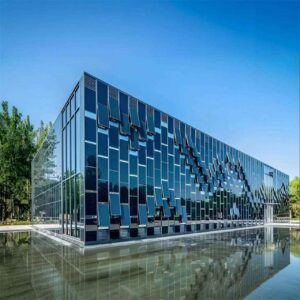
A photovoltaic facade on the Social Services Centre Jose Villarreal, Madrid. Photo: Hanjin, CC BY-SA 3.0, via Wikimedia Commons.
On a conventional facade, glass is passive. It transmits light, and you add shading and cooling to manage the consequences. On a BIPV facade, the same surface produces power and filters heat. The skin becomes part of the plant.

A BIPV facade in Norway. Photo: Sipetro, CC BY-SA 4.0, via Wikimedia Commons.
The visible difference is the cell pattern. At a distance it reads as a texture. Designers can choose cell spacing, color, and gradients, for example higher density on spandrel zones and higher transparency at eye level.
Glare and thermal comfort
The Jia Mao Bipv transparent product line lists SHGC between 0.15 and 0.45, 99% UV rejection, and anti-glare properties. A Solar Heat Gain Coefficient (SHGC) is the share of solar heat that gets through a window. Lower means cooler rooms.
Comfort also depends on how light falls on a desk. Run a daylight simulation for each facade zone, not just a whole-building average.
Certifications
Solar glass can support several rating systems:
- LEED rewards on-site renewable energy and energy performance.
- BREEAM assesses energy, health, and whole-life performance.
- WELL addresses light quality and visual comfort, which matters because VLT and glare affect both.
Credit rules differ by version and by project. Confirm the exact credits with your certification consultant before promising points to a client.
VII. Supply Chain and Distribution: Scaling for Commercial Viability
From bespoke to scalable
Early transparent PV was made in small batches and priced like jewelry. Now, standard sizes and cell-density options make lead times plan-able.
As a guide, standard products from established makers often ship in 8–12 weeks, and custom sizes or patterns add 4–8 weeks. Distributors who hold a second qualified supplier handle delays better.
Quality and certification
Ask for third-party test reports, not just declarations. The usual set includes:
| Standard | What it covers |
|---|---|
| IEC 61215 | Module durability (thermal cycling, humidity, UV) |
| IEC 61730 | Module electrical safety |
| IEC 63092-1 | BIPV-specific product requirements |
| UL 7103 | BIPV roofing system listing (U.S.) |
| NFPA 285 | Fire propagation in exterior wall assemblies (U.S., taller buildings) |
Fire is not a side issue. Factory Mutual’s large-scale tests on five BIPV facade systems found that most exceeded acceptable fire size criteria, which is why the full wall assembly matters, not just the module (pv magazine USA).
Logistics of fragile, electrified glass
BIPV glass is heavy, breakable, and has cables attached. Specify vertical racks, edge protection, and a cable-protection plan. Inspect on delivery, and order spares with the main batch. Re-making a custom unit years later can take months.
Jia Mao Bipv, with 3 GW of annual manufacturing capacity, publishes a 25-year spare-parts commitment on its transparent glass line. For distributors, that kind of commitment is worth asking every supplier about.
VIII. Comparative Analysis: Solar Glass vs. Traditional PV and Standard Glazing
Vertical vs. horizontal harvesting
A roof has limited space. A tower’s facade can be 10 or more times larger than its roof. Vertical surfaces make less power per square meter, but there is much more surface.
Comparison table
| Facteur | Rooftop PV (opaque) | Standard glazing | Transparent solar glass |
|---|---|---|---|
| Generates power | Yes, highest per m² | No | Yes, moderate per m² |
| Admits daylight | No | Yes | Yes, depends on VLT |
| SHGC (heat gain) | Not applicable | Roughly 0.25–0.40 for low-E commercial glass | 0.15–0.45 (manufacturer range) |
| Replaces a building material | No | Not applicable | Yes |
| Uses roof space | Yes | No | No |
| Typical installation | Separate trade | Glazing trade | Glazing plus electrical trades |
| Entretien | Cleaning, inverter | Nettoyage | Cleaning, string monitoring, inverter |
| Incremental cost* | Full system cost | Baseline | About $120–$280/m² (semi-transparent) |
Incremental cost from industry guidance cited in Jia Mao Bipv’s BIPV glass guide. U-values for low-E double-glazed units typically fall around 1.1–1.6 W/m²K, and BIPV laminates in an insulated unit can match that. Ask for a tested whole-unit U-value, not the PV layer alone.
What the matrix tells you
Rooftop PV wins on cost per kilowatt. Standard glass wins on cost per square meter. Transparent solar glass wins when roof area is limited, when facade area is large, and when cooling load matters. That is why it fits urban towers best.
IX. Future Horizons: The Era of “Smart” Solar Envelopes
Electrochromic glass
Electrochromic glass changes tint when a small voltage is applied. A building controller can darken glass on the sunny side at noon and clear it later. Smart glass can also be active (electrical) or passive (heat- or light-triggered) (Wikipedia: Smart glass).
Combined with PV, the same unit generates power, tints on demand, and cuts HVAC load. That combination is still emerging. If your project finishes in 2027 or later, ask suppliers now whether the framing and cable routes are compatible.
AI-driven energy routing
Modern buildings have many sensors already. AI-based controls can predict sunlight, then decide when to charge a battery, pre-cool a floor, or export to the grid. NREL’s SwitchGlaze research on self-tinting windows estimated a 4–6 year return on investment for that class of product (NREL report).
The building skin as an IoT layer
Each facade zone can report its output, temperature, and fault status. The building management system can then spot a shaded string or a failed unit within hours instead of months.
Watch for three trends over the next few years: perovskite-silicon tandem modules, better clear-film concentrators, and tighter links between facade controls and grid demand-response programs.
X. Strategic Implementation for Industry Leaders
Transparent solar glass has moved from experiment to specification. The science is proven, certifications exist, and projects like Bell Works show the details can be solved.
The firms that gain most are the ones that decide early. If you wait until shop drawings, the wiring route is already blocked and the budget is already spent.
A five-step plan
- Concept design: Pick the facade zones, VLT targets, and technology family.
- Design development: Confirm mullion depth, cable paths, and inverter locations.
- Pre-purchase: Request IEC, UL, and fire test documents for the exact model.
- Mock-up: Build and water-test one corner and one transition detail.
- Commissioning: Set up string-level monitoring and order spare units.
For a design-side companion, see the review of glass-integrated solar facade systems, and for material options, the guide to solar glass types and benefits.
In ten years, many cities may look different. Every large glass wall could be a small power station, and the grid would be spread across thousands of buildings. If you are designing, building, or supplying those walls, start the conversation with your manufacturer now.
Watch: Understanding Building-Integrated Photovoltaics
A webinar-style primer from Acelab on how BIPV works and where it fits in building design. Useful for sharing with clients and design teams.
Glossary
BIPV (Building-Integrated Photovoltaics): Solar technology that replaces a building material, such as glass, roofing, or cladding, instead of sitting on top of it.
VLT (Visible Light Transmittance): The percentage of visible daylight that passes through the glass. Example: 30% VLT looks like a dark tint, and 70% looks close to clear.
SHGC (Solar Heat Gain Coefficient): The share of solar heat that enters through a window. Example: SHGC 0.25 means a quarter of the solar heat gets through.
U-value: How fast heat flows through a window. Lower means better insulation.
TCO (Transparent Conducting Oxide): A clear coating that carries electricity, used as an electrode in transparent solar cells.
OPV (Organic Photovoltaics): Solar cells made from carbon-based materials, which can be tuned to be nearly clear.
Perovskite: A crystal-structured material used in newer solar cells. It tunes well but needs long-term durability proof.
Mullion / Transom: The vertical and horizontal frame members of a curtain wall.
MPPT (Maximum Power Point Tracking): A feature in inverters or optimizers that finds the best electrical operating point for each string of modules.
Rapid shutdown: An NEC 690.12 safety function that quickly lowers PV circuit voltage so firefighters can work safely.
Electrochromic glass: Glass that tints when a small voltage is applied.
Questions fréquemment posées
1. How does transparency affect the energy conversion efficiency of solar glass?
Higher transparency generally lowers power output per square meter. A 40% VLT semi-transparent silicon module might produce well under half the power density of an opaque panel. Treat VLT and power density as a pair, and choose the mix by facade orientation and daylight need.
2. What are the main installation challenges when integrating PV wiring into a curtain wall?
The main challenges are cable space in the mullion, keeping seals watertight where cables exit, and coordinating glazing and electrical crews. Decide the cable route during design development, and mock up the hardest corner detail before ordering.
3. How are warranty and maintenance different from standard glass?
You usually deal with two warranties: one for the glass and one for power output. For example, Jia Mao Bipv’s transparent glass lists a 25-year linear power warranty (80% output retained), a 15-year optical warranty, and a 20-year weather seal guarantee. Maintenance adds string monitoring and occasional inverter replacement to normal cleaning.
4. What is the typical ROI period for replacing standard glazing with BIPV?
Illustrative examples run from about 4.7 to 6.8 years on a net-premium basis with the 30% U.S. federal credit. Without incentives, or in low-sun and low-power-price markets, expect longer. Always model the net premium over the glass you would have installed anyway.
5. How does solar glass affect SHGC and indoor thermal comfort?
It usually lowers SHGC, because the PV layer absorbs or reflects part of the sun’s energy. Manufacturer ranges such as 0.15–0.45 are common. Lower SHGC means smaller cooling loads and fewer hot spots near the window, but you should confirm with a full glazing-unit rating.
6. Which certifications are required for high-rise commercial use?
Most projects need IEC 61215 and 61730 for the module, plus IEC 63092-1 for BIPV products. In the U.S., expect UL listings, NEC 690 compliance, and NFPA 285 for exterior walls on taller buildings. Local authorities may add requirements, so confirm early.
7. Can solar windows be retrofitted into existing curtain walls?
Often, yes. If the existing frame can take the new unit’s thickness and weight, you can swap insulated glass units for BIPV ones. You still need a cable route and an inverter location. Where the frame is too shallow, a secondary exterior skin may be an option.
8. How do we manage electrical load and inverter placement in a multi-story building?
Group modules by facade orientation and shading, then place inverters in electrical rooms near the cable risers. Use module-level optimizers or multiple MPPT inputs, so a shaded zone doesn’t drag down the rest. Confirm rapid shutdown and utility interconnection early.
9. What is the degradation rate of transparent PV over 20 years?
Crystalline silicon BIPV is commonly rated at about 0.5% per year in industry guidance, and a 25-year warranty to 80% output implies a limit near 0.8% per year. Newer technologies like OPV and perovskite have shorter field records, so request outdoor data.
10. How does the cost compare to high-performance glazing plus rooftop PV?
Rooftop PV alone is cheaper per kilowatt. Transparent solar glass costs more than standard glazing, but it adds generation and reduces cooling load in one product. It is competitive when roof space is limited, and the comparison should include the HVAC savings.
11. How does solar glass help earn LEED or BREEAM credits?
It can support energy-performance and renewable-energy credits, and it may help daylight and comfort credits when VLT and glare are managed. Exact points depend on the rating version and project. Ask your certification consultant to confirm.
12. What are the best practices for coordinating the architect and the PV EPC?
Bring the EPC in at concept design, not at tender. Agree on facade zones, VLT, and cable routes early. Share a BIM model, hold a joint review before shop drawings, and require a manufacturer feasibility review. This avoids most redesign costs later.
Need help matching a VLT, cell pattern, or curtain wall system to your project? The team at Jia Mao Bipv can review your drawings and recommend a specification.