Compare BIPV Integration Options: Thin-Film vs Crystalline vs Modular Facades
Building-integrated photovoltaics, or BIPV, means solar materials are part of the building envelope instead of being mounted on top of it. In facade projects, the solar surface may also act as glass, cladding, shading, rainscreen, or a curtain-wall panel.
This article compares three practical BIPV integration options: thin-film PV, crystalline silicon PVet modular BIPV facade systems. The goal is not to crown one winner. The right choice depends on architectural intent, climate, facade geometry, installation risk, energy targets, and lifecycle cost.
Introduction
BIPV facade decisions are usually made too late. Many projects start with an architectural rendering, then try to “add solar” after the curtain wall, cladding grid, fire strategy, and electrical risers are already fixed. That approach often creates redesign, weak energy yield, awkward wiring paths, or maintenance problems.
A better workflow starts with a comparison of integration options. Thin-film PV, crystalline PV, and modular BIPV facades can all work, but they solve different problems.
Best when a smooth, uniform surface, low-light response, or curved/lightweight integration is more important than maximum watts per square meter.
Best when power density, bankable performance, and predictable supply chains matter most.
Best when the facade needs repeatable units, factory quality control, faster installation, and easier replacement planning.
The comparison below uses five decision criteria: aesthetics, performance, durability, constructability, and cost. These are also the criteria that facade consultants, MEP engineers, architects, and owners tend to debate during early design.
Overview of BIPV integration options
What BIPV is and where it fits in building envelopes
BIPV is solar technology integrated into the building envelope. The envelope is the physical separator between indoors and outdoors: roof, facade, glazing, skylights, canopies, and exterior shading. Unlike building-applied PV, BIPV does not simply sit on a rack. It replaces or becomes part of a building material.
The Whole Building Design Guide BIPV resource describes BIPV as photovoltaic collector elements located directly within the building envelope or canopy structure. That definition is important because it makes BIPV a building product and an energy product at the same time.
The three main integration approaches: thin-film, crystalline, and modular facades
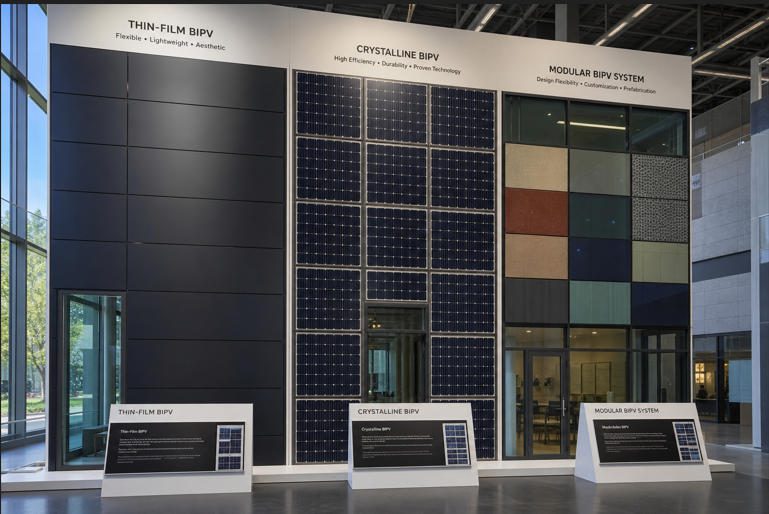
The three options compared in this article are not just cell technologies. They are integration strategies.
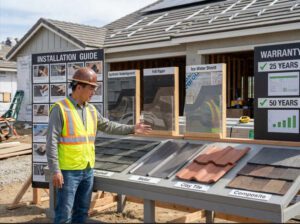
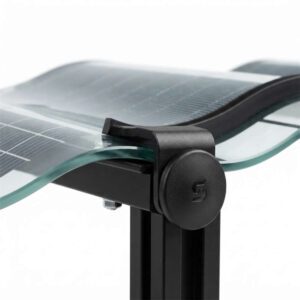
Thin-film BIPV uses very thin semiconductor layers deposited on glass, metal, or flexible substrates. Common types include amorphous silicon, CdTe, and CIGS. Thin-film often gives a more continuous color and can perform better under diffuse light or partial shade.
Crystalline silicon BIPV uses mono-crystalline or polycrystalline silicon cells laminated into glass-glass modules, spandrel panels, skylights, or cladding. It has higher power density and a mature supply chain, but the cell pattern may be visible unless design treatments are used.
Modular BIPV facades package PV glass, framing, wiring routes, drainage, and mounting logic into repeatable facade units. The cells may be crystalline or thin-film. The key difference is the system approach: factory-built modules reduce site variability and can simplify replacement.
Thin-film PV for BIPV facades
Technology and material options and their characteristics
Thin-film PV uses semiconductor layers that are much thinner than crystalline silicon wafers. For facades, the most common thin-film materials are:
- a-Si, or amorphous silicon: lower efficiency, but good uniform appearance and useful for semi-transparent glass.
- CdTe, or cadmium telluride: moderate efficiency, strong temperature behavior, and good production scale in utility PV markets.
- CIGS, or copper indium gallium selenide: flexible form factors and good appearance potential, though supply availability varies by manufacturer.
According to the Fraunhofer ISE Photovoltaics Report, crystalline silicon still dominates the global PV market, but thin-film remains relevant where form factor, temperature behavior, and appearance are decisive.
Aesthetic and design flexibility considerations
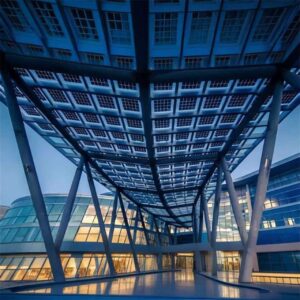
Thin-film is often selected because it looks less like a conventional solar panel. It can create a calm, dark, continuous facade surface without a visible grid of silicon cells. That matters in museums, airports, headquarters, cultural buildings, and mixed-use projects where the facade is part of the brand experience.
Thin-film can also support semi-transparent glazing. In a lobby, atrium, or canopy, this can reduce glare while generating electricity. The trade-off is lower power density. If the owner expects rooftop-like generation from a glass lobby wall, the design team needs to reset expectations early.
Typical performance, durability, and maintenance profiles
Thin-film modules generally produce fewer watts per square meter than high-efficiency crystalline modules. However, they may lose less power at high operating temperatures and can behave better under diffuse light or partial shading.
For hot, vertical facades, this matters. A facade panel can run warmer than a ventilated rooftop module because heat has fewer escape paths. A lower temperature coefficient can reduce summer yield losses.
Maintenance is usually similar to other glass facade systems: planned cleaning, electrical monitoring, seal inspection, and access planning. The key risk is not the cell layer alone. It is the full laminate, edge seal, junction box, cable routing, and facade drainage design.
Crystalline PV for BIPV applications
Monocrystalline vs polycrystalline: performance implications
Monocrystalline silicon uses cells cut from a single crystal structure. It usually offers higher efficiency and a cleaner black appearance. Polycrystalline silicon uses multiple crystal structures and is generally less common in premium facade BIPV today because monocrystalline products offer better output per area.
For dense urban projects, power density can decide feasibility. If the available south or west facade area is limited, crystalline silicon often produces more electricity from the same envelope area.
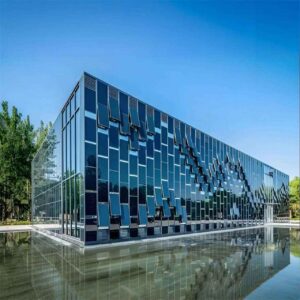
The main design issue is visibility. Crystalline cells can create a strong grid pattern. Some architects use that pattern intentionally. Others reduce its visual impact with ceramic frit, colored glass, wider spacing, custom cell layouts, or spandrel placement.
Integration techniques with standard glazing and cladding
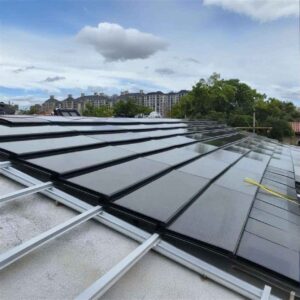
Crystalline BIPV can be laminated into glass-glass units and installed like architectural glazing. It can also be used in opaque spandrel panels, ventilated rainscreens, canopies, balcony guards, and roof-integrated products.
For teams comparing product categories, high-efficiency solar panels from Jia Mao Bipv are a useful reference point for understanding how crystalline silicon modules support projects that prioritize energy yield and dependable electrical performance.
Integration must be coordinated with the curtain wall supplier. The BIPV panel must meet wind load, water penetration, thermal movement, fire, and electrical safety requirements. A strong PV module that is poorly integrated into the facade can still fail as a building envelope component.
Long-term reliability, shading effects, and weather resistance
Crystalline modules are highly proven, but facades introduce different stress patterns from rooftops. Vertical surfaces may face wind-driven rain, thermal cycling, partial shade from neighboring buildings, and cleaning access constraints.
Partial shading is especially important. A balcony edge, mullion, sign, tree, or adjacent tower can shade a few cells and reduce the output of a larger electrical string. Design teams should use shade modeling and consider optimizers, microinverters, or string zoning where shading is unavoidable.
Weather resistance depends on the full assembly. Glass-glass laminates, edge seals, connector protection, drainage cavities, and tested framing details are more important than nameplate efficiency alone.
Modular facades as BIPV canvases
Module-level integration, attachment methods, and framing
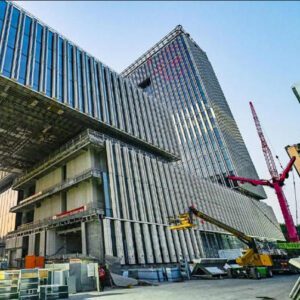
Modular BIPV facade systems treat the PV surface as part of a repeatable construction unit. The system may include the PV laminate, metal frame, gasket, drainage route, junction box access, cable path, and mechanical attachment.
Attachment methods include pressure plates, cassette systems, structural silicone, mechanical clips, and ventilated rainscreen brackets. The best method depends on building height, movement joints, fire strategy, replacement access, and the facade contractor’s installation method.
For projects that require coordinated brackets, mounting, and envelope detailing, the Jia Mao Bipv BIPV product range can help teams review how solar glass, panels, inverters, brackets, and accessories fit together as one system rather than separate purchases.
Design versatility, color, and texture options
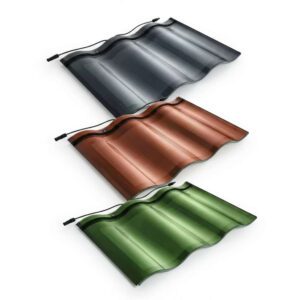
Modular facades can hide or express the solar layer. Panels may be black, blue-black, gray, bronze, terracotta-like, patterned, fritted, semi-transparent, or opaque. In premium projects, the value is not only electricity. It is the ability to keep the facade language consistent while adding generation.
Industry insight: developers increasingly ask BIPV suppliers for facade samples before asking for electrical calculations. That is not superficial. If the module fails the visual review, it will never reach the energy model.
Accommodating building services and facade geometry
Real facades are interrupted by corners, vents, smoke exhaust zones, slab edges, BMU tracks, balconies, signage, and maintenance anchors. Modular systems are useful because active PV modules can be mixed with dummy panels that look the same but do not generate electricity.
This approach keeps the elevation clean while preventing weak electrical zones. For example, if a narrow facade strip is always shaded by a neighboring tower, it may be better to install a matching non-active panel than to add a low-yield active module that complicates wiring.
Aesthetics and architectural compatibility
Visual impact, glazing harmony, and regulation compliance
Facade BIPV must pass the eye test before it passes the energy test. Architects evaluate reflection, color shift, cell visibility, joint rhythm, transparency, and how the system looks from street level, inside the building, and at night.
Planning authorities may also evaluate glare, historic context, reflectivity, and fire behavior. The IEA PVPS BIPV technical guidebook highlights that BIPV success depends on energy, building physics, aesthetics, and long-term operation being considered together.
Customization vs standardization trade-offs
Customization gives architects more control. Standardization gives owners more predictable cost, shorter lead times, and easier replacement. The strongest BIPV specifications usually standardize what cannot be seen and customize what matters visually.
For example, a project may use a standard electrical module size behind a customized frit pattern. This keeps production efficient while preserving the facade concept.
Energy performance and efficiency considerations
System-level performance metrics: U-value, g-factor, PCE
PV efficiency alone is not enough for BIPV decisions. A facade panel also affects heat transfer, solar heat gain, daylight, glare, and HVAC load.
Use these metrics together:
- PCE: how efficiently the PV layer converts sunlight into electricity.
- U-value: how much heat passes through the facade assembly.
- g-factor or SHGC: how much solar heat enters the building.
- Specific yield: annual kWh produced per installed kWp.
- Performance ratio: actual system output compared with theoretical output after real-world losses.
Building energy model integration and daylighting interactions
Transparent and semi-transparent BIPV can reduce cooling loads and glare, but may also reduce daylight. The correct balance depends on building use. Offices, hotels, schools, and retail spaces all have different daylight needs.
Use tools such as NREL PVWatts for early solar yield estimates, then move to detailed facade irradiance and building energy modeling before procurement.
Seasonal and climate-related performance expectations
Vertical facades usually produce less annual energy than optimally tilted roofs. However, they can perform well in winter because low sun angles strike vertical surfaces more directly. East and west facades can also produce useful morning and late-afternoon electricity, which may better match commercial building demand.
| Decision factor | Thin-film BIPV | Crystalline BIPV | Modular BIPV facade |
|---|---|---|---|
| Typical visual character | Uniform, smooth, low cell visibility | Visible cell pattern unless treated | Controlled grid; active and dummy panels can match |
| Power density | Low to medium | Medium to high | Depends on selected cell type and panel layout |
| Best facade zones | Vision glass, curved surfaces, shaded areas, design-led zones | Spandrels, opaque cladding, canopies, high-yield zones | Unitized curtain walls, rainscreens, repeatable commercial facades |
| Constructability | Good, but supplier-specific | Strong supply chain; careful glass integration needed | Strongest when factory pre-assembly is possible |
| Maintenance planning | Glass cleaning plus electrical checks | String monitoring and shade management important | Easier replacement if module sizes are standardized |
| Typical use case | Design-sensitive facade with moderate output target | Energy-driven facade with strong ROI target | Large commercial project needing repeatability and lower site risk |
Durability, weatherability, and maintenance
Environmental exposure, UV aging, and moisture management
Facade BIPV must resist UV exposure, temperature cycling, wind-driven rain, humidity, and structural movement. Moisture management is especially important because the panel is not only an electrical product; it is also part of the wall.
Look for tested details: edge seals, drainage cavities, gasket compatibility, cable penetrations, junction-box protection, and corrosion-resistant frames. In coastal cities, salt mist and fastener corrosion should be addressed during specification, not after installation.
Cleaning regimes, accessibility, and warranty coverage
Vertical facades usually collect less dust than low-slope roofs, but urban soot, bird droppings, and runoff staining still matter. Cleaning access can cost more than rooftop cleaning because rope access, boom lifts, or building maintenance units may be required.
Warranty review should include product warranty, performance warranty, glass breakage terms, waterproofing responsibility, workmanship warranty, and labor coverage. A replacement module is not very helpful if the owner must pay a high-rise access team every time a panel is changed.
End-of-life and recycling considerations
BIPV systems have long service lives, but end-of-life planning should be included in procurement. Glass, aluminum, copper, and silicon can often be recovered, though separation can be more complex for laminated PV glass than for conventional cladding.
Designing with repeatable module sizes helps future recycling and replacement. It also reduces the risk of needing a custom remake 18 years later when the original facade batch is no longer available.
Installation timelines and constructability
On-site integration vs pre-assembled systems
On-site integration gives flexibility but requires more coordination between facade and electrical trades. Pre-assembled systems shift more work to the factory, improving quality control and reducing site variability.
Modular BIPV facades are strongest when cables, connectors, panel IDs, and replacement logic are planned before the first unit reaches site. A project that treats BIPV as “glass with wires” will face avoidable commissioning issues.
Differences in permitting, testing, and commissioning
BIPV projects may require both building-envelope approval and electrical approval. Authorities may review structural glass, fire classification, wind load, water penetration, electrical isolation, inverter settings, rapid shutdown, and grid interconnection.
Use recognized references such as DOE solar photovoltaic technology basics for PV fundamentals and local building codes for envelope compliance.
Risk management during retrofit vs new construction
New construction allows cleaner integration because the facade grid, electrical risers, fire strategy, and access plan can be designed together. Retrofit projects are more constrained. Existing structure, unknown wall cavities, tenant disruption, and access limits can increase cost and schedule risk.
For retrofit projects, start with a facade survey, structural capacity check, shading study, electrical route review, and access plan. Do not order modules before these constraints are documented.
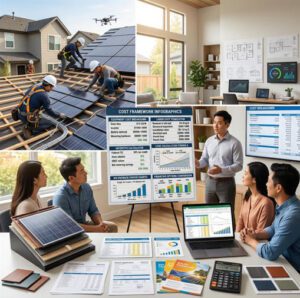
Cost considerations and lifecycle economics
Upfront capex, balance-of-system costs, and incentives
BIPV cost should be compared with the material it replaces, not only with rooftop solar. A BIPV panel that replaces premium curtain wall glass, stone cladding, or metal rainscreen has a different economic profile from a panel added to an already finished building.
Balance-of-system costs include inverters, wiring, combiner boxes, rapid shutdown equipment, monitoring, brackets, engineering, permits, commissioning, and access equipment. For electrical integration, review inverter compatibility early; BIPV inverter options should be matched to facade orientation, shade pattern, and monitoring needs.
Operational savings, maintenance costs, and payback periods
Payback varies widely. A south-facing opaque crystalline BIPV spandrel in a high-electricity-cost market can perform very differently from a north-facing semi-transparent atrium wall. Incentives, self-consumption, demand charges, and avoided cladding cost can all change the result.
Industry insight: the most persuasive BIPV business cases often combine four value streams: generated electricity, replaced facade material, reduced solar heat gain, and higher asset value for low-carbon buildings.
Sensitivity to supply chains and performance warranties
Custom facade modules can have longer lead times than standard PV panels. Color, size, glass thickness, transparency, and certification requirements all influence delivery. Supply-chain risk should be managed with early samples, approved mockups, clear tolerances, and documented warranty responsibilities.
Decision framework and case studies
How to select among thin-film, crystalline, and modular facades
Use this simple decision path:
- If the project is design-led and needs a smooth visual surface, evaluate thin-film or treated semi-transparent glass first.
- If the project is energy-led and has limited active area, evaluate crystalline silicon first.
- If the project is construction-led and has many repeated facade bays, evaluate modular BIPV facade systems first.
- If the facade has heavy shading, prioritize electrical zoning, optimizers, and dummy panels over maximum module efficiency.
- If access is difficult, prioritize standardized modules, replaceable units, and strong monitoring.
Case study snapshots: when each option shines
A transport hub uses semi-transparent thin-film glass over a concourse. The system softens daylight, reduces glare, and keeps a uniform architectural look. Output is moderate, but comfort and design value are high.
A commercial tower uses crystalline BIPV in opaque spandrel zones facing south and west. The visible cell pattern is hidden behind fritted glass, while the system delivers strong annual kWh per square meter.
A campus building uses repeatable BIPV cassettes with pre-planned cable routes. Factory assembly shortens site time, and matching dummy panels keep shaded zones visually consistent.
Practical checklist for stakeholders: architects, developers, building owners
| Stakeholder | Questions to ask before specification |
|---|---|
| Architect | What color, reflection, transparency, cell visibility, and joint rhythm are acceptable? Has a full-size mockup been reviewed? |
| Facade consultant | How will water, air, thermal movement, fire breaks, drainage, and replacement access be handled? |
| Electrical engineer | How will strings, inverters, optimizers, grounding, rapid shutdown, and monitoring be arranged? |
| Developer | Is the financial model based on incremental facade cost, self-consumption, incentives, and maintenance access? |
| Building owner | Who is responsible for cleaning, inspection, warranty claims, and replacement logistics after handover? |
Video: BIPV design principles and solar facade typologies. Use it as a visual companion when discussing facade form, orientation, transparency, and integration strategy.
Thin-film, crystalline, and modular BIPV facades each bring a different strength. Thin-film is often the better architectural surface. Crystalline silicon usually offers the strongest power density and the most mature performance data. Modular facade systems reduce construction risk by turning BIPV into a repeatable, serviceable envelope product.
The best choice is not the option with the highest cell efficiency on a datasheet. It is the option that fits the building’s climate, orientation, facade grid, maintenance access, budget, aesthetic intent, and operating strategy.
For design teams beginning a project, the most useful first step is a facade-specific feasibility study: solar exposure, visual targets, active area, dummy panel strategy, electrical zoning, structural loads, fire requirements, access, and lifecycle cost. Suppliers such as Jia Mao Bipv can support early-stage discussions by connecting module selection with facade integration, electrical components, and project-specific constraints.
Planning a BIPV facade?
Start with orientation, visual intent, and replacement strategy before selecting the module. To explore solar glass, facade panels, inverters, and integrated accessories, visit www.jmbipvtech.com.
FAQs
1. What are the main differences between thin-film and crystalline PV for BIPV?
Thin-film PV usually offers a smoother, more uniform appearance and can work well in diffuse light or semi-transparent applications. Crystalline PV usually offers higher power density and more mature supply chains. In facade projects, the choice often depends on whether visual integration or electricity generation is the stronger priority.
2. How do modular facades affect building envelope performance?
Modular BIPV facades can improve envelope consistency because panels, frames, drainage paths, and cable routes are planned as repeatable units. This can reduce site errors, but only if the system is tested for wind, water, fire, thermal movement, and electrical safety as a complete assembly.
3. What factors drive cost differences between BIPV options?
Major cost drivers include module technology, glass thickness, custom color, transparency, fire testing, framing, inverter architecture, access equipment, installation labor, and commissioning. The fairest comparison is incremental cost over the conventional facade material being replaced.
4. Which BIPV option has the fastest payback?
Opaque crystalline BIPV in sunny, south-facing or west-facing facade zones often has the fastest payback because it provides higher watts per square meter. Modular crystalline systems can also perform well when they reduce installation time. Thin-film may have a longer direct energy payback but can add value through aesthetics, glare control, and daylight management.
5. How should a project approach lifecycle considerations for BIPV?
Lifecycle planning should include energy production, cleaning access, inverter replacement, seal inspection, monitoring, warranty claims, module replacement, and end-of-life recycling. Standardized panel sizes and accessible electrical connections reduce long-term risk.
6. Can BIPV facades work in cloudy or cold climates?
Yes. Cloudy climates reduce annual output, but vertical facades can still produce useful energy, especially when electricity prices are high or when the BIPV replaces expensive cladding. Cold climates can also improve PV efficiency during sunny periods, though snow, low sun angles, and seasonal shading must be modeled.
7. Is transparent BIPV glass as efficient as opaque BIPV cladding?
No. Transparent or semi-transparent BIPV glass usually produces less electricity because part of the surface must transmit daylight. Opaque BIPV cladding can use more active cell area, so it normally delivers higher power density.
8. What should architects ask before approving a BIPV sample?
Architects should review color under different daylight conditions, reflectivity, cell visibility, joint width, interior appearance, glare, transparency, and how active panels match non-active panels. A small sample is useful, but a larger mockup gives a more realistic view of facade rhythm.
9. What is the biggest technical risk in BIPV facade projects?
The biggest risk is poor coordination between the facade system and the electrical system. Water management, fire stopping, cable routing, inverter zoning, access, and replacement procedures must be designed together. Treating them as separate scopes increases the chance of delays and performance problems.