A practical guide for apartment developers, architects, hotel owners, and retrofit teams who want balcony railings to generate clean power without compromising safety, appearance, or maintenance access.
1. What Are Balcony BIPV Solar Railings?
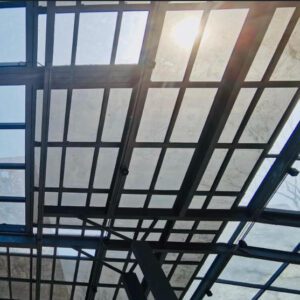
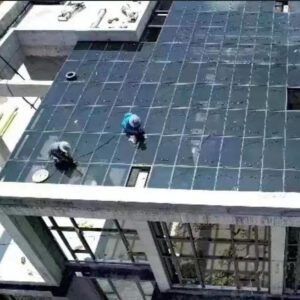
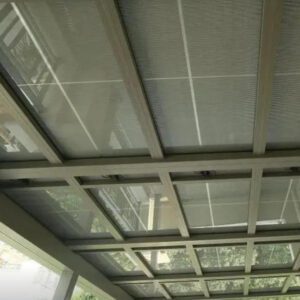
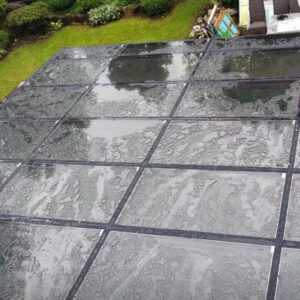
Balcony BIPV solar railings are photovoltaic glass, framed modules, or laminated safety panels that work as both a balcony guardrail and a solar generator. In simple terms: the railing still protects occupants, but the glass or panel also produces electricity.
This is different from a small plug-in panel hung on a balcony. A true balcony BIPV railing is designed into the building envelope. It must satisfy structural loading, impact resistance, edge protection, electrical safety, drainage, cleaning, and replacement requirements.
For developers, the value is not only energy generation. Balcony BIPV can help turn repetitive façade surfaces into productive assets, especially on apartment blocks, hotels, student housing, senior living projects, and mixed-use towers where roof area is limited.
2. Where Balcony BIPV Makes Commercial Sense
Balcony solar railings make the most sense when the building has many repeated balcony bays, limited roof area, and a visible sustainability target. The strongest business cases usually appear in new construction because the railing, glass, brackets, cable routes, and inverter layout can be coordinated before the façade is frozen.
A typical retrofit can still work, but the survey must confirm existing railing strength, fixing points, waterproofing, resident access, and the electrical route from balcony to distribution board. This is why Jia Mao Bipv often recommends an early feasibility review before a developer requests final pricing.


3. Product Types: Glass Railing, Framed Panel, or Decorative BIPV?
Balcony BIPV is not one product. It is a design family. The right choice depends on the building’s appearance, wind load, guardrail code, power target, and budget.
| Excel Row | Product Type | Best Use Case | Typical Power Density | Design Advantage | Main Risk to Check |
|---|---|---|---|---|---|
| A2 | Laminated PV glass railing | Premium apartments, hotels, waterfront buildings | 60–160 W/m² | Clean look, safety glass function, semi-transparency possible | Impact rating, edge protection, junction-box access |
| A3 | Framed balcony PV panel | Cost-sensitive retrofits and rental buildings | 120–220 W/m² | Higher output per square meter and easier replacement | Wind uplift, clamp design, resident tampering |
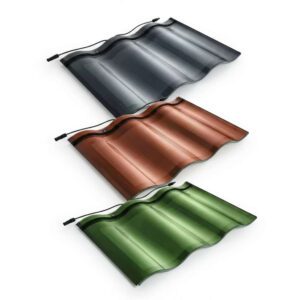
| A4 | Colored or patterned BIPV panel | Architectural façades with visible design requirements | 70–180 W/m² | Can match façade color palettes and branding | Color layer may reduce output; mockup approval is essential |
| A5 | Plug-in balcony solar kit | Small renter-led systems where local rules allow it | Varies by kit | Fast deployment and low upfront cost | Not always a code-compliant railing replacement |
| A6 | Custom Jia Mao Bipv railing module | New-build projects needing coordinated glass, size, wiring, and aesthetics | Project-specific | Can be sized around balcony grid, transparency, and power target | Requires early coordination with architect, façade engineer, and electrician |
If the project is already in schematic design, start with the balcony grid and sightline. If it is a retrofit, start with structural verification and resident safety. The product decision should come after those two checks, not before.
4. Cost Benchmarks and What Drives Price
Balcony BIPV pricing is usually discussed in two ways: cost per watt and cost per balcony. Both are useful. Cost per watt helps compare energy systems. Cost per balcony helps the developer understand the façade package, installation labor, and repeatability.
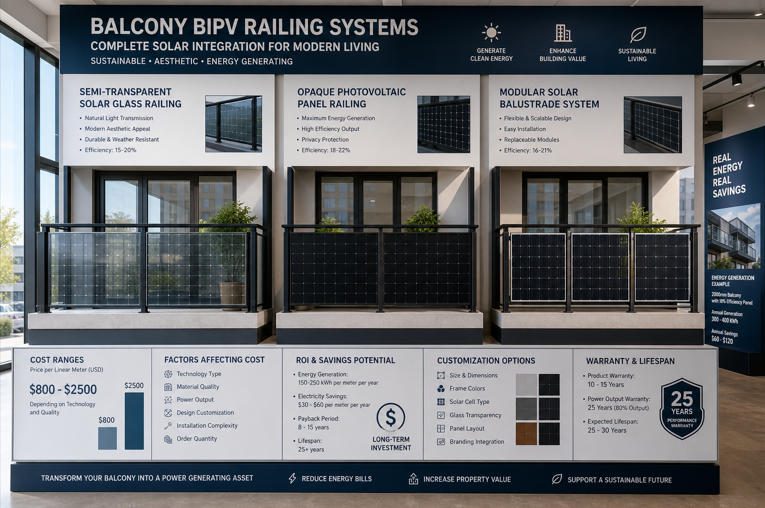
For early budgeting, many projects use a broad installed-cost range of $2.50–$8.00 per watt for balcony BIPV depending on product type, certification, mounting complexity, inverter choice, local labor, and project scale. Custom glass or decorative products may also be priced per square meter.
Bar Chart: Early Budget Cost Range by Balcony BIPV Product Type
5. Cost Breakdown: Why Hardware Is Only Part of the Budget
In balcony BIPV projects, the module is visible, but the hidden work often decides whether the system performs well. Mounting brackets, safety glass details, cable routing, microinverters, inspection, and commissioning can represent more than half of the installed cost.
Pie Chart: Typical Installed Cost Split for Balcony BIPV
- 42% PV modules, laminated glass, or custom railing panels
- 20% Mounting, brackets, guardrail interface, waterproofing details
- 16% Electrical BOS
- 22% Labor, access equipment, permits, testing, commissioning
6. Installation Workflow: From Balcony Survey to Handover
A well-run balcony BIPV project starts with the building, not the panel. The survey should confirm balcony dimensions, rail height, slab condition, waterproofing, wind exposure, shading, resident access, and electrical routes.
New-build workflow
- Confirm balcony module size before façade shop drawings are closed.
- Coordinate conduit routes through slab edges or service zones.
- Agree glass color, opacity, and mockup acceptance with the architect.
- Assign warranty boundaries between railing supplier, electrician, and BIPV manufacturer.
- Commission sample units before repeating across the full building.
Retrofit workflow
- Inspect existing railing fixings, corrosion, and structural capacity.
- Check local rules for balcony-mounted solar and grid connection.
- Plan safe installation access without entering every apartment repeatedly.
- Use visible cable protection where concealed routing is not possible.
- Give residents a simple safety and maintenance handover sheet.

7. Electrical Design: Simple Definitions for Non-Specialists
Solar cells create direct-current electricity. An inverter changes that into alternating current used by buildings. In balcony systems, the inverter may be a small microinverter behind each panel group or a larger inverter serving multiple balconies.
The most important design point is not the brand of inverter. It is whether the electrical layout is safe, inspectable, maintainable, and legal for the building’s grid connection.
For technical background, the U.S. Department of Energy provides a clear introduction to solar photovoltaic technology fundamentals. For annual yield modeling, project teams can test orientation and location assumptions in the PVWatts energy calculator by NREL.
8. Safety, Codes, and Approvals
Balcony BIPV touches multiple approval areas at once: guardrail safety, laminated glass behavior, wind loading, fire spread, electrical protection, emergency access, and grid interconnection. That is why it should not be treated as a decorative add-on.
A project specification should ask for documentation on mechanical loading, glass breakage behavior, electrical insulation, connector ratings, cable UV resistance, inverter certification, and installation instructions. It should also identify who signs off the railing function and who signs off the PV function.
For a wider building-envelope perspective, review the Whole Building Design Guide’s overview of building-integrated photovoltaics guidance. Incentive and policy research can start with the DSIRE clean energy incentive database for U.S. projects.
9. How Jia Mao Bipv Fits Into the Specification Process
Jia Mao Bipv works best when invited before balcony railing dimensions and façade colors are locked. Early coordination helps the project team decide whether to use transparent PV glass, opaque framed panels, decorative patterned modules, or a custom railing format.
For product-level research, start with the Jia Mao Bipv solar balcony railing system. If the project team is still comparing BIPV against conventional roof solar, this BIPV versus traditional solar comparison is useful for internal discussions.
Developers planning a full building package can also review the custom BIPV product catalog, the step-by-step BIPV installation guide, and the building-integrated solar ROI planner.
10. Video: Balcony Solar Setup Basics
The video below is not a substitute for engineering review, but it helps non-technical stakeholders understand why balcony orientation, mounting, inverter choice, and cable routing matter.
11. Buyer’s Checklist Before Requesting a Quote
A useful quotation package should reduce guessing. Send the supplier drawings, photos, project location, preferred appearance, electrical constraints, and performance expectations.
| Excel Row | Information to Send | Why It Matters | Example Detail | Owner of Data |
|---|---|---|---|---|
| B2 | Balcony elevation drawings | Confirms panel size, railing height, module repetition | 1.2 m railing height, 2.4 m bay width | Architect |
| B3 | Project location and orientation | Determines sunlight, wind, and likely annual yield | South-east façade, 12 floors, urban street canyon | Energy consultant |
| B4 | Appearance target | Controls transparency, cell spacing, color, and cost | Dark bronze glass, 30–40% visible light transmission | Architect + owner |
| B5 | Electrical strategy | Defines inverter layout, cable routes, monitoring, shutdown | Microinverter per two balconies | Electrical engineer |
| B6 | Access and maintenance plan | Reduces future replacement and cleaning costs | Exterior access from swing stage every two years | Facilities team |
12. Glossary and Hover Tips
Use these short definitions when discussing balcony BIPV with owners, architects, and residents.
Building-integrated photovoltaics: solar products that replace or become part of a building element.
Building-applied photovoltaics: solar panels added onto an existing surface without replacing it.
Watt-peak: the rated output of a solar panel under standard laboratory test conditions.
Kilowatt-peak: 1,000 watt-peak. Used to describe system size before weather losses.
Balance of system: inverters, cables, connectors, monitoring, protection devices, and mounting parts.
Visible light transmission: the percentage of visible light passing through glass.
Maximum power point tracking: inverter function that improves output under changing sunlight.
A small inverter serving one panel or a small group of panels, useful for shaded balconies.
The electricity generated over time, usually measured in kWh per year.
13. FAQs for Balcony BIPV Solar Railings
Are balcony BIPV solar railings the same as plug-in balcony solar panels?
No. Plug-in balcony panels are usually added to an existing railing. Balcony BIPV railings are designed as part of the railing or façade system and must satisfy both building safety and solar electrical requirements.
How much electricity can one balcony solar railing produce?
A common planning range is 180–420 W per balcony, depending on panel size, orientation, transparency, shading, and cell technology. Annual yield should be modeled using the actual project location and balcony geometry.
Do balcony BIPV railings work on east- and west-facing façades?
Yes, but output is usually lower than a south-facing surface in the northern hemisphere. East façades produce more morning energy, while west façades produce more afternoon energy. This can still be useful for apartment loads.
Can transparent solar glass be used as a balcony guardrail?
It can be considered, but only if the product is engineered and certified for the required railing function. The specification must address laminated glass behavior, impact resistance, edge protection, and local guardrail code.
What is the biggest design mistake in balcony BIPV projects?
The biggest mistake is waiting until the railing design is finished before involving the BIPV supplier and electrical engineer. Late coordination often causes awkward cable routes, custom brackets, lower output, and warranty confusion.
Are balcony solar railings suitable for rental apartments?
Yes, especially when the owner or property manager controls the system design, safety documentation, and maintenance. Resident-installed systems may be possible in some markets, but rules vary widely.
How should developers estimate ROI for balcony BIPV?
Estimate installed cost, annual kWh generation, self-consumption value, incentives, maintenance cost, and replacement risk. Use conservative yield assumptions because balcony shading is often more complex than roof shading.
Does Jia Mao Bipv provide custom balcony solar railing options?
Jia Mao Bipv can support balcony BIPV discussions around module format, appearance, power target, wiring strategy, and project feasibility. Early drawings and façade requirements help speed up the review.
14. References and Further Reading
- Jia Mao Bipv solar balcony railing system
- custom BIPV product catalog
- step-by-step BIPV installation guide
- building-integrated solar ROI planner
- BIPV versus traditional solar comparison
- solar photovoltaic technology fundamentals
- PVWatts energy calculator by NREL
- building-integrated photovoltaics guidance
- DSIRE clean energy incentive database
Ready to Evaluate Balcony BIPV for a Real Project?
Send Jia Mao Bipv your balcony elevation drawings, project location, appearance target, railing requirements, and electrical constraints. A good feasibility review should answer three questions quickly: what will it look like, how much energy can it produce, and what must be solved before installation?
Request a Jia Mao Bipv feasibility review