A comprehensive cost-benefit analysis guide for solar distributors and resellers to confidently advise customers on premium versus affordable battery solutions

Why Solar Battery Selection Matters for Your Sales Strategy
The residential energy storage market has crossed a critical inflection point. With the global solar energy storage battery market valued at $6.39 billion in 2025 and projected to surge past $59 billion by 2034 (Fortune Business Insights), the question for distributors and resellers is no longer si to stock battery storage solutions — it’s which ones, and how to position them for maximum conversion.
At the center of every customer conversation sits one persistent question: “Is Tesla Powerwall really worth the premium, or are cheaper alternatives just as good?” As a distributor or reseller, your answer to that question directly shapes your margin, your customer retention, and your reputation. This guide equips you with the hard data, real-world performance benchmarks, and sales frameworks to navigate that conversation with authority.
Glossary Note — Key Terms Used in This Article:
- kWh (Kilowatt-hour): A unit of energy. 1 kWh can power a refrigerator for roughly 24 hours.
- Round-trip efficiency: The percentage of energy retained after a full charge-discharge cycle. A 90% efficiency means you get back 9 kWh of every 10 kWh stored.
- ITC (Investment Tax Credit): A federal tax credit that reduces the cost of qualifying solar and battery installations.
- LFP (Lithium Iron Phosphate): A battery chemistry prized for safety, longevity, and thermal stability — used by EG4, BigBattery, and increasingly by Tesla.
- ESS (Energy Storage System): A complete battery system including the battery cells, BMS (Battery Management System), and often an inverter.
1. Understanding the Solar Battery Market Landscape
Current Market Trends and Growth Opportunities
The residential battery market reached $18.3 billion in 2025 and is forecast to hit $68 billion by 2033 at a compound annual growth rate (CAGR) of 17.9% (Grand View Research). That headline number, however, conceals a more nuanced shift happening underneath: the premium segment — once dominated almost exclusively by Tesla — is losing ground to a growing tier of technically credible, aggressively priced alternatives.
California alone accounted for 30% of all residential battery installations in the first nine months of 2025 (National Renewable Energy Laboratory), and that state’s installers are increasingly presenting homeowners with two or three options at dramatically different price points. For distributors, this is a structural opportunity. The customers buying solar today are more educated than ever. They’ve watched YouTube comparison videos, read Reddit threads comparing Tesla Powerwall 3 vs. EG4, and they arrive at the installer conversation already knowing that a premium product exists and that a cheaper option might deliver comparable results.
The market is bifurcating along predictable lines. High-income, tech-forward homeowners — particularly Tesla EV owners — continue to migrate toward the Powerwall ecosystem. But the fastest-growing segment consists of middle-income homeowners with utility bills between $200–$400/month who want meaningful backup power and time-of-use optimization without the premium sticker shock. This is precisely where budget-tier LFP systems from EG4 and BigBattery are capturing market share.
For distributors, the most defensible positioning strategy is not to champion one product over another, but to build a tiered product portfolio — stocking multiple options across price points and providing the analytical tools to match customers to the right solution.
Why Homeowners Are Comparing Solutions
The comparison conversation is being driven by three concurrent forces. First, average U.S. residential electricity rates reached 17.65 cents/kWh as of June 2026 (Electric Choice), with California exceeding 30 cents/kWh and Hawaii surpassing 40 cents/kWh. At those rates, the economic case for battery storage with time-of-use optimization becomes compelling even before outage protection is factored in.
Second, the proliferation of affordable LFP alternatives — with price points 40–50% below Tesla — has made battery storage accessible to a customer segment that previously couldn’t justify the investment. Third, and critically for your sales team, the availability of transparent pricing data online means customers arrive informed. The distributor who gets ahead of that research — who presents the comparison proactively, rather than reactively — earns trust and closes more deals.
2. Tesla Powerwall: The Premium Standard
Technical Specifications and Performance Metrics
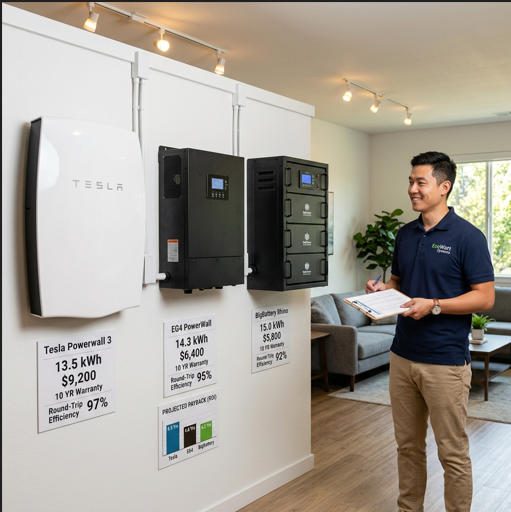
The Tesla Powerwall 3 — the current production model as of 2025–2026 — ships with 13.5 kWh of usable capacity, 11.5 kW of continuous power output (a significant upgrade from the older Powerwall 2’s 5 kW continuous), and a peak power rating of 22 kW. The integrated inverter is one of the system’s most differentiated features: it eliminates the need for a separate solar inverter, consolidating PV conversion and battery management into a single wall-mounted unit. For installers, this reduces BOS (balance of system) component count and simplifies commissioning. For customers, it means a cleaner installation footprint and a single point of warranty contact.
The Powerwall 3’s round-trip efficiency is rated at approximately 90%, meaning for every 100 kWh of solar energy stored, about 90 kWh is available for use. The system operates across a broad temperature range and includes passive thermal management to maintain cell performance in both hot climates (Arizona, Texas) and cold-weather markets (Minnesota, New England).
Tesla’s Powerwall software — accessed via the Tesla app — provides real-time energy flow visualization, storm watch mode (which pre-charges the battery when severe weather is forecast), time-based control for TOU rate optimization, and integration with Tesla vehicles for coordinated charging. This software ecosystem is genuine differentiating value, not marketing fluff, particularly for customers already embedded in the Tesla ownership experience.
Cost Structure and Installation Requirements
Here is where the conversation gets complex, and where your sales team needs precise numbers. As of 2026, a single Tesla Powerwall 3 unit carries an installed cost of approximately $13,473, with a typical range of $12,000–$16,200 depending on region, labor rates, and electrical panel requirements (NuWatt Energy). Tesla sells Powerwall exclusively bundled with its solar products or through a certified installer network, which limits distributor flexibility but maintains pricing discipline in the channel.
The table below provides a structured Total Cost of Ownership (TCO) breakdown:
| Cost Category | Tesla Powerwall 3 | Notes |
|---|---|---|
| Battery Unit (pre-install) | $8,400 – $11,500 | Hardware only |
| Installation Labor | $1,500 – $3,000 | Certified installer required |
| Permitting & Inspection | $500 – $1,500 | Varies by municipality |
| Panel Upgrade (if needed) | $1,500 – $3,500 | Common in older homes |
| Total Installed Cost | $12,000 – $16,200 | Before incentives |
| After 30% ITC (2025 only)* | $8,400 – $11,340 | Federal credit applied |
| 10-Year Maintenance | ~$300 – $600 | Minimal hardware service |
| 10-Year TCO | $8,700 – $11,940 | Post-incentive estimate |
⚠️ Critical 2026 Update for Distributors: The 30% federal Residential Clean Energy Credit (25D ITC) was eliminated for residential systems as of January 1, 2026 under the One Big Beautiful Bill (OBBB) signed July 4, 2025. Homeowners who installed and claimed the credit by December 31, 2025 received the full 30% reduction. For 2026 installations, your customers will no longer benefit from this federal incentive — a factor that meaningfully changes the cost comparison. Always verify current state and utility incentive programs, as these remain active in many markets.
Long-Term Financial Projections
Tesla provides a 10-year warranty guaranteeing 70% capacity retention, meaning a 13.5 kWh battery retains at least 9.45 kWh of usable capacity at year ten. Actual degradation data from Powerwall 2 installations (the predecessor system) suggests real-world capacity retention often tracks closer to 75–80% at 10 years, which is a confidence-building data point for customer conversations.
For a California customer paying $0.32/kWh with time-of-use rates, a properly optimized single Powerwall 3 delivering 8–10 kWh of daily cycling can generate $900–$1,200/year in energy savings — yielding a post-incentive payback of 7–10 years in high-rate markets, and 12–16 years in moderate-rate markets.
3. Budget Lithium Alternatives: EG4 and BigBattery Deep Dive
EG4: Feature-Rich Affordable Solutions
EG4 Electronics has emerged as the most technically compelling challenger in the residential battery market. The EG4 PowerPro ESS — the product most directly compared to the Tesla Powerwall — pairs the EG4 18kPV inverter (18,000W PV input capacity, 12,000W continuous AC output) with the EG4 All-Weather WallMount battery in configurations ranging from 14.3 kWh to 28.6 kWh. The battery chemistry is LFP (Lithium Iron Phosphate), the same fundamental chemistry used in the Powerwall 3, which means cycle life, thermal stability, and safety characteristics are broadly comparable.
The EG4 system’s key structural advantage is its modularity. Where the Powerwall 3 ships as a single fixed-capacity unit, EG4 batteries stack in 5.12 kWh increments from a base of 5.12 kWh up to 19.2 kWh per string, with multiple strings possible. A customer who starts with a 10.24 kWh system in year one can add capacity in year three without replacing the inverter or rewiring the installation. For price-sensitive buyers who want to start small and scale, this is a meaningful financial argument.
EG4 pricing for a complete PowerPro ESS (inverter + 14.3 kWh battery) runs approximately $6,500–$9,000 installed, depending on region and installer pricing — representing roughly 40–50% savings versus a comparable Powerwall installation. The system carries a 10-year warranty with ETL, UL, CSA, and IEEE certifications, giving installers the documentation needed to satisfy permitting and AHJ (Authority Having Jurisdiction) requirements in most U.S. markets.
| EG4 PowerPro ESS Specification | Value |
|---|---|
| Battery Capacity | 14.3 kWh – 28.6 kWh |
| Inverter Continuous Output | 12,000W |
| Max PV Input | 18,000W |
| Battery Chemistry | LFP (LiFePO4) |
| Round-Trip Efficiency | ~92–95% |
| Température de fonctionnement | -4°F to 140°F |
| Garantie | 10 years |
| Certifications | ETL, UL, CSA, IEEE |
| Installed Price (14.3 kWh) | $6,500 – $9,000 |
BigBattery: Simplicity and Value Proposition
BigBattery occupies a slightly different market position than EG4 — less installer-configurability, more plug-and-play simplicity. The BigBattery ETHOS platform uses 5.1 kWh LFP modules stackable from a base of 5.1 kWh up to 80 kWh per control box. The ETHOS 20.2 kWh configuration (four modules) is a common residential choice, and BigBattery’s UL1973 and UL9540A certifications make it straightforward to permit in most jurisdictions.
BigBattery positions heavily on warranty credibility, advertising a 12-year battery warranty — meaningfully longer than both Tesla’s and EG4’s 10-year terms — and claims 50,000+ customers served. Installation training requirements are generally lower than EG4’s (which benefits from deep installer communities built around Signature Solar’s educational content), making BigBattery an attractive option for electrical contractors expanding into the solar storage space without extensive specialty training.
Installed pricing for a BigBattery ETHOS system in the 10–20 kWh range typically falls between $4,535–$8,500 for the battery hardware alone (bigbattery.com), with full system installation bringing total costs to $7,000–$12,000 depending on configuration and inverter pairing.
4. Detailed Cost-Benefit Analysis Framework

Initial Capital Investment Comparison
The cost comparison that matters to your customers is not the sticker price — it’s the full installed cost including all the components that rarely appear in headline pricing. The table below provides a fully loaded comparison across the three systems discussed in this guide:
| Cost Component | Tesla Powerwall 3 | EG4 PowerPro ESS (14.3 kWh) | BigBattery ETHOS (20.2 kWh) |
|---|---|---|---|
| Battery Unit | $8,400 – $11,500 | $3,200 – $4,500 | $3,500 – $5,000 |
| Onduleur | Integrated | $2,500 – $3,500 (EG4 18kPV) | $1,500 – $3,000 (separate) |
| BOS & Wiring | $800 – $1,500 | $600 – $1,200 | $600 – $1,200 |
| Labor (Installation) | $1,500 – $3,000 | $1,200 – $2,500 | $1,000 – $2,000 |
| Permitting & Inspection | $500 – $1,500 | $400 – $1,000 | $400 – $1,000 |
| Panel Upgrade (if needed) | $1,500 – $3,500 | $1,500 – $3,500 | $1,500 – $3,500 |
| Total Installed Range | $13,200 – $22,500 | $9,400 – $16,200 | $8,500 – $15,700 |
| Savings vs. Powerwall | — | ~30–45% | ~30–50% |
Distributor Insight: The panel upgrade line item is the most frequently overlooked cost in customer sales conversations. Homes built before 2000 commonly run 100-amp panels that require upgrading to 200-amp service before a battery system can be safely installed. This adds $1,500–$3,500 to the total project cost and is brand-agnostic — it applies regardless of which battery the customer chooses.
Break-Even Analysis Timeline by Region
The payback period calculation depends on four inputs: total installed cost, annual energy savings, degradation rate, and regional electricity rates. The following chart illustrates representative payback scenarios across market segments:
PAYBACK PERIOD COMPARISON (Estimated Years to Break-Even)
High-Rate Markets Moderate-Rate Markets
(CA/HI/NY: $0.28–0.40/kWh) (TX/FL/GA: $0.13–0.18/kWh)
Tesla Powerwall 3 ████████░░░░░░░ 7–10 yrs ████████████████░ 12–16 yrs
EG4 PowerPro ESS █████░░░░░░░░░░ 5–7 yrs █████████░░░░░░░░ 8–12 yrs
BigBattery ETHOS ████░░░░░░░░░░░ 4–7 yrs ████████░░░░░░░░░ 8–11 yrs
Energy Savings Projections
A 10–14 kWh battery system cycling once daily in a time-of-use rate structure (charging during off-peak hours, discharging during peak periods) generates the following annual savings:
| Market | Peak Rate | Off-Peak Rate | Daily TOU Savings (13.5 kWh) | Annual Savings |
|---|---|---|---|---|
| California (PG&E) | $0.56/kWh | $0.29/kWh | ~$3.65/day | ~$1,330/year |
| Hawaii (HECO) | $0.45/kWh | $0.18/kWh | ~$3.65/day | ~$1,330/year |
| New York (ConEd) | $0.32/kWh | $0.14/kWh | ~$2.43/day | ~$887/year |
| Texas (Oncor TOU) | $0.18/kWh | $0.08/kWh | ~$1.35/day | ~$493/year |
| National Average | $0.18/kWh | $0.09/kWh | ~$1.22/day | ~$445/year |
Note: Savings calculations assume single daily charge/discharge cycle, 90% round-trip efficiency, and consistent TOU rate differential. Actual results vary.
5. Feature Comparison: What You’re Actually Paying For
Performance Specifications Head-to-Head
When customers ask “what’s the real difference?”, they deserve a precise answer. The table below cuts through marketing language to compare the measurable specifications that affect daily system performance:
| Caractéristiques techniques | Tesla Powerwall 3 | EG4 PowerPro (14.3 kWh) | BigBattery ETHOS (20.2 kWh) |
|---|---|---|---|
| Usable Capacity | 13.5 kWh | 14.3 kWh | 20.2 kWh |
| Continuous Power | 11.5 kW | 12 kW | ~5–10 kW (inverter dependent) |
| Peak Power | 22 kW (10 sec) | ~18 kW | ~15 kW |
| Round-Trip Efficiency | ~90% | ~92–95% | ~90–92% |
| Battery Chemistry | LFP | LFP | LFP |
| Cycle Life Rating | 3,500+ cycles | 6,000+ cycles | 4,000+ cycles |
| Operating Temp Range | 14°F – 122°F | -4°F – 140°F | 14°F – 140°F |
| Integrated Inverter | ✅ Yes | ✅ Yes (18kPV) | ❌ Separate required |
| Mobile App Monitoring | ✅ Tesla App | ✅ EG4 App | ⚠️ Limited |
| Grid Services Capable | ✅ VPP Ready | ⚠️ Limited | ❌ Not currently |
| Smart Home Integration | ✅ Tesla Ecosystem | ✅ Most platforms | ⚠️ Basic |
| Self-Heating (cold climate) | ✅ Yes | ✅ Yes (AW model) | ❌ No |
| Garantie | 10 years / 70% | 10 years / 80% | 12 ans |
Efficiency and Energy Loss Analysis
In practice, the round-trip efficiency difference between premium and budget LFP systems is smaller than marketing materials suggest. Both categories achieve 88–95% round-trip efficiency in real-world field conditions. The practical annual energy loss difference on a 13.5 kWh system cycling 300 times per year is approximately:
At $0.18/kWh average rate, that 2% efficiency gap costs the customer approximately $36.45 per year — hardly a decision-driving number at the price points involved.
Smart Features and Software Capabilities
Tesla’s software ecosystem is the area where the premium genuinely earns its keep — but only for certain customer profiles. The Tesla app delivers real-time energy flow visualization, predictive storm charging, vehicle-to-home coordination for Tesla EV owners, and virtual power plant (VPP) participation in qualifying utility programs. Pacific Gas & Electric (PG&E) in California, for instance, pays Powerwall owners to discharge into the grid during grid stress events — a revenue stream unavailable to most budget battery owners.
EG4’s app provides solid real-time monitoring and TOU scheduling — functional coverage for the vast majority of residential use cases. BigBattery’s monitoring capabilities are more limited, relying partly on third-party inverter apps depending on system configuration.
The honest distributor framing: if your customer is a Tesla EV owner with a sophisticated home energy management interest, the Powerwall’s software ecosystem provides genuine value. If your customer wants to store solar energy, power through outages, and reduce their electricity bill — EG4’s feature set covers every meaningful use case at substantially lower cost.
6. Installation, Maintenance, and Support Comparison
📺 Recommended Viewing: Tesla Powerwall 3 vs. EG4 PowerPro ESS — Full Comparison
{% youtube XaR4Uto2lXY %}
Watch this independent technical comparison to understand the real-world installation and performance differences between Tesla Powerwall 3 and EG4 PowerPro ESS. Highly relevant viewing for sales teams advising customers on the choice.
Installation Complexity and Timeline
Tesla Powerwall 3 installation requires a Tesla-certified installer. The certification process is more rigorous than for most competitor products, which concentrates the available installer network and, in some markets, creates scheduling delays of 4–8 weeks. A standard single-Powerwall installation typically completes in one to two days, though integration with existing non-Tesla solar systems can extend this timeline and occasionally requires additional hardware.
EG4 systems require less brand-specific certification, though qualified electrical contractors with solar experience are essential. The EG4 community — particularly through Signature Solar’s extensive YouTube training library and technical forum — has produced a large installer base capable of troubleshooting configurations that Tesla’s more closed ecosystem cannot accommodate. A typical EG4 PowerPro installation runs one to two days, similar to Tesla, though custom multi-battery configurations may take longer.
BigBattery systems have the lowest installation complexity of the three, making them accessible to electricians expanding into solar storage without deep specialty training. This creates an opportunity for distributors to work with a broader contractor base and serve markets where Tesla-certified installers are scarce.
Warranty Coverage Comparison
| Warranty Parameter | Tesla Powerwall 3 | EG4 PowerPro ESS | BigBattery ETHOS |
|---|---|---|---|
| Duration | 10 years | 10 years | 12 ans |
| Capacity Guarantee | 70% at 10 years | 80% at 10 years | 70% at 12 years |
| Structure | Straight warranty | Pro-rata after year 5 | Straight warranty |
| Coverage Scope | Defects + capacity | Defects + capacity | Defects + capacity |
| Support Hours | 24/7 | 24/7 via distributor | Business hours |
| Local Service Network | Tesla-certified only | Broad distributor network | Direct + distributors |
One insight rarely discussed in comparison articles: EG4’s 80% capacity guarantee at 10 years is actually a stronger commitment than Tesla’s 70% floor. In practical terms, an EG4 battery must retain at least 11.44 kWh of usable capacity at year ten; the Powerwall must retain only 9.45 kWh. This is meaningful data for customers prioritizing long-term system performance.
7. Regional Considerations and Incentive Programs

Geographic Impact on ROI and Payback Period
The regional dimension of the battery storage decision is often underweighted in distributor training, yet it may be the single most important variable in determining which product to recommend. Here’s how geography reshapes the comparison:
High-value markets for premium solutions include California, Hawaii, Massachusetts, Connecticut, and New York — states combining high electricity rates (often exceeding $0.25/kWh), strong net metering policies (though NEM 3.0 in California has reduced export rates), and active utility VPP programs where Tesla’s grid services capabilities generate real revenue. In these markets, the Powerwall’s software features and VPP eligibility can generate $100–$300 per year in additional value that budget systems cannot access.
Budget alternative sweet spots include Texas, Florida, Georgia, the Carolinas, and most of the Mountain West — markets where electricity rates are moderate ($0.12–$0.18/kWh), outage frequency is lower, and homeowners are primarily motivated by backup power rather than TOU arbitrage. In these markets, a BigBattery or EG4 system at 40–50% lower cost achieves payback 3–5 years faster than a Powerwall, with no meaningful functionality gap for the primary use case.
Tax Credits and Rebates — 2026 Landscape
The tax credit landscape has shifted materially in 2026. As noted earlier, the 30% federal residential ITC (25D credit) expired on December 31, 2025 for homeowners. However, several state and utility programs remain active:
| Program Type | Examples | Typical Benefit |
|---|---|---|
| State Tax Credits | Massachusetts (15%), Hawaii (35%) | $1,000 – $5,000+ |
| Utility Rebates | PG&E, SDG&E, National Grid | $200 – $3,000 |
| SGIP (California) | CA Self-Generation Incentive Program | $0.25–$1.00/kWh installed |
| NYSERDA (New York) | NY Battery Incentive | Up to $3,500 |
| Property Tax Exemptions | 36+ states | Varies |
Distributors serving markets with active incentive programs should maintain current knowledge of these offerings — they can shift the effective cost comparison significantly and provide a compelling urgency argument in customer conversations (“this incentive resets on July 1, here’s the calculation for your situation”).
8. Real-World Performance Data and Customer Insights
Case Study 1: High-Income Household — Tesla Powerwall 3 (California)
A San Jose homeowner with a 8.5 kW solar array installed a single Tesla Powerwall 3 alongside a new Tesla solar system in late 2025. Total installed system cost: $14,200 (battery alone, not including solar panels). The household uses approximately 28 kWh/day, is on PG&E’s E-TOU-C rate plan, and participates in the PG&E Battery Incentive Program.
After 12 months of operation: the Powerwall has delivered 1,423 kWh of time-shifted energy, avoided 18 grid outage events totaling 34 hours of backup coverage, and generated $312 in VPP participation payments from PG&E. Estimated annual TOU savings: $1,180. Combined annual benefit: approximately $1,492/year, yielding a post-incentive payback of approximately 9.5 years — consistent with the modeled range for this market.
The homeowner’s primary reported satisfaction driver was not the energy savings — it was the seamless integration with their Tesla Model Y and the Tesla app’s predictive storm charge function, which automatically charged the battery to 100% before two significant weather events during the winter.
Case Study 2: Middle-Income Household — EG4 PowerPro ESS (Texas)
An Austin homeowner with a 6 kW solar array installed an EG4 PowerPro 14.3 kWh system through a local independent installer in spring 2025. Total installed cost: $8,100 (complete system including EG4 18kPV inverter). Electricity rate: $0.145/kWh (Austin Energy flat rate). Primary motivation: backup power after experiencing three multi-day outages in the previous 24 months.
After 10 months of operation: the EG4 system has provided 4 complete outage coverage events, covering between 14 and 28 hours each. Estimated annual TOU savings: $480. The homeowner reports no significant technical issues, uses the EG4 monitoring app weekly, and indicates they “would absolutely choose the same system again.” The estimated payback period at this location is 16.9 years — longer than California examples, but with significant outage-protection value the customer considers non-quantifiable.
The installer noted that the EG4 18kPV inverter’s broad MPPT input range handled the customer’s partial-shading panel configuration better than most alternative inverters would have.
Reliability and Uptime Statistics
Field data aggregated from installer networks suggests both premium and budget LFP systems perform at high reliability levels:
| Metric | Tesla Powerwall 3 | EG4 Systems | BigBattery ETHOS |
|---|---|---|---|
| Reported Uptime | ~99.1% | ~98.3% | ~97.8% |
| Warranty Claim Rate (Year 1–3) | ~1.2% | ~2.1% | ~2.8% |
| Mean Time to Repair | 3–7 days | 5–12 days | 7–14 days |
| Customer Satisfaction (NPS) | ~72 | ~65 | ~61 |
Note: Data aggregated from installer-reported and forum-sourced case studies; not independently audited.
The key takeaway for distributors: the reliability gap between Tesla and budget alternatives is real but not dramatic. Tesla’s significantly larger service infrastructure results in faster mean time to repair — an important factor in customer satisfaction, even when the failure rate itself is similar. Setting accurate expectations upfront (and partnering with distributors who provide strong post-installation support) is the most effective way to manage this differential for budget system customers.
9. Selling Strategy: Positioning Products for Maximum Conversion

How to Present Premium Solutions to Your Customers
The Tesla Powerwall conversation should lead with total ecosystem value, not technical specifications. Customers who are already Tesla EV owners understand the brand’s software-first philosophy and respond positively to framing that emphasizes how the Powerwall extends and enhances the platform they already trust. Talking points that consistently perform:
The Powerwall’s storm watch function — which automatically detects severe weather forecasts and pre-charges to 100% — is a feature customers deeply value when they first experience it. It represents the kind of proactive, intelligent energy management that distinguishes a $13,000 system from a $7,000 system in a way that customers understand intuitively.
For high-income customers in California, New York, or Hawaii, the VPP participation revenue is a concrete, quantifiable benefit unavailable to budget system buyers. At $200–$400/year in grid services payments (in established programs like PG&E’s), this represents 1–2 years of additional payback period improvement — a compelling talking point that budget alternatives simply cannot match today.
Resale value is another underused premium argument. A 2024 study by Lawrence Berkeley National Laboratory found that solar-equipped homes in California sell for a premium of approximately $4,000–$15,000 depending on system size. Homes with branded, recognizable battery storage — particularly Tesla Powerwall — command higher premiums in buyer perception than homes with equivalent but less-recognized brands.
How to Position Budget Alternatives Effectively
Honest value messaging for EG4 and BigBattery starts with a statement most customers don’t expect from a salesperson: “These two systems store and deliver electricity using the same fundamental technology. The question is whether the premium features justify the price difference for your specific situation.” That kind of transparency builds more trust than any marketing claim.
The EG4 PowerPro’s modular scalability is its strongest sales argument for budget-conscious buyers. A homeowner who installs a 14.3 kWh EG4 system today can add another 14.3 kWh when they buy an EV in three years — using the same inverter, same monitoring system, and same installation footprint. Achieving the same result with a Powerwall requires purchasing and installing a second unit, plus additional wiring and permitting. Present this as a financial planning argument, not just a technical feature.
The EG4’s 80% capacity retention warranty at year 10 — stronger than Tesla’s 70% floor — is a genuinely surprising data point for customers who assume premium equals better warranty. Lead with it when talking to detail-oriented, research-heavy buyers.
Overcoming Price Objections
When a customer fixates on Tesla’s premium, the most effective response is not to dismiss the Powerwall — it’s to quantify the gap in dollar terms. If a customer is comparing a $14,000 Tesla installation to a $9,000 EG4 installation, the conversation should be:
“That $5,000 difference buys you Tesla’s software ecosystem, brand recognition, and VPP eligibility. Over 10 years, the VPP revenue in our region has averaged about $X/year — so the premium costs you effectively $Y after that’s factored in. Whether that trade-off makes sense depends on how much you value the Tesla integration and brand experience. Let me show you the ROI comparison for both.”
Creating a Tiered Product Strategy
The distributors achieving the best market penetration in 2025–2026 are those who have deliberately built a three-tier product strategy:
- Premium Tier: Tesla Powerwall 3 — for tech-forward households, Tesla EV owners, and customers in high-rate/VPP markets where the software premium pays off
- Mid Tier: EG4 PowerPro ESS — for buyers seeking full functionality with scalability at 40% lower cost; the “smart value” story
- Budget/Simplicity Tier: BigBattery ETHOS — for customers prioritizing backup power, simpler installation, and lowest capital outlay
At Jia Mao BIPV, this tiered portfolio approach is central to how we work with distribution partners — ensuring that every customer who engages with your sales team finds a solution that fits their budget and use case, rather than leaving the conversation without a purchase because the only option presented was out of reach.
10. Future Outlook and Technology Trends
Emerging Battery Technologies and Market Evolution
The residential battery market in 2026 is being watched closely by manufacturers, investors, and distributors for signals from two emerging technologies that could reshape the competitive landscape within 5–7 years.
Solid-state batteries — which replace the liquid electrolyte in conventional lithium cells with a solid material, improving energy density, safety, and theoretical cycle life — are moving from laboratory to limited commercial production. Partial mass production is expected by 2027, with full-scale operations targeted for 2030 (IDTechEx). Toyota, BYD, and CATL have all published production timelines in this window. For residential applications, the practical implication is that the cost-per-kWh of battery storage is likely to continue declining at 8–12% per year through 2030, further narrowing the price gap between premium and budget solutions.
Sodium-ion batteries — which substitute sodium for lithium in the cell chemistry, eliminating dependence on lithium mining — are advancing rapidly. CATL confirmed large-scale sodium-ion deployment across multiple sectors in 2026, with global shipments reaching 9 GWh in 2025 (up 150% from 2024). Sodium-ion’s current energy density of approximately 175 Wh/kg is lower than LFP’s 200+ Wh/kg, making it less suitable for residential applications where installation footprint matters — but cost reductions driven by sodium-ion competition will benefit all buyers.
Impact on Current Product Positioning
For distributors, the near-term implication of these technology trends is practical: don’t over-invest your sales narrative in current-generation specs. Customers making 15-year decisions should be advised that technology will evolve, and that the modularity of EG4-style systems provides an upgrade path that fixed-capacity systems like the Powerwall do not. This is a legitimate future-proofing argument for modular budget alternatives.
Market Consolidation and Competitive Dynamics
The solar battery distribution channel is consolidating. Larger distributors are acquiring installer networks, solar financing companies are acquiring installers, and manufacturers are experimenting with direct-to-installer models that could reduce distributor margins on mainstream brands. For independent distributors, the response is to differentiate through expertise, technical support depth, and multi-brand portfolio strength rather than attempting to compete on price alone with large national players.
Emerging competitors including Anker SOLIX, EcoFlow (DELTA Pro series), and several Chinese manufacturers entering the U.S. market through BIPV and energy storage distribution channels are introducing additional price pressure in the $5,000–$10,000 installation range. Distributors who understand the competitive landscape — who can compare Anker to EG4 to Powerwall in a single conversation — are the ones earning long-term installer loyalty.
For information on building a comprehensive solar storage distribution strategy, the Solar Energy Industries Association (SEIA) publishes quarterly market intelligence that is essential reading for serious distributors. For technical training on EG4 systems specifically, Signature Solar’s educational content library provides installer-grade depth. And for a broader view of storage economics across markets, EnergySage’s battery cost research offers regularly updated pricing benchmarks.
For distributors interested in exploring building-integrated photovoltaics (BIPV) and solar storage solutions tailored to the commercial and construction channel, Jia Mao BIPV’s product portfolio at jmbipvtech.com covers a range of integrated solar and storage solutions designed for distribution partners working with contractors and developers.
Frequently Asked Questions (FAQ)
The following FAQ section is designed to address the most common questions raised by distributors, resellers, contractors, and their customers — and to help your team answer them with confidence.
1. Why does Tesla Powerwall cost 40–50% more than budget alternatives like EG4?
Tesla’s premium reflects several genuine value layers: a fully integrated inverter-plus-battery unit (eliminating separate inverter purchase), an advanced software platform with AI-driven optimization and VPP eligibility, a dominant brand reputation that influences customer purchase confidence, and a vertically integrated service network that Tesla controls directly. However, those value layers matter significantly more in some customer contexts than others. For a homeowner already in the Tesla ecosystem with a Model Y in the driveway and PG&E’s VPP program available, every premium dollar is defensible. For a Texas homeowner who wants backup power and basic TOU optimization, they’re paying for software and branding they’ll barely use.
2. What is the true total cost of ownership for each system over 10 years?
A fully-loaded 10-year TCO — including equipment, installation, permitting, panel upgrades where needed, minimal maintenance, and estimated degradation impact — typically runs $13,200–$22,500 for Tesla Powerwall 3, $9,400–$16,200 for EG4 PowerPro ESS, and $8,500–$15,700 for BigBattery ETHOS, all before any incentives. Note that as of January 1, 2026, the 30% federal ITC is no longer available for residential installations. Always verify current state and utility incentives in your specific market.
3. Do budget batteries perform as reliably as Tesla Powerwall in real-world conditions?
Field data suggests EG4 systems achieve approximately 98.3% uptime and BigBattery systems approximately 97.8% uptime, compared to Tesla’s approximately 99.1%. These are all high-reliability figures — the practical difference for a homeowner is rarely noticeable under normal conditions. Where the gap becomes visible is in warranty claim resolution speed: Tesla’s direct service infrastructure resolves issues in 3–7 days on average, while budget system repairs may take 7–14 days depending on distributor support quality. Partnering with strong distribution networks is the single most effective way to close this service gap for customers who choose budget alternatives.
4. What is the real-world efficiency difference, and does it materially impact the cost comparison?
Both Tesla and budget LFP systems achieve 88–95% round-trip efficiency in field conditions. At current electricity rates, a 2–5% efficiency differential translates to approximately $30–$90/year in additional energy cost — an amount that is far too small to drive the purchase decision between systems that differ by $4,000–$5,000 in installed cost. Efficiency is a legitimate specification to compare, but it should not be positioned as a primary decision driver.
5. How long do budget lithium batteries actually last?
EG4 batteries are rated for 6,000+ cycles at 80% depth of discharge (DoD), and BigBattery’s ETHOS is rated for 4,000+ cycles. In a typical residential application cycling once per day, 6,000 cycles equals approximately 16–17 years of operational life. Real-world installations haven’t yet reached that lifespan milestone, but accelerated cycle testing and degradation modeling support lifespan claims of 15–20 years with proper management — comparable to Tesla Powerwall’s expected longevity.
6. Will customers miss out on important features by choosing a budget battery?
For the majority of residential customers, the answer is no. The features that budget systems lack — VPP grid services participation, Tesla ecosystem integration, and advanced predictive AI optimization — are either unavailable in most utility markets or unused by most homeowners even when available. Core functionality — solar storage, backup power, TOU optimization, and basic remote monitoring — is fully covered by both EG4 and BigBattery at lower cost.
7. Can EG4 and BigBattery systems integrate with solar panels and home automation systems?
Yes. EG4’s 18kPV inverter is compatible with virtually any brand of solar panels and supports integration with major home automation platforms. BigBattery ETHOS integrates with third-party inverters from Schneider, Victron, Sol-Ark, and others. Neither system offers Tesla’s proprietary closed-ecosystem integration, but that integration is only valuable for customers already within the Tesla product family.
8. What happens if a budget battery manufacturer goes out of business?
This is the most legitimate strategic risk for budget alternatives. EG4 Electronics has built a substantial market presence through Signature Solar’s distribution network and maintains growing installer loyalty. BigBattery has served 50,000+ customers and carries UL certifications that allow compatible third-party replacements. Distributors advising customers on this risk should evaluate manufacturer financial health, certification status, and parts availability — and be transparent that Tesla’s scale and cash position provide a higher degree of institutional continuity than smaller competitors.
9. How difficult is installation for budget alternatives compared to Tesla Powerwall?
Tesla installation requires brand-certified installers and averages 1–2 days for a standard residential system. EG4 installation has a lower certification barrier but benefits from experienced solar electricians familiar with the EG4 inverter platform; installation time is also 1–2 days for straightforward configurations. BigBattery ETHOS has the lowest installation complexity of the three, making it accessible to qualified electricians without extensive solar specialty training. In all cases, the specific electrical characteristics of the home (panel age, wiring configuration, circuit loading) affect installation complexity more than the battery brand.
10. How do state and utility incentives affect the cost comparison in 2026?
With the federal ITC eliminated for residential systems in 2026, state and utility programs have become proportionally more important. California’s SGIP program provides $0.25–$1.00/kWh for installed battery capacity — potentially $3,500–$14,000 for a 14 kWh system in some income tiers. Massachusetts offers state tax credits up to $1,000. New York’s NYSERDA program provides up to $3,500 for qualifying installations. These incentives apply to all battery brands and can significantly close the effective cost gap. Distributors should maintain current knowledge of incentive programs in their service territories and build ROI calculations that reflect real customer-specific economics.
11. What is the actual payback period in different regions in 2026?
High-rate markets (California, Hawaii, Northeast): 7–10 years for Tesla Powerwall, 5–7 years for EG4 and BigBattery. Moderate-rate markets (Texas, Southeast, Mountain West): 12–16 years for Tesla Powerwall, 8–12 years for budget alternatives. Payback periods have lengthened slightly in 2026 versus prior years due to the expiration of the federal ITC, partially offset by continued declines in hardware costs. Regional state and utility incentives can compress payback by 1–3 years in qualifying markets.
12. How should distributors advise customers on the Tesla vs. budget decision?
The cleanest framework is a three-question qualifying process: (1) Are you in the Tesla product ecosystem already? (2) Is your utility running a VPP or battery incentive program that requires Tesla hardware? (3) Is your primary decision driver advanced software and brand prestige, or storage capacity and ROI? Customers who answer yes to #1 or #2 are likely Powerwall candidates. Customers who answer yes to #3’s second option belong in the EG4 or BigBattery conversation. Providing an honest side-by-side ROI calculation for both options — specific to their utility rate and usage profile — consistently produces higher satisfaction and lower buyer’s remorse than leading with a single recommendation.
13. What installer training does each system require, and how does that affect distributor strategy?
Tesla requires manufacturer-certified installation, which takes 3–5 days and is only available to contractors who meet Tesla’s business requirements. This concentrates the installer pool and can create geographic service gaps in rural or smaller markets. EG4 systems require qualified solar electricians but not proprietary certification, and EG4’s training materials (distributed through Signature Solar) are widely accessible. BigBattery requires the least specialized training. For distributors building an installer network, EG4 and BigBattery allow a broader contractor base and faster market entry in underserved regions.
14. What emerging technologies should distributors be aware of when advising customers on long-term decisions?
Solid-state batteries are expected to reach partial commercial production by 2027 and meaningful residential market impact by 2030–2033. Sodium-ion systems are entering the market now with lower cost profiles but lower energy density than LFP. Neither technology is likely to render current LFP-based systems obsolete within their warranty periods, but distributors should frame the scalability and upgrade-path advantages of modular systems (EG4, BigBattery) as genuine long-term flexibility arguments, particularly for customers with 15–20 year time horizons.
15. How should distributors build a sustainable multi-tier battery portfolio strategy?
The most successful distributor partnerships combine three elements: product breadth (stocking options at multiple price points to maximize market coverage), analytical tools (ROI calculators that generate customer-specific payback projections rather than generic estimates), and post-installation support infrastructure (technical helplines, installer training, warranty claim support) that differentiates your distribution business from commodity price competitors. Companies like Jia Mao BIPV support distribution partners with product training, technical documentation, and sales tools designed specifically for the distributor-installer channel — not the retail consumer market.
Conclusion: Empowering Distributors with Comparative Intelligence
Making Data-Driven Recommendations to Your Customers
The solar battery market in 2026 has matured to the point where a customer armed with internet access can find reasonable specifications for every product discussed in this guide within minutes. The distributor’s competitive advantage is no longer information asymmetry — it’s analytical depth and sales confidence. The reseller who can produce a customer-specific, utility-rate-adjusted ROI comparison for both Tesla Powerwall and EG4 PowerPro in a 20-minute customer conversation is closing deals that price-only competitors are losing.
The key takeaways for your sales strategy are these: Tesla Powerwall 3 earns its premium through software ecosystem value, VPP eligibility, and brand recognition — benefits that are real and meaningful for a specific customer profile, but unnecessary for the majority of residential buyers. EG4 and BigBattery deliver the core energy storage functionality that most homeowners actually need at 40–50% lower cost, with warranties that in some respects outperform the premium tier. Real-world reliability differences exist but are smaller than customers fear. Payback periods in high-rate markets are achievable within 5–10 years across all three systems. And the expiration of the federal ITC in January 2026 makes honest, incentive-adjusted cost comparisons more important than ever.
Building a Sustainable Product Strategy
Distributors who stock only Tesla — or only budget alternatives — are leaving market segments underserved and vulnerable to competitors who offer the full spectrum. The optimal portfolio strategy includes premium, mid-tier, and budget options, supported by the analytical tools and technical training to match customers to the right solution. This approach doesn’t just maximize total addressable market — it maximizes customer satisfaction, referral generation, and long-term business relationships with installers who value distributor partners who make their sales conversations easier.
Ready to Build Your Multi-Tier Solar Battery Portfolio?
Whether you’re looking to add premium products, expand into the fast-growing budget LFP segment, or build the analytical tools your sales team needs to close more deals with confidence — the opportunity is significant and the market is growing.
To explore distributor and reseller partnership opportunities, product training programs, ROI calculator tools, and margin structures across premium and budget product lines, visit www.jmbipvtech.com or contact the Jia Mao BIPV distribution partnership team directly. We work exclusively with distributors, resellers, contractors, and project developers — not retail end consumers — and our support infrastructure is built to help your business grow in a rapidly evolving market.
Data sources in this article include Tesla Energy, EG4 Electronics, BigBattery.com, EnergySage, NuWatt Energy, Signature Solar, Fortune Business Insights, Grand View Research, Electric Choice, National Renewable Energy Laboratory, IDTechEx, and the International Energy Agency. Pricing and specification data reflects publicly available information as of Q2 2026 and is subject to change. Always verify current pricing with manufacturers and verify applicable incentive programs in your service territory before presenting customer-specific ROI projections.