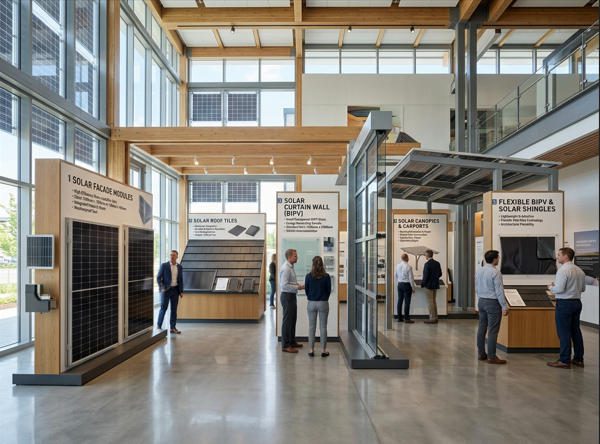
Top 5 BIPV Products with Rough Price Ranges and Installation Considerations
A practical buyer’s guide for comparing BIPV modules, roofing panels, solar roof tiles, PV shingles, and photovoltaic glass before requesting vendor quotes.
Building-integrated photovoltaics, or BIPV, means solar products that become part of the building itself. Instead of mounting conventional solar panels on top of a finished roof or façade, BIPV products can replace roof tiles, roofing panels, façade cladding, skylight glass, canopy glass, or curtain-wall sections.
That is why BIPV price ranges and installation considerations matter. A BIPV roof tile is not only a power generator. It is also a weather barrier. A photovoltaic glass module is not only an electrical product. It also affects daylight, glare, wind load, safety glazing, cleaning access, and façade warranty.
In this article, you will learn five common BIPV product options, rough price bands, and key installation tips. The product names below are example categories, not fixed quotations. Always request project-specific pricing from the supplier, installer, roofer, façade contractor, and electrical engineer.

Market Context and Decision Criteria for BIPV Systems
BIPV has moved from showcase architecture into practical procurement discussions. Owners are now asking a more mature question: not “Can this building make solar power?” but “Which building component should become solar, and what risk comes with that choice?”
The Whole Building Design Guide BIPV resource describes BIPV as photovoltaic collector elements located directly within the building envelope or canopy structure. That definition separates BIPV from normal rooftop PV. BIPV sits inside the responsibility chain of roofing, glazing, drainage, fire safety, structure, and maintenance.
Why BIPV Prices Vary by Product Type and Integration Method
A conventional solar module is usually priced in dollars per watt. BIPV can be priced by watt, square meter, piece, roof square, façade bay, or complete system. The price changes because the product may include laminated safety glass, colored encapsulation, custom dimensions, mounting rails, hidden wiring, fire-rated assemblies, or roofing accessories.
First-time definition: BOS means “balance of system.” It covers the parts that are not the solar module itself, such as inverters, connectors, cables, disconnects, and monitoring. In BIPV, BOS can cost more than expected because wiring must stay dry, accessible, code-compliant, and hidden inside a building assembly.
Jia Mao Bipv is often involved at this early stage because product selection depends on both solar performance and envelope detailing. A supplier conversation should include module size, glass structure, connector location, cable length, wind-load requirements, color target, certification documents, and packaging method.
Key Factors to Compare: Aesthetics, Efficiency, Warranty, Compatibility
Do not compare BIPV products using efficiency alone. A high-efficiency module can still be a poor choice if it creates awkward roof penetrations or does not match the visible roof line. A lower-output solar tile can be the right product for a heritage hotel where appearance protects room rates.
Estética
Check color, glare, cell visibility, edge details, frame lines, and how dummy pieces match active solar pieces.
Eficacia
Compare watts per square meter, not only cell efficiency. Roof area, tilt, shade, and temperature losses decide annual yield.
Garantía
Separate power-output warranty, product warranty, roof warranty, glass warranty, inverter warranty, and workmanship warranty.
Compatibility
Match the product to roof pitch, roof deck, drainage path, façade grid, local wind zone, and installer skill set.
Repair Access
Ask whether one failed piece can be replaced without dismantling a large roof or curtain-wall section.
Code Path
Confirm electrical, fire, structural, and waterproofing approvals before procurement, not after materials arrive on site.


Product A — SolaraSeries BIPV Module Example
Key Specifications
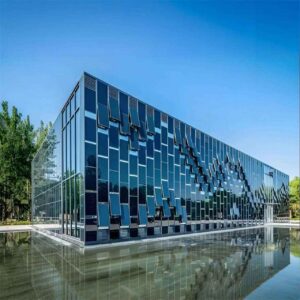
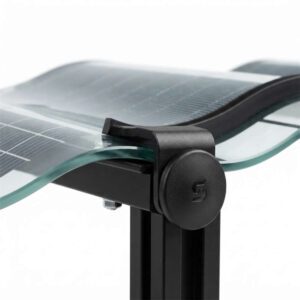
The SolaraSeries-style BIPV module represents a general-purpose laminated solar module used for façades, canopies, spandrel areas, carports, balcony rails, and sometimes roof-integrated assemblies. It is usually closer to a glass-glass solar module than a small roof tile.
First-time definition: glass-glass module means the solar cells are sealed between two sheets of glass. This structure is common in BIPV because it can support architectural use and improve durability compared with some glass-backsheet layouts.
- Typical application: façade spandrel, canopy, balcony, solar shading, carport roof.
- Power density: often around 120–220 W/m² depending on cell type, spacing, color, and transparency.
- Visual options: black, dark gray, patterned, semi-transparent, or color-treated surfaces.
- Integration type: framed or frameless, curtain-wall insert, rainscreen panel, canopy glass, or custom mounting system.
Rough Price Range
Rough planning band: about $1.20–$3.50/W, or about $180–$550/m² for many project discussions
The lower end usually applies to repeatable module sizes, standard colors, and simple mounting. The upper end appears when the project needs custom glass thickness, special colors, non-standard module dimensions, higher wind-load design, complex packing, or project-specific testing.
Aspectos a tener en cuenta en la instalación
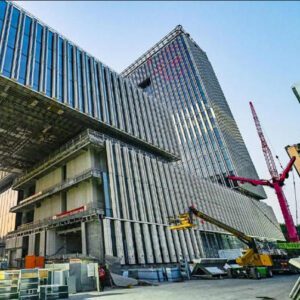
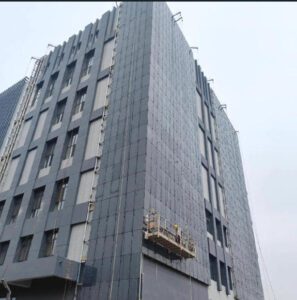
For façade use, the team must coordinate module clips, drainage, rear ventilation, expansion gaps, cable exits, and replacement access. For canopy use, check laminated safety glass requirements, overhead glazing rules, water runoff, and snow loads.
A practical example: a retail entrance canopy with 180 m² of BIPV glass should not hide all junction boxes above a sealed ceiling. The maintenance team needs a defined access route. If one connector fails, the repair should take hours, not require opening the finished ceiling across the entire entrance.
For related product-category research, see Jia Mao Bipv’s custom BIPV product portfolio.
Product B — SkyPanel BIPV Roofing Panel Example
Key Specifications
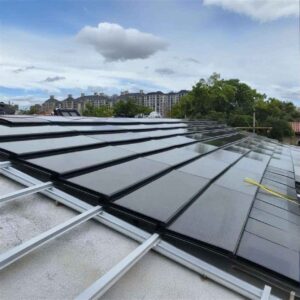
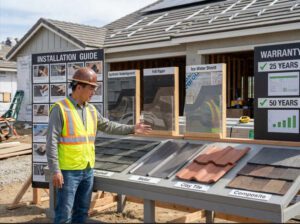
A SkyPanel-style BIPV roofing panel is a larger roof-integrated panel used on commercial roofs, industrial roofs, schools, sports facilities, and new residential developments with simple roof planes. It is different from a small solar tile because each unit covers more area.
- Typical application: large pitched roofs, standing-seam-like roof areas, industrial buildings, sheds, campuses.
- Power density: often around 140–220 W/m² where opaque crystalline cells are used.
- Roof fit: works best on repetitive roof planes with limited dormers, valleys, and penetrations.
- Electrical layout: simpler than tile systems because fewer units and fewer connectors are required.
Rough Price Range
Rough planning band: about $1.50–$4.00/W, or about $220–$650/m² installed depending on roof package
A large warehouse roof with repeatable panel rows may sit closer to the lower-middle range. A complex roof with many edges, smoke vents, skylights, and strict fire detailing may move toward the higher end.
Aspectos a tener en cuenta en la instalación
The roofing contractor and electrical contractor must agree on sequence. If the electrician needs to access connectors after the roofer has locked panels into place, the project can lose days. The drawings should show cable routes, roof penetrations, flashing details, fire setbacks, and inverter locations.
Confirm roof pitch limits. Some roof-integrated panels need a minimum slope to drain properly. Also verify whether walking paths, snow guards, roof hatches, and maintenance anchors interfere with the active solar zones.
For design and ROI context, review Jia Mao Bipv’s building-integrated solar planning guide.
Product C — SunTile 2.0 BIPV Roof Tile Example
Key Specifications
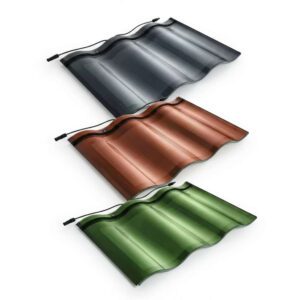
A SunTile 2.0-style product represents individual solar roof tiles used where appearance is a major driver. These tiles are smaller than roof panels and can blend more naturally with non-solar roof areas.
- Typical application: villas, townhouses, boutique hotels, public buildings, visible sloped roofs.
- Power density: often lower than large roof panels because of spacing, overlaps, edges, and tile geometry.
- Visual strength: cleaner roof appearance compared with rack-mounted PV.
- System complexity: more units, more connectors, more layout planning, and more installer training.
Rough Price Range
Rough planning band: about $2.50–$6.00/W, or about $300–$900/m² for premium visual roofs
Solar tiles can cost more because they combine small-format roofing, solar cells, weatherproofing interfaces, and a higher number of electrical connections. They are often chosen when the value of the building’s appearance is high enough to justify the premium.
Aspectos a tener en cuenta en la instalación
Tile layout should start from the roof geometry, not from the electrical string count. Valleys, hips, ridges, chimneys, dormers, gutters, and snow lines can quickly reduce usable solar area.
Ask for a roof-zone drawing that separates active tiles, dummy tiles, edge pieces, flashing pieces, and service paths. This prevents a common site problem: the installer reaches the roof edge and discovers that the electrical layout does not match the tile pattern.
Jia Mao Bipv’s BIPV tiles versus glass decision guide is useful when comparing roof appearance against power density.

Product D — PV Shingle System Example
Key Specifications
A PV shingle system is a roof-integrated product that resembles asphalt, slate, or flat roofing shingles more than large solar panels. It is designed for roofs where the owner wants solar power with a low-profile roof appearance.
- Typical application: residential neighborhoods, low-rise commercial buildings, community buildings, retrofit roofs.
- Power density: varies widely by shingle size, cell coverage, roof pitch, and usable roof area.
- Best use case: roof replacement projects where the owner already plans to remove old roofing.
- Main risk: many small electrical connections and careful flashing requirements.
Rough Price Range
Rough planning band: about $3.50–$8.00/W, with installed system cost strongly affected by roof complexity
PV shingles can be cost-effective in a roof replacement scenario because part of the cost overlaps with planned roofing work. They are less attractive if the existing roof is new, structurally sound, and not scheduled for replacement.
Aspectos a tener en cuenta en la instalación
Shingle systems need clear responsibility between roofer and solar electrician. If a leak appears two years later, the owner should not be trapped between two contractors blaming each other. The contract should define who owns underlayment, flashing, penetrations, connectors, inverter commissioning, and warranty response.
The safest procurement approach is to request an installed-system quote, not only a material quote. Include tear-off, underlayment, edge metal, flashing, electrical BOS, inverter, monitoring, inspection, and commissioning.

Product E — BIPV Glass Module Example
Key Specifications
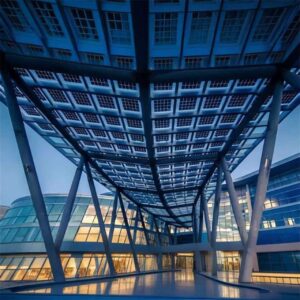
A BIPV glass module is used where the building needs glass and power generation in the same surface. Common locations include curtain walls, atriums, skylights, canopies, covered walkways, greenhouse roofs, and solar shading fins.
First-time definition: VLT means “visible light transmission.” A 30% VLT glass lets more daylight through than a 10% VLT glass, but usually produces less power per square meter because the solar cells are spaced farther apart or made more transparent.
- Typical application: skylights, atriums, curtain-wall vision glass, canopies, façade glass, solar louvers.
- Power density: commonly 40–180 W/m² depending on transparency, cell spacing, and glass design.
- Design benefit: can provide daylight, shade, weather protection, and electricity.
- Main risk: poor coordination between glazing requirements and electrical access.
Rough Price Range
Rough planning band: about $250–$1,000/m², or about $4.00–$12.00/W for highly customized transparent glass
BIPV glass is often better compared per square meter than per watt. A semi-transparent atrium roof may not win on $/W, but it can replace expensive architectural glass, reduce glare, create shade, and generate visible sustainability value for the building.
Aspectos a tener en cuenta en la instalación
BIPV glass must meet glazing rules first. Check laminated glass requirements, overhead glass rules, thermal stress, wind load, water drainage, edge seal protection, cable exits, junction-box access, and cleaning method.
For façade and glass system comparisons, see Jia Mao Bipv’s glass-integrated solar façade review.
Comparative Guide — Selecting the Right BIPV Product for Your Project
When to Prioritize Aesthetics vs. Performance
If the solar surface is visible from the street, the project may need to prioritize color, pattern, and roofline. If the surface is hidden from public view, power density and simple installation usually matter more.
Example: a museum roof facing a public square may justify solar tiles or PV shingles. A distribution center roof behind a parapet may be better served by larger BIPV roofing panels or conventional PV if envelope integration is not necessary.
Matching Roofing Type and Architectural Goals
Pitched residential roofs, commercial standing-seam roofs, curtain-wall façades, glass canopies, and skylights each need a different product. The wrong match creates hidden costs. A solar tile on a roof with too many valleys may waste labor. A large BIPV panel on a roof with many penetrations may require expensive custom pieces.
| Excel Row | BIPV Product Type | Best Project Fit | Rough Price Band | Installation Risk | Simple Decision Rule |
|---|---|---|---|---|---|
| A2 | SolaraSeries-style BIPV module | Façades, canopies, balconies, carports | $1.20–$3.50/W or $180–$550/m² | Cable access, drainage, replacement method | Choose when module grid can align with architecture |
| A3 | SkyPanel-style roofing panel | Large repetitive roof planes | $1.50–$4.00/W or $220–$650/m² | Roof pitch, flashing, sequence with electrician | Choose when roof geometry is simple |
| A4 | SunTile 2.0-style roof tile | Visible premium sloped roofs | $2.50–$6.00/W or $300–$900/m² | Many pieces, active/dummy tile planning | Choose when aesthetics carry financial value |
| A5 | PV shingle system | Roof replacement and low-profile roofs | $3.50–$8.00/W | Roofer/electrician warranty boundaries | Choose when roof replacement is already planned |
| A6 | BIPV glass module | Skylights, atriums, curtain walls, canopies | $250–$1,000/m² or $4.00–$12.00/W | Glazing code, thermal stress, junction-box access | Choose when glass must provide daylight and solar value |
Bar Chart: Rough Mid-Range Cost by Product Type
These are planning-level midpoints, not supplier quotes. BIPV glass is often better compared by $/m² because transparency can reduce W/m².
Pricing Landscape by Product Type — Rough Ranges You Can Expect
Typical Price Bands per Category: Modules, Tiles, Shingles, Glass
BIPV price ranges are wide because the product is only part of the system. A square meter of BIPV glass may include laminated safety glass and façade coordination. A solar roof tile may include hidden fasteners, dummy tiles, flashing, and a roof warranty path.
For market context, Jia Mao Bipv’s BIPV solar panel price comparison discusses how supplier pricing can vary by product type, efficiency, warranty, and installation model.
What Influences Price Beyond Base Product Cost?
Product cost is only one line item. The final installed cost can move because of inverters, ballast, connectors, wiring, mounting rails, roof underlayment, glass hardware, access equipment, design labor, permits, inspections, and commissioning.
The U.S. Department of Energy provides useful background on PV cost categories in its solar photovoltaic cost benchmark resources. While those benchmarks are not BIPV-only, they help teams understand why hardware and soft costs must both be tracked.
Pie Chart: Typical Installed Cost Components
Cost split is indicative. Tall buildings, custom glass, difficult roof access, and local code testing can change the percentages.
Installation Best Practices and Common Pitfalls
Permits, Codes, and Inspections to Plan For
BIPV projects need both building and electrical review. The product may need to satisfy roofing or glazing rules, while the electrical system must satisfy local PV codes, rapid-shutdown rules, overcurrent protection, grounding, disconnects, inverter certification, and utility interconnection.
For basic PV technology definitions, the U.S. Department of Energy’s solar photovoltaic technology basics page is a clear reference. For safety certification context, UL explains the transition from older module safety standards in its UL 1703 and UL 61730 module safety update.
Professional vs. DIY Considerations and Safety Notes
BIPV is not a good DIY category for most buildings. A small wiring mistake can become a roof leak, arc fault, failed inspection, or warranty dispute. Unlike a ground-mounted PV array, BIPV is tied into the weather layer of the building.
| Checklist Item | Why It Matters | Who Should Confirm |
|---|---|---|
| Roof or façade substrate condition | Weak decks, uneven framing, or poor air barriers can cause leaks and misalignment. | Roofer / façade engineer |
| Electrical string layout | Shading and voltage limits affect inverter performance and code compliance. | Electrical engineer |
| Connector accessibility | Hidden failed connectors can turn a small repair into a major dismantling job. | Installer / facility manager |
| Fire and inspection path | Unclear documentation can delay occupancy or utility approval. | Code consultant / authority having jurisdiction |
| Warranty boundary | The owner needs one clear response path for leaks, electrical faults, and broken glass. | Owner / contractor / supplier |
Financing, Incentives, and ROI Considerations for BIPV
Available Incentives and How They Affect Total Cost
Incentives vary by country, region, building type, ownership model, and tax position. In the United States, the DSIRE clean energy incentive database is a practical starting point. In other markets, check national renewable energy programs, local building-performance rules, green loans, feed-in tariffs, net billing, and carbon-reporting incentives.
BIPV incentives can be harder to calculate than normal PV incentives because the system also replaces building materials. The finance team should separate the “base building” cost from the “solar incremental” cost. That makes ROI more realistic.
Payback Period and Energy Yield Estimates
First-time definition: payback period is the time needed to recover the project’s net extra cost. For BIPV, the formula should include avoided roofing or façade material, not only electricity savings.
Use site-specific modeling for yield. The NREL PVWatts calculator can help estimate grid-connected PV production, but BIPV façade and glass projects may need more detailed simulation for shading, tilt, orientation, and heat effects.
Maintenance, Warranties, and Lifecycle Considerations
Cleaning, Inspection Cadence, and Degradation Expectations
Maintenance depends on product type and site conditions. A dusty industrial roof may need more frequent cleaning than a steep residential roof in a rainy climate. A glass canopy over a public entrance may need cleaning for appearance even if energy loss is modest.
Most PV products slowly lose output over time. This is called degradation. When reviewing warranties, ask what output is guaranteed after 10, 20, and 25 years, and whether the warranty covers labor or only product replacement.
Warranty Scopes for Modules, Inverters, and Glass Components
A BIPV warranty package may include several layers: product workmanship, power output, inverter warranty, roof workmanship, waterproofing warranty, glass breakage terms, coating warranty, and installer workmanship. These warranties may come from different companies.
The owner should ask for a written responsibility matrix. If water enters at a cable penetration, who responds first? If a glass-glass module cracks, who checks whether the cause was impact, thermal stress, mounting error, or manufacturing defect?
Glossary and Simple Examples
- BIPV
- Building-integrated photovoltaics. Example: a solar roof tile that replaces a normal roof tile while producing electricity.
- BAPV
- Building-applied photovoltaics. Example: a standard solar panel mounted on rails above an existing roof.
- Wp or W
- Watt-peak or watt rating. Example: a 400 W product can produce 400 W under standard test conditions, not all day.
- kWp
- Kilowatt-peak. Example: 100 pieces of 400 W modules create a 40 kWp system.
- BOS
- Balance of system. Example: inverter, cables, connectors, disconnects, mounting, and monitoring.
- VLT
- Visible light transmission. Example: 30% VLT glass allows more daylight than 10% VLT glass but may produce less power.
- MPPT
- Maximum power point tracking. Example: the inverter adjusts voltage and current to extract more power from the solar array.
Recommended Video: BIPV Basics and Applications
If your team is new to the category, this video gives a useful visual introduction to building-integrated photovoltaics and typical application areas.
The five BIPV product families in this guide solve different problems. SolaraSeries-style BIPV modules are flexible for façades, canopies, and carports. SkyPanel-style roofing panels fit larger repeatable roof planes. SunTile 2.0-style roof tiles support premium visible roofs. PV shingle systems work best during roof replacement. BIPV glass modules combine daylight, shading, weather protection, and power generation.
Rough prices can range from about $1.20/W for simpler BIPV module applications to more than $8/W for visually demanding shingle or glass systems. Per-square-meter comparisons are often more useful for roof tiles and photovoltaic glass because they replace building materials.
Before buying, request vendor quotes, conduct a site assessment, confirm local permits, check roof or façade compatibility, and run a feasibility model. For project teams comparing product types, Jia Mao Bipv can help review product fit, module layout, rough power capacity, and integration risks before the design is locked.
Planning a BIPV Roof or Façade?
Prepare your roof plan, façade elevation, project location, target appearance, and expected installation schedule. A short feasibility review can identify which BIPV product family is realistic before you request final pricing.
Contact Jia Mao Bipv for a feasibility discussionFAQs
1. What affects BIPV pricing the most?
The biggest pricing factors are material type, integration method, roof or façade complexity, product customization, electrical BOS, access equipment, local labor, permits, and warranty scope. A standard-size BIPV module on a simple canopy is usually much cheaper than custom photovoltaic glass in a high-rise curtain wall.
2. How do I estimate ROI for BIPV in a retrofit project?
Start with the net incremental cost: BIPV cost minus the cost of the conventional roof or façade material it replaces. Then subtract incentives and divide by annual electricity savings. Include maintenance, inverter replacement, roof life, and utility price escalation for a more complete model.
3. Do BIPV modules require special roof warranties or structural alterations?
Often, yes. BIPV changes the roof assembly, so the roof warranty must clearly include underlayment, flashing, penetrations, active solar pieces, dummy pieces, and workmanship. Structural review may be needed for dead load, wind uplift, snow load, and attachment points.
4. Which BIPV product is usually best for a new commercial building?
For a simple large roof, BIPV roofing panels are often practical. For a high-visibility façade or entrance canopy, BIPV modules or photovoltaic glass may fit better. The best choice depends on geometry, visibility, code requirements, and the owner’s energy target.
5. Are BIPV roof tiles better than PV shingles?
Not always. Roof tiles can suit premium architectural roofs and certain regional styles. PV shingles can work well for low-profile residential roofs and replacement projects. Compare waterproofing details, installer experience, replacement method, and total installed cost.
6. Is BIPV glass worth the higher price?
BIPV glass can be worth it when the building already needs architectural glass, skylight glass, canopy glass, or solar shading. It is less attractive if judged only by dollars per watt. Its value comes from combining glass function with electricity generation.
7. Can BIPV be installed on an existing building?
Yes, but retrofit projects need careful inspection. Check roof age, structural capacity, waterproofing condition, electrical room space, utility interconnection, fire access, and whether removing existing material makes financial sense.
8. What documents should I request before ordering BIPV products?
Request datasheets, warranty terms, installation manuals, certification documents, shop drawings, electrical diagrams, connector specifications, glass or roof assembly details, test reports, maintenance guidance, and a clear responsibility matrix.
References and Further Reading
- Jia Mao Bipv homepage
- custom BIPV product portfolio
- building-integrated solar planning guide
- glass-integrated solar façade review
- BIPV installation and design checklist
- Whole Building Design Guide BIPV resource
- solar photovoltaic technology basics
- solar photovoltaic cost benchmark resources
- NREL PVWatts calculator
- DSIRE clean energy incentive database
- UL 1703 and UL 61730 module safety update