A 7.2 kW residential solar system in the United States costs approximately $21,800 before incentives — and that number buys roughly 25 years of electricity generation. With that kind of financial commitment, the glass covering those photovoltaic cells is far more than a protective shell. It is the first optical surface every photon must cross before becoming an electron, and the wrong glass specification can silently erase 8–12% of your system’s lifetime output — a loss worth $5,000 to $9,000 on a typical suburban home.
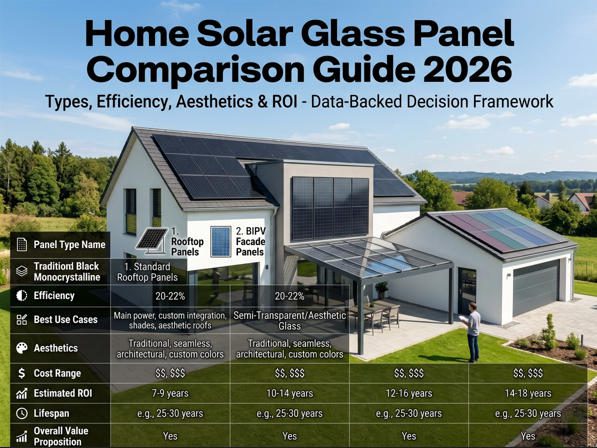
This guide walks through every decision factor a homeowner faces when choosing solar glass panels: technology types (monolithic, laminated, PV glass, solar thermal), performance metrics (STC ratings, temperature coefficients, real-world yield), aesthetics (framing, color, facade matching), total cost of ownership (upfront vs. lifetime savings, payback periods, resale value), durability (weather resistance, warranties, maintenance), climate suitability, installation codes, financing structures, brand evaluation, and the process for getting and comparing quotes. Each section includes field data, cost benchmarks, or project examples — not marketing language.
By the end, you will have a practical framework for comparing products and making an informed purchase decision — whether you are building new construction, retrofitting an existing roof, or evaluating building-integrated photovoltaic (BIPV) modules that replace conventional roofing materials entirely.
Understanding Solar Glass Panels: Types and Technology
Monolithic vs. Laminated Glass
Monolithic (single-pane) solar glass consists of one layer of tempered glass — typically 3.2 mm thick — covering the front of the PV module, with a polymer backsheet on the rear. This glass-backsheet construction has been the industry standard for two decades. It is lighter (approximately 11–13 kg/m²), less expensive to manufacture, and easier to install. However, the polymer backsheet degrades faster than glass when exposed to UV radiation and moisture cycling, leading to annual power degradation rates of 0.5–0.7% per year. After 25 years, a glass-backsheet panel retains roughly 80–83% of its original output.
Laminated (glass-glass or double-glass) panels sandwich the PV cells between two layers of tempered glass — usually 2.0 mm front and 2.0 mm rear — bonded with an encapsulant film. The dual-glass barrier virtually eliminates moisture ingress, the leading cause of potential-induced degradation (PID). Field studies published in the Clean Energy journal found that glass-glass bifacial modules in hot-arid climates maintained a performance ratio of 91%, compared with 81% for single-glass polycrystalline panels under identical conditions. Annual degradation rates drop to 0.3–0.4% per year, meaning the panel retains 88–90% of output at year 25. The trade-off: glass-glass panels weigh 20–30% more (approximately 14–17 kg/m²), and they cost 10–20% more upfront.
For homeowners, the choice hinges on roof structure and time horizon. If your roof framing can handle the extra weight and you plan to stay in the home for 15+ years, the lower degradation rate of laminated glass delivers a superior lifetime return. Manufacturers like Jia Mao Bipv use imported POE encapsulant films in their glass-glass modules, improving UV aging resistance by 40% over standard EVA encapsulation — a specification that matters in sun-belt states like Arizona, Texas, and Florida where cumulative UV exposure is extreme.
PV Glass vs. Solar Thermal Glass
These are fundamentally different technologies that occasionally get confused. PV (photovoltaic) glass contains semiconductor cells that convert sunlight directly into electricity. Solar thermal glass covers a collector that heats a fluid — typically water or glycol — for domestic hot water or space heating. PV glass generates kilowatt-hours of electricity; solar thermal glass generates kilowatt-hours of heat.
For the vast majority of U.S. homeowners in 2026, PV glass is the more versatile choice. An electric heat pump water heater paired with PV panels achieves higher combined efficiency than a solar thermal system — and the PV panels also power your air conditioning, lighting, appliances, and EV charger. Solar thermal remains viable in specific applications (large multifamily hot water demands, industrial process heat), but it is increasingly niche for single-family residential. The EnergySage technology comparison provides a deeper dive into panel types and their practical trade-offs.
Recent Innovations: Smart Glass, Anti-Reflective Coatings
Two innovations are narrowing the gap between standard rooftop panels and building-integrated solar glass. Anti-reflective (AR) coatings reduce glass surface reflection from approximately 8% (both surfaces combined) to under 2%, boosting effective light transmittance above 96%. A three-year outdoor field study by SunPower documented sustained energy gains of 3.5–5% from AR-coated modules versus uncoated equivalents — enough to recover the coating’s cost premium within the first year in most U.S. markets.
Smart glass with integrated PV cells takes this further by combining electrochromic tinting (clear-to-dark switching) with embedded photovoltaic layers. Research in Building and Environment showed that photovoltaic electrochromic windows delivered 47.7% annual energy savings by dynamically balancing daylight admission and cooling load. While primarily a commercial-building technology today, residential-scale smart PV glass prototypes are in pilot testing — and Jia Mao Bipv’s R&D arm is developing self-dimming materials that automatically adjust transparency based on ambient light conditions, targeting residential skylight and sunroom applications.
Measuring Efficiency and Performance
Sun-by-Sun vs. STC Ratings
Every solar panel carries a Standard Test Conditions (STC) rating — the wattage output measured at 25°C cell temperature, 1,000 W/m² irradiance, and AM1.5 solar spectrum. That rating appears on datasheets and drives most marketing claims. The problem: real rooftops almost never match STC. By mid-afternoon on a summer day in Phoenix, cell temperatures routinely hit 60–70°C — 35–45 degrees above the STC reference point.
A more realistic benchmark is the PTC (PVUSA Test Conditions) rating, which uses 20°C ambient air temperature and 1,000 W/m² irradiance but accounts for actual mounting and airflow. PTC ratings are typically 10–15% lower than STC. The California Energy Commission publishes PTC values for all certified panels; a panel rated at 400 W STC might show 348 W PTC — and even that number assumes direct sun, not the mix of direct, diffuse, and reflected light that real roofs receive.
The best metric for homeowners is expected annual energy yield in kWh for your specific location. Tools like NREL’s PVWatts calculator and the Global Solar Atlas account for your latitude, local weather data, roof tilt, azimuth, and shading to estimate first-year production. A 7.2 kW system in Raleigh, NC produces roughly 9,500 kWh/year; the same system in Tucson, AZ produces approximately 12,800 kWh/year — a 35% difference driven entirely by location.
Temperature Coefficients and Shading Impact
The temperature coefficient (expressed as %/°C) tells you how much power output drops for every degree Celsius above 25°C. Premium monocrystalline panels range from -0.28% to -0.35%/°C. A panel with a -0.30%/°C coefficient operating at 55°C (30 degrees above STC) loses 9% of rated output. Over a full summer in Houston, that temperature penalty can reduce seasonal yield by 12–18% compared to the STC rating.
Heterojunction (HJT) and N-type TOPCon cells, which represent the leading edge of residential panel technology in 2026, achieve lower temperature coefficients (-0.25% to -0.29%/°C) because their thin amorphous silicon passivation layers reduce recombination losses at elevated temperatures. If you live in a hot climate, specifying a panel with a low temperature coefficient is one of the highest-leverage decisions you can make — it directly protects your real-world yield.
Shading is equally critical. Even 10–15% coverage of a single cell can cascade through an entire string, reducing the output of the whole panel by 30–50% depending on the bypass diode configuration. Before signing any contract, insist on a professional shade analysis using tools like Aurora Solar, Helioscope, or on-site drone-based LiDAR mapping. A competent installer will model your roof’s shading profile at every hour of the year and design the array to avoid obstructed areas.
Real-World Performance Expectations
After accounting for temperature losses, soiling, wiring resistance, inverter conversion, clipping, and shading, most residential systems produce 75–85% of their nameplate STC rating over a full year — a metric called the performance ratio (PR). Glass-glass modules with AR coatings and low temperature coefficients consistently score at the top of this range (82–88% PR), while budget glass-backsheet panels cluster at 74–80%. Over 25 years, that 8-percentage-point PR gap on a 7.2 kW system translates to roughly 17,000–24,000 kWh of additional generation — worth $4,000–$7,000 at average U.S. residential electricity rates.
Residential Solar Glass Panel Performance Comparison
| Specification | Budget Panel (Glass-Backsheet) | Mid-Range (Glass-Glass) | Premium (Glass-Glass + AR Coat) |
|---|---|---|---|
| STC Efficiency | 19.5–20.5% | 21.0–22.0% | 22.0–23.0% |
| Glass Transmittance | 84–88% | 91–92% | 95–96% |
| Temp. Coefficient | -0.34 to -0.38%/°C | -0.30 to -0.34%/°C | -0.25 to -0.29%/°C |
| Annual Degradation | 0.5–0.7% | 0.3–0.5% | 0.25–0.40% |
| 25-Year Output Retention | 80–83% | 85–88% | 88–92% |
| Performance Ratio (PR) | 74–80% | 80–85% | 82–88% |
| Weight (per m²) | 11–13 kg | 14–17 kg | 14–17 kg |
| Typical Product Warranty | 12 years | 15–25 years | 25–30 years |
| Approximate Cost Premium | Baseline | +10–20% | +20–35% |
Sources: EnergySage, SolarReviews, Clean Energy journal, manufacturer datasheets (2025–2026 data).
Aesthetics and Architectural Integration
Framing Options and Colorways
The all-black aesthetic — black cells, black backsheet, black frame — has become the most popular residential choice because it blends into dark-colored roofs and avoids the visible silver grid lines that characterized older polycrystalline panels. However, “all-black” panels are not identical across brands. Frame profiles vary in height (30 mm to 45 mm), corner radius, and anodization finish (matte vs. satin). Some homeowners in HOA-regulated neighborhoods face specific color mandates. Before ordering, request a physical sample and hold it against your roof material in daylight.
For homes with lighter facades — white stucco, cream-colored stone, light timber cladding — frameless glass-glass panels offer a sleeker profile. Without the aluminum frame, the panel edge shows only a thin glass line, reducing visual contrast. Onyx Solar’s colored PV glass and Jia Mao Bipv’s photovoltaic glass range even allow custom tinting — terracotta, slate gray, bronze — so the PV surface can harmonize with clay tile roofs, metal cladding, or heritage facades without sacrificing more than 5–10% of output versus standard dark cells.
Building Codes and Appearance
Building codes affect aesthetics in two ways: setback requirements (how far panels must sit from roof edges, ridges, and valleys) and fire classification. The NFPA 1 fire code requires 18-inch pathways at the ridge and along one side of the roof for firefighter access — which limits the usable area and therefore the array layout. In California, the 2025 Building Standards Code added rapid-shutdown requirements at the module level (NEC 690.12), meaning each panel must have a power electronics device (micro-inverter or DC optimizer) that de-energizes the panel within 30 seconds of a shutdown signal.
These code constraints shape the visual footprint of the array on your roof. A well-designed system should look intentional and symmetrical, not randomly scattered. Ask your installer to provide a detailed roof layout rendering — ideally a 3D model — before signing. If the layout looks unbalanced, explore whether BIPV solar roof tiles (which replace the roofing material entirely) might deliver a more cohesive appearance.
Matching Existing Facade Materials
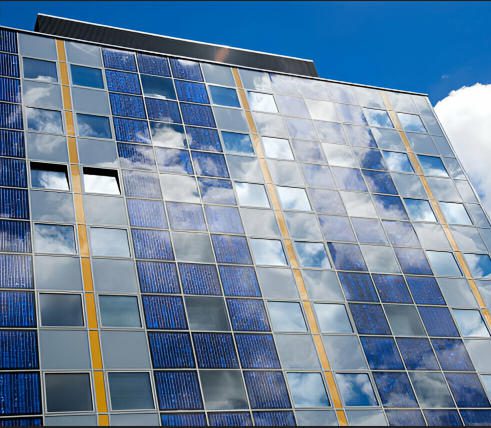
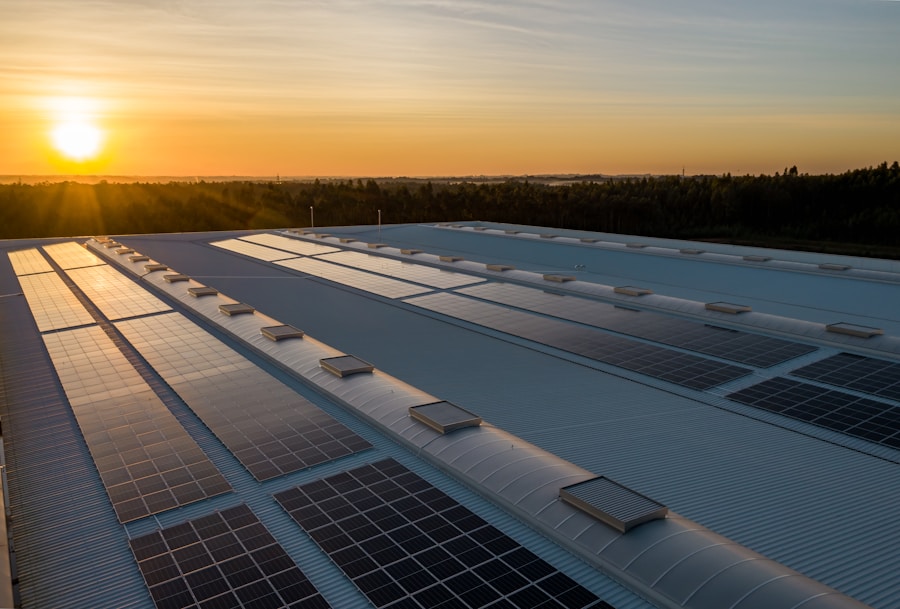
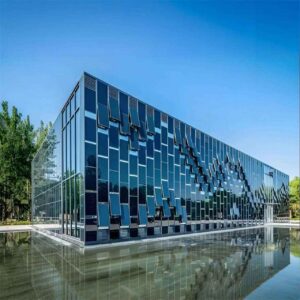
When solar glass panels are integrated into the building envelope rather than mounted above it, the architectural vocabulary changes. Solar roof tiles replace clay, slate, or asphalt shingles with PV-active tiles that maintain the roofline’s profile. Curtain-wall BIPV glass replaces spandrel or vision panels on a home’s glass-heavy elevations. For a 2,500 sq ft home with a complex roofline and multiple facade materials, a hybrid approach — solar tiles on the main south-facing roof slopes, plus a few transparent PV skylights — can generate 6–9 kW while looking indistinguishable from a non-solar house at street level.
ROI and Total Cost of Ownership
Upfront Costs vs. Long-Term Savings
The average cost of a residential solar system in the U.S. in 2026 is approximately $2.75–$3.50 per watt installed (before incentives), depending on region, panel brand, and installer. For a 7.2 kW system, that translates to $19,800–$25,200 out-of-pocket. In 2025, the 30% federal Residential Clean Energy Credit (Section 25D) would have reduced that by $5,940–$7,560 — but as of January 1, 2026, the residential ITC has expired for homeowner-purchased systems. Third-party-owned systems (leases and PPAs) still qualify under Section 48, with the tax credit benefiting the system owner — who may pass savings through as lower monthly rates.
Long-term savings depend on your electricity rate and rate escalation. At the current national average of approximately $0.17/kWh, a 7.2 kW system generating 10,000 kWh/year saves about $1,700 annually. With electricity prices historically rising 2–3% per year, cumulative 25-year savings reach $50,000–$65,000 — well above the system cost even without the federal credit.
Energy Yield Estimates
Your actual yield depends on five variables: local irradiance (peak sun hours), roof tilt, azimuth (orientation), shading, and panel efficiency. The table below shows estimated first-year production for a 7.2 kW system across representative U.S. cities.
| City | Peak Sun Hours/Day | Est. Year-1 Output (kWh) | Avg. Elec. Rate ($/kWh) | Year-1 Savings ($) |
|---|---|---|---|---|
| Phoenix, AZ | 6.5 | 12,800 | $0.13 | $1,664 |
| Los Angeles, CA | 5.8 | 11,400 | $0.30 | $3,420 |
| Dallas, TX | 5.2 | 10,200 | $0.14 | $1,428 |
| New York, NY | 4.6 | 9,000 | $0.24 | $2,160 |
| Seattle, WA | 3.8 | 7,500 | $0.12 | $900 |
| Miami, FL | 5.5 | 10,800 | $0.16 | $1,728 |
Data: NREL PVWatts, EIA electricity rate database (2026 estimates). Assumes south-facing roof, 20° tilt, minimal shading.
Resale Value and Payback Period
According to a 2025 Zillow/SolarReviews data study, homes with owned solar panels sold for 6.9% more than comparable homes without solar — up from the 4.1% premium measured in Zillow’s 2019 analysis. SolarInsure’s research across 5,000 California home sales found premiums of 5–10%. On a $500,000 home, that is $25,000–$50,000 in added value — often exceeding the original system cost.
Average payback periods in the U.S. range from 6 to 10 years, depending on local electricity rates, available state/utility incentives, and system cost. In high-rate states like California (averaging $0.30/kWh), payback can be as fast as 5–6 years. In low-rate states like Texas ($0.14/kWh), it stretches to 10–13 years. The key insight: even without the federal ITC in 2026, solar remains a net-positive investment in most of the country due to rising electricity costs and declining panel prices.
Estimated Solar Payback Period by U.S. Region (7.2 kW System, 2026)
Solar Payback Period by Region (Years)
California
Northeast (NY/MA)
Southwest (AZ/NV)
Southeast (FL/GA)
Midwest (IL/OH)
Texas
5.6 yrs
7.2 yrs
8.0 yrs
9.2 yrs
10.0 yrs
11.6 yrs
Source: EnergySage, SolarReviews, NRG Clean Power (2026 data, without federal ITC)
Durability, Warranties, and Maintenance
Weather Resistance and Surface Durability
Solar panels are built to survive outdoors for 25–30+ years. The baseline certification — IEC 61215 and IEC 61730 — includes hail impact (25 mm ice balls at 23 m/s across 11 points), mechanical load (5,400 Pa = 112 psf for wind/snow), damp-heat cycling (1,000 hours at 85°C / 85% RH), thermal cycling (-40°C to +85°C, 200 cycles), and UV exposure testing. Panels that pass these tests have demonstrated durability under conditions far more extreme than most residential roofs ever experience.
For homeowners in hail-prone regions (Texas Panhandle, Colorado Front Range, Oklahoma), look for panels that exceed the standard test. VDE and RETC introduced a new Hail Resiliency Curve test in 2025 that fires progressively larger hailstones at increasing velocities until the glass fractures — providing a more granular ranking than the pass/fail IEC test. Glass-glass panels consistently outperform glass-backsheet panels in these extended hail tests because the rear glass provides additional structural rigidity.
Warranty Scope and Transferability
Two separate warranties apply: the product warranty (covering manufacturing defects, delamination, junction-box failure) and the performance warranty (guaranteeing a minimum power output over time). Premium brands now offer 25-year product warranties and 30-year performance warranties guaranteeing ≥88% output at year 30, with no more than 1% degradation in year one and ≤0.4% annually thereafter. Budget brands typically offer 12-year product warranties and 25-year performance warranties guaranteeing ≥80% at year 25.
Transferability matters if you sell the home. Most manufacturer warranties transfer to the new homeowner automatically; some require a simple registration form. Installer workmanship warranties (covering the racking, wiring, and roof penetrations) are a separate item — typically 10–25 years depending on the installer — and may or may not transfer. Verify this before signing.
Cleaning and Maintenance Routines
Under normal conditions, solar panels need cleaning 1–2 times per year — and in rainy climates, natural rainfall often suffices. In dusty, pollen-heavy, or bird-heavy environments, quarterly cleaning maintains optimal output. A garden hose with a soft spray nozzle (no pressure washer) removes most soiling; stubborn grime may need a soft brush with diluted dish soap. Never clean panels in direct midday sun — the rapid temperature change can stress the glass.
Self-cleaning coatings on panels from manufacturers like Jia Mao Bipv (whose factory-applied hydrophilic coating reduces maintenance costs by 30% in field deployments across Southeast Asia and the Middle East) reduce cleaning frequency significantly. Over 25 years, the maintenance cost difference between a coated and uncoated panel can exceed $1,500 on a residential system — not counting the yield loss from soiling between cleanings.
Climate Suitability and Performance
Solar Irradiance Considerations by Region
Annual solar irradiance — measured as Global Horizontal Irradiation (GHI) — ranges from approximately 1,000 kWh/m²/year in northern Europe and the U.S. Pacific Northwest to over 2,400 kWh/m²/year in desert regions of North Africa, the Middle East, and the American Southwest. The World Bank’s Global Solar Atlas provides free, high-resolution irradiance data for any location on Earth.
For homeowners, the practical impact is straightforward: a panel in Phoenix produces roughly 70% more electricity per year than the same panel in Seattle. This does not mean solar is “not worth it” in low-irradiance regions — it means the payback period is longer. In cloudy climates, specifying textured glass (which captures more diffuse light) and panels with strong low-light performance coefficients becomes more important than in sunbelt states where direct-beam irradiance dominates.
Snow, Hail, and Wind Load Impacts
Panels certified to IEC 61215 withstand snow loads of 5,400 Pa (112 psf) — equivalent to roughly 4.5 feet of heavy wet snow. Most residential roofs in snow-belt regions are designed for 30–50 psf ground snow loads, so the panels typically exceed the structural capacity of the roof itself. Light snow often slides off the smooth glass surface; heavy snow may temporarily shade the array but does not damage it.
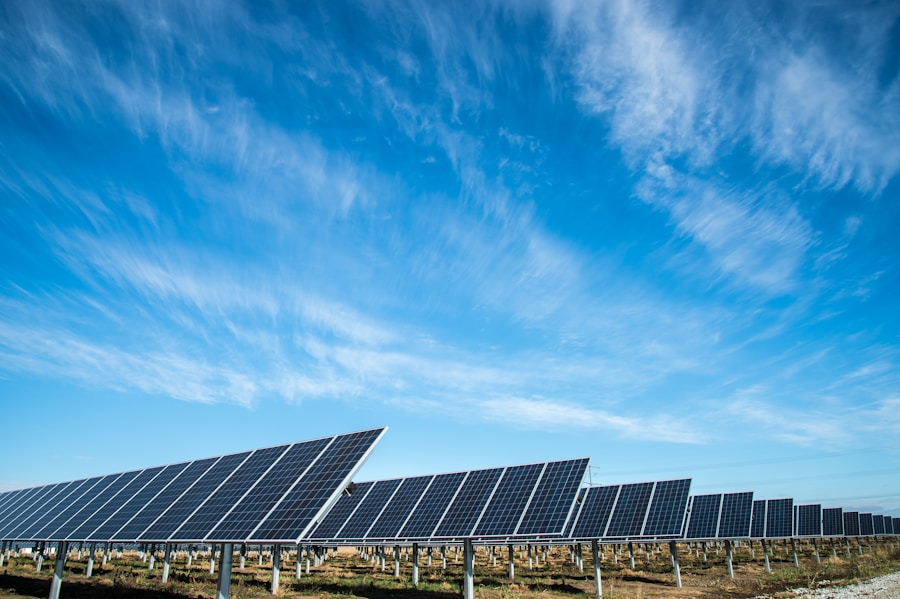
Wind resistance varies by mounting system. Flush-mounted panels (parallel to the roof surface) experience significantly lower wind uplift than tilted ground-mount arrays. Most residential racking systems are engineered for 90–130 mph wind speeds when properly installed. In hurricane-prone Florida, panels must meet the Florida Building Code large-missile impact test — laminated glass-glass panels with PVB or SGP interlayers perform best in these tests, maintaining structural integrity even after the glass surface fractures.
Temperature Range and Thermal Expansion
Solar panels cycle through extreme temperature swings: -40°C in a Minnesota January to +85°C cell temperature on a summer afternoon in Nevada. This thermal cycling causes micro-expansion and contraction of the glass, encapsulant, and cell layers. If these materials have mismatched thermal expansion coefficients, micro-cracks propagate over time. Manufacturers address this with matched-coefficient material selection and by specifying frame sealing systems that accommodate thermal movement. Jia Mao Bipv’s tempered laminated glass modules, for example, use matched thermal expansion coefficients across all layers specifically to prevent stress-cracking — a design detail that matters most in climates with wide daily temperature swings (continental interiors, high deserts).
Installation Considerations and Certifications
Roof Compatibility and Load Bearing
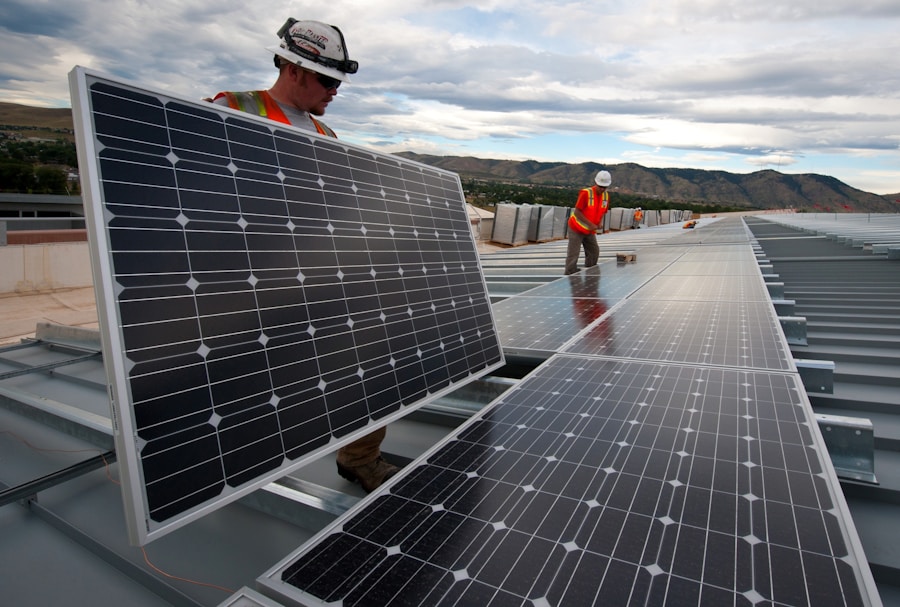
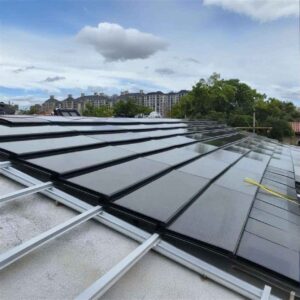
Before any panel goes on your roof, a structural assessment must confirm that the framing can support the additional dead load — typically 2.5–4.0 psf for standard rack-mounted panels. Older homes built before current code requirements may need reinforcement. Roof material matters too: asphalt shingles accommodate standard rail-mount penetrations; tile roofs require specialized hooks and flashing; metal roofs accept clamp-on rail systems that avoid any roof penetration at all (preserving the roofing warranty).
BIPV options sidestep this issue. Solar roof tiles are designed as a structural roofing material — they replace, rather than add to, the existing roof. The weight per square meter is comparable to clay tiles (typically 10–15 kg/m²), meaning no additional structural reinforcement is needed for most homes that currently have tile roofs.
Electrical Integration and Safety Codes
In the United States, residential solar installations must comply with NEC Article 690 (Solar Photovoltaic Systems), including rapid-shutdown requirements under NEC 690.12. Since 2019, this has required module-level shutdown — meaning each panel must reduce its voltage to ≤80V within 30 seconds of a system shutdown signal, protecting firefighters from energized rooftop conductors. Micro-inverters and DC optimizers inherently satisfy this requirement; string inverters require add-on module-level electronics.
Your inverter must also be listed to UL 1741 and, in many jurisdictions, comply with IEEE 1547 for grid interconnection. If you plan to add battery storage (increasingly common in 2026), the storage system adds UL 9540 and local fire-code setback requirements.
Permits and Inspections
Virtually all U.S. jurisdictions require a building permit and an electrical permit for residential solar. The permitting process typically involves submitting engineered plan sets (roof plan, electrical one-line diagram, equipment specifications) and scheduling two inspections: one for the structural and mechanical installation and one for the final electrical connection. In many states, the installer handles the entire permitting process as part of their scope. SolarAPP+ — the automated permitting portal now adopted by hundreds of municipalities — can approve a standard residential solar permit in hours rather than weeks.
Financing Options and Incentives
Tax Credits and Rebates
The 30% federal Residential Clean Energy Credit (Section 25D) expired on December 31, 2025 for homeowner-purchased systems. This is the single largest change in the 2026 solar financing landscape. However, several alternative incentive structures remain active: state-level tax credits (available in approximately 20 states), utility rebate programs, property-tax exemptions for solar improvements (in 36 states), and sales-tax exemptions on solar equipment (in 25+ states). The DSIRE database provides a searchable directory of every incentive by state and ZIP code.
Solar Leases and PPAs
With the residential ITC expired, solar leases and power purchase agreements (PPAs) have become more financially attractive relative to outright purchase. Under a lease or PPA, a third-party company owns the system, claims the Section 48 commercial ITC (still active at 30%), and passes savings to the homeowner through lower monthly electricity rates. A typical PPA in 2026 charges $0.08–$0.14/kWh — below the retail rate in most markets — with annual escalators of 1–3%.
The trade-off: you do not own the system, so you do not capture the full resale-value premium, and the agreement must transfer to the new buyer if you sell the home. Most 2026 lease/PPA contracts are designed for easy transferability — but verify this in writing before signing. Solar.com’s lease vs. PPA comparison breaks down the nuances.
Financing Terms and Cost of Capital
Solar loans in 2026 typically range from 5.99% to 8.99% APR for terms of 10–25 years. A $22,000 system financed at 6.99% over 15 years carries a monthly payment of approximately $198 — often less than the monthly electricity bill it offsets. Zero-down loan structures are common, and some lenders offer interest-rate buydowns funded by dealer fees. Watch for dealer fees hidden in the loan principal — they can inflate the effective interest rate by 2–4 percentage points above the quoted APR.
Typical 25-Year Cost Allocation: Owned vs. Leased Solar System (7.2 kW)
Cash Purchase
Lease / PPA
~$22K
total
~$28–36K
25-yr total
Equipment (65%)
Install (25%)
Maint (10%)
Payments (75%)
Escalators (15%)
Source: SolarReviews, EnergySage, industry average 2026 estimates
Evaluating Brands and Warranties
Brand Reputation and Field Performance
Laboratory efficiency numbers tell only part of the story. What matters is field-verified performance — how the panel actually performs on rooftops across diverse climates over 5, 10, and 15 years. PVEL (formerly PV Evolution Labs) publishes an annual PV Module Reliability Scorecard that tests modules from major manufacturers under accelerated stress conditions including thermal cycling, damp heat, and mechanical loading. Panels that earn “Top Performer” status have demonstrated statistically lower degradation rates and failure modes than the industry average.
For BIPV-specific applications, manufacturer track record in the building sector matters as much as cell-level performance. Jia Mao Bipv’s installation and design documentation details how their intelligent MES production management system assigns a unique ID to every panel — enabling full traceability from raw glass through to the installed rooftop module. That traceability simplifies warranty claims and post-installation performance audits, a benefit that becomes tangible if you need to file a claim at year 8 or year 15.
Warranty Differences Across Products
Do not compare warranties by headline number alone (“25-year warranty” vs. “30-year warranty”). Read the fine print: What is the guaranteed output at year 25? What degradation curve does the warranty follow — linear or stepped? Is the product warranty comprehensive (covering all material and workmanship defects) or limited (excluding certain failure modes like micro-cracking or hot spots)? The strongest warranties in 2026 guarantee ≥90% output at year 25 with linear degradation of ≤0.4%/year — a specification that only glass-glass panels with premium encapsulants can credibly support.
Supplier Support and Service Networks
A warranty is only as strong as the company behind it. Verify that the manufacturer has a physical presence (warehouse, service center, or authorized distributor) in your country. Ask about the claims process: Is there a local service partner who will handle removal, replacement, and reinstallation, or does the warranty only cover a replacement panel shipped to your door? For homeowners in the U.S. and Europe, manufacturers with regional warehousing and authorized installer networks — such as Jia Mao Bipv’s solutions and applications division — offer more practical post-sale support than brands that operate only through distributors.
How to Get Quotes and Make the Final Decision
Collecting Site Data and Shade Analysis
Before requesting quotes, gather your own baseline data: 12 months of electricity bills (to establish your annual consumption in kWh), your roof’s approximate dimensions and orientation (Google Earth or a measuring tape), and photos of any obstructions (chimneys, dormers, trees, neighboring buildings). Feed your address into NREL’s PVWatts to get a preliminary production estimate. This arms you with an independent benchmark against which to evaluate installer proposals.
Requesting Proposals and Evaluating ROI Spreadsheets
Request detailed proposals from at least three installers. Each proposal should include: system size (kW), specific panel model and quantity, inverter model, mounting system, estimated year-1 production (kWh), 25-year production estimate with degradation, total installed cost (itemized), available incentives, financing options with APR and total cost of financing, and a year-by-year cash flow or ROI spreadsheet. Compare proposals on net cost per kWh produced over 25 years — not just upfront price per watt — because panel quality, degradation rate, and inverter efficiency all affect lifetime economics.
Questions to Ask Installers
A prepared homeowner asks better questions and gets better outcomes. Here are ten high-leverage questions that separate thorough installers from order-takers:
| # | Question | Why It Matters |
|---|---|---|
| 1 | What glass type is used on the panels you’re proposing — and what is its transmittance rating? | Separates low-iron (91%+) from standard float glass (84%) — an 8% output gap. |
| 2 | What is the panel’s temperature coefficient, and how did you adjust the production estimate for my climate? | Catches inflated production estimates that ignore heat-related losses. |
| 3 | Have you performed a shade analysis for every hour of the year — and can I see the model? | Ensures the layout avoids shading from trees, chimneys, and adjacent structures. |
| 4 | What is your workmanship warranty, and does it transfer to the next homeowner? | Protects against roof leaks, wiring failures, and racking defects — the installer’s responsibility. |
| 5 | Will my roof warranty remain valid after the installation? | Some roofing manufacturers void warranties if unapproved penetrations are made. |
| 6 | Are you NABCEP-certified, licensed, bonded, and insured in my state? | NABCEP certification indicates professional training; bonding/insurance protects you financially. |
| 7 | What is the all-in price including dealer fees, and what is the true APR on the financing? | Exposes hidden costs that inflate the effective interest rate. |
| 8 | How many residential systems have you installed in this county in the past 12 months? | Local experience means familiarity with permitting authorities and code quirks. |
| 9 | What monitoring platform will I have access to, and what alerts does it provide? | Real-time monitoring catches production drops before they accumulate into significant losses. |
| 10 | Can you provide references from 3 homeowners with systems installed 3+ years ago? | Long-term references reveal post-sale service quality and real-world performance. |
Watch: Key Things to Know Before Installing Solar in 2026
Video: “Things you need to know before installing solar in 2026” (YouTube)
Choosing solar glass panels for your home is not a single decision — it is a series of interconnected trade-offs between efficiency, aesthetics, durability, cost, and financing structure. The glass itself (low-iron vs. standard, AR-coated vs. uncoated, monolithic vs. laminated) directly controls how much sunlight reaches the cell — an 8–12% difference that compounds over 25 years into thousands of dollars of generation. Framing and color choices determine whether the system enhances or detracts from your home’s appearance. Warranty terms, degradation rates, and weather ratings govern how long the investment performs. And financing — especially in a post-ITC 2026 landscape — shapes whether you own the asset and its full value, or rent it through a lease/PPA for lower upfront cost.
The framework is straightforward: start by assessing your site (roof structure, orientation, shading, electricity consumption), then match a technology tier (budget, mid-range, or premium glass-glass) to your time horizon and budget. Get at least three detailed proposals, compare them on lifetime cost per kWh (not just sticker price), and verify the installer’s credentials, local track record, and warranty transferability. Manufacturers like Jia Mao Bipv — whose product range spans everything from standard high-efficiency panels to transparent photovoltaic glass, solar roof tiles, and custom BIPV modules — give homeowners access to a breadth of options that can match nearly any architectural style or performance requirement.
Next steps: check NREL PVWatts for a production estimate at your address, search the DSIRE database for state and local incentives, and start gathering quotes. The buildings that harvest their own energy today will outperform — financially and environmentally — for decades to come.
Frequently Asked Questions (FAQs)
1. What is the difference between PV glass and traditional PV panels?
PV glass is a building material that integrates photovoltaic cells within a glass laminate, allowing it to serve dual functions — as a structural element (window, facade, skylight, roofing tile) and as an electricity generator. Traditional PV panels are opaque, framed modules designed to be mounted above existing building surfaces. PV glass replaces conventional construction materials; traditional panels are additions to them. The key trade-off: PV glass offers architectural integration and transparency options (10–90%) at the cost of lower peak efficiency (8–22% depending on transparency) compared with standard opaque panels (20–23%). For a deeper comparison, see Jia Mao Bipv’s solar glass vs. traditional glass analysis.
2. How does temperature affect solar glass efficiency?
Solar cells lose output as temperature rises above the 25°C standard test reference point. The rate of loss is expressed as the temperature coefficient, typically -0.25% to -0.38% per °C for crystalline silicon panels. On a 35°C day with cell temperatures reaching 55°C (30 degrees above STC), a panel with a -0.30%/°C coefficient loses 9% of its rated output. Over a full hot-climate summer, cumulative temperature losses can reduce seasonal yield by 12–18% versus the STC rating. Glass-glass panels with AR coatings run slightly cooler (1–3°C less) because less absorbed radiation converts to heat in the glass layer. N-type HJT cells offer the lowest temperature coefficients (-0.25%/°C), making them the best choice for hot regions like the Gulf Coast, Southwest, and Southeast Asia.
3. Are solar glass panels worth it for typical single-family homes?
For most U.S. single-family homes with south-facing roof area, solar panels deliver a positive return on investment within 6–12 years and add 5–7% to the home’s resale value. A 7.2 kW system generates approximately 9,000–12,800 kWh/year (depending on location), saving $1,200–$3,400 annually at current electricity rates. Over 25 years, cumulative savings typically reach $50,000–$65,000 against a system cost of $20,000–$25,000. Even without the federal ITC (expired in 2026), solar remains financially positive in 40+ states. The deciding factors are your electricity rate, available roof area, shading profile, and how long you plan to stay in the home.
4. How long do solar glass panels typically last, and what should be included in a warranty?
Modern solar glass panels are designed for 25–30+ year lifespans. Glass-glass panels with POE encapsulants demonstrate annual degradation rates of 0.3–0.4%, retaining 88–92% of output at year 25. A comprehensive warranty should include two components: a product warranty (covering manufacturing defects for 15–25 years) and a linear performance warranty (guaranteeing specific output at year 25 — look for ≥88%). The warranty should be transferable to new homeowners and backed by a manufacturer with in-country service infrastructure. Additionally, insist on a separate installer workmanship warranty (10–25 years) covering racking, wiring, roof penetrations, and labor for warranty-related replacements.
5. How should I compare ROI when evaluating different brands?
Compare brands on levelized cost of energy (LCOE) — the total lifetime cost divided by total lifetime energy production — rather than upfront cost per watt. A $0.30/W more expensive panel with 2% higher efficiency and 0.2%/year lower degradation will produce approximately 15,000–20,000 more kWh over 25 years than a cheaper alternative on a 7.2 kW system. At $0.17/kWh, that is $2,500–$3,400 in additional value — often exceeding the upfront premium. Factor in warranty coverage (a 25-year comprehensive warranty reduces long-term risk vs. a 12-year limited warranty), degradation curve (0.3%/year vs. 0.7%/year compounds significantly), and resale value (premium brands with recognized names command higher appraisals).
6. Can I install solar glass panels on a flat roof?
Yes. Flat-roof installations use ballasted or mechanically attached tilt racks that angle panels at 5–15° to optimize production and allow rainwater runoff for self-cleaning. Bifacial glass-glass panels benefit from flat-roof installations with light-colored roofing membrane (TPO or PVC), which reflects sunlight onto the panel’s rear side — generating 5–15% additional output. Weight is the primary consideration: the combined panel + ballast load can reach 5–8 psf, requiring a structural engineer’s review for older flat-roof buildings. Jia Mao Bipv’s commercial roof PV panels are rated for flat-roof deployment with no-penetration mounting options and Grade-14 wind resistance.
7. What maintenance do solar glass panels require?
Annual or semi-annual cleaning with a garden hose and soft brush is sufficient for most residential installations. In high-dust, pollen, or bird-traffic environments, quarterly cleaning maintains peak output. Beyond cleaning, check the mounting hardware annually for loosened fasteners (thermal expansion/contraction can loosen connections over time), verify that monitoring data shows expected production (a sudden drop indicates a potential panel, inverter, or wiring issue), and ensure vegetation has not grown into the panel’s shade zone. Panels with factory-applied self-cleaning coatings — such as those from Jia Mao Bipv — require less frequent cleaning and maintain higher average output between wash cycles.
8. What happens to my solar panels if I sell my home?
If you own the system outright or through a paid-off loan, it transfers with the home as a permanent improvement and adds to the sale price. Studies show premiums of 5–10% for homes with owned solar. If the system is under a lease or PPA, the agreement typically transfers to the buyer — most 2026 contracts facilitate this, but the buyer must qualify for the agreement. Leased systems do not add as much to resale value as owned systems. Before listing your home, obtain a copy of the system’s production history, warranty documentation, and (if applicable) the lease transfer terms to share with prospective buyers and their agents.
9. How do building codes in my area affect solar panel installation?
Local building codes dictate structural load requirements, fire-access setbacks (typically 18 inches at the ridge and one side), electrical code compliance (NEC 690, rapid shutdown), and fire classification (especially for roof-mounted systems). Most jurisdictions follow the International Residential Code (IRC) with local amendments. Your installer should be thoroughly familiar with your municipality’s specific requirements. The Solar Power World code guide provides a national overview, but always confirm with your local building department before finalizing system design.
10. Is it better to buy solar panels now or wait for better technology?
Waiting for “better technology” is a common trap. Panel efficiency has improved by only 1–2 percentage points over the past five years, while electricity prices have risen 15–25% in most U.S. markets over the same period. Every year you delay, you pay full retail electricity rates instead of generating your own. The financial case for solar is driven primarily by electricity cost avoidance, not peak panel efficiency. A system installed today begins saving money immediately and will generate returns for 25–30 years. Future technology improvements (such as perovskite-silicon tandem cells reaching mass production) may deliver incremental gains, but those products remain 2–5 years from mainstream residential availability. The best time to install is when your roof is in good condition and your electricity bill justifies the investment — for most homeowners, that is now.
Disclaimer: Data in this article is sourced from publicly available industry reports (EnergySage, SolarReviews, NREL, EIA, PVEL), peer-reviewed research, and manufacturer specifications current as of April 2026. Electricity rates, incentive programs, and product pricing change frequently. Consult a licensed solar installer and a tax professional for project-specific advice.


-300x300.jpg)