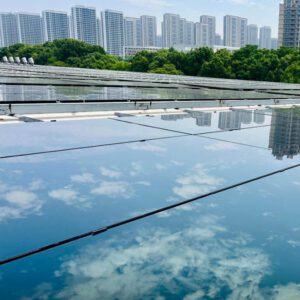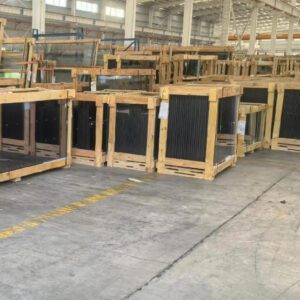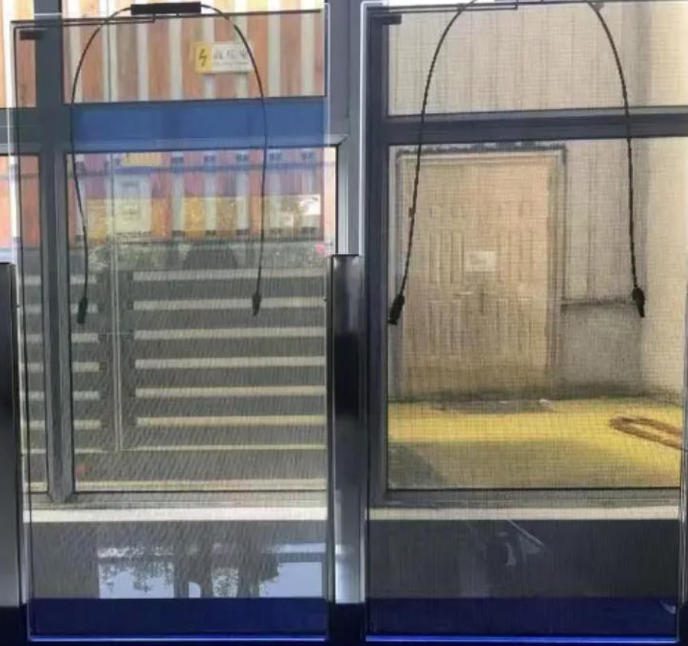
How to Choose Solar Glass for BIPV Projects: Expert Guide
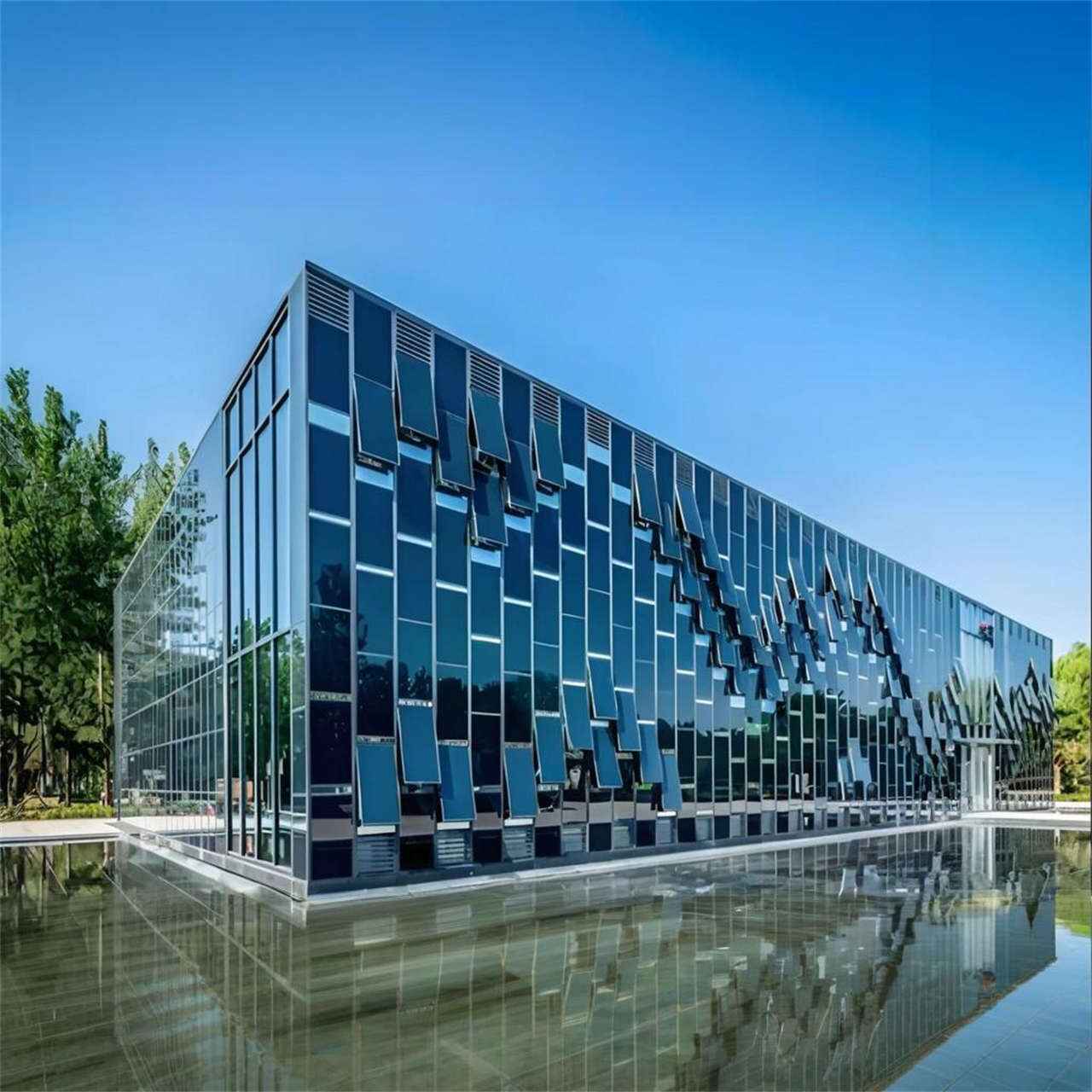
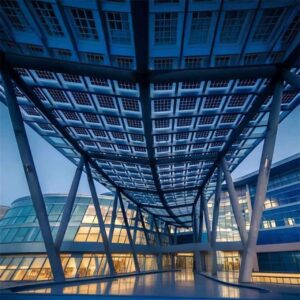
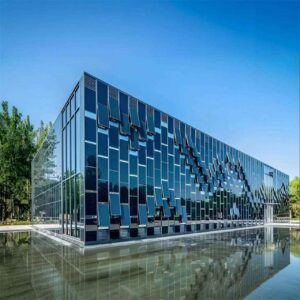
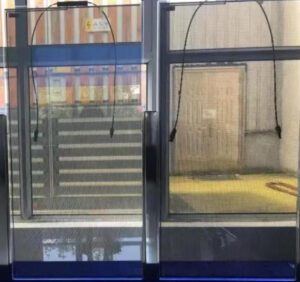
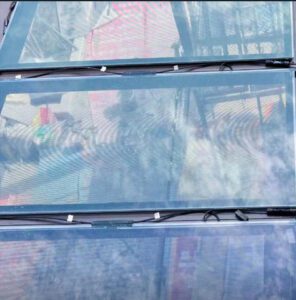
A 1,200 kW transparent PV glass facade and skylight system in Wuhan. Each panel works as glazing and as a power generator.
Picking solar glass is not a simple material choice. It’s an engineering decision. The glass has to produce power, hold up against wind and impact, and still look the way the architect drew it. If you get one of those wrong, the project’s 25-year return suffers.
This guide is for people who carry that risk: curtain wall and roofing contractors, PV EPCs, building material distributors, and architects or design institutes. It turns the selection process into a set of checks you can actually run on a project.
Key Terms at a Glance (Glossary)
Read this once. Each term comes up again later.
| Term | Plain-English Meaning | Quick Example |
|---|---|---|
| BIPV (Building Integrated Photovoltaics) | Solar modules that replace a building material (glass, roof, cladding) instead of sitting on top of it | A curtain wall pane that makes electricity |
| kWp (kilowatt-peak) | Maximum power output under standard lab conditions (1,000 W/m² sunlight, 25°C cell) | 100 m² of opaque PV glass ≈ 20 kWp |
| VLT / LT (Visible Light Transmission) | Percentage of visible daylight passing through the glass | 40% VLT = moderately shaded office |
| U-value | How fast heat leaks through the glass. Lower is better insulation | Double-glazed PV IGU ≈ 1.1–1.6 W/m²K |
| SHGC (Solar Heat Gain Coefficient) | Share of solar heat entering the room (0–1). Lower means less cooling load | SHGC 0.25 = only 25% of solar heat gets in |
| IGU (Insulating Glass Unit) | Two or more glass panes sealed with an air or argon gap | PV laminate + 12 mm argon + Low-E pane |
| Encapsulant | The plastic interlayer bonding cells between glass sheets (EVA, POE, PVB) | Prevents moisture from reaching cells |
| Delamination | Layers separating inside the laminate, usually seen as bubbles or cloudy edges | A failure mode found after years of hot/cold cycles |
| TCO (Total Cost of Ownership) | Purchase + installation + operation + maintenance over the full life | 25-year cost view, not just day-one price |
| Bypass diode | A small electronic “detour” that protects shaded cells from overheating | Stops hot spots when a mullion shadow falls on cells |
I. Why Solar Glass Selection Is Now an Envelope Decision
From Add-On Panels to Building Elements
For two decades, solar meant racking panels onto a finished roof. The building and the power system were separate scopes, separate contracts, and separate warranties.
BIPV changes that. The PV glass is the curtain wall, skylight, canopy, or balustrade. So it has to pass the same tests as any other glazing: structural, fire, water-tightness, and safety. It also has to meet electrical codes on top of those.
نظرة ثاقبة في المجال: The IEA PVPS Task 15 BIPV technical guidebook points out that one of the biggest barriers to BIPV adoption is not the technology. It’s the gap between the building-product world and the PV world. Glazing contractors think in Pascals and deflection. PV engineers think in kWh and string voltage. Most project failures happen where those two meet.
Where Aesthetics, Energy, and Codes Meet
Every solar glass specification makes three groups trade against each other:
- The architect wants transparency, color, and clean sightlines.
- The energy consultant or EPC wants maximum kWh per square meter.
- The code official and facade engineer want proven load capacity, safe breakage behavior, and fire compliance.
What This Guide Does
The sections below follow the order of a real project review: energy versus light, structure, thermal behavior, durability, system integration, aesthetics, cost, and certification. Each section ends with something you can check on a submittal.
II. Energy Conversion Efficiency vs. Visual Transparency
The main trade-off in solar glass selection is kWp output against Light Transmission (LT). Every percent of daylight you let through is sunlight that never reaches a cell.
Cell Technology: Monocrystalline vs. Thin-Film
There are two main ways to make glass semi-transparent:
- Crystalline silicon (mono-Si) with cell spacing. Opaque cells sit in a grid with clear gaps between them, and the gap size sets transparency. Power density stays high, but you see a visible “checkerboard” pattern.
- Thin-film (CdTe, a-Si, CIGS). A uniform film is laser-scribed into fine lines. The view through it looks evenly tinted, with no grid. Efficiency per square meter is lower.
For the latest lab-verified cell efficiencies by technology, the NREL best research-cell efficiency chart is the standard industry reference.
Typical ranges for crystalline BIPV glass. Exact values depend on cell type, cell layout, and glass build-up.
| Technology | Typical VLT Range | Typical Power Density | Visual Character | Best Fit |
|---|---|---|---|---|
| Opaque mono-Si | 0% | 180–220 W/m² | Solid dark panel | Spandrels, roofs, parapets |
| Spaced mono-Si | 10–50% | 90–170 W/m² | Visible cell grid | Skylights, atriums, canopies |
| CdTe thin-film | 10–50% | 40–90 W/m² | Uniform tint, no grid | Vision glass, premium lobbies |
| a-Si thin-film | 10–30% | 30–60 W/m² | Uniform, slightly brown | Low-budget vision glass |
| CIGS | 0% (opaque) | 100–150 W/m² | Uniform black, flexible options | Curved roofs, tiles |
The “Energy-to-Light” Ratio
Definition: The Energy-to-Light ratio is the annual energy each square meter produces (kWh/m²/yr) divided by the daylight it lets through (VLT %). It tells you how much power you give up for each point of transparency on a specific facade.
How you use it in practice:
- Run a shading and irradiance study of each facade (tools such as Ladybug, PVsyst, or Revit Insight).
- Zone the facade. Faces with high irradiance and little shading get low-VLT, high-power glass. Shaded faces get standard glazing or decorative opaque PV.
- Set a VLT floor for each space type from daylighting requirements (for example, 30–40% for offices and 15–25% for atriums).
- Compare kWh/m²/yr at that VLT across candidate products.
Orientation affects the result more than most teams expect:
Approximate mid-latitude values. In the southern hemisphere, swap north and south.
نظرة ثاقبة في المجال: Many facade teams put their best PV glass on the most visible elevation, usually the street front. That elevation is often the most shaded by neighboring buildings. Base the placement on the irradiance map, not on the renderings.
Coatings: Anti-Reflective vs. Low-E
Coatings are where good intentions go wrong most often.
- Anti-reflective (AR) coating goes on the outer surface (surface #1). It typically raises light reaching the cells by 2–3%, which converts almost directly into extra yield.
- Low-E coating reflects heat. If you put it in front of the cells, it blocks part of the energy the cells need. Put it on the inner pane of the IGU, behind the PV laminate (typically surface #3 or #4 counted from outside).
| Coating | Correct Position | Effect on Yield | Effect on Comfort |
|---|---|---|---|
| AR coating | Surface #1 (outer face) | +2–3% | Neutral; slightly lower exterior glare |
| Low-E (soft coat) | Inner pane, surface #3 or #4 | Neutral if placed behind cells | Big drop in U-value and winter heat loss |
| Solar-control tint | Inner pane only | Negative if placed outboard of cells | Lower SHGC |
III. Structural Integrity and Mechanical Load Requirements
Solar glass is part of the building envelope, so it has to meet the same safety and load standards as any other glazing. A cracked PV pane is an electrical problem, but it is also a falling-glass hazard.
Tempered vs. Heat-Strengthened Glass for High-Rise Curtain Walls
- Fully tempered glass is about four times stronger than ordinary annealed glass. It breaks into small cubes. The downside is rare spontaneous breakage caused by nickel-sulfide (NiS) inclusions. Always specify a heat-soak test (EN 14179) for tempered panes used at height.
- Heat-strengthened glass is about twice as strong as annealed glass. It breaks into larger shards that stay locked in the laminate. Spontaneous breakage risk is far lower.
| Property | Fully Tempered | Heat-Strengthened | What It Means on Site |
|---|---|---|---|
| Strength vs. annealed | ~4× | ~2× | Tempered handles higher wind loads per thickness |
| Break pattern | Small cubes | Large radial cracks | Heat-strengthened laminate stays in frame after breakage |
| NiS breakage risk | Present (reduce with heat-soak) | Very low | Lower callback risk with heat-strengthened |
| Post-breakage stability when laminated | Moderate (laminate can sag) | عالية | Key for overhead and high-rise use |
| Typical BIPV use | Single-pane canopies, low-rise | High-rise laminates, overhead glazing | Many engineers use HS + HS or HS + FT pairs |
نظرة ثاقبة في المجال: For laminated BIPV above about 20 m or in overhead positions, many facade engineers now specify heat-strengthened on both plies, or heat-strengthened outboard with tempered inboard. Glass size is calculated to ASTM E1300 load resistance procedures in North America, or to EN 16612 in Europe.
Wind Load and Seismic Requirements for Roof-Integrated Systems
Roofs get uplift (suction) at the corners and edges, often two to three times the pressure in the middle of the field. Seismic design adds racking: the frame moves sideways and the glass must not get crushed.
Checks to run:
- Get the design wind pressure by zone (field, edge, corner) from the structural engineer.
- Compare it with the module’s tested mechanical load. Ask for test reports, not just datasheet numbers. A typical reference test is 5,400 Pa static load.
- Confirm edge clearance and setting blocks so the glass can shift in a seismic drift without touching aluminum.
- For roofs, check snow load plus self-weight acting together on low-slope skylights.
Field reference: the laminated BIPV safety glass build-ups from Jia Mao Bipv are tested at 5,400 Pa with a 2.5 safety factor. Custom sizes go up to 3,000 × 2,000 mm. That is the size range where load calculations matter most.
Lamination Quality and Thermal Cycling
PV glass in a facade can swing from −20°C at dawn to over 70°C at midday. Over 25 years that adds up to thousands of expansion cycles. Weak lamination fails at the edges first.
Ask your supplier for:
- Encapsulant type. POE resists moisture and PID (Potential Induced Degradation, a voltage-driven power loss) better than standard EVA. PVB is the normal safety-glass interlayer and helps with building-code approval.
- Lamination process records. Autoclave temperature and pressure logs, and gel-content test results for EVA.
- Thermal cycling and damp-heat test reports. Look for 200+ thermal cycles (−40°C to +85°C) and 1,000 hours at 85°C/85% RH.
IV. Thermal Performance and Building Energy Modeling (BEM)
Solar glass changes the building’s thermal envelope and its HVAC load. If you model it as ordinary glazing, your energy model will be wrong.
U-Value and SHGC: Avoiding the “Greenhouse Effect”
PV cells absorb sunlight. Roughly 20% becomes electricity and most of the rest becomes heat. A single-pane PV laminate can therefore radiate heat into the room. In a sun-facing atrium, that turns into a greenhouse.
The fix is almost always an IGU build-up: PV laminate outside, gas-filled cavity, Low-E inner pane.
| Build-Up | Typical U-Value (W/m²K) | Typical SHGC | Comfort Risk |
|---|---|---|---|
| Single PV laminate (6+6 mm) | ~5.5 | 0.30–0.50 | High: hot interior surface |
| PV laminate + 12 mm air + clear | ~2.8 | 0.25–0.40 | Medium |
| PV laminate + 16 mm argon + Low-E | 1.1–1.6 | 0.15–0.35 | منخفضة |
| Triple with PV outer | 0.7–0.9 | 0.12–0.28 | Very low |
The transparent BIPV glass range from Jia Mao Bipv, for example, covers SHGC from 0.15 to 0.45 depending on cell density. That range lets an energy modeler match glass to each facade zone. Rating methods for U-factor and SHGC follow the National Fenestration Rating Council procedures in the US.
Practical tip for modelers: Most BEM tools (EnergyPlus, IES-VE, DesignBuilder) cannot calculate PV glass optical properties for you. Ask the supplier for angular-dependent transmission and absorption data, not just normal-incidence values. Without it, summer cooling loads are often understated by 10–20%.
Coordinating with LEED or BREEAM
Solar glass can earn credits in several categories at once:
- Energy performance. Lower cooling load from low SHGC, plus on-site generation.
- Renewable energy. On-site PV production counts directly.
- Daylight and views. Only if VLT stays high enough in regularly occupied spaces.
Check the credit language in the current LEED rating system from USGBC or the BREEAM certification framework early in design. A VLT that maximizes kWh can easily cost you the daylight credit.
Thermal Expansion Between Glass and Aluminum
Aluminum expands about 2.5 times more than glass (roughly 23 vs. 9 × 10⁻⁶ per °C). A 2-meter mullion can grow 2–3 mm more than the glass it holds across a hot day.
PV glass runs hotter than clear glass, so this mismatch gets bigger. Make sure that:
- Glazing pockets keep minimum edge clearance (often 5–6 mm around the perimeter).
- Structural silicone joints are sized for the higher service temperature of PV glass.
- Pressure plates and gaskets let the glass slide instead of clamping it rigidly.
V. Durability and Environmental Resilience
Long-term ROI depends on the glass surviving the stresses at its actual site. A product that works in a dry inland city can fail early by the sea.
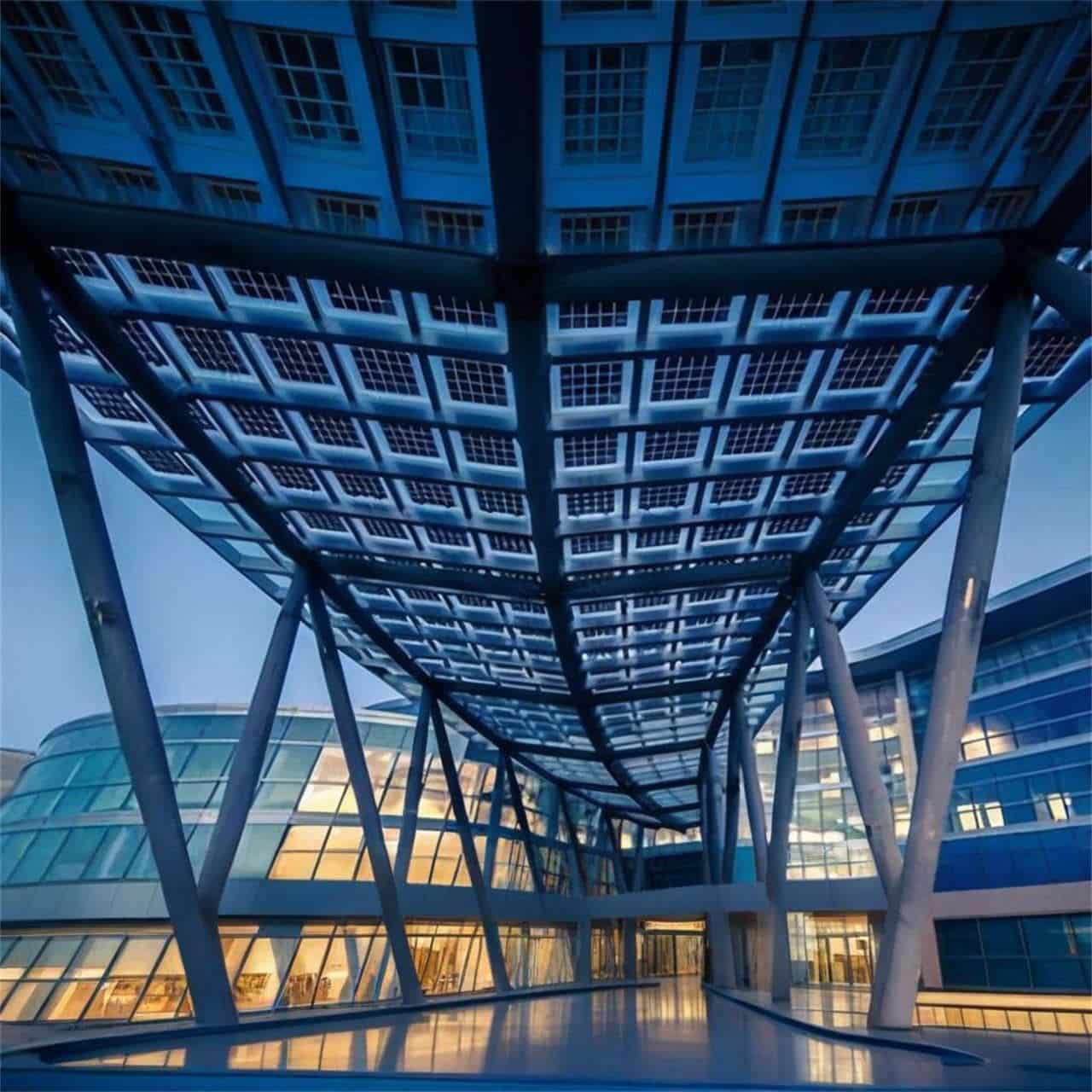
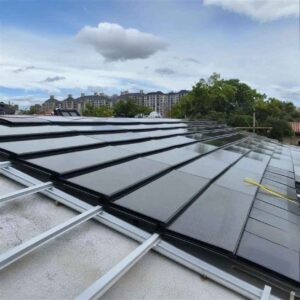
Large commercial BIPV installations face humidity, pollution, and temperature swings across their full service life.
Corrosion Resistance for Coastal Projects
Salt air attacks three weak points: junction boxes, connectors, and the laminate edge seal.
Specify:
- IEC 61701 salt mist test at the severity level that matches your site (severity 6 for direct marine exposure).
- IP67 or IP68 junction boxes with marine-grade connectors.
- Edge seal protection. Use a secondary silicone seal or a framed edge on exposed edges, not a bare laminate edge.
نظرة ثاقبة في المجال: In coastal BIPV forensic reviews, the cells are rarely what corrodes first. The usual culprit is moisture creeping in from an unsealed laminate edge, which then corrodes the busbar ribbons. The first visible sign is a brown “snail trail” moving inward from the edge.
Impact Resistance for Overhead and Public Areas
Glass over people’s heads, and glass that people can touch (balustrades, canopies), has to fail safely.
| Application | Minimum Requirement (Typical) | Reference Test |
|---|---|---|
| Overhead skylight | Laminated, heat-strengthened recommended | EN 12600 / local overhead glazing code |
| Balustrade / guard | Laminated safety glass, post-breakage load hold | EN 12600 Class 1(B)1 or local equivalent |
| Canopy / walkway roof | Laminated, hail-tested | IEC 61215 hail test (25 mm+ ice ball) |
| Ground-floor storefront | Laminated, optional security grade | EN 356 (P2A–P5A) |
Public-access products such as درابزين الشرفة الشمسي need laminated safety glass. They should also have their electrical parts fully hidden from touch.
UV Stability and the “Yellowing” Problem
Lower-grade EVA turns yellow under UV over 10–15 years. That reduces both light transmission (so your daylighting suffers) and power (because less light reaches the cells).
What to ask for:
- UV preconditioning results in the module’s IEC 61215 test report.
- Extended UV testing beyond the minimum. Several suppliers now test 2,000+ hours, or about 3× the IEC dose.
- An optical warranty, meaning a written limit on VLT and color change over time (for example, less than 5% VLT loss over 15 years).
VI. Integration Compatibility with Building Systems
Seamless integration depends on close coordination between the PV module and the curtain wall or roofing system. This is where contractors gain or lose margin.
Watch the installation sequence below. The way PV units are wired at the stack joints is the detail that most often catches teams out the first time:
https://www.youtube.com/watch?v=rX91CN86gOs
Interface Design: Watertight Seals and Drainage
A BIPV facade must manage water exactly like any other curtain wall, with one extra rule: water must never reach the junction box or the cable entries.
Checklist:
- Pressure-equalized drainage. Weep holes and baffles work as normal, but check that the junction box sits above the drainage path in the glazing pocket.
- Cable penetrations. Cables leave the glazing pocket through sealed grommets, never through the gasket line.
- Test it. Run water penetration tests (for example ASTM E331 / EN 12155) on a mock-up that includes the real cables.
For a detailed walkthrough of these interfaces, see our guide on integrating PV glass into curtain walls and roofs.
Electrical Integration: Cable Routing in Slim Profiles
Modern mullions can be as narrow as 50–65 mm. Getting PV cables, connectors, and sometimes optimizers through them takes planning:
- Edge-mounted or side junction boxes keep the glazing pocket clear.
- Dedicated cable channels inside the mullion keep DC cables away from drainage chambers.
- Connector access points at stack joints or behind removable covers allow testing without taking the glass out.
Unitized vs. Stick Systems
| العامل | Unitized System | Stick System |
|---|---|---|
| Where PV is wired | Factory, pre-wired and tested | On site, by the electrician |
| Install speed | Fast, plug-and-play at stack joints | Slower |
| Quality control | High, done under factory conditions | Depends on site crew |
| Single-panel replacement | Harder; design removable glazing beads | أسهل |
| Best for | High-rise, repetitive grids | Low-rise, irregular geometry, retrofits |
نظرة ثاقبة في المجال: On unitized BIPV jobs, the best contractors do an electrical continuity and insulation-resistance test on every unit in the factory. Then they repeat it after the unit is hung. Finding a faulty connector at floor 30 after the slab-edge firestop is sealed costs about ten times more than catching it on the factory floor.
VII. Aesthetic Customization and Architectural Intent
Solar glass has to deliver the architect’s vision without giving up too much electrical output. The skill is knowing which choices are cheap in kWh and which are expensive.

Cell spacing, glass tint, and frame color together decide how a PV element reads from the street.
Color, Fritting, and Opacity
Every color layer in front of the cells reflects some light away. Some colors cost much more power than others:
| Finish Option | Typical Power Loss vs. Standard Black | Visual Result |
|---|---|---|
| Standard black/blue cells | 0% | Classic PV appearance |
| Dark grey / anthracite | 5–10% | Blends with dark aluminum |
| Interference-color glass (blue, green, bronze) | 5–15% | Rich color, hides cells well |
| Light grey / champagne | 15–25% | Stone-like facade |
| Ceramic-frit printed patterns | 10–35% (depends on coverage) | Graphics, wood or stone imitation |
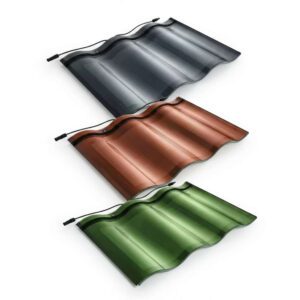
| Terracotta / red | 25–40% | Heritage-style roofs |
For more depth on durability and reflection by coating type, see our breakdown of color coating options for solar panels.
Cell Grids vs. Seamless Appearance
Some architects like the visible cell grid because it “honestly” shows the technology. Others want a monolithic look. The options:
- Accept the grid, but control it with cell layout (linear, staggered, custom patterns) and black backsheets or black busbars.
- Hide the grid with colored or frit outer glass. This costs power (see table above).
- Remove the grid by using thin-film. You get a uniform look but lower W/m².
Custom Dimensions to Reduce Waste and Install Time
Standard PV panel sizes rarely fit an architect’s module grid. The usual workaround is to fill the leftover gaps with “dummy” non-PV glass of the same color. This works well if the dummy glass matches exactly.
The better approach is to size PV glass to the facade grid from the start. Fewer dummy panels, fewer unique sizes, and fewer site cuts all reduce waste and lead time. Our article on custom-size module lead times covers realistic schedules for custom orders.
VIII. Cost-Benefit Analysis and Lifecycle Value
The selection process has to look past initial CAPEX to Total Cost of Ownership (TCO). On a per-square-meter basis, solar glass will always cost more than plain glass. The question is what it replaces and what it earns.
Solar Glass vs. Traditional Cladding Costs
On spandrels and opaque zones, BIPV glass replaces a cladding material you would have bought anyway, such as stone, ACM, ceramic, or spandrel glass. Only the difference in cost should count against the PV.
Worked example (illustrative, 1,000 m² south spandrel zone):
| Line Item | Value |
|---|---|
| Conventional spandrel cladding (installed) | $180/m² |
| Opaque BIPV glass + electrical BOS (installed) | $370/m² |
| Net premium for BIPV | $190/m² → $190,000 |
| Installed capacity (≈190 W/m²) | 190 kWp |
| Annual yield (vertical south, ~750 kWh/kWp) | ~142,500 kWh |
| Value at $0.15/kWh | ~$21,375/year |
| Simple payback on premium | ~8.9 years |
| With 30% incentive on PV premium (where available) | ~6.2 years |
Replace these numbers with your local cladding costs, tariffs, and irradiance.
Payback, Energy Offsets, and Incentives
Real projects back this up. On the Wuhan Science and Technology Exhibition Center project, 9,600 m² of transparent PV glass on the facade and skylights produces about 1.56 GWh per year. That saves the client around $110,000 a year, with an overall payback of 7.2 years.
Incentives change often and vary a lot by region. In the US, the DSIRE incentives database is the most complete starting point for state, utility, and local programs. Federal tax credit rules also changed in 2025, so confirm eligibility with a tax advisor before you count them in a pro forma.
Maintenance Costs Over the Lifespan
Illustrative split. Inverters usually need replacing once in a 25-year life, so put that in the budget from the start.
The main lifecycle cost drivers:
- Cleaning. It is often combined with regular facade cleaning (BMU access), so the extra cost is small.
- Inverter replacement. Plan for one replacement around year 12–15.
- Panel replacement. Keep 1–2% spare stock from the same production batch so color matches.
لدينا BIPV maintenance and monitoring guide covers inspection intervals and how to spot faults early.
IX. Quality Assurance and Certification Standards
Reducing project risk means following international electrical and safety certifications. Because BIPV is both a PV module and a building product, it needs certifications from both fields.
IEC 61215 and IEC 61730 for PV Performance and Safety
- IEC 61215 checks durability and performance: thermal cycling, damp heat, UV, hail, mechanical load, and hot-spot endurance. The current test sequences are in IEC 61215-2.
- IEC 61730 checks electrical and fire safety: insulation, protection against electric shock, and construction requirements. See IEC 61730-1 module safety requirements.
- IEC 63092 / EN 50583 are the BIPV-specific standards that connect PV and building requirements.
ASTM and EN Standards for Architectural Glazing
| Requirement | North America | Europe |
|---|---|---|
| Glass load resistance | ASTM E1300 | EN 16612 / EN 13474 |
| Safety glazing impact | ANSI Z97.1 / CPSC 16 CFR 1201 | EN 12600 |
| زجاج مصفح | ASTM C1172 | EN 14449 / EN ISO 12543 |
| IGU durability | ASTM E2190 | EN 1279 |
| Heat-soaked tempered | — (project spec) | EN 14179 |
| Thermal rating | NFRC 100/200 | EN 673 / EN 410 |
| PV safety (electrical) | UL 61730 | IEC 61730 |
Warranties: Glass و Power
A BIPV warranty has to cover two different risks:
- Power warranty. Typically 25 years linear, with about 80% minimum output at year 25.
- Product and glazing warranty. Covers materials, delamination, edge seal, and optical clarity. Usually 10–15 years.
Ask for both in writing, from one legal entity if possible. That avoids the “glass supplier blames the cell supplier” problem when a claim comes in.
X. Treat Solar Glass as Engineering, Not a Catalog Pick
Choosing solar glass means checking several things together: energy against light, structural safety, thermal behavior, durability on your actual site, system integration, design intent, lifecycle cost, and certification. A product that wins on one of these and fails on another is the wrong product.
The projects that perform best have one thing in common. The EPC, the architect, the facade contractor, and the glass supplier sit at the same table at concept stage, not after tender. That is when glass size, cell layout, and wiring paths cost nothing to change.

Your next step: Before you lock in a specification, ask for project-specific data: an irradiance-based yield estimate, a U-value/SHGC sheet for your exact build-up, wind-load calculations for your largest panel, and the full IEC test reports. You can browse the photovoltaic glass product range, or send your drawings to our engineering team for a technical review. The team at جيا ماو BIPV supports curtain wall contractors, EPCs, distributors, and design institutes from concept through commissioning.
الأسئلة المتداولة
1. How does colored solar glass affect energy yield (kWh)?
Colored glass reflects part of the sunlight before it reaches the cells. Dark grey or anthracite finishes usually cut yield by 5–10%. Interference colors such as blue, green, and bronze cut 5–15%. Light colors such as champagne or terracotta can cut 25–40%. Always ask for measured power on the actual colored sample, not the standard black datasheet.
2. How do installation timelines compare between standard curtain walls and BIPV systems?
On a unitized system with factory-wired PV, panel hanging speed is almost the same as standard glazing. The extra time comes from electrical work: connecting at stack joints, routing strings to inverters, and testing. Plan for an extra 10–20% on the facade program, plus 4–8 weeks of extra lead time for custom PV glass production.
3. How do we replace a single broken solar glass panel in a unitized facade?
Plan for it during design. Specify removable outer glazing beads or a structural silicone detail that allows replacement from outside with a BMU or swing stage. Disconnect the string at its connector, replace the panel from batch-matched spare stock, and re-test the string. Without this planning, you may have to remove the whole unit.
4. Which certification matters more for international projects: IEC or UL?
IEC 61215/61730 is accepted in most of Europe, Asia, the Middle East, and Latin America. UL 61730 is required in the US and Canada. The two now share much of the same test content because UL 61730 is harmonized with IEC 61730. For North American projects you still need the UL listing (or equivalent NRTL certification), and an IEC certificate alone won’t satisfy the code official.
5. How is the shading coefficient of solar glass different from Low-E glass in energy models?
Low-E glass mainly reflects heat. PV glass absorbs a lot of solar energy in the cells and then re-radiates part of it as heat. That makes its effective SHGC depend on the build-up, angle, and cell coverage. Model it with manufacturer-supplied angular optical data in a custom glazing definition, not as a library Low-E product.
6. How often should solar glass be cleaned in urban environments?
Vertical facades partly self-clean with rain, so 2–4 cleanings per year are usually enough, and they’re often combined with regular facade cleaning. Low-slope skylights and canopies collect more dirt and may need quarterly or more frequent cleaning near traffic, construction, or industry. Watch your monitoring data, because a sudden 5%+ drop often points to soiling.
7. Can solar glass be used on curved architectural surfaces?
Yes, but with trade-offs. Crystalline cells cannot bend much, so curved glass usually uses gently curved laminates or flexible thin-film. Different parts of a curve face different directions, so string design needs more care to avoid mismatch losses. For roofs, products such as CIGS curved solar roof tiles handle curvature without significant efficiency loss.
8. How do we prevent heat buildup and hot-spot damage in solar glass?
Use three layers of protection. First, choose modules with bypass diodes and a low temperature coefficient (around −0.29%/°C or better). Second, design string layouts so mullion and fin shadows don’t fall across a single cell row. Third, put the PV laminate on the outer pane of an IGU so heat can escape outward. Also check that the module passed the IEC 61215 hot-spot endurance test.
9. How much heavier is laminated solar glass than standard double glazing?
Glass weighs about 2.5 kg/m² per mm of thickness. A standard 6 + 12A + 6 IGU weighs about 30 kg/m². A typical BIPV IGU with a 6+6 mm laminate plus a 6 mm inner pane weighs about 45 kg/m², roughly 50% more. Check anchors, unit handling equipment, and crane loads early.
10. How is electrical wiring hidden inside high-rise curtain wall mullions?
Cables run out of edge-mounted junction boxes into a dedicated channel inside the mullion, kept apart from the drainage chamber. They connect at stack joints using factory-fitted plug connectors, then run down to riser cable trays at slab edges. Inspection access is through removable mullion covers or interior trim panels.
11. How much do transparency and color degrade over 20+ years?
With UV-stable encapsulants (high-grade POE or PVB) and good edge sealing, VLT loss is usually under 5% over 15–20 years, and color change is barely visible. Lower-grade EVA can yellow noticeably within 10–15 years. Ask for a written optical warranty with numbers, not just a power warranty.
12. How do we reconcile different warranty periods from glass and PV cell providers?
The cleanest solution is a single-source warranty from the BIPV module maker, covering glass, lamination, and power output under one contract. If that’s not possible, get back-to-back warranties with a clear claims process and an agreed independent testing lab to settle disputes.