Solar Glass for Facades: From Passive Glazing to Power
A glass wall can do more than keep weather out. With solar glass, it also makes power.
Quick answer: Solar glass is architectural glass with photovoltaic (PV) cells or thin-film layers built in. It works as a window, curtain wall, skylight, or canopy panel, and it also generates electricity. It replaces a building material instead of sitting on top of one.
I. The Evolution of the Building Envelope
Think about the last curtain wall you priced. The glass was one of the most expensive items in the envelope. It also did only one job. It sat there, passive, while the HVAC system worked against it.
Solar glass changes that deal. The same glass that fills the frame can generate power, cut solar heat, and soften glare.
From glazing to Building-Integrated Photovoltaics (BIPV)
BIPV means solar products that become part of the building itself, as roofs, walls, glass, or shades. Traditional rooftop solar is added after the building is done. BIPV is designed in from the start.
The shift is already showing up in sales. The solar PV glass market was valued at USD 18.46 billion in 2025. It is forecast to reach USD 93.72 billion by 2034.
The pain point: energy targets versus architectural intent
Most of our clients are caught between two bosses. The owner wants a LEED or BREEAM rating. The architect wants a clean, high-end facade.
Rack-mounted panels solve the first problem and hurt the second. Solar glass is built to satisfy both.
Rules are also forcing the issue. Under the EU’s zero-emission building rules, new buildings owned by public bodies must be zero-emission from 1 January 2028. All other new buildings follow on 1 January 2030. Certification systems such as LEED و BREEAM reward on-site generation, and glass is often the largest surface you can use.
What solar glass does on one building
Solar glass is a multifunctional tool. It can do three jobs at once:
- Generate power for on-site use, which supports energy autonomy.
- Control heat by lowering the solar heat gain through the glass.
- Shape daylight by cutting glare without closing every blind.
At Jia Mao Bipv, the projects that go smoothly are the ones where someone decided on solar glass before the curtain wall drawings were frozen. The projects that struggle treat it as a late substitution.
نظرة ثاقبة في المجال: The biggest cost surprise in solar glass is rarely the glass price. It is the redesign that happens when wiring, framing, and fire documents are raised after the shop drawings are approved.
II. Technical Differentiation: Solar Glass vs. Standard Glazing
Standard glass is passive. Solar glass is active. That one difference changes the structure, the electrics, and the paperwork.
For a full side-by-side, see our guide to solar glass vs traditional glazing. A curtain wall is a non-structural outer wall, usually aluminum framing filled with glass. Solar glass fits the same grid, which is why it works so well there.
Layers inside the glass decide how much heat, light, and power you get.
Integration of photovoltaic cells: thin-film vs. crystalline silicon
Two cell families dominate. Crystalline silicon (c-Si) uses small wafers laid between two glass panes with gaps between them. Light passes through the gaps. Thin-film puts an ultra-thin PV coating directly onto the glass. It looks like an even tint.
| Technology | Module efficiency | Light passing through (VLT) | Typical power (W/m²) | Typical life |
|---|---|---|---|---|
| Semi-transparent c-Si | 14–22% | 5–40% | 80–180 | 25–30 years |
| CdTe thin-film | 12–18% | 5–30% | 60–130 | 25+ years |
| Amorphous silicon (a-Si) | 6–12% | 10–40% | 40–80 | 15–20 years |
| Organic PV (OPV) | 12–15% | 30–70% | 30–60 | 10–15 years |
Indicative ranges from Jia Mao Bipv’s transparent solar panel comparison. Ask each supplier for tested data on the exact product.
The trade-off is simple. Crystalline silicon gives you more power per square meter. Thin-film gives you a cleaner look and does well in heat.
Optical properties: managing VLT and SHGC
VLT (visible light transmittance) is the share of daylight that gets through. SHGC (solar heat gain coefficient) is the share of the sun’s heat that gets through, on a scale from 0 to 1. Lower SHGC means less cooling load.
| Glazing type | U-value (W/m²K) | SHGC | VLT |
|---|---|---|---|
| Double-pane clear | 2.7 | 0.70 | 78–82% |
| Double-pane low-E (soft coat, argon) | 1.3–1.6 | 0.25–0.40 | 50–65% |
| Triple-pane low-E | 0.8–1.0 | 0.20–0.30 | 48–62% |
| BIPV photovoltaic glass | 0.9–1.6 | 0.15–0.35 | 0–45% |
Source: Jia Mao Bipv glazing comparison guide. U-value measures how fast heat moves through glass. Lower is better.
Here is why this matters on a real job. In a hot climate, one documented comparison found that moving from clear double-pane glass (SHGC 0.70) to a high-performance solar-control unit (SHGC 0.25) cut annual cooling energy by 35 to 45%. Solar glass gives you that same SHGC range and adds power on top.
Source: ASHRAE 90.1-2022 and DOE data as summarized in Jia Mao Bipv’s comparison guide. Run a project-specific simulation before specifying.
| Glazing type | U-value (W/m²K) |
|---|---|
| Single pane | 5.8 |
| Double clear | 2.7 |
| Low-E hard coat | 2.0 |
| Low-E soft coat | 1.4 |
| Solar glass (spectrally selective) | 1.1 |
| BIPV glass-glass | 0.98 |
| Triple solar glass | 0.82 |
The table repeats the chart data in case the chart does not load in your editor.
Durability and longevity
Both glass types face the same wind, rain, and heat cycles. The difference is that solar glass carries two promises: it must keep its optics and keep its power.
Typical degradation for crystalline silicon modules runs about 0.4 to 0.7% per year. A standard 25-year power warranty guarantees roughly 80% of rated output at year 25. For building-grade protection, Jia Mao Bipv uses fluorocarbon backsheets rated for 30 years of UV resistance without discoloration. It also uses imported POE encapsulant films that improve UV aging resistance by 40%. Ask any supplier for equivalent data, and check the glass type too. Our guide to solar glass types shows why the wrong glass can quietly cost a project thousands in lost output.
III. Core Technologies and Material Classifications
Picking the right product starts with one question: do people need to see through it?
Transparent and semi-transparent glass: skylights and facades
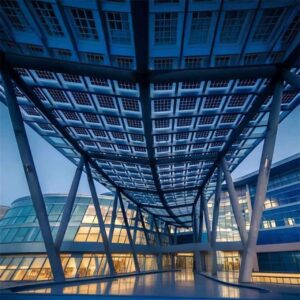
These panels let daylight in while spaced cells or a thin coating generate power. They suit skylights, atriums, vision glass, and canopies.
لدينا semi-transparent BIPV glass is offered in 30, 50, 70, and 90% transparency levels. More transparency means less power. A 40% transparency skylight over a university atrium will feel bright and make modest power. A darker 15% skylight will make more power and feel more like a covered court.
لدينا transparent solar panel comparison walks through that trade-off for windows and skylights.
Opaque and colored solar panels: spandrels and roofing
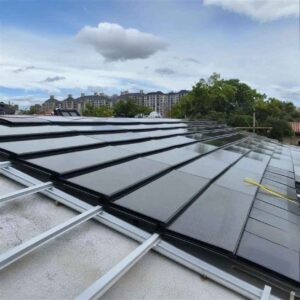
A spandrel is the opaque band of a curtain wall that hides floor slabs and ducts. Nobody looks through it. That makes it the best place for opaque solar glass.
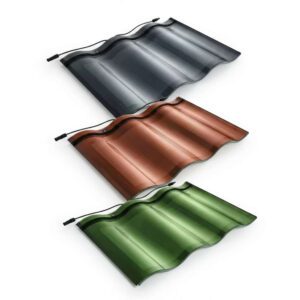
Opaque modules reach roughly 120 to 220 W/m², well above semi-transparent glass. They also come in colors, which helps when the architect wants a match to adjacent metal or stone. Our colored solar glass range offers custom color matching with transparency from 10% to 90%.
Color has a cost. Deeper filters let less light reach the cells. Always get the power loss for your exact color in writing.
Emerging tech: perovskite and organic PV
Perovskite cells use a crystal-like coating that can be tuned for color and transparency. Organic PV (OPV) uses carbon-based inks printed on thin substrates, so it can bend.
Both look great on paper for curved and flexible applications. Both need a reality check. Perovskite lab efficiencies now exceed 25%, but commercial products are only entering limited deployment, and not every product carries a 25-year warranty. OPV products often carry 10 to 15 year warranties. Read our overview of perovskite and organic PV for the efficiency and durability picture.
نظرة ثاقبة في المجال: For a 30-year building, ask emerging-tech suppliers for outdoor field data, not lab results. The gap between the two is where warranty claims live.
IV. Strategic Architectural Applications
Solar glass fits wherever a building already uses glass or cladding. The goal is to put the right type where the sun and the view demand it.
Photovoltaic glazing makes the facade part of the energy system.
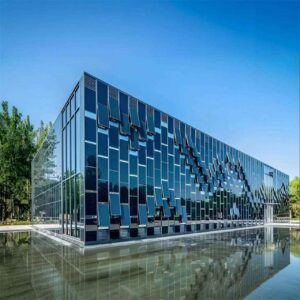
Curtain walls and facades: vertical power plants
On many mid-rise and high-rise buildings, the facade area is 1.5 to 3 times the roof area. That is often the only place left once mechanical units take over the roof.
Vertical walls make less power per kW than a tilted roof. A south-facing vertical facade captures roughly 60 to 70% of what an optimally tilted roof would. East and west walls capture about 40 to 55%. North-facing walls in the northern hemisphere are usually not worth it.
Our guide on facade mounting systems compares how different attachment methods affect cost and replacement access.
Solar roofs and atriums: using overhead light
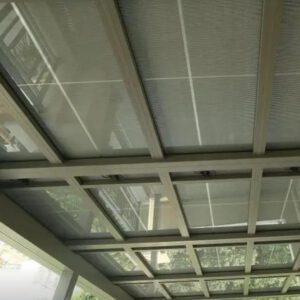
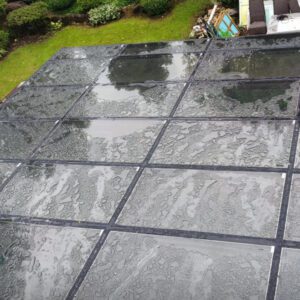
Overhead glass sees the sun longest. That makes skylights and atriums strong producers, and also the places where heat and glare show up first.
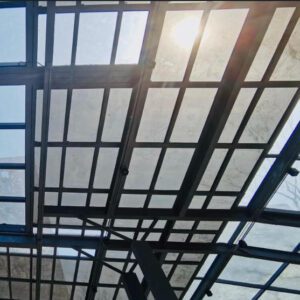
Use laminated glass overhead. زجاج مصفح bonds two glass sheets with a plastic layer, so broken pieces stay in place. Plan one shading logic for blinds and PV glass together, because a closed blind under PV glass can raise the glass temperature and lower output.
Shading systems and louvers: power plus passive control
Fixed louvers and canopies can carry PV and also block unwanted summer sun. The glass shades the interior and makes power in the same position. Place them on south and west elevations where overheating is the biggest comfort problem.
Watch: Advanced Glazing and BIPV
Click to watch “BIPV, Advanced Glazing and Energy Solutions” from the Engineering Institute of Technology on YouTube.
V. Visual Aesthetics and Design Flexibility
The old objection was “it looks like a solar panel.” That is a fair complaint about racks and blue cells. It is less fair about modern solar glass.
Color customization and opacity levels
Interference-coated glass can keep roughly 93 to 95% of power while changing the color. Very light or white-looking finishes can fall toward 60%. Color consistency is measured by ΔE, a number describing how different two colors look. Below 3, most people cannot see the difference.
Two practical rules save headaches. Order spare panels from the same production batch as the original, because a panel made years later may not match. Ask for a large outdoor mock-up, because a pattern that looks fine on a desk can feel heavy across 30 stories.
Seamless integration: fewer visible frames and wires
Jia Mao Bipv uses monocrystalline cells above 22% efficiency, with invisible busbar technology to avoid visible silver grid lines. Cell layouts can be arranged in custom patterns, so the PV layout reads as an intentional facade design.
Cable routing is the other half of the clean look. Plan cable exits and junction box positions in the mullions before shop drawings are approved. See our suitability assessment guide for a scoring method that covers glare, daylight, and integration.
Case study reference: a school facade that became a landmark

Copenhagen International School’s solar facade. Photo: Marta Victoria, Wikimedia Commons, CC BY-SA 4.0.
The Copenhagen International School facade is a well-known example of solar integration that people notice as architecture first. It uses about 12,000 colored, tilted panels covering roughly 6,000 m², and it is widely reported to supply a large share of the school’s yearly electricity.
The lesson for your team is the design intent. The solar surface was treated as the building’s visual identity, not hidden or apologized for. Our real-world BIPV case studies show how other building types handled similar choices.
For wider technical guidance, the IEA PVPS Task 15 BIPV technical guidebook includes drawings and case studies for roofs, facades, and shading systems.
VI. Economic Analysis for EPCs and Contractors
The wrong question is “What does solar glass cost?” The right question is “What does it cost after what it replaces?”
Cost decisions are made on drawings, long before the glass is ordered.
Moving from CAPEX to Total Cost of Ownership (TCO)
CAPEX is the upfront cost. TCO adds energy savings, maintenance, equipment sizing, and replacement over the life of the facade. HVAC downsizing, avoided blinds, and electricity credits all belong in the model.
Offset of traditional cladding costs
Solar glass is a dual-purpose material. Here are indicative installed costs per square foot from our comparison guide:
| System | Installed cost (USD/sq ft) |
|---|---|
| Standard double-pane clear | $45–85 |
| BIPV opaque solar glass (spandrel) | $110–200 |
| BIPV semi-transparent solar glass | $140–280 |
Where BIPV replaces spandrel glass or cladding, the avoided material typically reduces the net extra cost by about $20 to $40 per square foot. That is why spandrel zones are usually the easiest place to start.
Source: Jia Mao Bipv comparison guide, U.S. market, 2025–2026. Indicative only.
| Cost component | شارك |
|---|---|
| Glass modules and insulated glass unit | 42% |
| Curtain wall frame and hardware | 28% |
| Electrical and inverters | 16% |
| Installation labor | 14% |
Energy yield calculations and ROI timelines
Payback is simple to calculate once you use the net premium:
Here are example projects from our transparent solar panel guide, using NREL PVWatts estimates and a 30% U.S. Investment Tax Credit (ITC):
| Project | Net premium | Annual energy value | Payback with 30% ITC | Payback without ITC |
|---|---|---|---|---|
| 500 m² office facade, Phoenix | USD 120,000 | USD 18,000 | about 4.7 years | about 6.7 years |
| 500 m² office facade, New York | USD 120,000 | USD 13,200 | about 6.4 years | about 9.1 years |
| 300 m² atrium skylight, Chicago | USD 92,000 | USD 9,500 | about 6.8 years | about 9.7 years |
Calculated from the guide’s figures. Check the current status of the ITC for your project before relying on it.
A broader 30-year comparison on a 10,000 sq ft south-facing facade in Houston shows the long-run pattern:
Directional guidance from Jia Mao Bipv’s comparison guide. Assumes $0.11/kWh escalating 2.5% a year, 30% ITC applied to BIPV, and Zone 2 climate. Not a project-specific analysis.
| Glazing option | 30-year cost (USD thousand) |
|---|---|
| Standard double-pane | 815 |
| Low-E soft coat | 650 |
| Solar control IGU | 540 |
| Electrochromic | 505 |
| BIPV solar glass | 475 |
For a deeper look at the numbers from the EPC side, read our BIPV glass ROI guide for EPC contractors. For quick yield estimates at concept stage, the PVWatts calculator is a useful free tool.
Incentives, subsidies, and certifications
Incentives can swing the case. Beyond the ITC, projects may benefit from accelerated depreciation, green building loans, and local programs. Rules change often, so model your case with and without incentives. Certifications, covered in Section VIII, also add value at lease-up and sale.
نظرة ثاقبة في المجال: The strongest financial case often comes from combined effects: power generated plus cooling load avoided plus smaller HVAC equipment. Teams that only show the electricity credit leave money out of the proposal.
VII. Engineering Challenges and Implementation Solutions
Most solar glass problems happen at interfaces. Wiring, framing, and waterproofing belong to different trades, and none of them wants to own the junction.
Electrical wiring and junction box integration within curtain wall profiles
A mullion is the vertical frame bar between glass units. It is the natural hiding place for DC cables. Many first-time teams forget to plan this and then discover the cavity is sealed.
Three rules help:
- Decide cable exits and junction box locations before shop drawings are approved.
- Keep cables out of drainage channels and off hot insulation.
- Test each string (insulation resistance and open-circuit voltage) before the joints are closed.
لدينا facade module and inverter guide covers wiring layouts and weatherproofing details. Our guide for curtain wall contractors explains how to split work between glazier and electrician.
Thermal expansion management and structural load
Glass and aluminum expand at different rates. Glass moves about 9 × 10⁻⁶ per °C and aluminum about 23 × 10⁻⁶ per °C. On a 2-meter module with a 60 °C swing, the difference works out to:
That small movement is enough to stress sealants and cable exits. Leave clearance, and keep electrical connection points about 3 to 5 mm away from the perimeter weather seal so they can move freely. Choose sealants that are chemically compatible with the module encapsulant.
On weight, solar IGUs are typically 15 to 30% heavier than standard glass units of the same size. Check slab edge capacity and mullion sizing with your structural engineer. Wind is the bigger load on tall buildings. Jia Mao Bipv’s ultra-clear tempered glass is rated to a wind pressure of 4.0 kPa, and many projects specify a minimum of 3.5 kPa. Our tempered laminated glass is built for exposed, high-load locations.
Maintenance and cleaning protocols
Clean 2 to 4 times a year with pH-neutral solutions. Alkaline cleaners above pH 10 can damage coatings, and abrasive pads can scratch anti-reflective layers. Self-cleaning coatings, like the one on our ultra-clear glass, cut maintenance cost by roughly 30%.
Review string-level monitoring monthly. Plan on an inverter replacement somewhere between year 10 and 15.
Also order spare panels with the original batch. Replacing a custom unit years later can take 12 to 16 weeks. Our warranty and maintenance guide lists what voids a warranty.
VIII. Regulatory Compliance and Sustainability Standards
Permitting is where good projects lose weeks. Solar glass has to satisfy building rules and electrical rules at the same time.
Alignment with NZEB requirements
NZEB stands for nearly-zero-energy building: very high performance with the small remaining demand covered by renewable sources. Solar glass supplies on-site renewable generation from the building envelope itself. That helps meet EU zero-emission requirements, which apply from 2028 for public bodies and 2030 for other new buildings.
Impact on LEED, WELL, and BREEAM scoring
LEED awards points toward Certified, Silver (50–59), Gold (60–79), and Platinum (80+). Here is how solar glass can contribute, based on our comparison guide:
| Credit area | How solar glass helps |
|---|---|
| Optimize energy performance | Lower HVAC load from reduced heat gain |
| Renewable energy | On-site electricity generation |
| Daylight | Glare control without constant blind closure |
| Building life-cycle impact | Replaces conventional materials |
The WELL Building Standard focuses on occupant health, and good glare control and daylight help there. BREEAM covers energy, health, and resilience. Ask your certification consultant early which BIPV data they need so you can supply it with the submittal.
Safety standards: fire, impact, and electrical codes
| Standard | What it covers |
|---|---|
| IEC 61215 | Module design qualification (thermal cycling, damp heat, hail) |
| IEC 61730 / UL 61730 | PV module safety |
| IEC 63092-1 | BIPV-specific product standard |
| UL 7103 | BIPV roofing system listing |
| NFPA 285 | Fire test for exterior wall assemblies, required above 40 feet |
| NEC 690 | Electrical safety, including rapid shutdown |
| NFRC 100/200 | U-factor and SHGC ratings |
Fire deserves special attention. Fire testing by FM found that BIPV facade fire hazards include cavity fire spread, glass shattering, burning encapsulants, and falling debris. The lesson is to ask for test data on the whole wall assembly, not only the module.
For impact resistance in railings, canopies, and overhead glazing, specify laminated glass. Our laminated BIPV glass is an 11 mm build (5 mm glass + 1 mm EVA + 5 mm tempered glass) rated EN 356 P5A for security glazing. For third-party testing of BIPV systems, see UL’s BIPV testing and certification service.
نظرة ثاقبة في المجال: A common permitting failure is treating the electrical permit and the building permit as separate. The authority wants to see how modules, conduit, shutdown devices, and the wall assembly work together. Plan for 6 to 12 weeks of review on complex commercial jobs.
IX. Procurement and Supply Chain Strategy for Distributors
A late glass delivery stops the whole envelope trade. Solar glass has longer lead times than standard glazing, so procurement has to start earlier.
Specifications, schedules, and stock levels need to be agreed before the first order.
Quality assurance: testing standards for efficiency and transparency
Do not accept a supplier’s self-declared conformity alone. Ask for these four things:
- Third-party test reports for IEC 61215 and IEC 61730 (from labs such as TÜV Rheinland, SGS, or Bureau Veritas).
- A BIPV-specific certificate such as IEC 63092-1 where applicable.
- A measured VLT value for the exact transparency you ordered.
- Batch traceability, so any problem can be tied to a production lot.
Our guide on how to verify solar glass certifications shows how to read the documents and where bad ones hide. A fake certificate on a large order can mean six-figure rework.
Lead time management for custom architectural glass
Standard BIPV products typically take 8 to 12 weeks from confirmed purchase order. Custom dimensions, specific VLT, or custom cell patterns add 4 to 8 weeks. Heavily customized first orders can need 16 to 20 weeks.
Distributors who handle this well keep two qualified manufacturers. They also keep 4 to 6 weeks of safety stock on standard items. For custom items, they build lead time into the quote instead of holding inventory.
Jia Mao Bipv produces at 3 GW of annual capacity, with automated lamination and an MES system for traceable production. Capacity matters most when a large order needs to ship on one schedule.
Collaboration models: architect, EPC, and manufacturer
The best results come when the manufacturer joins during schematic design, not shop drawing review. A practical model has three steps:
- Concept design: pick surfaces, VLT targets, and technology family.
- Design development: confirm framing fit, cable routes, and string grouping.
- Construction documents: lock layout, structural calcs, and permit package.
Ask the manufacturer for a technical feasibility review before the spec is locked. Ask for BIM objects too, so coordination clashes show up on screen instead of on site.
X. The Future of Active Architecture
Solar glass is moving from a special feature to a standard part of the envelope. It works because it answers three questions at once: how to meet energy rules, how to keep the design intent, and how to make the glass pay back.
لدينا BIPV technology trends article follows what is coming next: smart monitoring, flexible modules, and self-dimming materials. Jia Mao Bipv is working on several of these, including self-dimming materials, thermal storage layers, anti-fouling coatings, and flexible BIPV for curved designs.
From “adding solar” to “integrating solar”
The shift is simple to describe and hard to do. It means bringing the manufacturer, facade engineer, and electrical engineer into the room at sketch stage. It means choosing zone by zone: opaque in spandrels, semi-transparent where daylight matters, and laminated overhead.
The next decade
Buildings that generate more than they use, talk to the grid, and adjust their glass to the weather will become normal. Early specifiers are building the track record that everyone else will follow.
Your next step
Pick one live project. Mark every glass surface on the elevation. Rank them by sun exposure, visibility, and access. That one sheet is the start of a feasibility study. Bring your elevations, location, and target transparency, and contact the Jia Mao Bipv team to review which surfaces make sense. You can also explore the full range at جيا ماو BIPV.
Glossary of Key Terms
| Term | Plain-English meaning | Example |
|---|---|---|
| BIPV | Solar products that replace building materials. | A solar skylight that is also the roof glass. |
| VLT | Share of visible daylight passing through glass. | 40% VLT lets in about as much light as tinted office glass. |
| SHGC | Share of solar heat passing through, from 0 to 1. | An SHGC of 0.25 lets in a quarter of the sun’s heat. |
| U-value | How fast heat flows through glass. Lower is better. | Triple-glazed solar glass can reach about 0.82 W/m²K. |
| IGU | Insulated glass unit: two or more panes sealed with a gas gap. | Standard double glazing. |
| Spandrel | Opaque wall band between floors. | The strip hiding the floor slab. |
| Mullion | Vertical frame bar in a curtain wall. | A cable path for DC wiring. |
| ΔE | Measure of color difference. Below 3 is hard to see. | Matching a replacement panel to the original. |
| ITC | U.S. Investment Tax Credit for solar systems. | 30% in the payback examples above. |
| NZEB | Nearly-zero-energy building. | A building whose small remaining load is met by renewables. |
الأسئلة المتداولة
1. How does the transparency of solar glass affect the interior lighting quality (lux levels)?
Higher VLT means more daylight and a lower power output. Offices usually aim for 40 to 65% VLT in vision glass, while semi-transparent solar glass often sits at 10 to 45%. At that range, the zone near the window will feel bright, but deeper rooms may need electric lighting. Run a daylight simulation for your orientation, and use higher transparency at eye level and denser cells in upper zones.
2. What is the typical efficiency loss when prioritizing aesthetics (color/transparency) over power output?
It depends on the choice. Interference-coated colored glass can keep roughly 93 to 95% of power. Very light or white-looking finishes can fall toward 60%. Higher transparency also cuts power density, from around 120 to 220 W/m² for opaque modules to roughly 40 to 180 W/m² for semi-transparent ones. Always ask for the loss percentage for your exact color and VLT.
3. Can solar glass be retrofitted into existing curtain wall systems, or does it require full replacement?
Often it can be retrofitted into the existing frame, but only if three things check out. The frame must have enough depth for cable routing, the structure must carry units that are roughly 15 to 30% heavier, and the existing weather seals must be compatible. If any of those fail, partial or full replacement is usually the better option.
4. How do we handle the electrical wiring for solar glass in high-rise facades without compromising the visual finish?
Route DC cables inside mullion cavities, fix cable exits before shop drawings, and use pre-wired plug connections at unit joints where possible. Group modules by orientation so each group has its own string or inverter input. Test every string before the joints are sealed. Unitized (factory-assembled) systems make this much cleaner.
5. What is the expected lifespan of BIPV glass compared to traditional tempered glass?
The glass itself can last as long as the building. The power side is usually warranted for 25 years, with output of about 80% at year 25. Inverters need replacing around year 10 to 15, and sealant joints are typically re-done every 7 to 12 years. Plan the maintenance budget around those, not the glass.
6. How does solar glass perform in low-light or indirect sunlight environments (diffuse light)?
Thin-film products tend to hold up better in diffuse light than crystalline silicon, but output is always lower than in direct sun. A south-facing vertical facade captures roughly 60 to 70% of an optimal roof, east and west about 40 to 55%, and north-facing walls are generally not viable. Use a yield model with local weather data before promising numbers.
7. What are the specific load-bearing differences between solar glass and standard double-glazed units?
Solar IGUs are typically 15 to 30% heavier than standard glazing of the same size. Wind loads on high-rise corners are the larger concern. Ask your structural engineer to check slab edge capacity, mullion sizing, and wind suction, and request the exact weight and wind rating from the datasheet. A minimum of 3.5 kPa wind resistance is common for demanding exposures.
8. How is the cleaning and maintenance of solar glass managed in high-rise commercial buildings?
Cleaning follows normal curtain wall practice, 2 to 4 times a year, with pH-neutral solutions and no abrasives. Self-cleaning coatings can cut maintenance cost by about 30%. Combine the facade cleaning contract and solar monitoring under one provider if you can, so no one argues over who owns a fault.
9. Which certifications are required for solar glass to be accepted by municipal building departments?
Expect to submit IEC 61215, IEC 61730 (or UL 61730 in the U.S.), and IEC 63092-1 where applicable. In the U.S., UL 7103 covers BIPV roofing, NFPA 285 applies to exterior wall assemblies above 40 feet, and NEC 690 covers electrical safety. In Europe, add CE marking and a fire classification such as EN 13501-1. Requirements vary, so confirm with your local authority early.
10. How do we calculate the exact energy offset for a project using semi-transparent solar glass?
Multiply the glass area by the product’s power density and by the local specific yield, then divide by the building’s yearly use. For example, 300 m² at 100 W/m² is 30 kWp. At 850 kWh per kWp, that is:
Replace the 850 with a yield that accounts for orientation, shading, and temperature. Use a tool like PVWatts for the first pass and 3D shading analysis for final sizing.
11. What is the impact of thermal stress on the PV layers within the glass during extreme temperature swings?
Heat has two effects. Cells lose roughly 0.4% of power for each degree above 25 °C, and modules in poorly ventilated spandrels can reach 70 to 85 °C. Differential expansion between glass and aluminum can stress seals and cables. A ventilated gap of about 40 mm behind modules, flexible connections, and matched backsheet and encapsulant materials all reduce the risk.
12. Can solar glass be integrated with Smart Glass (electrochromic) technology for dual-functionality?
It is an active area of development. Electrochromic glass already works in commercial buildings, with variable VLT of roughly 16 to 60%, but it needs control wiring in addition to PV wiring. Combined products are mostly at pilot stage. If you are specifying for completion in the next few years, ask the manufacturer about compatibility now, and leave extra space in mullions for future wiring.