Stay ahead of market demand by understanding emerging solar technologies that your customers are asking about — and how to position your distribution business to capitalize on the innovation wave reshaping the industry.
 The solar market is no longer just about panels on rooftops. From transparent building facades to record-breaking tandem cells, the innovation curve is accelerating — and your distribution strategy needs to keep up.
The solar market is shifting faster than ever.
Your customers — installers, contractors, and commercial end-users — are no longer asking if they should upgrade to newer technology. They’re asking when and what’s available now. As a distributor or solar product agent, you’re caught between supplier innovation and customer expectations that are moving faster than your inventory planning cycle.
Here’s the reality: the commercial solar segment grew 6% in 2025 while residential declined 2% year-on-year (SEIA, 2025 Year in Review). The growth is happening in segments where next-generation technology matters most — commercial facades, BIPV specification, and high-efficiency applications. The distributors capturing this growth are the ones who already understand what’s coming, not the ones scrambling to catch up.
This guide cuts through the noise. It covers which technologies matter, why they matter to your bottom line, and how to confidently position each one when your customers start asking questions — which they already are.
1. Why Your Distribution Business Needs to Understand Solar Innovation (And Why Now Matters)
The Market is Shifting Faster Than Your Inventory
Your competitors are already talking about transparent solar glass and perovskite cells. Your commercial customers are asking questions that require a more sophisticated answer than a spec sheet. And the buyers most willing to pay a premium — commercial developers, green-building contractors, institutional procurement teams — are specifically selecting distributors who can educate, not just supply.
This isn’t a comfortable position to be in without preparation. But it is a significant opportunity if you move first.
Customer Demand is Outpacing Supply Knowledge
Installers and contractors increasingly want to offer their clients cutting-edge solutions. A glazing contractor bidding on a commercial facade project needs a distributor who understands BIPV specifications. An EPC firm managing a utility-scale commercial installation needs a partner who can discuss bifacial mounting design without needing to Google the basics.
If you can’t educate them or provide access to next-gen products, they’ll find a distributor who can. This is already happening in competitive markets. The shift from commodity supply to knowledge-based distribution is the defining trend separating profitable distributors from squeezed ones.
Margin Opportunities in Emerging Technologies
New solar innovations consistently command premium pricing during early adoption phases — before they commoditize. BIPV glass distributors are currently achieving 25–38% gross margins on photovoltaic glass products, compared to 12–22% on commodity silicon panels (Jia Mao BIPV distributor resources). That 15–16 point margin differential doesn’t exist because the product is inherently expensive — it exists because fewer distributors understand it well enough to sell it confidently.
Understanding which technologies are market-ready, which are 18–36 months away, and which are pure laboratory research helps you make smarter inventory decisions — and capture premium margins before your competitors catch up.
2. Transparent Solar Glass: The Gateway Technology You Need to Stock
 Transparent solar glass eliminates the conflict between building aesthetics and energy generation — it’s not an addition to the building, it is the building.
What Transparent Solar Glass Actually Does (And Why It’s Not Science Fiction)
Transparent photovoltaic glass — the core product category in Building-Integrated Photovoltaics (BIPV) — is not a conceptual technology. The global BIPV market reached USD 21.4 billion in 2024 and is projected to hit USD 204.6 billion by 2034, growing at a CAGR of approximately 17% (OpenPR, BIPV Market Analysis, 2025).
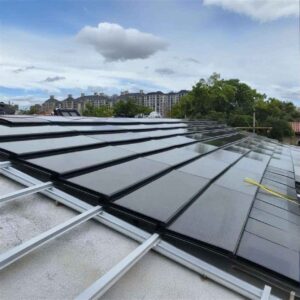
What it is, simply: Glass panels with photovoltaic cells embedded within the glass laminate that generate electricity when sunlight passes through — while simultaneously functioning as a structural building material: facade cladding, skylights, curtain walls, or roof glazing.
VLT (Visible Light Transmission) — the percentage of visible daylight the glass allows through — is the specification parameter that determines the balance between energy generation and transparency. A 30% VLT glass panel passes 30% of visible light and absorbs the rest for electricity generation. Commercial office applications typically specify 25–40% VLT to balance occupant comfort with generation output.
The reason this matters commercially: there is no rack-mounted solar panel equivalent for a glass facade. Transparent solar glass doesn’t compete with rooftop panels — it opens building surfaces that conventional solar simply cannot address.
How It Works and Why Building-Integrated PV (BIPV) Changes Everything
The mechanism is straightforward. Thin crystalline silicon or thin-film photovoltaic cells are embedded within the glass laminate — the same manufacturing process used for safety glass. The cells absorb a portion of the solar spectrum (typically the UV and infrared ranges) while allowing visible light to pass through. DC electricity generated by the cells travels via embedded conductors to the inverter system.
For architects, developers, and commercial property owners, this resolves a conflict that has stalled thousands of solar decisions: the choice between building aesthetics and energy generation disappears. The glass is the solar panel.
Real-world applications in commercial distribution today:
- Office building curtain walls: South and west-facing glass facades generating 120–160 kWh/m²/year in Southern European or equivalent climate zones
- Retail and hospitality atriums: Glass roof structures combining daylighting with active generation (see the shopping mall and railway station case studies from real-world BIPV projects)
- Industrial greenhouse roofs: Semi-transparent glass generating power while maintaining crop light levels
- Luxury residential facades: BIPV glass replacing conventional cladding in high-value developments, documented to achieve 15.3% sale price premiums in Singapore high-rise projects
The Distribution Advantage: Where Transparent Glass Fits in Your Product Mix
This isn’t replacing traditional panels — it’s opening entirely new market segments with entirely different procurement chains.
The decision-making pathway for a BIPV glass specification involves:
- An architect or facade engineer specifying the glazing system at design stage
- A building developer or owner approving the energy performance case
- A specialist glazing contractor tendering for the installation
- A procurement function buying materials — often through a distributor with technical specification support
This is not the same as selling panels to a rooftop installer. Your route to this market is through architecture practices, commercial developers, and facade contractors — not residential solar installers.
The customer types to prioritize in your BIPV glass strategy:
| Customer Type | Entry Point | What They Need From You |
|---|---|---|
| Commercial real estate developers | New-build specification | Technical specs, energy performance modeling, case studies from comparable projects |
| Glazing and facade contractors | Material supply for specified projects | Reliable lead times, custom sizing capability, technical documentation |
| Architecture practices | CPD presentations, design specifications | VLT options, fire ratings, structural load data, aesthetic samples |
| Industrial and logistics property owners | Energy cost reduction projects | ROI modeling, installation case studies, ITC/incentive data |
| Green building contractors | LEED/BREEAM projects | Certification documentation, carbon offset data |
3. Perovskite and Next-Gen Photovoltaic Materials: Separating Hype From Market Reality
Why Perovskite Matters (Even If Mass Production Isn’t Here Yet)
Your customers are reading about perovskite cells hitting 35% efficiency. They want a straight answer: should they wait for it, invest in it now, or ignore it for the next three years?
Here’s the honest picture based on current data — the kind of clarity that builds distributor credibility.
What it is, simply: Perovskite is a class of crystalline materials with a specific lattice structure that is exceptionally efficient at converting sunlight to electricity. As a photovoltaic material, it has reached 34.85% certified efficiency for perovskite-silicon tandem cells (NREL, April 2025), with LONGi subsequently setting a new world record of 35.5% efficiency for a crystalline silicon-perovskite tandem cell (PV Magazine, July 2026).
These are not laboratory curiosities. They are commercially significant numbers.
Current State of Perovskite Technology: Lab Success vs. Commercial Viability
The commercialization timeline, as of 2026:
| Phase | Status | Key Data Point |
|---|---|---|
| Lab efficiency records | Achieved | 35.5% (LONGi, 2025) |
| Small-scale pilot production | Achieved | Oxford PV first commercial shipments (2024–2025) |
| Commercial module production | Early-stage | UtmoLight: 150 MW pilot line operational; 18.1% module efficiency at commercial size |
| Mass market availability | 2027–2030 estimated | IDTechEx forecasts 85 GW annual perovskite installations by 2035 |
The gaps that still separate lab performance from mass-market availability:
Durability: Perovskite cells degrade faster than silicon under prolonged UV exposure and humidity. The 25-year performance guarantee your commercial clients require is not yet achievable from pure perovskite modules. Perovskite-silicon tandem configurations are more stable, but the manufacturing challenge of combining both cell types at scale remains.
Manufacturing yield: Producing large-format perovskite modules with consistent performance across the entire panel surface is technically harder than silicon. Current commercial-size modules run at 18–20% efficiency — significantly below the lab cell records.
Lead (Pb) content: Many high-efficiency perovskite formulations use lead halides, which creates regulatory compliance concerns in the EU and other markets under RoHS (Restriction of Hazardous Substances) directives.
The global perovskite solar cell market is estimated at USD 465 million in 2026, projected to reach USD 11 billion by 2033 (Coherent Market Insights, 2026). The growth curve is steep — but from a small base.
How to Position Perovskite in Your Sales Strategy Today
You don’t need to be selling perovskite panels to make this technology work for your business right now.
The distributors winning in the commercial and institutional segments are using their perovskite knowledge as a trust-building tool. When a commercial developer asks “should we wait for perovskite?”, the answer that builds credibility isn’t “no, buy silicon now.” It’s:
“Here’s an honest timeline. Perovskite-silicon tandem cells are entering early commercial production in 2026–2027. Full commercial scale with competitive pricing is likely 2029–2031 for most markets. In the meantime, the HJT and bifacial silicon panels available today are already at 22–23% efficiency — here’s what that means for your project’s ROI over the next 10 years, compared to waiting.”
That’s the answer that closes the deal today and retains the client relationship for when next-gen technology does scale. Position yourself as the honest market intelligence source — not a salesperson pushing whatever’s on your current inventory list.
4. Bifacial Panels and Dual-Sided Energy Capture: The Technology Your Customers Are Already Asking About
Why Bifacial Isn’t “Next-Gen” — It’s Here, and You Should Be Selling It
Bifacial panels have crossed the threshold from emerging technology to mainstream commercial product. They’re proven, cost-competitive, and increasingly specified by default in commercial and utility-scale projects. Many of your residential and small-business customers still don’t understand the advantage — and that knowledge gap is a sales opportunity.
What it is, simply: A bifacial solar panel generates electricity from both the front face (direct sunlight) and the rear face (reflected light from the ground or adjacent surfaces, called “albedo”). A standard monofacial panel uses only the front face.
Real-World Performance Gains: What Your Customers Actually Get
The performance numbers from field research are now well-documented and specific:
- A 2024 study in Nature Scientific Reports (Badran et al., 2024) measured seasonal bifacial energy gains of 8.1–12.5% depending on season for vertical installation configurations
- Research in EPJ Photovoltaics reports 25–30% energy yield improvement for utility-scale installations with optimized ground albedo
- Australian rooftop simulation data (Ernst et al., 2024) shows bifacial gains of up to 22.6% depending on roof surface reflectivity
- Long-term field study data (IJSAT, 2026) shows observed bifacial gains up to 19.24% annually
What this means in your sales conversation — translated from specs to outcomes:
| Installation Scenario | Bifacial Gain | What It Means for the Customer |
|---|---|---|
| Ground-mount on light-colored gravel | 20–30% | Payback period reduces by 1.5–2.5 years vs. same-spec monofacial system |
| Rooftop on white TPO membrane | 12–18% | 10–15% more energy from the same roof area — smaller system needed for same output |
| Raised agricultural solar (agrivoltaic) | 15–25% | Captures reflected light from crop canopy — significant for agri-solar installers |
| Commercial flat roof standard | 8–14% | 8–10% improvement on annual output — relevant for demand-charge management |
Stop leading with technical specifications. Lead with the outcome: “A bifacial system on a standard commercial flat roof with light-colored membrane generates approximately 12% more energy per year than an equivalent monofacial system. For a 500 kW commercial installation at $0.15/kWh, that’s roughly $9,000–$13,000 in additional annual energy value — from the same installation footprint.”
Installation Considerations and Margin Opportunities
Bifacial panels require specific installation conditions to deliver their performance advantage:
- Clearance height: Minimum 0.5–1.0 m above the ground or roof surface to allow rear-face irradiance
- Ground cover: Light-colored or reflective surfaces (white gravel, concrete, light-colored membrane) significantly improve bifacial gain — dark-colored rooftops reduce the advantage
- Row spacing: Wider row spacing reduces rear-face shading from adjacent panel rows — important in utility-scale design
The installation complexity creates two distribution opportunities: First, bifacial-optimized mounting hardware (elevated racking, white ground reflectors) is a natural add-on sale. Second, your ability to provide bifacial-specific system design guidance — which most commodity competitors don’t offer — positions you as the technically credible partner who earns the order even when a competitor quotes lower.
5. Tandem Solar Cells: The Efficiency Breakthrough Your High-End Clients Need to Know About
Stacking Technologies for Next-Level Efficiency
Tandem solar cells — also called multi-junction cells — stack two or more photovoltaic materials on top of each other, each absorbing a different portion of the solar spectrum. The most commercially significant configuration is the perovskite-silicon tandem, which combines a crystalline silicon bottom cell with a perovskite top cell.
Why this matters in simple terms: A single silicon solar cell is physically limited to converting approximately 29.4% of incoming solar energy (the Shockley-Queisser theoretical limit). A perovskite-silicon tandem can theoretically convert close to 44%, because the two materials together capture a wider range of the solar spectrum. At 35.5% efficiency already demonstrated at cell level, tandem technology is closing in on that ceiling.
Efficiency Gains That Justify Premium Pricing
In practical distribution terms, tandem efficiency matters most for two customer types:
Space-constrained commercial installations: A customer with 500 m² of available rooftop who currently specs a standard 20% efficiency system gets 100 kWp from that area. At 30% efficiency (achievable with tandem cells at commercial scale within 3–5 years), the same area yields 150 kWp — a 50% output increase with no additional installation footprint. For urban commercial rooftops where available area is genuinely limited, this is a transformational ROI improvement.
Premium residential where aesthetics constrain panel count: Luxury residential clients who want minimal visible panel coverage — or who are working with specific architectural constraints — benefit significantly from efficiency gains. Fewer panels for the same output means cleaner aesthetics and often lower installation labor cost.
The current efficiency reference points for your sales conversations:
| Technology | Best Lab Efficiency | Commercial Module Efficiency | Market Status |
|---|---|---|---|
| Standard PERC silicon | 23.6% (cell) | 19–21% (module) | Fully commoditized |
| TOPCon silicon | 25.7% (cell) | 21–23% (module) | Mainstream commercial |
| HJT (Heterojunction) | 26.8% (cell) | 22–23.5% (module) | Scaling commercially |
| Perovskite-Silicon Tandem | 35.5% (cell, LONGi 2025) | 18–20% (early commercial modules) | Early commercialization |
| All-perovskite tandem | 34%+ (cell) | Pre-commercial | R&D stage |
Supply Chain Reality: When Can You Actually Source Tandem Panels?
Honest assessment for your planning cycle:
- 2026–2027: First commercial tandem modules available from a small number of manufacturers (Oxford PV, LONGi pilot lines). Very limited volume, high pricing, primarily for premium projects.
- 2028–2030: Volume scaling begins. Pricing starts to approach premium silicon territory. Viable for premium commercial and high-efficiency residential niches.
- 2031+: Broad commercial availability expected. The cost curve will follow the same pattern silicon followed — sharp price declines as manufacturing scales.
For your distribution strategy today: identify one or two tandem technology manufacturers and establish early commercial relationships. You don’t need significant inventory now. You need visibility into their commercialization timeline, pilot project access for reference customers, and a conversation your high-value clients can’t have with your competitors.
6. Heterojunction (HJT) Technology: The Efficiency Upgrade Your Installers Can Install Today
Why HJT Panels Are Gaining Ground Faster Than You Might Think
Unlike perovskite and tandem cells, HJT technology is not a future story. The HJT solar panel market was valued at USD 4.32 billion in 2025 and is projected to reach USD 14.36 billion by 2034, growing at 14.2% CAGR (DataIntelo, 2025). Major manufacturers including REC Group, Panasonic (HIT technology), and Chinese tier-1 producers are supplying HJT at commercial scale.
What it is, simply: HJT panels combine thin amorphous silicon layers with crystalline silicon in a structure that dramatically reduces electron recombination — the primary mechanism by which solar cells lose energy. The result is higher efficiency and significantly better temperature performance than standard silicon.
Key specification comparison:
| Parameter | Standard PERC Silicon | HJT Panel | Practical Difference |
|---|---|---|---|
| Module efficiency | 19–21% | 22–23.5% | 10–20% more power per m² |
| Temperature coefficient | -0.35 to -0.45%/°C | -0.24 to -0.26%/°C | 15–20% less efficiency loss on hot days |
| Annual degradation rate | 0.5–0.7%/year | 0.3–0.4%/year | ~6% more cumulative energy over 25 years |
| Bifacial factor | 65–75% | 90–95% | Significantly better rear-face performance |
| Payback premium vs. standard (hot climates) | — | 6–9 years on premium | Better long-term economics in warm regions |
Source: Heaven Green Energy HJT vs. TOPCon comparison, 2026
Performance Advantages That Translate to Customer ROI
The temperature coefficient advantage deserves specific attention for distributors serving hot-climate markets (Middle East, Southeast Asia, Southern Europe, Australia, Southwestern U.S.).
Standard silicon panels lose approximately 0.4%/°C of efficiency above 25°C operating temperature. On a 45°C roof surface — common in Phoenix, Dubai, or Singapore — that’s an 8% efficiency reduction compared to rated output.
HJT panels, at -0.24%/°C, lose only approximately 4.8% under the same conditions. For a 10 kW residential system, that difference represents:
$$\text{Additional Annual Energy} = 10\text{kW} \times 3.2% \times 5\text{ hrs/day} \times 365 = 584 \text{ kWh/year}$$
At $0.15/kWh, that’s $87/year more energy value — every year, for 25 years — from the same roof area. Over a full system life, cumulative advantage exceeds $2,175 per 10 kW system for the customer’s energy bill, before accounting for the lower degradation rate.
That’s the conversation that justifies the premium price. Not “HJT is more efficient” — but “here’s exactly how much more energy value your customer captures over 25 years compared to a standard panel, based on their local climate.”
Competitive Positioning: How to Stock HJT Without Cannibalizing Standard Panel Sales
The concern most distributors raise: “If I start stocking HJT, will I kill my existing PERC/TOPCon business?”
The answer is no — if you segment correctly:
| Customer Segment | Recommended Technology | Rationale |
|---|---|---|
| Hot-climate residential (>35°C typical summer) | HJT priority | Temperature coefficient delivers measurable additional value; premium justified |
| Space-constrained commercial (<50 m² per kW needed) | HJT priority | Higher efficiency per m² resolves the space constraint |
| Cost-sensitive residential (price is primary decision factor) | Standard TOPCon | Market-rate product; protect volume |
| Large-area ground mount (space is not constrained) | Bifacial TOPCon | Best cost-per-kWh at scale |
| Premium residential (aesthetics + performance) | HJT or BIPV glass | Position as the intelligent upgrade |
| Commercial facade BIPV | Transparent PV glass (Jia Mao BIPV) | No standard panel equivalent; entirely different market segment |
HJT and BIPV glass expand your addressable market. They don’t compress it.
7. Integrated Energy Storage and Smart Solar Systems: The Bundle Your Customers Want
 Commercial clients are no longer evaluating panels and batteries separately. The system integration opportunity is where distributor margin expansion is happening.
Solar Panels Alone Aren’t Enough Anymore — Your Customers Know It
The commercial installers and EPC firms you distribute to are experiencing a fundamental shift in what their clients want. In 2023, a commercial customer bought solar panels. In 2025, they’re asking for energy management systems: generation, storage, demand response, and monitoring in a single integrated solution.
This is not a technical trend. It’s a business reality that reshapes distribution strategy. A distributor who supplies panels and stops there is leaving a significant portion of the project value on the table.
How Next-Gen Panel Technology Enables Better System Performance
High-efficiency panels and integrated storage create compounding benefits:
- HJT + storage: HJT panels’ lower temperature coefficient means more midday generation at peak grid stress periods — exactly when battery charging is most economical and demand charge reduction is most valuable
- Bifacial + east-west mounting: Bifacial panels mounted east-west on commercial flat roofs capture both morning and evening peaks — extending the solar generation profile and improving battery state-of-charge across a longer daily window
- BIPV glass + building management system: When BIPV glass is connected to the BMS (Building Management System), real-time generation data integrates with HVAC and lighting controls for whole-building energy optimization — a capability that attracts premium specification from intelligent building developers
The system integration value proposition isn’t complicated: more hours of self-generated power, fewer hours on expensive grid supply, smaller backup generator requirements. For a commercial facility manager, that translates directly to reduced utility bills, lower demand charges, and improved energy security.
Your Role in the System Integration Value Chain
The critical positioning shift for distributors who want to capture the integrated system market:
From: “We supply solar panels — you figure out the rest.”
To: “We supply optimized solar systems — panels, storage, monitoring, and the design guidance that connects them.”
You don’t need to become a software company or a battery manufacturer. You need to build preferred-partner relationships with:
- One or two battery storage suppliers (matched to the scale of projects your customers manage)
- An energy monitoring software provider that your installer partners can use without deep technical training
- Structural and electrical engineering partners who can provide bankable system design documentation for commercial clients
The distributors who structure these partnerships create a system solution their competitors can’t easily replicate. Jia Mao BIPV’s technical resources include system design guidance specifically for BIPV + storage configurations in commercial buildings.
8. Manufacturing Sustainability and Supply Chain Transparency: What Your Customers Are Actually Asking About
“Where Are These Panels Made?” Is Now a Business-Critical Question
Twelve months ago, this was an occasional question from sustainability-conscious buyers. Today, it’s a formal procurement requirement for commercial enterprise clients, institutional buyers, and any project requiring ESG disclosure.
The drivers:
- EU Carbon Border Adjustment Mechanism (CBAM): Requires documented carbon footprint data for products entering the EU market, including solar panels from non-EU manufacturers
- U.S. Uyghur Forced Labor Prevention Act (UFLPA): Restricts solar products with supply chain links to Xinjiang polysilicon — affecting the majority of Chinese-manufactured panels
- ESG reporting mandates: Commercial building owners required to disclose Scope 3 emissions (supply chain) under ISSB and GRI standards increasingly need product-level carbon documentation
China controls 78–97% of global solar PV manufacturing capacity across the supply chain (Klein Center, UPenn, 2025). That concentration creates both supply security and compliance risk for distributors serving regulated markets.
How to Evaluate and Communicate Manufacturing Standards
The certifications and documentation your commercial customers will request:
| Certification / Standard | What It Covers | Why It Matters |
|---|---|---|
| IEC 61215 | Performance and durability testing for PV modules | Industry baseline — mandatory for credible commercial supply |
| IEC 61730 | Safety qualification for PV modules | Required for installation in most markets |
| UL 61730 | U.S. safety standard | Required for U.S. utility and commercial projects |
| ISO 9001 | Quality management system at manufacturer | Demonstrates process discipline, not just product testing |
| INMETRO (Brazil) / MCS (UK) | Market-specific certification | Required for local incentive schemes and grid connection |
| Carbon Footprint LCA | Life cycle carbon assessment of panel manufacturing | Required for EU CBAM, ESG reporting, LEED v4.1 |
| UFLPA Compliance Documentation | Supply chain traceability audit | Required for U.S. market entry post-2022 |
| Intertek / Bureau Veritas Third-Party Audit | Manufacturing facility audit | Provides independent verification of claimed standards |
When evaluating suppliers for your next-gen technology lineup, request this documentation proactively — before your customer asks for it. The distributor who arrives at a commercial procurement meeting with a compliance document pack already assembled is perceived as a professional partner. The distributor who responds to compliance questions with “I’ll check with the manufacturer” is perceived as a risk.
Navigating Tariffs, Trade Policy, and Supply Chain Risk
The tariff landscape for solar products entering the U.S. and EU markets is genuinely complex and actively changing:
- U.S. Section 201 safeguard tariffs apply to crystalline silicon modules; the first 12.5 GW of cells imported annually is exempt
- Anti-dumping and countervailing duties (AD/CVD) apply to Chinese-origin panels through various third-country manufacturing arrangements
- EU anti-dumping investigation on solar panels from China was reinstated in 2024, affecting pricing for EU-market distributors
The practical strategy for risk mitigation:
- Diversify your supplier base — avoid 100% dependency on a single manufacturing country for your core product line
- Maintain 90-day inventory buffer on high-velocity products — tariff changes and shipping disruption historically require 60–90 days to work through pricing structures
- Build non-China supply relationships — Malaysian, Vietnamese, Indian, and European BIPV glass manufacturers are expanding capacity; qualifying a second source for each product category protects your business
- Document everything — maintain full supply chain traceability records for all products; your commercial customers will ask for them
For BIPV glass specifically, the production concentration is lower than standard silicon panels, giving distributors more geographic supply diversification options.
9. The Economics of Upgrading: When to Push Next-Gen Tech and When to Hold Back
Not Every Customer Needs the Latest Technology (And That’s Okay)
The distributor who recommends next-gen technology on every project will quickly lose credibility. The distributor who can explain, with specific reasoning, exactly when next-gen tech delivers genuine ROI — and when standard silicon is the smarter choice — is the one customers trust.
Here’s the honest framework.
Cost-Benefit Analysis Framework for Your Sales Team
When each technology genuinely earns its premium:
Transparent BIPV glass: recommend when
- Customer is replacing or specifying building cladding or glazing (the incremental cost vs. conventional glass is 35–60%, not the full BIPV price)
- Building has significant south or west-facing facade area (>500 m² is where economics become compelling)
- Client has ESG reporting requirements or LEED/BREEAM certification target
- Aesthetic requirements preclude conventional rooftop panels
HJT panels: recommend when
- Installation climate averages >30°C in peak summer (temperature coefficient advantage is measurable)
- Available roof area is constrained relative to output target (efficiency per m² justifies premium)
- Customer is comparing system performance over a 20+ year horizon (lower degradation compounds significantly)
Bifacial panels: recommend when
- Ground-mount or elevated flat-roof installation with light-colored surface
- Row spacing can be designed for adequate rear-face clearance (>0.5m)
- Commercial installation where 12–25% additional energy yield directly affects demand charge management
Standard PERC/TOPCon: recommend when
- Cost per watt is the primary decision driver
- Shaded or complex roof installation (bifacial advantage is diminished in partial shade)
- Roof surface is dark-colored (limits bifacial rear-face irradiance)
- Customer has a short ownership horizon (<7 years) where efficiency premium doesn’t compound meaningfully
Wait for perovskite tandem when:
- Your customer is specifying a system in 2028 or later and efficiency gain is critical
- Project timeline allows for 18–24 months of product development monitoring
Pricing Strategy for Your Distribution Business
The tension every distributor faces: volume requires competitive pricing; margin requires premium positioning. The resolution is customer segment pricing — not product-level pricing.
The same HJT panel at a different price point, depending on:
| Segment | Pricing Approach | Rationale |
|---|---|---|
| Commercial enterprise (>500 kW) | Volume-based tiered pricing | Relationship depth and specification support justify margin; compete on value, not price |
| Mid-market commercial (50–500 kW) | Market rate + service premium | Bundle with design support, warranty, monitoring — protect margin with service value |
| Small commercial / premium residential | Efficiency-value pricing | Customer ROI justifies premium; present as investment, not cost |
| Cost-sensitive residential | Competitive market pricing | Protect volume; reduce service component; manage cost of sale |
The margin protection strategy that works: never compete on panel price alone in the premium segments. Every premium technology recommendation should come with a total value package — installation guidance, performance modeling, warranty documentation, and ongoing monitoring support. This service layer is margin that a commodity competitor cannot easily replicate.
10. Building Your Competitive Advantage: Becoming the Distributor Who Understands Tomorrow’s Technology
 Technical expertise is the distribution asset that price competition cannot erode. The distributor who educates wins the relationship before the RFP opens.
Education as Your Competitive Moat
Your competitors might have similar products. They probably don’t have your expertise — and in the commercial and institutional solar segments, expertise is what determines who gets the specification.
The 2025 solar distribution market is bifurcating: commodity panel distributors are being compressed by margin erosion on one side and direct manufacturer sales on the other. Knowledge-based distributors — those who can provide genuine technical guidance, honest market intelligence, and system-level thinking — are experiencing expanding margins and deeper customer relationships in the same market conditions.
The reason is simple: as technology complexity increases, the buyer’s dependence on knowledgeable suppliers increases. BIPV specification, HJT system design, tandem cell timeline planning — none of these decisions can be made from a price sheet.
Training Your Sales Team to Speak Confidently About Innovation
Practical resources for building your team’s technical fluency:
Internal training structure:
- Monthly technology briefings (30 minutes, covering one technology per session: this month bifacial performance data, next month HJT temperature coefficient, following month perovskite timeline update)
- Product sample library — physical samples of each technology type your team is discussing
- Client scenario library — documented cases from your own customer base showing real outcomes for each technology type
Conversation frameworks your team needs:
Instead of: “This panel is 22% efficient.” Use: “This panel generates 10–15% more energy from the same roof area as a standard panel. For your 2,000 m² facility in [customer’s city] at current electricity rates, that’s approximately $X more energy value per year over the system’s life — here’s the 25-year comparison model.”
Instead of: “BIPV glass generates electricity.” Use: “The glass replacement you already have budgeted for next year’s facade renovation — what if that renovation budget generated a return for the next 25 years instead of just replacing an existing cost? Here’s the energy model for a building like yours in [climate zone].”
Instead of: “Perovskite is coming soon.” Use: “Perovskite-silicon tandem cells are in early commercial production now. Full market availability is 3–5 years out. Here’s why the system I’m recommending today is the smart choice for your current project timeline — and here’s how we’d approach the conversation differently if your installation date were 2029.”
Positioning Yourself as the Market Intelligence Partner Your Customers Need
The relationship that transcends price competition is built on one currency: reliable, honest, specific information.
Your commercial customers — commercial developers, facility managers, institutional procurement teams — are inundated with solar marketing material that overpromises and underspecifies. The distributor who provides honest market intelligence — including when not to buy a product, and when a technology timeline is genuinely uncertain — earns a level of trust that no discount can buy.
Practical ways to build this position:
- Quarterly technology update newsletter (500–700 words, one technology topic, specific data, honest timeline assessment) — distributed to your top 50 commercial accounts
- Site-specific energy modeling offered as a standard part of your commercial sales process — not a brochure, but a project-specific analysis based on the customer’s actual building, climate, and energy profile
- Reference installation program — documented outcomes from customers who have used your products, organized by sector and building type, available to prospects facing similar decisions
For BIPV glass specifically, the case study library at Jia Mao BIPV provides documented real-world performance data across 10 building types — office towers, industrial facilities, hospitals, transport hubs — that you can reference directly in commercial sales conversations.
🎥 Watch: Understanding Next-Generation Solar Technologies

This video breaks down the perovskite breakthrough in plain language — exactly the kind of context your team needs before meeting with customers who’ve read the headlines. Use it as a pre-meeting briefing resource for your commercial sales team.
The Window for Competitive Advantage Is Open Now
The solar industry is in a genuine innovation cycle. Technologies that seemed theoretical two years ago are commercially available or rapidly approaching market readiness:
- Transparent BIPV glass is generating electricity on commercial facades in Frankfurt, Rotterdam, Singapore, and Dubai — right now
- Bifacial panels are delivering 11–25% more energy in real-world field installations — and your customers’ installers can spec them today
- HJT technology is in commercial production at scale, with a 14.2% CAGR that confirms the market has moved past the early-adopter phase
- Perovskite-silicon tandem cells hit 35.5% efficiency in 2025 — commercial availability at scale is within a 3–5 year planning horizon
The distributors who thrive in the next 3–5 years won’t be the ones with the cheapest commodity panels. They’ll be the ones who understand their customers’ challenges, speak confidently about emerging technology, and make smart decisions about which innovations to stock, promote, and position.
Start now. Your customers are already asking questions. Make sure you have the answers.
Position Your Distribution Business as an Innovation Leader
Ready to move from commodity supplier to technical partner?
Download the complete Next-Gen Solar Technology Buyer’s Guide for Distributors — featuring detailed technology comparison charts, customer segmentation framework, margin analysis by technology type, and sales conversation templates.
👉 Explore BIPV Products and Specifications
👉 View Real-World BIPV Case Studies
👉 Join the Jia Mao BIPV Distributor Partnership Program
Or schedule a consultation with the Jia Mao BIPV technical team to discuss which technologies make the most sense for your specific distribution market and customer base.
Glossary: Key Solar Technology Terms Defined
BIPV (Building-Integrated Photovoltaics): Solar technology embedded directly into building materials — glass facades, roofing, windows — that simultaneously functions as a structural component and electricity generator. Distinct from “Building-Applied PV” (BAPV), which is mounted on top of existing building structures.
VLT (Visible Light Transmission): The percentage of visible daylight a glass panel transmits. Higher VLT = more transparency = less power generation per m². Typical commercial BIPV: 20–40% VLT. Example: A 30% VLT panel allows 30% of visible light through — comfortable for office environments — while absorbing the remaining spectrum for power generation.
Perovskite: A class of crystal materials (named after Russian mineralogist Lev Perovski) that are highly efficient at converting light to electricity. Current record: 35.5% efficiency for perovskite-silicon tandem cell (LONGi, 2025). Think of it as a turbocharger stacked on top of a silicon engine — each absorbs a different part of the solar spectrum.
HJT (Heterojunction Technology): A solar cell architecture combining thin-film amorphous silicon layers with crystalline silicon, producing lower recombination losses, higher efficiency, and significantly better temperature performance than standard silicon. The temperature coefficient of -0.24%/°C vs. -0.40%/°C for standard PERC means measurable additional energy value in hot climates.
Bifacial Gain: The additional energy generated by a bifacial panel’s rear face, expressed as a percentage of front-face output. Depends on ground albedo (reflectivity), clearance height, and shading. Example: 15% bifacial gain on a 10 kW system = 1.5 kW of additional equivalent capacity from the same hardware.
Temperature Coefficient: The rate at which a solar panel’s power output decreases per degree Celsius above 25°C (standard test condition). Standard silicon: approximately -0.35 to -0.45%/°C. HJT: -0.24 to -0.26%/°C. Lower is better — it means less performance loss on hot summer days when electricity demand is highest.
Albedo: The reflectivity of a surface, expressed as a percentage. White concrete reflects approximately 30–50% of incident light; dark bitumen reflects only 5–10%. Higher albedo beneath bifacial panels = more rear-face irradiance = higher bifacial gain.
ITC (Investment Tax Credit): U.S. federal tax credit for solar energy installations — currently 30% of the eligible system cost through 2032 under the Inflation Reduction Act. Applies to both commercial and residential solar, including BIPV systems.
Tandem Solar Cell: A multi-junction cell stacking two or more photovoltaic materials to capture a broader range of the solar spectrum. Perovskite-silicon tandem cells currently hold world efficiency records at 35.5%. Think of it as two solar cells sharing the same piece of glass — one absorbs blue/UV light, the other absorbs red/infrared.
EPC (Engineering, Procurement, and Construction): The contracting model for commercial solar projects where a single firm manages the complete scope from design through installation. Critical for large commercial BIPV projects where the buyer needs single-point accountability for both the building element and the electrical system.
FAQs: Next-Generation Solar Technology for Distributors and Agents
1. What’s the real difference between bifacial and standard panels, and when should I recommend one over the other?
Bifacial panels generate electricity from both faces — front (direct sunlight) and rear (reflected light from the ground or surface below). Real-world data shows 8–25% additional annual energy output depending on installation conditions. Recommend bifacial when: the installation surface is light-colored or reflective (white membrane, concrete, light gravel), the mount height allows at least 0.5m clearance above the surface, and the application is ground-mount or elevated flat-roof commercial. For dark rooftop applications or heavily shaded sites, the rear-face advantage is minimal and standard panels offer better cost-per-watt value.
2. Is transparent solar glass ready for commercial projects, or should I tell my contractor customers to wait?
Transparent BIPV glass is commercially available and commercially proven right now. The global BIPV market reached USD 21.4 billion in 2024. Real-world case studies document payback periods of 5–13 years across office buildings, industrial facilities, retail centers, and transport infrastructure. The products are IEC-certified, carry 25-year warranties, and have been installed on buildings ranging from regional shopping malls in Spain to luxury towers in Singapore. The right question for your customers isn’t “is it ready?” — it’s “is my building type a good candidate?” Buildings undergoing scheduled glazing replacement or new construction with significant facade glass areas are the strongest economic candidates.
3. How much more efficient is perovskite technology really, and when will it be available at scale?
At cell level, perovskite-silicon tandem cells have achieved 35.5% efficiency (LONGi world record, 2025) versus ~22% for the best commercial silicon modules today. At commercial module scale, early production perovskite cells are achieving 18–20% — meaningful improvement is still in progress. Mass-market commercial availability at competitive pricing is realistically 2028–2031 for most markets. The honest recommendation for your customers: don’t delay a project with a 2025–2027 installation window waiting for perovskite at scale. Specify the best available silicon technology now; the ROI case for waiting doesn’t close for most projects.
4. Should I stock HJT panels if I’m already selling standard silicon panels? Won’t they cannibalize my business?
No cannibalization if you segment correctly. HJT earns its premium in hot climates (temperature coefficient advantage is real and measurable), space-constrained installations (efficiency per m² matters), and premium residential markets where long-term performance matters more than upfront cost. Standard PERC/TOPCon remains the right recommendation for cost-sensitive buyers, large ground-mount installations where cost-per-kWp is the primary metric, and markets where electricity rates don’t justify the premium payback. HJT and standard silicon serve different customer needs — stocking both expands your addressable market rather than splitting it.
5. What’s the actual payback period difference between next-gen panels and standard panels for my residential customers?
For a 10 kW residential system in a hot climate ($0.15/kWh, 5 peak sun hours, 35°C summer average):
- Standard PERC (20% efficiency): Annual output ~7,300 kWh; 25-year cumulative ~176,000 kWh (accounting for 0.6% annual degradation)
- HJT (22.5% efficiency, better temp coefficient, lower degradation): Annual output ~8,200 kWh; 25-year cumulative ~204,000 kWh
- Difference: ~28,000 kWh over 25 years × $0.15 = ~$4,200 additional value from the same roof area
If the HJT premium is $1,000–$1,500 over standard panels, the payback on the premium is 6–9 years — after which the customer earns $150–$200/year more from the HJT system for the remaining life. Present the comparison as a 25-year financial decision, not a hardware price comparison.
6. How do I explain tandem solar cells to customers without sounding like I’m overselling them?
Simple analogy: “A standard silicon solar panel is like a radio that only receives FM frequencies — it converts its specific range of the solar spectrum to electricity and lets the rest pass through as heat. A tandem cell stacks two different materials — like adding AM reception to the same radio. Each layer absorbs a different part of the solar spectrum. The result is 35%+ efficiency versus 22% for standard silicon. At commercial scale, this is 3–5 years from broad availability. For a project starting today, the better conversation is about HJT or bifacial — both of which deliver real efficiency improvements and are in your warehouse next week.”
7. What supply chain risks should I be aware of with emerging solar technologies?
The key risks: U.S. UFLPA compliance requires supply chain traceability auditing for products with Xinjiang polysilicon content — affecting most Chinese-manufactured silicon panels. EU CBAM requires carbon footprint documentation for products entering the EU market. Emerging technology supply chains (HJT, perovskite) are more geographically concentrated than standard silicon, with fewer backup suppliers. Practical mitigation: qualify a second source for every core product category; maintain 90-day inventory buffers on high-velocity products; request compliance documentation from all suppliers before you need it for a customer tender.
8. Are next-gen solar panels worth the premium pricing, or am I just paying for hype?
Depends entirely on the application. HJT is worth the premium in hot climates and space-constrained installations — the performance data is real and the ROI calculation closes within a typical project planning horizon. BIPV glass is worth the premium when it replaces conventional building materials (the incremental cost vs. conventional glazing is 35–60%, not 100%). Bifacial is worth the premium for ground-mount and elevated flat-roof commercial — the additional energy yield is field-verified. Perovskite tandem at current pricing and availability is premium pricing for early-adopter access — worth it for a reference project or pilot, not yet for volume distribution. The honest answer always requires a project-specific calculation — not a blanket recommendation.
9. How should I position battery storage alongside next-gen solar panels?
Integrated positioning: higher-efficiency panels (HJT, bifacial) generate more energy during solar production hours — which means more opportunity to charge storage during cheap/free solar generation periods and more discharge capacity available during peak demand. For commercial clients subject to demand charges (typically 30–50% of their utility bill), an HJT + battery system that flattens their peak demand profile can deliver combined savings that neither technology achieves independently. Present storage as the completion of the system, not an add-on — and calculate the combined ROI, not just the panel ROI.
10. What certifications and standards should I verify before stocking new solar technologies?
Minimum verification checklist for any new product in your lineup: IEC 61215 (module performance), IEC 61730 (safety), UL 61730 (for U.S. market), ISO 9001 (manufacturer quality management), and supply chain traceability documentation for your key markets. For BIPV glass specifically, also verify: fire resistance classification (EN 13501, ASTM E84, or local equivalent), structural glazing certification (EN 12150 or local laminated safety glass standard), and BMS integration protocol documentation. For the U.S. market specifically, verify UFLPA compliance documentation before any product enters your inventory — a post-import compliance failure is significantly more costly than a pre-import verification process.
11. How quickly are next-gen technologies dropping in price, and should I wait to stock them?
BIPV glass: pricing has declined approximately 15–20% over the past 3 years as production scales — but supply is still constrained relative to growing demand, and price is not the barrier to adoption (specification complexity and customer education are). HJT: declining at ~8–12% per year as Chinese manufacturers ramp capacity; the premium over standard silicon has compressed from 30% to approximately 12–18% over 2 years. The “wait for lower prices” strategy has a hidden cost: every month you’re not positioned in the HJT or BIPV market is a month your technically-informed competitor is building reference installations and distributor relationships you’ll have to buy your way into later.
12. Which next-gen solar technology should I prioritize for my distribution business first?
Sequence based on market readiness and margin opportunity: (1) BIPV glass — if your customer base includes commercial developers, architects, or green-building contractors. Highest margin, lowest competition from commodity distributors, 17% CAGR. (2) Bifacial panels — if you serve commercial installers with flat-roof or ground-mount work. Proven technology, measurable performance advantage, natural add-on sale. (3) HJT panels — if you serve hot-climate markets or premium residential customers where efficiency and temperature performance are quantifiably valuable. (4) Tandem/perovskite — build supplier relationships and market knowledge now; don’t prioritize inventory investment until 2027–2028.
13. How do I train my sales team to confidently discuss emerging solar technologies?
Three-part approach: (1) Monthly 30-minute internal technology briefings — one technology, real data, specific sales conversation examples. Keep it applied, not academic. (2) Physical product samples — HJT panels and BIPV glass samples in your showroom or sales kit. Customers who can hold the product make faster decisions. (3) Scenario-based role play — practice “a commercial customer asks whether they should wait for perovskite” or “an installer asks why HJT is worth the premium.” The ability to answer confidently under customer pressure requires rehearsal, not just product knowledge.
14. What’s the difference between manufacturing sustainability claims and actual environmental impact?
The distinction matters increasingly for commercial and institutional buyers who face ESG audit requirements. A claim: “Our panels are eco-friendly.” A verifiable statement: “This panel’s lifecycle carbon assessment shows a manufacturing carbon cost of X kg CO₂ equivalent, with a carbon payback period of 2.1 years at [specific climate zone’s grid carbon intensity].” Verifiable sustainability requires third-party Life Cycle Assessment (LCA) documentation, ISO 14040/14044 methodology, and specific carbon intensity data. IEC TS 63209 is the technical specification for PV module LCA. Any supplier offering sustainability claims should be able to back them with LCA documentation — if they can’t, the claim is marketing, not data.
15. Should I partner with multiple suppliers for next-gen technologies, or go exclusive with one?
For commodity silicon panels, multi-supplier strategy protects against supply disruption and maintains negotiating leverage. For BIPV glass and premium technologies, the calculus is different. A deep exclusive or preferred-supplier relationship with a manufacturer like Jia Mao BIPV provides: access to custom sizing and specification support that spot-buyer competitors don’t get, technical documentation depth that closes specification-led commercial deals, priority allocation during supply-constrained periods, and joint marketing resources (case studies, technical content, reference installations) that compound over time. The right structure for emerging technology is exclusive or preferred on specific high-value product lines, combined with multi-source capability on volume commodity products.
For BIPV product specifications, distributor partnership programs, and regional market support, visit www.jmbipvtech.com — or explore our top BIPV products and price guides to start building your next-gen product lineup today.