The Ultimate Skylight Shade Buyer’s Guide: Controlling Heat, Glare, and Energy Costs
Maximize your solar product portfolio and customer satisfaction by understanding how skylight shades integrate with renewable energy systems. This guide equips distributors and solar agents with the knowledge to reduce customer energy costs by up to 30% and position your business as a trusted integrated energy efficiency partner.
Introduction: Why Skylight Shades Matter for Your Solar Business
A solar customer who invests $25,000 in rooftop panels and then watches their summer cooling bills remain stubbornly high is a customer with a problem you didn’t solve. The reason is simple: approximately 76% of the sunlight striking a standard skylight enters the building as heat. When that heat drives up HVAC load, it directly offsets the value of the solar energy being generated — creating what building scientists call the “solar energy paradox”: you generate power on the roof while your cooling system consumes it inside.
Skylight shades are the direct answer to this problem. Properly specified and installed, they reduce solar heat gain through skylights by 40–70%, cut cooling-season HVAC energy use by 20–30%, and when integrated with motorized systems and solar monitoring platforms, create a fully managed building energy environment that maximises the ROI of your customer’s entire renewable energy investment.
The broader market opportunity is significant. The global blinds and shades market reached $7.14 billion in 2025 and is projected to reach $9.85 billion by 2034. The electric blinds segment in the US alone is forecast to grow from $320 million in 2024 to $2.5 billion by 2034 — a 7.8× expansion driven by smart home adoption and energy efficiency mandates. For solar distributors, agents, and builders with an existing customer base, skylight shades represent a cross-sell opportunity with high margin, low competition, and direct measurable value added to customers who already trust you.

Section 1: Understanding Skylight Shades and Their Core Functions
What Are Skylight Shades and Why They’re Essential
A skylight shade is a covering system — fabric, film, or panel — installed at a skylight opening to modulate the quantity, quality, and thermal impact of the light passing through. Unlike vertical window treatments, skylight shades must manage light and heat arriving from directly overhead, where solar angles are steepest and thermal gain is most intense.
They are installed in three configurations: interior-mounted (inside the skylight curb), exterior-mounted (above the glazing, where they intercept radiation before it enters the glass), and between-glass (within the sealed unit of a double-glazed skylight). Each configuration has distinct performance characteristics that matter for product specification — covered in Section 5.
Three Key Problems Skylight Shades Solve
For solar distributors, framing skylight shades around these three customer pain points creates a sales narrative that resonates with both residential and commercial buyers:
Heat Control: An unshaded south-facing skylight in a commercial building can be responsible for 30–50% of the peak cooling load in that zone during summer afternoons. Quality skylight shades reduce solar heat gain by 40–70%, with high-reflectance exterior shades achieving the upper range. For a 5,000 sq ft commercial office with four large skylights, this can translate to $8,000–$15,000 in annual HVAC savings in a hot climate — a figure that is immediately compelling in a customer ROI conversation.
Glare Reduction: Skylights focused on workspaces or retail environments frequently cause glare complaints that reduce productivity and customer dwell time. A commercial lighting study published in the Journal of Daylighting found that uncontrolled glare from skylights reduced measured task performance by 12–18% in office environments. Shades with controlled Visible Transmittance (VT) ratings allow natural light while eliminating direct beam glare — maintaining the psychological and health benefits of daylighting without the comfort penalties.
Energy Cost Savings: The US Department of Energy documents that tightly installed cellular shades reduce heat loss through windows by 40% or more — equivalent to approximately 10% total heating energy savings. When combined with summer cooling reduction, annual energy cost impacts of 15–30% of glazing-zone conditioning costs are well-supported by field data across climate zones.
📖 Essential Terms for Distributor Conversations
- Solar Heat Gain Coefficient (SHGC)
- A number between 0 and 1 measuring how much solar radiation passes through a glazing product as heat. SHGC of 0.30 means 30% of available solar heat enters. Lower SHGC = better for cooling-dominated climates. The most important single performance metric for skylight shade specification in warm climates.
- Visible Transmittance (VT)
- The fraction of visible light (0.40–0.70 µm wavelength) that passes through the product. VT of 0.50 means 50% of visible light passes through — a tinted but functional daylighting level. Higher VT preserves natural light; lower VT reduces glare but also reduces daylight quality.
- R-Value
- Thermal resistance — higher is better for insulation. Double-cell honeycomb shades achieve R-values of 3.25–5.0 versus R-2.5 for standard horizontal blinds. Higher R-value reduces heat loss in winter and delays heat gain in summer, reducing HVAC demand year-round.
- NFRC (National Fenestration Rating Council)
- The independent body that certifies and verifies SHGC and VT ratings for fenestration products in North America. NFRC-certified ratings are independently verified — not manufacturer self-reported. Always prioritise NFRC-certified products in customer proposals.
- ENERGY STAR (Fenestration)
- EPA’s voluntary certification programme for windows, doors, and skylights meeting specific U-factor and SHGC thresholds by climate zone. ENERGY STAR Most Efficient criteria qualify products for the federal 25C tax credit. As of 2024, EPA updated criteria under ENERGY STAR 7.0.
Section 2: Fixed vs. Motorized Skylight Shades — A Distributor’s Comparison
Fixed Skylight Shades: Benefits and Limitations
Fixed shades are non-adjustable fabric or film panels installed permanently in the skylight opening. They deliver consistent, predictable heat and glare reduction at the lowest possible capital cost. For budget-conscious customers in stable climate zones where year-round shading makes sense — hot-arid climates like the US Southwest, Middle East, or tropical Asia — fixed shades represent excellent value and minimal complexity.
The limitation is inflexibility. A fixed shade set at 30% VLT delivers the same light reduction in January as in July — which is comfortable in Phoenix but may create a dark and unwelcoming space in Oslo in winter. For commercial clients with variable occupancy, seasonal operations, or buildings in mixed climates where both heating and cooling seasons are significant, fixed shades force a performance compromise that motorized systems resolve.
Motorized Skylight Shades: Advanced Features and ROI
Motorized skylight shades use electric actuators — typically 24V DC quiet motors — to raise, lower, or tilt fabric panels on demand or automatically in response to sensors or programmed schedules. They connect to building management systems, smart home platforms, and increasingly, solar monitoring software. This connectivity is what transforms a shade from a comfort product into an energy management tool.
In a solar-integrated building, motorized skylight shades can be programmed to open fully on cold winter mornings (maximising solar heat gain and reducing boiler load), close partially on summer afternoons (blocking direct beam radiation while maintaining diffuse daylight), and adjust automatically based on real-time solar irradiance, interior temperature, and electricity price data. The US electric blinds market is growing at an anticipated compound rate toward $2.5 billion by 2034, driven precisely by this smart home and energy management integration capability.
✅ Fixed Shades — Best For:
- Budget-conscious residential customers
- Hot climates where year-round shading is appropriate
- Simple retrofit projects with limited electrical access
- Low-traffic areas where manual adjustment is not needed
- Industrial and warehouse skylights
⚡ Motorized Shades — Best For:
- Commercial offices and retail with variable occupancy
- Buildings with solar panels and energy monitoring
- Multiple skylights requiring centralised control
- Mixed climates needing seasonal optimisation
- Premium residential with smart home integration
Head-to-Head Comparison Table
| Parameter | Fixed Skylight Shades | Motorized Skylight Shades |
|---|---|---|
| Upfront Cost (per skylight) | $150–$500 | $500–$1,800 |
| Installation Complexity | Low — no electrical work | Moderate — requires 24V wiring |
| Heat Reduction Performance | 40–60% (fixed position) | Up to 70% (optimised position) |
| Seasonal Adaptability | None | Fully adaptive via schedule/sensor |
| Solar System Integration | Not possible | Full integration with monitoring apps |
| Smart Home / BMS Compatibility | No | Yes — Alexa, Google, KNX, Lutron |
| Annual HVAC Savings (avg. commercial) | 15–20% | 20–30% |
| Payback Period (energy savings only) | 3–5 years | 5–9 years |
| Lifespan | 10–15 years | 10–15 years (motor: 8–12 years) |
| Maintenance Requirements | Minimal — annual cleaning | Annual cleaning + motor lubrication |
| Distributor Margin Potential | Moderate | High (premium product + installation) |
| Warranty (typical) | 5–10 years fabric; lifetime hardware | 5–10 years fabric; 2–5 years motor |
▶ A practical overview of how motorized cellular skylight shades reduce heat transfer and HVAC demand — covering the insulation mechanism, installation approach, and energy performance data relevant to distributor proposals.
Section 3: Heat Reduction Technology and Energy Savings Quantification
How Skylight Shades Reduce Solar Heat Gain
Solar radiation arrives at a skylight as a combination of direct beam radiation (from the sun’s disc), diffuse sky radiation (scattered light from clouds and atmosphere), and reflected radiation (from surrounding surfaces). A standard double-glazed skylight without shading transmits approximately 55–65% of incident solar energy as heat gain into the building — with peak intensity occurring when the sun angle is highest at midday in summer.
Skylight shades interrupt this heat transfer through three mechanisms: reflection (surfaces with high solar reflectance bounce incoming radiation back before it converts to heat), absorption (dark materials absorb radiation within the shade layer rather than letting it penetrate into the occupied space), and insulation (cellular structures trap air between layers, creating a thermal barrier that slows conductive heat transfer). The best-performing products combine all three mechanisms — reflective outer surfaces, absorptive mid-layers, and honeycomb air pockets — to achieve SHGC values below 0.15 for the combined skylight-plus-shade assembly.
Quantifying Energy Savings for Your Customers
To translate these percentages into customer-facing numbers: a mid-size commercial office building (15,000 sq ft) in Houston, Texas with six 4×4 ft skylights and an annual cooling bill of $28,000 can expect to save $5,600–$8,400 per year from well-specified skylight shade installation. At an installed cost of $12,000–$18,000 for motorized cellular shades, the energy-only payback period is 2.2–3.2 years — before accounting for improved occupant comfort, HVAC maintenance cost reduction, or any available rebate programmes. For a distributor, presenting this calculation in a one-page ROI summary is more powerful than any brochure.
Combining Skylight Shades with Solar Panels
Here is a connection point that most shade distributors miss entirely but that every solar distributor should lead with: solar panel efficiency degrades at high temperatures. Specifically, most silicon solar panels lose 0.3–0.5% of rated output for every 1°C rise above 25°C cell temperature. In a hot summer with cell temperatures reaching 60–70°C, this means 18–22% efficiency reduction — wiping out the output of one in five panels on your customer’s roof during the hottest hours of the day.
While skylight shades do not directly cool rooftop panels, exterior skylight shade systems installed on the building envelope reduce building heat gain, lower interior temperatures, reduce HVAC operation, and reduce the thermal loading on the roof structure — all of which contribute to a cooler overall building thermal environment. More directly, when shade systems are integrated with solar monitoring platforms, they can be programmed to automatically optimise building energy balance: close during peak cooling demand (reducing the load the solar system must power), and open during cooler hours when solar generation is lower.
Section 4: Material Science and Shade Composition

Common Skylight Shade Materials and Their Properties
| Material Type | R-Value | SHGC Reduction | Best Climate Use | Price Range (per unit) |
|---|---|---|---|---|
| Single-Cell Honeycomb | 2.5–3.5 | 30–45% | Mixed climates | $180–$400 |
| Double-Cell Honeycomb | 3.25–5.0 | 40–55% | Heating-dominated | $250–$600 |
| Standard Roller Shade (fabric) | 1.0–2.0 | 20–40% | All climates | $150–$350 |
| Reflective Roller Shade | 1.5–2.5 | 45–65% | Cooling-dominated | $200–$500 |
| Reflective Film (applied) | 0.5–1.0 | 50–70% | Hot climates | $80–$200 (DIY) |
| Cellular-Reflective Hybrid | 3.5–5.5 | 55–70% | All climates | $350–$900 |
| Exterior Solar Screen | 1.0–2.0 | 60–80% | Hot/arid climates | $300–$800 |
For distributors sourcing products, the cellular-reflective hybrid category delivers the broadest performance profile across climate zones — making it the most defensible recommendation for customers who may not know their precise performance requirements. It achieves high SHGC reduction (cooling benefit) while also providing meaningful R-value insulation (heating benefit), without requiring a customer to choose between the two.
Performance Ratings and Standards
When sourcing skylight shade products for your distribution catalogue, three certification indicators are commercially essential. NFRC certification means the SHGC and VT ratings have been independently tested and verified — not self-declared by the manufacturer. This distinction matters because manufacturer-stated SHGC values without third-party verification can overstate performance by 15–30%. For customer proposals, always state “NFRC-certified SHGC of X” rather than “manufacturer-rated SHGC of X.”
ENERGY STAR qualification — particularly the Most Efficient designation — confirms the product meets EPA’s current performance thresholds for the customer’s climate zone and may qualify the installation for federal tax credits under the 25C residential clean energy programme. The EPA’s ENERGY STAR fenestration database is searchable by product and climate zone — bookmark this resource for your sales team.
IECC compliance documentation confirms the product meets regional building energy code requirements — necessary for new construction projects and increasingly required for permitted retrofit work. The Efficient Windows Collaborative’s code overview resource provides current IECC U-factor and SHGC requirements by climate zone in an easily referenced format.
Section 5: Installation, Integration, and Technical Specifications
Installation Best Practices for Distributors and Installers
Precise Measurement
Skylights are frequently non-standard dimensions. Measure the interior frame width and length at three points each (top, middle, and bottom/left to right), use the smallest measurement for inside-mount installations, and verify the frame depth allows the shade mechanism to sit flush without obstructing the skylight glazing or seal. For irregular shapes (pyramid, hexagonal, triangular), custom fabrication is required — confirm fabrication capability and lead time with your supplier before quoting.
Mounting Method Selection
Interior mounting (inside the skylight well) is the most common — cost-effective and accessible for maintenance. Exterior mounting provides the best thermal performance (intercepting radiation before it enters the glass) but requires weatherproofed hardware and is typically only specified for new construction or major renovations. Between-glass mounting is available only in purpose-designed double-glazed skylight units with shade-integrated cavities — primarily applicable to BIPV and smart glass skylight systems.
Weatherproofing and Air Seal Integrity
Cellular shades lose a significant portion of their insulating performance if warm air can bypass the shade edges between the shade and the skylight frame. For maximum thermal resistance, use shade systems with side channels or compression seals that minimise edge air gaps. The US DOE documents that properly sealed cellular shades achieve their stated R-values; improperly fitted shades can perform 30–50% below rated R-value due to edge convection losses.
Electrical Installation for Motorized Systems
Most motorized skylight shades require 24V DC power, supplied via a small transformer from the building’s 120V or 240V supply. Wire routing must reach each skylight location — typically through the ceiling cavity or along conduit within the skylight well. In multi-skylight installations, systems using RF (radio frequency) control can reduce wiring requirements significantly. For integration with solar monitoring or smart home systems, ensure the motor controller is compatible with the target platform (Lutron Caséta, Somfy TaHoma, KNX, or local IP bridging).
Commissioning and Smart System Configuration
For motorized systems integrated with solar monitoring or building management systems, commissioning involves configuring automation triggers (time schedules, irradiance thresholds, temperature setpoints, and occupancy inputs), testing manual override functions, and verifying fail-safe behaviour (most systems default to open position on power failure to prevent darkness). Document the final configuration for the customer’s building manual and provide installer-level access credentials to the customer’s facilities team.
Integrating Shades with Solar and Smart Home Systems
The integration capability that most clearly differentiates motorized skylight shades as part of a solar distributor’s portfolio is real-time coordination with solar production data. Modern shade controllers can receive input from solar monitoring platforms — including SolarEdge, Enphase, SMA, and Fronius systems — via API or local network connection. When solar generation is above a threshold (indicating high irradiance and potential heat gain), shades can be programmed to partially close, reducing cooling demand. When a cloud passes and generation drops below threshold, shades open to restore natural light and reduce artificial lighting load.
This kind of dynamic management is precisely the integrated energy solution that forward-thinking commercial clients are seeking. For distributors positioning as comprehensive energy partners rather than equipment suppliers, this capability is a tangible differentiator. The comparison framework for transparent solar panels with skylights and windows from Jia Mao BIPV provides a useful reference for understanding where shade management fits within the broader BIPV and skylight energy system.
Section 6: Market Positioning and Competitive Differentiation

Building Your Competitive Advantage
The bundling strategy — solar panels + battery storage + skylight shades presented as a single integrated energy management system — is the most effective positioning for solar distributors entering the shade market. The commercial logic is compelling: a customer who buys all three components from a single trusted supplier achieves better system integration, simpler warranty management, and a single point of contact for optimisation support. For the distributor, it increases average project value by 15–35%, improves customer retention through system dependency, and creates a premium positioning that commodity solar panel suppliers cannot replicate.
Pricing strategy for this bundled approach should use value-based rather than cost-plus methodology. If the combined solar + shades installation saves a commercial customer $14,000 per year and payback occurs in under 5 years, pricing the shade component at 20–30% margin above cost is easily justified — and the customer conversation is not about shade prices but about the total energy economics. Train your sales team to lead every shade conversation with the customer’s energy bill, not with the product catalogue.
Identifying and Targeting Customer Segments
Section 7: Customer Education and Sales Enablement Tools
Creating Persuasive Customer Presentations
The most effective sales presentations for commercial skylight shade projects are built on three data inputs specific to the customer’s building: the customer’s current annual HVAC electricity costs (available from utility bills), the total skylight area and orientation, and local climate data (heating and cooling degree days, available free from NOAA or the DOE’s EnergyPlus weather data repository). With these three inputs, a distributor can generate a credible energy savings estimate in 15 minutes using any standard energy cost calculator — and present it as a custom analysis, not a generic brochure claim.
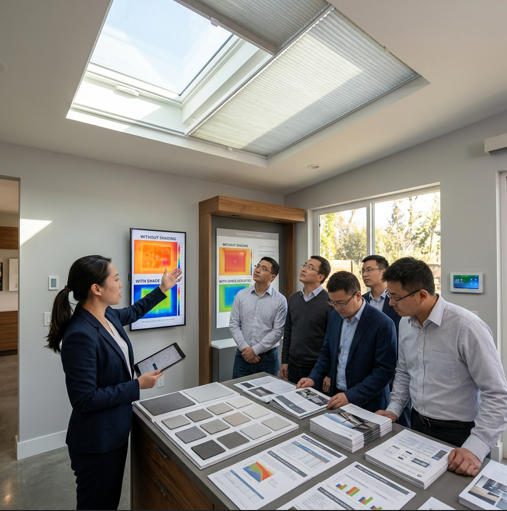
Before-and-after thermal imaging is a powerful visual tool that requires minimal investment. Thermal cameras cost $200–$500 or can be rented, and a single visit to a completed shade installation on a sunny afternoon generates dramatic infrared images showing the temperature difference between shaded and unshaded zones. These images are exceptionally persuasive in commercial sales presentations because they make invisible heat gain physically visible to decision-makers who may be sceptical of energy modelling numbers.
Sales Collateral and Marketing Materials
The materials that generate the highest ROI for skylight shade distributors are: a one-page climate-zone product selector (which shade type for which climate, based on heating/cooling degree days), an ROI calculator worksheet in Excel that inputs local electricity rates and skylight area and outputs annual savings and payback period, and a case study portfolio showing three or four completed installations with metered before-and-after energy data. These three materials can be developed in-house for under $2,000 in design costs and will be used by your sales team in every commercial presentation.
Training Your Distribution Network
Effective installer training for skylight shades covers four domains: measurement and specification (avoiding the most common failure mode — incorrectly sized products), weatherproofing and seal integrity (the performance difference between a properly sealed and loosely fitted cellular shade is 30–50% of R-value), electrical installation for motorized systems (24V DC wiring, transformer sizing, RF vs. hardwired control selection), and smart system commissioning (pairing with solar monitoring platforms, configuring automation rules, and customer handover documentation). Develop a day-long certification workshop that your installer network can attend and update it annually as product ranges evolve. For a complete BIPV and solar installation framework that contextualises shade integration within the broader building energy system, refer to Jia Mao BIPV’s step-by-step BIPV installation and design guide.
Section 8: Regulatory Compliance, Incentives, and Financing Options
Understanding Energy Codes and Building Standards
The International Energy Conservation Code (IECC) sets prescriptive U-factor and SHGC requirements for fenestration — including skylights — in commercial and residential construction. IECC 2021 requirements for skylights are climate-specific: in Climate Zones 1–3 (hot climates, US South and Southwest), maximum skylight SHGC is 0.25 for commercial buildings without daylight controls; in Climate Zones 4–8 (temperate to cold), maximum U-factor of 0.50 is the primary constraint. When a customer’s existing skylights do not meet current code SHGC requirements, adding certified shade systems can bring the combined skylight+shade assembly into compliance — a pathway that many building owners are unaware of and that creates an additional justification for shade investment.
For LEED-certified or LEED-pursuing commercial projects, skylight shade systems contribute to credits under Energy and Atmosphere (EAc1 — reduced energy demand), Indoor Environmental Quality (EQc8.1 — daylighting and views), and Innovation credits for integrated energy management strategies. The USGBC’s technical guidance on LEED certification provides the current credit calculation methodology for fenestration energy performance contributions.
Government Incentives and Rebate Programs
The federal 25C Residential Energy Efficiency Credit applies to qualifying exterior doors, windows, and skylights for residential installations — but shade systems are not currently separately qualifying components under 25C. However, shade systems installed as part of an ENERGY STAR Most Efficient skylight upgrade (where the shade is integral to achieving the qualifying SHGC rating) may be included as part of the total qualifying cost. Always advise customers to confirm current eligibility with a tax professional, as 25C eligibility rules have evolved with recent legislation.
Many state utility rebate programmes explicitly include interior window and skylight shade treatments as eligible measures under residential and commercial energy efficiency programmes. The DSIRE (Database of State Incentives for Renewables and Efficiency) maintained by NC Clean Energy Technology Center is the most comprehensive source of current state and utility incentive data — bookmark this and provide your sales team with regular updates on programmes active in your territory.
Financing Solutions for Your Customers
C-PACE (Commercial Property Assessed Clean Energy) financing is available in 36+ US states and allows commercial property owners to finance energy efficiency improvements — including HVAC load reduction measures like skylight shades — through a property tax assessment repaid over 10–25 years. The key advantage is that repayments are typically structured so monthly energy savings exceed monthly assessment costs from day one, meaning the project is cash-flow positive immediately. The EPA’s Commercial PACE programme overview provides current state availability and programme contact information. For commercial customers who are hesitant about upfront costs, introducing C-PACE financing often converts a “maybe later” to a “yes now” — because the financial barrier disappears entirely.
Section 9: Maintenance, Warranties, and Long-Term Customer Support

Maintenance Requirements and Schedules
| Task | Frequency | Fixed Shades | Motorized Shades | Labour Time |
|---|---|---|---|---|
| Fabric Cleaning | Every 6–12 months | Yes | Yes | 15–20 min/shade |
| Frame and Track Cleaning | Annually | Yes | Yes | 10 min/shade |
| Motor Function Test | Annually | N/A | Yes | 5 min/shade |
| Motor Lubrication | Every 2–3 years | N/A | Yes | 10 min/shade |
| Sensor Calibration Check | Annually | N/A | Yes | 15 min/system |
| Smart System Software Update | As released | N/A | Yes | 10 min/system |
| Weatherstrip / Seal Inspection | Annually | Yes | Yes | 5 min/shade |
| Full System Performance Review | Annually | Optional | Recommended | 30–60 min/site |
Building Long-Term Customer Relationships
Annual maintenance contracts are a direct recurring revenue opportunity for skylight shade distributors that requires minimal capital investment. A commercial customer with 8–12 motorized skylights paying $300–$500 annually for a maintenance contract provides predictable recurring income while simultaneously ensuring the customer’s shades are performing optimally — protecting the energy savings you sold as the justification for the initial investment. When performance data is reviewed annually, it also creates a natural conversation about upgrades, expansions, and complementary products.
Technology upgrade pathways are increasingly relevant as shade automation standards evolve. Customers who purchased motorized systems 5–7 years ago may have controllers that do not support current API integrations with modern solar monitoring platforms. Offering a controller upgrade service — replacing legacy RF controllers with current-generation WiFi or Zigbee units — extends customer relationships, improves system performance, and generates incremental revenue without requiring full shade replacement.
Section 10: Future Trends, Innovation, and Market Outlook
Emerging Technologies in Skylight Shade Solutions
Electrochromic (EC) smart glass skylights represent the most significant emerging competition — and opportunity — for shade distributors. EC skylights change tint electronically, eliminating the mechanical shade entirely. However, current EC skylight glazing costs $150–$300/sq ft installed versus $30–$80/sq ft for standard skylight glazing plus a $500–$1,800 motorized shade — making EC skylights currently 5–10× more expensive per unit of heat gain management achieved. This cost gap creates a durable market for shade systems through at least 2030. Where EC skylights do gain adoption, they will primarily be specified in premium new construction — creating an adjacent product category for distributors already serving commercial developers.
AI-powered adaptive control is entering the motorized shade market through platforms that learn occupant preferences, seasonal patterns, and energy price signals to autonomously optimise shade positions across a building. Early commercial deployments have shown an additional 8–12% energy savings improvement over manual schedule-based automation — a meaningful incremental benefit for customers who have already invested in motorized systems. Distributors who offer system upgrades including AI control modules will benefit from this trend without requiring hardware replacement.
Demand response programme integration is an emerging capability where shade systems respond directly to utility grid signals, closing automatically during periods of grid stress (when electricity prices spike or brown-out risk is elevated) to reduce building cooling load and support grid stability. Several US utilities now offer demand response rebates to commercial customers who participate — and shade systems that can be verified as load-reduction assets may qualify. This creates a new financial benefit stream for commercial shade customers beyond direct energy cost savings.
Market Growth Projections and Opportunities
Positioning Your Business for Future Success
The distributors positioned to capture the most value from the skylight shade market through 2030 are those who build technical depth — understanding energy codes, SHGC/VT specifications, NFRC certification, and smart system integration — rather than those who simply add shades to a product catalogue. The market is shifting toward specification-led, performance-verified procurement in commercial applications, where a distributor’s ability to model, certify, and document energy outcomes is a genuine barrier to entry that competitors cannot easily replicate.
Strategic partnerships with solar monitoring platform providers (SolarEdge, Enphase, and similar), building management system integrators, and commercial HVAC service companies create referral networks that generate qualified leads without active marketing cost. A solar monitoring technician who encounters a customer with high cooling costs has a natural handoff opportunity to a shade distributor who can demonstrate how motorised shading and solar generation optimisation work together. Building these referral partnerships is the highest-leverage business development activity available in this market. Review real-world BIPV and solar glass building case studies for examples of how integrated energy solutions are successfully positioned in commercial building projects.

Making Skylight Shades a Core Part of Your Solar Strategy
Skylight shades have crossed from optional comfort accessory to essential energy efficiency component in the modern solar installation toolkit. The data is unambiguous: an unshaded skylight in a solar-equipped building actively undermines the value of the solar investment by driving HVAC demand at precisely the moments when solar generation is highest and most valuable. Addressing this with properly specified shading — and integrating it intelligently with solar monitoring and building management systems — is the difference between selling a solar system and selling a complete energy solution.
For distributors and agents, the commercial opportunity is structural: your existing customer base of solar-equipped homeowners and commercial building operators is the highest-quality target market available for skylight shade cross-sell. They are already invested in energy management, already trust your recommendations, and are already experiencing the exact pain points — high cooling bills, HVAC strain, underperforming solar ROI — that skylight shades directly address. The product is proven, the regulatory environment is supportive, and the market is growing at a 22%+ annual rate in the motorized segment alone.
Ready to Expand Your Solar Portfolio with Skylight Shade Solutions?
Start by downloading our Distributor’s Skylight Shade Product Comparison Worksheet to identify which solutions best fit your market. Then, schedule a consultation with our product specialists to develop a customised go-to-market strategy that positions your business as the trusted energy efficiency partner in your region.
Explore Our BIPV Solar Portfolio View Integration Case StudiesFrequently Asked Questions
Answers to the questions solar distributors, agents, builders, and commercial building operators most frequently ask when evaluating skylight shading as part of an integrated energy management strategy.
Performance data, market figures, and energy savings estimates in this article reflect publicly available research and verified field data current as of mid-2025. Energy savings projections should be validated through site-specific modelling using local climate data and actual building energy consumption figures before inclusion in customer proposals. For solar glass, BIPV skylight, and transparent solar panel product information, visit jmbipvtech.com.