Solar windows are transforming the way we think about building energy. By generating electricity and providing natural shading, these innovative glass panels help commercial and residential buildings save both energy and money — without sacrificing aesthetics or daylighting.
Unlike traditional rooftop solar panels, solar windows serve a dual function: they produce clean power from sunlight while simultaneously improving indoor comfort by blocking excess heat and harmful UV rays. This makes them one of the most exciting developments in Building Integrated Photovoltaics (BIPV) technology.
In this comprehensive guide, we’ll explain how solar windows work, break down their energy and cost benefits with real data, and share practical installation and maintenance tips. Whether you’re an architect, building owner, or sustainability professional, you’ll discover why leading BIPV manufacturers like Jia Mao Bipv are making solar windows more accessible than ever.

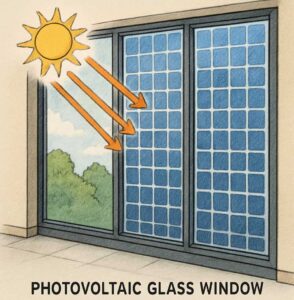
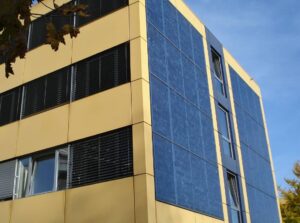
Solar windows seamlessly integrate into modern building facades, generating clean electricity while maintaining transparency.
How Solar Windows Improve Energy Efficiency
Solar Window Technology Basics
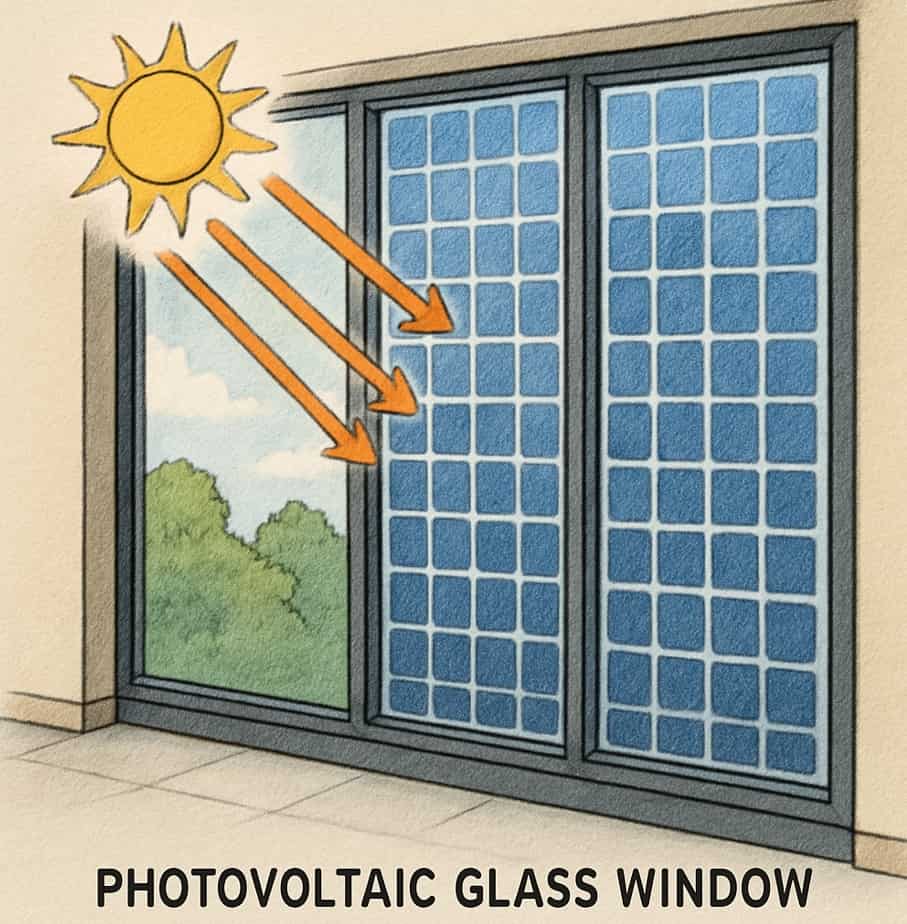
Solar windows — also known as transparent photovoltaic glass or photovoltaic windows — use advanced thin-film solar cells, organic photovoltaics (OPV), or luminescent solar concentrators (LSC) embedded within or coated onto glass panels. These technologies capture non-visible portions of the light spectrum, primarily ultraviolet and infrared wavelengths, and convert them into electricity while allowing visible light to pass through.
The core architecture of a solar window typically includes an outer protective layer of tempered glass, a transparent conducting layer (such as indium tin oxide), an active photovoltaic layer that absorbs non-visible light, and a back contact layer that completes the electrical circuit. Manufacturers like Jia Mao Bipv have refined this technology, offering variable transparency levels from 30% to 90% and monocrystalline silicon cells that achieve over 22% individual cell efficiency.
Several technology approaches are currently used in the market. Luminescent Solar Concentrators embed fluorescent dyes in transparent material that re-emit absorbed light to edge-mounted solar cells. Organic Photovoltaics use carbon-based compounds engineered for transparency and low-cost manufacturing. Perovskite Solar Cells deliver high laboratory efficiencies with semi-transparent properties. Thin-Film Solar Cells deposit ultra-thin photovoltaic material layers onto glass substrates. Each approach offers trade-offs between efficiency, cost, durability, and transparency.
Close-up of transparent photovoltaic glass showing the precision cell architecture that enables both light transmission and energy generation.
Generating Electricity and Reducing Grid Reliance
One of the most compelling advantages of solar windows is their ability to generate on-site electricity, directly reducing a building’s dependence on grid power. According to data from Jia Mao Bipv’s transparent BIPV glass product specifications, modern solar windows can produce between 140–200 W/m² depending on the transparency level selected, yielding an annual energy output of 180–250 kWh/m² in typical commercial orientations.
To put this in perspective, a 40-story commercial building with approximately 6,000 m² of window area could generate between 1,080,000 and 1,500,000 kWh of electricity per year — enough to offset 20–40% of the building’s total electricity consumption. NEXT Energy Technologies has demonstrated that PV-coated windows on a typical commercial high-rise could produce around 20 million kWh of electricity over a 30-year lifespan.
This on-site generation has a cascading effect. It reduces peak demand charges (often the most expensive component of commercial electricity bills), minimizes transmission losses that occur when electricity travels long distances from power plants, and supports utility grid stability through distributed energy resources. For building owners pursuing net-zero energy certification, solar windows contribute meaningfully across multiple LEED credit categories including energy performance, on-site renewable energy, and daylighting.
Table 1: Estimated Annual Electricity Generation by Solar Window Coverage
| Building Type | Window Area (m²) | Transparency Level | Power Output (W/m²) | Annual Generation (kWh) | Grid Reliance Reduction |
|---|---|---|---|---|---|
| Small Office (5 floors) | 500 | 70% | 140 | 90,000 | 10–15% |
| Mid-Rise Commercial (15 floors) | 2,000 | 50% | 165 | 420,000 | 20–30% |
| High-Rise Tower (40 floors) | 6,000 | 50% | 165 | 1,260,000 | 25–40% |
| Glass Curtain Wall HQ (60 floors) | 10,000 | 30% | 200 | 2,500,000 | 30–50% |
Source: Estimates based on Jia Mao Bipv BIPV transparent glass performance specifications and industry benchmarks. Actual results vary by location, orientation, and climate.
Shading, Insulation, and Indoor Comfort
Beyond electricity generation, solar windows dramatically improve the thermal performance of a building’s envelope. Traditional clear glass windows are notoriously poor insulators — the U.S. Department of Energy estimates that roughly 25% of energy used to heat and cool buildings is lost through inefficient windows. Solar windows address this problem on multiple fronts.
First, solar windows inherently block a significant portion of infrared radiation — the primary contributor to solar heat gain. Jia Mao Bipv’s transparent BIPV glass blocks up to 85% of infrared radiation while still allowing visible light through, resulting in a Solar Heat Gain Coefficient (SHGC) as low as 0.15. For comparison, standard clear double-pane glass has an SHGC of approximately 0.56–0.70. The Wells Fargo Foundation and NREL IN2NEXT project confirmed that PV-coated windows from NEXT Energy Technologies reduced the SHGC to below 0.20 — a result described as “extremely significant” by Viracon, one of North America’s largest architectural glass manufacturers.
Second, solar windows provide 99% UV rejection, protecting interior furnishings, artwork, and flooring from sun damage and fading. Third, modern BIPV glass units incorporate insulated glazing construction, Low-E coatings, and condensation management features that further improve thermal insulation and prevent cold-surface condensation in winter. The net effect is a building that stays cooler in summer and warmer in winter, reducing HVAC loads by 25–40% compared to conventional glazing. Occupants benefit from improved comfort, reduced glare, and consistent natural daylighting with a color rendering index above 80.
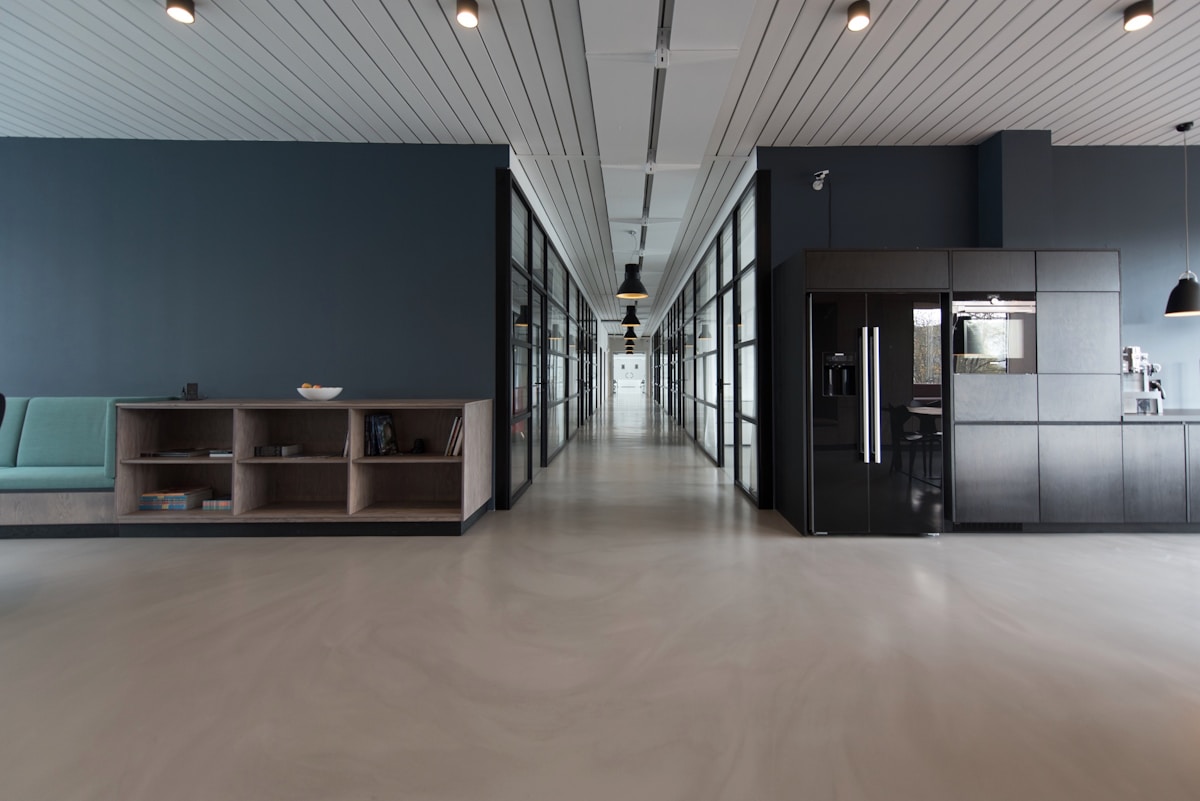
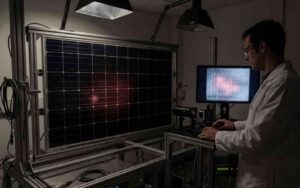
Solar windows provide excellent natural daylighting and thermal comfort in commercial interiors while generating electricity.
Energy and Cost Savings with Solar Windows
Lower Heating, Cooling, and Lighting Costs
The energy savings from solar windows accumulate across three major building systems: heating, cooling, and lighting. By blocking infrared heat and reducing the SHGC to as low as 0.15, solar windows can reduce cooling loads by 25–40%. In hot climates like the American Southwest or the Middle East, this translates to substantial reductions in air conditioning energy and equipment sizing. At the same time, their insulating properties reduce heat loss during cold months, lowering heating costs.
The superior daylighting performance of solar windows also reduces the need for artificial lighting. Buildings equipped with solar windows and daylight-responsive lighting controls can cut lighting energy consumption by 30–60%, depending on the floor plate depth and window orientation. The combined effect across all three systems is a total building energy reduction of 15–35%.
Chart 1: Annual Energy Cost Savings Breakdown — Solar Windows vs. Traditional Glazing (10,000 m² Commercial Building)
The following bar chart illustrates estimated annual savings in USD across three categories.
| Energy Category | Traditional Windows (Annual Cost) | Solar Windows (Annual Cost) | Annual Savings |
|---|---|---|---|
| Cooling (HVAC) | $120,000 | $78,000 | $42,000 (35%) |
| Heating | $65,000 | $52,000 | $13,000 (20%) |
| Lighting | $48,000 | $24,000 | $24,000 (50%) |
| TOTAL | $233,000 | $154,000 | $79,000 (34%) |
📊 Bar Chart Data: Visualize this data as a bar chart with three grouped bars (Cooling, Heating, Lighting), each showing Traditional vs. Solar Windows annual cost.
Financial Savings and Incentives
The financial case for solar windows extends well beyond utility bill reductions. Building owners benefit from multiple revenue streams and incentive programs that accelerate the return on investment.
On the generation side, a commercial building producing 1,000,000+ kWh per year from its solar windows can offset $100,000–$150,000 in annual electricity costs (at the national average commercial rate of approximately $0.13/kWh). Buildings in high-rate states like California ($0.22+/kWh) or Connecticut ($0.21+/kWh) see even greater savings. Peak demand charge reductions — enabled by on-site generation during afternoon peak hours — can add another 20–30% in savings on top of energy volume reductions.
Government incentives further improve the economics. For commercial solar installations, the federal Investment Tax Credit (ITC) provides a 30% credit on qualifying system costs for projects that begin construction by the end of 2025. The 179D Energy Efficient Commercial Buildings Tax Deduction offers up to $5.00 per square foot for qualifying energy-efficient upgrades. Many states and municipalities offer additional rebates, renewable energy certificates (RECs), and performance-based incentives. Building owners should consult the DSIRE database for location-specific incentive programs.
When combining energy savings, generation revenue, incentives, and the avoided cost of separate conventional glazing, solar windows from reputable BIPV manufacturers like Jia Mao Bipv typically achieve a payback period of 6–10 years, with a useful lifespan of 25+ years backed by comprehensive warranty coverage.
Comparing Solar Windows to Traditional Windows
To make an informed decision, building owners need a clear side-by-side comparison of solar windows versus traditional high-performance glazing. The table below summarizes the key differences across critical performance and economic metrics.
Table 2: Solar Windows vs. Traditional High-Performance Windows — Feature Comparison
| Recurso | Traditional High-Performance Window | Solar Window (BIPV Glass) | Advantage |
|---|---|---|---|
| Electricity Generation | None | 140–200 W/m² | Solar Window ✓ |
| Solar Heat Gain Coefficient (SHGC) | 0.25–0.40 | 0.15–0.25 | Solar Window ✓ |
| UV Rejection | 70–85% | 99% | Solar Window ✓ |
| Infrared Heat Blocking | 40–60% | Up to 85% | Solar Window ✓ |
| Visible Light Transmission | 50–70% | 30–90% (adjustable) | Comparable |
| Initial Cost (per m²) | $150–$350 | $350–$700 | Traditional ✓ |
| Lifetime Energy Savings (25 yr) | $20–$50/m² | $150–$400/m² | Solar Window ✓ |
| Tempo de vida | 20–30 years | 25+ years (warranted) | Comparable |
| LEED / Green Certification | Partial credits | Multiple credit categories | Solar Window ✓ |
| Government Incentives Eligible | Limited | ITC, 179D, state rebates | Solar Window ✓ |
Sources: U.S. DOE, NREL IN2NEXT Project, Jia Mao Bipv product specifications, EnergySage.
Chart 2: 25-Year Total Cost of Ownership — Solar Windows (Pie Chart)
| Cost Component | Percentage |
|---|---|
| Initial Purchase & Installation | 55% |
| Maintenance & Cleaning (25 yr) | 10% |
| Inverter Replacement (Year 12–15) | 8% |
| Monitoring & Insurance | 7% |
| Energy Savings Offset (negative cost) | -35% |
| Incentives & Tax Credits Offset | -15% |
| Net 25-Year Cost (% of initial) | 30% |
📊 Pie Chart Data: Render as a pie chart showing the cost composition over 25 years. Green slices represent savings offsets.
Installation and Maintenance Tips
Key Installation Factors
Successful solar window installation requires careful planning across several critical factors. Orientation and tilt angle are paramount — south-facing facades in the Northern Hemisphere receive the most direct sunlight and generate the highest annual energy yields. East- and west-facing windows also perform well, capturing morning and afternoon sun respectively, while north-facing installations generate less power but still contribute to the building’s thermal performance through insulation and UV rejection.
Structural compatibility is another essential consideration. Solar windows from manufacturers like Jia Mao Bipv are engineered at just 11mm total thickness for standard curtain wall compatibility, with wind load capacity rated for high-rise applications up to 300 meters. However, existing buildings may require structural assessment to ensure the facade framing can support the additional weight and electrical connections. New construction projects have the advantage of designing the curtain wall system around the BIPV glass specifications from the outset.
Electrical integration must be planned by a certified solar installer working in coordination with the building’s electrical engineer. This includes selecting the appropriate inverter system (string inverters for uniform facades, or micro-inverters/power optimizers for facades with partial shading), routing concealed wiring through the curtain wall mullions, and connecting to the building’s electrical distribution panel or directly to an energy storage system. Jia Mao Bipv’s installation guide recommends Maximum Power Point Tracking (MPPT) optimizers at the individual panel level to maximize energy harvest even when some windows are partially shaded.
Finally, local building codes, fire safety requirements (Jia Mao Bipv’s products meet B1-grade flame retardancy standards), and permitting processes must be addressed before installation begins. Working with a reputable BIPV manufacturer that provides structural engineering services, certified glazing contractor training, and commissioning support ensures a smooth installation process.
Necessidades de manutenção
One of the advantages of solar windows over rooftop solar panels is their relatively low maintenance requirements. Because they are vertically mounted in the building facade, solar windows accumulate less dust and debris than horizontally oriented rooftop panels. Rain naturally washes vertical surfaces, and advanced self-cleaning hydrophobic coatings — such as those applied to Jia Mao Bipv’s transparent glass products — further reduce cleaning frequency by up to 30%.
Routine maintenance for solar windows includes periodic visual inspections (recommended quarterly) to check for seal integrity, surface damage, or condensation between glass layers. Cleaning should be performed 1–2 times per year using soft, non-abrasive cloths and mild detergent — never harsh chemicals or high-pressure washers, which can damage the photovoltaic coatings. For high-rise buildings, this cleaning schedule can be integrated with the building’s existing facade maintenance program.
On the electrical side, remote performance monitoring systems provide 24/7 surveillance with automated alerts if any panel’s output drops below expected levels. This predictive maintenance approach allows facility managers to identify and address issues — such as a failing connection, inverter fault, or localized shading from new construction — before they significantly impact energy production. Annual professional performance audits are recommended to ensure optimal long-term output. Jia Mao Bipv backs their solar windows with a 25-year linear power warranty (guaranteeing 80% output retention), a 15-year optical clarity warranty, and a 12-year product warranty covering materials and manufacturing.
Maximizing Energy and Cost Benefits
To extract the maximum value from a solar window investment, building owners should consider several optimization strategies. First, pair solar windows with smart building automation systems. By integrating real-time solar heat gain data from the BIPV glass with the building’s HVAC controls, the system can dynamically adjust cooling and heating setpoints, reducing energy waste. Daylight-responsive lighting controls that dim or switch off artificial lights when solar windows provide sufficient natural illumination can save an additional 30–60% on lighting costs.
Second, consider combining solar windows with on-site battery storage. DC-coupled energy storage systems can capture excess daytime generation for use during evening peak-rate hours, maximizing the financial return on every kilowatt-hour produced. This also provides resilience during grid outages.
Third, take full advantage of available financial incentives. Stack the federal ITC with state rebates, utility demand-response programs, and renewable energy certificate revenue to minimize the effective cost of the installation. Buildings that achieve high energy performance ratings through solar window integration may also command higher rental rates and property values — studies have shown that green-certified buildings achieve 3–7% rental premiums.
Fourth, select the right transparency level for each facade orientation. South-facing facades in warm climates may benefit from lower transparency (30–50%) to maximize both power generation and solar heat reduction, while north-facing facades can use higher transparency (70–90%) to maximize daylighting with minimal thermal penalty. Jia Mao Bipv offers four standard transparency levels (30%, 50%, 70%, and 90%) plus custom options to accommodate any architectural requirement.
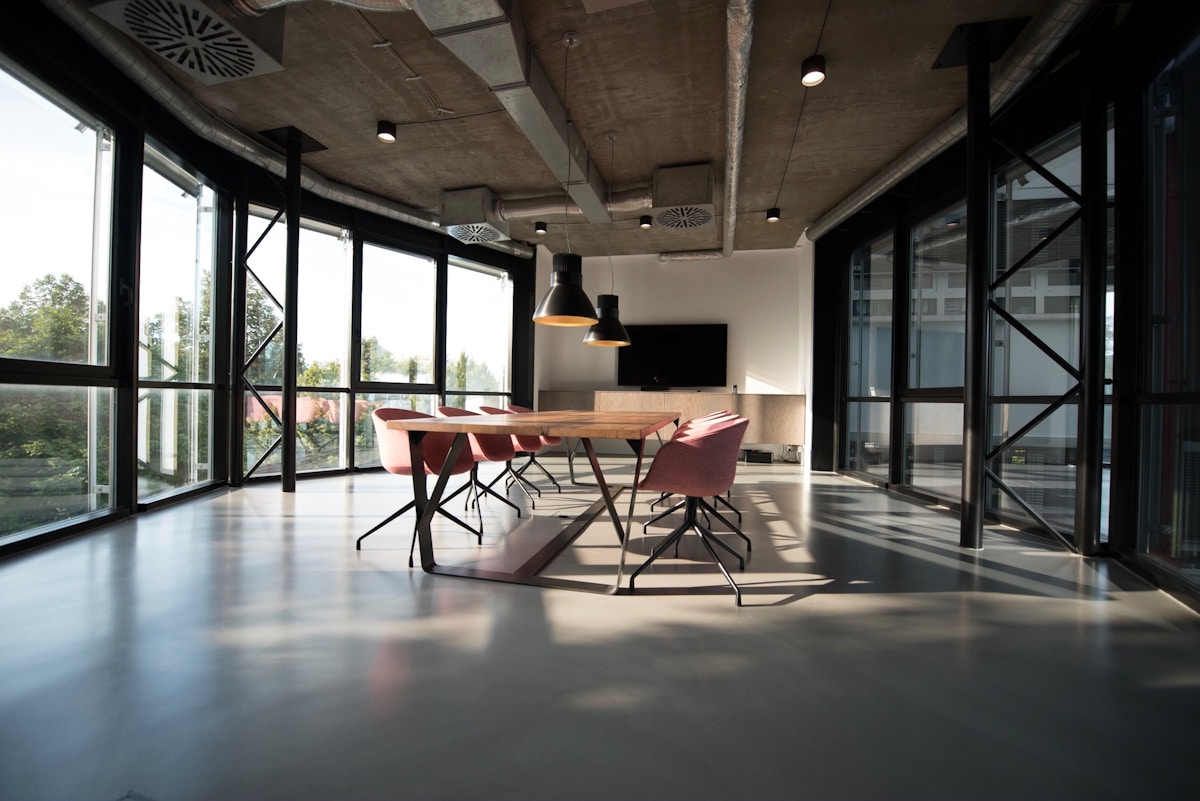
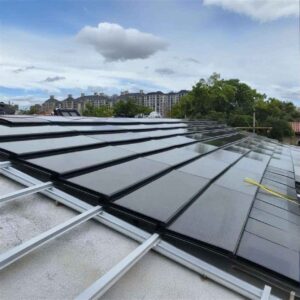
Strategic selection of transparency levels across different facade orientations maximizes both energy generation and occupant comfort.
Watch: How Solar Panel Windows Are Changing Building Design
This video from a leading clean energy channel explains how transparent solar windows are hitting record efficiency levels and what this means for the future of building-integrated photovoltaics.
Video: “This NEW Solar Panel Window Hits Record Efficiency” — An international research team achieved 12.3% power conversion efficiency with 30% visible transparency, a milestone for transparent photovoltaic technology.
Conclusion
Solar windows represent a paradigm shift in building design — transforming passive glass surfaces into active energy-generating assets. By generating clean electricity, providing superior shading and insulation, and dramatically reducing heating, cooling, and lighting costs, solar windows help buildings save energy and money at every level.
The technology has matured rapidly. Today’s solar windows from leading BIPV manufacturers like Jia Mao Bipv deliver proven performance with 140–200 W/m² generation capacity, up to 85% infrared rejection, 99% UV blocking, and 25-year power warranties. When combined with government incentives, smart building integration, and strategic facade design, the financial payback typically occurs within 6–10 years — followed by 15+ years of net-positive returns.
Whether you’re planning a new commercial tower, retrofitting an existing office building, or exploring BIPV solutions for residential projects, solar windows deserve serious consideration. They don’t just reduce your carbon footprint — they improve occupant comfort, increase property values, and future-proof your building against rising energy costs. The window of opportunity, quite literally, is wide open.

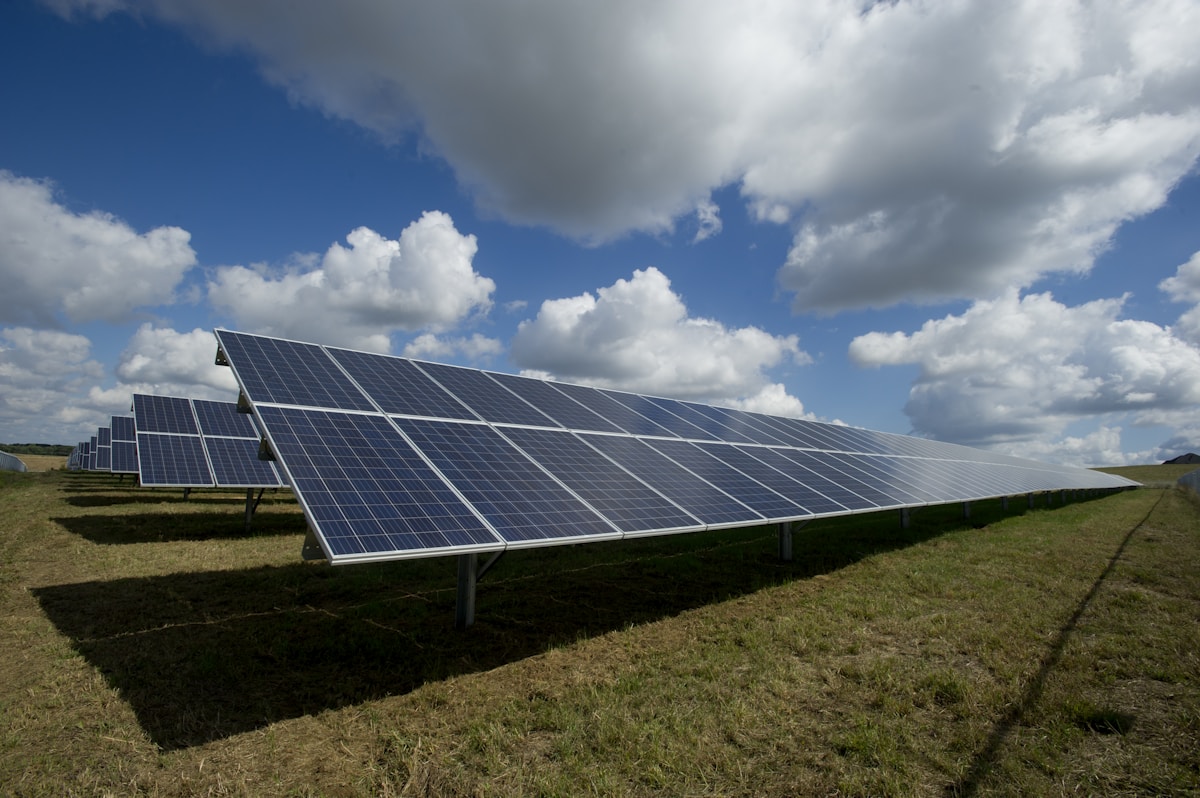
Solar windows are paving the way toward a future where every building facade contributes to clean energy generation.
Frequently Asked Questions About Solar Windows
1. What are solar windows and how do they work?
Solar windows are transparent glass panels embedded with photovoltaic technology that generates electricity from sunlight. They use thin-film solar cells, organic photovoltaics, or luminescent solar concentrators to capture ultraviolet and infrared light while allowing visible light to pass through. This dual functionality means they serve as both traditional windows and solar power generators, making them a core component of Building Integrated Photovoltaics (BIPV) systems.
2. How much electricity can solar windows generate?
Modern solar windows can generate between 140–200 watts per square meter, depending on the transparency level. In a typical commercial building orientation, this translates to an annual energy yield of 180–250 kWh per square meter. A large commercial high-rise with 6,000 m² of solar window area could produce over 1.2 million kWh of electricity annually, offsetting 25–40% of the building’s total energy consumption.
3. Are solar windows as transparent as regular windows?
Solar windows are available in multiple transparency levels. Manufacturers like Jia Mao Bipv offer options ranging from 30% to 90% visible light transmission. At the 70–90% transparency range, solar windows are virtually indistinguishable from conventional glass to the naked eye, though they generate less electricity than lower-transparency versions. Building designers can select different transparency levels for different facade orientations to optimize both aesthetics and energy performance.
4. How do solar windows compare to traditional solar panels in efficiency?
Traditional rooftop solar panels achieve 20–23% efficiency, while transparent solar windows currently operate at 5–12% system-level efficiency due to the trade-off between transparency and power generation. However, solar windows compensate for lower per-unit efficiency by covering much larger surface areas — a building’s total window area is often 3–5 times larger than its roof area. This means the total energy generated by a full-facade solar window installation can rival or exceed a rooftop solar array.
5. How much money can solar windows save on energy bills?
Solar windows save money in three ways: electricity generation (offsetting grid purchases), reduced cooling costs (25–40% HVAC savings through infrared heat rejection), and lower lighting costs (30–60% reduction through enhanced daylighting). For a typical 10,000 m² commercial building, total annual savings can reach $79,000 or more compared to traditional glazing. Over a 25-year lifespan, cumulative savings often exceed the initial investment by 2–3 times.
6. What is the payback period for solar windows?
The payback period for solar windows typically ranges from 6–10 years, depending on the building’s location, energy rates, facade area, and available incentives. Buildings in high-electricity-cost regions (like California or the Northeast U.S.) and those that qualify for the federal ITC, 179D deductions, and state rebates may achieve payback in as few as 5–6 years. After payback, the remaining 15–20 years of the system’s lifespan represent net positive returns.
7. Do solar windows require special maintenance?
Solar windows require minimal maintenance — less than rooftop solar panels because their vertical orientation means they accumulate less dust and debris. Routine care includes 1–2 cleanings per year with soft cloths and mild detergent, quarterly visual inspections, and annual professional performance audits. Advanced features like self-cleaning hydrophobic coatings and remote performance monitoring systems further reduce maintenance effort and costs.
8. Can solar windows be retrofitted into existing buildings?
Yes, solar windows can be retrofitted into existing buildings, though the process requires structural assessment and electrical planning. Many BIPV glass products, such as those from Jia Mao Bipv, are engineered at standard thicknesses (11mm) for compatibility with existing curtain wall systems. Retrofit projects benefit from combining the window replacement cycle with the BIPV upgrade, avoiding the need for a separate renovation. Working with a manufacturer that provides structural engineering services and certified installer training streamlines the process.
9. What government incentives are available for solar windows?
Several government incentives apply to solar window installations. The federal Investment Tax Credit (ITC) provides a 30% credit for qualifying commercial solar installations (check current eligibility timelines). The 179D Energy Efficient Commercial Buildings Tax Deduction offers up to $5.00 per square foot for qualifying energy upgrades. Many states offer additional rebates, renewable energy certificates, and utility incentive programs. The DSIRE database is the best resource for finding location-specific incentives.
10. How long do solar windows last?
High-quality solar windows are designed to last 25+ years. Reputable manufacturers like Jia Mao Bipv offer comprehensive warranty coverage including a 25-year linear power warranty (guaranteeing 80% output retention), a 15-year optical clarity warranty, a 12-year product warranty, and a 20-year weather seal guarantee. The glass and aluminum frame components are fully recyclable at end of life, supporting circular economy principles.


-300x300.jpg)