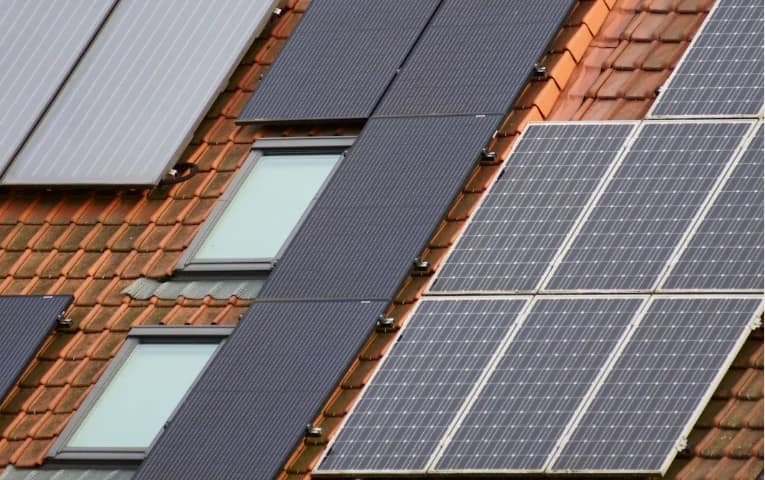
Monocrystalline solar panels are black. Polycrystalline solar panels are blue. That one-sentence answer covers the surface-level difference — but the reasons behind those colors, and what they mean for performance, efficiency, heat behavior, and building aesthetics, run much deeper than most buyers realize.
For homeowners comparing rooftop options, the color of a solar panel affects curb appeal and how well the array blends with existing roofing materials. For architects and commercial developers, panel color influences facade design, client approval, and even municipal planning permissions. And for engineers, color is a visible indicator of crystal structure, which directly determines how efficiently a panel converts photons into electricity.
The color differences between monocrystalline and polycrystalline panels are not cosmetic choices made in a factory. They are rooted in how silicon is grown, cut, and assembled — processes that also determine efficiency ceilings, temperature behavior, and long-term degradation rates. This article walks through each of those factors in detail, using real performance data and field-tested comparisons, so you can make an informed decision based on substance rather than appearance alone.
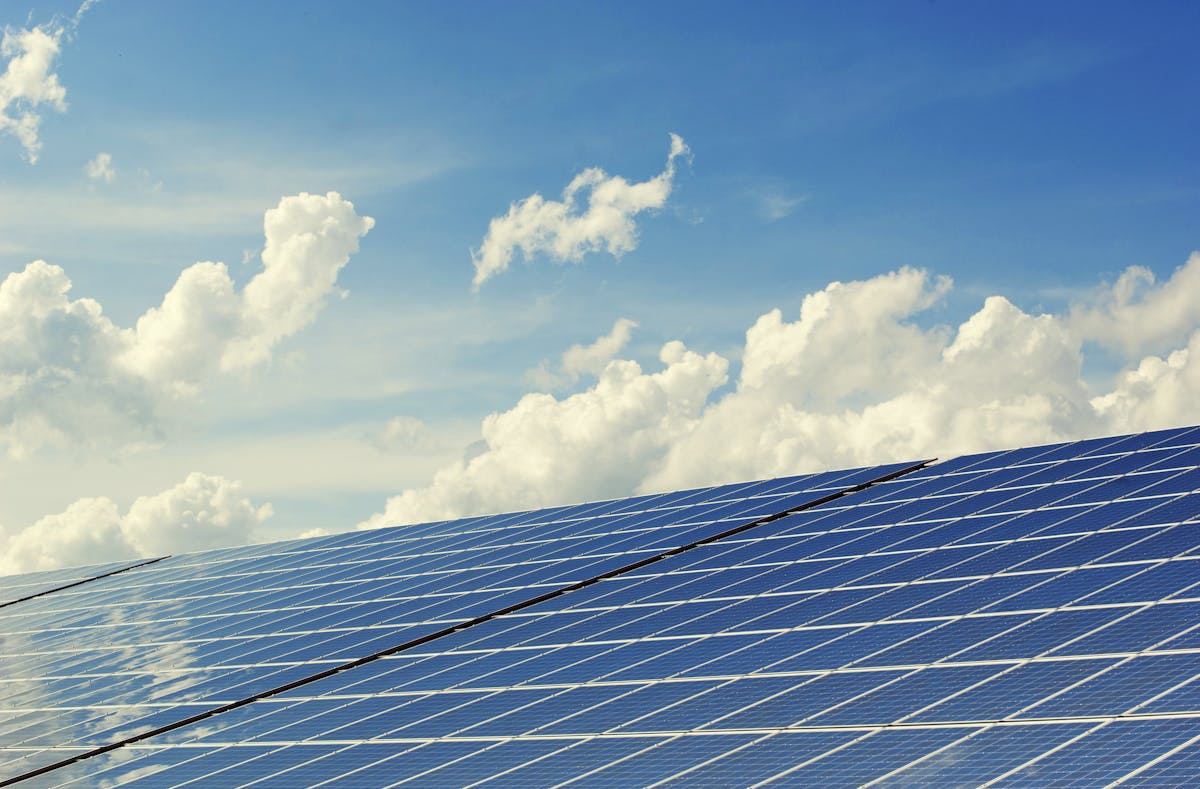
Image: Polycrystalline solar panels display a distinctive blue shimmer caused by light refracting through multiple silicon crystal boundaries. (Source: Pexels – Free to use)
Solar Panel Color Differences
Monocrystalline Solar Panels: Black Color
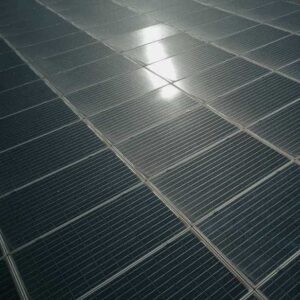
Monocrystalline solar panels appear uniformly black or very dark. This coloring results from the way a single, continuous silicon crystal interacts with incoming sunlight. Because the crystal lattice is unbroken and aligned in one direction, light entering the cell is absorbed across a broad spectrum with minimal reflection at the surface. The anti-reflective coating applied during manufacturing further suppresses light bounce-back, deepening the dark appearance.
In practical terms, a monocrystalline panel installed on a dark-gray asphalt shingle roof becomes nearly invisible from street level. A 2023 residential survey by EnergySage found that 68% of homeowners who chose monocrystalline panels cited “visual blending with the roof” as a deciding factor — ranking it above price in their priority list.
Polycrystalline Solar Panels: Blue Shade
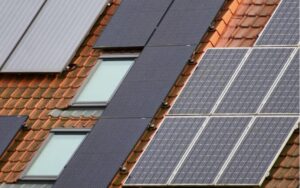
Polycrystalline panels carry a blue or blue-speckled appearance. The color emerges because the silicon wafer inside each cell contains many small crystals oriented in different directions. When sunlight strikes these crystal boundaries, portions of the light spectrum — particularly shorter blue wavelengths — are reflected rather than absorbed. The result is the characteristic blue shimmer that makes polycrystalline panels immediately recognizable.
The blue tone varies between manufacturers and even between production batches. Some polycrystalline cells appear almost navy; others lean toward a lighter cerulean. This inconsistency is a natural byproduct of the multi-crystal casting process, where the number, size, and angle of silicon grains differ from wafer to wafer.
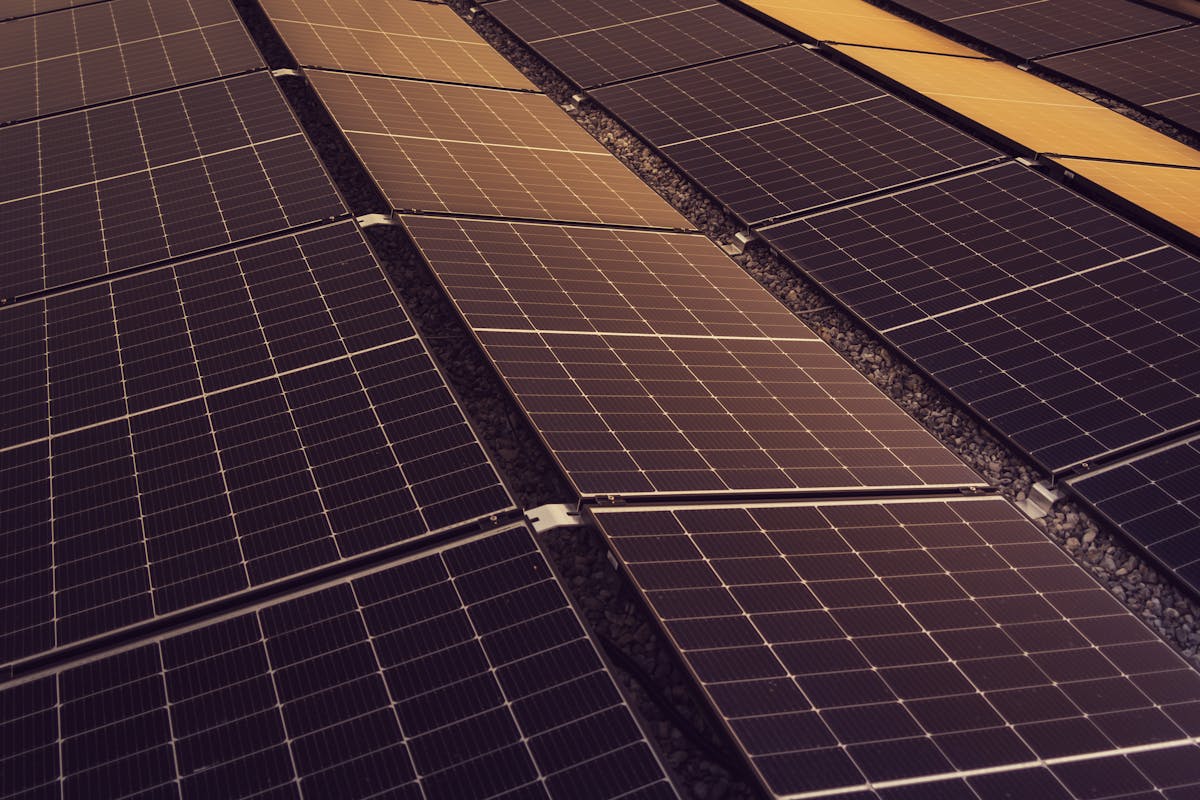
Image: Monocrystalline panels feature a deep, uniform black surface — the result of single-crystal silicon absorbing light efficiently. (Source: Pexels – Free to use)
Why Panel Colors Differ
Manufacturing Process Impact
The color difference traces directly back to the factory floor. Monocrystalline cells begin as a single silicon seed crystal dipped into a vat of molten silicon at approximately 1,425°C. Using the Czochralski (CZ) method, technicians slowly pull the seed upward while rotating it, allowing a large cylindrical ingot of perfectly aligned silicon to form over several hours. This ingot — a single crystal from top to bottom — is then sliced into wafers roughly 160–180 micrometers thick. Because every atom in the wafer shares the same orientation, the surface absorbs light uniformly, producing that deep black color.
Polycrystalline cells, by contrast, are made by pouring molten silicon into a square mold and allowing it to cool and solidify naturally. As the silicon cools, multiple crystal seeds form spontaneously throughout the mold, growing into a patchwork of differently-oriented grains. When this block is sliced into wafers, each cell contains dozens or hundreds of tiny crystals, each reflecting light at slightly different angles — hence the blue, fragmented appearance.
Crystal Structure and Appearance
At the atomic level, monocrystalline silicon has a perfectly repeating diamond-cubic lattice. This uniformity means the material’s optical properties — how it absorbs, transmits, and reflects photons — are consistent across the entire wafer surface. The anti-reflective silicon nitride coating (typically 70–80 nanometers thick) further reduces reflection to under 5%, which is why the panel looks almost entirely black to the human eye.
Polycrystalline silicon, by comparison, has grain boundaries — the zones where one crystal orientation meets another. These boundaries act as micro-mirrors, reflecting incoming light in unpredictable directions. The blue color specifically appears because silicon’s reflectivity increases at shorter wavelengths (blue light around 450–490 nm) when the surface is not optically uniform. The anti-reflective coating on polycrystalline cells reduces overall reflection but cannot fully compensate for the scattering that occurs at grain boundaries.
Monocrystalline vs. Polycrystalline: Key Comparison Table
| Feature | Monocrystalline | Polycrystalline |
|---|---|---|
| Cell Color | Black / Dark | Blue / Speckled Blue |
| Crystal Structure | Single continuous crystal | Multiple fused crystals |
| Manufacturing Method | Czochralski (CZ) pulling | Cast block cooling & slicing |
| Typical Efficiency | 17% – 23% | 13% – 17% |
| Temperature Coefficient | −0.3% to −0.4% per °C | −0.4% to −0.5% per °C |
| Cost per Watt | Higher | Lower |
| Space Efficiency | Higher (fewer panels needed) | Lower (more panels needed) |
| Visual Uniformity | Uniform, sleek appearance | Variegated, mosaic-like pattern |
| Typical Lifespan | 25 – 30+ years | 25 – 30+ years |
| Best For | Space-limited roofs, aesthetics-focused projects | Budget-focused installs, large open areas |
Table: Side-by-side comparison of monocrystalline and polycrystalline solar panels across 10 key metrics.
Visual Appearance of Panels
Uniform Look of Monocrystalline Solar Panels
Walk past a home with monocrystalline panels on the roof and you will notice a seamless, almost monolithic dark surface. Each cell has a consistent black tone, and the rounded corners of individual wafers (a remnant of the cylindrical ingot they were cut from) create a subtle pattern of small diamond-shaped gaps between cells. Premium all-black monocrystalline panels — where the frame, backsheet, and cells are all black — eliminate even these visual interruptions, producing a surface that looks more like a skylight than a power generator.
This visual uniformity is a significant driver of adoption in architecturally-sensitive neighborhoods. Homeowners associations (HOAs) in planned communities often specify that solar panels must not “substantially alter the visual character” of a roofline. In practice, monocrystalline all-black panels satisfy this requirement far more often than polycrystalline alternatives.
Variegated Pattern of Polycrystalline Solar Panels
Polycrystalline panels have a distinctly textured look. The multiple crystal grains inside each cell create a mosaic of blue tones — lighter and darker patches that shift subtly as the viewing angle changes. From a distance, the overall impression is a consistent blue, but up close, the grainy pattern is clearly visible. Some people find this pattern aesthetically appealing in the way that natural stone or terrazzo has visual interest; others consider it less clean than the monocrystalline alternative.
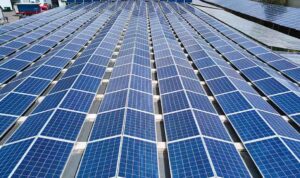
For large-scale ground-mounted solar farms where aesthetics matter less than unit cost, the variegated blue appearance of polycrystalline panels is a non-issue. For residential rooftops — especially those visible from the street — the preference typically tilts toward monocrystalline.
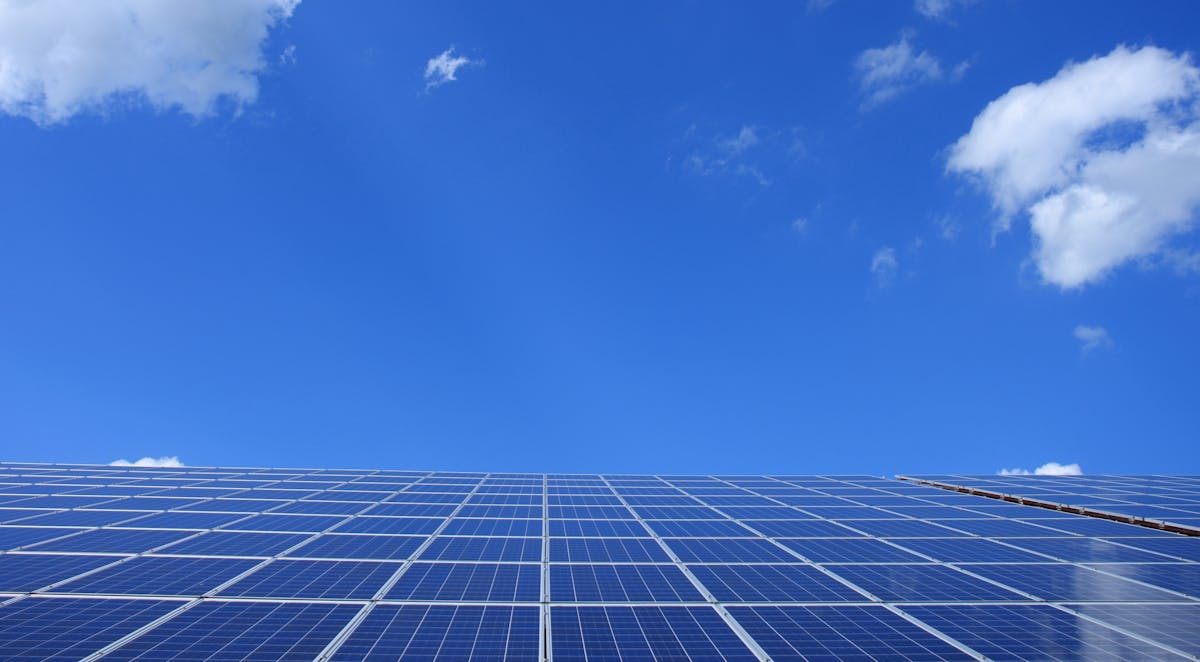
Image: In large ground-mounted installations, polycrystalline panels’ blue appearance is a non-factor — cost and total output matter more. (Source: Pexels – Free to use)
Color and Solar Panel Performance
Efficiency and Light Absorption
The connection between panel color and efficiency is not merely correlation — it is causation. A monocrystalline cell’s black appearance directly reflects its ability to absorb a wider portion of the solar spectrum. According to data from the National Renewable Energy Laboratory (NREL), the best monocrystalline cells in laboratory conditions have exceeded 26.1% efficiency, while top polycrystalline cells peak around 23.3%. In commercial modules (which include encapsulation losses, wiring, and frame effects), monocrystalline panels typically deliver 17%–23% conversion efficiency, while polycrystalline panels range from 13%–17%.
What this means in real-world terms: a homeowner in Phoenix, Arizona, with 25 square meters of available roof space could generate approximately 7,500 kWh per year with monocrystalline panels at 21% efficiency, versus roughly 5,800 kWh per year with polycrystalline panels at 16% efficiency. Over a 25-year system life, that 1,700 kWh annual gap compounds into roughly 42,500 kWh of additional electricity — worth approximately $5,500 to $7,000 at current U.S. residential rates.
Efficiency Comparison: Monocrystalline vs. Polycrystalline
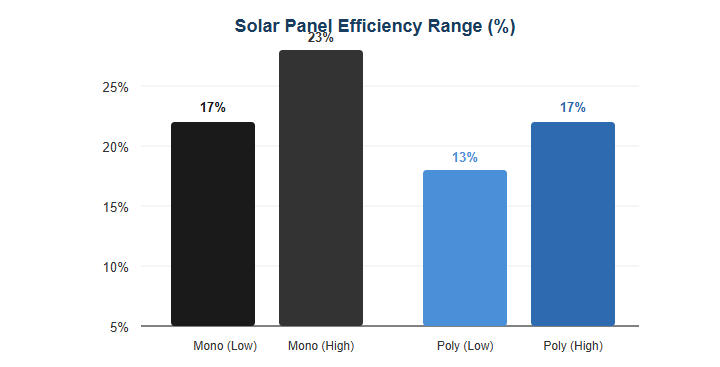
Bar Chart: Monocrystalline panels reach 17–23% efficiency; polycrystalline panels range from 13–17%. Data compiled from NREL, EnergySage, and CNET (2024–2025).
Heat Absorption and Temperature
Because monocrystalline panels are darker, they absorb slightly more thermal energy from sunlight than their lighter-blue polycrystalline counterparts. In theory, this should make monocrystalline panels hotter and therefore less efficient in extreme heat — since all silicon solar cells lose output as temperature rises. The standard measure for this is the temperature coefficient of Pmax, expressed as a percentage loss per degree Celsius above 25°C (the Standard Test Condition temperature).
However, the reality is more nuanced. Monocrystalline panels typically have a temperature coefficient of −0.3% to −0.4% per °C, while polycrystalline panels fall between −0.4% and −0.5% per °C. This means monocrystalline cells are actually less sensitive to heat than polycrystalline cells, despite being darker. The reason is crystal purity: a single-crystal lattice conducts thermal energy more efficiently and maintains more orderly electron flow at elevated temperatures than a multi-grain lattice riddled with boundary defects.
In a field test documented by Oxford Academic’s Clean Energy journal, monocrystalline panels maintained a performance ratio of 91% in a hot climate, while polycrystalline panels dropped to 81% under the same conditions. That 10-percentage-point gap translates directly into fewer kilowatt-hours delivered — a gap that compounds every summer across the entire lifespan of the system.
Temperature Sensitivity Distribution
Performance Ratio in Hot Climates
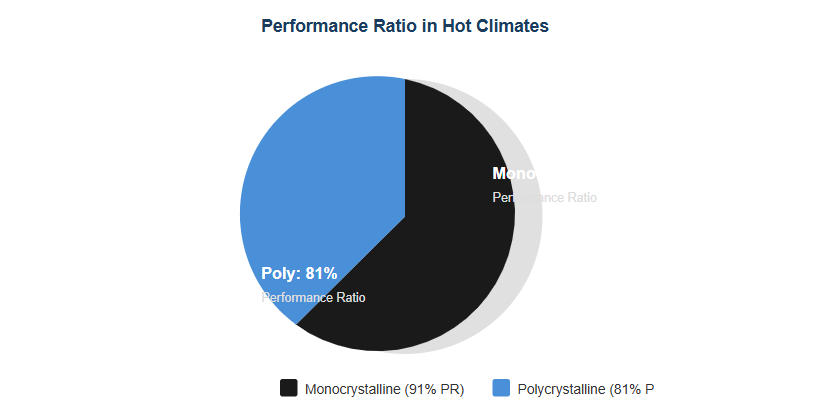
Pie Chart: Performance Ratio comparison in hot climates. Monocrystalline retains 91% of rated output vs. 81% for polycrystalline. Source: Oxford Academic / Clean Energy, 2022.
Aesthetic Choices and Coloured PV Panels
Residential Solar Installations
For residential projects, the visual integration of solar panels with a home’s roofline has gone from afterthought to design priority. In markets like California, Germany, and Australia — where residential solar penetration exceeds 20% of eligible homes — panel appearance directly affects property values and neighborhood reception.
Monocrystalline all-black panels currently dominate the residential segment. According to a CNET analysis, monocrystalline panels account for the vast majority of new residential installations in the U.S., driven by both their efficiency advantage and their ability to blend with dark-colored roofs. Polycrystalline panels, once the default budget option, have declined in residential market share as monocrystalline prices have dropped significantly over the past five years.
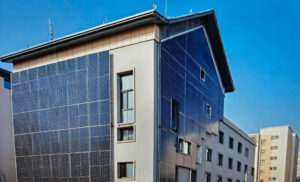
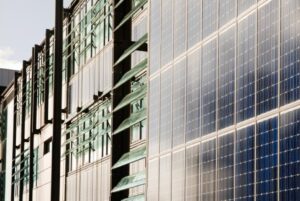
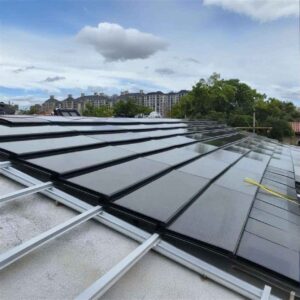
However, the aesthetic conversation has evolved beyond the black-versus-blue binary. A growing number of homeowners are asking for panels that match specific roof colors — terracotta, slate gray, forest green. This is where Building Integrated Photovoltaic (BIPV) technology has opened new doors. Companies like Jia Mao Bipv now manufacture BIPV modules that can be customized in color, transparency, and size — allowing solar cells to be embedded directly into roofing tiles, facade panels, and even floor surfaces without any visible “panel” at all.
Commercial and Specialty Applications
Commercial buildings present a different set of aesthetic challenges. Corporate headquarters, hotels, museums, and retail spaces often require exterior designs that reflect brand identity or architectural distinction. Standard blue or black panels mounted on visible facades can clash with a building’s design language.
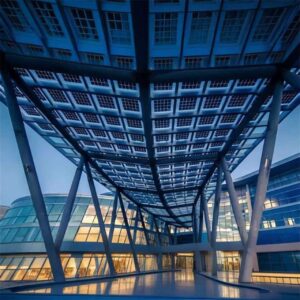
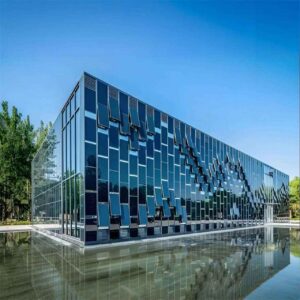
Colored BIPV modules address this directly. By applying structural color coatings, colored encapsulants, or nano-patterned glass overlays, manufacturers can produce photovoltaic panels in virtually any hue — from terracotta red for heritage buildings to cool gray for modernist towers. Jia Mao Bipv’s transparent solar glass, for example, integrates into curtain wall systems and skylight structures, generating electricity while maintaining up to 90% light transmittance. With monocrystalline cells rated above 22% efficiency and a documented annual degradation rate of just 0.4%, these panels deliver measurable ROI even while serving primarily as building envelope elements.
Specialty applications extend further still: photovoltaic floor tiles for walkable solar surfaces in plazas and patios, solar canopies for parking structures, and custom-shaped panels for curved facades. In each case, the “color” of the panel is determined not by crystalline type alone, but by the combination of cell technology, encapsulant chemistry, and glass surface treatment selected for the project.
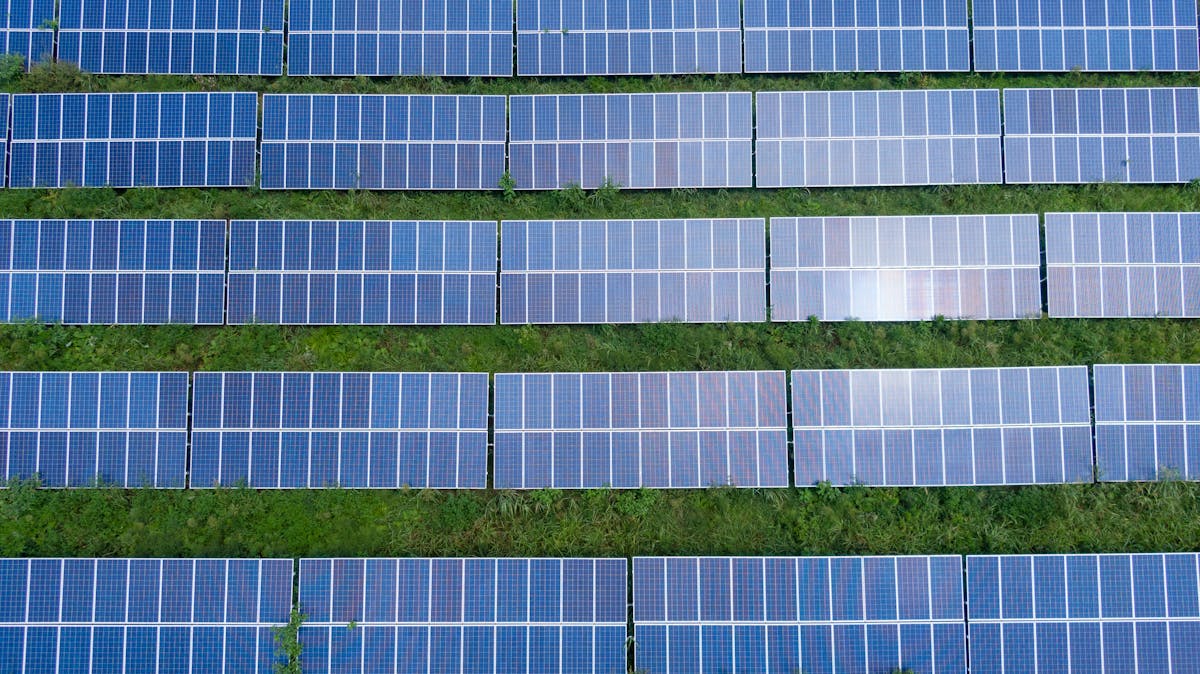
Image: Modern residential solar installations increasingly prioritize seamless visual integration with the building’s architecture. (Source: Pexels – Free to use)
Common Misconceptions About Panel Colors
Color vs. Quality
One of the most persistent myths in solar purchasing is that a darker panel is automatically a higher-quality panel. This misconception has some logical basis — monocrystalline panels are both darker and more efficient — but the causal link is inverted. A panel is not better because it is dark; it is dark because of how its silicon was grown. A poorly-manufactured monocrystalline panel with substandard encapsulation, weak solder joints, or low-grade bypass diodes will be just as black as a premium one — but its real-world performance will be dramatically worse.
Conversely, a well-engineered polycrystalline panel from a Tier-1 manufacturer can outperform a cheap monocrystalline panel on reliability metrics. According to a long-term field study by Solar Choice Australia, the efficiency gap between mid-range mono and poly panels of the same generation was only 0.5%–1.5% in real-world conditions — far smaller than the laboratory headline numbers suggest. Manufacturing quality, installation angle, shading, and inverter matching had a larger impact on annual yield than cell type alone.
The takeaway: judge a panel by its datasheet specifications (efficiency, temperature coefficient, degradation rate, warranty terms), its certification credentials (IEC 61215, IEC 61730, UL 1703), and the manufacturer’s track record — not by its color.
Color and Panel Lifespan
Another widespread misconception is that blue polycrystalline panels degrade faster than black monocrystalline panels. The data does not support this. Both panel types carry standard warranties of 25 years, and real-world installations from the 1990s and early 2000s show both types still operating at 80%+ of their rated capacity after three decades.
The primary factors that determine solar panel lifespan are encapsulation quality (resistance to moisture ingress and UV degradation), solder joint integrity, backsheet durability, and the quality of bypass diodes. None of these are visible to the naked eye, and none correlate with cell color. A polycrystalline panel with POE encapsulant, fluorocarbon backsheet, and properly soldered ribbon conductors — such as those produced with the advanced encapsulation methods used by Jia Mao Bipv — can last as long as any monocrystalline panel on the market.
Watch: Monocrystalline vs. Polycrystalline Solar Panels Explained
For a visual walkthrough of the five key differences between mono and poly panels — including color, efficiency, cost, and appearance — this video provides a clear, practical summary:
Video: “Monocrystalline vs Polycrystalline Solar Panels | The 5 Key Differences!” — YouTube
Making Your Decision: A Practical Framework
Choosing between monocrystalline and polycrystalline panels — or moving beyond both into colored BIPV — depends on a handful of concrete project variables. The following framework distills the decision into the factors that actually move the needle on return on investment and long-term satisfaction.
| If Your Priority Is… | Best Panel Choice | Why |
|---|---|---|
| Maximum power from limited roof space | Monocrystalline | Higher efficiency (20–23%) means more kWh per square meter |
| Lowest upfront cost | Polycrystalline | Lower cost per watt; suitable for large open areas |
| Sleek, dark rooftop appearance | Monocrystalline (all-black) | Uniform black blends with dark shingles/tiles |
| Hot climate performance | Monocrystalline | Lower temperature coefficient preserves output in heat |
| Building facade integration | Colored BIPV (e.g., Jia Mao Bipv modules) | Custom colors, transparency levels, and sizes match any design |
| Large ground-mount solar farm | Polycrystalline or budget Mono | Aesthetics are secondary; cost-per-watt and total output dominate |
Table: Decision framework matching project priorities to the most suitable panel type.
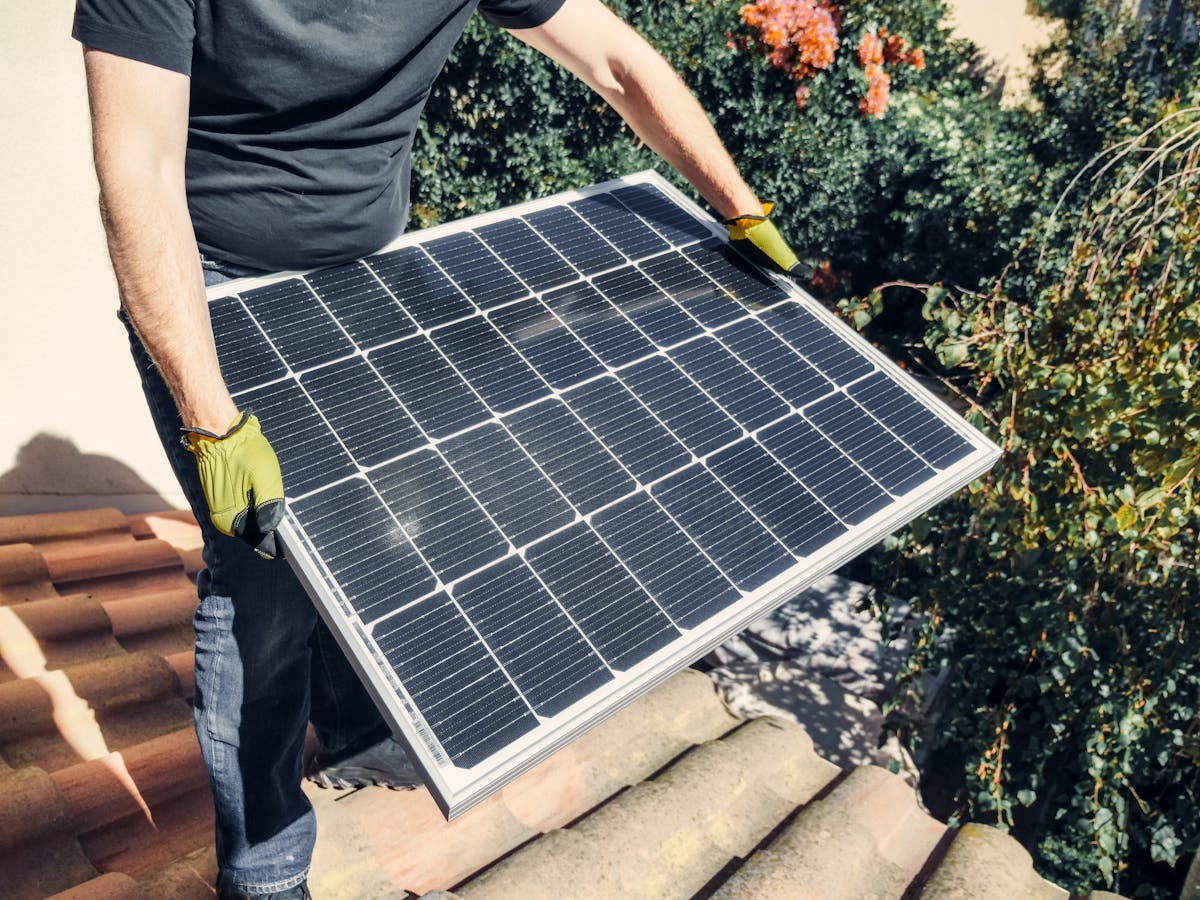
Image: A professional installer mounts solar panels on a residential rooftop. Both monocrystalline and polycrystalline panels use similar racking systems. (Source: Pexels – Free to use)
The color difference between monocrystalline (black) and polycrystalline (blue) solar panels is a direct, visible consequence of how silicon crystals are grown and structured during manufacturing. Monocrystalline cells, formed from a single continuous crystal via the Czochralski method, absorb light uniformly and appear black. Polycrystalline cells, cast from multiple fused crystal grains, scatter shorter wavelengths and appear blue.
That structural difference also drives measurable performance gaps. Monocrystalline panels deliver 17%–23% efficiency and maintain better output in high temperatures (−0.3% to −0.4%/°C coefficient), while polycrystalline panels operate in the 13%–17% efficiency range with steeper thermal losses (−0.4% to −0.5%/°C). Over a 25-year system life, these numbers translate into thousands of additional kilowatt-hours and hundreds to thousands of dollars in additional electricity value for monocrystalline systems.
However, color alone is not a reliable proxy for quality or lifespan. Both technologies carry 25+ year warranties when manufactured to IEC and UL standards, and the real determinants of long-term reliability — encapsulation, backsheet quality, solder integrity — are invisible to the eye. For projects where aesthetics extend beyond the black-or-blue choice, colored BIPV solutions from specialized manufacturers like Jia Mao Bipv now offer panels in virtually any color and form factor, with monocrystalline cells exceeding 22% efficiency behind customized glass surfaces.
The best panel for your project is the one whose efficiency, cost, aesthetic profile, and thermal behavior match your specific roof constraints, climate, budget, and design goals. Start with the data. Let the color follow the engineering — not the other way around.
Frequently Asked Questions (FAQ)
1. Why are monocrystalline solar panels black and polycrystalline panels blue?
Monocrystalline panels appear black because their single-crystal silicon structure absorbs sunlight uniformly across a broad spectrum, with very little reflection. Polycrystalline panels look blue because their multi-grain structure scatters shorter (blue) wavelengths of light at the boundaries between differently-oriented crystals.
2. Does solar panel color affect energy efficiency?
Yes. The color is a visible indicator of crystal structure, which directly determines efficiency. Monocrystalline (black) panels typically achieve 17%–23% efficiency, while polycrystalline (blue) panels range from 13%–17%. The single-crystal lattice in monocrystalline cells allows electrons to flow more freely, producing more electricity per square meter.
3. Do darker solar panels get hotter and lose more power?
Darker panels do absorb slightly more thermal energy, but monocrystalline panels compensate with a lower temperature coefficient (−0.3% to −0.4%/°C versus −0.4% to −0.5%/°C for polycrystalline). In field tests, monocrystalline panels maintained a 91% performance ratio in hot climates, compared to 81% for polycrystalline, because single-crystal silicon handles heat more efficiently.
4. Can I get solar panels in colors other than black or blue?
Yes. Building Integrated Photovoltaic (BIPV) technology now allows manufacturers to produce solar panels in virtually any color — including terracotta, gray, green, and white. Companies like Jia Mao Bipv offer custom-colored BIPV modules that integrate into facades, roofing tiles, and floor surfaces while generating electricity.
5. Are black solar panels higher quality than blue ones?
Not necessarily. A panel’s color reflects its crystal type, not its manufacturing quality. A well-engineered polycrystalline panel with premium encapsulation and certified components can outperform a low-quality monocrystalline panel on reliability and real-world output. Always evaluate panels by their datasheet specs, certifications, and manufacturer reputation — not just color.
6. Do polycrystalline solar panels have a shorter lifespan than monocrystalline?
No. Both types carry standard 25-year warranties and real-world installations from the 1990s show both technologies still producing above 80% of rated capacity. Lifespan depends on encapsulation quality, backsheet durability, and installation conditions — not cell color or crystal type.
7. Which type of solar panel is better for a residential rooftop with limited space?
Monocrystalline panels are the better choice for space-constrained roofs. Their higher efficiency (up to 23%) means you generate more electricity per panel, so you need fewer panels to meet your energy goals. The sleek black appearance also blends better with most residential roofing materials.
8. What is BIPV and how does it relate to solar panel color?
BIPV (Building Integrated Photovoltaics) refers to solar technology designed to replace conventional building materials — such as roofing, facade cladding, or windows — while generating electricity. BIPV panels can be manufactured in custom colors and transparency levels, freeing architects from the traditional black-or-blue limitation of standard panels. Manufacturers like Jia Mao Bipv specialize in this technology.
9. How much more do monocrystalline panels cost compared to polycrystalline?
Monocrystalline panels historically cost 15%–25% more per watt than polycrystalline panels. However, the price gap has narrowed significantly since 2020 as monocrystalline manufacturing has scaled up. In many markets, the lifetime value of monocrystalline panels — thanks to higher output and better temperature performance — exceeds the extra upfront cost within 7–10 years.
10. Are colored BIPV panels less efficient than standard black or blue panels?
Colored BIPV panels do sacrifice some efficiency compared to standard panels because the color layer reflects a portion of the solar spectrum. The typical efficiency reduction ranges from 5% to 15% depending on the color and technology used. However, BIPV panels generate energy from surfaces that would otherwise produce nothing — facades, windows, walkways — so the net energy gain for the building is positive. Advanced BIPV manufacturers now achieve cell efficiencies above 22% behind colored glass, narrowing the gap further.


-300x300.jpg)