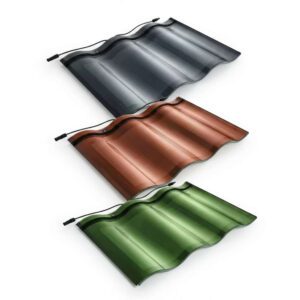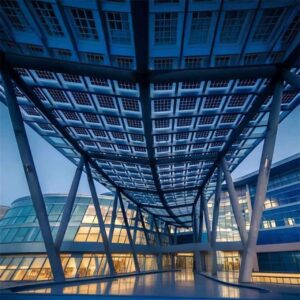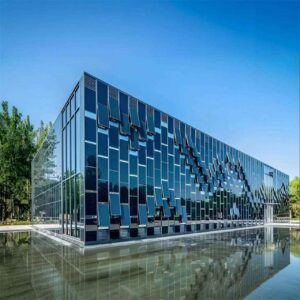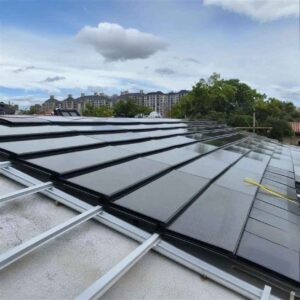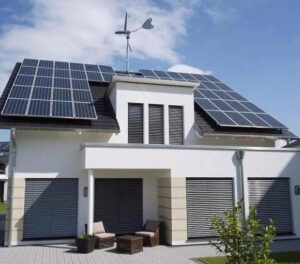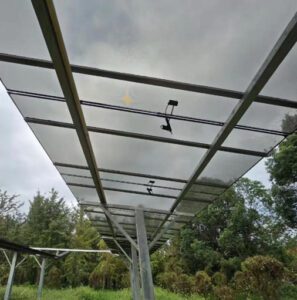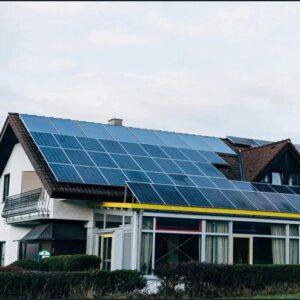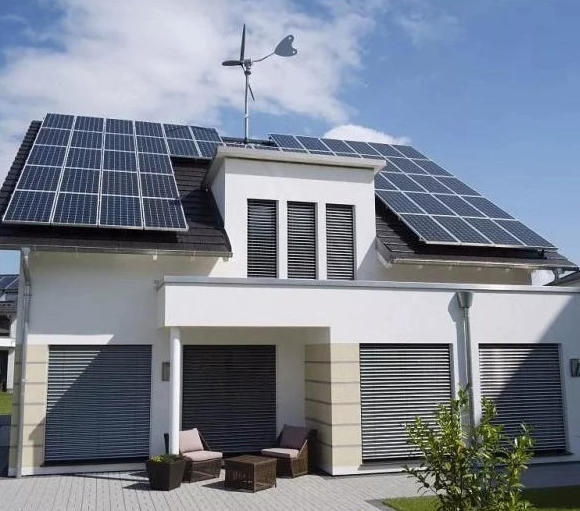

An integrated solar roof replaces the roof covering instead of sitting on top of it. This residential example shows the finish; it is not a Jia Mao Bipv project. Photo: Wikideas1, Wikimedia Commons file page, CC0 public domain.
A boutique hotel and a logistics warehouse can sit under the same sun. They should not get the same solar roof.
The hotel has a visible, pitched roof and a design brief that bans racks. The warehouse has a flat roof nobody sees and a CFO who wants the shortest payback.
If you specify, bid, or sell roofs, you already know this. The hard part is proving it to a client with numbers.
This guide gives you those numbers. It covers technical differences, cost, yield, warranty risk, and a scoring matrix you can reuse on your next bid.
Key takeaways
- Solar roof tiles are the roof. Solar panels sit on a roof. That one difference drives cost, warranty, and trade coordination.
- In our 100 kW example, tiles cost $40,000 more upfront and pay back about 4 years later than panels.
- Tiles win on visible pitched roofs, new builds, and roofs due for replacement. Panels win on healthy, hidden, or flat roofs.
- Most disputes come from the gap between the roofer and the electrician. Write that boundary into the contract.
I. The Strategic Shift from “Added-On” to “Integrated” Solar
Thesis: Conventional PV is a fast, low-cost way to generate power. Solar roof tiles are a stronger architectural solution. The right choice depends on balancing immediate ROI against long-term asset value, design integrity, and what the project can procure.
BIPV vs BAPV: the basic split
Building-integrated photovoltaics (BIPV) are solar products that replace a normal building material, such as a roof tile or a glass panel. Building-applied photovoltaics (BAPV) are standard solar modules bolted onto a finished roof.
その U.S. Department of Energy’s BIPV overview describes BIPV as products that swap conventional materials for solar-generating ones in roofs, skylights, awnings, facades, and windows. It also names two situations where BIPV can beat rooftop panels: HOA rules that ban panels, and buildings with roof weight limits.
Solar roof tiles are the roof-level version of BIPV. A tile keeps water out and makes power at the same time.
The tension you have to manage
Efficiency pushes you toward large, dark, tilted panels. Architecture pushes you toward a flat, uniform roof surface. Each choice costs something.
A panel array can deliver more watts per square metre. A tile roof can delete the “visual pollution” objection before it reaches a zoning board.
What this guide gives you
This is a technical and financial framework for contractors, solar EPCs, distributors, and architects. It helps you guide a client’s decision with a written model, not a hunch.
At Jia Mao Bipv, we see the same pattern in RFQs. Projects that compare tiles and panels on the same cost basis make faster decisions and have fewer change orders. For a longer side-by-side, see our guide to BIPV vs traditional solar panels: pros and cons.
II. Technical Architecture: Solar Tiles vs. Conventional PV
The core difference: a solar tile is a structural building material. A solar panel is an electrical add-on.
Design integration: weather barrier vs mounted module
A tile roof works as one system. The tile, its underlay, the flashing, and the fixings together keep water out. Remove any layer and the roof can leak.
A panel array works differently. The existing roof stays the weather barrier. The panels sit above it on rails and attachments.
| Question | Solar roof tiles | Solar panels on existing roof |
|---|---|---|
| What keeps water out? | The tile assembly | The roof underneath |
| What carries wind uplift? | Tile fixings and roof deck | Rails and roof attachments |
| Where are the roof penetrations? | Built into the roofing detail | At every rail attachment |
| What if the roof is old? | Roof is replaced as part of the job | Roof problems stay underneath |
| Main design risk | Flashing and edge details | Attachment sealing and roof condition |
Our guide to how roof-integrated solar tiles work explains the layer stack in more detail.
Installation workflows: roofers vs electrical crews
Panels are usually a PV crew’s job. They survey the roof, set attachments, run rails, clip in modules, and wire strings.
Tiles need both trades on one roof. A roofer sets underlay and flashing. An electrician connects each tile or tile group as it goes down.
Jia Mao Bipvの comparison of solar roof tiles and traditional panels reports about 6.9 worker-hours per kW for tile installation. It also cites 55–70 worker-hours for a typical 8–10 kW tile system, against 8–16 worker-hours for the same size of panel system. Those are residential figures, so treat them as a direction, not a commercial quote.
Industry insight: The labor gap is not just hours. Tiles also need roofers who understand DC wiring and electricians who understand water-shedding details. Crew training on a mock-up section is cheaper than fixing leaks later.
Durability and lifecycle
Both options are built for decades outdoors. The weak points differ.
| Factor | Solar roof tiles | Rack-mounted modules |
|---|---|---|
| Module efficiency range | 17–22% (published residential range) | 20–23% |
| Typical degradation claim | 0.3–0.5% per year | 0.25–0.7% per year |
| Power warranty | 25–30 years | 25–30 years |
| Expected lifespan claim | 30–50 years | 25–35 years |
| Typical failure point | Flashing, sealing, damaged single tile | Rail attachments, loose clamps, inverter |
Ranges are from the Jia Mao Bipv comparison guide linked above. Treat lifespan claims as marketing until a supplier shows test data and field history.
Thermal expansion is how much a material grows when it heats up. It is a quiet cause of leaks.
Aluminum expands at about 23 × 10⁻⁶ per °C. Glass expands at about 9 × 10⁻⁶ per °C. For a 6 m aluminum rail with a 50 °C temperature swing:
A 720 mm glass tile moves only about 0.3 mm over the same swing. Rails need slotted holes and expansion joints. Tiles need correct joint gaps.

Conventional PV mounted above an existing tile roof. The roof below still does the waterproofing. Photo: Marta Victoria, Wikimedia Commons file page, CC BY-SA 4.0.
Watch: the trade-off in under 15 minutes
Sunsave’s video walks through the same question from a residential angle. It is useful for training junior staff or explaining the basics to a client.
https://www.youtube.com/watch?v=YLAdWCzeJ7g
III. Aesthetic Value and Architectural Preservation
Why this matters: solar tiles solve the “visual pollution” problem on high-end projects, where racked arrays often get refused.
Design flexibility: roof lines, colors, textures
Tiles follow the roof’s pattern. Some mimic slate. Others use curved profiles like clay.
Jia Mao Bipvの CIGS curved solar roof tiles come in carbon black, brick red, and emerald green. CIGS means copper indium gallium selenide, a thin-film cell material that bends to fit curved tiles.
Color has a price. The product page lists 32 W per tile for black and 25 W for red or green. That is about 22% less rated power per colored tile:
A visible hotel roof may happily accept that loss. It still has to appear in the energy model.
Property valuation: be honest with the client
Clients often ask what a seamless solar roof adds to property value. Be careful here.
Published premium figures vary widely by market and building type. Keep any value premium out of your base financial case. Show it as an upside only when you have local sales evidence.
What you can prove is simpler. An integrated roof can remove a planning objection, and that can save months.
The consultant’s view: zoning and heritage boards
Heritage boards and design committees judge what they can see. A raised array with visible rails and gaps often fails that test.
Give the board a complete picture:
- A roof layout marking active and inactive tiles.
- Ridge, valley, and eaves details.
- A full-size mock-up viewed from the street.
- Color and glare samples in daylight.
- A written repair method that keeps the roof pattern intact.

A visible array on a church roof shows the challenge on public-facing buildings. Photo: Cary Bass-Deschenes, Wikimedia Commons file page, CC BY 4.0.
Industry insight: Get design approval before you finalize the energy layout. A late color or roof-pattern change shifts power density, cable routes, and the number of inactive tiles.
IV. Cost Driver Analysis: CapEx vs. OpEx
The point: the tile premium looks smaller once you count what the tile replaces.
The “double cost” problem
With panels, you pay twice. You pay for a roof, then you pay for a solar system on top of it. A tile roof merges those two purchases.
Here is a 100 kW worked example. These are illustrative modeling assumptions, not quotes or market averages.
| 仮定 | 価値 |
|---|---|
| System size | 100kW |
| Conventional roof replacement (baseline) | $110,000 |
| Panel system installed | $150,000 |
| Solar tile roof, all-in (roof and solar in one) | $300,000 |
| First-year generation, panels | 140,000 kWh |
| First-year generation, tiles | 130,000 kWh (about 7% lower, from heat and layout) |
| Blended electricity value | $0.12/kWh |
| Annual upkeep, panels | $2,700 |
| Annual upkeep, tiles | $2,580 (no rails to inspect) |
| Incentives, financing, property premium | Excluded |
Figure 1. Panels plus a new roof cost $260,000 in this model. The tile roof costs $300,000. The real gap is $40,000, not the $150,000-vs-$300,000 gap a careless comparison would show.
If you compare the $300,000 tile roof with only the $150,000 panel package, the premium looks like $150,000. That comparison is wrong whenever the roof needs replacing anyway.
Payback and return
The formula is simple:
| Result | Panels over new roof | Solar roof tiles |
|---|---|---|
| Roof | $110,000 | Included |
| Solar system | $150,000 | $300,000 (roof plus solar) |
| Total project cost | $260,000 | $300,000 |
| Extra cost above roof-only baseline | $150,000 | $190,000 |
| Electricity value per year | $16,800 | $15,600 |
| Upkeep per year | $2,700 | $2,580 |
| Net benefit per year | $14,100 | $13,020 |
| Simple payback | 10.6 years | 14.6 years |
| 25-year cumulative cash (flat output) | +$202,500 | +$135,500 |
Figure 2. Both lines cross zero. The panel line crosses at about year 10.6 and the tile line at about year 14.6.
For a real-world residential check, the Jia Mao Bipv comparison guide cites an Austin, Texas pair. A Tesla Solar Roof cost $52,000 for 8.5 kW and had a 14.6-year payback. A neighbor’s 10 kW panel array cost $28,000 and paid back in 8.7 years. The pattern matches our model.
Incentives can change the picture. U.S. commercial solar tax rules tightened under the 2025 federal law, and deadlines apply. Confirm eligibility with a tax adviser before putting any credit in a proposal.
Labor specialization
Tiles shift money from equipment to labor. Skilled roofers who also handle DC connections cost more per hour than a standard PV crew.
In the Jia Mao Bipv commercial guide, labor and flashing together make up close to one third of a typical tile project budget. That is why crew training and a factory-matched flashing kit protect margin better than a small discount on the tile itself. Our cost-saving strategies for solar tile contractors go deeper on this.
Procurement lead times
Standard modules sit in distributor warehouses. Custom tiles do not.
Jia Mao Bipv’s installation planning data points to about 8–12 weeks for standard tiles and 14–20 weeks for custom colors or profiles. Place custom orders around the 60% construction-documents stage. Waiting for “issued for construction” drawings is a common reason schedules slip.
For a broader cost view, read our BIPV cost and ROI guide.
V. Performance Metrics and Energy Yield
The trade-off: maximum power density vs a cohesive roof.
Efficiency comparison
Do not mix up three numbers: efficiency (share of sunlight turned into power), kW (rated size), and kWh (energy produced over time).
Jia Mao Bipvの commercial solar roof tiles guide gives planning ranges of 120–170 W/m² for tiles and 190–230 W/m² for panels. Its CIGS tile page lists 21% module efficiency, with 110 W/m² for the black tile and 86 W/m² for the colored tiles.
Power density (W/m²) is rated power per square metre of roof. It tells you how much roof you need.
| For 100 kW, you need about | Assumed density | Roof area |
|---|---|---|
| Panels | 210 W/m² | 476 m² |
| Tiles (mid-range) | 150 W/m² | 667 m² |
| CIGS tiles (black) | 110 W/m² | 909 m² |
Tiles need roughly 40% more roof area than panels at mid-range density:
On a small roof, that gap can decide the project.
For a first-pass yield estimate, use the PVWatts calculator. It is a screening tool, so final BIPV design should model your actual roof build-up, shading, and wiring.
熱管理
Heat cuts solar output. Panels on rails have an air gap underneath that carries heat away. Tiles sit flush on the roof, so they run hotter.
That is the reason our model gives tiles 7% less generation. It is an assumption, not a law.
CIGS is a useful exception to watch. Jia Mao Bipv’s CIGS tile page notes a lower temperature coefficient and strong low-light performance. That helps on hot or overcast roofs.
Scalability
Panels are easy to expand. Add rails, add modules, and upsize the inverter.
A tile roof is closed. You cannot add tiles later without opening the roof. So decide your final capacity on day one. Oversize conduit, leave inverter headroom, and plan EV charging or batteries now.
For detailed technical background, the IEA PVPS BIPV technical guidebook offers design roadmaps and case studies.
VI. Procurement and Stakeholder Decision Framework
The challenge: owners, architects, and contractors want different things from the same roof.
The conflict of interest
| Stakeholder | Wants most | Fears most |
|---|---|---|
| オーナー | Lowest cost, fast payback | Hidden costs, roof leaks |
| Architect | Clean roof, approved design | Racks ruining the elevation |
| Roofing contractor | Watertight handover | Blame for electrical faults |
| Solar EPC | Output, clean commissioning | Blame for roof leaks |
私たちの commercial buyer’s comparison of tiles and panels suggests adding one more question to every tender review: who owns the roof-to-electrical boundary?
Risk mitigation: warranty overlaps
A power warranty does not cover leaks, labor, or access equipment. A roof warranty does not cover lost output.
| Risk | Who usually covers it | What to ask |
|---|---|---|
| Water entry | Roofing contractor or tile maker | Named roof warranty provider in writing |
| Power loss over time | Module maker | Linear vs step warranty, years, and percentage |
| Installation labor | Installing contractor | Labor warranty length and scope |
| Damage to roof from attachments | Installer | Roofing manufacturer’s written approval |
| Single-tile replacement | Often unclear | Demonstrated procedure and spare stock |
If a third party owns the system under a PPA, the table gets longer. The EPA’s explanation of solar power purchase agreements also covers who owns the renewable energy certificates. For a tile PPA, agree on roof ownership, leak liability, and roof condition at contract end.
The selection matrix
Use a weighted score. Score each option from 1 to 5, then calculate:
| Criterion | 重量 | Hotel: tiles | Hotel: panels | Warehouse: tiles | Warehouse: panels |
|---|---|---|---|---|---|
| Visual approval | 25 | 5 | 2 | 3 | 5 |
| Upfront and lifetime cost | 20 | 2.5 | 4 | 2 | 5 |
| Energy yield | 20 | 3 | 4 | 2.5 | 4 |
| Roof condition and timing | 15 | 5 | 2 | 2 | 5 |
| Install and upkeep simplicity | 10 | 2.5 | 4 | 1.5 | 5 |
| Zoning and permit risk | 10 | 5 | 2 | 3 | 3 |
| Total (out of 100) | 100 | 77 | 60 | 48 | 92 |
Figure 3. Same method, opposite answers. The scores are illustrative. Change the weights to fit your client.
Industry insight: Set the weights と the client before you score. If the owner won’t agree that visual approval is worth 25%, you’ve learned something important before you’ve priced anything.
VII. Best-Fit Project Scenarios: Conventional PV
The rule: use the “utility-first” approach when the roof’s job is to carry modules, not to impress people.
Industrial and commercial warehouses
Large flat roofs hide everything. Ballasted racks cost less per watt and get the highest yield per square metre.
Tiles need slope to shed water, and a flat roof removes that logic. In the matrix above, a warehouse gives panels 92 points against 48 for tiles.
Retrofit projects
If the roof still has plenty of life, panels add energy without a tear-off. The Jia Mao Bipv comparison guide uses roughly 10 or more remaining years as a rule of thumb.
Panels must outlive the roof under them. A 25-year module on a 12-year-old roof means a remove-and-reinstall job in the middle of its life.
Budget-constrained developments
When payback is the main goal, panels win. In our model they pay back 4 years sooner. A developer selling units within five years usually cannot wait 14.6 years for a roof to earn its premium.
VIII. Best-Fit Project Scenarios: Solar Roof Tiles
The rule: use “design-first” integration where the roof is part of the product being sold.
Luxury residential and boutique hospitality
Guests see the roof from the street and from upper floors. Visual prestige is a real KPI here.
Look at Jia Mao Bipv’s top solar roof tile options for building projects to compare form factors, wind ratings, and fire classes before you commit.
New construction and greenfield projects
New builds avoid the biggest tile penalty, which is tearing off a working roof. You also coordinate roofing and electrical design from the first drawing.
Our guide to BIPV design for new construction recommends early schematic-stage integration. It also notes that retrofit can add 10–20% to cost.
Strict urban planning zones
Some zones require hidden or integrated solar. Policy is moving the same way. The EU zero-emission building rules require new buildings to be zero-emission from 1 January 2030, with public buildings from 1 January 2028.
Green building schemes reward on-site generation too. LEED awards Certified, Silver, Gold, and Platinum levels at 40, 50, 60, and 80+ points. ブリーアム assesses whole-life performance for new construction and refurbishment. Whether a tile roof earns credits depends on your project’s scorecard, so check it before promising points.
IX. Contractor’s Implementation Checklist
Purpose: avoid the deployment failures that turn a good roof into a warranty claim.
1. Waterproofing verification
- Get flashing details for ridge, hip, valley, eaves, and every penetration.
- Confirm who signs off the tile-to-flashing interface. Both trades should sign.
- Photograph underlay and flashing before tiles cover them.
- Run a hose or flood test on each roof plane before electrical close-out.
2. Electrical safety and code compliance
Wiring inside a roofing system is hard to reach later. Plan it before the first tile goes down.
Because tiles are roof coverings, they face both electrical and roofing tests. UL Solutions’ BIPV roof-covering certification covers electrical safety, fire, wind, weather protection, impact, and durability. It also notes that UL 7103 combines these concerns for BIPV roof coverings.
Rapid shutdown means quickly reducing voltage on roof wiring so firefighters can work safely. In the U.S., NEC 690.12 calls for 30 V outside the array boundary and 80 V inside within 30 seconds. Confirm which products you need to comply, and check your local code edition.
私たちの permitting guide for solar roof tiles explains how missing documents add 2–6 weeks per re-review.
3. Quality control during installation
- Build a mock-up panel first and have the architect and inspector approve it.
- Test string voltage and insulation resistance before closing up each section.
- Log tile batch numbers against roof zones so a future repair can match color and rating.
- Keep a photo record of every flashing detail.
4. Maintenance access
Plan replacement before you need it. Ask the supplier to demonstrate swapping one tile without disturbing its neighbors.
Order about 5% overage and store it vertically in a dry place. Mark safe walking routes and anchor points on the as-built drawings.
For design-stage coordination of layout and electrical routing, use our BIPV installation and design guide.
X. Future-Proofing the Built Environment
Tiles trade efficiency for elegance. Panels trade elegance for efficiency. Neither is better in the abstract.
The numbers in this guide show the pattern:
- Tiles cost about $40,000 more on a $260,000 baseline, and pay back about 4 years later.
- Tiles need about 40% more roof area for the same kW.
- Tiles score highest where design, timing, and zoning matter most.
- Panels score highest where cost, speed, and simplicity matter most.
The market is heading toward energy-positive buildings, where the envelope makes more power than the building uses. Tiles, glass, and facades will all play a part. Your job is to match the technology to the project’s identity and financial goals.
If you are weighing tiles for a visible roof, send your roof drawings and target capacity to the Jia Mao Bipv team. Include location, roof condition, preferred finish, and electricity-use data so we can compare options before the spec is locked.
Key Terms: A Plain-English Glossary
| Term | Meaning | Example |
|---|---|---|
| BIPV | Solar that replaces a building material | A solar tile that replaces a clay tile |
| BAPV | Solar mounted onto a finished building | Racked modules on a metal roof |
| kW / kWp | Rated system power under test conditions | A 100 kW array rated at full sun |
| kWh | Energy produced over time | 140,000 kWh in a year |
| W/m² | Rated power per square metre | 150 W/m² means 667 m² for 100 kW |
| CIGS | Thin-film solar material that can curve | Curved roof tiles |
| Dead load | Permanent weight a structure carries | Tile roof weight on the trusses |
| Flashing | Metal or membrane that directs water away at joints | Ridge and valley details |
| Rapid shutdown | Fast voltage reduction on roof wiring | 30 V outside the array in 30 seconds |
| LCOE | Cost of each kWh over the system’s life | $0.066 per kWh in our panel example |
| PPA | A contract to buy power from a third-party system | A hotel buys solar kWh, a developer owns the array |
Related FAQs for Professional Stakeholders
1. How do solar roof tiles affect the overall roof warranty compared to conventional PV?
With tiles, the roof warranty comes from the tile supplier or the installer, because the tile is the roof. Ask for the leak warranty and the power warranty separately.
With panels, the existing roof warranty can be affected by roof attachments. Get the roofing manufacturer’s written approval for the mounting method before work starts.
2. What is the typical payback period difference between BIPV tiles and traditional rack-mounted systems?
In our 100 kW model, panels paid back in 10.6 years and tiles in 14.6 years, a gap of about 4 years. The Austin residential example showed 8.7 years vs 14.6 years.
The gap narrows when the roof needs replacing anyway. It widens when the roof is healthy.
3. Can solar tiles be installed on an existing roof, or is a full tear-off required?
Usually the old covering has to come off, because tiles replace it. Some lighter products allow partial retrofits, so confirm for each product.
Jia Mao Bipv’s CIGS tile weighs about 22 kg/m² against 40–60 kg/m² for ceramic tile, which can help on retrofit structures. Always have an engineer check the structure.
4. How do solar tiles handle thermal expansion and contraction compared to standard PV panels?
A 6 m aluminum rail can grow about 6.9 mm over a 50 °C swing. A 720 mm glass tile grows about 0.3 mm. Rails need slotted holes and expansion joints. Tiles need correct joint gaps and flexible flashing.
5. Which system is easier to maintain or repair if a single cell or tile is damaged?
Panels are usually easier to swap one at a time, as long as the rails and wiring are accessible. Tiles can be replaced individually if the system is designed for it, but you must re-flash and reseal the area.
Ask the supplier to demonstrate a single-tile replacement, and keep about 5% spare stock.
6. How do the fire ratings differ between integrated solar tiles and traditional roofing/PV combinations?
Tiles are tested as roof coverings, typically against UL 790 / ASTM E108 in the U.S. or EN 13501 in Europe. Panels over an existing roof are rated as a module plus roof assembly, and fire-service access rules also apply. Always check the rating for the complete assembly.
7. What are the specific certification requirements (UL, IEC) that contractors should demand for solar tiles?
Ask for IEC 61215, IEC 61730, and IEC 63092-1 (the BIPV standard). In the U.S., add UL 7103, UL 61730, and UL 790 or ASTM E108 fire testing. The wiring must also meet NEC Article 690.
Match each certificate to the exact model you are buying. Jia Mao Bipv’s CIGS tile page lists ISO 9001, CE, and IEC 61215.
8. How does the weight of solar tile systems compare to the combined weight of a roof and conventional PV?
Glass solar tiles run roughly 15–25 kg/m² according to Jia Mao Bipv’s commercial guide. A typical residential panel weighs 40–50 lb (18–23 kg) over about 1.6 m², roughly 11–14 kg/m² before rails, and it sits on top of the existing roof.
So tiles replace the old covering, while panels add to it. The net change depends on what you remove.
9. In terms of procurement, how do lead times for custom solar tiles impact the construction schedule?
Plan on about 8–12 weeks for standard tiles and 14–20 weeks for custom colors or profiles. Order at roughly 60% construction documents. A late color change can push the roof past the weather-tight date.
10. How do solar tiles perform in high-wind or heavy-snow regions compared to traditional panels?
Look for tested wind and snow values for the whole roof assembly. Examples in the market include ASTM D3161 Class F (110 mph) and UL 580 Class 90 (130+ mph) for wind uplift. One tile supplier cites snow loads above 50 lb/ft². Jia Mao Bipv’s tempered PV glass is rated for 4.0 kPa wind pressure.
Panels are tested to IEC 61215 loads of 2,400 Pa wind and 5,400 Pa snow, but real uplift depends on rails and attachments. Check edge and corner zones, where wind forces are highest.
11. Which system offers a better LCOE (Levelized Cost of Energy) over a 25-year horizon?
LCOE is lifetime cost divided by lifetime energy:
In our model, with 0.5% yearly degradation and extra cost measured above a roof-only baseline, panels come to about $0.066 per kWh and tiles about $0.083 per kWh:
Tiles are about 26% higher. Add a design or zoning benefit and the result can still favor tiles.
12. How do architects integrate solar tile specifications into BIM (Building Information Modeling) workflows?
Start with a BIM object from the supplier that includes tile dimensions, active vs inactive zones, and connection points. Run clash checks against trusses, vents, and drains.
Link the model to quantity schedules so inactive “dummy” tiles and spares are counted. Put the performance requirements, including certifications, in the specification, not just on the drawing.