Solar Glass Maintenance for BIPV: A Contractor’s Guide

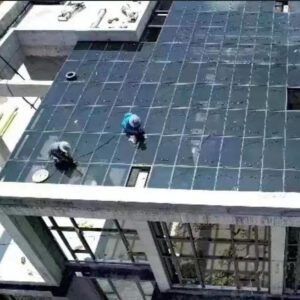
Crews cleaning a glass tower. Photo: Buiobuione, CC BY-SA 4.0, via Wikimedia Commons.
Quick answer: BIPV (building-integrated photovoltaics) glass needs three things after handover: gentle cleaning with the right water, a scheduled inspection routine, and a written safety plan for work at height. Most sites do well with one or two cleanings a year and one detailed inspection a year. Dusty, coastal, or industrial sites need more.
In this guide: environmental stressors, cleaning protocols, inspection tools, warning signs, facade-specific care, safety rules, maintenance calendars, and a cost model. A glossary and 12 questions close the article.
I. Where architecture meets energy: why solar glass matters
Picture a glass facade that looked perfect on handover day. The architect is happy. The owner is happy. The solar glass, which is both the skin of the building and its power plant, is doing both jobs.
Then three years go by. Dust sticks to the lower panes. Hard water leaves white spots. A few edge seals begin to cloud. Nobody notices, because nothing alarms.
At ジャ・マオ・ビップフ, this is the story we hear most from contractors who inherit projects: not a dramatic failure, but a slow slide. The global solar PV glass market is valued at about $22.05 billion in 2026, which tells you how many square meters of glass now need care.
Solar glass has two jobs. As a building material, it keeps out weather and carries load. As an electrical part, it passes sunlight to the cells. Both jobs depend on a clean, intact, well-sealed surface.
The “performance gap”: why neglect gets expensive
その performance gap is the difference between what a system was designed to produce and what it actually delivers. It grows when soiling, cracks, and seal failures go unnoticed.
The numbers add up fast. The IEA’s PV Power Systems Programme estimates that soiling alone cost the global PV fleet at least 3–4% of annual energy in 2018, worth about €3–5 billion, and expects 4–5% by 2023. Our own commercial solar roof tile maintenance guide notes that a roof that performs for 25 years and one that quietly loses 10–15% of its output usually differ in one thing: upkeep.
With BIPV the stakes are higher than with racked panels. A cracked glass unit can mean lost power and a leak at the same time. The asset is also part of the building envelope, so lost value shows up in warranty claims and tenant complaints, not just in the energy report. The U.S. Department of Energy describes building-integrated photovoltaics as solar that replaces conventional roofing, skylight, and facade materials. When it replaces those materials, it takes on their maintenance duties too.
Objective: a roadmap you can use on site
This guide gives EPCs, contractors, distributors, and architects a working plan. You will find what to clean with, how to inspect, what to watch in the data, how to stay safe, and what each choice costs. Where we use numbers, we say where they come from.
II. Understanding the Environmental Stressors on Building Solar Glass
Three forces wear on solar glass: dirt on the surface, temperature swings through the glass, and living things that grow on it.
Atmospheric pollutants and soiling
Soiling is the layer of dust, soot, pollen, salt, and grime that builds up on glass and blocks light before it reaches the cells.
Losses depend heavily on place and time since the last wash. The IEA PVPS Task 13 report collects measured examples, and the range is wide.
Source: IEA PVPS Task 13 soiling report. The bars use different time bases, shown in each label, so compare the pattern and not the exact heights.
The takeaway: the same glass can lose 1% in one place and nearly half its output in another when left alone. A U.S. map from NLR (the lab formerly known as NREL) tracks 255 sites. Its soiling map uses a simple scale where a ratio of 0.95 means a 5% annual loss.
Where does the dust come from? The IEA report cites a global survey of airborne mineral dust.
Source: Engelbrecht et al., as cited in the IEA PVPS Task 13 report. “All other regions” is the remainder after the three named sources.
Three details from that report matter for facades and roofs:
- Moisture makes dirt stick. Humidity and dew help dust cement onto glass. Solar glass loses heat to the night sky and cools below the air temperature, so dew forms on it early.
- Small particles stay put. Particles smaller than 10 µm are rarely blown off by wind.
- Dirt collects low. Soiling tends to build up along the lower edge of a module, which can hurt output more than an even film would.
Cities add their own mix. The IEA lists carbon, oil smoke, and diesel exhaust among urban sources. These form sticky films that rain does not remove.
Industry insight: Vertical facades shed loose dust better than tilted roofs. Do not assume they stay clean. Sticky traffic and industrial films, plus runoff from concrete above, often matter more on a facade than dry dust. Measure your own baseline in the first year.
Thermal cycling and mechanical stress in curtain walls
Thermal cycling means the glass and frame heat up by day and cool by night, over and over, for decades.
Glass and aluminum move by different amounts. Here is a simple example for a 2 m aluminum mullion and a 2 m glass edge over a 50 °C swing:
That 1.4 mm gap must be absorbed every day by gaskets, setting blocks, and sealants. If the joint is too tight, the glass takes the stress. Our BIPV curtain wall design guide adds that BIPV glass units weigh about 15–35 kg/m², compared with 10–14 kg/m² for a standard insulating glass unit, so supports see more load too.
強化ガラス is heat-treated so its surface is under compression. It is strong, but rare internal impurities can cause it to break on its own, years later.

Tempered glass that broke without impact, caused by an internal impurity. Photo: Ox1997cow, CC BY-SA 3.0, via Wikimedia Commons.
Cold regions add a second risk. The IEA report notes that freeze-thaw cycles can crack cells, bend frames, and damage coatings.
For a quick visual of why laminated glass behaves differently from tempered when it breaks, watch this short comparison:

Biological fouling: algae and lichen in humid cities
Biological fouling is growth of algae, moss, or lichen on the glass, usually along shaded edges and horizontal ledges where water sits.
It matters for two reasons. It blocks light, and it holds moisture against seals and metal. The NLR team warns that standard soiling calculations do not capture pollen and biological soiling well, so these losses can hide inside your data.
Watch the bottom edge of each pane, the corners of framing, and any spot where water pools. These show growth first.
III. Strategic Cleaning Protocols for Large-Scale Installations
Cleaning is where most well-meaning crews do damage. The glass is tough, but its coating is thin.
An anti-reflective (AR) coating is a very thin layer on the glass that lets more light through. On solar glass it is often only around 100 nanometers thick, about a thousand times thinner than a human hair. Scrub it hard and you remove what you paid for.

An AR-coated optical window seen at 45° (left) and straight on (right). This is a lab optic, shown only to illustrate how thin coatings behave. Photo: Zaereth, CC0, via Wikimedia Commons.
Coatings are worth protecting. Our ultra-clear tempered glass reaches up to 91.5% light transmittance, about 8% higher than standard glass, and our types of solar glass for BIPV guide explains how iron content, coating, and thickness produce that gain.
Selecting cleaning agents
| Use | Avoid | |
|---|---|---|
| Water | Purified water (see next section) | Hard tap water, recycled gray water |
| Detergent | Mild, neutral-pH cleaner approved by the glass maker | Strong acids, strong alkalis, bleach, solvents near seals |
| Tools | Soft microfiber, soft brush, water-fed brush | Scrapers, razor blades, steel wool, abrasive pads and powders |
| Pressure | Low pressure, as the manufacturer allows | High-pressure jets that push water into edge seals and cable entries |
| Timing | Early morning or evening, glass cool to the touch | Midday on hot glass (cold water on hot glass adds thermal shock) |
Industry insight: Write the approved cleaning agents into the maintenance contract. A third-party cleaner who uses an unapproved chemical can give a manufacturer grounds to reject a later warranty claim. Our warranty, certification, and maintenance buyer’s guide explains how to read those clauses.
Water quality: why deionized or RO water matters
Deionized (DI) water has had its mineral ions removed. Reverse osmosis (RO) water is pushed through a fine membrane that strips out most dissolved solids. Either one dries without leaving spots.
Hard water leaves calcium and magnesium behind as it evaporates. Over many cycles these form a scale that scatters light and is hard to remove without abrasion. Many cleaning contractors aim for water under about 50 ppm total dissolved solids. Confirm the limit with your glass supplier.
Robotic systems vs. manual reach-and-wash
| Method | Best for | Watch out for |
|---|---|---|
| Water-fed pole (reach-and-wash) | Low-rise roofs and lower facade zones, up to about 20 m | Operator fatigue, uneven results on high panes |
| Rope access crews | Irregular facades with no permanent access | Weather limits, labor cost, anchor points must be certified |
| Gondola or BMU (building maintenance unit) | Tall, regular facades | Needs rails and roof space designed in advance |
| Cleaning robots | Large, repeated surfaces | Needs rails, edges, or anchors; check brush contact with coatings |
| Drones with spray | Hard-to-reach spots, light cleaning | Limited scrubbing power; not for sticky films |
For curtain walls, robots work best when the facade was designed for them. Brush tracks, continuous top edges, and parking points need to be on the drawings. That is a design-phase decision, not a retrofit.
IV. Advanced Inspection Frameworks: Beyond the Visual Check
Your eyes find dirt and obvious breaks. They miss the defects that cost energy slowly. Three tools cover the gaps.
| Tool | What it finds | When to use it |
|---|---|---|
| Visual audit | Delamination, color change, seal failure | Every inspection round |
| Infrared thermography | Hot spots, failed strings, bypass-diode faults | Yearly, in steady sunlight |
| EL testing | Micro-cracks, broken contacts | At handover, after storms, and when output drops |
Thermographic imaging: infrared drones for hotspots
A hot spot is a small area that runs hotter than its neighbors, often because a cell is cracked, shaded, or failing. A thermal camera sees the extra heat that your eyes cannot.
Sinovoltaics describes infrared thermography inspection to IEC TS 62446-3 as covering failed modules and strings, bypass-diode faults, connection problems, and severe soiling. The standard sets the sunlight and angle conditions so results can be compared year to year. That matters for lenders and insurers.
On a vertical facade, drones are useful for first-pass screening. Handheld cameras then confirm anything suspicious.
Electroluminescence testing: finding micro-cracks
Electroluminescence (EL) testing runs current through a module in a dark setting, so the cells glow faintly in infrared. A camera photographs the glow. Cracked areas look dark.

A solar cell glowing under electroluminescence imaging. Dark patches in such images mark defects. Photo: Pablo García-Linares, CC BY-SA 4.0, via Wikimedia Commons.
Sinovoltaics calls micro-cracks the top defect found in electroluminescence (EL) testing of PV modules. It also notes EL can reveal busbar contact failures and potential-induced degradation, neither of which shows on a visual check.
For BIPV, the practical rule is simple: take an EL baseline of sample units at handover. Compare against it after hail, a heavy storm, or any unexplained drop in output.
Visual auditing: delamination, discoloration, and seal failure
Delamination means the layers of the glass sandwich are separating. Check for these signs on every round:
- Milky or foggy patches near the edges
- Bubbles or wavy lines in the interlayer
- Yellow or brown cell areas
- Moisture lines or white residue at the seal
- Rust-colored streaks from corroding metal contacts
Photograph each finding with a location tag. A photo of the same pane taken a year apart beats any description.
V. Identifying Early Warning Signs of Performance Degradation
Your monitoring data already holds clues. You just have to know what to look for.
Reading IV curve deviations
An IV curve plots the current a module produces against its voltage. A healthy curve has a flat top and a sharp corner. Changes in shape point to specific problems.
| What you see | Likely cause | Systemic or local? |
|---|---|---|
| Whole curve lower, same shape | Even soiling, or slow aging | Systemic |
| Step or kink in the curve | Shading, cracked cell, or active bypass diode | Local |
| Slope near the corner gets rounder | Added resistance (corroded contacts, loose connectors) | Local or string |
| Lower voltage at the same current | Heat, or cell damage | Either |
Run IV curve tests as part of the annual round, and keep the first set as your baseline. Our wiring and electrical integration guide shows where test points should be placed so crews can reach them without removing glass.
Recognizing shading patterns
Shade changes over time. A new building next door, a rooftop unit, a tree, or a pile of debris can cast a moving shadow across a few panes. In a series string, one shaded pane can drag the whole string down.
Plot output by time of day. A daily dip at the same hour every day is a classic sign of a fixed shadow.
Monitoring inverter data
Performance ratio (PR) compares actual energy output with what the system should produce for the sunlight it received. A slow PR drop over several months points to soiling or aging. A sudden step points to a failure.
Watch string voltage. A step down of roughly one cell-group (often about a third of a module’s voltage) suggests a bypass diode has failed or a section is shaded. Compare strings that face the same direction. A string that stands apart is the one to inspect.
VI. Specialized Maintenance for BIPV Curtain Walls and Facades
A facade is a vertical, drained, sealed system. That brings its own care list.
Managing drainage and runoff
Water that runs down a facade carries minerals with it. Concrete spandrels and limestone trim release alkaline runoff that dries into white streaks on the glass below.
Keep these clear:
- Weep holes and drainage channels in the frame
- Drip edges above glass zones
- Gutters and roof drains that feed the facade
Streaks are not only cosmetic. They scatter light and often hide deeper drainage trouble.
Structural silicone and weather seals
Structural silicone is the adhesive that bonds glass to the frame in some curtain wall systems. Weather seals and gaskets keep water out.
私たちの ROI guide for photovoltaic EPC contractors lists sealant joint inspection every 3–5 years. Our independent review of glass-integrated facade systems adds periodic electrical inspection every 2–3 years, and says to budget 2–3 times the per-square-meter maintenance cost of rooftop solar because of high-rise access.
Check for cracking, loss of grip at the edges, color change, and gaps at corners. Do not patch with an unapproved sealant. Some sealants attack the module edge seal.
Glass choice affects how much damage a seal failure can cause. Our tempered laminated BIPV glass uses a 0.76 mm PVB interlayer that holds fragments together if a pane breaks, and the product page lists a 25-year structural integrity warranty. A broken laminated pane is far easier to make safe than a broken monolithic one.
Coordinating with facility management
Facility teams care about tenants, schedules, and risk. Agree these items up front:
- Cleaning windows that avoid peak hours and events
- Written notice to tenants on affected floors
- Access booking for the gondola or BMU
- Who isolates the electrical system, and who signs off
- A single contact for emergencies
Our guide for curtain wall contractors working with solar energy glass panels covers how to split these duties between glazing and electrical trades, so nothing falls between them.
VII. Risk Mitigation and Safety Standards for High-Altitude Maintenance
Cleaning and inspection happen at the edge of a roof or on a rope. This is where people get hurt.

A rooftop gondola system used for facade cleaning and maintenance. Source: Wikimedia Commons.
Compliance with OSHA and EN standards
In the United States, OSHA’s duty to have fall protection rule requires guardrails, safety nets, or personal fall arrest systems for any worker at an unprotected edge 6 feet (1.8 m) or more above a lower level. Rules for other places vary, so check local law.
In Europe, EN 795 covers anchor devices, and EN 1808 covers suspended access equipment such as gondolas. Rope access teams usually hold certification from bodies such as IRATA.
Watch this short report from a professional rope technician working on a tall building:

Fall protection and secure anchoring
Plan anchor points at the design stage. Retrofits are slow and often impossible on a finished facade. Before each job:
- Confirm that anchors and rails have a current inspection tag.
- Check each worker’s harness, lanyard, and rope.
- Set an exclusion zone on the ground below.
- Check wind forecasts and stop work above your set limit.
- Make sure a rescue plan exists, and that the crew knows it.
“Safe-to-clean” lockout/tagout procedures
Lockout/tagout (LOTO) is a method of switching off and locking an energy source so it cannot be turned on while someone works. OSHA’s hazardous energy control guidance explains the idea and points to the general-industry rule 29 CFR 1910.147 as the usual reference. Construction work follows related rules.
There is one point many crews miss. Solar glass makes voltage whenever light hits it, even after the inverter is off and the disconnects are open. Locking out the inverter protects the inverter side. It does not make the glass safe.
Industry insight: Treat every module as live in daylight. Use insulated tools, keep water away from open connectors, and never touch damaged glass or exposed wiring. Where a broken pane is found, mark it, cordon it, and call the electrical contractor before anyone cleans near it.
VIII. Extending Service Life: Preventative vs. Reactive Strategies
Reactive maintenance waits for alarms. Preventative maintenance follows a plan. For BIPV, the plan is cheaper.
A maintenance calendar based on local climate
The table below is a starting point. Adjust it with your first-year baseline data.
| Climate | クリーニング | Inspection | Extra attention |
|---|---|---|---|
| Dusty or arid | Every 1–3 months in dry season, as soiling data suggests | Yearly thermal scan | Dust build-up on lower edges |
| Coastal or salty | Rinse more often with RO water | Yearly, plus metal corrosion check | Frames, fasteners, edge seals |
| Humid and green | Twice a year, plus spot cleaning | Yearly | Algae and lichen on shaded edges |
| Cold and snowy | After heavy snow, spring wash | Spring inspection | Freeze-thaw cracks, frame distortion |
| Temperate city | One to two cleanings a year | Yearly | Sticky traffic film, runoff streaks |
Periodic torque checks on mounting hardware
Clamps and fixings loosen over time. Gaskets compress and relax. Loose hardware lets glass rattle and rub. Over-tightened hardware puts the glass under point stress.
Use a calibrated torque wrench set to the manufacturer’s value. Check the first time after the first year, then at intervals the manufacturer sets. Never over-tighten “to be safe”.
A digital logbook for assets and warranty compliance
Keep one record per glass unit or zone. Use a spreadsheet or your building’s maintenance system. You can copy this table into Excel:
| Field | Example entry |
|---|---|
| Unit ID and location | Level 6, grid C4 |
| Serial number and batch | From the label |
| Last cleaning date | 2026-09-14 |
| Cleaning agent and water source | Neutral cleaner, RO water |
| Last inspection and findings | Edge seal clear, no cracks |
| IV or EL result | Baseline or last test |
| Photos | Linked file names |
| Repairs and parts | Replaced gasket, 2026-05-02 |
| Warranty notes | Claim filed, reference number |
When a warranty claim arrives, the manufacturer asks for exactly this. A complete log answers the question in minutes. A missing log can turn a valid claim into an argument.
IX. Economic Impact Analysis: The Cost of Neglect vs. The Value of Maintenance
More cleaning is not always better. The goal is the cheapest plan that protects output and safety.
Calculating the value of cleaning: LCOE and recovered kWh
LCOE (levelized cost of energy) is the lifetime cost of a system divided by the lifetime energy it makes:
Cleaning adds cost but also adds kWh. It lowers your cost per kWh only when each extra kWh it recovers is cheaper than the kWh you already make. The simplest test is:
If that number is lower than your power price, the cleaning pays for itself.
Example. Take a 100 kWp BIPV system making about 130,000 kWh a year, with power at $0.12 per kWh. Assume a dusty, industrial site, and a cleaning visit that costs $700. These are example assumptions. Use your own.
| Plan | Soiling loss | Lost revenue | Cleaning cost | Total yearly cost |
|---|---|---|---|---|
| No cleaning | 15% | $2,340 | $0 | $2,340 |
| 1 clean per year | 9% | $1,404 | $700 | $2,104 |
| 2 cleans per year | 5% | $780 | $1,400 | $2,180 |
| 4 cleans per year | 3.5% | $546 | $2,800 | $3,346 |
The math for the no-cleaning row:
Example model using the assumptions above. Soiling percentages are illustrative for a dusty industrial site.
Look at what happens. At $0.12 per kWh, one cleaning a year is cheapest. Going from one to two cleanings costs $0.135 for each kWh recovered ($700 for 5,200 kWh), which is more than the power is worth.
Now change the tariff to $0.25. Total yearly cost becomes $4,875 with no cleaning, $3,625 with one clean, $3,025 with two, and $3,938 with four. The best plan moves. This is why a site-specific model beats a rule of thumb.
Industry insight: On energy value alone, mild-climate roofs often pay off with just one cleaning a year. Facades cost more to reach. That means the inspection value (finding cracks, seal failures, and drainage faults early) usually justifies the visit even when the energy gain does not.
Reducing O&M costs by preventing catastrophic failure
A single unnoticed edge-seal failure lets moisture into a unit. That can mean corrosion, ground faults, and a pane replacement, plus scaffold or gondola time. Catching it early may mean a gasket or a re-seal.
Add the access cost. Replacing one pane on a tall facade can cost far more than the pane. The cheapest repair is the one done during a scheduled visit when the crew is already there.
Resale value and green certification
Documented operation helps at sale and at certification. LEED has rating tracks for existing buildings that reward verified operations, and ブリーアム assesses whole-life performance of assets. A building with maintenance logs, cleaning records, and test results can show its solar skin still performs. A building without them cannot.
私たちの advanced solar roof tile maintenance guide shows how roofing contractors can package this documentation at handover.
X. Stewardship, not “install and forget”
Solar glass pays back when it is treated like a building system with a service plan. That means:
- Know your site’s stressors.
- Clean with the right water and the right agents.
- Inspect with tools that see what eyes miss.
- Read your data for early warnings.
- Work safely at height.
- Choose a maintenance frequency by cost, not by habit.
A gold standard worth adopting
If you are a contractor, build the maintenance handover into your scope. If you are an EPC, price a service plan in the bid. If you are an architect, draw in the anchors, rails, and access panels. If you are a distributor, ship a care sheet with every order.
Jia Mao Bipv engineers often review maintenance plans for glass specifications before a bid is finalized. If you want a second opinion on yours, contact the Jia Mao team with your project type, location, and facade layout.
Glossary: Key Terms in Plain English
| Term | Plain meaning | Example |
|---|---|---|
| BIPV | Solar that is part of the building skin | A solar glass curtain wall |
| Soiling | Dirt film on glass that blocks light | Dust and traffic film on lower panes |
| AR coating | Thin layer that lets more light in | About 100 nm on solar glass |
| DI / RO water | Purified water without dissolved minerals | Used for spot-free rinsing |
| Thermal cycling | Daily heating and cooling | Frame moves more than glass |
| Hot spot | A cell area running hotter than neighbors | Often a cracked or shaded cell |
| EL testing | Photographing cells that glow under current | Dark lines show cracks |
| IV curve | Graph of current vs. voltage for a module | Kinks point to local faults |
| Performance ratio | Actual vs. expected energy output | A falling PR signals trouble |
| Delamination | Layers separating inside the glass | Milky patches at the edge |
| LOTO | Lock and tag an energy source before work | Inverter isolation |
| LCOE | Lifetime cost per kWh produced | Lower is better |
| BMU | Building maintenance unit, a facade access rig | Gondola on roof rails |
よくある質問
1. How does the use of hard water during cleaning impact the long-term transmittance of AR-coated glass?
Hard water leaves calcium and magnesium deposits as it dries. Repeated cycles build a scale that scatters light and tempts crews to scrub, which wears the coating. Use DI or RO water, aim for low dissolved solids (many contractors target under about 50 ppm), and confirm the limit with the glass maker.
2. What is the optimal frequency for thermographic inspections in high-density urban environments?
Once a year is a sound default, taken in steady sunlight under IEC TS 62446-3 conditions. Add a scan after a hailstorm, a lightning event, or an unexplained drop in output. Take the first scan at commissioning so you have a baseline to compare against.
3. How can we distinguish between permanent cell degradation and temporary soiling in performance data?
Clean a test section and compare output before and after. If output returns, it was soiling. If it does not, look for cracks, delamination, or seal faults. Sudden steps point to failures, and slow drifts point to aging or soiling. IV curves help: a uniformly lower curve fits soiling, while kinks suggest local damage.
4. Which robotic cleaning technologies are most compatible with integrated curtain wall systems?
Rail-guided and edge-guided robots suit regular facades because they follow fixed tracks. Systems that need anchors or parking bays must be planned at design stage. Always check that brush material and contact pressure are approved for your coating, and run a trial on a spare pane first.
5. What are the specific risks of using high-pressure washers on BIPV modules?
High pressure can force water past edge seals, junction boxes, and cable entries. It can also lift sealant and damage coatings. It does little against sticky films, which need chemistry and soft contact, not force. Follow the manufacturer’s pressure limit.
6. How do we manage warranty claims with glass manufacturers when third-party cleaning is involved?
Use only approved agents, tools, and water, and put those into the cleaning contract. Keep service records, dates, photos, and the chemical datasheets. Ask the manufacturer to approve the cleaning specification in writing before work starts.
7. What is the impact of urban “smog films” on the energy yield of vertical solar facades?
We do not have a single universal figure. Urban films include carbon, oil smoke, and diesel exhaust, which stick even to vertical glass. Measure your own baseline by cleaning a test pane and comparing output. The first-year data tells you what your site loses.
8. How can architects design for “maintainability” to reduce future O&M costs for the client?
Draw in permanent anchors, rails, and roof space for a gondola. Choose glass sizes that allow replacement without removing neighbors. Keep junction boxes reachable. Add drip edges to stop runoff streaks. Include a maintenance access plan in the design package, not as an afterthought.
9. What are the signs that a BIPV module’s edge seal has failed, and how does it affect the glass?
Look for milky or cloudy patches near the edge, bubbles, moisture lines, yellowed cells, and rust-colored streaks. Moisture can then corrode contacts, cut insulation resistance, and cause ground faults. A failed seal is a replacement job in most cases, not a cleaning job.
10. In what scenarios should a contractor recommend full module replacement over specialized cleaning?
Recommend replacement for a cracked or shattered pane, a failed edge seal with moisture inside, delamination that is spreading, burn marks, or a hot spot that returns after cleaning. Cleaning can fix only surface problems. If an EL test shows widespread cracks, replacement of that unit protects the rest of the string.
11. How does thermal expansion in large-scale glass arrays affect the mechanical stability of the cells?
Frames and glass move by different amounts, as the 1.4 mm example in section II shows. If joints do not absorb it, the glass takes stress, and stress can crack the cells behind it. Cells are brittle, so the cracks are often invisible until EL testing. Movement joints, setting blocks, and correct torque are the defense.
12. What are the best practices for cleaning solar glass in regions with high saline/coastal air?
Rinse more often with RO water, because salt absorbs moisture and helps dirt cement onto the glass. Avoid scrubbing dry salt. Check aluminum frames, fasteners, and seals for corrosion at every visit. Keep drainage clear, and shorten the inspection interval compared with inland sites.