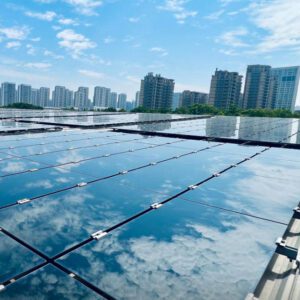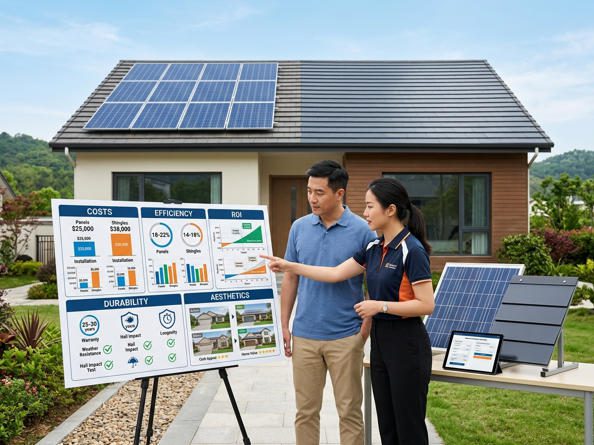

A homeowner in Austin, Texas recently paid $52,000 for a Tesla Solar Roof on a 2,000 sq ft home. The system generates 8.5 kW and offsets roughly 11,900 kWh per year — saving about $1,547 annually. Down the street, a neighbor installed a 10 kW traditional panel array for $28,000 and generates 14,200 kWh per year, saving $1,846. The panel system pays off in 8.7 years; the shingle system takes 14.6 years. Yet the first homeowner got a brand-new roof, seamless curb appeal, and a 30+ year lifespan in a single project. That gap — higher upfront cost versus better aesthetics and dual function — defines the solar shingle vs traditional panel decision that hundreds of thousands of homeowners face every year.
This guide compares both technologies across every dimension that matters: aesthetics, installation, efficiency, durability, weather resistance, cost, environmental impact, and long-term savings. Every claim is backed by manufacturer specs, third-party research, or verified field data — not marketing copy.
Whether you are replacing an aging roof, building a new home, or simply adding solar generation to an existing structure, the right answer depends on your specific situation. Let’s walk through it systematically.
Overview: Solar Shingles vs Traditional Solar Panels
Definition of Solar Shingles and Traditional Panels
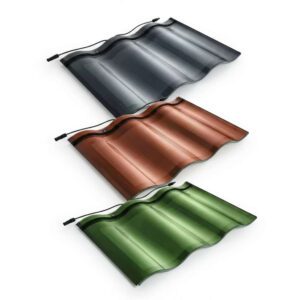
A solar shingle — also called a BIPV roof tile or photovoltaic shingle — replaces conventional roofing material entirely. Each unit contains monocrystalline or thin-film solar cells laminated between layers of tempered glass or durable polymer. When sunlight hits the tile, embedded cells convert photons into direct current (DC) electricity. The shingle is simultaneously the roof and the power plant — there is no separate structure beneath it.
A traditional solar panel (also called a rack-mounted or rooftop PV module) is a standalone energy device mounted on metal rails bolted to an existing roof. The roof itself stays intact. A typical residential panel measures approximately 65 × 39 inches, weighs 40–50 lbs, and produces 370–450 watts. Unlike shingles, panels are optimized purely for power density because aesthetics are a secondary concern — which is why they consistently outperform shingles on efficiency per square foot.
Core Technology Differences and Integration Approaches
The key architectural difference is integration depth. Shingles are part of the building envelope; panels sit on top of it. This distinction has cascading implications for installation time, structural loading, maintenance access, waterproofing, and aesthetics. The table below captures the foundational contrast before diving into individual categories.
| Characteristic | Solar Shingles | 従来のソーラーパネル |
|---|---|---|
| Integration type | Replaces roofing material (BIPV) | Mounts on top of existing roof (BAPV) |
| Roof removal required? | Yes — full or partial tear-off | No — installs over existing roof |
| Primary cell technology | Monocrystalline silicon (most brands) | Monocrystalline silicon (mono PERC, TOPCon, HJT) |
| Electricity generation | DC → AC via inverter or microinverter | DC → AC via string inverter or microinverter |
| Visual appearance | Flush with roofline; indistinguishable from premium shingles | Protrudes 3–6 inches above roof surface |
| Roof serves as waterproofing? | Yes — shingle IS the roof | No — separate roofing layer beneath |
| Typical installation time | 5–14 days | 1–3 days |
| Suitable for flat roofs? | No (minimum 2:12 pitch) | Yes (with tilted ballast mounts) |
The global BIPV market is growing at 21.3% CAGR and is projected to reach $28.3 billion by 2034. Solar shingles represent the fastest-growing BIPV residential segment, driven by HOA adoption barriers to rack-mounted panels and growing demand for net-zero new construction where aesthetics and energy performance are co-designed from day one.
Aesthetics and Design
Roof Appearance and Architectural Compatibility
Solar shingles win the aesthetics category by a wide margin — and for many homeowners, this is the deciding factor. Installed correctly, solar shingles are essentially indistinguishable from premium architectural shingles, slate tiles, or clay tiles at street-viewing distances. Tesla’s Solar Roof uses a colored louver film so tiles appear opaque to observers below but transparent to sunlight from above. GAF Energy’s Timberline Solar shingles nail directly to the roof deck alongside standard GAF shingles, creating a completely uniform roof surface.
Traditional panels, even with the substantial aesthetic improvements of all-black modules and low-profile mounting systems, still protrude 3–6 inches above the roofline and remain visibly distinct from surrounding roofing material. For a rear-facing roof slope, this is usually acceptable. For a street-facing primary gable on a Victorian or craftsman-style home, it can be a dealbreaker — particularly in homeowner associations or historic districts where design review boards have authority to reject visible solar installations.

Solar shingles integrate flush with the roofline, eliminating the raised-panel profile that many HOAs and historic district boards reject. Photo: Unsplash
Color, Finish Options, and Curb Appeal
Most solar shingle brands offer 3–8 color and texture options designed to mimic conventional roofing materials. GAF’s Timberline Solar comes in Charcoal (the most popular 2025 residential roof color per industry data), Pewter Gray, and Barkwood. Tesla offers a single dark glass-tile aesthetic. Luma Solar provides both black and natural slate finishes.
Traditional panels are largely standardized in appearance: black or dark-blue cells with silver or black frames. All-black panels (black backsheet, black frame) have become the aesthetic standard for premium residential installations, offering a cleaner look than older silver-frame configurations — but they still don’t match the seamless profile of shingles.
One consideration that is routinely underweighted: the resale audience. A U.S. Department of Energy study found that BIPV shingle installations increase home resale value by 3–5% on average, compared to 2–4% for traditional panel systems, reflecting the premium buyers place on integrated aesthetics in higher-value home segments.
Installation and Retrofit Considerations
Roof Structure Requirements and Compatibility with Existing Roofs
Solar shingles require a minimum roof pitch of approximately 2:12 (about 9.5°) — they are not suitable for flat or very low-slope roofs. Beyond pitch, the roof structure must be assessed for load-bearing adequacy, since shingles have specific structural requirements including proper sheathing, ridge and valley framing, and fastening schedules. Most solar shingle installations require a full or partial roof tear-off, replacing the existing roofing material entirely.
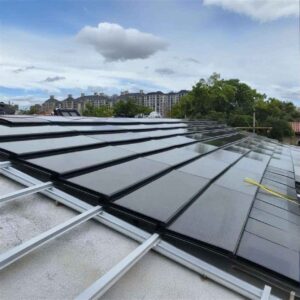
Traditional panels can be installed on virtually any existing roof type — asphalt shingle, metal, clay tile, concrete tile, or flat membrane — with minimal structural modification. The racking system distributes loads through lag bolts into the roof structure. For a roof with 10+ years of remaining life, adding traditional panels is the path of least structural disruption.
For detailed installation sequencing — including structural preparation, waterproofing, and electrical rough-in — Jia Mao BIPV’s step-by-step solar tile installation guide documents the complete process with recommended fastener specs and quality checkpoints at each phase.
| Installation Factor | Solar Shingles | 伝統的なパネル | Winner |
|---|---|---|---|
| Roof tear-off required? | Yes (full or partial) | No | Panels |
| Minimum roof pitch | 2:12 or steeper | Any pitch (flat OK with tilted mounts) | Panels |
| Structural engineer review required? | Usually yes | Rarely (standard residential) | Panels |
| Installation crew specialization | Roofer + electrician (dual trade) | Solar installer only | Panels |
| Installation duration | 5–14 days | 1–3 days | Panels |
| Disruption to occupants | High (roof fully exposed) | Low | Panels |
| Expandability after install | Complex (tile removal required) | Easy (add modules to existing rails) | Panels |
| Advantage when replacing old roof | High — eliminates separate roofing cost | None | Shingles |
Installation Time, Labor Needs, and Potential Disruptions
The labor intensity gap between the two technologies is significant and directly explains much of the cost premium for shingles. According to field data from Jia Mao BIPV’s installation reference guide, solar tile projects require approximately 6.9 worker-hours per kW installed — compared to roughly 2.5–3.5 worker-hours per kW for traditional panels. For a standard 8 kW system, that translates to 55–70 worker-hours for shingles versus 20–28 worker-hours for panels — a 2.5× labor difference that accounts for approximately $8,000–$15,000 of the typical cost gap between the two systems.
⚠️ Roof Age Check: If your existing roof has fewer than 5 years of remaining life and you install traditional panels now, you’ll likely pay $1,500–$6,000 to have the panels removed and reinstalled when the roof needs replacement — per EnergySage’s roof-replacement cost data. Factor this into your total cost comparison if your roof is aging.
Efficiency and Energy Output
Typical Efficiency Ranges for Each Option
PV efficiency measures what percentage of sunlight is converted to electricity. Traditional panels hold a clear advantage here, and the gap matters practically — not just on specification sheets.
Note: Module efficiency differs from system efficiency. Shingles often run hotter due to enclosed installation cavities, adding a 2–5% temperature-related performance reduction on top of the cell efficiency gap. Site-specific modeling with NREL PVWatts is recommended for accurate production estimates.
Impact of Shading, Orientation, and Residential Typical Outputs
Both technologies suffer from shading, but they handle it differently. Traditional panels on adjustable racking can be tilted for optimal sun exposure and positioned to avoid roof obstructions (chimneys, vents, skylights). Shingles must follow the roof plane exactly — if your ideal solar slope is obstructed by a dormer, there’s no workaround.
A 10 kW traditional system on a south-facing 30° roof in Charlotte, NC (production ratio 1.3) generates approximately 13,000 kWh/year. A comparable-wattage solar shingle installation on the same roof — covering 20–30% more area due to lower power density — generates approximately 10,400–11,700 kWh/year. That 10–20% production gap is a real-world outcome of both the efficiency difference and the temperature penalty shingles incur from their enclosed installation position.

Traditional rack-mounted panels can be positioned at the optimal tilt angle regardless of roof pitch — a flexibility solar shingles don’t have. For maximum kWh per dollar, panels consistently outperform shingles. Photo: Unsplash
Durability and Maintenance
Cleaning Needs and Maintenance Frequency
Both technologies require modest but consistent maintenance to preserve performance. Dust, pollen, bird droppings, and debris accumulate on solar surfaces and reduce output by 3–8% annually if not addressed. The cleaning approach differs slightly by form factor:
- Solar shingles: Clean 1–2× per year using soft brush and water; many brands include self-cleaning hydrophobic coatings that reduce frequency in moderate climates. Integrated installation means no accessible mounting hardware to inspect for corrosion.
- Traditional panels: Clean 2–4× per year depending on environment; urban and arid locations require higher frequency. Annual visual inspection of mounting hardware, rail clamps, and roof penetration sealants is recommended. The elevated position above the roof surface actually helps: light rain washes panels more effectively than the flush-mounted shingle surface.
For both system types, Enphase’s maintenance guide recommends professional inspection every 5–10 years for electrical components regardless of the technology chosen.
Replacement Cycles and Expected Lifespan of Components
Lifespan is an area where solar shingles have a genuine structural advantage. Because the shingle is made of tempered glass over a ceramic or polymer substrate, it can outlast the solar cells themselves — several manufacturers offer lifetime structural warranties on the tile, separate from the 25-year power output warranty. Traditional panels last 25–35 years but the racking system beneath them — including lag bolts, rail clamps, and waterproofing sealants at roof penetrations — typically requires inspection and possible replacement at 15–20 years.
| Component | Solar Shingles — Lifespan | Traditional Panels — Lifespan |
|---|---|---|
| PV cells / module | 25–30 years (80% output) | 25–35 years (80% output) |
| Roofing / structural substrate | 30–50 years (glass tile) | 20–30 years (asphalt beneath panels) |
| Mounting / racking | Integrated — no separate racking | 15–25 years (corrosion risk) |
| Inverter (string) | 12–15 years | 12–15 years |
| Microinverter (if used) | 25 years (Enphase IQ8 warranty) | 25年 |
| Annual degradation rate | 0.3–0.5%/yr | 0.25–0.5%/yr (premium) / up to 0.7%/yr (standard) |
| Single-unit replacement difficulty | Moderate (involves waterproofing) | Easy (unbolt old panel, bolt new panel) |
Weather Resistance and Longevity
Wind Uplift Resistance and Hail Tolerance
Solar shingles are engineered to weather standards required of commercial roofing products — a higher bar than what PV modules alone must meet. Leading brands achieve:
| Brand | Wind Rating (mph) | Hail Rating | Fire Class | Testing Standard |
|---|---|---|---|---|
| テスラ・ソーラールーフ | 130 mph | Class 4 (2-inch ice ball) | Class A | UL 7103, ASTM D3161 |
| GAF Energy Timberline Solar | 130 mph | Class 4 | Class A | UL 7103, ASTM D3161 |
| Luma Solar | 166 mph | Class 4 | Class A | UL 7103, ASTM D3161 |
| VOLTAIC | 130 mph | Class 4 | Class A | UL 7103 |
| Traditional Panels (standard) | 90–140 mph (racking-dependent) | Class 3–4 (1.75–2 inch ball) | Class C (panel only) | IEC 61215, UL 61730 |
Solar shingles have an important structural advantage in severe weather: because they are mechanically fastened directly to the roof deck (not elevated on rails), they lack the lever-arm effect that can cause rack-mounted panels to peel away from the roof in extreme wind events. However, if a single shingle cracks from hail impact, the replacement process is more involved than swapping out a rack-mounted panel — the installer must address waterproofing, which adds 1–2 hours of labor beyond the simple module swap required for traditional panels.
Performance in Extreme Temperatures and Weather Events
Both technologies are engineered for outdoor long-term exposure, but temperature performance differs. Solar shingles installed flush with the roof deck — with limited airflow beneath — routinely operate at 70–85°C on hot sunny days. Since PV cell output drops by approximately 0.35–0.45%/°C above 25°C (the standard test condition), a shingle at 80°C loses roughly 19–25% of its rated output on the hottest days. Traditional panels elevated 3–6 inches above the roof benefit from convective airflow beneath the module that keeps operating temperatures 10–15°C lower — translating to 4–7% better real-world output in hot summer conditions.
In cold climates, the flush installation of solar shingles creates a different problem: snow accumulation. Snow slides off elevated rack-mounted panels more readily. Shingles, flush with the roof plane, retain snow longer — reducing winter output, though the effect is partially offset by the shingles’ Class 4 hail and freeze-thaw cycle certification that ensures structural integrity through repeated thermal cycling.
Cost Analysis: Initial Investment
Module Costs, Inverters, and Integration Requirements
The cost gap between solar shingles and traditional panels is real, significant, and — critically — more nuanced than the headline numbers suggest. The correct comparison is not gross system cost but net effective cost: what you actually pay after subtracting the value of the conventional roofing material that shingles replace.
Sources: EcoWatch, Palmetto Solar, SolarReviews 2025. Varies by brand, region, and roof complexity.
The full cost comparison requires accounting for the material-offset credit: if you would be replacing your roof within the next 5 years anyway, the cost of conventional roofing ($8,000–$18,000 for a 2,000 sq ft home) is avoided by choosing solar shingles. This credit can close the payback gap between the two technologies substantially — in some cases to within 2–3 years.
| Cost Item | Solar Shingles (8 kW) | Traditional Panels (10 kW) | Notes |
|---|---|---|---|
| Installed cost per watt | $3.80–$7.00 | $2.50–$3.50 | Source: EcoWatch, EnergySage 2025 |
| Total system cost (8–10 kW) | $30,400–$56,000 | $20,000–$35,000 | Before incentives |
| Material-offset credit (if re-roofing needed) | $8,000–$18,000 | $0 | Avoids separate roof replacement |
| Net effective cost | $22,400–$48,000 | $20,000–$35,000 | After material offset |
| Federal ITC (30% — verify current status) | $9,000–$16,800 | $6,000–$10,500 | IRS Section 25D |
| Future roof removal cost (if panels installed on aging roof) | $0 | $1,500–$6,000 (add later) | EnergySageのデータ |
Roof Repair Implications and Warranty Considerations
Traditional panels add roof penetration points — lag bolts through the sheathing — that require periodic sealant inspection and potential re-flashing as the roof ages. Installer workmanship warranties typically cover these penetration points for 10 years; after that, they represent an ongoing maintenance liability. If a panel-covered section of roof needs repair, panels must be removed ($1,500–$6,000), the roof repaired, and panels reinstalled — a cost that is never visible in the original installation quote.
Solar shingles eliminate this liability because the shingle IS the waterproofing layer. There are no penetrations separate from the shingle system itself. The tradeoff is that a single damaged shingle in the active solar zone is more involved to replace than a traditional panel — requiring careful re-sealing of the surrounding waterproof membrane, adding 1–2 hours of skilled roofing labor beyond the panel swap equivalent.
Cost Analysis: Long-Term Savings and Payback
Electricity Rates, Capacity Factor, and ROI Timelines
The 25-year ROI scenario makes the financial difference concrete. Consider a 2,000 sq ft home in Dallas, TX (electricity rate $0.13/kWh, production ratio 1.4, 2% annual rate escalation):
Scenario A — Solar Shingles (8 kW): Gross cost $48,000. Material offset (aging roof) –$14,000. ITC (30%) –$10,200. Net cost: $23,800. Year-1 savings: $1,456 (11,200 kWh × $0.13). 25-year cumulative savings (2% escalation): ~$46,800. 25-year net profit: +$23,000. Payback: 12.1 years.
Scenario B — Traditional Panels (10 kW): Gross cost $30,000. ITC (30%) –$9,000. Net cost: $21,000. Year-1 savings: $1,820 (14,000 kWh × $0.13). 25-year cumulative savings: ~$58,500. 25-year net profit: +$37,500. Payback: 8.4 years.
Traditional panels generate approximately $14,500 more net profit over 25 years in this scenario. However, the shingle homeowner also has a 30–50 year roof compared to a 20–25 year asphalt roof — a deferred capital expenditure worth $12,000–$20,000 that narrows the gap further when considered on a full life-cycle basis.
All figures are illustrative projections. Actual results depend on local electricity rates, sun hours, system performance, degradation rate, and incentive status at time of installation. Verify ITC eligibility with a qualified tax professional.
Available Incentives, Rebates, and Financing Options
Both solar shingles and traditional panels qualify for the IRS Residential Clean Energy Credit (Section 25D), which historically provided a 30% nonrefundable tax credit on qualifying solar installations. For solar shingles, the credit applies to both the PV cost and the roof structure cost when the shingles are part of a solar energy system. As of mid-2025, legislation changes may affect this credit’s availability — always verify current status with a tax professional before making purchase decisions.
State-level programs vary significantly. The DSIRE database is the authoritative source for state rebates, property tax exemptions, and utility-specific programs by zip code. Massachusetts, New York, California, Maryland, and New Jersey historically offer the strongest stacking of incentives. PACE (Property Assessed Clean Energy) financing and green home equity products are available for both technologies in most states.
Environmental Impact and Sustainability
Material Recycling and End-of-Life Management
Both technologies face end-of-life challenges, but they differ in scale and complexity. Traditional solar panels contain silicon wafers, aluminum frames, glass, and in some cases small amounts of lead solder — all recoverable materials. The EPA’s end-of-life solar panel guidance notes that recycling infrastructure for PV modules is growing but remains inconsistent across US states. IRENA estimates that by 2030, the global volume of decommissioned panels will reach 4 million metric tons annually, creating both a challenge and a significant materials recovery opportunity.
Solar shingles have an additional end-of-life complexity: because the tile is integrated into the building envelope, disposal involves both roofing waste and electronic waste streams. Some manufacturers — notably GAF Energy — have established take-back programs that address this dual-stream challenge, but industry-wide standards remain in development. Homeowners should ask about end-of-life handling policies before purchasing any solar tile brand.
Lifecycle Emissions and Ecological Footprint
On a lifecycle basis, both technologies are dramatically lower-carbon than the fossil fuels they displace. NREL’s lifecycle GHG analysis puts rooftop PV at median emissions of approximately 41 grams of CO₂-equivalent per kWh — compared to 820 g CO₂e/kWh for coal and 490 g CO₂e/kWh for natural gas. A 10 kW residential solar system displacing grid power in a coal-heavy state avoids roughly 7,800 kg of CO₂ emissions annually — the equivalent of not driving a car for 19,500 miles.
Solar shingles carry a modestly higher manufacturing carbon footprint per watt than panels because of the additional glass, polymer, and roofing materials in each tile unit. However, when the embodied carbon of the replaced conventional roof (asphalt shingles manufacturing and transport) is subtracted, the lifecycle footprint difference between the two approaches narrows considerably. For new construction where a roof must be built anyway, BIPV shingles often represent the lower embodied-carbon option versus building both a conventional roof and a separate solar array.

Both solar shingles and traditional panels generate electricity at 41–50 grams CO₂e/kWh over their lifetime — roughly 20× cleaner than coal power. The difference between the two technologies in lifecycle emissions is far smaller than the difference between either and fossil-fuel generation. Photo: Unsplash
Choosing the Right Solution: Factors and Best Practices
Home Aesthetics, Budget, Climate, and Energy Goals
The decision framework is more personal than technical. Start by answering these four questions honestly before comparing product specifications:
- Does your roof need replacement within 5 years? If yes, the material-offset credit makes solar shingles significantly more competitive.
- Are there HOA, local ordinance, or architectural design restrictions on visible panels? If yes, shingles may be the only viable path to solar.
- Is maximum energy per dollar your primary goal? If yes, traditional panels deliver more kWh per dollar invested, with a shorter payback period.
- Are you building new construction or doing a major renovation? If yes, BIPV shingles integrated from the design phase offer a compelling lifecycle cost case.
Brands like Jia Mao BIPV’s photovoltaic tile range offer customizable monocrystalline solar tiles in flat, textured, and curved profiles — a practical option for developers and builders sourcing BIPV materials at scale or for international projects where domestic tile brands have limited availability. Their comprehensive solar roof tiles vs. traditional panels comparison provides detailed specification data for side-by-side product evaluation.
▶ Tesla Solar Roof vs Traditional Solar Panels: A real homeowner walks through the actual cost quotes, performance expectations, and ROI analysis for both options. (YouTube — Solar Time USA)
When to Prefer Shingles vs Traditional Panels — Decision Checklist
🌿 Choose Solar Shingles When:
- Your roof needs replacement within 5 years
- HOA or historic district restricts visible panels
- Building new construction or doing major renovation
- Aesthetics are a primary buying criterion
- Planning to stay in the home 20+ years
- Targeting premium curb appeal or resale value
- Your roof has a standard pitch (2:12 or steeper)
⚡ Choose Traditional Panels When:
- Roof has 10+ years of remaining life
- Maximum energy output per dollar is the priority
- You need the shortest possible payback period
- Flat or unconventional roof geometry
- You plan to sell within 10 years
- System expandability matters (add panels later easily)
- Budget is the primary constraint
Conclusion: Summary of Key Trade-Offs and Next Steps
The solar shingle vs traditional panel decision comes down to one central trade-off: aesthetic integration and dual functionality versus cost efficiency and faster payback. Neither technology is objectively superior — they serve different homeowner profiles with different priorities.
Traditional panels remain the financially dominant choice for homeowners whose roof is in good condition and who want maximum energy value per dollar invested. They generate more electricity per square foot, cost 30–55% less per watt installed, and pay back in 7–10 years compared to 12–16 years for shingles in equivalent conditions.
Solar shingles earn their premium when the project involves a simultaneous roof replacement, when design constraints prohibit rack-mounted panels, or when the homeowner is building new and can amortize the integrated system over a 30+ year building lifespan. The material-offset credit — eliminating a $8,000–$18,000 conventional roof replacement — is the financial mechanism that brings shingle ROI into competitive range with panels for homeowners who would re-roof regardless.
For your next step: use NREL PVWatts to model your specific address’s solar production potential, get minimum three quotes from installers experienced in your chosen technology, confirm warranty terms in writing for both the roofing and PV components, and verify the current status of federal and state incentives before signing any contract. The best solar investment is the one built on accurate data — not on brochure claims from either camp.
Exploring BIPV Solar Tiles for Your Project?
Jia Mao BIPV manufactures customizable monocrystalline photovoltaic tiles in flat, textured, and curved profiles — with IEC certification, full technical datasheets, and pre-specification support for architects, developers, and procurement teams.
View BIPV Solar Tile Products →