A factory-focused guide for PV glass manufacturers, BIPV suppliers, process engineers, quality managers, procurement teams, and project owners who need repeatable inspection, testing, traceability, and corrective-action systems.
Quality control, or QC, is critical in photovoltaic glass manufacturing because PV glass must work as both a building material and an energy-generating product.
In conventional glass, a small visual defect may be mainly an appearance issue. In photovoltaic glass, the same defect can affect optical transmittance, cell alignment, coating adhesion, electrical output, hot-spot risk, water resistance, and field reliability.
Modern PV glass factories face several challenges at once: thinner glass, larger module sizes, colored coatings, transparent BIPV designs, tighter architectural tolerances, and customers asking for traceable test data before shipment. A simple final visual check is no longer enough.
This guide explains a practical QC framework from raw material qualification to continuous improvement. It is written for quality engineers, production supervisors, procurement teams, BIPV project managers, and technical buyers evaluating suppliers such as Jia Mao Bipv.

Process Overview and QC Objectives
Define quality goals for PV glass: transmittance, strength, and durability
PV glass quality goals should be measurable. The most common targets include optical transmittance, haze, reflectance, coating uniformity, surface defect limits, edge quality, dimensional tolerance, bending strength, thermal stability, adhesion, and long-term environmental resistance.
Transmittance matters because PV cells need light. Strength matters because PV glass is handled, laminated, installed, cleaned, and exposed to wind or impact. Durability matters because BIPV glass may remain in a façade for decades.
Key QC milestones across the production line
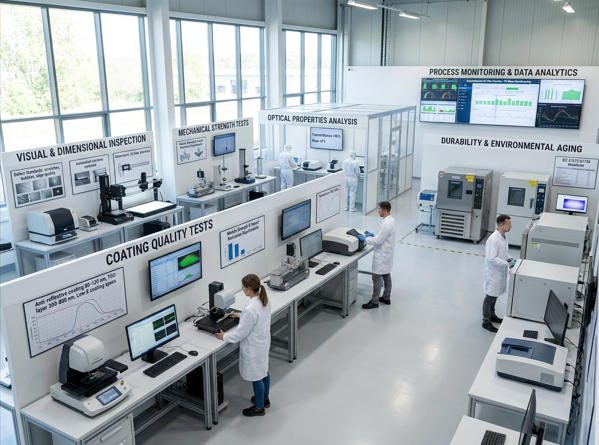
A practical PV glass QC plan has checkpoints at incoming materials, cutting, edge grinding, washing, coating, curing, printing or patterning, lamination, electrical integration, final inspection, packaging, and shipment.
Each checkpoint should answer one question: can this defect still be corrected cheaply, or will it become expensive later? Edge chips are easier to catch before lamination. Coating non-uniformity is easier to correct before the glass is bonded into a custom BIPV module.
Roles and responsibilities in a QC program
Good QC is not only the quality department’s job. Procurement controls supplier qualification. Production controls machine settings and work instructions. Maintenance controls equipment stability. The lab controls test accuracy. Engineering defines specifications. Sales and project teams communicate customer requirements.
For BIPV suppliers such as Jia Mao Bipv, QC responsibility also extends into project documentation: module datasheets, glass make-up, transparency options, coating information, and test records must match the building application.
| Excel Row | QC Stage | Main Objective | Typical Test or Check | オーナー | Release Decision |
|---|---|---|---|---|---|
| A2 | Incoming glass | Verify base glass quality before processing | Thickness, bow, scratches, bubbles, inclusions, edge defects | Incoming QC | Accept, quarantine, or supplier claim |
| A3 | Coating and printing | Control optical and adhesion performance | Transmittance, haze, color, adhesion, curing temperature | Process QC | Proceed to lamination only if optical limits pass |
| A4 | Lamination | Prevent bubbles, delamination, cell shift, and moisture risk | Vacuum profile, temperature profile, visual check, adhesion sample | Production + QC | Hold lot if bubble or adhesion trend shifts |
| A5 | Mechanical testing | Confirm strength and safety behavior | Bend, impact, scratch, thermal shock, edge strength | Lab | Release only after project-specific limits pass |
| A6 | Reliability testing | Predict field durability | UV, damp heat, humidity-freeze, thermal cycling | Reliability team | Compare against qualification and internal limits |
| A7 | Final inspection | Protect customer acceptance and installation fit | Visual defects, dimensions, labels, packaging, traceability | Outgoing QC | Ship, rework, or reject |
Raw Materials and Supplier Qualification
Critical raw materials: glass, coatings, and binders
PV glass quality starts before production. Critical raw materials include base glass, coated glass, encapsulants, interlayers, ceramic frits, conductive materials, edge sealants, junction box adhesives, packaging films, and cleaning chemicals.
A small change in coating chemistry can alter reflectance. A different interlayer batch can affect lamination bubbles. A new glass supplier may meet thickness tolerance but fail edge-strength expectations after grinding.
Supplier qualification process and audits
Supplier qualification should include document review, sample testing, production trial, process audit, incoming defect history, corrective-action response, and change-control discipline.
For a formal quality system, factories can align supplier control with the principles in ISO 9001 quality management requirements. ISO 9001 does not test PV glass by itself, but it provides a structure for controlled processes, records, supplier evaluation, and continuous improvement.
Materials testing before production starts
Before mass production, run pilot tests on optical performance, coating adhesion, lamination behavior, thermal compatibility, and environmental aging. Do not approve a raw material only because the supplier certificate says it meets a generic specification.
For example, a transparent BIPV façade project may require low haze and specific color neutrality. A raw glass batch that is acceptable for ordinary modules may be unacceptable for a hotel atrium because occupants will see the glass from both sides.


Incoming Material Inspection and Sampling
Sampling strategies and acceptance criteria
Sampling means checking part of a lot to decide whether the lot is acceptable. High-risk materials need tighter sampling. New suppliers, new coatings, and project-critical batches may need 100% inspection or enhanced lab testing.
Acceptance criteria should be written in numbers: maximum scratch length, allowable bubble diameter, haze limit, thickness tolerance, coating color range, bow limit, and edge chip size. Vague terms like “good appearance” cause disputes.
Analytical methods used on incoming lots
Incoming tests may include spectrophotometer readings, haze meter measurements, thickness gauges, visual light tables, edge inspection, moisture content checks, adhesion spot checks, and chemical compatibility screening.
A spectrophotometer is especially useful for PV glass because it measures optical behavior across wavelengths rather than relying on human eyesight.
Documentation and traceability requirements
Traceability connects every finished product to material batches, process settings, inspection results, operators, machines, and shipment records. If a field issue appears later, traceability tells the team whether the problem affects one unit, one lot, one supplier batch, or a full production period.
For architectural PV glass, traceability also helps when replacement units are needed. A façade owner may require matching color, transparency, glass size, and electrical configuration years after installation.
Visual and Dimensional Quality Checks
Surface defects, waviness, and edge quality inspection
Visual inspection should check scratches, pits, bubbles, inclusions, stains, coating streaks, roller marks, edge chips, corner cracks, waviness, and contamination. Some defects are cosmetic. Others become crack starters or delamination points.
Edge quality deserves special attention. PV glass is often laminated, framed, clamped, or installed in curtain-wall systems. Small edge damage can grow during thermal cycling, transport vibration, or site handling.
Dimensional tolerances and flatness measurements
Dimensional tolerance controls installation fit. If a PV glass unit is too large, it may not fit the frame. If it is too small, sealant bite and waterproofing may be compromised.
Flatness and bow affect optical appearance, lamination quality, stress distribution, and façade alignment. For large BIPV panels, even small deviations can be visible when panels reflect the sky or adjacent buildings.
Image-based inspection and automation opportunities
Automated optical inspection uses cameras and software to detect defects that operators may miss during repetitive shifts. It is useful for scratches, coating streaks, cell alignment, busbar defects, edge chips, and contamination.
The best factories do not use automation to replace judgment. They use it to create consistent defect detection, measurable defect maps, and trend data for process improvement.
Bar Chart: Example Defect Pareto from a PV Glass Line
Example only. A real Pareto chart should be generated from factory defect records by line, shift, product family, and supplier batch.
Coating Quality and Optical Performance
Coating uniformity, adhesion, and cured properties
Coatings affect light transmission, reflectance, color, durability, and sometimes self-cleaning behavior. Coating uniformity means the coating thickness and optical behavior stay consistent across the glass surface.
Adhesion testing checks whether the coating stays attached after processing, cleaning, humidity exposure, thermal cycling, and field use. If coating adhesion fails, a façade can develop patchy appearance, reduced output, or warranty claims.
Optical transmittance, reflectance, and haze testing
Haze is important for transparent and semi-transparent PV glass because occupants can see through the product. High haze may be acceptable for privacy glass but not for vision areas.
Reflectance affects glare and architectural appearance. Transmittance affects PV output and daylight. For BIPV façades, these values should be checked against the architect’s sample approval and the electrical yield model.
Coating defect classification and remediation
Coating defects should be classified by type and severity: pinholes, streaks, scratches, color bands, stains, adhesion loss, haze shift, edge build-up, or cure marks. Each defect class needs a clear acceptance limit.
Remediation depends on timing. A minor washable residue can be cleaned. A cured coating streak may require rejection. Reworking active PV glass after lamination is risky and should be controlled by engineering approval.

Thermal and Mechanical Stress Testing
Thermal cycling and expansion compatibility with PV cells
Thermal cycling exposes PV glass to repeated hot and cold conditions. Different layers expand at different rates: glass, cells, coatings, interlayers, busbars, adhesives, and edge seals.
If these materials are not compatible, the product may develop microcracks, delamination, coating stress, solder fatigue, or seal failure. This is why thermal cycling is a core reliability test, not a paperwork exercise.
Mechanical strength tests: scratch, bend, and impact
Mechanical testing checks whether the glass can survive handling, installation, cleaning, wind, hail, impact, and service loads. Common tests include scratch resistance, bending strength, impact testing, point-load checks, and edge strength evaluation.
For building-integrated products, the test plan should match the application. Overhead PV glass in a canopy has different safety expectations from vertical spandrel PV glass on a façade.
Reliability screening and accelerated aging
Accelerated aging tests speed up exposure to heat, moisture, UV, and temperature swings. They do not perfectly predict every field condition, but they help compare designs, suppliers, and process changes.
Photovoltaic module qualification often refers to IEC standards. For example, IEC 61215 design qualification for PV modules is widely used for long-term performance qualification, while IEC 61730 photovoltaic module safety requirements addresses PV module construction and safety.
Environmental Durability and Reliability
UV exposure, humidity, and chemical resistance tests
PV glass operates outdoors for years. It sees ultraviolet light, humidity, acid rain, salt mist, dust, cleaning chemicals, sealants, and temperature changes. These stresses can weaken coatings, interlayers, edge seals, adhesives, junction boxes, and cable exits.
Chemical resistance testing should include the cleaning agents and sealants likely to be used in the field. A coating that survives lab water may still fail after repeated contact with alkaline cleaners or incompatible façade sealants.
Low-temperature and high-temperature cycling
Low-temperature cycling reveals brittleness, edge stress, and seal behavior. High-temperature cycling reveals softening, expansion mismatch, and adhesive creep.
For desert, high-altitude, tropical, coastal, or cold-climate projects, test conditions should be reviewed carefully. One generic durability test may not cover every project environment.
Long-term field performance monitoring considerations
Field monitoring connects factory QC to real performance. Track output, insulation resistance, visual appearance, coating condition, water ingress, hotspot events, and cleaning records.
For BIPV projects, monitoring should identify the exact façade zone or glass unit. A drop in output from one string should be traced to a module group, not treated as a mystery inside the building envelope.

Data Management and SPC in Glass QC
Real-time data capture and KPI dashboards
QC data should be captured in real time where possible. Important values include glass thickness, transmittance, haze, coating color, curing temperature, lamination pressure, visual defect count, edge chip rate, rework rate, and customer complaints.
A dashboard should show trends by line, shift, supplier batch, product type, machine, and operator. The goal is not to create a beautiful screen. The goal is to make process drift visible before it becomes customer risk.
Statistical process control methods for glass manufacturing
SPC uses process data to distinguish normal variation from abnormal signals. Control charts can track transmittance, haze, thickness, coating weight, cure temperature, or defect counts.
For example, if average transmittance remains within the customer limit but moves steadily downward for five batches, SPC can trigger investigation before the lot fails.
Data integrity, traceability, and record keeping
Data integrity means records are accurate, complete, time-stamped, protected from unauthorized changes, and connected to the actual product. Manual spreadsheets are acceptable for small factories only if they are controlled and reviewed.
As production grows, a manufacturing execution system, barcode labels, QR codes, and linked lab records reduce errors. For project-specific BIPV glass, this traceability can prevent costly disputes when a customer asks which coating batch was used on a specific façade elevation.
Pie Chart: Recommended QC Effort Allocation for PV Glass Manufacturing
- 24% Incoming materials and supplier qualification
- 20% Visual, edge, dimensional, and flatness inspection
- 16% Optical performance and coating quality
- 16% Thermal, mechanical, and process stress testing
- 14% Environmental durability and reliability screening
- 10% SPC, traceability, non-conformance, and CAPA
Non-Conformance Handling and Corrective Actions
Deviation management workflow
A non-conformance is any failure to meet a defined requirement. It may involve raw material, process settings, dimensions, coating appearance, test results, packaging, labeling, or documentation.
A practical workflow is: identify, contain, label, quarantine, evaluate risk, decide disposition, investigate root cause, implement corrective action, verify effectiveness, and update records.
Root cause analysis techniques: 5 Whys and Ishikawa
その 5 Whys method is useful for simple problems. An Ishikawa diagram is better when multiple causes are possible.
Example: coating streaks may come from glass cleaning, coating viscosity, roller pressure, curing temperature, air contamination, or inspection lighting. A fishbone diagram helps the team avoid blaming the operator before checking the process.
Corrective and preventive action closure
Corrective action fixes the current problem. Preventive action stops recurrence. A closed CAPA should show evidence: updated work instruction, training record, changed inspection plan, machine adjustment, supplier action, and follow-up data proving defect reduction.
If a factory records “operator reminded” for repeated coating defects, the CAPA is weak. If it changes nozzle maintenance frequency, adds a pressure sensor limit, and verifies a 70% defect reduction over four weeks, the CAPA is useful.
Continuous Improvement and Industry Standards
Internal audits and management review
Internal audits check whether the QC system is followed in real production, not just described in documents. Auditors should sample records, interview operators, review rejected lots, check calibration status, and compare actual practice with written procedures.
Management review should focus on trends: scrap cost, customer complaints, defect Pareto, supplier performance, calibration overdue rate, test failures, CAPA closure time, and audit findings.
Alignment with standards: IEC, ISO, and glass-specific specifications
PV glass manufacturers should align internal controls with relevant PV, glass, safety, and quality standards. IEC 61215 and IEC 61730 are common references for PV module qualification and safety. ISO 9001 supports quality management discipline.
For BIPV applications, additional building-envelope requirements may apply: laminated glass safety, fire classification, curtain-wall performance, impact resistance, and project-specific façade specifications.
Roadmap for ongoing QC maturity and supplier collaboration
A factory can improve QC maturity in stages. Stage one is basic inspection and quarantine. Stage two is controlled work instructions and lab testing. Stage three is SPC, traceability, and supplier scorecards. Stage four is predictive quality using machine data, automated inspection, and field-performance feedback.
Jia Mao Bipv’s product and project teams often review PV glass requirements at the intersection of manufacturing, façade design, and long-term field use. For context on product applications, see the BIPV laminated photovoltaic glass solution, the photovoltaic glass product category, and the glass-integrated solar façade systems review.
Glossary and Hover Tips for Key QC Terms
Use these short definitions when discussing PV glass QC with engineers, operators, suppliers, and customer audit teams.
Quality control: checks and tests used to confirm that a product meets requirements.
Statistical process control: using process data to detect abnormal variation early.
Corrective and preventive action: a structured process for fixing problems and preventing recurrence.
Light scattering that makes glass look cloudy or milky.
The percentage of light that passes through the glass.
The percentage of light reflected by the glass surface.
A reliability test using high temperature and high humidity to stress materials.
Repeated heating and cooling used to reveal expansion mismatch and fatigue.
The ability to link a finished product to material batches, process data, tests, and shipment records.
A practical QC framework for PV glass must cover raw materials, incoming inspection, visual and dimensional checks, coating quality, optical performance, thermal and mechanical testing, environmental reliability, SPC, traceability, and corrective actions.
Implementation should be prioritized by risk. Start with defects that affect safety, water resistance, electrical performance, optical performance, and customer acceptance. Then expand into automated inspection, supplier scorecards, predictive maintenance, and field-performance feedback.
Teams starting or improving a QC program should take three next steps: define measurable product requirements, map checkpoints across the production line, and build a traceability system that connects raw materials to final shipment.
Need PV Glass for a Project with Clear Technical Documentation?
Jia Mao Bipv supports BIPV projects where photovoltaic glass must meet architectural, optical, structural, and electrical expectations. For a serious review, prepare glass size, transparency target, coating preference, building application, certification needs, and inspection documentation requirements.
Explore photovoltaic glass technology insightsFAQs
What are the most critical QC tests for PV glass in production?
The most critical QC tests include visual inspection, dimensional checks, edge quality inspection, optical transmittance, haze, reflectance, coating adhesion, lamination quality, mechanical strength, thermal cycling, humidity exposure, and traceability review. The exact priority depends on whether the product is used for façades, skylights, canopies, or opaque BIPV panels.
How is coating adhesion tested, and why does it matter?
Coating adhesion can be tested with cross-hatch tape tests, pull tests, abrasion tests, humidity exposure, thermal cycling, or project-specific methods. It matters because poor adhesion can cause patchy appearance, reduced light transmission, lower PV output, and customer claims after installation.
How can small manufacturers implement SPC effectively in glass production?
Small manufacturers can start with a few high-risk metrics such as thickness, haze, transmittance, curing temperature, defect count, and edge-chip rate. Use simple control charts first, review them daily, and trigger investigation when trends move toward limits. SPC does not need to start with expensive software; it needs disciplined data and reaction rules.
Why is traceability important in photovoltaic glass manufacturing?
Traceability helps connect each finished PV glass unit to material batches, equipment settings, inspection results, lab tests, operators, and shipment records. When a field issue occurs, traceability helps determine whether the issue is isolated or linked to a larger batch.
What defects should be checked during visual inspection?
Visual inspection should check scratches, pits, bubbles, inclusions, coating streaks, stains, roller marks, edge chips, corner cracks, waviness, color variation, and contamination. Acceptance limits should be measurable and linked to customer requirements.
How often should PV glass testing equipment be calibrated?
Calibration frequency depends on equipment type, use intensity, customer requirements, and internal quality procedures. Critical devices such as spectrophotometers, haze meters, thickness gauges, temperature sensors, and mechanical test equipment should have documented calibration schedules and status labels.
What is the difference between final inspection and process control?
Final inspection checks whether finished products meet requirements before shipment. Process control monitors production conditions while the product is being made. Process control is more powerful because it prevents repeated defects instead of only sorting good and bad units at the end.
Which standards are commonly referenced for PV glass quality?
PV glass projects may reference IEC 61215 for PV module design qualification, IEC 61730 for module safety, ISO 9001 for quality management, and project-specific glass, façade, fire, impact, and laminated safety standards. The correct list depends on product type and installation region.
References and Further Reading
- BIPV laminated photovoltaic glass solution
- photovoltaic glass product category
- glass-integrated solar façade systems review
- photovoltaic glass technology insights
- solar glass types for BIPV guide
- ISO 9001 quality management requirements
- IEC 61215 design qualification for PV modules
- IEC 61730 photovoltaic module safety requirements
- DOE solar photovoltaic performance basics
- Whole Building Design Guide BIPV resource