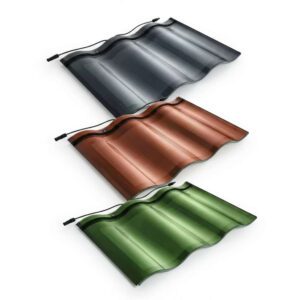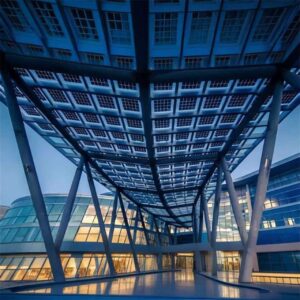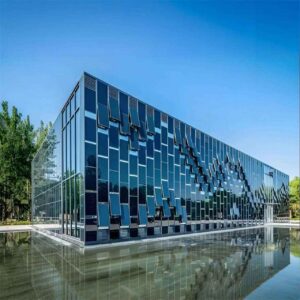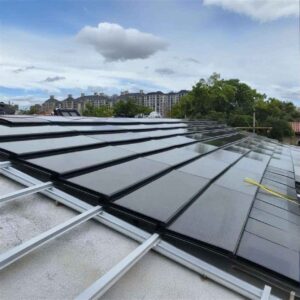
The Rise of Building-Integrated Photovoltaics (BIPV)
The building sector accounts for 30% of global energy consumption et 26% of energy-related emissions (Smart Glass World, 2026). That single statistic is rewriting how contractors, EPCs, architects, and building material distributors specify and sell glazing products.
For decades, solar energy was something you added to a finished building — panels bolted onto a completed roof, electrical systems retrofitted after the structure was sealed. That model is changing.
Building-Integrated Photovoltaics (BIPV) embeds solar-generating capability directly into the building envelope — the roof, facade, windows, and curtain wall — so the building skin is the power plant. The glass does two jobs: structural enclosure and electricity generation.
Glossary — BIPV (Building-Integrated Photovoltaics): Solar technology incorporated directly into a building’s envelope materials (glass, roofing tiles, cladding panels) rather than mounted on top of or alongside them. The photovoltaic element replaces — not duplicates — a conventional building material.
The market numbers reflect this shift. The global BIPV market was valued at USD 23.4 billion in 2025 and is projected to grow to USD 28.3 billion in 2026, on its way to an estimated USD 250.9 billion by 2035 (Precedence Research). The BIPV solar curtain wall sub-segment alone is projected to grow at a 12% CAGR from 2026 to 2033 (LinkedIn Industry Analysis).
For professionals working in glazing, roofing, energy contracting, and material distribution, this is not a future consideration. It is a current procurement and specification decision.
This guide covers the 10 most consequential trends in photovoltaic glass for modern homes — with real data, application-level detail, and the business case you need to advise clients and win projects.

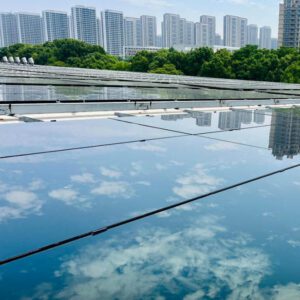
BIPV glass turns the building envelope into a power-generating surface — no additional structure, no rooftop array required.
Trend 1: Transparent and Semi-Transparent Solar Glass
The most common objection to PV glass from architects and high-end residential clients is simple: “We don’t want the building to look like a power station.”
Transparent and semi-transparent BIPV glass answers that objection directly.
Modern thin-film PV technologies — particularly CdTe (Cadmium Telluride) et CIGS (Copper Indium Gallium Selenide) — can be deposited onto glass in ultra-thin layers that allow significant daylight transmission while still generating electricity. The result is a glass unit that admits natural light, controls solar heat gain, and produces on-site power simultaneously.
Glossary — VLT (Visible Light Transmittance): The percentage of visible light that passes through a glass unit. Higher VLT = more daylight admitted. Standard transparent glass: ~70–90% VLT. Semi-transparent PV glass: typically 10–50% VLT depending on cell density and type.
In practical terms, this opens BIPV glass to applications that were previously off-limits:
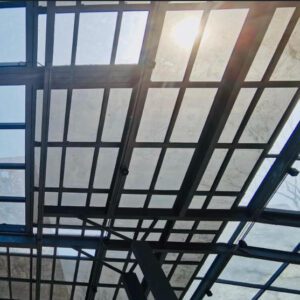
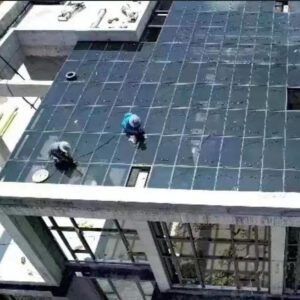
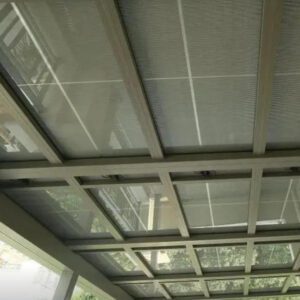
- Skylights — semi-transparent PV glass replaces conventional skylight glazing, generating power from overhead sunlight while maintaining diffuse daylighting below
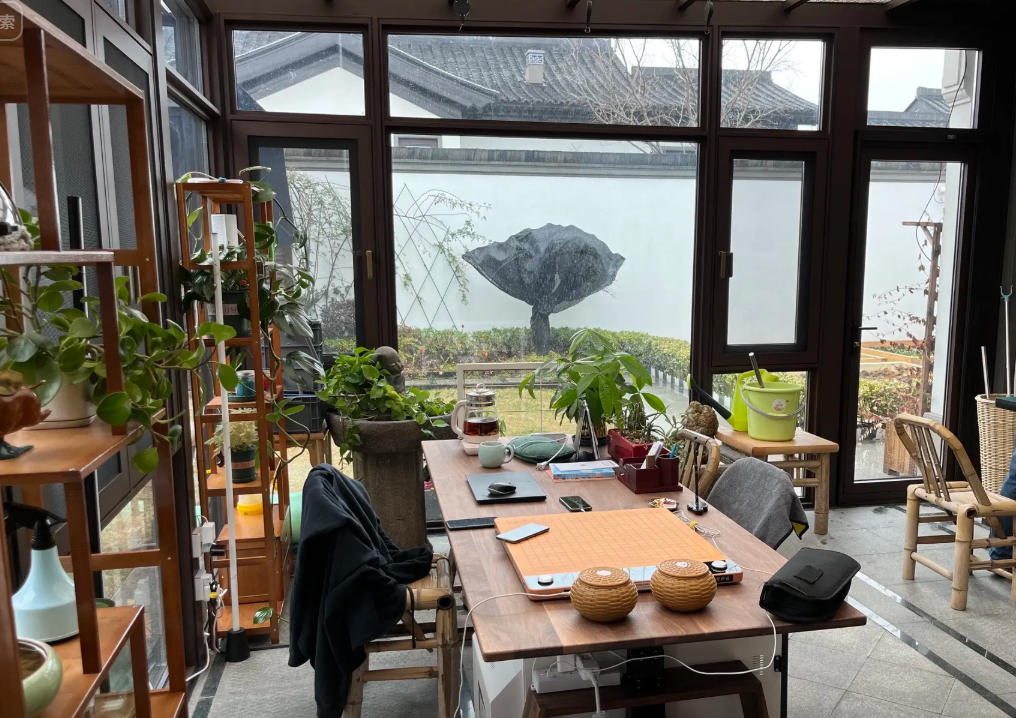
- Solar windows — thin-film coatings on standard window glass enable energy generation without blocking views
- Glass railings and balustrades — structural glass elements that generate electricity from incidental solar exposure
- Atriums and glazed roofs — large glass areas that would otherwise represent pure energy loss now contribute to generation
For architects, this means they can specify glazing that supports their daylighting design intent et contributes to the building’s energy performance simultaneously — without choosing between the two.
Thin-film CdTe PV glass currently achieves efficiencies of approximately 16% under standard test conditions, generating up to 160 W/m² in peak sunlight. That figure is lower than opaque crystalline silicon modules, but the value proposition is different: this glass is replacing non-generating glazing, not competing with roof-mounted panels.
Trend 2: Customizable Aesthetics and Color-Tuning
Color has traditionally been the friction point between architects and solar technology. Standard PV modules are dark blue or black. Most residential design programs and neighborhood guidelines are not.
Colored BIPV glass resolves this with engineered precision. Current color-tuning methods include:
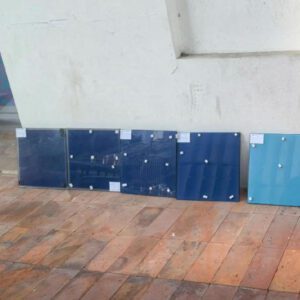
- Optical interference filters applied to the glass surface, which selectively reflect specific wavelengths of light to create color while transmitting the rest to the solar cells below
- Ceramic frit printing on the glass surface, enabling custom patterns, logos, and tonal gradients
- Digital printing on PV interlayers, offering near-unlimited visual customization
The performance trade-off is manageable. Research published in Energy and Buildings confirms that high-saturation colored PV panels incur an efficiency loss of approximately 7% compared to their uncolored equivalents (ScienceDirect, 2025). For most residential applications, that is a fully acceptable trade-off for complete architectural freedom.
The colored BIPV market is growing accordingly — colored photovoltaic glass is forecast to represent 50% of the colored BIPV product segment in 2026 (Future Market Insights).
What this means for contractors and distributors: The color-customization capability opens BIPV glass to premium residential projects, heritage-sensitive neighborhoods, and commercial-residential mixed-use buildings where visual standards are non-negotiable. When a client says “solar panels won’t work here aesthetically,” colored PV glass is the specification answer.

Trend 3: Smart Photovoltaic Glass with Dynamic Tinting
The next step beyond static transparency control is dynamic tinting — glass that actively adjusts how much light and heat it transmits in real time, while simultaneously generating electricity.
Two primary technologies underpin this:
Electrochromic (EC) glass uses an applied electrical voltage to trigger a color change in the glass, moving from clear to dark in response to building management system commands or occupant input. EC glass can block up to 93% of solar heat in its darkest state (SageGlass). When paired with a BIPV layer, the PV cells can power the tinting function directly — no mains electrical connection required.
Thermochromic glass changes tint automatically in response to temperature, without requiring any electrical input. It is simpler to install but offers less precise control.
The energy performance data for dynamic smart PV glass is compelling:
- Electrochromic tinting delivers 20–30% reductions in HVAC costs through dynamic solar heat gain control (Eureka, PatSnap Research)
- When integrated with predictive building controls (AI-driven, not just reactive), BIPV smart glass delivers 5–10% additional HVAC energy savings compared to reactive systems (Medium / Architects Blog)
- Advanced PhotoVoltaChromic (PVCD) devices — currently in late-stage development — can reduce cooling loads by up to 32% in hot desert climates while simultaneously exporting surplus electricity to the building
Glossary — Electrochromic Glass: Glass containing a thin electrochromic film that changes opacity when a small electrical voltage is applied. Used in smart windows to reduce glare and solar heat gain on demand.
For EPC providers and energy service companies, this trend directly improves the building energy performance metrics — kWh/m²/year energy use intensity, solar heat gain coefficients — that underpin LEED, BREEAM, and NZEB compliance scores.
Trend 4: Enhanced Structural Integration with Curtain Wall Systems
One of the practical barriers that has slowed BIPV adoption among glazing contractors is the assumption that PV glass requires a completely different installation methodology. Modern product engineering is dismantling that assumption.
Today’s leading BIPV glass manufacturers engineer their products specifically to integrate into standard unitized curtain wall systems — the same aluminum framing, the same mullion and transom profiles, the same wet and dry glazing methods that experienced glazing crews already use every day.
The integration advances that matter most to contractors include:
- Standardized panel dimensions matched to common curtain wall module sizes (typically 1,200 × 2,400 mm or custom), eliminating the need for non-standard framing
- Factory-integrated electrical connections — junction boxes, output leads, and connectors pre-installed at the manufacturing stage, reducing on-site electrical work to simple plug-in connections
- Weight-matched engineering — modern BIPV glass units are designed to match the structural load profile of equivalent standard glass units, so existing structural calculations for the curtain wall frame remain valid
Research confirms the labor impact: unitized BIPV curtain wall systems reduce on-site labor by 30–45% compared to stick-built solar facade approaches (JMBIPVTech). For a typical mid-rise residential facade project, that represents a significant reduction in installation cost and schedule duration.
Prefabricated Unitized BIPV Wall (PUBW) systems also minimize on-site work at height — panels arrive at the site as complete assemblies, reducing scaffolding time and height-related safety risk (IntechOpen, 2023).
For glazing contractors evaluating BIPV for the first time, the PV+ BIPV Installer Guide provides a practical reference covering curtain wall integration, electrical routing, and commissioning.
Trend 5: Improved Efficiency and Low-Light Performance
The question most EPC providers and energy consultants ask when evaluating BIPV glass is straightforward: “Does it still work on a cloudy day in Manchester, Oslo, or Vancouver?”
The answer, increasingly, is yes — and the cell technology driving that improvement is perovskite-silicon tandem solar cells.
Traditional silicon solar cells have a theoretical efficiency ceiling of approximately 29%. Tandem cells stack a perovskite layer on top of silicon, allowing the two layers to capture different parts of the solar spectrum. In April 2025, LONGi set a new world record of 34.85% efficiency for a crystalline silicon-perovskite tandem cell, certified by the U.S. National Renewable Energy Laboratory (NREL) (LONGi, 2025).
For BIPV glass applications, the relevant benefit is not just peak efficiency — it is low-light performance. Perovskite and thin-film technologies maintain a higher proportion of their rated output under diffuse (overcast) light conditions than conventional crystalline silicon. In northern European climates, where diffuse radiation can constitute 70% of annual solar irradiance on vertical facades (MDPI Energies, 2021), this low-light efficiency advantage translates directly into measurable annual kWh generation.
| Cell Technology | Peak Efficiency | Performance à faible luminosité | BIPV Application |
|---|---|---|---|
| Standard crystalline silicon | 18–22% | Moderate | Opaque modules |
| Thin-film CdTe | 14–16% | Bien | Semi-transparent glass |
| CIGS thin-film | 15–17% | Very good | Semi-transparent glass |
| Perovskite-silicon tandem | 28–34.85% | Excellent | Next-gen BIPV glazing |
For energy service providers and EPCs calculating project ROI, the improved annual yield from low-light-capable cells meaningfully shortens the payback period — particularly for north-facing facades and projects in temperate or overcast climates.
Trend 6: Lightweight and Flexible Photovoltaic Glass Solutions
Conventional BIPV glass, for all its advantages, carries one structural constraint: it weighs approximately the same as standard architectural glass. For existing buildings with older facade systems or lighter roof structures, that weight budget can be a hard limit on what is possible.
Lightweight and flexible PV glass solutions — some weighing as little as 2.9 kg/m² (Apollo Power, LightV2) — change the equation entirely. Standard glass-based modules weigh 10–14 kg/m², so flexible systems represent a 70–80% weight reduction.
That reduction has direct practical implications:
- Curved roofs become viable for solar integration without structural modification — flexible PV panels can bend to follow non-standard surface geometries
- Retrofit projects on older buildings that cannot support the load of conventional modules become accessible — a roofing contractor can specify solar generation without requiring a structural engineering review
- Pergolas, canopies, and semi-enclosed structures can incorporate PV generation where traditional glass panels would be impractical
- High-rise residential projects where facade load budgets are tight gain access to solar integration that would otherwise require costly structural uprating
Polycarbonate-based flexible PV substrates are also advancing rapidly — a 2025 study in Advanced Engineering Materials (Wiley Online Library) demonstrates their viability for lightweight photovoltaic applications where traditional glass is not an option.
For roofing contractors in particular, this trend expands the scope of solar integration projects without adding structural engineering complexity to the project workflow.

Flexible, lightweight PV glass opens curved roofs and weight-limited retrofit projects to solar integration — without structural modification.
Trend 7: Plug-and-Play Modular Systems for Faster Installation
One of the most consistent operational pain points for contractors and EPCs managing BIPV glass projects is on-site electrical work. Traditional BIPV installation requires licensed electricians on-site for wiring, fusing, and system configuration — a scheduling dependency that can hold up facade installation programs.
Pre-wired, plug-and-play modular BIPV systems are designed to eliminate that dependency.
The system architecture is straightforward: PV glass panels arrive on-site with factory-installed junction boxes, pre-terminated cables, and standardized MC4 or similar locking connectors. The glazing crew installs the panels using standard curtain wall methods. The electrical connections are made via plug-in connectors that require no specialist electrical knowledge to complete. A single licensed electrician connects the string leads to the inverter at the end of the installation sequence.
The practical impact:
- Fewer trades on-site simultaneously — reduces program coordination complexity
- Shorter installation windows — plug-in connections take seconds versus minutes for traditional field wiring
- Lower risk of wiring errors — polarized connectors and factory labeling prevent mis-wiring
- Easier module replacement — if a panel needs replacement, the glazing contractor can swap it without an electrician present for the disconnection/reconnection work
For EPC firms managing multiple residential projects simultaneously, the scalability advantage is significant. A modular system that can be installed by the glazing crew without dedicated solar installation teams enables faster programme replication across project portfolios.
The U.S. Department of Energy’s BIPV summary acknowledges plug-and-play design as a key enabler for broader BIPV adoption — reducing the coordination overhead that has historically made BIPV more complex to procure and install than standalone solar arrays.
Trend 8: Integration with Home Energy Management Systems (HEMS)
Installing BIPV glass without connecting it to intelligent energy management is like buying a high-performance car and only ever driving it in first gear. The generation potential is there — but the system is not optimized.
Home Energy Management Systems (HEMS) are the software and hardware layer that unlock full system performance. A properly configured HEMS connects PV glass generation to battery storage, grid export, and controllable building loads — and makes real-time decisions about how to route that energy for maximum financial and comfort benefit.
Glossary — HEMS (Home Energy Management System): An intelligent controller that monitors real-time electricity generation, consumption, storage state, and grid prices — automatically routing power to maximize self-consumption, minimize grid purchases, and optimize battery charging/discharging cycles.
The capabilities a modern HEMS adds to a BIPV glass installation include:
- Real-time generation monitoring — homeowners and building managers see exactly how much electricity the facade glass is producing, hour by hour
- Load shifting — the system automatically runs high-consumption appliances (dishwasher, EV charging, washing machine) when PV generation is highest and grid prices are lowest
- Battery coordination — excess PV generation charges on-site battery storage rather than being exported at low feed-in tariff rates; stored energy powers the building after dark
- Predictive optimization — AI-driven HEMS platforms, including systems unveiled at CES 2025, integrate real-time electricity pricing forecasts to preemptively charge or discharge batteries ahead of tariff changes
For energy service providers offering turnkey residential solutions, HEMS integration is the value-add that converts a one-time installation sale into an ongoing energy management service relationship. Homeowners with HEMS-connected BIPV glass systems typically see self-consumption rates of 60–80% of generated electricity — compared to 30–40% without intelligent management.
Trend 9: Compliance with Global Green Building Certifications
For architects, consultants, and building material distributors, one of the most commercially important aspects of PV glass specification is its relationship with green building certifications. These certifications are no longer optional extras on premium projects — they are increasingly required by municipal planning codes, institutional investors, and corporate ESG reporting frameworks.
PV glass contributes to multiple credit categories simultaneously across the three major certification systems:
LEED (Leadership in Energy and Environmental Design) The U.S. Green Building Council awards LEED points across nine credit categories. PV glass can earn contributions in:
- Energy & Atmosphere — on-site renewable energy generation
- Sustainable Sites — reduced urban heat island effect (glass facades vs. dark surfaces)
- Innovation — exemplary performance in renewable energy generation
A single well-specified BIPV glass facade can contribute up to 20 LEED points across these categories (Vitro Architectural Glass / Glassed).
BREEAM The BREEAM certification framework similarly rewards on-site energy generation, envelope thermal performance, and reduced operational carbon — all directly addressed by BIPV glass.
NZEB (Nearly Zero Energy Building) The EU’s Energy Performance of Buildings Directive mandates that all new buildings meet NZEB standards. On-site renewable generation via BIPV glass is one of the most effective technical pathways to NZEB compliance, particularly for glazing-intensive residential typologies.
For building material distributors, this certification alignment is a direct sales tool. Contractors and developers pursuing LEED or BREEAM certification have a specific need for products that contribute to their credits — and PV glass delivers across multiple categories simultaneously. Providing clients with specification documentation, BIM files, and performance certificates (IEC 61215 for performance durability, IEC 61730 for electrical safety) removes barriers to specification and positions your product at the front of the supply chain.

Trend 10: Lifecycle Performance, Durability, and Maintenance Advances
Long-term reliability has historically been the due-diligence question that slows BIPV glass procurement: “What happens to this glass in 15 years? Who is responsible? What does maintenance look like?”
The industry has answered those questions with improving specificity.
Warranty coverage is now well-established for quality BIPV glass products:
- 12–15 year product warranty covering material and workmanship defects
- 25+ year linear performance warranty guaranteeing at least 80% of rated output at year 25 — the same standard applied to conventional solar modules
Self-cleaning coatings are increasingly standard on BIPV glass products. Nano-structured hydrophilic or photocatalytic coatings cause water to sheet off the surface, carrying dust and particulate with it. Studies confirm these coatings maintain functional performance for 8–18 years depending on technology type and environmental exposure (DataIntelo Research), reducing cleaning frequency and maintaining energy output without manual intervention.
Performance degradation rates for modern PV glass modules are typically <0.5% per year — meaning a system generating 100 kWh/month in year one still generates approximately 87.5 kWh/month in year 25. For building owners, that is a predictable and quantifiable long-term energy asset.
Weather resistance has also advanced significantly. Modern BIPV IGUs are tested to IEC 61215 (design qualification and performance durability) and IEC 61730 (electrical safety), which include thermal cycling, humidity freeze, UV exposure, and hail impact testing. For contractors and their clients, specifying a product with both certifications confirmed provides the performance assurance that supports long-term warranties and insurance coverage.
The net result for building investors and facility managers: maintenance requirements for BIPV glass facades are not materially different from conventional architectural glass facades. There are no moving parts to service, no inverter-mounted components on the facade surface, and the electrical monitoring is handled remotely through the inverter platform.
Watch: How BIPV Curtain Wall Systems Are Installed
Understanding the installation process is critical for glazing contractors and project managers evaluating BIPV for the first time. The video below walks through the complete installation sequence for a BIPV curtain wall system — embedded part positioning, panel handling, electrical routing, and commissioning.
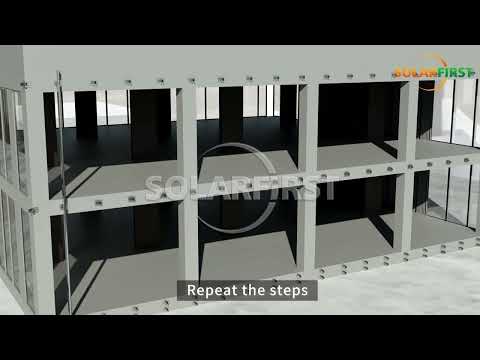 Source: YouTube — Full BIPV curtain wall installation walkthrough for contractors and project managers.
Positioning Photovoltaic Glass as a Strategic Building Material
PV glass is not a niche product waiting for the market to catch up. The market — measured in tens of billions of dollars and growing at double-digit rates — has already caught up. What is shifting now is who captures that market.
For curtain wall contractors, the shift is from glazing subcontractor to integrated envelope solutions provider. For EPCs, it is from roof-only solar installer to full building energy systems integrator. For architects and consultants, it is from energy-code compliance to net-zero envelope design. For building material distributors, it is from commodity glass supply to specification-led technical sales.
The firms and professionals who build fluency in BIPV glass specification, installation, and performance monitoring now will hold a durable competitive advantage as building energy codes tighten, client ESG requirements intensify, and homebuyers increasingly factor energy performance into purchasing decisions.
The strategic advice is straightforward: engage with BIPV glass early in the design process, specify products with verified certifications (IEC 61215, IEC 61730), and build partnerships with manufacturers and distributors who can provide the technical documentation, BIM support, and performance data your clients and certification consultants need.
Connect with a BIPV Glass Specialist
Whether you are evaluating BIPV glass for a specific project or building a longer-term supply partnership, the right technical support makes the difference between a specification that performs and one that creates liability. Reach out to a qualified BIPV glass supplier with certified product data, project references, and technical specification support.
For professionals working across the broader tube and flexible packaging ecosystem, Miyoda Packaging Machinery provides a useful parallel perspective on how precision manufacturing and material innovation intersect — the same engineering discipline that drives advances in packaging tube production is increasingly applied to the building materials supply chain.
Glossary of Key Terms
| Term | Definition |
|---|---|
| BIPV | Building-Integrated Photovoltaics — solar technology built into the building envelope, replacing conventional materials |
| BAPV | Building-Applied Photovoltaics — solar modules mounted onto an existing structure without replacing it |
| VLT | Visible Light Transmittance — percentage of visible light that passes through a glazing unit |
| CdTe | Cadmium Telluride — a thin-film solar cell material used in semi-transparent PV glass |
| CIGS | Copper Indium Gallium Selenide — another thin-film cell material offering good low-light performance |
| SHGC | Solar Heat Gain Coefficient — fraction of solar radiation admitted through glass as heat; lower = less cooling load |
| IGU | Insulated Glass Unit — a sealed multi-pane glass assembly incorporating gas fills and coatings for thermal performance |
| Electrochromic Glass | Glass that changes opacity/tint in response to an applied electrical voltage |
| HEMS | Home Energy Management System — intelligent software/hardware that optimizes energy generation, storage, and consumption |
| LEED | Leadership in Energy and Environmental Design — the most widely used global green building certification system |
| BREEAM | Building Research Establishment Environmental Assessment Method — UK-origin green building certification standard |
| NZEB | Nearly Zero Energy Building — a building whose total annual energy consumption is close to or covered by on-site renewable generation |
| IEC 61215 | International standard for design qualification and performance durability of PV modules |
| IEC 61730 | International standard for electrical safety of PV modules |
| Perovskite-silicon tandem cell | Next-generation solar cell stacking a perovskite layer on silicon to capture more of the solar spectrum, achieving efficiencies above 34% |
Frequently Asked Questions (FAQs)
How does photovoltaic glass compare to traditional rooftop solar panels in energy output?
Per square meter, PV glass delivers slightly lower output than optimally tilted rooftop panels — typically 100–160 W/m² for thin-film BIPV versus 180–220 W/m² for crystalline silicon roof panels at peak. However, PV glass integrates into vertical facades, windows, and skylights — surfaces that would generate zero energy with standard glazing. In urban residential settings with limited roof area, the total energy yield from a BIPV facade can match or exceed a comparable roof installation because the available surface area is much larger.
Can photovoltaic glass be retrofitted into existing buildings?
Yes, particularly with lightweight flexible modules and modular plug-and-play systems. Lightweight BIPV glass (as low as 2.9 kg/m²) can be installed on existing facade structures without structural modification. Curtain wall recladding projects — where aging glazing is replaced during planned maintenance cycles — are an ideal retrofit opportunity: the contractor is already removing and replacing glass, and the incremental cost of specifying BIPV over standard glazing is substantially lower than a standalone BIPV installation.
What are the structural load implications of installing PV glass on curtain walls?
Modern BIPV glass units are engineered to match the weight profile of equivalent standard architectural glass. For most projects, existing structural calculations for the curtain wall frame remain valid. That said, a structural review at design stage is still recommended — particularly for older or heavily loaded facade systems. The increase in glass thickness associated with some BIPV IGU configurations (typically 2–6 mm thicker than a comparable standard unit) should be factored into dead-load calculations.
Is photovoltaic glass suitable for residential projects in low-sunlight regions?
Yes. Advances in thin-film CdTe and CIGS cell technologies — combined with the emerging perovskite-silicon tandem cell platform — significantly improve performance under diffuse light conditions. In northern European climates, where diffuse radiation can account for 70% of annual solar irradiance on vertical facades, modern BIPV glass systems maintain meaningful generation output year-round. Projects in Scandinavia, the UK, Canada, and the northern United States are technically viable — the key design variable is accurate energy yield simulation at the project’s specific latitude and orientation.
How do I ensure electrical safety when integrating PV glass into building envelopes?
Specify products certified to IEC 61215 (performance) and IEC 61730 (electrical safety). During installation, use certified DC isolators, arc-fault protection, and rapid shutdown systems compliant with local electrical codes. All electrical connection work beyond the plug-in panel connections should be completed by a licensed electrician familiar with BIPV systems. In European projects, ensure compliance with the EU Construction Product Regulation (CPR), Low Voltage Directive, and the BIPV-specific standard EN 50583 / IEC 63092.
What certifications should I look for when specifying photovoltaic glass?
The baseline certifications are IEC 61215 (design qualification and long-term performance durability) and IEC 61730 (electrical safety — insulation, fire resistance, and performance under fault conditions). For European projects, CE marking and compliance with EN 50583 (BIPV standard) are required. For U.S. projects, check UL 790 (fire resistance) and ASTM E84 (flame spread). For green building certification projects, verify that the manufacturer can provide EPDs (Environmental Product Declarations) and performance data in the format required by LEED or BREEAM documentation.
Can PV glass be combined with other glazing features like insulation or soundproofing?
Yes — this is standard practice for high-performance residential applications. BIPV glass can be laminated into double or triple insulated glass units (IGUs) incorporating low-e coatings for improved U-value, argon or krypton gas fills for thermal performance, and acoustic interlayers (typically PVB or SGP) for sound attenuation. The PV layer is integrated into the laminated structure without compromising the thermal or acoustic performance of the overall unit.
What is the typical payback period for residential PV glass installations?
Payback ranges from approximately 7–12 years for residential BIPV glass installations, depending on local electricity prices, available incentives (tax credits, feed-in tariffs, rebates), system orientation, and climate (Reddit / Solar Community Research, 2026). This range shortens when BIPV glass is specified as part of a planned facade renovation (where the glass would be replaced anyway) and when combined with battery storage and HEMS for high self-consumption rates. European BIPV installations, where the average system cost is €200–€625/m², can reach payback in as little as 6 years in high-electricity-cost markets (Metsolar).
How do maintenance requirements differ from conventional glass facades?
In practice, the differences are minimal. BIPV glass facades have no moving parts, no components mounted on the exterior surface that require periodic inspection, and no degradation mechanisms that differ from standard architectural glass. Routine maintenance consists of the same periodic washing — water and non-abrasive cleaning solution — used for any glass facade. Self-cleaning coatings on modern BIPV products reduce even this frequency. Annual performance monitoring via the inverter platform confirms system health without requiring physical inspection of the glass.
Are there financing or incentive programs available for residential PV glass projects?
Yes, and the range is broad. The U.S. Section 25D Residential Clean Energy Credit provided a 30% federal tax credit for qualifying BIPV installations (check current status at IRS.gov). The DSIRE database catalogs state-level rebates, property tax exemptions, and net metering programs across all 50 U.S. states. European markets offer varying national and regional schemes — feed-in tariffs, green building grants, and low-interest financing for energy renovation projects. Many programs specifically recognize BIPV as an eligible technology, so verify applicability with the relevant energy authority in your jurisdiction.
Can architects customize the appearance of PV glass without compromising performance?
Yes. Color filters, opacity control, and digital printing on PV interlayers allow extensive visual customization. The efficiency trade-off for high-saturation color applications is approximately 7% — meaning a colored PV glass unit that would generate 100 kWh/month in standard black generates approximately 93 kWh/month in a custom color. For most architectural applications, that trade-off is commercially and technically acceptable. The visual customization capability is what enables PV glass to be specified on luxury residential projects, heritage buildings, and design-controlled developments where standard dark modules would never be approved.
How do I coordinate between the glazing contractor, electrical team, and EPC provider during installation?
BIM (Building Information Modeling) coordination at the design stage is the most effective approach. BIPV glass manufacturers increasingly provide BIM-compatible product models that integrate with standard curtain wall design workflows, allowing the glazing and electrical teams to plan cable routing, junction box locations, and inverter placement before any work begins on-site. During installation, plug-and-play modular systems significantly reduce the dependency on concurrent electrical trade presence — the glazing crew completes panel installation independently, and the electrical contractor connects string leads to the inverter as a single final step.
What warranties are typically offered for photovoltaic glass products?
Standard warranty coverage for quality BIPV glass products includes a 12–15 year product warranty (materials and workmanship) and a 25+ year linear performance warranty guaranteeing at least 80% of rated power output at year 25. Reputable manufacturers will also provide IEC certification documentation, third-party test reports, and EPDs (Environmental Product Declarations) to support contractor and developer procurement processes. Always request the warranty terms in writing before specification, and verify that the manufacturer has a claims handling process and financial backing to service warranties over the full 25-year period.
Is there a risk of overheating or thermal stress in PV glass facades?
Thermal stress is a manageable design consideration, not an inherent limitation. BIPV glass facades that are well-ventilated — with an air gap between the PV glass outer skin and the inner glass layer — naturally cool through convection, keeping cell temperatures within operating range. Thermal modeling at the design stage, using climate-specific solar irradiance data and the building’s facade geometry, identifies any hotspot risks. Heat-reflective low-e coatings on the non-PV panes and appropriate edge-seal specifications address residual thermal stress concerns. This is standard practice for any high-performance facade engineering.
How can building material distributors add value when selling photovoltaic glass?
The distributors who win BIPV glass supply contracts are those who provide more than product availability. Specifically: technical specification support (helping contractors write correct product specifications and prepare RFQ documentation), BIM product models for use by design teams, sample kits for client presentations and mock-up builds, IEC certification documentation packages, and training for contractor installation crews. In a market where many contractors are evaluating BIPV glass for the first time, the distributor who reduces specification friction — by making the product easy to understand, easy to specify, and easy to install — captures the sale.