The Ultimate Guide to Installing Small Photovoltaic Panels for Sheds and Cabins
Yes — you absolutely can install small photovoltaic panels on your shed or cabin, and for most people, it is a practical DIY project. A basic off-grid system using two to four panels, a charge controller, a battery bank, and an inverter can be assembled in a single weekend with standard tools. Thousands of homeowners across North America and Europe already power their workshops, garden sheds, and remote cabins this way, running everything from LED lighting and power tools to mini-fridges and laptop chargers without ever connecting to the utility grid.
The main benefits include energy independence, lower long-term electricity costs, and reduced carbon emissions. The main challenges include upfront planning around energy needs, understanding local permitting rules, choosing the right panel size for your roof, and ensuring safe electrical connections. None of these are insurmountable — they just require the kind of careful, step-by-step preparation this guide provides.
This guide walks you through every stage of the process: assessing whether your structure is suitable, calculating your power needs, choosing panels and equipment, preparing the site, completing the installation, navigating permits, testing and optimizing, and maintaining the system for years of reliable performance. Whether you are outfitting a 6×8-foot garden shed or a remote 400-square-foot off-grid cabin, the principles are the same — and by the end, you will have a clear roadmap to follow.
Can You Install Small Photovoltaic Panels on Sheds and Cabins?
Shed and Cabin Suitability
Not every shed or cabin is an ideal candidate for solar panels, but the vast majority can be made to work with minor adjustments. The critical factors are roof condition, structural load capacity, orientation, and available sunlight. A standard wooden shed with an asphalt-shingle or metal roof can typically support two to four residential-sized panels (roughly 20–25 kg each) without any structural reinforcement, because the total added weight — around 60–100 kg spread across several square meters — falls well within the load tolerances of most framed roofs.
Metal roofs are particularly well-suited: they accept clamp-style mounting brackets without penetration, which eliminates leak risk entirely. Asphalt-shingle roofs work too, but require lag-bolt mounts with proper flashing. Flat or low-slope roofs (common on lean-to sheds) need tilt-angle racking to achieve a reasonable angle toward the sun — typically between 20° and 40° depending on latitude. If the roof is in poor condition — sagging, rotting, or missing shingles — it should be repaired or replaced before any solar work begins.
Cabins present a broader range of scenarios. A weekend-use cabin with minimal electrical demand (lights, phone charging, a small radio) may need only 100–200W of panel capacity. A full-time off-grid cabin running a refrigerator, water pump, and occasional power tools might need 800–2,000W. The structure itself matters less than the roof area and sun exposure available.
Key Considerations Before Installation
Before purchasing any equipment, you should confirm three things. First, check that the roof faces within 45° of true south (in the Northern Hemisphere) or true north (in the Southern Hemisphere). East- and west-facing roofs still produce energy — roughly 80–85% of what a south-facing roof generates — but pure north-facing roofs in the Northern Hemisphere are generally not viable. Second, verify that no large trees, neighboring buildings, or other obstructions cast shadows on the planned panel area during the peak sun hours of 9 AM to 3 PM. Even partial shading on a single panel can reduce the output of an entire string by 30–70%. Third, determine whether your local jurisdiction requires a permit for the installation — we cover this in detail in the Regulatory and Permitting section below.

Benefits and Drawbacks
Advantages of Small Solar Systems
The economics of small solar systems have shifted dramatically in the last decade. In 2015, a 400W off-grid kit with battery storage cost roughly $2,000–$2,500. By 2024, comparable kits from manufacturers like Renogy, EcoFlow, and Jia Mao Bipv retail for $600–$1,200, a reduction of 50–70%. Panel efficiency has climbed too: where a 100W panel once measured 1,200 × 540 mm, today’s N-type monocrystalline cells deliver 180–210W from a panel the same physical size, with conversion efficiencies exceeding 22%.
The practical result is significant. A 400W shed system in a location receiving 4.5 peak sun hours per day generates approximately 1,800 Wh (1.8 kWh) per day — enough to run six 10W LED lights for eight hours, charge two laptops, power a small fan, and operate a cordless-tool charging station simultaneously. Over a year, that adds up to roughly 657 kWh of free electricity. At the U.S. average retail rate of $0.16/kWh, that represents about $105 in annual savings, which means a $900 system pays for itself in under nine years — and with rising electricity rates, often sooner.
Beyond cost, there are resilience advantages. An off-grid shed system keeps your workshop running during grid outages. For remote cabins without any grid access, solar is often the only viable option besides a noisy, fuel-dependent generator. And the environmental arithmetic is straightforward: every 1 kWh of solar electricity you produce displaces roughly 0.85 lbs (0.39 kg) of CO₂ that would have been emitted by the average U.S. grid — so a 400W shed system eliminates approximately 558 lbs (253 kg) of CO₂ per year.
Limitations to Consider
Small solar has real constraints that should be acknowledged honestly. Battery storage remains the most expensive single component in any off-grid system: a quality 100Ah 12V LiFePO4 battery costs $250–$500 and stores only about 1,200 Wh of usable energy (assuming 80% depth of discharge). Running high-draw appliances like space heaters (1,000–1,500W), full-size refrigerators (150–400W continuous), or air compressors (1,500–2,500W startup surge) requires substantially larger — and more expensive — battery banks and inverters.
Weather dependence is another real factor. A system that produces 1.8 kWh/day in June may produce only 0.6–0.9 kWh/day in December at higher latitudes due to shorter days and lower sun angles. Cloud cover further reduces output. This is manageable through oversizing the panel array relative to your average load, but it does increase upfront cost.
Finally, small panels on sheds and cabins are not eligible for net metering in most jurisdictions, because they are typically off-grid and not connected to the utility. This means you cannot sell excess power back to the grid — any energy produced beyond what you consume or store is simply lost.
Why Homeowners Install Small Solar Systems – Motivation Breakdown
Source: Compiled from EnergySage 2024 survey data and Ohio State University research on solar adoption motivations.
Power Needs and System Sizing
Calculating Energy Use
Accurate sizing starts with a load audit — a simple spreadsheet exercise where you list every device you plan to run, its wattage, and the number of hours per day you expect to use it. The product of watts × hours gives you watt-hours (Wh) per device per day. Sum all devices, and you have your daily energy requirement.
Here is an example load audit for a typical garden workshop shed:
| Device | Wattage (W) | Hours/Day | Daily Wh |
|---|---|---|---|
| LED Lights (×4) | 40 | 6 | 240 |
| Laptop Charger | 65 | 4 | 260 |
| Phone Charger | 15 | 3 | 45 |
| Cordless Tool Charger | 80 | 2 | 160 |
| Small Fan | 35 | 5 | 175 |
| Radio / Bluetooth Speaker | 10 | 6 | 60 |
| TOTAL | 245 | — | 940 |
In this example, the shed requires about 940 Wh (0.94 kWh) per day. That is the baseline figure you will use to size every other component in the system.
Applying the 20% Rule
Real-world solar systems never deliver their rated output perfectly. Wiring losses, charge controller conversion inefficiency, battery charge/discharge losses, inverter conversion losses, dust on panels, and temperature derating all reduce usable energy. A conservative rule of thumb is to add 20–25% to your calculated daily load to account for these system losses.
Using our 940 Wh example: 940 × 1.25 = 1,175 Wh. This is the actual solar energy you need to generate each day. If your location receives an average of 4.5 peak sun hours per day (a figure you can find on the NREL PVWatts Calculator), the required panel wattage is 1,175 ÷ 4.5 = 261W. Rounding up to the nearest commonly available panel size, you would need approximately 300W of panel capacity — which could be one 300W panel or two 160W panels.
Small Photovoltaic Panel System Options
Choosing Panel Size and Type
For sheds and cabins, you will encounter three main panel categories. Rigid monocrystalline panels (the standard framed aluminum-edge type) offer the highest efficiency per square meter — typically 20–23% — and are the most durable and cost-effective for permanent installations. Polycrystalline panels are slightly cheaper per watt but deliver lower efficiency (16–18%) and require more roof area. Flexible (thin-film) panels are lightweight and can conform to curved surfaces, but their efficiency is lower (12–16%) and their lifespan is shorter (10–15 years vs. 25–30 for rigid panels).
For most shed and cabin applications, rigid monocrystalline panels deliver the strongest return on investment. Manufacturers such as Jia Mao Bipv produce N-type monocrystalline modules reaching 23.3% cell efficiency with degradation rates of only 0.4% per year after the first year — meaning a panel rated at 445W today will still produce roughly 375W in its 25th year of operation. That level of long-term reliability is particularly important for off-grid applications where underperformance means running out of power, not just a slightly higher electricity bill.
Common panel sizes for small installations include 100W (popular for single-light setups), 200W (adequate for basic shed use), 400–465W (the current residential standard, suitable for cabins), and kits combining two or three panels with a charge controller and wiring. When choosing, match the panel voltage to your battery bank voltage: 12V panels for 12V batteries, or higher-voltage panels paired with an MPPT charge controller that steps down the voltage efficiently.
Series vs. Parallel Connections
When you use more than one panel, how you wire them together matters. In a series connection, you connect the positive terminal of one panel to the negative terminal of the next — this adds the voltages together while the current (amps) stays the same. In a parallel connection, you join all positive terminals together and all negative terminals together — this adds the currents while the voltage stays the same.
| Facteur | Series | Parallel |
|---|---|---|
| Voltage | Adds up (e.g., 2 × 18V = 36V) | Stays same (e.g., 18V) |
| Current (Amps) | Stays same (e.g., 5.5A) | Adds up (e.g., 2 × 5.5A = 11A) |
| Shade Tolerance | Poor — one shaded panel drags down entire string | Good — shaded panel only affects itself |
| Wire Gauge Required | Thinner (lower amps) | Thicker (higher amps) |
| Best Charge Controller | MPPT (handles higher voltage) | PWM or MPPT |
| Ideal For | Unshaded roofs, long wire runs | Partially shaded sites, short wire runs |
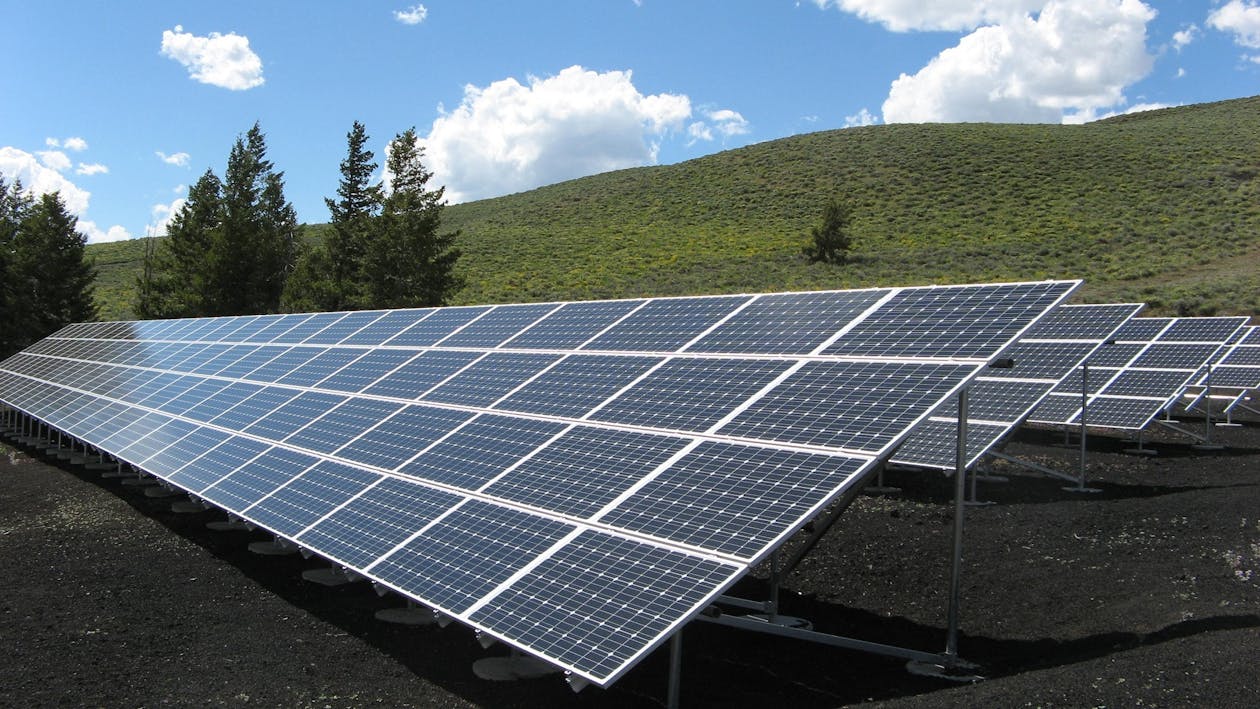
For a shed with two panels and minimal shading, series wiring with an MPPT controller is typically the best choice: the higher voltage reduces current, allowing you to use thinner, cheaper wire for the run from roof to charge controller. For cabins surrounded by tall trees where partial shading is unavoidable, parallel wiring preserves more total output because a shaded panel does not drag down its neighbors.
Equipment Selection for Installation
Essential Components (Panels, Batteries, Charge Controller)
A complete off-grid small photovoltaic system consists of five core components: solar panels, a charge controller, a battery bank, an inverter (if you need AC power), and the wiring/connectors that link them all. Here is what to look for in each:
Solar Panels: For sheds, 100–200W panels are the practical sweet spot — they are light enough for one person to handle (7–12 kg) and physically small enough to fit on compact roofs. For cabins, 400–465W residential panels like the Jia Mao Bipv N-type monocrystalline modules offer substantially more power per panel, meaning fewer mounting points and a simpler roof layout. These particular panels weigh 21.5 kg each and measure 1762 × 1134 × 30 mm — compact enough to fit on a standard cabin roof slope with room to spare.
Charge Controller: The charge controller sits between the panels and the battery and regulates the charging voltage and current. PWM (Pulse Width Modulation) controllers are inexpensive ($15–$40) and work well when panel voltage closely matches battery voltage. MPPT (Maximum Power Point Tracking) controllers cost more ($80–$250) but extract 15–30% more energy from the panels, especially in cold weather or when panel voltage is significantly higher than battery voltage. For any system above 200W, an MPPT controller is worth the investment.
Battery Bank: LiFePO4 (lithium iron phosphate) batteries have become the standard for off-grid solar. They tolerate deep discharges (80–90% DoD vs. 50% for lead-acid), last 3,000–5,000 cycles (vs. 300–500 for lead-acid), and weigh roughly half as much. A 12V 100Ah LiFePO4 battery stores 1,280 Wh and costs $250–$500 — enough for a full day of autonomy for our example 940 Wh workshop shed. For cabins with higher loads, 200Ah or multiple batteries in parallel are common.
Inverter: If you only run 12V DC devices (LED strips, USB chargers, DC fans), you can skip the inverter entirely and save $100–$300. If you need standard 120V AC outlets for tools, appliances, or laptop chargers with AC adapters, a pure sine wave inverter is necessary. Size the inverter at least 25% above your peak simultaneous load — for example, if the most you will run at once totals 500W, choose at least a 700W inverter.
Tools and Materials Needed
The installation itself does not require specialized tools. You will need: a drill/driver with appropriate bits for your roof material, a stud finder (for locating rafters), lag bolts or appropriate roof clamps, a multimeter for verifying voltages and continuity, wire strippers and crimpers, MC4 connector tools (or pre-made MC4 cables, which most people find easier), appropriately gauged solar cable (usually 10 AWG or 12 AWG for short runs), a cable gland or weatherproof conduit for the roof penetration, and basic hand tools (wrenches, screwdrivers, tape measure, level). If you are mounting panels on a metal roof, you will also need stainless-steel or galvanized rail clamps rated for your specific panel frame width.
Typical Cost Breakdown — 400W Off-Grid Shed Solar System
Prices reflect mid-range components as of early 2025. Battery cost represents a 12V 100Ah LiFePO4 unit. Actual costs vary by brand and retailer.
Site Preparation and Safety
Roof Condition and Orientation
Walk the roof (or inspect it from a ladder) and look for damaged shingles, rust spots on metal, soft or spongy decking, and any signs of water intrusion at seams or edges. Repair any issues first. If the roof is more than 15–20 years old and is asphalt shingle, strongly consider re-roofing before installing panels — you do not want to remove and reinstall a solar array five years from now to replace the shingles beneath it.
Determine roof pitch with a simple smartphone inclinometer app. For most latitudes in the contiguous U.S. (25°–50°N), the ideal fixed tilt angle roughly equals your latitude. A shed roof with a 4/12 pitch (about 18°) in a location at 40°N latitude is not perfectly optimized, but a 200W panel on an 18° slope still produces about 92% of what it would at the optimal 40° — a marginal loss that rarely justifies the cost of adjustable tilt racking on a small system.
Sunlight Exposure and Shading
The best way to assess shading is to visit the site at three different times on a sunny day — 9 AM, noon, and 3 PM — and photograph the roof from the same angle each time. You will quickly see which areas remain shadow-free throughout the peak production window. If you want a more precise analysis, apps like Sun Surveyor or the NREL PVWatts Calculator can model sun paths and shading for your exact GPS coordinates.
If tree shading is an issue, consider whether selective pruning (removing lower branches while preserving the canopy) is feasible before assuming the site is unsuitable. Even removing a single obstructing branch can recover 15–25% of lost production during critical midday hours.
Safety Precautions
Solar panels produce DC voltage the moment they are exposed to light — you cannot “turn them off.” A single 100W 12V panel produces about 22V open-circuit voltage (Voc), which is low enough to be safe. But two panels wired in series produce 44V, and four in series produce 88V — high enough to be dangerous. Always cover panels with an opaque tarp or blanket during installation to prevent shock hazard. Wear rubber-soled shoes, use insulated tools, and never work on the system in rain or on a wet roof. If your system voltage exceeds 48V DC, NEC (National Electrical Code) requirements become significantly more stringent, and a licensed electrician should be involved.
Solar Panel Installation Steps
This section walks through the physical installation process from start to finish. Before you begin, lay out all components on the ground, confirm that all parts are present, and test-fit the mounting brackets on the panels.
Watch: DIY Solar Powered Shed Setup — Step-by-Step Walkthrough
Mounting the Solar Panels
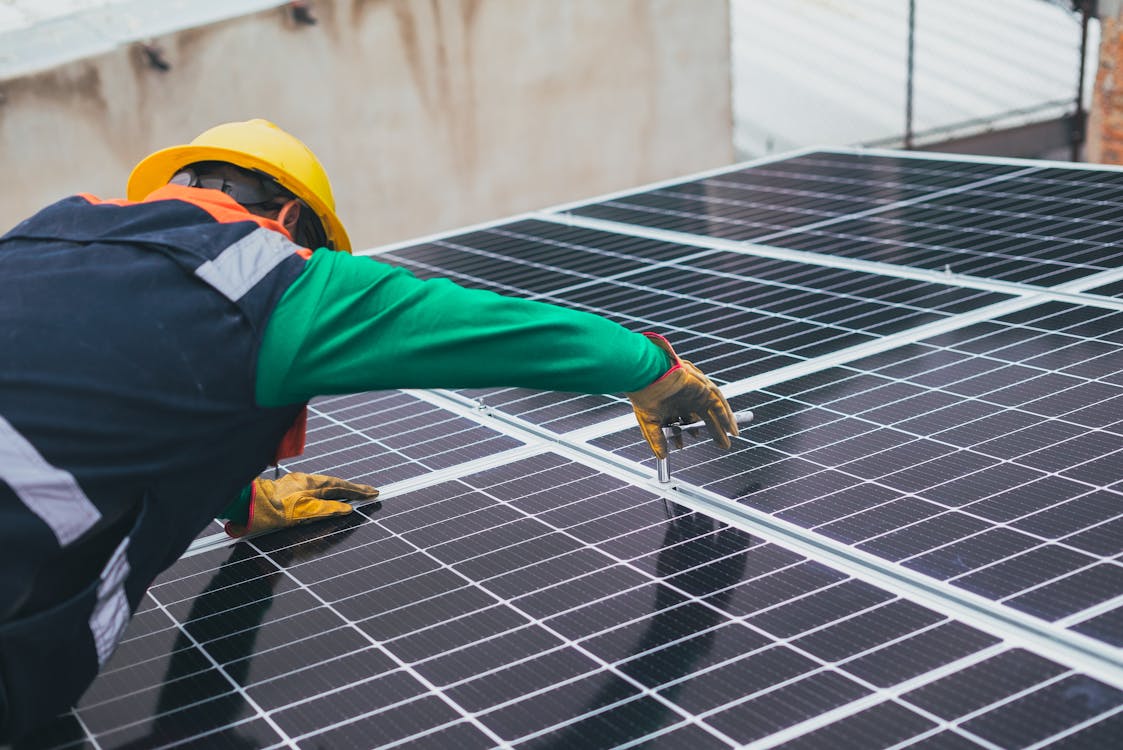
For a metal shed roof, clamp-style mounting is ideal: rail-less clamps grip the standing seams or corrugated ridges without any holes. For shingle roofs, use lag bolts driven into the rafters (not just the decking), with proper L-foot mounts and aluminum flashing to maintain waterproof integrity. Locate rafters with a stud finder from inside the shed, mark their positions, and transfer those marks to the roof surface.
Mount the rails first (if using a rail system), then slide the panels into the rail clamps and secure them. Leave at least 3–4 inches of clearance between the panel bottom and the roof surface for airflow — panels that run hot lose efficiency at a rate of roughly 0.3–0.5% per °C above 25°C (77°F), so ventilation underneath matters. On a hot summer day, a well-ventilated panel can be 10–15°C cooler than one mounted flush, translating to 3–7% more power output.
Wiring and Connections
Run the MC4-terminated cables from the panels down to the charge controller location. If penetrating the roof, use a weatherproof cable gland or run the cables under the eaves and through a wall entry point instead (often simpler and equally effective on a shed). Maintain polarity throughout — red to positive, black to negative — and use a multimeter to verify the open-circuit voltage (Voc) at the charge controller input before connecting to the battery. It should match the expected value for your wiring configuration (e.g., ~44V for two 22V panels in series).
Connecting Batteries and Charge Controller
Connect the battery to the charge controller before connecting the panels — most charge controllers require battery voltage to initialize their programming. Use the thickest wire gauge recommended by the controller manufacturer for the battery-to-controller connection (typically 8 AWG or 6 AWG for systems under 30A). After the battery is connected and the controller powers on, connect the panel input cables. The controller should immediately show incoming solar voltage and begin charging.
Grounding and Weatherproofing
Ground the panel frames and mounting rails to a ground rod using a continuous bare copper conductor (typically 6 AWG). This is required by the NEC for all PV systems and protects against lightning-induced surges. Seal all roof penetrations with butyl tape and/or silicone flashing sealant — not ordinary caulk, which degrades under UV exposure within 2–3 years. Protect all exposed wire connections from moisture by using weatherproof junction boxes or heat-shrink tubing rated for outdoor use.
Regulatory and Permitting
Local Codes and Permits
Permit requirements vary widely by jurisdiction. In many U.S. counties, small off-grid systems on accessory structures (sheds under 200 square feet) are exempt from building and electrical permits — but this is not universal. Some municipalities require a permit for any permanently installed electrical system regardless of size, and a few require engineering stamps for any rooftop-mounted equipment. The safest approach is to call your local building department before purchasing anything: ask specifically whether an off-grid PV system under 600W on an existing shed or cabin requires a building permit, an electrical permit, or both.
Grid-tied systems (where excess energy flows back to the utility) always require permits and utility interconnection agreements, even on small structures. This is one reason most shed and cabin systems are designed as off-grid — it dramatically simplifies the regulatory path.
Utility Notification
Even if no permit is required, some utilities ask to be notified of any solar installation on the property, particularly if the main house is already grid-connected. This is primarily a safety concern: utility line workers need to know that a property has an independent power source. A quick email or phone call to your utility usually satisfies this requirement. In most cases, a standalone off-grid shed system that has no physical connection to the grid or the main house panel does not require utility notification — but verify this with your provider to be certain.
System Testing and Optimization
Initial Checks
Once everything is connected, perform these checks on day one. First, verify that the charge controller displays the correct battery voltage (12.5–13.2V for a fully charged 12V LiFePO4 battery at rest). Second, check that solar input voltage and current are shown on the controller’s display — on a sunny midday, you should see close to the panel’s rated Vmp (maximum power voltage) and Imp (maximum power current). Third, turn on your loads one at a time and verify that the inverter (if used) delivers clean AC power: a multimeter set to AC should read 118–122V. Fourth, inspect all connections for heat — warm wires or warm connectors indicate undersized wire gauge or loose connections that must be corrected immediately.
Maximizing Efficiency
After the initial installation, several adjustments can squeeze additional performance from the same hardware. Tilt-angle optimization is the most impactful: if you installed fixed-angle panels at your roof’s existing pitch, adding seasonal adjustment (steeper in winter, flatter in summer) can increase annual production by 5–10%. Even a simple two-position bracket (summer angle and winter angle) helps. Keep panels clean — even a thin film of pollen or dust can reduce output by 5–15%. In dry or dusty climates, monthly rinsing with a garden hose is sufficient; avoid abrasive cleaners or pressure washers, which can damage the anti-reflective coating on the glass.
For systems with MPPT charge controllers, verify that the controller firmware is up to date and that the battery charging profile matches your specific battery chemistry. An MPPT controller configured for lead-acid charging a LiFePO4 battery will undercharge it by 0.2–0.4V, leaving 5–10% of usable capacity on the table every cycle.
Maintenance and Troubleshooting
Routine Maintenance
One of the strongest practical arguments for small solar systems is their minimal maintenance requirements. There are no moving parts, no fluids, and no filters. A realistic maintenance schedule looks like this:
| Frequency | Task | Details |
|---|---|---|
| Monthly | Visual Inspection | Check panels for debris, cracks, or discoloration. Inspect wiring for rodent damage or UV degradation. Confirm mounting hardware is tight. |
| Quarterly | Panel Cleaning | Rinse with water and a soft cloth. Remove bird droppings, pollen, or sap. Clean early morning or late evening when panels are cool to avoid thermal shock to glass. |
| Every 6 Months | Electrical Check | Use a multimeter to verify Voc and Isc at panels. Compare to original commissioning values. A drop of more than 10% from baseline (adjusted for temperature) warrants investigation. |
| Annually | Full System Review | Tighten all electrical connections. Check battery health (cycle count, internal resistance if your BMS reports it). Inspect charge controller and inverter for error codes or degraded performance. Verify ground connection integrity. |
Common Issues
The most frequently encountered problems with small off-grid systems, along with their typical causes and solutions:
Battery not charging fully: Usually caused by undersized panel array (not enough energy input to reach full charge before sunset), incorrect charge controller settings (wrong battery type selected), or a failing battery cell. Verify Voc at the panels, check controller settings against the battery manufacturer’s recommended charge profile, and test the battery’s voltage under load.
Inverter shutting off under load: Typically means the load exceeds the inverter’s continuous rating, or the battery voltage is dropping below the inverter’s low-voltage cutoff (usually 10.5–11V for a 12V system). This often happens when people connect tools with high startup surges (like a circular saw at 2,400W surge) to an inverter rated for only 1,000W. The fix is either a larger inverter or avoiding high-surge tools on the solar system.
Lower-than-expected output: Shading is the number one cause. Even a shadow the width of a single cell across one panel in a series string can reduce total output by 30–70%. Other causes include dirty panels, a faulty MC4 connector (corrosion inside the connector housing), or a charge controller that has entered a fault or protection mode. Systematic diagnosis with a multimeter — checking each panel’s Voc individually — will usually isolate the issue quickly.

Conclusion
Installing small photovoltaic panels on a shed or cabin is not a complex engineering project — it is a straightforward, achievable weekend build that delivers measurable energy, financial, and environmental returns for years. The core process involves auditing your power needs, sizing the system with a 20–25% loss margin, selecting quality components, preparing the site, and following a methodical installation sequence from mounting rails to final grounding.
The technology has matured to the point where a $600–$1,200 investment in a 200–400W off-grid system can reliably power a workshop shed for a decade or more with minimal maintenance. For cabins, slightly larger systems (600–2,000W) with expanded battery banks provide genuine energy independence in locations the grid will never reach. And with panel efficiencies climbing past 23% — as demonstrated by manufacturers like Jia Mao Bipv, whose N-type modules deliver 445–465W in a compact residential form factor — the performance-per-dollar equation improves every year.
If you have been considering solar for your shed or cabin, the practical barriers are lower now than they have ever been. Start with the load audit table in this guide, run the numbers through an online sizing calculator, and build your component list. The sun is already shining on your roof — the only question is whether you are ready to put it to work.
Have you installed solar on a shed, cabin, or other small structure? Share your experience, lessons learned, or questions in the comments below — this community grows stronger when we learn from each other’s projects.
Watch: Cheap & Simple Off-Grid Cabin Solar Setup — Anyone Can Do This
Frequently Asked Questions (FAQ)
How many solar panels do I need for a shed?
For a basic shed powering lights, phone charging, and a small fan, one to two 100W panels (200W total) is typically sufficient. A workshop shed running power tool chargers and a laptop may need 300–400W. The exact number depends on your daily energy consumption in watt-hours, divided by your local peak sun hours and a 1.25× system loss factor. The load audit table earlier in this article provides a template for calculating your specific needs.
Can I install solar panels on my shed without a permit?
In many U.S. jurisdictions, small off-grid solar systems on accessory structures under 200 square feet are exempt from building permits. However, this varies significantly by county and municipality. Some areas require electrical permits for any permanently wired system. Always contact your local building department before starting — a five-minute phone call can prevent costly compliance issues later.
What size battery do I need for a solar-powered shed?
Match your battery capacity to your daily energy consumption plus one day of autonomy (for cloudy days). If your shed uses 940 Wh per day, a 12V 100Ah LiFePO4 battery provides about 1,200 Wh of usable capacity at 80% depth of discharge — slightly more than one full day’s worth. For cabins with higher loads or in regions with frequent overcast weather, doubling the battery capacity is a prudent choice.
How much does a solar panel system for a shed cost?
A complete 400W off-grid system including panels, a 100Ah LiFePO4 battery, an MPPT charge controller, a 1,000W pure sine wave inverter, and mounting hardware typically costs between $800 and $1,200 in 2025. The battery is the single most expensive component, representing roughly 35–45% of total cost. Smaller 100–200W setups for basic lighting can be assembled for as little as $300–$500.
Should I wire my shed solar panels in series or parallel?
Series wiring is generally preferred for unshaded installations because it increases voltage (reducing current and allowing thinner, cheaper wire) and works optimally with MPPT charge controllers. Parallel wiring is better for partially shaded sites because a shaded panel only reduces its own output without dragging down the other panels. For a two-panel shed system with no shading, series wiring with an MPPT controller is the most efficient choice.
How long do small photovoltaic panels last on a shed?
Modern monocrystalline solar panels are warrantied for 25 years and routinely last 30 years or more. High-efficiency panels like those from Jia Mao Bipv degrade at only 0.4% per year after the first year, meaning a 445W panel will still produce approximately 375W after 25 years. LiFePO4 batteries typically last 10–15 years with daily cycling, and charge controllers and inverters generally last 10–20 years.
Do solar panels work on a shed roof with partial shade?
Yes, but output will be reduced. A shadow covering even one cell in a series string can cut total string output by 30–70%. Mitigation strategies include using microinverters or power optimizers on each panel, wiring panels in parallel instead of series, strategic tree pruning, and positioning panels on the least-shaded portion of the roof. Panels with bypass diodes (most modern panels have three) also help limit the impact of partial shading.
What is the difference between PWM and MPPT charge controllers?
PWM (Pulse Width Modulation) controllers are simpler and cheaper ($15–$40) but require the panel voltage to closely match the battery voltage, wasting any excess voltage as heat. MPPT (Maximum Power Point Tracking) controllers ($80–$250) convert the higher panel voltage down to battery voltage while capturing the extra energy — typically harvesting 15–30% more power than PWM from the same panels. For any system above 200W, the extra cost of an MPPT controller pays for itself within one to two seasons through increased energy harvest.
Can a solar panel system power a full-size refrigerator in a cabin?
Yes, but it requires a larger system than most basic shed setups. A standard full-size refrigerator draws 100–400W and runs intermittently, consuming roughly 1,000–1,500 Wh per day. You would need at least 600–800W of panel capacity, a 200Ah+ LiFePO4 battery bank, and a 2,000W inverter to handle compressor startup surges. Energy-efficient DC refrigerators designed for off-grid use (like those from Sundanzer or Unique) consume only 500–700 Wh/day and are a far more practical choice for small solar cabin systems.
Where can I find high-efficiency solar panels for small building applications?
Specialty manufacturers that focus on building-integrated and small-structure applications are often the best source. Jia Mao Bipv offers N-type monocrystalline panels at 23.3% efficiency with compact dimensions suitable for sheds and cabins, along with BIPV options for structures where aesthetics matter. Major retailers like Renogy, Rich Solar, and BougeRV also carry panels in the 100–400W range designed specifically for off-grid small-structure applications. When comparing, focus on the actual cell efficiency, the annual degradation rate, and the warranty terms rather than just the sticker price per watt.


-300x300.jpg)