China manufactures roughly 80 % of the world’s solar panels and exported a record 455 GW of photovoltaic products in 2025. For distributors, EPC contractors, and project developers worldwide, sourcing directly from Chinese factories remains one of the most cost-effective ways to procure high-quality PV modules. Yet the process is not without risk — fraudulent suppliers, substandard cells, opaque pricing, and complex import regulations can turn a promising deal into a costly lesson.
This guide walks you through every stage of buying solar PV panels from China safely and efficiently: from finding and verifying reliable suppliers, evaluating product quality, negotiating contracts and payments, navigating import logistics, to managing hidden costs and delivery risks. Whether you are ordering a single container of 550 W TOPCon modules or scaling up a multi-megawatt procurement pipeline, the framework below will help you make informed decisions at each step.
Companies like Jia Mao Bipv — a Shanghai-based BIPV manufacturer with a 3 GW annual production capacity — exemplify the depth of expertise available in the Chinese solar supply chain. By the end of this article, you will have a practical, repeatable process for tapping into that expertise without exposing your business to unnecessary risk.
Find Reliable Solar PV Panels China Suppliers
Research Verified Sellers
Your first task is to build a longlist of potential suppliers and then systematically narrow it down. Start with the major B2B sourcing platforms — Alibaba, Made-in-China, and Global Sources — and filter for “Verified Supplier” or “Gold Supplier” badges. These indicators mean the platform has performed at least a basic background check on the company’s business license, factory location, and export history.
Go beyond platform badges. Cross-reference the company name on China’s official National Enterprise Credit Information Publicity System (gsxt.gov.cn) to confirm business registration, legal representative, registered capital, and operating status. Check whether the supplier has exhibited at recognized industry trade shows such as SNEC (Shanghai), Intersolar (Munich), or Solar Power International (SPI). Attendance at these events signals a supplier that invests in international visibility and reputation.
Additionally, look for the supplier’s track record on Bloomberg New Energy Finance (BNEF) Tier 1 lists. While Tier 1 status is not a quality certification per se, it reflects bankability — meaning at least six different banks have financed projects using that manufacturer’s modules in the past two years.
Use Sourcing Services
If you lack in-country experience, consider hiring a professional sourcing agent or quality inspection firm with offices in China’s major solar-manufacturing hubs — Jiangsu, Zhejiang, Anhui, and Guangdong provinces. Reputable firms such as Asiaction, V-Trust, and QIMA offer end-to-end services including supplier shortlisting, factory audits, production monitoring, and pre-shipment inspections.
A sourcing service adds cost — typically 5–8 % of the order value or a flat project fee — but it can save many times that amount by catching quality issues before shipment, negotiating better prices through local-language fluency, and consolidating logistics. For first-time buyers or orders exceeding $50,000, the return on investment is almost always positive.
Check Supplier Credentials
Before sending a purchase order, verify the following credentials:
Business license and export rights: Every legitimate Chinese exporter holds a business license (营业执照) and an import-export registration certificate. Ask for scanned copies and verify them against government records.
Factory audit reports: Request the supplier’s latest ISO 9001 (Quality Management), ISO 14001 (Environmental Management), and ISO 45001 (Occupational Health & Safety) certificates. Confirm the certificates are current and issued by accredited bodies — not self-declared.
Product certifications: Solar modules sold internationally must carry certifications relevant to the destination market. The table below summarizes the most important ones:
| Certification | Issuing Body | Required Market | What It Verifies |
|---|---|---|---|
| IEC 61215 | IEC | Global | Design qualification and type approval for crystalline silicon modules |
| IEC 61730 | IEC | Global | PV module safety — electrical and mechanical hazard protection |
| UL 61730 | UL (Underwriters Laboratories) | North America | Harmonized IEC 61730 with U.S./Canadian national deviations |
| CE Marking | EU | European Union | Compliance with EU Low Voltage Directive and EMC Directive |
| TÜV Rheinland / TÜV SÜD | TÜV | Global (highly respected) | Independent third-party testing of safety and performance |
| MCS | MCS (UK) | United Kingdom | Microgeneration Certification Scheme for renewable products |
| CEC Approved | Clean Energy Council | Australia | Listed on the CEC-approved module directory |
| BIS (IS 14286) | Bureau of Indian Standards | India | Mandatory for modules sold or deployed in India |
Tip: Always ask for the actual test report — not just the certificate — and verify the report number with the issuing laboratory. Counterfeit certificates are unfortunately common among low-tier Chinese suppliers.

Evaluate Product Quality and Specifications
Review Performance Parameters
Once you have shortlisted credible suppliers, the next step is evaluating the products themselves. Solar panel performance is defined by a set of standardized electrical and mechanical parameters. The key metrics to compare include nominal power output (Wp), module efficiency (%), power tolerance, temperature coefficient of Pmax, and degradation rate. The table below shows benchmark specifications for mainstream module types available from Chinese manufacturers in 2026:
| Parameter | PERC Mono (P-type) | TOPCon (N-type) | HJT (Heterojunction) | BIPV Module (e.g., Jia Mao Bipv) |
|---|---|---|---|---|
| Typical Wattage | 540–560 W | 570–620 W | 700–740 W | 150–350 W (custom sizes) |
| Cell Efficiency | 22.5–23.5 % | 24.0–25.5 % | 25.0–27.0 % | >22 % (monocrystalline) |
| Module Efficiency | 21.0–22.0 % | 22.0–23.5 % | 22.5–24.0 % | 18.0–21.0 % |
| Temp. Coefficient (Pmax) | −0.35 %/°C | −0.30 %/°C | −0.26 %/°C | −0.35 %/°C |
| Year-1 Degradation | 2.0 % | 1.0 % | 1.0 % | 2.0 % |
| Annual Degradation (Yr 2–30) | 0.55 % | 0.40 % | 0.35 % | 0.50 % |
| Warranty (Product / Performance) | 12 yr / 25 yr | 15 yr / 30 yr | 15 yr / 30 yr | 25 yr / 25 yr |
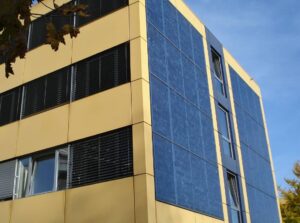
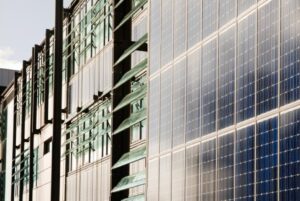
Note: BIPV modules, such as those produced by Jia Mao Bipv, are designed to replace conventional building materials (glass facades, roof tiles) so their form factor differs from standard utility modules. Performance specifications should be evaluated against the building-integration context rather than purely against utility-scale panels.
Request Samples
Never commit to a bulk order without first evaluating physical samples. Request two to three sample modules from each shortlisted supplier and conduct or commission the following checks:
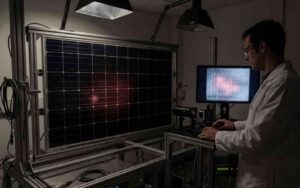
Visual inspection: Look for micro-cracks, cell misalignment, yellowed encapsulant, solder defects, and frame scratches. Use an electroluminescence (EL) tester if available — EL imaging reveals hidden micro-cracks invisible to the naked eye.
Flash test: Every reputable manufacturer flash-tests each module at STC (Standard Test Conditions: 1000 W/m² irradiance, 25 °C cell temperature, AM 1.5 spectrum) before shipping. Ask the supplier for the flash-test report (IV curve data) for each sample. Compare the measured power output (Pmax) against the nameplate wattage — it should be within the stated power tolerance (typically 0 to +5 W).
Third-party lab verification: For orders above $100,000, consider sending a sample to an independent test laboratory such as TÜV Rheinland, PI Berlin, or CSA Group. A full IEC 61215 sequence test costs $15,000–$25,000 and takes 8–12 weeks, but a reduced spot-check program (flash test, wet leakage, EL imaging) can be done in 1–2 weeks for $2,000–$4,000.
Compare Standards
Different destination countries require different certification standards. Before confirming your supplier, verify that the product datasheet and test reports align with the requirements of your target market. For instance, modules destined for the U.S. must carry UL 61730 and UL 1703 listings; modules for the EU must be CE-marked; and modules for Australia must appear on the Clean Energy Council (CEC) approved modules list.
Also compare warranty terms across suppliers. A 25-year linear power warranty with a first-year degradation cap of 1 % and annual degradation of 0.4 % (typical for TOPCon) is materially better than an older-style stepped warranty that only guarantees 80 % output at year 25. Confirm that the warranty is backed by a bankable entity — some small Chinese factories may not exist in 10 years, rendering their warranty worthless.
China’s Solar Module Technology Mix — 2025 Shipments
Source: InfoLink Consulting, Ember Energy (2025 data). TOPCon has overtaken PERC as the dominant cell technology in Chinese module shipments.
Buy Solar Panels: Pricing, Contracts, and Payments
Negotiate Prices and Terms
Solar module pricing from China is among the most competitive in the world. As of early 2026, FOB China prices for mainstream TOPCon modules sit at approximately $0.09–$0.11 per watt, while PERC modules trade at $0.07–$0.09 per watt. However, the final landed cost at your warehouse will be significantly higher after factoring in shipping, insurance, customs duties, and local taxes.
When negotiating, keep the following principles in mind. First, always request quotes on a per-watt ($/W) basis rather than per-panel — this standardizes comparison across different wattages and suppliers. Second, clarify the Incoterm: FOB (Free on Board) means the supplier delivers to the port and loads onto the vessel, while CIF (Cost, Insurance, and Freight) includes freight and insurance to the destination port. For first-time buyers, CIF is simpler; experienced importers often prefer FOB to control their own logistics. Third, negotiate MOQ (Minimum Order Quantity) — most factories require at least one 40-foot HQ container (roughly 800–1,000 panels of 550 W), but some suppliers, including Jia Mao Bipv, offer flexible MOQs for custom BIPV products.
Average FOB China Solar Module Prices (2021–2026)

Source: InfoLink, PV InfoLink, S&P Global. Prices reflect mainstream mono PERC/TOPCon modules. BIPV and specialty modules carry a premium.
Secure Payment Methods
Payment security is arguably the single most important factor in a cross-border solar procurement deal. The table below compares the most common payment methods for importing solar panels from China:
| Payment Method | Buyer Protection Level | Cost to Buyer | Best For |
|---|---|---|---|
| Irrevocable Letter of Credit (L/C) | High — bank guarantees payment on document compliance | 1–3 % of L/C value (bank fees) | Orders > $100K; first-time supplier relationships |
| Alibaba Trade Assurance | Medium — covers shipping delays and quality disputes up to $200K | Free for buyers (supplier pays 1–2 %) | Alibaba orders < $200K |
| T/T (Telegraphic Transfer) — 30/70 split | Low-Medium — 30 % deposit, 70 % before shipment or against B/L copy | Wire fees ($15–$50 per transfer) | Established supplier relationships |
| PayPal Business | Medium — buyer dispute resolution | 2.9 % + $0.30 per transaction | Sample orders and small purchases < $10K |
| Escrow (third-party) | High — funds held until buyer confirms receipt | 1–3 % of transaction value | Medium orders $10K–$100K |
Best practice: For your first order with a new supplier, use an irrevocable L/C at sight or Alibaba Trade Assurance. As trust builds over multiple successful shipments, you can transition to T/T (30 % deposit / 70 % against copy of Bill of Lading) to reduce banking fees. Never send 100 % payment upfront via T/T to an unproven supplier — this is the most common way buyers lose money in Chinese solar trade.
Draft Clear Contracts
A well-drafted purchase contract is your legal safety net. At a minimum, your contract should include the following clauses:
Product specification sheet: Attach the agreed datasheet as an annex. Specify model number, wattage, cell type, dimensions, weight, and all required certifications. State the acceptable power tolerance (e.g., 0 to +5 W).
Quality assurance clause: Define the inspection protocol — who inspects, when, and what standards apply. Include the right to hire a third-party inspector (e.g., TÜV, Bureau Veritas, SGS) at the factory before shipment. Specify rejection and replacement criteria.
Delivery and Incoterms: State the Incoterm (FOB, CIF, DDP, etc.), the port of loading, the estimated delivery date, and the penalty for late delivery (typically 0.5–1 % of contract value per week of delay, capped at 5–10 %).
Warranty terms: Include the product warranty (workmanship defects) and performance warranty (power output degradation), the process for making warranty claims, and who bears the cost of replacement modules and shipping.
Dispute resolution: For international solar contracts, specify arbitration under the rules of the China International Economic and Trade Arbitration Commission (CIETAC), the International Chamber of Commerce (ICC), or the Singapore International Arbitration Centre (SIAC). Arbitral awards under these institutions are enforceable in most countries under the New York Convention.
Force majeure: Define force majeure events and the obligations of each party if one occurs.
Import Solar Panels: Regulations and Logistics
Understand Import Laws
Import regulations vary dramatically by destination country, and non-compliance can result in shipments being held at customs, heavy fines, or even confiscation. Below is a summary of the major regulatory frameworks for the largest solar-importing regions:
United States: Importing solar panels directly from China into the U.S. triggers some of the highest tariff barriers in the world. As of 2025, Chinese-origin modules face anti-dumping duties (AD) of up to 238.95 % and countervailing duties (CVD) of 17.10 %, plus Section 301 tariffs of 50 % on polysilicon, wafers, and cells, and Section 201 safeguard tariffs of 14.25 % on bifacial modules. These layers make direct China-to-U.S. importation economically unviable for most standard modules. Many buyers source from Chinese-owned factories in Southeast Asia (Vietnam, Malaysia, Thailand, Cambodia), though the U.S. Department of Commerce finalized anti-circumvention tariffs on these countries in April 2025 as well. Consult a trade attorney before importing solar modules into the U.S.
European Union: The EU removed anti-dumping and anti-subsidy duties on Chinese solar products in September 2018. As of 2026, there are no additional tariffs on Chinese solar modules entering the EU beyond the standard customs duty rate of 0 %. However, modules must carry CE marking and comply with the EU’s Low Voltage Directive (LVD) and Electromagnetic Compatibility (EMC) Directive.
India: India imposes a 40 % Basic Customs Duty (BCD) on imported solar modules and 25 % on imported cells (reduced from 25 % to 20 % in the Union Budget 2025-26 for cells). Additionally, an Approved List of Models and Manufacturers (ALMM) restricts which modules can be deployed in government-subsidized projects. BIS certification (IS 14286) is mandatory.
Australia: No anti-dumping duties on Chinese solar panels. Products must be listed on the Clean Energy Council (CEC) Approved Modules list and comply with Australian electrical safety standards (AS/NZS 5033).
Always check the latest regulations with your customs broker or trade counsel before placing an order.
Estimate Transportation Costs
Shipping is a significant component of the total landed cost for solar panels. The table below estimates shipping costs from China to major destination regions:
| Destination | Shipping Method | Estimated Cost | Transit Time |
|---|---|---|---|
| North America (West Coast) | Sea Freight (40HQ FCL) | $4,500–$6,500 | 14–20 days |
| North America (East Coast) | Sea Freight (40HQ FCL) | $5,500–$7,500 | 25–35 days |
| Europe (Hamburg / Rotterdam) | Sea Freight (40HQ FCL) | $3,500–$5,500 | 28–35 days |
| Europe | Rail Freight (40HQ) | $2,800–$3,800 | 18–25 days |
| Australia (Sydney / Melbourne) | Sea Freight (40HQ FCL) | $2,500–$4,000 | 14–21 days |
| South America (Santos / Buenos Aires) | Sea Freight (40HQ FCL) | $5,000–$8,000 | 35–45 days |
| Any destination | Air Freight | $4.50–$6.50 per kg | 5–7 days |
Container capacity rule of thumb: A standard 40-foot High Cube (40HQ) container holds approximately 800–1,000 pieces of 550 W modules (roughly 440–550 kW). If your order is smaller than a full container, LCL (Less than Container Load) shipping is available but costs more per panel and increases the risk of handling damage.
Don’t forget to budget for marine cargo insurance (typically 0.2–0.5 % of CIF value) and inland trucking from the destination port to your warehouse.
Arrange Shipping and Delivery
Work with a freight forwarder experienced in oversized, fragile cargo. Solar panels require proper stacking, edge protection, and moisture-barrier packaging. Key steps include:
Booking and documentation: Your freight forwarder will arrange the container booking, collect the Bill of Lading (B/L), commercial invoice, packing list, certificate of origin, and any required test reports or certificates. Ensure all documents match exactly — discrepancies are the number-one cause of customs clearance delays.
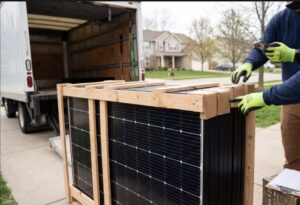
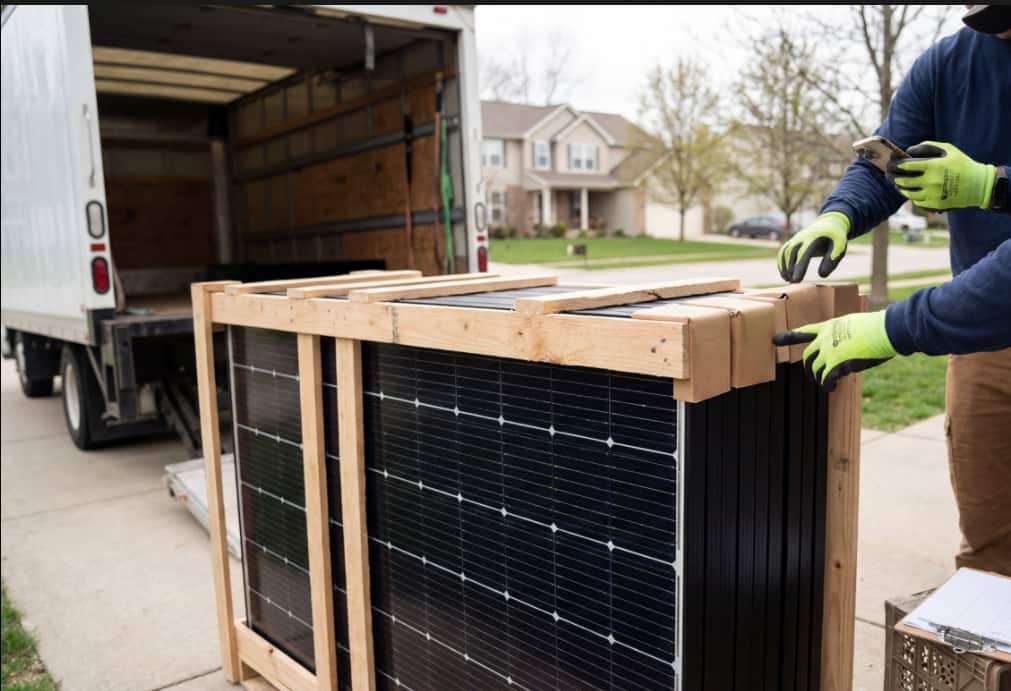
Packaging standards: Modules should be packed on custom wooden pallets (ISPM-15 heat-treated for international shipping), wrapped in cardboard corner protectors, and sealed in plastic stretch wrap. Each pallet should be strapped to prevent shifting. For containers traveling through rough seas, additional airbag dunnage between pallets is recommended.
Customs clearance: Appoint a licensed customs broker at the destination port. Provide them with all shipping documents in advance to pre-clear the shipment and avoid demurrage charges (typically $100–$300 per container per day for port storage after the free period).
Manage Hidden Costs and Delivery Risks
Identify Extra Charges
Many first-time importers are surprised by the gap between the quoted FOB price and the total landed cost. The “hidden” cost categories include:
Customs duties and tariffs: As outlined above, these vary from 0 % (EU) to over 250 % (U.S. for direct China imports). Model your landed cost accurately before committing to an order.
VAT / GST / Import tax: Most countries levy Value Added Tax on imported goods. In the EU this is 19–27 % (reclaimable for VAT-registered businesses); in Australia, GST is 10 %; in India, IGST is 12 %.
Port and handling fees: Terminal handling charges (THC), container drayage, and warehouse fees can add $500–$1,500 per container.
Demurrage and detention: If your container sits at the port or depot beyond the free days (typically 7–14 days), you will be charged $100–$300 per day. Plan your customs clearance timeline carefully.
Currency exchange and bank fees: Wire transfers from USD or EUR to CNY incur exchange spreads (0.5–2 %) and intermediary bank fees ($15–$50 per transfer). L/C amendment fees can run $50–$200 each.
Inspection costs: Third-party pre-shipment inspections cost $300–$500 per man-day. A typical container inspection takes one day.
Total Landed Cost Breakdown — 1 × 40HQ of 550 W TOPCon Modules to Europe
Example assumes 800 × 550 W TOPCon modules at $0.10/W FOB, shipped to Rotterdam. EU customs duty = 0 %. Total landed cost ≈ $51,000 or ~$0.116/W. Costs vary by season and route.
Inspect Goods on Arrival
Even with pre-shipment inspections, you should perform an arrival inspection at your warehouse. Unpack a random sample (5–10 % of the shipment) and check for:
Shipping damage: Cracked glass, bent frames, punctured backsheets, or water ingress. Photograph all damage immediately and notify both the freight forwarder and the supplier within 48 hours — this is critical for insurance claims.
Label verification: Confirm that the nameplate label on each module matches the contract specifications — model number, wattage, certifications, and serial number.
Flash testing: If you have access to an IV curve tracer, flash-test a random sample and compare results against the factory flash-test reports provided with the shipment. Any module with power output more than 3 % below the nameplate rating should be flagged.
Documentation audit: Verify that all certificates of origin, test reports, and warranty cards are present and match the shipped goods.
YouTube Video: Importing Solar Panels from China
For a visual walkthrough of the entire process — from contacting a Chinese factory to receiving panels at your doorstep — watch this comprehensive video:
This video covers the practical experience of purchasing a solar system directly from a Chinese factory, including pricing negotiation, shipping logistics, and installation.
Buying solar PV panels from China safely and efficiently is entirely achievable when you follow a disciplined, step-by-step process. To recap the critical stages: start by researching and verifying suppliers through platform badges, government databases, and third-party audits. Evaluate product quality by reviewing performance specs, requesting samples, and commissioning independent lab tests. Protect your money with secure payment methods — particularly Letters of Credit or Trade Assurance for new relationships. Draft airtight contracts that specify quality standards, delivery timelines, warranties, and dispute resolution mechanisms. Understand your destination country’s import regulations and tariff structure before committing. Budget for the full landed cost — not just the FOB price — by accounting for shipping, insurance, customs duties, port fees, and inspections. And always inspect goods on arrival.
Specialized suppliers like Jia Mao Bipv demonstrate that the Chinese solar industry offers far more than cheap commodity panels. From cutting-edge BIPV glass facades and solar roof tiles to high-efficiency TOPCon modules, the depth and diversity of the Chinese PV supply chain is unmatched. By applying the framework in this guide, you can tap into that supply chain confidently — reducing costs, accelerating project timelines, and delivering high-performance solar installations for your clients.
Quick Buyer Checklist
| Step | Action Item | Status |
|---|---|---|
| 1 | Build supplier longlist (Alibaba, Made-in-China, trade shows) | ☐ |
| 2 | Verify business license and certifications on government databases | ☐ |
| 3 | Request and evaluate product samples (visual + flash test + EL) | ☐ |
| 4 | Compare pricing on a $/W basis (FOB vs. CIF) | ☐ |
| 5 | Negotiate contract with QA clause, warranty, and arbitration | ☐ |
| 6 | Secure payment via L/C or Trade Assurance | ☐ |
| 7 | Confirm destination-market certifications (UL, CE, BIS, CEC, etc.) | ☐ |
| 8 | Calculate total landed cost including duties, freight, insurance, handling | ☐ |
| 9 | Arrange pre-shipment third-party inspection | ☐ |
| 10 | Inspect goods on arrival and file claims within 48 hours if damaged | ☐ |
Frequently Asked Questions About Buying Solar PV Panels from China
1. Is it safe to buy solar panels directly from Chinese manufacturers?
Yes, it is safe provided you follow a rigorous verification process. Research the supplier on China’s official business registry, confirm ISO and IEC certifications with the issuing bodies, request third-party factory audits, and use secure payment methods like Letters of Credit or Alibaba Trade Assurance. Thousands of businesses worldwide successfully import solar panels from China every year — including many of the world’s largest EPC firms and utility developers.
2. What certifications should Chinese solar panels have?
At a minimum, solar panels should carry IEC 61215 (design qualification) and IEC 61730 (safety) certifications. For North America, UL 61730 or UL 1703 is required. The EU requires CE marking. Australia requires CEC listing. India requires BIS (IS 14286) certification. TÜV Rheinland or TÜV SÜD certification is widely regarded as a gold standard globally. Always request the actual test report — not just the certificate — and verify the report number with the laboratory.
3. How much does it cost to ship solar panels from China?
Sea freight for a full 40-foot High Cube container (holding approximately 800–1,000 panels of 550 W) costs roughly $3,500–$7,500 depending on the destination, with transit times of 14–45 days. Air freight is significantly more expensive at $4.50–$6.50 per kilogram but delivers in 5–7 days. Additional costs include marine insurance (0.2–0.5 % of CIF value), port handling fees ($500–$1,500), and inland trucking.
4. What is the best payment method when buying solar panels from China?
For first-time purchases, an irrevocable Letter of Credit (L/C) at sight offers the strongest buyer protection, as the bank only releases payment when the supplier presents compliant shipping documents. Alibaba Trade Assurance is a good alternative for orders under $200,000 placed through Alibaba. As the relationship matures, many buyers shift to T/T (30 % deposit / 70 % against Bill of Lading copy) to reduce banking fees. Never wire 100 % payment upfront to an unverified supplier.
5. What are the U.S. tariffs on solar panels from China?
As of 2025, importing solar modules directly from China into the U.S. incurs anti-dumping duties of up to 238.95 %, countervailing duties of 17.10 %, Section 301 tariffs of 50 %, and Section 201 safeguard tariffs of 14.25 % on bifacial modules. These combined duties make direct China-to-U.S. import economically unviable. Many buyers source from Chinese-affiliated factories in Southeast Asia, though anti-circumvention duties were also finalized in April 2025. Consult a trade attorney for the latest rates.
6. Can I import solar panels from China to Europe without tariffs?
Yes. The EU removed all anti-dumping and anti-subsidy duties on Chinese solar panels in September 2018. As of 2026, the customs duty on solar modules entering the EU from China is 0 %. However, VAT applies at the national rate (19–27 % depending on the country) and is reclaimable for VAT-registered businesses. Modules must be CE-marked and comply with the EU’s Low Voltage and EMC Directives.
7. What is the difference between BIPV panels and standard solar panels?
BIPV (Building-Integrated Photovoltaic) panels serve a dual purpose: they generate electricity while simultaneously functioning as a building material — replacing conventional glass facades, windows, skylights, or roof tiles. Standard panels are mounted on top of existing building surfaces using racks. BIPV modules, such as those manufactured by Jia Mao Bipv, offer transparency options from 10 % to 90 %, custom sizes, and architectural-grade aesthetics, making them ideal for modern sustainable building design.
8. How do I verify if a Chinese solar panel supplier is legitimate?
Cross-reference the supplier’s company name on China’s National Enterprise Credit Information Publicity System (gsxt.gov.cn). Confirm their business license, registered capital, legal representative, and operating status. Request ISO 9001, ISO 14001, and ISO 45001 certificates and verify them with the issuing bodies. Check whether the manufacturer appears on the BNEF Tier 1 module list. Consider hiring a third-party inspection firm (e.g., TÜV, SGS, Bureau Veritas) to conduct a factory audit.
9. How many solar panels fit in a 40-foot container?
A standard 40-foot High Cube (40HQ) container typically holds 800–1,000 solar panels of 550 W (approximately 440–550 kW of total capacity). The exact number depends on the panel dimensions and packaging method. BIPV modules with custom sizes may have different loading capacities. Always confirm the packing plan with your supplier and freight forwarder before booking the container.
10. What should I do if solar panels arrive damaged?
Photograph all damage immediately upon unpacking. Notify the freight forwarder, the supplier, and your marine cargo insurance provider within 48 hours — most insurance policies have strict claim filing deadlines. File a written claim with supporting evidence (photos, flash-test data, inspection reports). If you used Alibaba Trade Assurance or an L/C, initiate the dispute resolution process through the platform or your bank. Include a damage clause in your original contract that defines the procedure and responsibilities for damaged goods.


-300x300.jpg)