How to Evaluate Solar Glass for BIPV: A Spec and Supplier Checklist
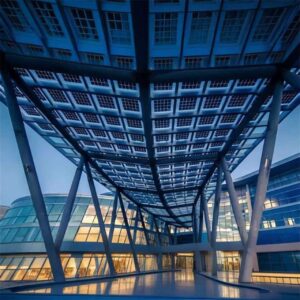
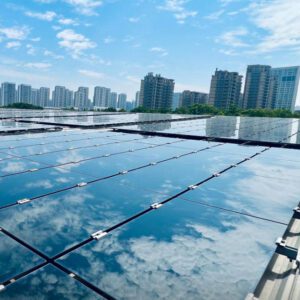
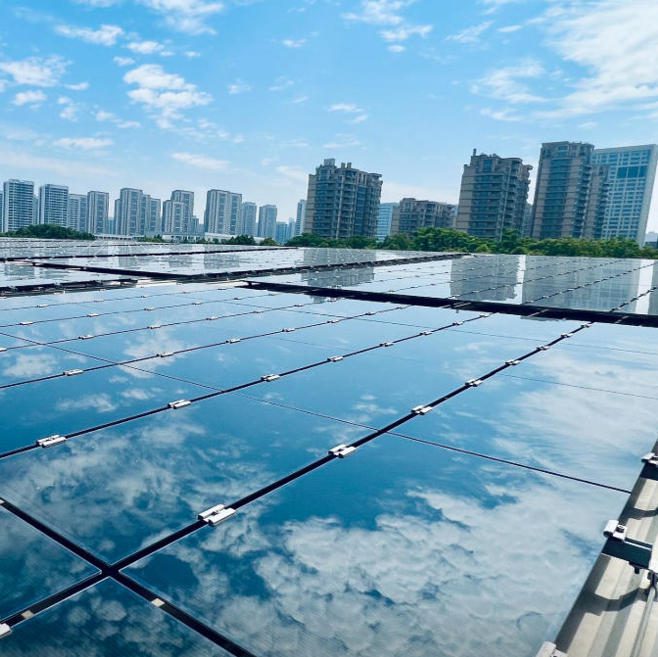
A 1,200 kW BIPV photovoltaic glass project at the Wuhan Science and Technology Exhibition Center, shown on the Jia Mao Bipv website.
Quick answer: To evaluate solar glass, check five things in this order:
- Strength: heat treatment type (tempered or heat-strengthened), surface stress, and breakage pattern.
- Light transmission: low-iron content, AR coating, and measured transmittance, not just a claimed number.
- Durability: damp heat, thermal cycling, salt, UV, and wind or snow load results.
- Project fit: thermal expansion, sealant compatibility, U-value, and SHGC.
- Supplier proof: certificates you can verify, batch records, lead time, and warranty terms.
I. Introduction
A. The Critical Role of Glass Selection in the Lifecycle of Solar Construction Projects
A 100 kW commercial rooftop array in Phoenix, Arizona lost 7,400 kWh in its first year. The cells were fine, and so was the inverter. The installer had used standard float glass instead of low-iron, anti-reflective solar glass.
At $0.12 per kWh, that single choice cost about $888 a year. Over 25 years, it adds up to more than $22,000, according to a solar glass types guide from Jia Mao Bipv.
Solar glass does two jobs at once. It is the first optical layer that sunlight crosses before it reaches the cell. In BIPV (building-integrated photovoltaics, meaning solar that replaces a roof, wall, or window material), it is also part of the building envelope. It carries wind, sheds water, and protects people below.
The market has noticed. Fortune Business Insights puts the global solar PV glass market at $22.05 billion in 2026, growing to $93.72 billion by 2034.
Source: Fortune Business Insights.
B. Common Pain Points for EPCs and Architects
You probably know these three conflicts well.
- Looks vs. safety. The architect wants thin, clear, color-matched glass. The code reviewer wants proof it will not fall on the sidewalk.
- Safety vs. cost. Laminated or heat-treated glass costs more per square meter, and the lowest bid rarely includes it.
- Cost vs. yield. A cheaper cover glass can quietly cut energy output for 25 years.
These conflicts are real, but you can settle them with data. That is what the rest of this guide is for.
C. Objective: A Professional Guide to Technical Evaluation and Supplier Vetting
This guide gives you a repeatable method. Part one covers three technical pillars: mechanical strength, optical performance, and weather durability. Part two covers how to match glass to your project, how to audit a supplier, and how to run a checklist before you sign a purchase order.
A glossary and 12 answers to common questions close the article.
II. Technical Pillar 1: Mechanical Strength and Structural Integrity
A. Why Load-Bearing Capacity Comes First
Evaluating how much load the glass can carry is the first step for safety and code approval in curtain walls and roofing.
A curtain wall is a non-structural outer wall, usually aluminum framing with glass infill. It carries no floor loads. It does carry its own weight and passes wind loads to the main structure. Solar glass in that frame must handle the same forces as any other glass in it.
B. Tempered vs. Heat-Strengthened Glass for Impact Resistance
Both are heat-treated glass. The glass is heated to roughly 620–680°C and then cooled with air. The outer surface cools first and ends up squeezed (compression). The core stays in tension. That locked-in stress is what makes the glass stronger.
Fully tempered glass is cooled fast, so it has more compression. Heat-strengthened glass is cooled slower, so it has less.
| Property | Annealed (untreated) | Heat-strengthened | Fully tempered |
|---|---|---|---|
| Surface compression (ASTM C1048) | Near zero | 24–52 MPa | 69 MPa or more |
| Typical strength vs. annealed | 1× | About 2× | About 4× |
| How it breaks | Large, sharp shards | Large pieces, often stays in the frame | Small, blunt cubes |
| Risk of spontaneous breakage | None | Very low | Low, but not zero |
| Flatness | Best | جيد | Slight waviness possible |
| Common solar use | Rarely | Laminated facades, thin glass-glass modules | Rooftop and standard module cover glass |
Typical industry ratios. Exact values depend on thickness and process.
Here is the part many specs miss. Fully tempered is not always the better choice.
- Impact and thermal stress: fully tempered wins.
- Spontaneous breakage and flatness: heat-strengthened wins.
- Overhead use: many codes require laminated glass above people, so the heat treatment type matters less than the laminate.
نظرة ثاقبة في المجال: Very thin glass-glass modules (about 2 mm per sheet) are hard to temper fully. Many use heat-strengthened or semi-tempered glass instead. Do not assume “tempered” on a datasheet means 69 MPa. Ask for the measured surface stress.
Watch this short demonstration of how annealed, tempered, and laminated glass break differently:

C. Stress Distribution and Breakage Patterns
A breakage pattern is the fingerprint of the heat treatment. If you know what to look for, you can test a supplier’s claim in an afternoon.
Fully tempered glass should crumble into many small, blunt pieces. European standard EN 12150 sets a minimum particle count inside a 50 × 50 mm patch. Large splinters mean the glass was not tempered properly.
Uneven stress is the hidden risk. If the furnace cools one area faster than another, the glass carries weak spots that look fine until a hot afternoon.
Then there is the nickel sulfide problem. Nickel sulfide is a tiny crystal that sometimes forms inside float glass. It can grow slowly and make fully tempered glass burst years after installation. The photo below shows a tempered pane that broke on its own from an internal impurity.

Spontaneous breakage in tempered glass. Photo: Ox1997cow, CC BY-SA 3.0, via Wikimedia Commons.
The standard fix is a heat soak test. The glass is held at a set temperature so any flawed pane breaks in the factory and not on your facade. For tall buildings, ask whether heat soaking is done and what percentage of panes are tested.
لدينا tempered laminated glass uses a 680°C furnace, reports surface compression above 69 MPa, and lists 100% stress pattern analysis on the product page. Ask any supplier, including us, for the matching test records.
نظرة ثاقبة في المجال: Most field breakage starts at an edge or a corner, not in the middle of the pane. A chipped edge made during cutting or handling acts like a crack starter. Include edge finish (arrised or seamed) in your incoming inspection.
D. Compliance with International Safety Standards
You will see many standard names on datasheets. This table shows what each one actually covers.
| Standard | What it covers | Where it matters |
|---|---|---|
| IEC 61215 | Module design qualification: thermal cycling, damp heat, mechanical load, hail | All PV modules |
| IEC 61730 | Module electrical and fire safety | All PV modules |
| IEC 63092-1 | Extra requirements for BIPV modules | Roofs, facades, glazing |
| EN 12150 | Thermally toughened (tempered) safety glass | Europe and many export markets |
| EN 1863 | Heat-strengthened glass | Laminated facades |
| ASTM C1048 | Heat-treated flat glass: surface stress limits | North America |
| ASTM E1300 | Method to size glass for wind and snow loads | Design calculations |
| EN 14449 / ASTM C1172 | زجاج مصفح | Overhead and facade glazing |
| EN 356 | Security glazing (hand-attack resistance) | High-security facades |
For third-party proof, look at labs such as TÜV Rheinland. UL’s BIPV testing page explains why BIPV must be tested as a building material, not only as a solar product.
لدينا BIPV photovoltaic laminated glass is built from 5 mm tempered glass, a 1 mm EVA layer, and another 5 mm tempered sheet (11 mm total). The product page lists an EN 356 P5A rating. Use it as an example of how a build-up and its rating should be written on a datasheet.
III. Technical Pillar 2: Optical Performance and Light Transmission
A. Why Transparency and Anti-Reflection Must Be Balanced
Every percent of light that does not reach the cell is energy you cannot sell. Two tools raise transmittance: removing iron from the glass, and adding an anti-reflective coating.
B. Low-Iron vs. Standard Glass
Ordinary float glass contains iron oxide. You see it as a green tint at the edge of a thick pane. Iron absorbs sunlight as heat before it reaches the cell.
Low-iron glass (also called ultra-clear or ultra-white) cuts the iron to roughly 120 ppm or less (parts per million). That drops absorption below about 2% and lifts transmittance to 91–92% for a 3.2 mm sheet, versus about 84% for standard float glass. These are typical values, so always confirm with a test report.
The axis starts at 70% to make the differences visible. Typical values for 3.2 mm glass.
C. Anti-Reflective (AR) Coatings: Durability, Cleaning, and Gains
An AR coating is a very thin layer, often porous silica, that reduces the mirror-like reflection at the glass surface. Bare glass reflects about 4% of light at each surface. A good coating cuts that loss roughly in half and typically adds 2–3% to module output.
The photo shows the effect. The left side is viewed at a steep angle and shows the coating’s purple tint. At the right angle, the coated window barely reflects at all.

An anti-reflection coated window. Photo via Wikimedia Commons.
Three practical points decide whether the coating pays off:
- Durability. Most coatings are applied before tempering and baked on in the furnace. Ask for abrasion and damp-heat test data on the coating itself, not just the finished module.
- Cleaning. Use soft brushes and clean water. Abrasive pads, scrapers, and strong solvents can wear a porous coating away.
- Gain. On a single array the gain is small. Across 25 years and hundreds of kilowatts, it is large.
Use the Phoenix case to check the math. A loss of 7,400 kWh on a 100 kW system is roughly 4% of a year’s output. Priced at $0.12 per kWh:
D. Glass Thickness: Light Absorption and System Yield
Thicker glass absorbs slightly more light. For low-iron glass the difference between 2.0 mm and 3.2 mm is small. For standard glass it is larger.
Thickness mostly changes weight, strength, and cost. Pick it by structural need first, then check the optical penalty.
| Thickness | Typical use | Strength and weight | Optical note |
|---|---|---|---|
| 2.0 mm | Glass-glass modules, light roofs | Needs heat treatment control; light | Highest transmittance |
| 3.2 mm | Standard module cover glass | Good balance | Most common reference value |
| 4–6 mm | Single-glass BIPV, canopies | Stronger, heavier | Small extra absorption |
| 5 + 5 mm laminated | Facades, overhead, security | Highest safety; about 25 kg/m² for glass alone | Interlayer adds a little loss |
Glass weighs about 2.5 kg per square meter for every millimeter of thickness.
IV. Technical Pillar 3: Weather Resistance and Environmental Durability
A. Why Durability Decides Whether a System Lasts 25 Years
Solar glass must keep working through extreme thermal cycling and corrosive air. A roof surface can swing from -20°C at night to 80°C in the afternoon sun. A coastal facade may see salt mist every day.
B. Hydrolysis and Coating Degradation in Humid Climates
Hydrolysis here means water slowly attacking the glass surface. Moisture pulls sodium out of the glass and leaves a hazy, alkaline film. Over time that film can lift an AR coating or cloud the surface.
The standard test is damp heat: 85°C and 85% relative humidity for 1,000 hours (IEC 61215). It is a useful screen, but a pass on the module does not guarantee the coating alone survives a real tropical climate. Ask for coating-specific humidity data.
نظرة ثاقبة في المجال: Surface staining often starts in the warehouse, not on the roof. Glass sheets stacked wet in a hot container can develop permanent stains. Ask your supplier how they interleave and seal packs, and who is responsible if staining appears.
C. Wind-Load and Snow-Load Resilience
The IEC 61215 mechanical load test uses 2,400 Pa for wind and 5,400 Pa for snow. Pa (pascal) is a unit of pressure. 1 Pa is about 0.1 kg of force on each square meter.
You can estimate wind pressure with a simple formula, where V is wind speed in meters per second:
For a 45 m/s design wind:
Corners and edges see higher local pressure. A pressure coefficient of 1.5 gives about 1,860 Pa, and a 1.5 safety factor gives about 2,800 Pa. This is only a screening number. Your structural engineer and local code (ASCE 7 in the U.S., EN 1991-1-4 in Europe) set the real design load.
| Load source | Typical test or design reference | What to ask the supplier |
|---|---|---|
| Wind | IEC 61215 at 2,400 Pa, higher for storm zones | Test report at your design pressure |
| Snow | IEC 61215 at 5,400 Pa | Report plus frame and clamp details |
| Hail | 25 mm ice ball at 23 m/s as a baseline | Larger ice sizes if your region needs it |
| Thermal stress | 200 thermal cycles, -40°C to 85°C | Edge quality and heat-treatment records |
D. UV and Chemical Pollutants in Urban and Industrial Zones
Glass itself is stable under UV. The risk is in the layers around it: coatings, interlayers, and sealants. IEC 61215 includes a UV preconditioning step, which is a good minimum.
For harsh sites, add targeted tests:
- Salt mist (IEC 61701) for coastal buildings.
- Ammonia (IEC 62716) for farms and livestock buildings.
- Acid rain and industrial fallout through field data from a similar site.
For coastal or industrial projects, a laminated build-up with a durable interlayer is usually the safer baseline.
V. Aligning Glass Specs with Project-Specific Requirements
A. Why Generic Glass Fails Specialized Designs
A datasheet describes a product in a lab. Your project has a frame, a wind zone, a climate, and a schedule. Generic glass often meets the first and ignores the rest.
B. Matching Glass Type to Application
| Application | Top priority | Typical glass build | Key checks |
|---|---|---|---|
| Curtain wall, vision zone | Safety, daylight, looks | Laminated or insulated unit with semi-transparent PV | VLT, SHGC, laminate rating |
| Curtain wall, spandrel (opaque zone between floors) | Output and color | Opaque PV laminate | Color tolerance, ventilation |
| Pitched or flat roof (BIPV) | Water-tightness, load | Tempered or laminated, sealed to flashing | Weight, drainage, fire class |
| Skylight or canopy | Overhead safety | Laminated, often heat-strengthened | Breakage behavior, drainage |
| Utility-scale ground mount | Cost per kWh | 2.0–3.2 mm AR-coated low-iron glass | Transmittance, hail rating |
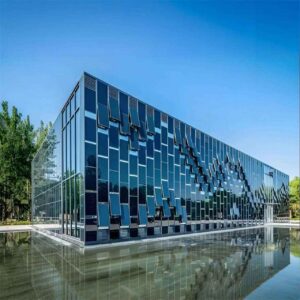
A glass facade with integrated photovoltaics, from the independent facade systems review below.
For a broader market comparison, see this independent facade systems review.
C. Integration with Framing: Thermal Expansion and Sealant Compatibility
Glass and aluminum grow at different rates when heated. Soda-lime glass expands about 9 × 10⁻⁶ per °C. Aluminum expands about 23 × 10⁻⁶ per °C.
Here is a 1.5 m span with a 60°C temperature swing:
Aluminum: 23 × 10⁻⁶ × 1,500 mm × 60 ≈ 2.1 mm. Glass: 9 × 10⁻⁶ × 1,500 mm × 60 ≈ 0.8 mm. The difference is about 1.3 mm per span. Your gaskets, setting blocks, and edge clearances must absorb it.
Sealant compatibility is the other trap. A sealant that stains or softens the PV laminate’s edge seal can void the warranty. ASTM C1087 is the usual lab test for sealant compatibility with structural glazing accessories. Ask the sealant maker for a written compatibility letter naming the exact laminate or interlayer (PVB or EVA).
D. Balancing U-Value and SHGC for LEED and BREEAM
The U-value shows how fast heat passes through a window or wall. Lower is better. SHGC (solar heat gain coefficient) is the share of sunlight heat that enters the room. In hot climates you want it low. In cold climates you may want more.
A BIPV unit’s U-value is set mainly by its build-up (glass layers, gap, gas fill, low-e coating), not by the cells.
| الخيار | Typical U-value | Typical SHGC | Notes |
|---|---|---|---|
| Single laminated PV glass | About 5–6 W/m²K | Depends on cell density | Fine for spandrels, weak for vision zones |
| Insulated unit with PV outer pane and low-e | About 1.1–1.6 W/m²K | Can be well below 0.4 | Best for vision zones |
| لدينا BIPV transparent glass | Per build-up | 0.15–0.45 listed on the product page | VLT 0.3–0.9 depending on option |
LEED و BREEAM both reward energy performance and daylight. Glass affects both through the SHGC and VLT values in your energy model. Give your energy modeler whole-unit values from a recognized test method, not center-of-glass numbers.
VI. The Strategic Supplier Evaluation Framework
A. Why a Datasheet Is Not Enough
A datasheet shows what one sample did once. You are buying thousands of panes over months. The question is whether pane 4,000 matches pane 1.
B. Quality Management Systems and Batch-to-Batch Consistency
Start with ISO 9001 (quality management), then go deeper. Ask for:
- Lot traceability: can they trace a single pane to a furnace run and a date?
- Records of surface stress, thickness, and transmittance for recent lots.
- Process control data, such as the spread of results over the last six to twelve months.
- Retained samples from each lot, stored for the warranty period.
On a visit, watch the furnace quench and the inspection station. Ask how often the equipment is calibrated.
C. Supply Chain Reliability and Lead-Time Management
Standard stock items can ship in weeks. Custom sizes, coatings, or colors take much longer. Our experience with custom color and build-up orders is 12–20 weeks from confirmed order, so the order must be placed around 30–40% design completion.
Capacity matters too. Jia Mao Bipv lists an annual production capacity of 3 GW on its website. Ask any supplier what share of that capacity your order would use, and what happens if your schedule slips.
نظرة ثاقبة في المجال: Ask who the second source is for low-iron sand and for the interlayer film. A single-sourced raw material can stop a line even when the factory looks large.
D. After-Sales Support and Warranty Terms
Read the warranty like a contract. Four questions matter most:
- Does it cover labor and access cost for replacement, or only the glass?
- Which events are excluded (hail above the rated size, installation damage, wrong cleaning chemicals)?
- Is the optical or power guarantee linear or stepped, and how is it measured?
- Is the manufacturer financially stable enough to honor it in year 15?
لدينا warranty, certification, and maintenance guide walks through these in detail.
VII. Practical Supplier Evaluation Checklist (The Tool)
Copy these tables into Excel or Google Sheets. Score each line from 1 to 5, multiply by the weight, and total the result:
A. Certification Verification: ISO, UL, TÜV, and Project-Specific Certificates
| Item to check | How to check it | Red flag |
|---|---|---|
| IEC 61215 and IEC 61730 certificate | Match the certificate number in the issuer’s public database | Model name differs from the one you are buying |
| BIPV-specific approval (IEC 63092, UL 7103 for roofs) | Read the scope page | Certificate covers modules only, not the BIPV use |
| ISO 9001 (and ISO 14001 if required) | Check the accreditation body and expiry date | Expired, or issued to a different company name |
| Glass standard (EN 12150, EN 1863, ASTM C1048, EN 14449) | Ask for the lab report for your thickness | Report is for another thickness or build-up |
| Fire and wall-assembly tests | Match to your full assembly | Test is for a different wall build-up |
If a certificate does not cover your exact model, the safe answer is to ask for new testing or choose a different certified product. Our certification verification guide explains the process in more depth.
B. Sample Testing Protocol: Mechanical Stress and Spectrometry
Order samples from a normal production lot, not a hand-picked showpiece. Then test.
| Test | Method | What a good result looks like |
|---|---|---|
| Light transmittance | Spectrophotometer, 380–1100 nm range | Within 0.5 points of the claim |
| Surface stress | Scattered-light or edge stress meter | Meets ASTM C1048 or EN limits |
| Fragmentation | EN 12150 particle count | Meets the minimum count, no long splinters |
| Edge quality | Visual and magnified check | No chips, clean arrised edge |
| Thickness and flatness | Caliper and straightedge | Within tolerance, low roller wave |
| Coating adhesion and abrasion | Lab abrasion method | No visible wear after test cycles |
| Hail, on a sample module | 25 mm ice ball or larger | No cracks, power loss within limits |
This video shows what a hail test looks like in practice:
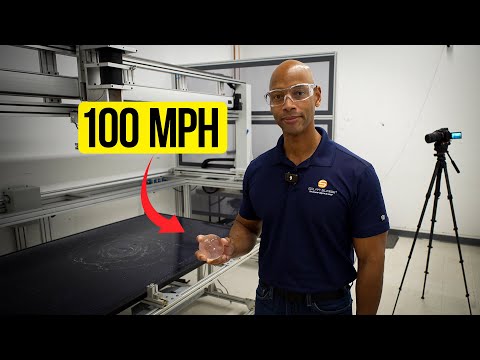
The hail impact test is mainly a qualification test. Mass production rarely repeats it, so ask for lot-level substitutes such as stress and fragmentation records.
A common baseline from IEC 61215 for ice balls:
| Ice ball diameter | Mass | Impact speed |
|---|---|---|
| 25 mm | 7.6 g | 23.0 m/s |
| 35 ملم | 20.7 g | 27.2 m/s |
| 45 mm | 43.9 g | 30.7 m/s |
C. Logistics and Packaging: Breakage in Transit and at the Site
| Checkpoint | What to specify |
|---|---|
| Packing | Edge protectors, corner guards, interleaving material between sheets |
| Crate type | Rated A-frame or crate, with load plan and tilt indicators |
| Moisture | Sealed or desiccant-protected packs for sea freight |
| Spare allowance | Typically 2–3% extra, from the same lot |
| Delivery inspection | Photos at the dock, written notes on the receipt, claim window of 48–72 hours |
| Breakage terms | A clear threshold, with the supplier or insurer covering excess |
D. Cost-Benefit Analysis: CAPEX vs. OPEX
CAPEX is the upfront purchase cost. OPEX is the running cost over the years, including cleaning and energy lost. Here is a worked example using the Phoenix numbers. The $2,000 premium is an assumption for illustration. Replace it with your quote.
| Line | Standard float glass | Low-iron, AR-coated glass |
|---|---|---|
| Glass premium (100 kW system) | $0 | $2,000 (assumed) |
| Extra annual energy | 0 kWh | 7,400 kWh |
| Extra annual revenue at $0.12/kWh | $0 | $888 |
| 25-year extra revenue, not discounted | $0 | $22,200 |
For a fuller model, see our EPC ROI guide for BIPV glass and our price and performance comparison of glass types.
VIII. Risk Mitigation in Procurement and Installation
A. Where Projects Fail Between Design and Site
Most glass problems do not come from bad physics. They come from small changes nobody tracked between the drawing, the purchase order, and the truck.
B. The Risk of “Spec-Drift” During Procurement
Spec-drift means the product delivered slowly differs from the product specified. A coating changes, a thickness tolerance widens, or a “same-spec” glass from another factory is swapped in.
Five controls stop most of it:
- Put exact build-up, thickness, tolerance, coating, and standards in the purchase order.
- Add a change-control clause: no change without written approval.
- Keep a sealed golden sample from the approved lot.
- Hire a third party for pre-shipment inspection.
- Re-test one random pane per lot on arrival.
C. Handling and Installation Guidelines to Avoid Micro-Cracks and Stress Fractures
A micro-crack is a hairline crack, often invisible, that can spread later. Fully tempered glass cannot be cut, drilled, or ground after treatment, so any on-site change risks the whole pane.

Glass installation on a construction site. Photo: Shixart1985, CC BY 2.0, via Wikimedia Commons.
Most installation breakage has a handful of repeat causes:
| Cause | What happens | Prevention |
|---|---|---|
| Edge contact with steel or concrete | Chip starts a crack | Edge guards, soft pads, vacuum lifters |
| Point loads from clamps or tools | Local stress breaks the pane | Torque-controlled clamps, correct setting blocks |
| No expansion room | Frame pinches glass as it heats | Follow the clearance in the shop drawings |
| Cold water on hot glass | Thermal shock | Let panes cool before cleaning |
| Stacking and sliding | Surface scratches and edge damage | Store upright on padded A-frames |
| Walking on glass | Cracks and hidden damage | Walk boards and clear no-walk marking |
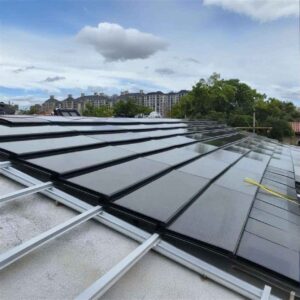
Glass solar panels on a commercial rooftop.
D. A Clear QA/QC Handover Between Supplier and General Contractor
QA (quality assurance) is the plan that prevents defects. QC (quality control) is the inspection that finds them. Write both into a simple sequence.
| Stage | Who | What is recorded |
|---|---|---|
| Factory acceptance | Supplier and buyer | Stress, thickness, and transmittance records |
| Pre-shipment inspection | Third party | Count, packing photos, sample test |
| Delivery | Site team | Breakage count, photos, signed receipt |
| التركيب | Glazing contractor | Torque logs, sealant batch numbers |
| Commissioning | Electrical contractor | Insulation resistance and string tests |
| Handover | General contractor | Spare stock, cleaning guide, warranty file |
Our guide on BIPV glass integration for specialized contractors covers the trade-by-trade split in more detail.
IX. Future Trends in Solar Glass Technology
A. Why Trends Matter to Today’s Spec
New materials solve today’s bottlenecks: low yield on facades, weight limits on old roofs, and glare or heat in glass buildings. Some are ready now. Others are still in pilots.
B. Bifacial Glass and Albedo-Based Energy Gains
A bifacial module collects light on both sides. Albedo is the share of sunlight a surface reflects. Grass reflects about 20%, concrete about 30%, a white roof membrane 60–70%, and fresh snow up to 80%.
| Ground surface | Approximate albedo | Typical rear-side gain |
|---|---|---|
| Dark roof or soil | 0.10–0.20 | Low, about 3–5% |
| Grass or concrete | 0.20–0.30 | About 5–10% |
| White membrane roof | 0.60–0.70 | Can exceed 15% with enough rear clearance |
| Snow | Up to 0.80 | Seasonal, can be high |
These are approximate. Real gain depends on mounting height, row spacing, and shading.
On most opaque facades, the back of the module faces insulation, so bifacial gain is small. It suits canopies, carports, balustrades, skylights, and elevated flat roofs.
C. Smart Glass and Electrochromic Layers
Electrochromic glass changes its tint when a small voltage is applied. Pairing it with PV could let one pane make power and control glare. Today this is mostly in pilots, and cost and joint warranties are the open questions. Jia Mao Bipv lists self-dimming materials among its R&D areas.
نظرة ثاقبة في المجال: Treat smart glass like a prototype in your spec. Ask for cycle-life data, and decide in advance who owns the warranty when two vendors’ products meet in one unit.
D. Ultra-Lightweight Glass for Weight-Constrained Roofing
Many older commercial roofs cannot take another 20 kg per square meter. Thinner glass is one answer. Glass weighs about 2.5 kg per square meter per millimeter, so you can estimate quickly.
Calculated at about 2.5 kg per m² per mm. Frames, cells, and interlayers add more.
The trade-off is strength. Thin glass needs careful heat treatment, edge quality, and often a stiffer frame.
X. Conclusion
A. Summary of the Tri-Factor Evaluation: Strength, Transmission, and Resistance
Strong glass protects people and keeps the facade intact. Clear glass pays you back in kWh every year. Resistant glass keeps both promises for 25 years. A supplier who can prove all three, lot after lot, is worth more than a lower quote.
B. Architectural Vision Meets Engineering Reality
The architect’s drawing and the engineer’s load table both need to win. That happens when you decide glass type, coating, and build-up together, at concept stage, and write them into the purchase order.
C. Your Next Steps
- Pick the application from the table in Section V and list the loads and code needs.
- Request samples from a normal production lot, and run the tests in Section VII.
- Verify certificates in the issuer’s database, and check they cover your exact model.
- Score each supplier with the weighted checklist.
- Lock the spec with change control, pre-shipment inspection, and a QA/QC handover plan.
Treating glass as a building material that happens to make power changes how you buy it. The shift is from “adding solar to a building” to “building with solar materials.”
If you want a second pair of eyes on a spec, contact the Jia Mao Bipv engineering team with your elevations, load requirements, and target transmittance. You can also browse our full product range before you call. For more on how solar glass differs from regular glazing, see solar glass versus traditional glass, and for a wider panel comparison see our guide to evaluating BIPV panel options. The types, features, and benefits of solar glass article is a good refresher on the basics.
Glossary: Key Terms in Plain English
| Term | Plain meaning | Example |
|---|---|---|
| BIPV | Solar that replaces a building material | A solar glass facade panel |
| Low-iron glass | Glass with very little iron, so it is clearer | 91–92% transmittance vs. about 84% |
| AR coating | Thin layer that cuts reflection | Adds about 2–3% to module output |
| Fully tempered | Heat-treated glass with high surface stress | Breaks into small cubes |
| Heat-strengthened | Heat-treated glass with medium stress | Breaks into larger pieces |
| زجاج مصفح | Two sheets bonded with a plastic interlayer | Pieces stay stuck after breakage |
| Nickel sulfide | Rare internal flaw in float glass | Can cause delayed breakage in tempered glass |
| Heat soak test | Factory test that breaks flawed panes early | Used on tall-building facades |
| SHGC | Share of sun heat that gets through | 0.25 blocks most solar heat |
| U-value | How fast heat leaks through | Lower is better |
| VLT | Share of visible daylight that passes | 0.5 means half |
| Albedo | Share of sunlight a surface reflects | White roof about 0.65 |
| Spec-drift | Delivered product slowly differs from the spec | A coating changes mid-order |
| CAPEX / OPEX | Upfront cost / running cost | Purchase price vs. cleaning and lost energy |
الأسئلة المتداولة
1. How do I determine if my project requires tempered or heat-strengthened solar glass?
Start with where the glass sits. For standard rooftop modules, fully tempered glass is the usual baseline. For facades, spandrels, and large formats, heat-strengthened glass in a laminated build-up is often better because it is flatter and has lower spontaneous breakage risk. For overhead glazing, many codes require laminated glass whichever heat treatment you choose. Check your local code and confirm the choice with the facade engineer.
2. What is the acceptable tolerance for light transmission loss over a 25-year period?
There is no single industry number. A practical target for the glass and coating is a total loss of no more than about 2–3% over 25 years, backed by accelerated test data. As a reference point, our BIPV transparent glass product page lists a 15-year optical clarity warranty with less than 5% degradation. Write your tolerance and the test method into the contract.
3. How does the choice of glass affect the overall U-value of a BIPV curtain wall?
The build-up affects it more than the cells do. A single laminated PV pane has a high U-value, roughly 5–6 W/m²K. An insulated unit with a low-e coating and gas fill can reach roughly 1.1–1.6 W/m²K. Ask for whole-unit U and SHGC values from a recognized test method.
4. Which anti-reflective coatings are most durable for high-pollution urban environments?
Look for coatings that come with abrasion and damp-heat data, and ask for field results from a similar site. Hard, dense coatings are usually more durable than very porous ones, but they may add a little less transmittance. Durability also depends on cleaning: use soft brushes and clean water, and avoid abrasive pads and strong solvents.
5. How can I verify if a supplier’s “high-transmission” claim is accurate through third-party testing?
Send samples from a random production lot, not a golden sample, to an independent lab. Ask for a spectrophotometer report across 380–1100 nm, weighted for the solar spectrum, with the measurement method named (for example ISO 9050 or EN 410). Compare the result with the claim, and repeat on a second lot.
6. What are the most common causes of glass failure in solar roofing, and how can they be avoided?
The usual causes are chipped edges, point loads from clamps, missing expansion room, hail above the rated size, nickel sulfide inclusions, and leaks at flashing. Avoid them with edge inspection, torque-controlled clamps, correct clearances, a hail rating that fits your climate, heat soak testing where needed, and a flashing detail agreed with the roofer before installation.
7. How do I balance the need for transparency (aesthetics) with the need for energy efficiency?
Split the facade into zones. Use opaque, full-power modules at spandrels and parapets where nobody needs daylight. Use semi-transparent glass only where you need views or daylight. For options, see our BIPV colored glass page and the IEA PVPS report on coloured BIPV, which explains why color and transparency reduce power.
8. What certifications should I insist upon for projects located in high-wind or seismic zones?
For wind, ask for IEC 61215 mechanical load results at or above your design pressure, plus a curtain wall test such as ASTM E330. In hurricane regions, add windborne debris testing (ASTM E1886 and E1996) and local approvals such as Miami-Dade requirements. For seismic zones, ask for drift testing, for example AAMA 501.6 or the seismic provisions of EN 13830. Always get stamped engineering calculations for the full assembly.
9. How does glass thickness impact the structural load calculations for an existing roof?
Glass adds about 2.5 kg per square meter per millimeter:
A 5 + 5 mm laminated build-up carries about 25 kg/m² in glass alone, while a 3.2 mm sheet carries about 8 kg/m². Add frames, cells, interlayers, and snow. Then ask a structural engineer to check the existing roof’s spare capacity.
10. What is the industry standard for acceptable breakage rates during the shipping of solar glass?
There is no universal published standard. Buyers usually set a threshold in the purchase order, often a fraction of one percent, and cover the rest through cargo insurance and a 2–3% spare allowance. Ask for a packing specification, inspect at delivery, and photograph damage before anything is moved.
11. How do I evaluate the compatibility of solar glass with various curtain wall sealant types?
Ask the sealant manufacturer to test their product against your exact laminate: the PVB or EVA interlayer, the edge seal, and any coating. ASTM C1087 is the usual method for structural glazing accessories. Get a written compatibility letter, use neutral-cure silicone where required, and run a small adhesion and staining mock-up before full installation.
12. In what scenarios should I prioritize bifacial glass over monofacial glass for construction?
Choose bifacial glass when the back side can see light: elevated flat roofs with white membranes, carports, canopies, balustrades, skylights, and snowy sites. Avoid it where the back faces insulation or a dark roof surface, such as most opaque facades and roof-hugging BIPV. In those cases the extra cost rarely pays back.