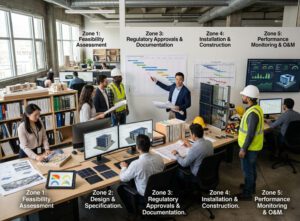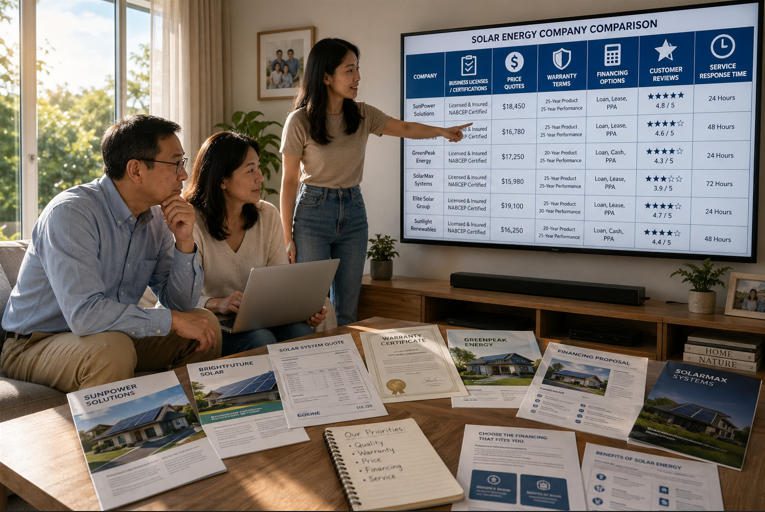

Choosing a solar energy company is one of the highest-impact decisions in a solar project. Panel wattage and price matter, but the company behind the proposal determines whether the system is sized correctly, permitted smoothly, installed safely, monitored properly, and supported years after the sales team has moved on.
This guide explains how to evaluate solar providers step by step: your own energy needs, local installer networks, credentials, financing, equipment warranties, installation process, customer service, reviews, quotes, and final decision criteria.
The common pitfalls are predictable. Homeowners and facility managers often compare only price per watt, ignore roof condition, accept production estimates without checking assumptions, or sign long-term leases without understanding transfer terms. Those upfront decisions affect 20+ years of performance, savings, maintenance, and resale flexibility.
The U.S. Federal Trade Commission advises buyers to compare detailed bids, review costs and warranties in writing, and avoid companies that pressure customers into quick decisions or cash payments. Its consumer guidance on solar power for your home is worth reading before signing any proposal.
Understand Your Solar Needs
Assess energy consumption patterns and goals
Before contacting installers, collect at least 12 months of utility bills. Look at total kilowatt-hours, seasonal peaks, fixed charges, demand charges if applicable, and time-of-use rates. A household with daytime EV charging has a different solar profile from a family that uses most electricity after sunset. A commercial building with HVAC peaks may need a different design from a warehouse with steady refrigeration loads.
Define your goal clearly:
- Bill reduction: You want the strongest savings under local utility rules.
- Energy independence: You may need battery storage or backup-ready design.
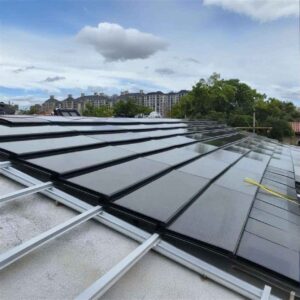
- Roof aesthetics: You may prefer all-black modules, roof-integrated solar, or BIPV products.
- Carbon reduction: You want documented renewable generation for ESG reporting.
- New construction integration: You want solar planned with roofing, facades, canopies, or glazing.
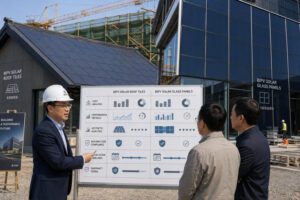
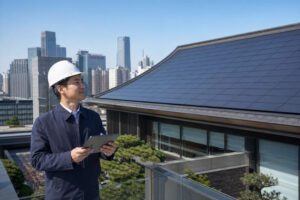
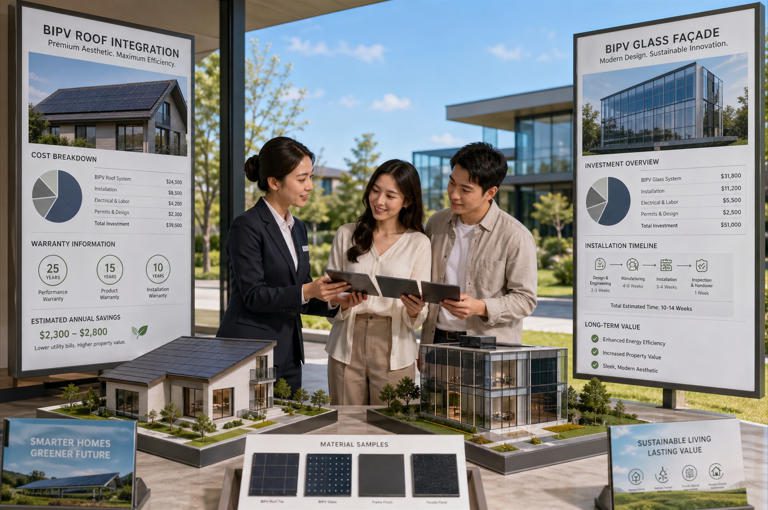
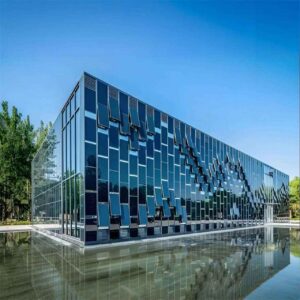
If the project involves building-integrated photovoltaics, solar roof tiles, or photovoltaic glass, equipment selection should begin earlier than a conventional rooftop PV project. Jia Mao Bipv, for example, works in project categories where solar can become part of the roof or building envelope rather than a rack-mounted add-on. Reviewing Jia Mao Bipv solar building solutions can help owners and designers understand when standard PV is enough and when integrated solar materials should be considered.
Determine system size, type: grid-tied, off-grid, or hybrid, and location considerations
A solar energy company should size the system using your annual usage, roof area, shade profile, local weather data, utility rules, and future load changes. Ask whether the design assumes future EV charging, heat pumps, battery storage, pool equipment, or business expansion.
Most projects fall into three system types:
- Grid-tied solar: Connected to the utility grid. Usually the simplest and most common option where net metering or export compensation is available.
- Off-grid solar: Designed to operate independently from the utility. Requires careful battery and backup generator planning.
- Hybrid solar: Grid-connected solar with battery storage for backup, load shifting, or demand management.
Location matters. A shaded roof, aging roof covering, strict HOA, historic district, coastal corrosion zone, heavy snow area, or high-wind region changes the correct equipment and installation approach. A credible installer should discuss these constraints before promising a payback number.

Budgeting and expected return on investment
Set a realistic budget range before requesting proposals. The lowest cash price is not always the lowest total cost. A weak design can reduce annual production; poor workmanship can lead to roof repairs; unclear warranties can make future service expensive.
For ROI, compare:
- Installed cost after incentives, if applicable.
- Estimated first-year production in kWh.
- Electricity rate escalation assumptions.
- System degradation assumptions.
- Inverter replacement expectations.
- Maintenance and monitoring costs.
- Loan interest, dealer fees, or lease escalators.
Use independent tools to challenge assumptions. The NREL PVWatts Calculator estimates grid-connected PV energy production using location and system inputs. It is not a replacement for a bankable engineering study, but it is useful for spotting quotes that appear too optimistic.
Research Local Solar Providers
Geographic relevance and installer networks
Solar is local. A company with strong experience in one region may not understand another region’s utility paperwork, snow loads, hurricane requirements, roof materials, fire setbacks, or inspection practices. Prioritize installers that can show completed projects in your service territory.
Ask about:
- Local utility interconnection experience.
- City or county permitting history.
- Experience with your roof type: asphalt shingle, tile, metal, flat membrane, slate, or standing seam.
- Local service crews instead of only subcontracted sales teams.
- Response time for warranty and troubleshooting calls.
For commercial or architectural projects, look for companies that can coordinate with general contractors, roofers, facade consultants, and electrical engineers. If the project includes solar roofing or BIPV, the installer may need to coordinate with manufacturers such as Jia Mao Bipv earlier in design development.
Initial narrowing criteria: experience, licenses, and local permits
Start with a shortlist of three to five companies. Eliminate providers that cannot prove licensing, insurance, recent local installations, and a clear permitting process. Also be cautious with companies that outsource every critical step: sales, design, engineering, permitting, installation, and service.
A strong initial screen includes:
- Years in business under the same legal entity.
- State contractor license and electrical license where required.
- General liability and workers’ compensation insurance.
- Local references from the past 12–24 months.
- Clear explanation of who performs the installation.
- Written permit and inspection responsibility.
Bar chart: practical weight of installer selection criteria
0%
20%
40%
60%
80%
100%
88%
License & safety
83%
Design quality
78%
Warranty clarity
68%
Local references
53%
Lowest price
Planning note: Weighting is illustrative, but it reflects a practical reality: licensing, safety, design accuracy, and warranty support usually deserve more attention than headline price.
Verify Credentials and Certifications
Necessary licenses and bonding
Licensing requirements vary by location, but the installer should be able to explain exactly which licenses apply to your project. In many regions, solar installation may require an electrical contractor license, home improvement contractor license, roofing license, or specialized solar license.
Verify credentials directly with the issuing authority. Do not rely only on a logo in a proposal. Ask for license numbers, insurance certificates, and bond information. If subcontractors are used, ask for their license and insurance documents as well.
Important documents to request include:
- Business license and contractor license.
- Electrical license where required.
- Roofing license if the company performs roof penetrations or roof replacement.
- General liability insurance certificate.
- Workers’ compensation coverage.
- Bonding information where applicable.
Industry certifications: NABCEP or regional equivalents
Certifications do not replace local licensing, but they help show technical training. In North America, NABCEP is one of the most recognized solar credentialing organizations. NABCEP states that its board certifications are developed for renewable energy professionals and are built around rigorous standards. You can review the organization’s NABCEP certification programs when evaluating installer qualifications.
Outside North America, look for regional equivalents, manufacturer training records, utility-approved installer lists, or professional electrical qualifications. For BIPV or solar glass work, also ask for roofing, facade, glazing, or curtain wall experience where relevant.

Compare Financial Options
Purchase vs. loan vs. lease vs. PPA
The financing model affects ownership, savings, maintenance responsibility, tax incentives, resale flexibility, and contract risk. The FTC explains that residential buyers commonly choose between buying a system, leasing a system, or signing a power purchase agreement.
| Option | Who owns the system? | Upfront cost | Incentive access | Best fit | Watch-outs |
|---|---|---|---|---|---|
| Cash purchase | Homeowner or building owner | Highest upfront | Owner may claim eligible incentives | Buyers seeking maximum long-term savings and control | Requires capital and responsibility for maintenance after installer warranties |
| Solar loan | Usually homeowner or building owner | Low to moderate upfront | Owner may claim eligible incentives | Buyers who want ownership but prefer monthly payments | Check APR, dealer fees, lien terms, prepayment rules, and total interest |
| Lease | Third-party provider | Often low upfront | Usually system owner claims incentives | Buyers wanting predictable payments and third-party maintenance | Escalators, transfer terms, roof repair terms, and early termination fees |
| Power purchase agreement | Third-party provider | Often low upfront | Usually system owner claims incentives | Buyers who want to buy solar energy instead of owning equipment | Long contract term, kWh price escalation, minimum production language |
Financing terms, incentives, and tax benefits
Financing terms can make two identical system prices very different. Ask for the cash price and financed price separately. Some loan offers include dealer fees that raise the installed price even if the advertised interest rate looks low.
Ask every provider:
- What is the cash price?
- What is the financed price?
- What is the APR?
- Are there dealer fees or origination fees?
- Is there a lien on the property or equipment?
- Can the loan be prepaid without penalty?
- Who receives tax credits, rebates, renewable energy certificates, or other benefits?
In the United States, tax rules change, and eligibility depends on the placed-in-service date and property type. The IRS explains qualified expenses and timing for the Residential Clean Energy Credit. Always verify current rules with a tax professional before relying on incentives in an ROI calculation.
For state and local programs, check the DSIRE renewable incentives database and confirm details with the program administrator.
Pie chart: what commonly drives total solar project cost
التكلفة
structure
Modules and inverters: 35%
Labor and installation: 30%
Permits, design, engineering: 15%
Racking, wiring, BOS: 12%
Sales, admin, monitoring: 8%
ملاحظة: Cost allocations are illustrative. Roof repair, battery storage, main panel upgrades, trenching, or BIPV products can shift the mix substantially.
Review Equipment Quality and Warranties
Panel and inverter brands, efficiency ratings, and degradation warranties
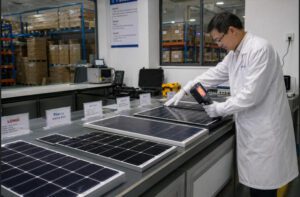
Equipment quality should be compared through datasheets, warranty language, third-party certifications, and real-world suitability. A premium module may be worth the price on a space-limited roof. On a large commercial roof with ample area, a mid-range module from a stable manufacturer may produce better ROI.
Compare these equipment factors:
- Module efficiency and wattage.
- Power tolerance.
- Temperature coefficient.
- First-year and annual degradation warranty.
- Product warranty length and exclusions.
- Inverter warranty and replacement cost.
- Compatibility with batteries or EV chargers.
- Monitoring platform ownership and data access.
For buyers with limited roof area, high-efficiency solar panels for residential and commercial rooftops may be worth evaluating because higher output per square meter can reduce the number of modules needed. Jia Mao Bipv lists N-type monocrystalline options in the 445–465 W range with a stated 23.3% peak efficiency, which is the type of datasheet-level detail buyers should request from any supplier before comparing offers.
System warranties, workmanship guarantees, and monitoring options
A complete solar proposal should separate equipment warranties from workmanship warranties. Panel manufacturers typically cover product defects and power output. Inverter manufacturers cover inverter hardware. The installer covers workmanship: roof penetrations, mounting, wiring, labeling, and installation quality.
Ask each company:
- Who handles warranty claims if the panel manufacturer is overseas?
- How long is the workmanship warranty?
- Does the roof penetration warranty match or conflict with the roof warranty?
- Is monitoring included, and who actively watches alerts?
- What happens if production falls below the estimate?
- Is there a written performance guarantee or only a modeled estimate?

Assess Installation Process and Scheduling
Project timeline, permitting, and inspection milestones
A professional solar company should explain the timeline in milestones, not vague promises. Typical steps include site survey, final design, engineering review, permit submission, utility application, equipment procurement, installation, inspection, utility permission to operate, monitoring setup, and customer handover.
Ask for realistic durations for each step. Installation itself may take only one to three days for many residential projects, but permitting and utility approval can take weeks or longer depending on the jurisdiction.
A clear timeline should identify:
- Who submits permits.
- Who coordinates with the utility.
- When equipment is ordered.
- When roof or electrical upgrades must be completed.
- What inspections are required.
- When the system can legally be turned on.
Site assessment, roof compatibility, and safety practices
A proper site assessment includes roof age, roof structure, attic access, shading, electrical service, main panel capacity, grounding, conduit routing, fire setbacks, and safe access. If the roof needs replacement within five years, solve that before installing solar.
For BIPV, solar roof tiles, or photovoltaic glass, the site assessment becomes more detailed because the solar product may replace part of the roof or facade. In those cases, review BIPV solar installation planning to understand why waterproofing, thermal movement, and envelope coordination must be resolved before electrical routing is finalized.
Safety practices should include fall protection, electrical lockout procedures, fire-code compliance, conduit protection, and weather-aware installation scheduling.
Evaluate Customer Service and Support
Responsiveness, communication cadence, and after-sales service
The sales process often shows how the service process will feel later. Track how quickly each company answers technical questions, corrects proposal errors, explains assumptions, and follows up without pressure.
Good communication includes:
- A named project manager after contract signing.
- Written milestone updates.
- Clear contact channel for permitting, installation, and service.
- Transparent explanation of delays.
- Monitoring setup and owner training after commissioning.
After-sales support matters because most solar systems last far longer than the sales relationship. Ask whether the company has a dedicated service department or only installation crews. Ask how service requests are prioritized and how warranty labor is billed.
Read Customer Reviews and Testimonials
Analyzing reviews across multiple platforms
Read reviews across several platforms: Google, Better Business Bureau, local consumer agencies, solar marketplaces, neighborhood groups, and contractor licensing boards. Do not focus only on star rating. Look for patterns in project management, communication, schedule accuracy, roof leaks, failed inspections, monitoring problems, and warranty responsiveness.
Strong review signals include:
- Customers mention specific employees and project milestones.
- The company responds professionally to negative reviews.
- Reviews include post-install experiences, not only sales praise.
- Customers report successful inspections and utility activation.
- Commercial references can describe production and service history.
Red flags and how to verify claims with references
Red flags include high-pressure sales, “free solar” claims, unrealistic utility escalation assumptions, refusal to provide cash price, vague equipment models, missing warranties, and promises that incentives are guaranteed without explaining eligibility.
Ask for references from customers with similar systems. For example, if you have a tile roof, ask for tile-roof references. If you need battery backup, ask for battery projects. If you are considering BIPV, ask for integrated roof or facade examples.
Get Multiple Quotes and Use a Request for Proposal
Standardizing quotes for apples-to-apples comparison
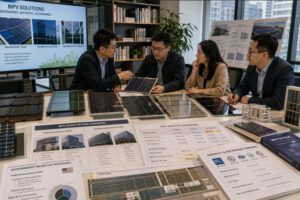
Get at least three detailed quotes. To compare them fairly, standardize the requested information. Do not let one company quote a cash system, another quote a financed system, and another quote a lease without separating ownership and finance assumptions.
| Quote item | Company A | Company B | Company C | Why it matters |
|---|---|---|---|---|
| System size, kW DC and kW AC | Reveals DC/AC ratio and inverter sizing strategy | |||
| Estimated annual production, kWh | Core savings driver; check against PVWatts or third-party modeling | |||
| Module model and quantity | Prevents vague “premium panel” claims | |||
| Inverter or optimizer model | Affects monitoring, shading behavior, warranty, and battery readiness | |||
| Cash price before incentives | Needed to compare financing honestly | |||
| Financed price and APR | Dealer fees can make low-interest offers more expensive | |||
| Workmanship warranty | Protects against installation defects | |||
| Roof penetration warranty | Critical for long-term roof risk | |||
| Monitoring and service terms | Defines who detects and responds to performance issues |
Asking the right questions in proposals: maintenance and performance guarantees
Every RFP should ask direct questions that expose risk:
- What production estimate method did you use?
- What shading assumptions are included?
- What happens if production is lower than estimated?
- Who monitors the system after installation?
- How often should the system be cleaned or inspected?
- What roof work is excluded?
- What electrical upgrades are excluded?
- Who pays for removing and reinstalling panels if roof repairs are needed?
- What happens if the installer goes out of business?
Make Your Final Decision and Next Steps
Scoring rubric and decision criteria
Use a scoring rubric instead of relying on instinct after several sales calls. A simple 100-point model can keep the decision grounded.
- Licensing, insurance, and safety: 20 points
- System design accuracy: 20 points
- Equipment and warranties: 15 points
- Financial transparency: 15 points
- Local references and reviews: 10 points
- Installation schedule and project management: 10 points
- After-sales support and monitoring: 10 points
Do not award a contract until the company has provided final equipment models, final layout, financing terms, warranties, exclusions, permit responsibility, and utility interconnection responsibility in writing.
How to prepare for signing, installation, and post-install follow-up
Before signing, save copies of the proposal, contract, site layout, datasheets, warranties, production estimate, financing documents, and incentive assumptions. Confirm cancellation rights and construction start conditions.
Before installation, clear access to the attic, electrical panel, roof area, driveway, and any planned equipment locations. After installation, request as-built drawings, inspection approval, monitoring login, inverter documentation, emergency shutdown instructions, and warranty contacts.
Related video: using PVWatts to check solar production estimates
The video below is useful when comparing installer proposals because it explains how to use PVWatts-style production estimates. It helps buyers ask better questions when a quote promises unusually high annual output.
The right solar energy company is the one that can prove its work before, during, and after installation. Key decision factors include your energy goals, local experience, licenses, certifications, financing transparency, equipment quality, warranty clarity, installation process, customer support, and verified reviews.
Create a personalized shortlist, request standardized quotes, use independent tools to sanity-check production estimates, and set realistic timelines for permitting, inspection, and utility approval. Do not let a salesperson rush a decision that will sit on your roof or building for decades.
Finally, verify warranties and post-install support before signing. A solar project does not end when panels are installed; it becomes valuable when the system is producing, monitored, documented, and supported. For projects involving high-efficiency modules, BIPV, solar roof tiles, or photovoltaic glass, include manufacturers and technical suppliers such as Jia Mao Bipv early enough to avoid redesign, compatibility issues, or unclear service responsibility.
FAQs
What is the most important factor when choosing a solar installer?
The most important factor is proven execution quality: valid licensing, local installation experience, accurate system design, safe workmanship, clear warranties, and responsive post-install support. Price matters, but a low bid can become expensive if the system is poorly designed or unsupported.
How do I compare solar quotes effectively?
Compare quotes using the same categories: system size, annual production estimate, panel model, inverter model, cash price, financed price, warranty terms, roof work, electrical upgrades, monitoring, and maintenance. Ask each company to explain assumptions in writing.
How long does installation typically take and what should I expect during the process?
The physical installation for many residential systems may take one to three days, but the full project often takes longer because of design, permitting, utility interconnection, inspection, and permission to operate. Commercial, battery, roof replacement, or BIPV projects usually require more coordination.
Should I choose the solar company with the lowest price?
Not automatically. Compare the lowest price against equipment quality, production assumptions, workmanship warranty, roof protection, local references, financing terms, and service response. A slightly higher bid may produce better lifetime value if it reduces performance and warranty risk.
What certifications should a solar company have?
At minimum, the company should hold all required local contractor and electrical licenses. NABCEP certification or regional equivalents can provide additional confidence that personnel have solar-specific training, but certification should be verified directly with the issuing organization.
What questions should I ask before signing a solar contract?
Ask who owns the system, who gets incentives, what equipment will be installed, what annual output is expected, who handles permits, what warranties apply, who monitors the system, what exclusions exist, and what happens if the roof needs repair later.
How can I verify whether a solar company is reputable?
Check licenses with the relevant authority, review insurance certificates, read customer feedback across multiple platforms, ask for recent local references, verify business history, and confirm whether the company has a dedicated service department.
Is it better to buy, finance, lease, or sign a PPA?
Buying or financing usually provides more control and may allow the owner to claim eligible incentives. Leases and PPAs can reduce upfront cost but often transfer incentives to the system owner and may affect resale. The best option depends on cash flow, tax situation, risk tolerance, and how long you plan to keep the property.


-300x300.jpg)