Commercial Solar Panel Companies: Buyer Due Diligence

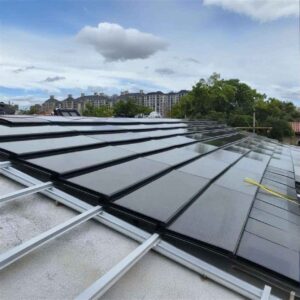
Barnstable Airport rooftop solar installation. Illustrative photograph—not a Jia Mao Bipv project. Source: Barnstable Airport solar photograph on Wikimedia Commons, listed as a Massachusetts public-domain government work.
Thesis Statement
Choosing the right commercial solar panel company means checking more than equipment price. Contractors and architects need clear service boundaries, usable warranties, and transparent proposals to protect the project’s schedule, budget, and long-term performance.
Two solar companies quote the same building. Both offer similar installed capacity. One price is lower.
Then the exclusions appear.
Roof repairs are outside the contract. Utility upgrades are provisional. Monitoring is included, but fault investigation costs extra. The “25-year warranty” covers panel output—not replacement labor.
For roofing and curtain-wall contractors, photovoltaic EPCs, building-material distributors, and design institutes, these gaps can become someone else’s unfinished work.
A commercial solar panel company may be a manufacturer, distributor, installation contractor, EPC, or energy service provider. These roles are not interchangeable.
EPC means engineering, procurement, and construction. An EPC typically coordinates design, equipment purchasing, and installation. A manufacturer supplies products but may not take responsibility for the complete site installation.
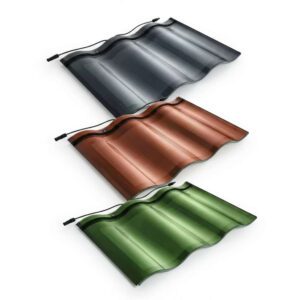
This distinction matters even more with building-integrated photovoltaics, or BIPV: solar products that also function as building materials, such as roof coverings or façade glass.
The Jia Mao Bipv manufacturer and product overview describes a building-material supply role. Buyers should still define who owns structural design, weatherproofing, electrical installation, and local approvals.
The following comparison focuses on three decisions:
- Does the company’s service scope match your project?
- Will its warranty and support arrangements work when something fails?
- Does the proposal explain costs and risks clearly?
1. Service Scope Comparison
A thorough understanding of service scope is essential for effective project planning.
“Turnkey solar” is not a precise contract description. It can mean anything from delivering equipment to handing over an operating system with permits, monitoring, and maintenance.
Start by identifying the provider’s role
| Provider type | Typical role | What the buyer must clarify |
|---|---|---|
| Manufacturer | Makes modules or BIPV products and provides product documents | Who handles site design, installation, warranty administration, and local compliance? |
| Distributor | Supplies equipment and may support product selection | Who holds the warranty relationship and replacement inventory? |
| Installation contractor | Installs equipment under an agreed design | Are engineering, roof work, permits, and utility applications included? |
| EPC contractor | Coordinates engineering, purchasing, and construction | Which risks remain with the owner or general contractor? |
| Energy service provider | May combine development, financing, operation, and energy services | Who owns the system, building interfaces, data, and long-term obligations? |
These are common role descriptions, not guarantees. The signed scope takes priority over the company’s label.
What published company services actually show
Different providers emphasize different capabilities.
| Company | Published service emphasis | Procurement implication |
|---|---|---|
| Ameresco | Solar development, engineering, construction, financing, ownership options, monitoring, and maintenance | Useful when assessing a broader energy-infrastructure package; confirm the contracted local team |
| PowerFlex | Commercial solar EPC, monitoring, asset management, and coordination with batteries, EV charging, and building loads | Check whether the proposed package includes active energy control or only visibility |
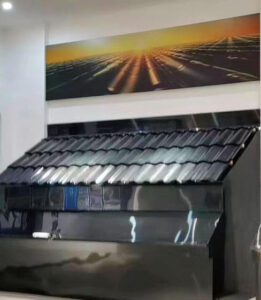
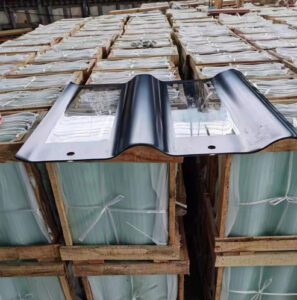
| Jia Mao Bipv | BIPV manufacturing and supply, including solar roofing and photovoltaic glass | Useful for product and building-envelope selection; define installation and project-level responsibilities separately |
Ameresco’s published solar infrastructure services include ongoing monitoring, maintenance dispatch, and annual testing and recommissioning.
PowerFlex’s commercial solar and energy-management offering describes engineering, procurement, construction, monitoring, and coordination across energy assets.
These are descriptions of advertised capabilities—not independent rankings or confirmation that every service is included in every bid.
Build a responsibility matrix before comparing price
Ask each bidder to mark every item as included, excluded, allowance, or owner responsibility.
| Work package | Evidence required | Why it matters |
|---|---|---|
| Site survey | Roof condition, access, dimensions, and electrical survey | Prevents design based only on aerial images |
| Structural review | Signed calculations where required | Confirms loads and mounting suitability |
| Building-envelope work | Flashing, drainage, sealant, and interface details | Reduces disputes over leaks |
| Electrical engineering | Layout, protection, cable sizing, and connection design | Establishes a safe, coordinated system |
| Permits and utility approval | Named applicant and fee allocation | Avoids gaps between installation and operation |
| Procurement | Approved models, delivery dates, and substitution rules | Protects specification and schedule |
| Commissioning | Test plan and acceptance records | Confirms readiness for handover |
| Monitoring and maintenance | Alarm ownership, visits, reporting, and response process | Turns data into action |
| Energy management | Control functions, licenses, and integration scope | Distinguishes savings control from a dashboard |
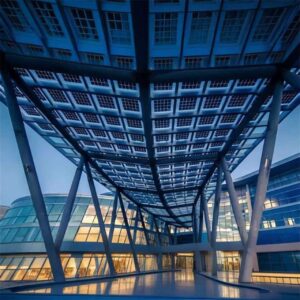
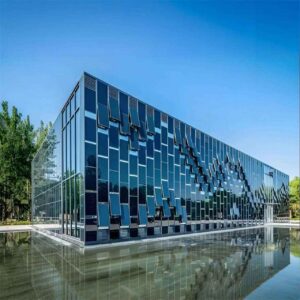
For façade packages, review the photovoltaic glass product category alongside the curtain-wall specification. Solar glass selection must be coordinated with structural support, safety glazing, drainage, and electrical access.
Industry insight: A product can sit inside both the façade package and the electrical package. If neither contractor owns the interface, the general contractor often inherits the problem.
Monitoring is not the same as energy management
Monitoring shows what the system is doing. Energy management uses data and controls to change how energy assets operate.
For example:
- A dashboard reports that solar generation is high.
- An energy-management system may use that signal to charge a battery or adjust EV charging.
- A maintenance team investigates an inverter alarm and restores operation.
Ask for a demonstration using a specific scenario: “What happens when one inverter stops at noon?”
PowerFlex’s explanation of solar operations, maintenance, and asset management separates monitoring, corrective work, preventive maintenance, and administrative services. It also identifies a maintenance partner, showing why buyers should ask who performs the field work.
Compare milestones—not one completion date
A useful schedule separates:
- Design approval.
- Permit and utility application.
- Equipment release and delivery.
- Roof or façade readiness.
- Installation.
- Commissioning and inspection.
- Utility permission to operate.
- Final documentation and training.
A system may be installed but unable to export electricity. Likewise, a façade may be weather-tight before its solar circuits are commissioned.
Industry insight: Ask bidders to identify which milestones they control. Utility approval should not be presented as a fixed contractor-controlled date.

Commercial rooftop example. Photo: Jaggery, Sugarbox rooftop solar photograph, licensed under Creative Commons Attribution-ShareAlike 2.0. Image unchanged.
2. Warranty and Support Considerations
Warranties and support affect the value of a solar installation long after handover.
A long warranty is useful only if the failed item is covered, the claim is accepted, and someone can complete the repair.
Separate the warranty layers
| Warranty or agreement | What it generally addresses | What needs separate confirmation |
|---|---|---|
| Module product warranty | Defects in materials or manufacture | Labor, transport, access equipment, and exclusions |
| Module performance warranty | A minimum retained power rating over time | Whole-system generation and electricity savings |
| Inverter warranty | Covered inverter defects | Duration, replacement logistics, labor, and extensions |
| Installation workmanship warranty | Defined installation defects | Roof damage, subcontractor work, and claim limits |
| Roofing or façade warranty | Defined weatherproofing or envelope obligations | Solar interfaces and repair responsibility |
| Maintenance service agreement | Specified inspections and response services | Parts, cleaning, corrective labor, and restoration deadlines |
A panel performance warranty is not an annual energy guarantee.
It generally concerns the module’s retained rated power under defined conditions. Annual building-level generation also depends on weather, shading, equipment availability, and system design.
A commercial warranty can differ from a residential headline
REC’s U.S. ProTrust page provides a clear example:
- Eligible installations up to 25 kW can receive 25-year product, performance, and labor coverage.
- Eligible systems between 25 and 500 kW can receive 25-year product and performance coverage, but 10-year labor coverage.
The REC ProTrust warranty conditions also tie eligibility to REC Certified Solar Professional installers.
A buyer planning a 300 kW installation should therefore not assume that a “25-year labor warranty” headline applies.
Qcells provides another example of model-specific terms. Its published Q.PEAK DUO M-G11 datasheet lists 12-year product and 25-year linear performance warranties.
Check the Qcells model-specific warranty specification against the exact product offered. Warranty terms can differ across a manufacturer’s range and sales regions.
Industry insight: The warranty document must match the model, destination country, project size, installer status, and purchase date. A brochure headline is not enough.
Ask who pays to reach the failed component
Suppose a module fails above a busy loading area.
Even if the replacement module is covered, the repair may require:
- A lift or scaffold.
- Traffic management.
- Electrical isolation.
- Removal and reinstallation labor.
- Transport and disposal.
- Roof protection.
On a BIPV façade, replacement may also require glazing crews and temporary weather protection.
Ask the provider:
“For one covered failure at this location, list every cost paid by the warranty provider and every cost paid by the buyer.”
For the Jia Mao Bipv BIPV product portfolio, request separate product, power-output, and project-interface documents. Do not treat a manufacturer’s power warranty as a complete roof or façade warranty.
Write support expectations into the contract
A service-level agreement, or SLA, sets measurable service commitments.
It should distinguish:
- Alarm review.
- Customer acknowledgement.
- Remote diagnosis.
- Site attendance.
- Temporary workaround.
- Full restoration.
For example, a buyer might request next-business-day acknowledgement for a noncritical fault and faster triage for a major outage. These are negotiated requirements—not universal industry standards.
Also confirm:
- Support hours and time zone.
- Local field-service coverage.
- Named escalation contacts.
- Spare-parts arrangements.
- Warranty claim ownership.
- Access to monitoring data after the service contract ends.
The laboratory report Best Practices for PV and Energy Storage Operations and Maintenance is a useful reference when preparing maintenance scope and documentation requirements.
Video: Questions about maintenance and warranties
Pivot Energy’s TOP 5 Tips for Your Commercial Solar Maintenance and Warranty discusses practical commercial maintenance and roof-warranty questions.
Use it to prepare bidder questions—not as a substitute for your project’s contract terms.
https://www.youtube.com/watch?v=H8PZKBJtnZI

An inverter converts solar-generated direct current into alternating current used by buildings. Photo: Asurnipal, photovoltaic inverter equipment photograph, licensed under Creative Commons Attribution-ShareAlike 4.0. Image unchanged.
3. Red Flags in Proposals
Identifying proposal red flags can prevent costly mistakes before the contract is signed.
A red flag does not automatically prove misconduct. It identifies information that needs correction or verification.
Ten proposal gaps worth challenging
| Red flag | Commercial risk | What to request |
|---|---|---|
| “Complete turnkey system” without a scope schedule | Missing work becomes a variation | Itemized inclusions and exclusions |
| No confirmed module or inverter models | Equipment can change after approval | Model list and substitution process |
| Savings based only on annual electricity use | Solar output may not match demand | Interval-use analysis and tariff assumptions |
| No shading or loss assumptions | Production estimate may be overstated | Energy-model inputs and loss breakdown |
| “25-year warranty” without documents | Coverage may apply to only one component | Model- and market-specific warranty terms |
| One vague completion date | Installation and grid approval are confused | Milestone schedule and dependencies |
| Missing licenses or insurance evidence | Compliance and liability are unclear | Current, independently verifiable records |
| Large advance payment without safeguards | Buyer carries delivery risk | Milestone payments and suitable security |
| No commissioning or handover package | Fault tracing becomes difficult | Test records, drawings, serial numbers, and training |
| Unpriced monitoring or software renewal | Operating costs rise later | Full subscription and data-access terms |
Test the energy estimate
A proposal should identify:
- kW DC: Rated panel capacity on the direct-current side.
- kW AC: Inverter capacity on the alternating-current side.
- kWh: Electricity generated over a period.
- Weather data and orientation.
- Shading, temperature, soiling, and electrical losses.
- Export restrictions.
- Expected equipment availability.
Installation methods usually affect system energy yield, not the panel’s laboratory efficiency rating.
For example, poor ventilation can raise operating temperature. A different mounting angle can change solar exposure. Cable design and inverter sizing can change losses.
A simple sensitivity check helps expose financial risk:
If a proposal assumes 700,000 kWh per year, a 4% shortfall equals 28,000 kWh. At an assumed avoided tariff of $0.15/kWh, that represents $4,200 per year—if all of that electricity would otherwise have been used on site.
This is an illustrative calculation, not a measured project result.
Verify qualifications independently
Check the contracting company and the people assigned to the project.
For U.S. work, the NABCEP professional certification directory can help verify individual solar credentials. A professional certification does not replace the licenses required by local authorities.
For equipment, request relevant certificates and verify the exact product model. UL Solutions’ photovoltaic module testing and certification overview distinguishes safety and performance-related testing.
Common standards include:
- IEC 61215: Design qualification testing for PV modules.
- IEC 61730: PV module safety qualification.
- Applicable local electrical and building requirements.
BIPV may need additional evidence for glazing, roofing, fire performance, weather resistance, and structural use.
Industry insight: A certificate for a standard panel does not automatically cover a custom glass size, different laminate, or complete façade assembly.
Check financial strength and delivery capacity
Ask for evidence suited to the contract size:
- Recent financial statements or other credible financial information.
- Comparable completed-project references.
- Current insurance from the insurer or broker.
- Equipment orders and delivery commitments.
- Subcontractor responsibilities.
- Performance security where appropriate.
- A plan for claims if the original installer closes.
Contact reference customers and ask specific questions: Were variations justified? Was handover complete? How quickly were defects resolved?
Use a weighted review after mandatory checks
Safety, legal compliance, and essential scope should be pass/fail gates. Do not allow a low price to compensate for missing licenses or unacceptable structural design.
After those gates are passed, a suggested evaluation worksheet is:
| Evaluation category | Suggested weight | Evidence |
|---|---|---|
| Service scope and responsibility | 30% | Scope schedule and responsibility matrix |
| Warranty and support | 20% | Warranty documents and service plan |
| Technical design | 20% | Engineering review and energy model |
| Delivery plan | 15% | Milestones and supply commitments |
| Financial strength | 10% | Financial evidence and safeguards |
| Price | 5% | Matched-scope commercial comparison |
| Total | 100% |
Suggested starting weights—not an industry standard or survey result. Adjust them to your procurement rules and project priorities.
Apply mandatory compliance checks before using a weighted score.
Short Procurement Glossary
| Term | Plain-language definition | Example |
|---|---|---|
| Availability | How often equipment is capable of operating under the contract’s definition | An inverter fault reduces availability until repair |
| Degradation | Gradual reduction in module power over time | A financial model allows output to decline |
| Commissioning | Tests and checks before operational handover | Confirming wiring, protection, monitoring, and safe operation |
| Performance guarantee | A contractual promise with defined measurement rules and remedies | Compensation for an agreed, attributable shortfall |
| Variation | A change to the agreed work or price | Additional roof reinforcement after a survey |
| Total cost of ownership | Purchase and operating costs across a stated period | Equipment, service fees, repairs, and access costs |
Counterargument
Some buyers argue that initial cost should be the main deciding factor.
That view is reasonable when bids have the same scope, compliant designs, comparable energy estimates, and similar risk allocation. Paying more does not automatically buy better service.
The problem is comparing unequal packages.
An illustrative ten-year cost comparison
Assume two hypothetical bids provide the same usable system and expected generation.
| Buyer-paid cost item | Bid A: Lower headline price | Bid B: Broader included scope |
|---|---|---|
| Quoted installation price | $600,000 | $630,000 |
| Required work excluded from quotation | $40,000 | $0 |
| Ten-year maintenance and software budget | $70,000 | $50,000 |
| Allowance for uncovered repairs and access | $25,000 | $15,000 |
| Ten-year combined cost | $735,000 | $695,000 |
All figures are illustrative assumptions—not market averages or supplier quotations. The comparison is undiscounted and excludes financing, taxes, incentives, inflation, and common costs.
Bid A starts $30,000 lower. After scope normalization, its required capital cost is $10,000 higher. Under the stated operating assumptions, it costs $40,000 more over ten years.
The chart uses the worksheet assumptions above.
The lesson is not “choose the expensive company.” It is:
Compare complete scope, credible output, enforceable coverage, and buyer-paid costs before choosing the lowest price.
Selecting a commercial solar panel company requires a clear view of service scope, warranty coverage, and proposal quality.
For contractors, EPCs, distributors, architects, and consultants, the strongest proposal makes responsibility visible. It explains what will be delivered, how performance was estimated, and what happens after a failure.
Before placing an order, secure:
- An approved equipment and design schedule.
- A complete responsibility matrix.
- Model-specific warranty documents.
- A milestone-based delivery plan.
- A maintenance and escalation process.
- A matched-scope financial comparison.
For a Jia Mao Bipv product review, submit drawings, project location, required dimensions, intended roof or façade use, and target delivery dates through the commercial BIPV specification enquiry page.
Those details support a useful technical discussion—and help separate product supply from the obligations of the complete project.
Related FAQs
1. What services should a commercial solar panel company provide?
The required services depend on its role. For a complete EPC package, check surveys, engineering, procurement, permits, installation, commissioning, and handover. Maintenance and energy management may be separate. A product manufacturer should provide accurate specifications and warranty documents, but site obligations must be assigned explicitly.
2. How do warranties differ between solar panel manufacturers?
Warranties differ by model, country, installation size, and eligibility rules. Compare product coverage, retained-power commitments, labor, transport, access costs, and remedies. Do not compare only the number of years. The document attached to the offered product is more important than a brand-wide headline.
3. What should I ask about maintenance services?
Ask who monitors alarms, how faults are investigated, when technicians attend, and which costs are included. Confirm inspection frequency, cleaning criteria, spare parts, reporting, warranty administration, and subscription fees. Also ask who owns the data and monitoring access when the service agreement ends.
4. How can I verify qualifications and certifications?
Verify company licenses with the relevant authority and insurance with the insurer or broker. Check named staff credentials in official directories. Confirm that equipment certificates match the exact model. For BIPV, review building-material and assembly requirements as well as electrical qualifications.
5. What are common red flags in commercial solar proposals?
Common gaps include undefined “turnkey” scope, missing equipment models, unsupported savings, vague dates, absent warranty documents, and unpriced exclusions. Large advance payments without suitable safeguards also deserve scrutiny. Request written corrections before awarding the contract.
6. What is the typical lifespan of commercial solar panels?
The U.S. Department of Energy describes an expected operational lifespan of roughly 25–35 years in its discussion of solar panel service life and end-of-life management. Actual life depends on the product, installation, environment, and damage. Inverters and other components may need replacement earlier.
7. Why do installation timelines vary between companies?
Timelines depend on design readiness, roof condition, permits, equipment availability, site access, and utility approval. Compare milestone schedules rather than a single duration. Ask which dates are firm commitments, which depend on third parties, and how delays affect payments and acceptance.
8. What customer support should commercial buyers expect?
Expect a documented contact route, escalation process, service hours, and responsibility for warranty claims. Site response and repair times should be agreed contractually. A remote support desk is not the same as local repair capability; ask who can physically attend the site.
9. How can I assess a solar company’s financial stability?
Review credible financial information, comparable references, insurance, delivery commitments, and subcontractor arrangements. Match payment milestones to verifiable progress. For larger contracts, consider suitable bonds, guarantees, or other security. Financial size alone does not prove that the local project team can deliver.
10. How do installation methods and energy-management solutions affect results?
Mounting angle, shading, ventilation, cable losses, and inverter sizing affect annual energy yield. Energy-management tools may further change when batteries charge or building loads operate. Ask providers to separate measured monitoring functions from active control, and demonstrate savings using your tariff and electricity-use data.