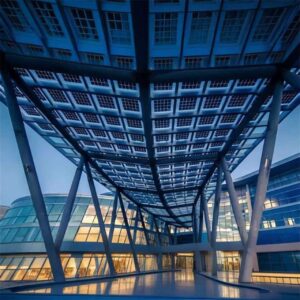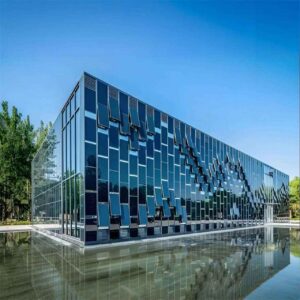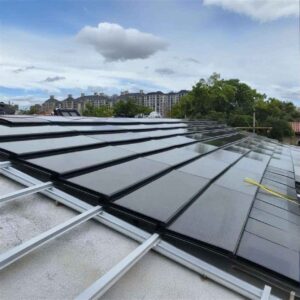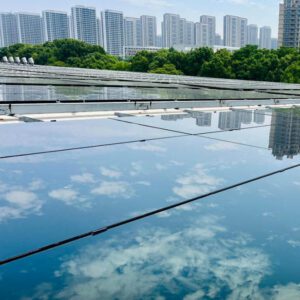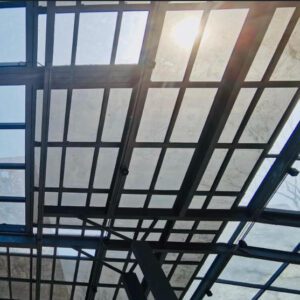
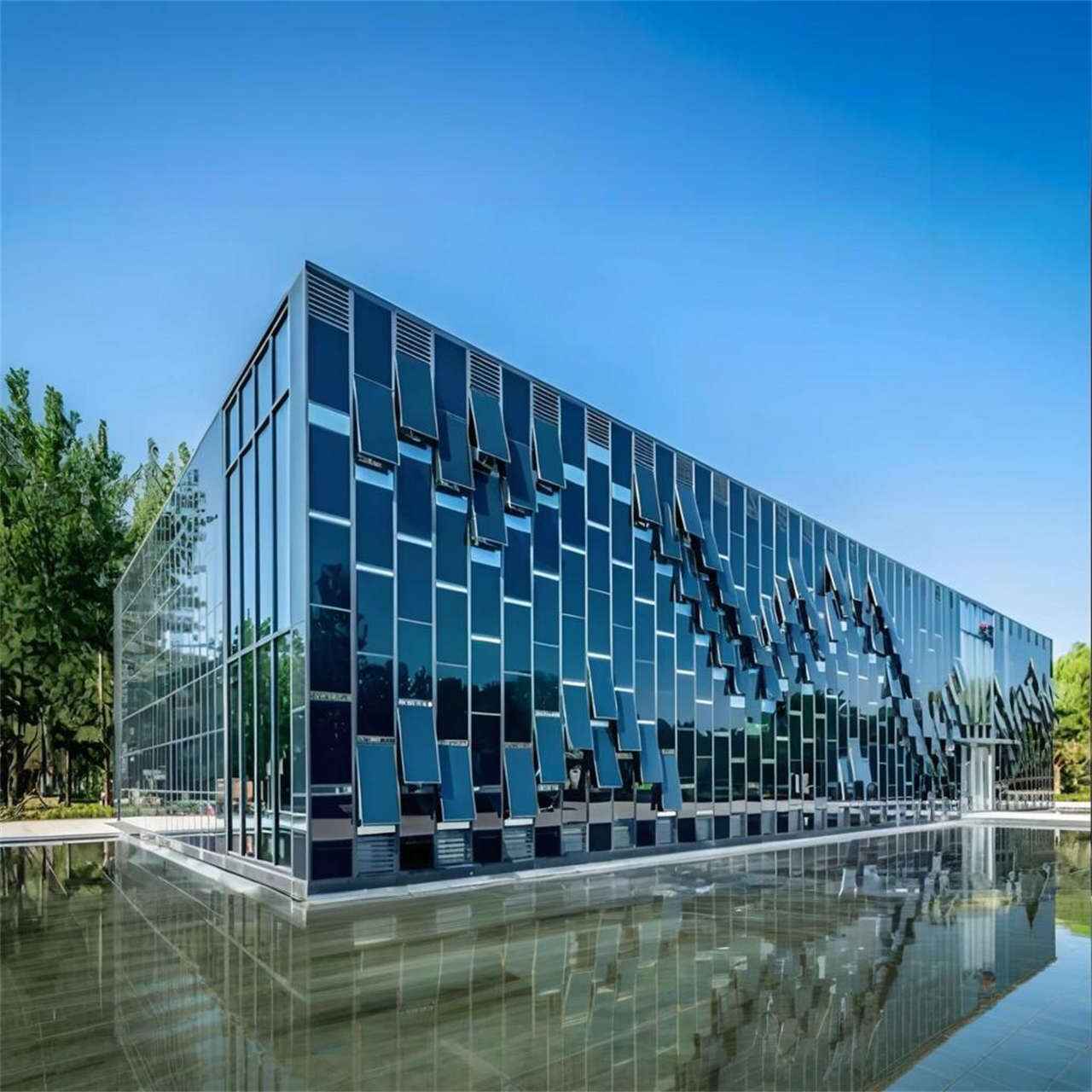
For decades, glass was a building’s biggest energy liability — a surface that let in light but also bled heating, cooling, and electricity dollars. That equation has flipped. Photovoltaic (PV) glass now functions simultaneously as a structural envelope material, a daylighting element, and a distributed power plant. In commercial towers across Shanghai, hospital atriums in Copenhagen, and residential retrofits in California, PV glass facades are generating 30–80 kWh per square meter per year while meeting the same wind-load, fire-rating, and thermal-performance codes as conventional curtain walls.
The stakes are enormous. Buildings consume roughly 40% of global energy and produce about one-third of energy-related CO₂ emissions. Integrating energy harvesting directly into the building envelope — rather than bolting panels onto rooftops — multiplies the available surface area for generation by a factor of three to five in a typical mid-rise structure. The global solar PV glass market, valued at approximately $10 billion in 2024, is projected to surge past $47 billion by 2030, growing at a compound annual growth rate (CAGR) of 29.5%.
This article examines seven key breakthroughs — spanning material science, manufacturing scale, and policy drivers — that are collectively reshaping modern facades and interiors. Each section includes real performance data, cost benchmarks, and practical considerations for developers, architects, and manufacturers evaluating these technologies today.
1. Transparent Photovoltaics Integration in Facades
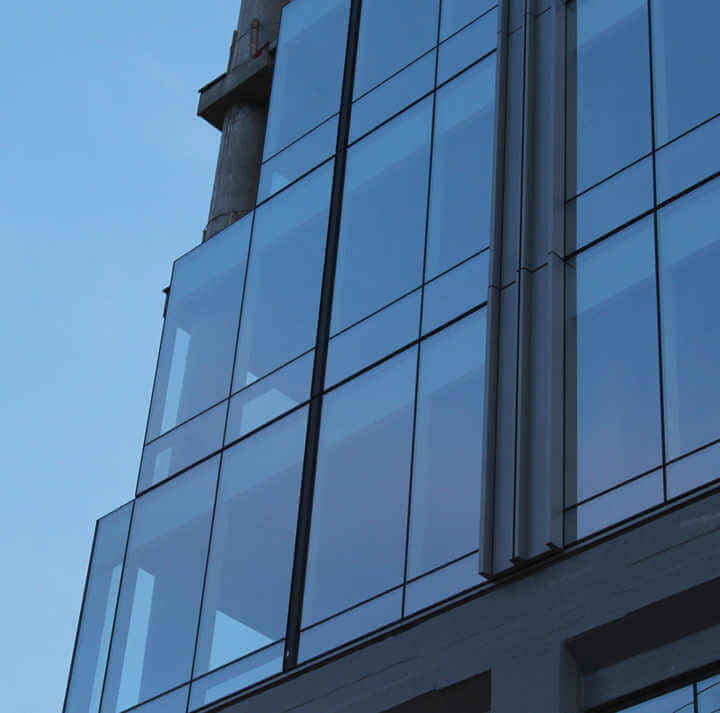
Facade-Level Energy Generation and Daylighting Balance
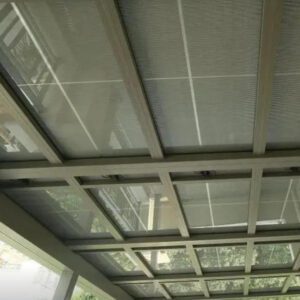
Transparent photovoltaic glass captures portions of the solar spectrum — primarily ultraviolet and near-infrared — that human eyes cannot see, while allowing visible light to pass through. The result is a window or curtain-wall panel that looks nearly clear yet generates electricity. In March 2025, the EU-funded CitySolar project announced a record 12.3% power conversion efficiency at 30% visible light transparency for a semi-transparent tandem cell — roughly double the efficiency available just three years earlier. For context, a south-facing facade clad in these modules at a temperate latitude can produce approximately 50 kWh/m²/year, enough to offset the lighting load behind the glass and contribute to HVAC reduction through reduced solar heat gain coefficient (SHGC).
Companies such as ClearVue, Onyx Solar, and Jia Mao Bipv now offer transparent PV glass in customizable transparencies from 10% to 70%, allowing architects to tune the balance between energy generation and interior daylight. Jia Mao Bipv’s ultra-clear tempered variants deliver up to 91.5% light transmittance on the non-PV zones of the glass, an 8% improvement over standard float glass, while monocrystalline silicon cells embedded in the panel achieve conversion efficiencies exceeding 22%.
Manufacturing Scalability and Installation Workflows
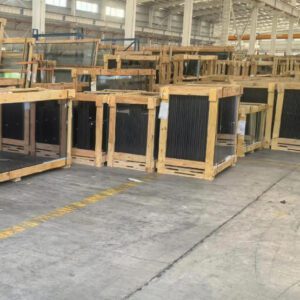
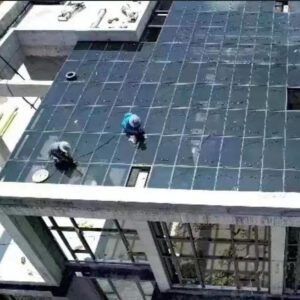
Scaling transparent PV glass from pilot lines to 3 GW annual capacity — the level that manufacturers like Jia Mao Bipv have reached — required solving three bottlenecks: laser-patterning speed for thin-film cells, lamination uniformity across panels up to 3.2 m × 6 m, and integration with standard curtain-wall framing profiles. Modern automated production lines now use precision laser cutting, robotic cell-stringing, and intelligent MES (Manufacturing Execution System) traceability so that every panel’s IV-curve data is logged before it ships. Installation follows the same unitized-curtain-wall workflow glaziers already use: panels arrive on-site, connect via MC4 or proprietary quick-connect wiring, and plug into a string inverter or micro-inverter array. The incremental labor above conventional glazing is typically 8–12%, according to field data from commercial retrofit projects in East Asia.
2. Building-Integrated Photovoltaics (BIPV) with High Efficiency
Module-Level Efficiency Gains and Electrical Integration
Building-integrated photovoltaics replaces conventional building materials — roof tiles, spandrel panels, curtain-wall glass, skylights — with modules that generate electricity. The global BIPV market grew from $25.13 billion in 2025 to an estimated $30.78 billion in 2026, reflecting a 22.5% CAGR as module-level efficiencies have climbed into the 20–22% range for crystalline-silicon laminates.
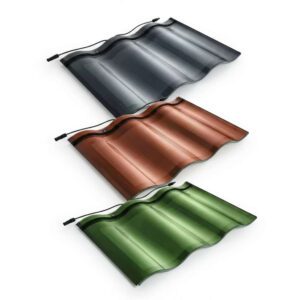
A decisive factor in this growth is the shift from custom one-off modules to standardized product families. Jia Mao Bipv’s BIPV module portfolio, for example, spans laminated glass, double-glass units, solar roof tiles, and transparent modules — all manufactured on the same automated line with adjustable cell spacing, glass thickness, and encapsulant chemistry. By sharing the same junction box and connector standard across the range, electrical integration with string or micro-inverters becomes predictable, and architects can mix opaque and transparent modules on a single facade without rewiring.
Structural and Architectural Considerations for BIPV
BIPV modules must satisfy both IEC 61730 safety qualification and local building envelope codes — wind load (typically ≥4.0 kPa for high-rise curtain walls), impact resistance (EN 12600 class 1B1 or equivalent), and fire rating (B1-grade or Class A per local codes). That dual certification imposes stricter lamination, edge-sealing, and back-sheet requirements than a standard rooftop panel faces. The payoff is direct: a certified BIPV facade panel replaces both the cladding material and the power-generation system, eliminating the cost of conventional spandrel glass or stone cladding. In net-cost analyses of new-build commercial towers, BIPV facade systems show a 10–15 year payback and then deliver 10–15 additional years of free electricity generation under typical 25-year warranties.
Global BIPV Market Growth (2022–2030)
Global BIPV Market Size (USD Billion)
80
60
40
20
0
8.0
2022
10.5
2023
14.0
2024
25.1
2025
30.8
2026
38.0
2027
47.0
2028
58.0
2029
72.0
2030
Source: Precedence Research, Business Research Company, Grand View Research (2026 estimates)
CAGR 2025–2030: ~22.5%
3. Perovskite-Silicon Tandem Photovoltaics in Glass
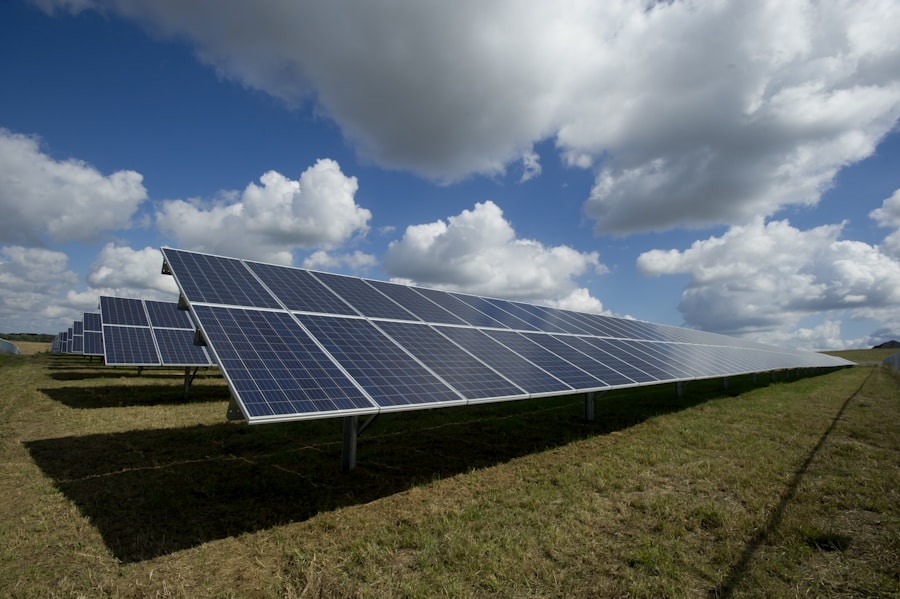
Synergy of Tandem Cells for High Transparency and Efficiency
Single-junction silicon cells hit a theoretical efficiency ceiling (the Shockley–Queisser limit) of about 32%. Perovskite-silicon tandem cells blow past that barrier by stacking a wide-bandgap perovskite top cell — which absorbs high-energy blue and green photons — on a narrow-bandgap silicon bottom cell that captures red and near-infrared photons. In April 2025, LONGi announced a certified 34.85% conversion efficiency for a two-terminal crystalline silicon-perovskite tandem cell, verified by the U.S. National Renewable Energy Laboratory (NREL). By June 2025, the company demonstrated 33% efficiency at a much larger 260.9 cm² area — a critical milestone for commercial-scale glass integration.
When these tandem architectures are deposited on glass substrates and configured for partial transparency, the glass can simultaneously serve as a high-performance window with 20–40% visible light transmission and deliver 15–18% module efficiency — roughly double what prior-generation transparent PV achieved. For BIPV facade applications, this means a 1.5 m × 3 m curtain-wall panel could generate 120–150 W under standard test conditions while still admitting comfortable levels of daylight.
Reliability Challenges and Stabilization Strategies
Perovskite’s Achilles’ heel has been longevity. Early formulations degraded rapidly under moisture, heat, and UV exposure. Recent advances — two-dimensional/three-dimensional (2D/3D) perovskite heterostructures, self-healing encapsulant films (which repair micro-damage in as little as six minutes under sunlight), and edge-seal barrier coatings — have pushed accelerated-aging test results past the equivalent of 25 years of outdoor exposure. Several manufacturers have begun pilot lamination of perovskite-silicon tandem cells into double-glazed insulated glass units (IGUs) with argon fill and low-E coatings, combining thermal insulation (U-value < 1.1 W/m²K) with energy generation — a package that simply did not exist five years ago.
4. Spectrally Selective Glazing and Solar Window Films
Glare Control, Visible Transmission, and Energy Gain
Spectrally selective glazing works by allowing visible light to pass while reflecting or absorbing near-infrared wavelengths that carry heat. Traditional low-E coatings have done this passively for years, but the latest generation of spectrally selective window films combines this heat-rejection function with embedded photovoltaic nanostructures that convert the rejected infrared energy into electricity rather than simply bouncing it away. The practical benefit is measurable: one peer-reviewed study found that photovoltaic electrochromic modular smart windows cut annual building energy consumption by 47.7% compared to ordinary glazing in a mixed-climate scenario, because they simultaneously reduced cooling load (less solar heat gain), lighting load (optimized daylight), and grid demand (self-generated electricity).
Compatibility with Existing Glazing Systems
Retrofit is where spectrally selective solar films gain an edge over full-panel replacement. Films can be laminated onto existing glass in occupied buildings during off-hours, with no structural modifications. Installation cost ranges from $15–$45/m² for film-only products versus $250–$600/m² for full BIPV curtain-wall replacement. For building owners who cannot justify a full facade overhaul, solar window films offer a pragmatic intermediate step: reducing energy spend immediately while generating modest power (typically 5–15 W/m²). Suppliers like LLumar, 3M, and regional specialists offer films that meet ASTM and EN standards for adhesion, abrasion, and UV stability, and most carry 10–15 year product warranties.
5. Dynamic, Switchable PV Glass for Adaptive Shading
Electrochromic and Smart-Tint Integration with Power Generation
Electrochromic glass changes tint when a low voltage (typically 1–5 V DC) is applied, shifting from clear to dark states in 5–15 minutes. Companies like SageGlass have deployed this in hundreds of commercial buildings. The next frontier merges electrochromic tinting with integrated PV cells so the glass both generates the electricity it needs to switch states and exports surplus power to the building. Research published in Building and Environment demonstrated that such a smart PV window provides up to 47.7% annual energy savings by dynamically optimizing the trade-off between daylight admission and cooling load — compared to static glazing, which forces a fixed compromise.
Building Energy Optimization Through Active Shading
In practice, a building management system (BMS) reads real-time data from irradiance sensors, indoor temperature probes, and occupancy detectors, then signals the electrochromic PV glass to darken or lighten zone by zone. On a bright summer afternoon, west-facing panels tint to block solar gain; on a cloudy winter morning, they remain clear to maximize passive heating and daylight. The NREL estimates that electrochromic glazing alone can reduce cooling electricity consumption by up to 48% in hot climates. When PV generation is layered on top, the facade can become net-energy-positive during peak cooling hours — exporting power to the grid precisely when rates are highest under time-of-use tariffs.
6. Self-Cleaning and Anti-Reflective Coatings for Longevity
Maintenance Reduction and Performance Under Soiling Conditions
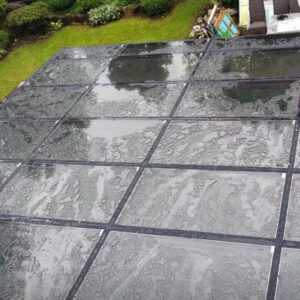
Dust, pollen, bird droppings, and urban particulate matter can reduce PV output by 15–30% if panels go uncleaned for six months in arid or high-pollution environments. Self-cleaning coatings — typically hydrophilic TiO₂-based or superhydrophobic silica-nanoparticle layers — cause rainwater to sheet across the glass in a thin, even film that carries away dirt. On Jia Mao Bipv’s laminated facade glass, the factory-applied self-cleaning surface coating has been shown to reduce maintenance costs by 30% over a ten-year field cycle, as reported in project monitoring data from installations across Southeast Asia and the Middle East. Meanwhile, anti-reflective (AR) coatings reduce front-surface reflection losses from approximately 4% to under 1%, adding a measurable 2–3% boost to annual energy yield.
Coating Durability, Environmental Resistance, and Cost
AR coatings etched into glass via fluosilicic acid processes have demonstrated less than 1% transmittance loss after seven years of outdoor exposure in Swedish field tests (NREL data). Newer sol-gel and sputtered coatings are achieving similar longevity in accelerated damp-heat (85 °C / 85% RH) and UV-exposure testing. The added cost at the manufacturing stage is approximately $1.50–$3.00/m² — trivial compared to the cumulative yield gain over a 25-year module life. For specifiers, the key is to verify that the coating survives the tempered-glass heat-treatment cycle (typically 620–680 °C) and is compatible with the lamination adhesive.
7. Flexible and Curved PV Glass for Architecturally Ambitious Buildings
New Form Factors Enabling Complex Geometries
Flat panels cannot wrap around the free-form surfaces that define contemporary landmark architecture — domed atriums, hyperbolic canopies, twisted towers. Flexible PV laminates, using thin-film CIGS or organic photovoltaic (OPV) cells on polymer substrates, can conform to curvature radii as tight as 25 cm. In September 2025, Gain Solar unveiled the world’s first curved crystalline silicon solar tile, demonstrating that even high-efficiency c-Si technology can be bent to match roof curvatures without fracturing. For glass-based BIPV, hot-bending and cold-bending processes allow the creation of curved insulated glass units with embedded PV cells — opening possibilities for solar-active barrel vaults, domed skylights, and serpentine facade ribbons.
Manufacturing and Handling for Curved Glass
Curved PV glass manufacturing is more complex and expensive than flat-panel production. Hot-bending requires precise mold tooling and controlled cooling to avoid residual stress; cold-bending relies on the elastic deformation of thin glass plies constrained by the frame structure. Both approaches add 20–40% to the per-square-meter cost compared to flat equivalents. However, the total installed-system cost difference shrinks when one accounts for the fact that curved BIPV replaces custom curved cladding that would be expensive anyway. Manufacturers such as Megasol in Switzerland, Mitrex in Canada, and Jia Mao Bipv — whose R&D arm is actively developing flexible BIPV materials for curved architectural designs — are investing in automated mold-adjustment systems that reduce setup time and make short production runs economically viable.
8. Transparent Solar Concentrating Systems
Concentration Techniques and Light Management in Glass
Luminescent solar concentrators (LSCs) embed fluorescent dyes or quantum dots in a glass or polymer slab. These materials absorb incoming photons and re-emit them at a longer wavelength; total internal reflection then guides the re-emitted photons to small, high-efficiency PV cells mounted at the glass edges. Michigan State University researchers demonstrated that transparent solar technology using LSCs could eventually supply 40% of U.S. electricity demand if deployed across the nation’s estimated 5–7 billion square meters of glass surfaces. A 2025 breakthrough published in Nature Communications integrated an LSC directly with a lithium-ion storage layer, creating a window that both harvests and stores solar energy in a single laminate.
Trade-Offs: Efficiency, Heat, and Cooling Needs
Current LSC efficiencies remain modest — typically 3–7% for fully transparent devices — because re-absorption losses and escape-cone losses limit waveguide performance. Concentrated light at the glass edges also generates localized heat, requiring careful thermal design of the edge-mounted cells and frame. For most commercial applications today, LSCs are best suited to low-rise facades, interior partitions, and decorative elements where the aesthetic value of color-neutral transparency outweighs the need for maximum power output. As quantum-dot stability and waveguide engineering improve, efficiencies in the 10–12% range are considered achievable within the next five years.
9. Energy Storage Integration with PV Glass
On-Glass Storage Concepts and Microgrid Readiness
Generating electricity is only half the equation; storing it for use after sunset or during peak-demand hours completes the loop. Several research teams are developing on-glass battery layers — thin-film lithium or zinc-air cells laminated directly behind the PV layer inside the insulated glass unit. While these integrated storage systems remain pre-commercial, they point toward a future in which every window is both a generator and a battery, enabling true building-level microgrid functionality without requiring a separate centralized battery room.
Inverter, Control Systems, and Safety Considerations
Until on-glass storage matures, PV glass facades connect to conventional DC-to-AC inverters — either string inverters for large contiguous arrays or micro-inverters for individual panels. Micro-inverters add per-panel monitoring, rapid shutdown capability (required under NEC 2020 §690.12 in the U.S.), and tolerance for partial shading across a facade. Safety codes increasingly require arc-fault detection and module-level disconnect, both of which are straightforward to implement with current power electronics. The inverter cost for a BIPV facade system adds roughly $0.15–$0.25/W to the total installed cost — a fraction of the glass and installation expense.
10. Lifecycle Sustainability and Recycling of PV Glass
End-of-Life Pathways for PV-Enabled Glass
The first wave of PV modules installed in the 2000s is now approaching decommissioning age, making end-of-life (EoL) management an urgent topic. PV glass panels consist primarily of glass (approximately 75% by weight), aluminum frames, encapsulant polymers (EVA or POE), silicon cells, copper wiring, and trace amounts of silver and lead solder. Advanced recycling processes — mechanical crushing, thermal delamination, and chemical etching — can now recover up to 95% of these materials, including high-purity silicon and silver suitable for reuse in new cells.
Circular Economy and Material Recovery
The EU’s Waste Electrical and Electronic Equipment (WEEE) Directive already mandates PV module collection and recycling. The challenge for BIPV-specific glass is that panels are embedded in the building envelope, making removal more complex than unbolting a rooftop array. Design-for-disassembly strategies — mechanical clipping systems rather than structural adhesives, standardized panel dimensions, and material passports logged in digital-twin models — are gaining traction. NREL’s circular economy research emphasizes that extending module lifetime (through reuse, repair, and re-powering) delivers greater environmental benefit than recycling alone, because it avoids the energy and material cost of manufacturing a replacement.
Typical PV Glass Module Material Composition (% by Weight)
PV Module Material Composition
100%
Glass (75%)
Encapsulant (10%)
Aluminum (8%)
Silicon Cells (5%)
Other (Cu, Ag) (2%)
Source: IRENA, NREL Circular Economy PV Reports
PV Glass Technology Comparison at a Glance
| Technology | Efficiency Range | Transparency | Cost ($/m²) | Payback (Yrs) | Best Application |
|---|---|---|---|---|---|
| Transparent PV Glass | 8–12.3% | 30–70% | 250–500 | 10–15 | Curtain walls, windows |
| BIPV c-Si Laminate | 18–22% | 0–40% | 200–450 | 8–14 | Facades, spandrels, roofs |
| Perovskite-Si Tandem | 28–34.85% | 20–40% | 300–600* | 7–12* | High-performance facades |
| Spectrally Selective Film | 1–5% | 60–80% | 15–45 | 3–6 | Retrofits, existing glazing |
| Electrochromic PV Glass | 5–10% | 10–60% (variable) | 500–900 | 12–18 | Premium commercial, airports |
| Flexible/Curved PV Glass | 12–20% | 0–30% | 300–650 | 10–16 | Domes, canopies, twisted facades |
| Luminescent Solar Concentrator | 3–7% | 50–85% | 150–350 | 15–20+ | Interior partitions, decorative glass |
* Perovskite-Si tandem costs and payback are projected for early commercial products (2026–2028). Actual figures will depend on manufacturing scale-up.
Watch: How Photovoltaic Glass is Transforming Modern Buildings
Video: “Buildings Are Now Power Plants…We’ve Been Thinking About Solar All Wrong” (YouTube)
BIPV Facade Cost Breakdown: Where Does the Money Go?
BIPV Facade System Cost Breakdown (% of Total Installed Cost)
PV Glass Modules
38%
Framing & Mounting
18%
Installation Labor
20%
Inverters & Wiring
10%
Design & Engineering
8%
Permits & Inspection
6%
Source: Compiled from Metsolar, IEA-PVPS Task 15, and Jia Mao Bipv project data
The seven breakthroughs outlined in this article — transparent PV facades, high-efficiency BIPV, perovskite-silicon tandems, spectrally selective glazing, dynamic electrochromic PV, self-cleaning coatings, and flexible curved PV glass — are not isolated laboratory novelties. They are converging into a mature, code-compliant product ecosystem that allows buildings to function as distributed power plants. Additional innovations in transparent solar concentrating systems, on-glass energy storage, and circular-economy recycling pathways further expand the design palette and lifecycle sustainability of PV-enabled architecture.
For developers and architects, the decision framework starts with project context: a high-rise commercial tower with floor-to-ceiling glazing gains the most from transparent PV and electrochromic systems; a residential community with complex rooflines benefits from flexible BIPV tiles and facade modules; a retrofit of an occupied office building may begin with spectrally selective window films as a low-disruption first step. Manufacturers like Jia Mao Bipv — with a 3 GW automated production base, IEC 61730-certified product lines, and customizable transparency from 10% to 90% — offer the kind of breadth that allows a single supply chain to serve diverse project types. Policymakers, meanwhile, can accelerate adoption by updating building energy codes to credit facade-generated power, streamlining dual-certification pathways for construction-plus-electrical products, and funding recycling infrastructure.
The outlook is compelling. With perovskite-silicon tandem efficiencies climbing past 34%, manufacturing costs declining along established solar learning curves, and net-zero building mandates proliferating across the EU, North America, and East Asia, the next five years are likely to see PV glass transition from a premium option to a default specification for new commercial construction. The buildings we erect today will stand for 50–100 years; embedding energy generation into their skin is one of the highest-leverage climate actions the construction industry can take.
Frequently Asked Questions (FAQs)
1. What is PV glass and how does it differ from traditional solar panels?
PV glass is a building material that integrates photovoltaic cells into a glass laminate, allowing it to simultaneously function as a window, facade panel, or skylight and generate electricity. Unlike traditional solar panels — which are opaque, framed modules bolted to racks on rooftops — PV glass is designed to replace conventional architectural glass. It meets both electrical safety standards (such as IEC 61730) and building envelope codes for wind load, impact resistance, and fire rating. Transparency levels range from 10% (nearly opaque, used in spandrel panels) to 70% or higher (used in vision glazing), with power conversion efficiency inversely related to transparency.
2. Which breakthrough offers the quickest path to retrofit projects?
Spectrally selective solar window films offer the fastest and lowest-cost retrofit path. They can be laminated onto existing glass in an occupied building during off-hours with no structural modifications. At $15–$45/m², they begin reducing energy bills immediately — typical payback is 3–6 years. For a more substantial retrofit, transparent PV glass replacement of curtain-wall panels achieves higher energy generation but requires 10–15 year payback periods and more complex installation logistics.
3. How do these technologies impact building codes and warranties?
BIPV products must carry dual certification: IEC 61215/61730 for photovoltaic performance and safety, and local building codes (EN 12600 for glass impact, EN 13501 for fire classification, ASCE 7 or Eurocode 1 for wind load). Most reputable BIPV manufacturers offer 25-year performance warranties with guaranteed output at 80% of nameplate capacity at year 25 and 10-year product warranties covering material defects. Building insurance policies are increasingly familiar with BIPV; however, specifiers should confirm that the product’s fire classification meets the local authority’s requirements for the specific building height and occupancy type.
4. What are the primary cost drivers and ROI considerations for PV glass adoption?
The PV glass modules themselves represent roughly 38% of total installed facade system cost, followed by installation labor (20%) and framing/mounting hardware (18%). ROI depends on four variables: local electricity price, available solar irradiation, the cost differential between PV glass and the conventional cladding it replaces, and applicable incentive programs (tax credits, feed-in tariffs, or green-building certification premiums on property value). In markets with electricity above $0.15/kWh and good irradiation (≥1,200 kWh/m²/year), south-facing BIPV facade systems show payback periods of 8–14 years on a 25-year module life.
5. How efficient are transparent solar panels compared to conventional ones?
Conventional opaque solar panels achieve 20–22% efficiency in commercial products. Transparent PV glass trades some efficiency for visible light transmission: fully transparent devices (70%+ transparency) currently reach 5–8% efficiency, while semi-transparent devices (30% transparency) have hit a record 12.3% as of early 2025. Perovskite-silicon tandem technology promises to narrow this gap significantly, with semi-transparent tandem modules projected to reach 15–18% at 25–35% transparency within the next two to three years.
6. Can PV glass withstand extreme weather conditions like hail and high winds?
Certified BIPV glass passes IEC 61215 hail-impact testing (25 mm ice balls at 23 m/s) and typically meets wind-pressure resistance of ≥4.0 kPa, suitable for high-rise curtain walls. The tempered or heat-strengthened glass used in BIPV laminates is 3–5 times stronger than annealed glass. Jia Mao Bipv’s products, for instance, are manufactured with fluorocarbon backsheets rated for 30 years of UV exposure, double-layer POE encapsulation to prevent potential-induced degradation, and structural adhesive seals guaranteed for 25 years of all-weather performance.
7. What happens to PV glass at the end of its useful life?
Advanced recycling facilities now recover up to 95% of materials from decommissioned PV modules, including high-purity glass cullet (reusable in new float-glass production), silicon wafers, silver, copper, and aluminum. The EU’s WEEE Directive mandates PV recycling. The key challenge for BIPV specifically is disassembly: panels integrated into the building envelope are harder to remove than rooftop arrays. Design-for-disassembly techniques — mechanical clip-in systems, standardized dimensions, and digital material passports — are being adopted by forward-looking manufacturers to ensure that today’s installations can be efficiently recycled at end of life.
8. Is PV glass suitable for residential buildings or only commercial towers?
PV glass is available in formats suited to both scales. Solar roof tiles, transparent balcony balustrades, greenhouse panels, and residential skylight modules all fall under the PV glass umbrella. For homes, the payback period is roughly 14 years, after which the system generates free electricity for the remaining 10+ years of its warranted life. Residential PV glass is particularly attractive in jurisdictions that offer net metering or feed-in tariffs, where surplus generation earns a direct financial return.
9. How does PV glass affect a building’s thermal performance?
PV glass can improve thermal performance in two ways. First, the PV cells themselves absorb a portion of solar radiation that would otherwise enter the building as heat, reducing the solar heat gain coefficient (SHGC). Second, BIPV insulated glass units (IGUs) can incorporate low-E coatings and argon or krypton gas fills, achieving U-values below 1.1 W/m²K — comparable to high-performance conventional IGUs. Dynamic electrochromic PV glass takes this further by modulating visible and infrared transmission in real time, reducing cooling loads by up to 48% in hot climates.
10. Where can I source customizable PV glass for a building project?
Several global manufacturers offer custom PV glass: Onyx Solar (Spain), Mitrex (Canada), ClearVue (Australia), and Jia Mao Bipv (China). Jia Mao Bipv stands out for its 3 GW production capacity, full product range (transparent panels, laminated facade glass, solar roof tiles, inverters, and mounting brackets), and customization services that adjust size, color, light transmittance, and power output per project. Their intelligent MES manufacturing system provides full traceability from raw material intake to shipment, and all products carry a 25-year performance guarantee backed by IEC certification.
Disclaimer: Market data cited in this article is sourced from publicly available industry reports (Grand View Research, Precedence Research, IRENA, NREL, IEA-PVPS) and manufacturer specifications as of April 2026. Projected figures are estimates and subject to change. Always consult a qualified engineer for project-specific design and compliance requirements.